Cost/benefit analysis of DAB radio: Murdoch rushes in where governments fear to tread

Governments have had plenty of practice, over many years, of hiding reports from the electorate. In some cases, they might justify this as a matter of national security or military expedience. However, it is hard to understand how the UK government thought it could justify hiding from the public a cost/benefit analysis of digital radio switchover it had commissioned and then, a year later, have believed the matter had been successfully buried. But so it was, until the House of Lords Communications Committee intervened in early 2010.

On 6 February 2009, PricewaterhouseCoopers [PWC] delivered a 91-page report entitled ‘Cost Benefit Analysis of Digital Radio Migration’ to Ofcom. It contained a number of serious reservations that any benefits would arise from switchover to DAB radio, even by the year 2030:

“The results suggest that there are relatively few up-sides to the estimates, and several significant downside risks. … The results suggest that there is a very long pay-back from the Digital Radio Working Group [DRWG] policy ‘investment’ – the Net Present Value [NPV] turns positive after 2026. This result assumes that the existing multiplex licences are extended to 2030, as per the DRWG recommendations. Without the licence extension or any other policy instruments that provide clarity on the long term future of commercial radio, the industry and consumers may fail to see the benefits of digital radio over the longer term. Our analysis suggests that the NPV is negative should either of these two proposals not be implemented.” [emphasis added]

Since then, parliamentary policy has failed to provide “clarity on the long term future of commercial radio,” as evidenced by last week’s wholly ambivalent government statement about digital radio switchover. As a result, just as PWC predicted, industry and consumers increasingly “fail to see the benefits of digital radio over the longer term.”

The PWC report, and its verdict that digital radio switchover offers almost no benefits, remained hidden from public view from February until November 2009, when an appendix to the government’s Digital Economy Bill mentioned it casually. That citation raised questions: what was this PWC report, and why could not the public see it?

When the House of Lords Select Committee on Communications convened in January 2010 to consider the digital switchover issue, it asked those same questions of the Ofcom officers it invited to present evidence:

Baroness McIntosh of Hudnall: We understand that you commissioned a report from PWC last year into the costs and benefits of digital switchover in radio, but you didn’t publish it. We know, therefore, what we have learned from the Department for Culture, Media & Sport about what it said. It appears that it found, for example, that the benefits could – and I emphasise the word “could” – outweigh the costs by £437 million after 2026, but that conclusion is hedged about with quite a lot of caveats to do with what would have to happen in order for that good outcome to eventuate, and that if those things didn’t happen, then quite quickly you would get into a position where the costs would outweigh the benefits. Can you tell us a bit about that report? In particular, can you tell us why you haven’t published it? Do you think that, given what it appears to say – I choose my words carefully – about the constraints on potential for benefit, that it should have been available to inform the Government’s digital policy? ….. [edited]

Mr Peter Davies [Director of Radio Policy & Broadcast Licensing, Ofcom]: We were asked to commission it by the Government. We then commissioned it from PWC with a lot of input from various government departments and then submitted it to the Secretary of State.

Chairman: So you decided not to publish it.

Mr Stewart Purvis [Partner for Content & Standards, Ofcom]: …. [edited] On this particular occasion, it was decided in conjunction with the Department that work would be sent to the Department. Perhaps the most important thing is for Peter to respond to your characterisation of the work, but, in a sense, we have not hidden the piece of work. Indeed, I think it is now available to you. Is that right?

Baroness McIntosh of Hudnall: In, as they say, a redacted form.

Chairman: Just to be absolutely clear, the Department asked you to commission the work from PWC. Is that what you are saying?

Mr Purvis: They asked us to commission the work. Did they ask us specifically from PWC?

Mr Davies: Not specifically from PWC.

Chairman: The Department said to Ofcom, “Ofcom, you go and commission this particular work.” Is that the position?

Mr Davies: Yes.

Chairman: You then got the work which then came back to you and then you sent it to the Government and the Government said, “We’re not going to publish this in full.”

Mr Davies: I think they have certainly made it available to various groups. I think consumer groups have had it for some time.

Chairman: Fine. There will be no problem, therefore, in this Committee having the full report. …. [edited]

Baroness McIntosh of Hudnall: The thing that is slightly troubling – perhaps only to me, but a bit – is that when you see what appears to be evidence that the costs and benefits are, let’s say, finely balanced, or could be, that the drive towards digital migration, one might think, was driven more by the technology than by the needs either of the broadcasters or the consumers.

The Committee’s displeasure with Ofcom and the government was evident both in this exchange and in its subsequent report on digital switchover, published in March 2010, which stated:

“We strongly regret that the cost benefit analysis carried out by PricewaterhouseCoopers was not published at the time it was delivered to Ofcom and the Department for Culture, Media & Sport in February 2009.”

The government’s response to the Committee’s statement, published in June 2010, was:

“The Cost Benefit Analysis produced by PricewaterhouseCoopers, to accompany the work of the Digital Radio Working Group, was widely distributed amongst broadcasters and consumer representatives. However, there were technical difficulties which prevented the initial publication of the report on the DCMS website; these were rectified and the report published in February 2010.”

“Technical difficulties” for a whole year? As excuses go, this really takes the biscuit. It seems unlikely that the PWC report would ever have been made public, if not for the intervention of the House of Lords Communications Committee in January 2010 (first publication of the report’s findings was in this blog a few days later).

The PWC report did not offer the government the support for its digital radio switchover strategy that it had anticipated, so now it has to commission a further cost/benefit analysis which it hopes will produce a more favourable outcome. Is the government in a hurry to complete another study evaluating the supposed benefits of digital radio switchover? Hardly, judging by the evidence.

In June 2009, the government’s Digital Britain report had promised:

“We will conduct a full Impact Assessment, including a Cost/Benefit Analysis of Digital Radio Upgrade.”

In January 2010, Ofcom’s Peter Davies had offered evidence to the House of Lords Communications Committee:

Baroness McIntosh of Hudnall: What about your own impact assessment?

Mr Davies: We haven’t done an impact assessment yet.

Baroness McIntosh of Hudnall: But you have been asked to – correct?

Mr Davies: At some point in the future. I think the Digital Britain report said that we would be asked to do one, but we haven’t been asked to do one yet. Obviously we would need to do that and we would need a much fuller cost-benefit analysis before any final decision was taken.

Most recently, in June 2010, the government stated:

“We agree that a full impact assessment is an essential part of informing the Government’s decision on whether and when to move from a primarily analogue to a digital radio landscape. Work has already begun to collect the evidence needed to support an impact assessment and analysis should begin shortly.” [emphasis added]

Why bother with yet another report at this late hour in DAB’s history? Someone else has already done the sums. News International has just run its sliderule over the idea of launching a national digital radio station ‘SunTalk’ (a brand extension of its national daily newspaper ‘The Sun’) on the DAB platform. Its result was: DAB radio is not a viable commercial platform.

According to The Guardian: “News International management were considering extending the [SunTalk] station’s reach by launching it nationally on DAB digital radio. But it is understood they baulked at the extra cost.”

If Murdoch cannot see a way to make a profit from a broadcast platform that is crying out for compelling content, then how exactly does any other content owner think it can make a financial return from DAB radio?

It’s the platforms Rupert Murdoch rejects ….

Ofcom’s DAB radio strategy: busy doing nothing, trying to find lots of things not to do

In June 2010, the government published its flimsy 5-page response to the House of Lords Communications Committee’s critical 279-page report on digital switchover that had been unveiled three months earlier. The response was a disappointing document that dismissed with little more than one sentence each of the Committee’s carefully worded recommendations, deduced after having considered hours and volumes of evidence.

One of the Communications Committee’s most forceful recommendations, in Paragraph 107, had concerned the necessary improvements to DAB reception:

“Given the importance for the Government’s plans for digital switchover of universal reception of the BBC’s national stations, it is essential that a firm and unambiguous plan and funding for the completion of build-out of the BBC’s national multiplex is put in place as soon as possible.”

The government’s feeble response to this issue was:

“In order to agree a plan for DAB coverage build-out, so that it can ultimately meet the current levels of FM coverage, Ofcom have been asked to form a Coverage and Spectrum Planning Group to make recommendation on the following:
• the current coverage of national and local radio on FM;
• changes to the current multiplex structure and frequency allocation; and
• what new infrastructure is needed so that DAB can match FM.
Ofcom are expected to present their recommendation to Government in Spring 2011.”

Surely it does not need yet another government committee to look into DAB? Had not these issues already been considered by the Digital Radio Working Group two years ago? By Digital Britain a year ago? By Ofcom? By anybody during the last decade of DAB underachievement?

Then I recalled a speech made by Ofcom Director of Radio, Peter Davies, to the Radio Festival in July 2008, in which he had set out his imminent workplan on the DAB issue:

“Increased coverage of DAB will be absolutely essential if it is ever to become a full replacement for FM for most services…… That brings us to the tricky part – defining what existing coverage is and how we improve it. This is still work in progress but we are approaching it in three stages. Firstly, we need to define what existing FM coverage is. That’s not nearly as simple as it might sound. Radio is not like television where you stick an aerial on the roof and you get reception or you don’t. Radio is used in every room in the house, usually with a portable aerial. It’s used outdoors on a wide variety of devices and it’s listened to in cars. So we need to look at geographic coverage as well as population coverage, and we need to look at indoor coverage in different parts of the house. FM coverage gradually fades as you move around, so we need to decide how strong the signal needs to be to be usable. And, surprisingly, this work has never really been done in any kind of consistent manner for the UK as a whole, so it has taken a little while to agree a framework and calculate the numbers.

Having done that, we then have to do the same for existing DAB coverage. Now DAB has all the same issues as FM, but it also has different characteristics. It doesn’t fade in the same way – you either get it or you don’t – so we need a different set of definitions here. Once we have defined what existing DAB coverage is, we then have to work out what it would take to get existing DAB coverage up to the level of existing FM coverage. Now, we have already done a lot of work on this, and certainly enough to inform the interim report, and the whole thing will be finalised in time for the [government’s] Digital Radio Working Group final report later this year.”

This 2008 workplan seems to comprise precisely the same tasks that the government has just told Ofcom to start and complete by Spring 2011. So what happened? Was this work not done by late 2008, as Davies had promised? And if not, why not?

Improvements to DAB reception were considered a critical issue for consumer take-up of DAB radio … in 2008. Now, in 2010, they are probably the main factor likely to sound the death knell of DAB as a mass market consumer platform. So are we to assume that, in the intervening two years, work on this essential issue was never done, or was not completed, by Ofcom?

Why should consumers consider DAB radio to be anything other than a disaster if even our public servants appear to be busy doing little to fix the acute problems with DAB reception that the public has been rightly complaining about for years?

Digital Economy Act 2010: a smokescreen for backroom radio ‘deal’

On 8 April 2010 at 1732, the Digital Economy Act was given Royal Assent by Parliament. Who exactly will benefit from the radio clauses in the Act? Certainly not the consumer.

“The passing of the Digital Economy Bill into law is great news for receiver manufacturers,” said Frontier Silicon CEO Anthony Sethill. As explained by Electronics Weekly: “Much of the world DAB industry revolves around decoder chips and modules from UK companies, in particular Frontier Silicon. These firms can expect a bonanza as consumers replace FM radios with DAB receivers.” Frontier Silicon says it supplies semi-conductors and modules for 70% of the global DAB receiver market.

Sadly, the Bill/Act was not really about digital radio at all. For the radio sector lobbyists, it was all about securing an automatic licence extension for Global Radio’s Classic FM, the most profitable station in commercial radio, so as to avoid its valuable FM slot being auctioned to allcomers. The payback on this valuable asset alone easily justified spending £100,000’s on parliamentary smooching. It was interesting to see one Labour MP acknowledge the true purpose for all this parliamentary lobbying in the House of Commons debate when he congratulated “[Classic FM managing director] Darren Henley for making a cause of the issue.”

The clauses in the Digital Economy Bill on the planned expansion of DAB radio and digital radio switchover were simply promises that Lord Carter had insisted upon as the radio industry’s quid pro quo for government assistance to Global Radio’s most profitable asset. The existence of this ‘deal’ between Lord Carter and Global Radio was confirmed by Digital Radio Working Group chairman Barry Cox in his evidence to the House of Lords:

“Lord Carter did not like to do [the deal] immediately. As I understand, he wanted to get something more back from the radio industry. I think there is a deal in place on renewing these licences, yes.”

However, the quid pro quo promise to develop DAB radio will never come to fruition. Now that Global Radio has got what it wanted, over the coming months, the radio industry’s commitment to continue with DAB will inevitably be rolled back. Every excuse under the sun will be wheeled out – the economy, the expense, the lack of industry profitability (having spent nearly £1bn on DAB to date), consumer resistance, the regulator, the Licence Fee, the government (old and new), the car industry, the French, the mobile phone manufacturers, whatever …….

The reasons that digital radio migration/switchover will never happen are no different now than they were before the Digital Economy Bill was passed into law. For the consumer, who seems increasingly unconvinced about the merits of DAB radio, this legislation changes nothing at all. Those reasons, as itemised in my written submission to the House of Lords in January 2010, are:

• The characteristics of radio make the logistics of switchover a very different proposition to the television medium
• The robustness of the existing analogue FM radio broadcasting system
• Shortcomings of the digital broadcast system, ‘Digital Audio Broadcasting’ [DAB], that is intended to replace analogue radio broadcasting in the UK.

More specifically:

1. Existing FM radio coverage is robust with close to universal coverage
• 50 years’ development and investment has resulted in FM providing robust radio coverage to 98.5% of the UK population

2. No alternative usage is proposed for FM or AM radio spectrum
• Ofcom has proposed no alternate purpose for vacated spectrum
• There is no proposed spectrum auction to benefit the Treasury

3. FM/AM radio already provides substantial consumer choice
• Unlike analogue television, consumers are already offered a wide choice of content on analogue radio
• 14 analogue radio stations are available to the average UK consumer (29 stations in London), according to Ofcom research

4. FM is a cheaper transmission system for small, local radio stations
• FM is a cheaper, more efficient broadcast technology for small, local radio stations than DAB
• A single FM transmitter can serve a coverage area of 10 to 30 miles radius

5. Consumers are very satisfied with their existing choice of radio
• 91% of UK consumers are satisfied with the choice of radio stations in their area, according to Ofcom research
• 69% of UK consumers only listen to one or two different radio stations in an average week, according to Ofcom research

6. Sales of radio receivers are in overall decline in the UK
• Consumer sales of traditional radio receivers are in long-term decline in the UK, according to GfK research
• Consumers are increasingly purchasing integrated media devices (mp3 players, mobile phones, SatNav) that include radio reception

7. ‘FM’ is the global standard for radio in mobile devices
• FM radio is the standard broadcast receiver in the global mobile phone market
• Not one mobile phone is on sale in the UK that incorporates DAB radio

8. The large volume of analogue radio receivers in UK households will not be quickly replaced
• Most households have one analogue television to replace, whereas the average household has more than 5 analogue radios
• The natural replacement cycle for a radio receiver is more than ten years

9. Lack of consumer awareness of DAB radio
• Ofcom said the results of its market research “highlights the continued lack of awareness among consumers of ways of accessing digital radio”

10. Low consumer interest in purchasing DAB radio receivers
• Only 16% of consumers intend to purchase a DAB radio in the next 12 months, according to Ofcom research
• 78% of radio receivers purchased by consumers in the UK (8m units per annum) are analogue (FM/AM) and do not include DAB, according to GfK data

11. Sales volumes of DAB radio receivers are in decline
• UK sales volumes of DAB radios have declined year-on-year in three consecutive quarters in 2008/9, according to GfK data

12. DAB radio offers poorer quality reception than FM radio
• The DAB transmission network was optimised to be received in-car, rather than in-buildings
• Consumer DAB reception remains poor in urban areas, in offices, in houses and in basements, compared to FM

13. No common geographical coverage delivered by DAB multiplexes
• Consumers may receive only some DAB radio stations, because geographical coverage varies by multiplex owner

14. Increased content choice for consumers is largely illusory
• The majority of content available on DAB radio duplicates stations already available on analogue radio

15. Digital radio content is not proving attractive to consumers
• Only 5% of commercial radio listening is to digital-only radio stations, according to RAJAR research
• 74% of commercial radio listening on digital platforms is to existing analogue radio stations, according to RAJAR research

16. Consumer choice of exclusive digital radio content is shrinking
• The majority of national commercial digital radio stations have closed due to lack of listening and low revenues
• After ten years of DAB in the UK, no digital radio station yet generates an operating profit

17. Minimal DAB radio listening out-of-home
• Most DAB radio listening is in-home, and DAB is not impacting the 37% of radio listening out-of-home
• Less than 1% of cars have DAB radios fitted, according to DRWG data

18. DAB radio has limited appeal to young people
• Only 18% of DAB radio receiver owners are under the age of 35, according to DRDB data
• DAB take-up in the youth market is essential to foster usage and loyalty

19. DAB multiplex roll-out timetable has been delayed
• New DAB local multiplexes licensed by Ofcom between 2007 and 2009 have yet to launch
• DAB launch delays undermine consumer confidence

20. Legacy DAB receivers cannot be upgraded
• Almost none of the 10m DAB radio receivers sold in the UK can be upgraded to the newer DAB+ transmission standard
• Neither can UK receivers be used to receive the digital radio systems implemented in other European countries (notably France)

21. DAB/FM combination radio receivers have become the norm
• 95% of DAB radio receivers on sale in the UK also incorporate FM radio
• 9m FM radios are added annually to the UK consumer stock (plus millions of FM radios in mobile devices), compared to 2m DAB radios, according to GfK data

22. DAB carriage costs are too high
• Carriage costs of the DAB platform remain too costly for content owners to offer new, commercially viable radio services, compared to FM
• Unused capacity exits on DAB multiplexes, narrowing consumer choice

23. DAB investment is proving too costly for the radio industry
• The UK radio industry is estimated to have spent more than £700m on DAB transmission costs and content in the last ten years
• The UK commercial radio sector is no longer profitable, partly as a result of having diverted its operating profits to DAB

24. DAB is not a globally implemented standard
• DAB is not the digital radio transmission standard used in the most commercially significant global markets (notably the United States)

These factors make it unlikely that a complete switchover to DAB digital terrestrial transmission will happen for radio in the UK.

With television, there existed consumer dissatisfaction with the limited choice of content available from the four or five available analogue terrestrial channels. This was evidenced by consumer willingness to pay subscriptions for exclusive content delivered by satellite. Consumer choice has been extended greatly by the Freeview digital terrestrial channels, many of which are available free, and the required hardware is low-cost.

Ofcom research demonstrates that there is little dissatisfaction with the choice of radio content available from analogue terrestrial channels, and there is no evidence of consumer willingness to pay for exclusive radio content. Consequently, the radio industry has proven unable to offer content on DAB of sufficient appeal to persuade consumers to purchase relatively high-cost DAB hardware in anywhere near as substantial numbers as they have purchased Freeview digital television boxes.

Additionally, it has taken far too long to bring DAB radio to the consumer market, and its window of opportunity for mass take-up has probably passed. Technological development of DAB was started in 1981, but the system was not demonstrated publicly in the UK until 1993 and not implemented for the consumer market until 1999. In the meantime, the internet has expanded to offer UK consumers a much wider choice of radio content than is available from DAB.

In this sense, DAB radio can be viewed as an ‘interim’ technology (similar to the VHS videocassette) offering consumers a bridge between a low-tech past and a relatively high-tech future. If DAB radio had been rolled out in the early 1990s, it might have gained sufficient momentum by now to replace FM radio in the UK. However, in the consumer’s eyes, the appeal of DAB now represents a very marginal ‘upgrade’ to FM radio. Whereas, the wealth of radio content that is now available online is proving far more exciting.

The strategic mistake of the UK radio industry in deciding to invest heavily in DAB radio was its inherent belief in the mantra ‘build it and they will come.’ Because the radio industry has habitually offered content delivered to the consumer ‘free’ at the point of consumption, it failed to understand that, to motivate consumers sufficiently to purchase relatively expensive DAB radio hardware would necessitate a high-profile, integrated marketing campaign. Worse, the commercial radio sector believed that compelling digital content could be added ‘later’ to DAB radio, once sufficient listeners had bought the hardware, rather than content being the cornerstone of the sector’s digital offerings from the outset.

In my opinion, the likely outcome is that FM radio (supplemented in the UK by AM and Long Wave) will continue to be the dominant radio broadcast technology. For those consumers who seek more specialised content or time-shifted programmes, the internet will offer them what they require, delivered to a growing range of listening opportunities integrated into all sorts of communication devices. In this way, the future will continue to be FM radio for everyday consumer purposes, with personal consumer choice extended significantly by the internet.

DAB radio receiver sales: never let facts get in the way of a big number

A newsletter arrived in my in-box today from Digital Radio UK, the new organisation charged with making DAB radio a success. It told me some startling news:

“By the end of 2009, when buying a radio, more than three quarters of people chose a digital one.”

And, just in case I did not believe this fact, immediately beneath, it told me the same thing again:

“New sales figures reveal that, when buying a radio, more than 75% of people choose a digital one.”

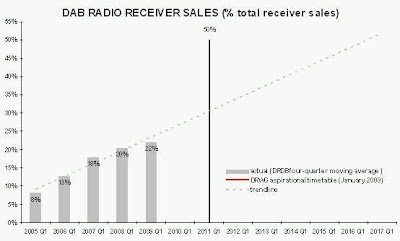
I did not believe it. All the previous data from the radio industry had shown that DAB radios are around 22% of total radio sales, as demonstrated in the graph below.

A year ago, the government’s Digital Radio Working Group had set an ‘aspirational’ target for DAB radios to be 50% of total radios sold by the beginning of 2011. As this graph clearly shows, the odds of successfully coming anywhere close to that target are zero.

Maybe something revolutionary had happened in the consumer market for the proportion of DAB radios sold to have suddenly surged from 22% in Q1 of 2009 to 75% by year-end. It was extremely puzzling.

Then I read an extraordinary letter that Ford Ennals, chief executive of Digital Radio UK, had written to the House of Lords Select Committee on Communications on 15 February 2010. It said in part:

“I thought […] that it might be useful if I wrote with the very latest radio sales data. Encouragingly, it shows that, during 2009, consumers increasingly chose digital sets over analogue ones.

I thought it clearest to present the data in a simple table, which is attached, but it may be useful if I explain a couple of the terms used. Where the data refers to ‘kitchen radios’ it means the kind of sets that you and I would call ‘a radio’ i.e. a set whose sole function is to listen to the radio.

Where it refers to ‘all radios’, these figures include those pieces of electrical equipment which happen to have a radio chip in them (e.g. a hi-fi where the main reason for purchase may be to listen to CDs or an MP3 player where listening to downloaded music is the primary function).

As you can see, by Christmas 2009, 76% of people buying ‘a radio’ chose a digital one…… [emphasis added]”

Aha! Now I think I understand. The only way in which it is possible to contrive that more than three quarters of radios sold are digital radios is to arbitrarily create a completely new definition of ‘radio’. In this brave new world, only a ‘kitchen radio’ will now be called a ‘radio’. (The truth is: 76% of people who purchased a kitchen radio during December 2009 bought a digital radio, though the proportion for the whole of 2009 was 63%.) Every other type of radio is no longer defined as a radio. This new definition of ‘radio’ would completely exclude:
     • Micro systems
     • Clock radios
     • Tuner separates
     • Handhelds
     • Boomboxes
     • In-car radios
     • Audiovisual systems
     • Home cinemas
     • Docking stations
     • Dect phones [?]
     • Mobile phones
     • LCD TVs
     • Record players

This seems like a long list of products which, if they also happen to include a radio, will no longer be defined as having a ‘radio’. How can a ‘clock radio’ not be a radio? How can a ‘tuner’ not be a radio? I know this long list to be a comprehensive definition of ‘radio’ because it was the very definition of ‘radio’ used by the Digital Radio Development Bureau, the forerunner to Digital Radio UK, in its published data. Of course, that was last year. In 2010, ‘radio’ seems now to have a whole new definition.

What can I say? However desperate you might be to try and make DAB radio a success, how is it justifiable to deliberately mis-state data so outrageously in print? And to Parliament?

Costs/benefits of digital radio switchover: why the government buried the evidence

Digital radio switchover was first mooted in the 1980s and started to gather momentum following the first UK public demonstration of the DAB digital transmission system at the Radio Festival in Birmingham in 1991. New Scientist magazine reported then that DAB radio could be up and running in the UK “by the mid-1990s”. However, it was not until 1999 that DAB radio was launched publicly and DAB radio receivers were made available commercially.

Over this period of decades, it would have been sensible to commission some kind of cost-benefit analysis to assess if there were a potential net benefit to radio listeners, to the radio industry, and to the UK generally of embarking on a plan to convert the whole nation to digital terrestrial radio. If such an analysis was ever published, I must have missed it.

We are now in 2010, an incredible 29 years after research and development first started on DAB radio technology. The issue of digital radio switchover has been the subject of a succession of government initiatives since the end of 2007 (the Digital Radio Working Group, Digital Britain, the Digital Economy Bill). Has the government shared with the public a cost-benefit analysis which demonstrates that the public policy on digital radio pursued over the last 20+ years is somehow worthwhile? No. Does such a cost-benefit analysis exist? Yes. Can we see it? No. Where is it? Apparently, gathering dust on a government or Ofcom shelf.

How do we know this? A parliamentary committee recently delved into these facts during its current investigation into the issues surrounding digital switchover in the television and radio markets (see transcript below). Ofcom has remained remarkably silent on the issue of digital radio switchover in recent years. The regulator’s director of radio, Peter Davies, was last seen speaking publicly about DAB in November 2008 when he admitted that new legislation would be necessary to salvage the DAB platform. A little earlier, in April 2007, Davies had prematurely declared that “we are potentially at a Freeview moment with digital radio.” Three years later, radio’s ‘Freeview moment’ seems as far over the horizon as ever.

The first we knew that the government had commissioned some kind of cost/benefit analysis [CBA] for its proposed digital radio switchover was in November 2009 when the Digital Economy Bill was published. The government’s accompanying Impact Assessment document stated:

“The partial Cost Benefit Analysis conducted by Price Waterhouse Cooper (PWC) for the Digital Radio Working Group, which is available on the DCMS website, suggests the Digital Radio Upgrade could reduce the total transmission costs for the radio industry from £87.9 million to £64 million….”

“First, by supporting greater investment in DAB infrastructure a greater number of consumers will have access to DAB and the quality of reception will improve. Secondly, consumers will benefit from access to a wider range of services, specifically new national stations and functionality, such as pausing and rewinding live radio. Finally, the released analogue spectrum will allow for a greater range of community radio stations, as well as possible non-radio services. The PWC partial CBA for the Digital Radio Working Group suggests the value of these benefits could be in the region of £1.1 billion, over a period from 2009 to 2030…..”

“The significant consumer costs of the Digital Radio Upgrade in the non-voluntary conversion of analogue sets to digital, including the cost of in-car conversion. The PWC report suggested the cost of such conversion to be in the region of £800 million, again over the period from 2009 to 2003.” [typo – “2003” should be “2030”]

Although this document stated that the PWC report was available from the government’s web site, I have searched for three months and still never found it there. Nevertheless, the 91-page report entitled ‘Cost Benefit Analysis of Digital Radio Migration’, prepared for Ofcom by PWC on 6 February 2009, contains a number of very serious reservations that there will be ANY benefit from digital radio switchover, and it states:

“The results suggest that there are relatively few up-sides to the estimates, and several significant downside risks. … To a significant extent, the positive Net Present Value [NPV] of the Cost Benefit Analysis relies on two crucial parameters. The first is the Digital Radio Working Group [DRWG] recommendation that an enlarged regional [DAB] multiplex network should be implemented. Failure to implement would result in a substantial negative NPV. The second critical parameter is the time horizon. The results suggest that there is a very long pay-back from the DRWG policy ‘investment’ – the NPV turns positive after 2026. This result assumes that the existing multiplex licences are extended to 2030, as per the DRWG recommendations. Without the licence extension or any other policy instruments that provide clarity on the long term future of commercial radio, the industry and consumers may fail to see the benefits of digital radio over the longer term. Our analysis suggests that the NPV is negative should either of these two proposals not be implemented.” [emphasis added]

The PWC report explicitly noted for Ofcom the limitations of its analysis, as a result of the lack of consideration it had assigned to external factors. These paragraphs probably explain why the government has been so keen to keep the report away from public scrutiny:

“The scope of this study is limited to the assessment of the DRWG policy. The overall digital radio policy appraisal process would need to take into account other policy options and ‘states of the world’. With this in mind, we highlight three issues in particular:

1.    The impact of recession: We have assumed no change in commercial radio sector structure and health beyond a consensus view of advertising forecasts. As this CBA is conducted for the time period to 2030, short term recessionary impacts may have only a limited impact on the longer term outcome for the industry. On the other hand, the current economic downturn could still affect the short and medium term investments required for marketing or coverage extension, which in turn could delay the desired DRWG policy outcome.

2.    Other policy options: We recognise that to reach a view on this question of how to drive digital radio penetration and listening (which in turn delivers consumers’ and citizens’ objectives) requires a full assessment of the costs and benefits of a number of policy options; this study has examined one, the DRWG policy. This is the only policy assessed in this study and the policy is at an early stage of its development; Government and Ofcom could give consideration to other possible policy options. In addition, we recommend modelling a number of other ‘business-as-usual’ scenarios taking into account different assumptions, and assessing how they affect the CBA of the DRWG policy.

3.    Other digital platforms: This CBA assumes that DAB listening will continue to be the leading platform for digital radio listening. The DRWG has reinforced the view that ‘a radio-specific broadcast platform is an essential part of radio’s future’, and that DAB is the ‘most effective and financially viable way of delivering digital radio’ for the medium to long term. A long term view needs to account for the possibility of technology obsolescence or replacement. At present, there is no consensus view that suggests otherwise. However, there are signs that internet listening may begin to take off if internet radios are more actively promoted and technologies such as WiFi or mobile broadband mature and become universally available. A number of the cost and benefit categories assume an impact from increasing the coverage of DAB (for example, consumer benefits from increased coverage is assumed based upon the incremental benefits to consumers who could not receive digital radio stations). Should these trends continue, or a more structural shift to internet to occur, there would be a smaller benefit from increasing the coverage of DAB; consumers either have alternative access to digital radio even within out-of-coverage areas, or would prefer a non-DAB solution when they receive DAB coverage.” [emphasis added]

In the 12 months since the PWC report was prepared, all three of these assumptions have been undermined by subsequent events:

1.    The health and structure of the commercial radio industry have changed considerably during 2009:
•  Commercial radio’s financial health has been impacted severely by the recession. The sector’s revenues were down 19.5%, 10.8% and 12.5% year-on-year in the first three quarters of 2009. Revenues from national advertisers were down 28.8%, 16.1% and 16.5% respectively
•  In January 2009, an analysis commissioned by RadioCentre found that “the [commercial radio] industry as a whole is now loss making”. Hours listened, revenues and profitability have all fallen further since then
•  At the beginning of 2009, Global Radio was the biggest owner of DAB multiplex infrastructure. Since then, it has disposed of its entire stake in the national DAB multiplex and most of its stakes in local DAB multiplexes to transmission provider Arqiva, demonstrating the radio sector’s inability to generate profits from the DAB platform after 10 years

2.    The policy recommendations for digital radio switchover made by the Digital Radio Working Group have since been amended by the Digital Britain report and the Digital Economy Bill. The recommendations of the Working Group’s Final Report published in December 2008 had included:
•  “Government should agree a set of criteria and timetable for migration to digital”, whereas no criteria or timetable are specified in the Bill
•  “A long term plan should be developed to move all services to digital”, whereas the Bill acknowledges that some local radio stations will never have the opportunity to migrate to digital
•  “The BBC should build out its national [DAB] multiplex across the UK to reach FM comparable levels [of coverage]”, whereas the BBC has acknowledged that such expenditure is constrained by the Licence Fee settlement
•  “The government should consider funding options to enable this important investment [in DAB infrastructure]”, whereas the government has made no financial commitment to the build-out of DAB multiplexes
•  “The government must consider the case for a [import] duty exemption for digital radios”, a proposal that is not mentioned in the Bill
•  “Consumer groups believe that, once an announcement [of digital switchover] is made, no equipment should be sold that does not deliver both DAB and FM”, a proposal that has been dropped

3.    The DAB platform has failed to grow in 2009, as had been forecast by the government, Ofcom and the Digital Radio Development Bureau [DRDB]:
•  Volume sales of DAB radio receivers were down 10%, down 1% and down 6% year-on-year in the three most recent quarters for which data have been released by the DRDB
•  Listening to radio via digital platforms accounted for 20.9% of total radio listening at year-end 2009, compared to the 26% forecast by the government’s Digital Britain report in June 2009 (and compared to the 42% forecast by Ofcom in November 2006)
•  Listening to commercial radio via digital platforms accounted for 19.7% of commercial radio listening at year-end 2009, compared to the target 30% announced by RadioCentre in January 2007
•  Total hours listened to digital-only radio stations at year-end 2009 were at their lowest level since 2007, demonstrating that digital radio content is failing to drive consumer take-up of digital radio
•  Unused capacity on the DAB platform has increasingly been filled during 2009 by non-commercial, government-funded, listener-funded, religious or ethnic radio services, rather than by mainstream, mass appeal stations
•  The commercial radio sector launched no completely new broadcast digital radio stations in 2009 (Absolute Xtreme was replaced by Absolute 80s), and the BBC is expected to announce cuts to its digital radio stations at the end of this month

As a result of these developments during 2009, the minimal, long term benefits from digital radio switchover identified by the PWC report a year ago are likely to have been diminished to the point where there may no longer be any benefit evident at all, even as far into the future as 2030. So how can the government still justify pursuing its policy of digital radio migration? It cannot, which is why it remains so reluctant to engage in an analysis of the facts, the numbers, the data and the evidence, all of which clearly show that this misguided, poorly executed, top-down attempt to switch radio broadcasting in the UK to the DAB platform is likely to become a ‘white elephant’ that has already cost the radio industry getting on for £1 billion.

House of Lords
The Select Committee on Communications
“Digital Switchover Of Television And Radio In The UK”
27 January 2010 [excerpts]

Witnesses:
Mr Stewart Purvis, Partner for Content and Standards, Ofcom
Mr Peter Davies, Director of Radio Policy & Broadcast Licensing, Ofcom
Mr Greg Bensberg, Senior Adviser, Digital Switchover, Ofcom.

Baroness McIntosh of Hudnall: I feel we could get back on to slightly safer territory and the notion of cost and benefit. We understand that you commissioned a report from PWC last year into the costs and benefits of digital switchover in radio, but you didn’t publish it. We know, therefore, what we have learned from the DCMS about what it said. It appears that it found, for example, that the benefits could – and I emphasise the word “could” – outweigh the costs by £437 million after 2026, but that conclusion is hedged about with quite a lot of caveats to do with what would have to happen in order for that good outcome to eventuate, and that if those things didn’t happen, then quite quickly you would get into a position where the costs would outweigh the benefits. Can you tell us a bit about that report? In particular, can you tell us why you haven’t published it? Do you think that, given what it appears to say – I choose my words carefully – about the constraints on potential for benefit, that it should have been available to inform the Government’s digital policy? Can you also tell us about your own impact assessment on radio digital migration, which I believe you have been asked to undertake? Will this include a full cost-benefit analysis? When are you intending to publish it? ….. [edited]

Mr Purvis: There are a lot of questions there. Peter commissioned the piece, so I am going to ask him to talk to them, but let me say that you have talked about informing the Government’s decision and one of the main points of doing this was to help inform the Government’s decision. It was a government decision as to whether this information should be published or not. But, we felt, as part of the ….

Lord Gordon of Strathblane: Sorry, it was your document, though, wasn’t it?

Mr Purvis: No, it was actually a PWC document.

Lord Gordon of Strathblane: It was commissioned by you.

Mr Purvis: Commissioned by us, yes.

Lord Gordon of Strathblane: Surely, it would be your decision to publish.

Mr Davies: We were asked to commission it by the Government. We then commissioned it from PWC with a lot of input from various government departments and then submitted it to the Secretary of State.

Chairman: So you decided not to publish it.

Baroness McIntosh of Hudnall: Who owns it?

Mr Purvis: Whenever you commission a document from an outside source, in a sense the ownership of the detail must lie with the people who actually did the work, but, in a sense, when you commission it, obviously you commission it with a purpose and the purpose was to give it to the Government.

Baroness McIntosh of Hudnall: With respect, that is not necessarily true.

Mr Purvis: No, there are options.

Baroness McIntosh of Hudnall: I have work commissioned from me and it may be, and often is, on the understanding that the ownership of what I produce falls to the person who commissioned it from me.

Mr Purvis: Yes, that’s true, but in terms of the ownership. But in the sense of the responsibility for the detail of the commission, the source of the commission must inevitably take its full share of that. But there are a number of options which apply when these pieces of work are done. On this particular occasion, it was decided in conjunction with the Department that work would be sent to the Department. Perhaps the most important thing is for Peter to respond to your characterisation of the work, but, in a sense, we have not hidden the piece of work. Indeed, I think it is now available to you. Is that right?

Baroness McIntosh of Hudnall: In, as they say, a redacted form.

Chairman: Just to be absolutely clear, the Department asked you to commission the work from PWC. Is that what you are saying?

Mr Purvis: They asked us to commission the work. Did they ask us specifically from PWC?

Mr Davies: Not specifically from PWC.

Chairman: The Department said to Ofcom, “Ofcom, you go and commission this particular work.” Is that the position?

Mr Davies: Yes.

Chairman: You then got the work which then came back to you and then you sent it to the Government and the Government said, “We’re not going to publish this in full.”

Mr Davies: I think they have certainly made it available to various groups. I think consumer groups have had it for some time.

Chairman: Fine. There will be no problem, therefore, in this Committee having the full report.

Mr Davies: I think they have made available the redacted version rather than the full report. The reason for that is some of the numbers in there are commercially sensitive, but there is no reason why the Committee should not have the full report.

Mr Purvis: You certainly have seen the conclusions.

Baroness Howe of Idlicote: I just wonder who has paid for it. Has it come out of your budget?

Mr Davies: Yes.

Baroness Howe of Idlicote: Even more indication of ownership.

Baroness McIntosh of Hudnall: Shall we go back to the questions. We now know why you didn’t publish it. Am I right in thinking that, notwithstanding the fact that you did not publish it, it did influence the Government or is in the process of influencing the Government as far as their policy on digital migration goes?

Mr Davies: I think it is one of the inputs to government thinking, certainly. We were very careful when we sent it to the Secretary of State to make clear what all the caveats were. You are absolutely right, there are a lot of caveats around it. This is a piece of work which is at a very early stage of the process. We were very clear to government that they should not use this as the means of making a decision, but it might help to inform the decision.

Baroness McIntosh of Hudnall: The thing that is slightly troubling – perhaps only to me, but a bit – is that when you see what appears to be evidence that the costs and benefits are, let’s say, finely balanced, or could be, that the drive towards digital migration, one might think, was driven more by the technology than by the needs either of the broadcasters or the consumers. That’s the question that seems to me still to hang in the air. Is this technology-led or is it consumer-led, if we wrap into ‘consumers’ both the people who are the end-users and the people who are using the technology to deliver a service?

Mr Davies: I think that is why there are so many caveats around it, because it needs to be, as you say, consumer-led. So, some of the conditions that would need to be met for the figure to come out positive are that coverage needs to be built out, that the content proposition needs to be right, that a lot of the benefit in there is from additional choice for consumers. That is obviously down to industry to provide. That is not something that either government or Ofcom can do. One of the main caveats was the need to roll out the regional layer [of DAB multiplexes] that we were talking about earlier, to become a new national layer, so providing more choice of mass market stations, if you like. So it is absolutely consumer-driven, but where that leads you, I think it is probably too early to say, and, as you say, it is very finely balanced.

Baroness McIntosh of Hudnall: What about your own impact assessment?

Mr Davies: We haven’t done an impact assessment yet.

Baroness McIntosh of Hudnall: But you have been asked to – correct?

Mr Davies: At some point in the future. I think the Digital Britain report said that we would be asked to do one, but we haven’t been asked to do one yet. Obviously we would need to do that and we would need a much fuller cost-benefit analysis before any final decision was taken.

Baroness McIntosh of Hudnall: So that’s a future thing.

Criteria and a date for digital radio switchover: where'd they go?

When will the UK government’s proposed ‘digital radio switchover’ happen? For a long time, we had always been told that the pre-requisites were:
• market criteria that had to be reached before switchover could be announced;
• a fixed, single date for switchover to happen.

So both of these must be in the Digital Economy Bill somewhere, surely? Well, it seems that everything (except the Bill itself) points to 2015 as the switchover date. But as for the criteria?

The government’s press release of 20 November 2009 announcing the Digital Economy Bill stated:
• “Digital radio: update the regulatory framework to prepare for moves to digital switchover for radio by 2015”.

The government’s accompanying Factsheet of 20 November 2009 stated:
• “At the centre of our ambition is the delivery of a Digital Radio Upgrade programme by the end of 2015.”

The government’s accompanying Impact Assessments of 20 November 2009 referred to:
• “a switchover to digital radio by 2015”
• “a switchover to digital only radio by 2015”
• “a Digital Radio Upgrade programme, which should be completed by the end of 2015”.

However, the government’s Explanatory Notes to the Digital Economy Bill said:
• nothing about criteria that have to be met;
• nothing explicitly about a switchover date.

Published on 20 November 2009, the Digital Economy Bill itself contained nothing about:
• criteria that have to be met;
• an explicit date for digital radio switchover.

What? Is this not strange? Somewhere along the way, it seems as if the agreed criteria and the switchover date just vanished into thin air. So what happened? Let’s go back and follow the timeline of how we got to where we are now.

JUNE 2008
The Interim Report of the government’s Digital Radio Working Group recommended:
• “Government should agree a set of criteria and timetable for the migration to digital.
• These criteria should include an assessment of:
      * The percentage of listening to DAB enabled devices;
      * Current and planned coverage of DAB and FM; and
• In considering the case for migration we expect the Government will also want to consider the take-up of digital radio in cars, affordability, functionality, and an environmental impact plan.”

DECEMBER 2008
The Final Report of the Digital Radio Working Group recommended:
• “Three broad criteria that must be met in order to trigger the digital migration process:
     * That at least 50% of total radio listening is to digital platforms;
     * That national multiplex coverage will be comparable to FM coverage by time of digital migration;
     * That local multiplexes will cover at least 90% of the population and, where practical, all major roads ….”
• “Government should announce a date for digital migration, ideally two years after the criteria have been met”.

JANUARY 2009
The Interim Report of the government’s Digital Britain recommended:
• “We will create a plan for digital migration of radio, which the Government intends to put in place once the following criteria have been met:
     * When 50% of radio listening is digital;
     * When national DAB coverage is comparable to FM coverage, and local DAB reaches 90% of population and all major roads.”

JUNE 2009
The Final Report of Digital Britain recommended:
• “The delivery of a Digital Radio Upgrade programme by 2015”
• “Included within the Digital Radio Upgrade timetable is our intention that the criteria should be met by the end of 2013”:
     * “When 50% of listening is to digital; and
     * When national DAB coverage is comparable to FM coverage, and local DAB reaches 90% of the population and all major roads”

This Report also included a critically important graph (see below) which, it said, “shows the projected digital share of listening under two scenarios: organic growth and with a concerted drive to digital”.

Shockingly, the historical data in this graph had been ‘doctored’ to make it look as if the faster growth path advocated by Digital Britain was easily achievable [confusingly, the key on this graph labels the lines round the wrong way]. When I queried the source of this false data, the government told me it had been supplied by another party, which I later found to be a report produced by the Digital Radio Development Bureau, but not made public.

Digital Britain’s graph sought to demonstrate that continuation of the current growth trend in digital listening would lead to the 50% criterion being achieved in early 2015, whereas the actual data (from RAJAR) in my graph shows the 50% criterion not being reached until the end of 2018 [the trend line here is automatically generated by Microsoft Excel from all available quarterly data].

Digital Britain proposed policies to accelerate DAB take-up which, it said, would ensure that the 50% criterion would be achieved by year-end 2013, a gain of a little over one year from its natural trend. However, in my graph that uses RAJAR data, the acceleration necessary is shown to be five years, not one year, which would prove an almost impossible task to achieve [I wrote about the false data in June 2009].

JUNE TO DECEMBER 2009
Between the publication of the Digital Britain final report in June 2009 and today, it has slowly dawned on some of radio’s stakeholders that the agreed criteria necessary for digital radio switchover stand zero chance of being achieved by 2013. Neither do they stand a chance of being achieved by 2014 or 2015, nor probably by 2016. It always was pie in the sky, wishful thinking, fiction rather than fact. The manipulation of key data in a significant government report only demonstrates the duplicity.

So, what to do about it now? Admit you were wrong? Admit your culpability? Best to simply pretend that the criteria and the proposed switchover date never really mattered. Botched data – ignore it. Unrealistic targets – lose them. Perhaps nobody will notice the whole, sorry deception.

In the here and now, Digital Radio UK (the new organisation responsible for implementing DAB) explains the current thinking:
• “The [Digital Economy] Bill does not set a definite date for digital radio switchover …”
• “The Government has stated that switchover will not happen until the majority of radio listening is to digital, and until anyone who can currently receive FM is able to receive digital radio” [but fails to address why these criteria are not included in the Bill].

In the here and now, RadioCentre (the commercial radio trade body) explains:
• “[Digital Economy Bill Clause 30] allows the Secretary of State to set a [digital switchover] date, but does not require one to be set, or indicate when the date might be”.
• “The objective that switchover should not occur until certain thresholds have been reached for listening … appears sensible on first reading. However, RadioCentre does not believe it is appropriate for the industry to be tied to any figures in primary legislation. This is a very inflexible mechanism against which to manage our industry going forwards”.

Figures. Numbers. Dates. Criteria. This kind of factual evidence or hard data might obstruct a future decision to force consumers to switch to DAB radio.

So to answer the original question – the criteria and the switchover date that had been agreed upon by stakeholders, over two years of deliberations, have now quietly been relegated to oblivion.

When would digital radio switchover have happened if the agreed criteria had been implemented in law? Probably never.

When will digital radio switchover happen now? Whenever those in power want it to.

DAB radio: the customer is always wrong?

Politicians, government, civil servants, regulators. We pay their wages. They work for us, don’t they? So why does the voice of the consumer, the citizen, the customer so often seem to be ignored or become lost when the government makes new policies or passes new legislation. DAB radio seems to be a case in point.

The government had convened the Digital Radio Working Group [DRWG] in 2007 to consider:
• what conditions would need to be achieved before digital platforms could become the predominant means of delivering radio?
• what are the current barriers to the growth of digital radio?
• what are the possible remedies to those barriers?

The Group met for a year and published its Final Report six days before Christmas 2008. It had created a number of sub-groups to examine specific aspects of digital radio. One of these, the Consumer Impact Group, submitted its own report to the Working Group in November 2008 to inform its Final Report.

The Consumer Impact Group’s recommendations about DAB radio make sober reading and carry as much gravitas, maybe more, now as when they were written a year ago. To quote directly and extensively from its report:

“The group is concerned that the case for digital [radio] migration has not been made clearly enough from the point of view of the consumer. While it is clear what the rationale is for the radio industry, the group would like to see a compelling argument as to why digital migration is desirable for consumers and what its benefits would be for consumers.”

“The group also considers that the proposed migration criteria of 50% of all listening through digitally enabled devices is too low, and disproportionately affects disadvantaged groups who are less likely to be represented in the first 50% to take up digital radio. The group would therefore like to see the 50% figure analysed in more detail and a stronger case made for it, before it is adopted by the full DRWG, to ensure this is not the case.”

“The group notes that neither the market nor consumers are currently prepared for migration at this stage. Information provided to the group shows that take-up varies from region to region and amongst demographic groups. Therefore, the group recommends that if digital migration proceeds, a help scheme will be essential to assist those where the cost of migration is significantly greater than the benefit. The information provided by the cost benefit analysis for the more vulnerable social groups will be an essential element in considering where and how a help scheme is best delivered.”

“The group believes that further research should be undertaken to examine the extent of ownership and usage of analogue and digital radio particularly amongst disabled people, older people, people whose first language is not English and consumers from low income households. The research must be structured and use appropriate methodology to capture information on those over 65 and those over 75. The findings should be fed into plans to protect the consumer interests, i.e. for a help scheme, for effective labelling, for information and education campaigns and for the development of easy-to use products.”

“The group urges caution with migration to digital radio should the uptake amongst older people, disabled people and low-income households be found to be low or should the costs be found to be prohibitive for these groups.”

Commenting on DAB radio take-up and the proposed digital migration criteria, the report said:

“The RadioCentre was asked to present figures, drawn from the existing Rajar and DRDB figures, setting out the current information on the number of DAB sales, household penetration and listening, defined by region, age and social class.”

“The figures, which are annexed to this report at B [but excluded from the published version], show a number of interesting trends. For example sales, penetration and listening to DAB vary across the UK. Generally speaking, listening and awareness of DAB is highest in London and the South East, and the English Midlands. These have been the areas of longest DAB broadcasts and the widest choice of stations.”

“When awareness and penetration are broken down by Socio-Economic Group and age, there does appear to be a divide. The figures show that consumers in lower income groups are considerably less likely to own a DAB set than other social groups. Even when owning a DAB, in some areas weekly listening to DAB by the over 65s is very low at less than 10%.”

“The main conclusions to be drawn from this research is the general low level of ownership and listening by the over 65s compared to other age groups, and the low listening figures for consumers in the lower socio economic groups. This perhaps reflects that financially lower income groups are finding the price of sets a barrier, whilst for older groups, despite having sets, over 65’s may find DAB radio’s less easy to use than analogue sets, or perhaps prefer the traditional use of their analogue sets.”

“Whilst recognising that universal DAB coverage is not achievable, the group considered that after migration, DAB coverage for UK-wide stations and stations for the nations should be equivalent or better than that available for analogue radio at present.”

“The group stressed the importance of encouraging availability and use in cars, and noted that it would be virtually impossible to meet any listening criteria without addressing the issue of take up in cars. The group feels this should be a priority for the full DRWG.”

On the topic of research, the Consumer Impact Group commented:

“More and wider research is required, particularly about the ownership and usage of analogue and digital radio amongst those people with disabilities, people whose first language is not English, older people (both over 65s and over 75s) and those in low income groups. This additional research, when used together with the RadioCentre research and Rajar figures should be used to guide future work in this area, particularly around take-up, equipment features, programming and a help scheme. The group feels that there is an opportunity here to ensure that future work is based on comprehensive and reliable evidence and analysis. The findings should be fed into plans for any help scheme, for effective labelling, for information and education campaigns and for developing easy-to use products. Where it doesn’t already, this research should also take into account ways of listening to digital radio other than through a DAB enabled set, for example via the internet, digital terrestrial and satellite television, which may provide a significant proportion of the growth in the future.”

The Consumer Impact Group’s recommendations included:

• “We believe, that before migration could begin, additional research into radio users who are disabled, older people (both over 65 and over 75) and consumers from low income households is essential, since these people are likely to require particular assistance with migrating to DAB. This research should inform the development of plans for a help scheme, for effective labelling, for information and education campaigns and for developing easy to use products.”
• “In the absence of the finalised cost benefit analysis at this point in time, the group recommends that the cost of converting to digital radio for the average household, as well as the affordability for low income groups should be investigated. In addition, the current take-up amongst older people, disabled people and low-income households needs to be investigated. The group urges extreme caution with migration to digital radio should the uptake in these groups be found to be low or should the costs be considered to be prohibitive by any of these groups, unless an appropriate help scheme is in place.”

Analysis. Research. Cost benefit analysis. Comprehensive and reliable evidence. All were considered to be very important by the Consumer Impact Group.

However, when the 26-page Final Report of the Digital Radio Working Group was published in December 2008, it did not include a single graph, a single numerical table or the results of any commissioned consumer research. Neither were such data attached in appendices.

The Final Report of the Digital Radio Working Group did recommend that “the government should conduct a cost benefit analysis of digital migration”. The government accepted this recommendation. One might think that this would be an urgent imperative, given that proposed legislation on DAB radio in the Digital Economy Bill is about to be debated in Parliament.

Wrong! The government has stated explicitly that it is “committed to a full cost benefit analysis of the Digital Radio Upgrade programme before any Digital Radio Upgrade is set” which would include “the timings and costs to consumers”. But the government has stated that “this is likely to begin in 2011”.

What? The government wants a huge (some would say impossible) commitment from the UK radio sector and from the British public to forge ahead with migration of radio listening to DAB, even though its own full cost benefit analysis of pursuing that policy will not be STARTED until 2011.

Is this not mad? Are our public servants working for us? Does the consumer viewpoint on these issues count for nothing?

FM radio in mobile phones: the universal standard

Although some politicians and civil servants might try to convince us that the UK can lead Europe and the world in technological innovation, new broadcast standards and electronic hardware, the reality is that the sun set on the British Empire a long time ago. Almost none of the gadgets we use are manufactured in the UK, and even those that have British corporate logos glued on the front are inevitably assembled in China or Korea. When global commercial forces make a decision on the adoption of a new consumer mass technology, the best Britain can do is follow in the slipstream and make the most of innovations that the rest of the world is pioneering.

Right now, the new broadcast standard for mobile radio reception is being decided in the corridors of power in Washington DC and in the boardrooms of the mobile phone manufacturers. That standard will be FM radio. This inevitably means that FM radio delivered to on-the-go consumers via mobile devices will become the universal standard for years to come. Please, Ofcom and DCMS [the Department of Culture, Media & Sport], do not bother getting uppity just because you were not consulted by Congress, Nokia, Samsung or Apple. Neither were several hundred other countries around the globe. And please, DCMS and Ofcom, do not even think about committing the UK to going its own sweet way unilaterally on this issue. All it will do is create more embarrassment.

Recall the DCMS-led Digital Radio Working Group which spent a year deliberating on the digital radio issue and included in its Final Report published in December 2008 a note that “consumer groups believe that, once an announcement [of digital radio switchover] is made, no equipment should be sold that does not deliver both DAB and FM”. In the margin, at the time, I had scribbled “in your dreams!” After ten years of DAB broadcasting, there is still not one mobile phone currently on sale in the UK that incorporates DAB radio.

Recall the report from Ingenious Consulting published in January 2009 which suggested that, in order for the DAB platform to succeed for commercial radio, it would need a “commitment [from radio stakeholders] not to pursue alternative technologies to DAB”. So, is the only way to drive consumers’ use of DAB to prevent them from listening to radio on other competing platforms? Will ‘DAB police’ be storming some West Country town next year and taking all the residents’ analogue radios away from them?

Whereas the UK has too often pursued these sort of fundamentally impractical strategies to achieve its aims (and thus usually fails), the US is adopting a much more practical and sensible approach. Almost everyone in the US carries a mobile phone. Therefore, mobile phones should all have FM radios in them. An FM chip costs next to nothing for a mobile phone manufacturer. The benefit to the consumer is that FM radio is free at the point of access and its usage is only limited by the battery power of the phone.

This week, Homeland Security Secretary Janet Napolitano and FCC chairman Julius Genachowski received a cross-party letter, signed by 60 members of the House of Representatives, encouraging FM radio capability to be included in mobile phones sold in the US. The letter noted that the Warning Alert & Response Network Act of 2006 requires the mobile phone industry to create an emergency alerting system in the US, and it stated:

“There are well over seven hundred million cell phones with FM radios globally. Currently, only a handful of FM radio enabled cell phones are in the U.S. market. There is no excuse for American consumers’ access to advanced technology to lag behind that available worldwide.”

In June 2008, the commercial broadcasters’ trade body, NAB, had published a report which outlined the potential benefits from including FM radios in mobile phones. “Radio is a service that already reaches 235 million American listeners every week,” said NAB president & CEO David Rehr. “With 257 million cell phones currently in service, we’re confident that implementation of a new FM-radio feature would result in rapid penetration, benefiting not only the radio business and American consumers, but the cell phone, electronics manufacturing, and music industries as well.”

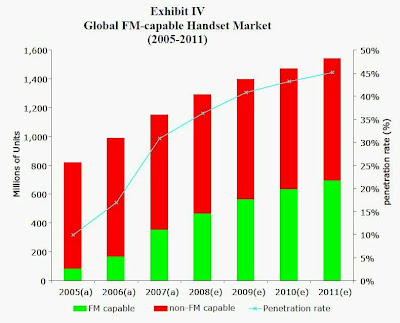
The NAB report included a graph (see below) which displays data supplied by iSuppli Corporation forecasting that, by 2011, 45% of all mobile handsets globally will incorporate FM radio.

It is noteworthy that the US, in this case, seems totally happy to ‘follow’ the rest of the world in incorporating FM radios in its mobile phones, a feature that is already widely available in many other countries (including the UK). The US is not trying to argue that some new proprietary broadcast standard (such as HD Radio) be adopted in phones to further the objectives of a particular commercial US business.

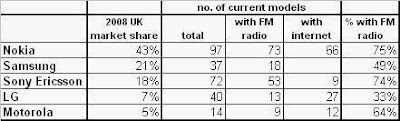
In the UK, we are in a somewhat different position. Mobile phones with FM radios are already out there and being purchased by most consumers. My survey earlier this year of mobile phones available in the UK found that more than half the available models included FM radio (see table below).

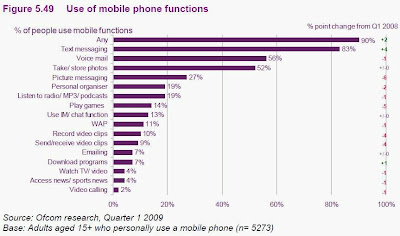
It is remarkable that the hardware is already sitting in millions of UK citizens’ pockets with the capability to listen to FM radio. And it costs them nothing (but battery power) to listen. The only disappointment is that people do not seem to be using their phones much to listen to the radio, according to Ofcom data (see graph below):

Most industries would kill to achieve the kind of penetration levels that FM radio has already achieved in the UK with mobile handsets. Yet the commercial radio industry in the UK, unlike in the US, appears to see little advantage to directing listeners to the mobile phone platform. Why?

Maybe because:
• RAJAR, the radio audience metric, does not publish listening data separately for the mobile phone platform in its quarterly survey [confusingly, it presently seems to lump respondents’ reported mobile phone listening to live radio into its ‘digital unspecified’ platform category, even though FM radio received via mobiles is, in fact, analogue]
• DAB is the platform of choice for the commercial radio industry because it (like the BBC) has invested so heavily over a decade in building its expensive infrastructure, so why persuade listeners to go elsewhere? The questions to be asked are: What is your radio company primarily – a content provider or a platform operator? Are ‘hours listened via DAB’ really more important to you than ‘TOTAL hours listened’?
• DAB (like FM) restricts consumers’ listening to BBC and UK commercial radio stations, whereas mobile devices increasingly offer a much wider choice of content (not on FM, but via G3 or broadband). So there is reluctance to promote a mobile platform that could potentially attract a previously loyal listener to, say, Last.fm

As a result, a drive to encourage FM radio listening on mobile phones does not figure in UK commercial radio’s overall strategy, even though it might help maintain the sector’s audiences and revenues (admittedly, some companies such as Global Radio and Absolute Radio have individual initiatives that do push the point). You cannot help but think that opportunities are being lost here because:
• All the industry’s platform eggs have been placed in the DAB basket
• The DAB campaign in the UK seeks to persuade consumers to PURCHASE a new radio receiver, whereas almost everyone already owns a mobile phone, so a campaign to persuade consumers to use its FM radio will involve no additional purchase
• The UK industry wants to maintain its ‘walled garden’ that shields consumers from experiencing non-BBC/non-UK commercial radio content, thus maintaining the cosy content duopoly.

A parallel might be Tesco not wanting to tell customers about its ‘Metro’ stores within petrol stations because it was worried that they might spend their disposable income on forecourt petrol rather than Tesco items. That would be crazy. Tesco simply wants consumers to be offered as many opportunities as possible to buy Tesco goods, wherever that opportunity might arise.

The incongruity is that the US radio industry desperately wants to be at a place where we, in the UK, already are (lots of mobile phones incorporating FM radio). Yet, what are we ourselves doing to promote FM radio listening on mobile phones? Almost nothing.

DAB radio: "let us get on this horse or get off it"

House of Commons Culture, Media & Sport Committee
“The future for local and regional media”
27 October 2009 in the Thatcher Room, Portcullis House

Andrew Harrison, chief executive, RadioCentre
Travis Baxter, managing director, Bauer Radio
Steve Fountain, head of radio, KM Group

[excerpts]

Mr Tom Watson: Can I ask you about Digital Britain and the Digital Britain Report? Do you think the report gave a good way forward for the commercial sector to journey out of its current troubles?

Mr Baxter: Perhaps I could ask Andrew to give an overview on that and then maybe we can give our respective views?

Mr Harrison: To give an overview, I think the short answer to that is “yes”. One of the fundamental issues the sector faces right now is the appalling cost of dual transmission. Ultimately, right now, this is a small sector and very many of our stations are simultaneously paying for the cost of analogue and digital transmission. That clearly does not make any financial sense. What we advocated for in Digital Britain was a pathway for all stations to end up with a very clear plan of what is the single transmission platform for them. That led, as I said in my opening remarks, to three very complementary tiers of the commercial radio offer. The first tier is a strong national offer on digital to compete with the BBC, and that is critical for the sector because the truth is that the FM spectrum is full. I am sure all of you will know from some of the other conversations we have had before that the BBC dominates the gift of analogue spectrum. It has four national FM stations; we only have one with Classic FM. For the sector to compete and capture its share of national advertising revenue, the ability to have a national digital platform I think is critical. As we then had the conversations with Digital Britain, I think it became very clear to all of us that you cannot just migrate national stations to digital and leave all of the large metropolitan local stations, like City in Liverpool for example or Metro in Newcastle, all the BBC’s local stations, as analogue only. The listeners to those stations will want the functionality, experience and benefits that come with digital. It is then very important that we have a second tier of the large local and regional stations which also migrate to digital. Critically, however, that nevertheless leaves an important third tier, which are the smaller or the rural stations for which either DAB coverage is currently not present – there is just not the transmitter build-out in some of the rural areas – or for which it is likely to be prohibitively expensive going forward. That sector equally needs clarity and that sector being able to stay on FM alongside community radio we feel gives a very balanced ecology where the sector has the most opportunity to compete and the lowest cost base because each station can ultimately choose whether it is on one transmission methodology, i.e. digital, or another, analogue. At the moment, we are in limbo where stations are paying for both but the profitability of the sector is fragile and there is not a plan. So we absolutely welcome the beginnings of that plan, which we recognise is the start of what is going to be a long and difficult journey as stations migrate and decide if their future is on digital only or their future is on analogue. The quicker we can move the industry there, clearly the better for the fragile economics of the sector.

Mr Baxter: Perhaps I can encapsulate some of the things we sent in to the Carter Review. Our business view generally is that the future is digital. There is hardly the need for me to make that clear to you. Our view has been for the last ten years that we will look at all platforms as we develop our business. We have successful radio stations, primarily operating for example off the audio channels on the Freeview digital television system. However, within that we think it is of real value for radio to have a bespoke platform and the one that is available to us that is a bespoke broadcast platform is DAB. It has, however, taken 12 to 13 years of very slow development for that platform to get to its current state. Therefore, our proposition to Carter’s Review was: let us get on this horse or get off it. We think we should get on it and put every possible energy we can over the next view years into getting consensus, direction and pace into the whole process of take-up, like there has not been during the last 12 years. If that can be achieved, it will produce a new resonance for commercial radio as a whole, indeed for the whole of radio. It will help position radio more effectively in the fragmenting media landscape we all have to deal with and give us an opportunity, as Andrew said, of clarifying our investment levels around platforms where currently we are having to pay for two when, in a future where either one is successful, we would only have to pay for one, thereby allowing resource to be put into developing content and other things around our business.

Mr Fountain: KM Group does have a digital platform. It is currently costing us over £100,000 a year and we get absolutely nothing back from it. I think the company at the time, six years ago, took the view that they wanted to be a part of the future. Circumstances since have not really helped them to be able to develop that particular medium. I think we too take the view that we would want to be part of a digital platform going forward, but there are a number of issues that would need to be overcome, not least of all the cost of entry and also in our particular case our DAB coverage and the coverage of our FM stations is not mirrored. We have better coverage right now on our FM platforms than we do on our one single DAB coverage. The problem around the coast, if you take that from Medway right the way round perhaps as far down as Rye, around the Kent coast and just touching into Sussex, is such that DAB does not actually reach into large parts of that coastal area.

Mr Watson: Would DAB+?

Mr Fountain: I could not answer that because I do not actually know.

Mr Harrison: No, there is no difference in terms of the coverage for DAB or DAB+. DAB+ is just a different method of compressing the signal so you can actually get more signal down the pipe, if you like; you tend to get more stations, but it does not actually affect the coverage.

Mr Fountain: You can see that in order for us to extend the coverage of DAB, there is clearly a cost involved, and there is also a conversation to be had between Ofcom and the French communication authorities as well.

Mr Watson: Presumably you are all relatively happy with what is quite a demanding timetable outlined in Digital Britain if your view is that we should just get on with it and do it?

Mr Harrison: I think you have expressed it exactly right. The timetable is demanding. I think it is set deliberately as being demanding. Digital Britain does not set a date for switchover. What it sets are two criteria that it says are axiomatic to be hit before switchover can be contemplated: one on listener levels and one on coverage, both of which we support. The aspiration in Digital Britain is to try and hit those two gates, if you like, by the end of 2013. On what Travis was saying earlier on, we think that is absolutely right, that the industry now works terrifically hard together, alongside the BBC and alongside the Government and the regulator to do our very best to hit those criteria. Once we then hit the criteria, the Digital Britain report identifies that it will probably take a couple of years from the criteria being hit before we could actually contemplate switchover. That is aggressive but we think it is appropriately aggressive against the context of an industry that is clearly struggling financially now, and the vast majority of my members are highlighting the cost of dual transmission as the single biggest cost issue that they face and self-evidently one that could be eliminated the quicker we can get to a decision one way or the other.

Mr Watson: May I ask you a bit of a left field question? You are quite confident that we should move to digital radio quite quickly. How confident are you that consumers will want to make that journey and that they will not migrate to internet, radio or choose to listen to live streaming sites like Spotify?

Mr Harrison: There are two different points there. We are quite confident, as you say, about the movement to digital, but purely because what the Digital Britain Report sets up are consumer-led criteria to drive that change. The criteria are absolutely that we will not move until coverage is built out to match FM. It would be absolutely suicidal for the industry to switch people off who currently listen and enjoy radio services, so it is axiomatic that we have to build coverage out. Secondly, the criterion is that listenership to digital has to be that the majority of all listening has to be to digital before you would contemplate switchover. We are not going to rush into this without being led by the consumer. What we are trying to do, as Travis said earlier, is inject some pace, momentum and energy into the process. If we wait for the natural replacement of sets and the natural progression of DAB – it has taken a long time to get to the listener levels we have right now, we still have all of the BBC’s services for example available on analogue – it is going to be very difficult to kick start the progression. We are very comfortable but we are comfortable because it is led by the consumer. The second part of your question is: are we worried about competing services? We are absolutely. I think there is a whole generation of new entrants into the market – Spotify, Last.fm, Pandora – available on-line, all of which are unregulated and against which we are competing for listeners and for advertising revenue. When you have a small, heavily regulated, constrained local radio sector competing with an unregulated world-wide series of music offerings, that is one of the challenges we have to face. We are, however, absolutely committed to the importance of a broadcast transmission methodology for digital. That is not to say that the internet will not be an important complement to that but our business model is based on a broadcast signal of one signal to a wider audience. There is very little evidence so far that on-line music offerings are in themselves profitable business models. For UK citizens and consumers, for our listeners, we think it is absolutely critical that radio remains free at the point of delivery. That has been one of its great strengths ever since the BBC was founded in the 1920s. Of course at the moment, although as I heard this morning the cost of broadband is potentially down to £6 a month, nevertheless, to access any internet-delivered service, you have to pay an ISP connection. That may change but I suspect we are a long way away from that.

[edit]

Mr Watson: Do you think the car industry is sufficiently prepared for the digital revolution?

Mr Baxter: I think we have had some very encouraging conversations with the motor industry over the last six months. The response to Carter’s work during the beginning of this year has helped galvanise interest in that area quite significantly, so I think there is a very different aura around those discussions than there was 12 months ago.

Mr John Whittingdale, Chairman: Just on the cost of the digital upgrade, what is your best estimate of how much it is going to cost?

Mr Harrison: I was on the working party, the Digital Radio Working Group, that was the forerunner for Digital Britain. That working group identified the cost of build-out, the one-off capital cost, as between £100 million and £150 million. That is quite a spread. The reason for the spread ultimately depends on what degree of coverage build-out you get to from equalling FM to universality and at what signal strength. Of course, you get real diminishing returns as you go to the very rural areas. That is the reason for the spread. There has been a lot of debate about that number. In reality, the way we have tended to look at it is that if you take that spread of £100-£150 million over the 12 year period of a licence, which is typically when a radio station is licensed or a multiplex is licensed, and if you said for round figures it is £120 million, that is £10 million a year for the licence period. I think it was £10 million a year that the Secretary of State quoted for example last week. Funding that we have always felt is actually absolutely critical to the build-out and conversation to Digital Britain. The commercial sector is absolutely happy to pay its way to the extent that the build-out is commercially viable but, after that, there is a clear public policy imperative. If the Government and Parliament decide that it is important to have a dedicated transmission structure for radio, that will be a public policy decision and it will need funding. That said, we believe that funding is very affordable. If you take that £100 million number, we believe that, for example, the BBC would save much more than that over the period of the 12-year licence just on what it will save on FM transmission alone, so there is a straightforward business proposition. Another way to think about the £100 million over a 12-year licence with the current Licence Fee settlement for the BBC at around about £3.5-£3.6 billion a year is that over 12 years that is £43 billion. The £100 million infrastructure cost for DAB radio is less than a quarter of one per cent of what the BBC’s income will likely be over the next 12 years. So it is eminently affordable if there is a public policy decision that it is important to do that build-out.

Chairman: Those two arguments suggest that you are looking for the BBC to pay for this.

Mr Harrison: We have said very clearly and very fairly that we are absolutely happy to pay our fair share in our way to what is commercially viable.

Chairman: What does that mean?

Mr Harrison: That means that we have already put our hands in our pockets substantially to build out coverage on a local and a national basis as far as we judge is affordable. I think realistically, given the state of the sector, the vast majority of the cost going forward, which is primarily designed to meet the BBC’s obligations of universality rather than the commercial sector’s obligations of viability, should rest with the BBC.

Chairman: So whilst RadioCentre is keen to move ahead with the digital upgrade, the economics of your sector at the moment means that you cannot really afford to put any more money into it?

Mr Harrison: We believe that transmission coverage build-out is axiomatic; it is one of the criteria to effect switchover. We cannot afford it but we absolutely believe the BBC can.

Philip Davies: Andrew, on this part can I ask you about how representative your view is of the industry as a whole? It was over this issue it seems more than any other that UTV Radio quit the RadioCentre and said that it felt that it was no longer representing the interests of the wider industry and gave too much power to its biggest member.

Mr Harrison: Yes, UTV did say that. Scott Taunton, the UTV Radio managing director, actually represented the commercial radio industry with me on the Digital Radio Working Group through all the per-work that was done for Digital Britain, and so they have been intimately involved. To be fair to UTV’s position, they have a particular reservation over the date and the timing for digital, but to be fair to the Digital Britain Report, and indeed we await the clauses of any potential Bill because it is not yet written, there has never been a formal switchover date actually agreed. Although, for example, I think Scott in his Guardian article yesterday talked about a 2015 date being farcical, that date has never been set. What have been set are two consumer-led criteria that have to be hit and then a transition period after that before we all migrate. As Travis said earlier, the majority of opinion across the sector, and certainly across my members and representing my board, is that we need now to put our foot on the gas and work hard to deliver the criteria. Inevitably, there is going to be a spectrum of views with different businesses in different places in terms of their own business models as to the urgency or not they see behind that. UTV are absolutely right to have their own position. They are more at the tail end of the timing.

Philip Davies: UTV did not just say that they had a different position to you. They said something a bit more fundamental than that that they felt that you were no longer representing the interests of the wider industry. It was not just as if they had a disagreement. They were indicating that there were others in the sector who shared their view. Do you accept that there are many others or some others in the sector that would share their view?

Mr Harrison: I would absolutely accept that we are a broad church and there is a breadth of opinion. I represent large and small stations, local and national, rural and metropolitan, so there is a breadth of opinion. To give you an example of that, our other major national station member that is on AM is Absolute Radio and they believe that the timing for digital should be sooner rather than later. They already have over 50% of their listening on digital platforms, one way or another, so they would move sooner. I have a number of digital-only stations in membership, stations like Jazz and Planet Rock, which clearly are already digital-only and would like to be in the vanguard. Inevitably, there is a spectrum of opinion and we try our best to reflect the overall views. The truth is that it is very unfortunate that UTV have left membership but we continue to represent the vast majority of the sector and its stations and will continue to try to steer a path, helping Government and helping the regulator through this tension.

Paying for DAB radio carriage: god only knows

Premier Christian Radio, the London AM station, is planning to broadcast on the national DAB platform from 21 September 2009. In an e-mail to listeners, its chief executive Peter Kerridge explained:

“Beginning in September, we will start to incur the cost to transmit on this digital platform – £650,000 per annum – which is an expense that is over and above our current operating costs. The only way the £650,000 in transmission costs will be covered is through the generosity of friends like you. It is fantastic that God has moved in such an amazing way to provide Premier this national digital licence! Now may you and I be found faithful as we steward this new resource for His glory and for the advancement of His Kingdom!”

DAB carriage remains a costly business. Digital One, the owner of the sole national commercial DAB multiplex, fixes the carriage costs for content providers such as Premier Christian Radio. If £650,000 seems like a lot of money for broadcast on a platform that reaches 33% of adults in the UK and accounts for only 13.1% of radio listening [RAJAR Q1 2009], understand that this is a bargain compared to the expensive contracts some content providers had signed previously. In January 2009, Digital One responded to the government’s Digital Britain initiative by cutting its prices. Acting chief executive Glyn Jones said:

“We’re turning the ideas set out in the Digital Radio Working Group’s report into actions. That includes looking hard at how Digital One can offer lower carriage costs. In turn we’re expecting that stakeholders involved in the Working Group, and other companies with the ambition to launch new national radio stations in 2009, will step up and engage with a view to adding compelling new choice for consumers. We’re expecting that prices will initially be set below Digital One’s 2008 rate card. One reason for that is to help provide an incentive for people to invest in high quality services. But, over time, companies providing new services will be expected to contribute to the costs of a transmitter roll-out plan which was something also identified by the DRWG as important.”

Digital One’s January 2009 press release was ambitiously headlined ‘New National Radio Stations To Launch In 2009’. Seven months later, what stations have stepped forward to take advantage of the Digital One offer? Government-funded BFBS Radio started DAB simulcasting on 20 April 2009, following a three-month trial in 2008. Amazing Radio launched on DAB in June 2009 for a six-month trial period, playing unsigned artists from its music web site. Also in June 2009, Fun Kids, which is normally on DAB only in London, launched a fourteen-week trial simulcast on national DAB. Neither BFBS nor Amazing Radio are participating in RAJAR radio audience research, so it is impossible to know how much listening these services are attracting on the DAB platform.

Have we seen any major media players step forward and put a new mass market radio service on the national DAB platform? Not yet. Why? Because, even at the knockdown rate of £650,000 per annum, it still proves impossible to make a profit from offering radio content on DAB. The table below offers very rough estimates of what digital stations measured in RAJAR (and carried on a mix of broadcast platforms including DAB and digital TV) should and might be earning in revenues. The second column lists the total hours presently listened to each digital station. The third column uses the average commercial radio sector yield (how much revenue was generated from how much radio listening in 2008) to estimate, in theory, what these stations’ revenues should be.


However, the ‘Commercial Radio: The Drive To Digital’ report commissioned from Ingenious Consulting by RadioCentre in January 2009 told us that:

“Incremental revenue from DAB-only stations is negligible at ~£130k per ‘bespoke’ station …”

The list above comprises the 14 digital radio stations that subscribe to RAJAR. Not all of these stations broadcast on DAB (Smash Hits Radio is only on digital TV), not all of them are national (Yorkshire Radio is only on the Yorkshire DAB multiplex, for example), but let us be generous and assume that each station earns revenues of £130,000 per annum. In total, these stations combined would generate £1.82m per annum of revenue. This is substantially less than the £29.7m revenues that would be expected to be generated from them attracting 22.7m hours per week of listening.

The final column in the table estimates how much revenue each station might be earning from the £1.82m total, if revenues were proportionate to hours listened. I must stress again that this only a rough estimate – none of these stations, nor Ofcom, publishes the actual revenues of digital radio stations. What these estimates demonstrate is that, if Planet Rock were (like Premier Christian Radio) paying £650,000 per annum for its carriage on the national DAB multiplex (the financial details of its “long-term” deal with Digital One were not made public), the station is still nowhere near breaking even, not even after ten years on-air.

The Ingenious Consulting report found that DAB-only stations are spending £25m per annum on operating expenses. The above table shows that, if these stations were attracting revenues proportionate to the listening they presently enjoy, collectively they would then be profitable (£29m revenues minus £25m operating expenses). But, in fact, their revenues are presently less than £2m. The Ingenious Consulting report concluded that, as a result, the “annual negative cash flow impact of DAB” on the commercial radio sector is around £27m per annum.

This £27m annual loss attributable to digital radio stations represents around 5% of commercial radio’s revenues, a significant impact on an industry which is only marginally profitable overall at present. The nub of the problem is this: digital radio stations presently account for 5.3% of listening to commercial radio, but digital radio stations attract only 0.3% of commercial radio revenues. Here is a massive economic disconnect that requires much more than a mere increase in productivity or some kind of performance improvement. Doubling or even tripling these stations’ revenues would barely dent the problem.

Maybe DAB is simply not a platform where the traditional commercial radio model can be made to work – the old model of ‘give away free content, pay for it by attracting advertisers to buy on-air spots’. Maybe DAB is not a medium from which traditional UK commercial broadcasters can generate profits from offering content, as they had anticipated in the 1990s. Commercial broadcasters are pushing no commercial product other than their on-air brand (and some music downloads, concert tickets and click-through purchases). Instead, perhaps DAB can only be made to work as a marketing tool to assist companies selling (non-radio) products. So, for example, it would make sense for Universal Music to have a DAB radio station to expose directly to the public the CDs/videos/movies they are currently selling. It would make sense for Amazon to have a DAB radio station to promote all the consumer products it is selling. Then, the £650,000 carriage cost could be considered an additional ‘marketing expense’ for these companies’ core business, rather than a direct operating expense that had to be recouped ON-AIR.

The other possibility is for DAB to be used predominantly by organisations whose objective is something other than breaking even financially. In January 2008, I had written:

“Worryingly, this sudden flowering of ethnic, religious and publicly-funded radio stations on the DAB platform echoes the fate of the ‘AM’ waveband in the 1990s, at a time when the radio industry and the regulator had become convinced that audiences were deserting that platform for the improved audio quality offered by the ‘FM’ waveband. By 2002, declining audiences of ‘AM’ stations had persuaded the regulator to suggest that the platform be used in future “for better serving minority, disadvantaged or currently excluded audience groups, whether defined by their interests, demographics or ethnicity”. The ‘DAB’ platform of 2008, particularly in London, is already starting to resemble the ‘AM’ platform of 1998, suggesting that ‘DAB’ might have already been written off by the sector as a means to reach the ‘mass market’ audiences that national advertisers desire from the medium.”

This trend towards non-commercial content has developed further since then. The national DAB platform has added BFBS Radio (government-funded) and now Premier Christian Radio (religious), but no new permanent digital radio stations operating on a commercial model. Local DAB multiplexes have added Traffic Radio (government-funded), Colourful Radio (ethnic) and UCB (religious). Interestingly, UCB has taken two channels on each of the regional MXR DAB multiplexes, giving it a substantial amount of DAB spectrum. But there have also been ethnic DAB radio casualties since my earlier report – Islam Radio in Bradford closed its DAB service in December 2008, and India’s Zee Radio closed its London DAB service in April 2009. Even for ethnic broadcasters locked out of analogue radio, DAB can prove a struggle.

Premier Christian Radio’s Peter Kerridge hit the DAB nail on the head when Media Week reported:

“Kerridge said Premier Media’s funding meant it was in a better position than other media organisations, as the ‘ad-funded model is smashed’ …..”

The available financial data confirms that, certainly for the DAB platform, an ad-funded model simply is not viable at present. To make DAB work for your content, you need government funding, direct listener financial support, a sugar daddy, or some kind of god smiling benevolently down upon you.