Digital Economy Act 2010: a smokescreen for backroom radio ‘deal’

On 8 April 2010 at 1732, the Digital Economy Act was given Royal Assent by Parliament. Who exactly will benefit from the radio clauses in the Act? Certainly not the consumer.

“The passing of the Digital Economy Bill into law is great news for receiver manufacturers,” said Frontier Silicon CEO Anthony Sethill. As explained by Electronics Weekly: “Much of the world DAB industry revolves around decoder chips and modules from UK companies, in particular Frontier Silicon. These firms can expect a bonanza as consumers replace FM radios with DAB receivers.” Frontier Silicon says it supplies semi-conductors and modules for 70% of the global DAB receiver market.

Sadly, the Bill/Act was not really about digital radio at all. For the radio sector lobbyists, it was all about securing an automatic licence extension for Global Radio’s Classic FM, the most profitable station in commercial radio, so as to avoid its valuable FM slot being auctioned to allcomers. The payback on this valuable asset alone easily justified spending £100,000’s on parliamentary smooching. It was interesting to see one Labour MP acknowledge the true purpose for all this parliamentary lobbying in the House of Commons debate when he congratulated “[Classic FM managing director] Darren Henley for making a cause of the issue.”

The clauses in the Digital Economy Bill on the planned expansion of DAB radio and digital radio switchover were simply promises that Lord Carter had insisted upon as the radio industry’s quid pro quo for government assistance to Global Radio’s most profitable asset. The existence of this ‘deal’ between Lord Carter and Global Radio was confirmed by Digital Radio Working Group chairman Barry Cox in his evidence to the House of Lords:

“Lord Carter did not like to do [the deal] immediately. As I understand, he wanted to get something more back from the radio industry. I think there is a deal in place on renewing these licences, yes.”

However, the quid pro quo promise to develop DAB radio will never come to fruition. Now that Global Radio has got what it wanted, over the coming months, the radio industry’s commitment to continue with DAB will inevitably be rolled back. Every excuse under the sun will be wheeled out – the economy, the expense, the lack of industry profitability (having spent nearly £1bn on DAB to date), consumer resistance, the regulator, the Licence Fee, the government (old and new), the car industry, the French, the mobile phone manufacturers, whatever …….

The reasons that digital radio migration/switchover will never happen are no different now than they were before the Digital Economy Bill was passed into law. For the consumer, who seems increasingly unconvinced about the merits of DAB radio, this legislation changes nothing at all. Those reasons, as itemised in my written submission to the House of Lords in January 2010, are:

• The characteristics of radio make the logistics of switchover a very different proposition to the television medium
• The robustness of the existing analogue FM radio broadcasting system
• Shortcomings of the digital broadcast system, ‘Digital Audio Broadcasting’ [DAB], that is intended to replace analogue radio broadcasting in the UK.

More specifically:

1. Existing FM radio coverage is robust with close to universal coverage
• 50 years’ development and investment has resulted in FM providing robust radio coverage to 98.5% of the UK population

2. No alternative usage is proposed for FM or AM radio spectrum
• Ofcom has proposed no alternate purpose for vacated spectrum
• There is no proposed spectrum auction to benefit the Treasury

3. FM/AM radio already provides substantial consumer choice
• Unlike analogue television, consumers are already offered a wide choice of content on analogue radio
• 14 analogue radio stations are available to the average UK consumer (29 stations in London), according to Ofcom research

4. FM is a cheaper transmission system for small, local radio stations
• FM is a cheaper, more efficient broadcast technology for small, local radio stations than DAB
• A single FM transmitter can serve a coverage area of 10 to 30 miles radius

5. Consumers are very satisfied with their existing choice of radio
• 91% of UK consumers are satisfied with the choice of radio stations in their area, according to Ofcom research
• 69% of UK consumers only listen to one or two different radio stations in an average week, according to Ofcom research

6. Sales of radio receivers are in overall decline in the UK
• Consumer sales of traditional radio receivers are in long-term decline in the UK, according to GfK research
• Consumers are increasingly purchasing integrated media devices (mp3 players, mobile phones, SatNav) that include radio reception

7. ‘FM’ is the global standard for radio in mobile devices
• FM radio is the standard broadcast receiver in the global mobile phone market
• Not one mobile phone is on sale in the UK that incorporates DAB radio

8. The large volume of analogue radio receivers in UK households will not be quickly replaced
• Most households have one analogue television to replace, whereas the average household has more than 5 analogue radios
• The natural replacement cycle for a radio receiver is more than ten years

9. Lack of consumer awareness of DAB radio
• Ofcom said the results of its market research “highlights the continued lack of awareness among consumers of ways of accessing digital radio”

10. Low consumer interest in purchasing DAB radio receivers
• Only 16% of consumers intend to purchase a DAB radio in the next 12 months, according to Ofcom research
• 78% of radio receivers purchased by consumers in the UK (8m units per annum) are analogue (FM/AM) and do not include DAB, according to GfK data

11. Sales volumes of DAB radio receivers are in decline
• UK sales volumes of DAB radios have declined year-on-year in three consecutive quarters in 2008/9, according to GfK data

12. DAB radio offers poorer quality reception than FM radio
• The DAB transmission network was optimised to be received in-car, rather than in-buildings
• Consumer DAB reception remains poor in urban areas, in offices, in houses and in basements, compared to FM

13. No common geographical coverage delivered by DAB multiplexes
• Consumers may receive only some DAB radio stations, because geographical coverage varies by multiplex owner

14. Increased content choice for consumers is largely illusory
• The majority of content available on DAB radio duplicates stations already available on analogue radio

15. Digital radio content is not proving attractive to consumers
• Only 5% of commercial radio listening is to digital-only radio stations, according to RAJAR research
• 74% of commercial radio listening on digital platforms is to existing analogue radio stations, according to RAJAR research

16. Consumer choice of exclusive digital radio content is shrinking
• The majority of national commercial digital radio stations have closed due to lack of listening and low revenues
• After ten years of DAB in the UK, no digital radio station yet generates an operating profit

17. Minimal DAB radio listening out-of-home
• Most DAB radio listening is in-home, and DAB is not impacting the 37% of radio listening out-of-home
• Less than 1% of cars have DAB radios fitted, according to DRWG data

18. DAB radio has limited appeal to young people
• Only 18% of DAB radio receiver owners are under the age of 35, according to DRDB data
• DAB take-up in the youth market is essential to foster usage and loyalty

19. DAB multiplex roll-out timetable has been delayed
• New DAB local multiplexes licensed by Ofcom between 2007 and 2009 have yet to launch
• DAB launch delays undermine consumer confidence

20. Legacy DAB receivers cannot be upgraded
• Almost none of the 10m DAB radio receivers sold in the UK can be upgraded to the newer DAB+ transmission standard
• Neither can UK receivers be used to receive the digital radio systems implemented in other European countries (notably France)

21. DAB/FM combination radio receivers have become the norm
• 95% of DAB radio receivers on sale in the UK also incorporate FM radio
• 9m FM radios are added annually to the UK consumer stock (plus millions of FM radios in mobile devices), compared to 2m DAB radios, according to GfK data

22. DAB carriage costs are too high
• Carriage costs of the DAB platform remain too costly for content owners to offer new, commercially viable radio services, compared to FM
• Unused capacity exits on DAB multiplexes, narrowing consumer choice

23. DAB investment is proving too costly for the radio industry
• The UK radio industry is estimated to have spent more than £700m on DAB transmission costs and content in the last ten years
• The UK commercial radio sector is no longer profitable, partly as a result of having diverted its operating profits to DAB

24. DAB is not a globally implemented standard
• DAB is not the digital radio transmission standard used in the most commercially significant global markets (notably the United States)

These factors make it unlikely that a complete switchover to DAB digital terrestrial transmission will happen for radio in the UK.

With television, there existed consumer dissatisfaction with the limited choice of content available from the four or five available analogue terrestrial channels. This was evidenced by consumer willingness to pay subscriptions for exclusive content delivered by satellite. Consumer choice has been extended greatly by the Freeview digital terrestrial channels, many of which are available free, and the required hardware is low-cost.

Ofcom research demonstrates that there is little dissatisfaction with the choice of radio content available from analogue terrestrial channels, and there is no evidence of consumer willingness to pay for exclusive radio content. Consequently, the radio industry has proven unable to offer content on DAB of sufficient appeal to persuade consumers to purchase relatively high-cost DAB hardware in anywhere near as substantial numbers as they have purchased Freeview digital television boxes.

Additionally, it has taken far too long to bring DAB radio to the consumer market, and its window of opportunity for mass take-up has probably passed. Technological development of DAB was started in 1981, but the system was not demonstrated publicly in the UK until 1993 and not implemented for the consumer market until 1999. In the meantime, the internet has expanded to offer UK consumers a much wider choice of radio content than is available from DAB.

In this sense, DAB radio can be viewed as an ‘interim’ technology (similar to the VHS videocassette) offering consumers a bridge between a low-tech past and a relatively high-tech future. If DAB radio had been rolled out in the early 1990s, it might have gained sufficient momentum by now to replace FM radio in the UK. However, in the consumer’s eyes, the appeal of DAB now represents a very marginal ‘upgrade’ to FM radio. Whereas, the wealth of radio content that is now available online is proving far more exciting.

The strategic mistake of the UK radio industry in deciding to invest heavily in DAB radio was its inherent belief in the mantra ‘build it and they will come.’ Because the radio industry has habitually offered content delivered to the consumer ‘free’ at the point of consumption, it failed to understand that, to motivate consumers sufficiently to purchase relatively expensive DAB radio hardware would necessitate a high-profile, integrated marketing campaign. Worse, the commercial radio sector believed that compelling digital content could be added ‘later’ to DAB radio, once sufficient listeners had bought the hardware, rather than content being the cornerstone of the sector’s digital offerings from the outset.

In my opinion, the likely outcome is that FM radio (supplemented in the UK by AM and Long Wave) will continue to be the dominant radio broadcast technology. For those consumers who seek more specialised content or time-shifted programmes, the internet will offer them what they require, delivered to a growing range of listening opportunities integrated into all sorts of communication devices. In this way, the future will continue to be FM radio for everyday consumer purposes, with personal consumer choice extended significantly by the internet.
When is an FM radio not a radio? When it’s in a portable media player, says digital switchover group

Digital Radio UK is the new organisation funded by the BBC and commercial radio “to ensure that the UK is ready for digital radio upgrade”. In February 2010, Digital Radio UK submitted written evidence to the House of Lords Communications Committee informing it of the latest data for UK retail sales of radio receivers. Amongst other things, the data showed that:

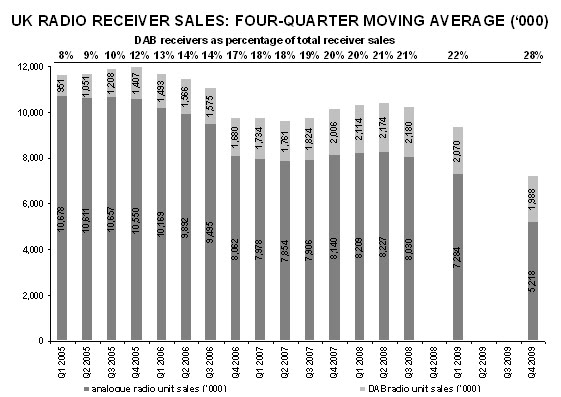
• Sales of digital radios in 2009 were under 2 million units, their lowest annual volume since 2006
• Sales of analogue radios seemed to have dropped dramatically to 5.2 million in 2009 from between 7 and 8 million during 2008
• As a proportion of the total volume of radios sold, digital radios had apparently leapt to 28% in 2009 from 21% only a year earlier.

I was puzzled. Why had sales of analogue radios fallen so dramatically by year-end 2009 (see graph below)? There seemed to be almost no substitution effect by DAB radios, whose volume sales were also down, though not by as much as analogue radios. It appeared as if many consumers had just suddenly decided to stop purchasing radios. I wrote to [*****], the company that [***********************************************] Digital Radio UK, asking why the data had suddenly ‘jumped’ in Q4 2009.

The written response from [*****] was:

“The q4 2009 drop is more about the basket of products included as areas previously included such as set top boxes and portable media players were excluded from the data at that time.”

[*****] defines a ‘portable media player’ as any device that plays music and has a 3.5mm headphone jack: MP3 players, iPods, portable cassette players, portable CD players, etc. From Q4 2009 onwards, when any of these devices are sold in the UK and also include a radio, they are no longer counted as ‘a radio’. Now, every MP3 player sold that includes a radio is simply excluded from these statistics. This is why the number of radios sold appeared to drop so significantly (by around 2m units per annum) in the latest Digital Radio UK data.

Why was this change in definition made? It is hard to understand the logic because a radio within an MP3 player is still used as a radio and has no other purpose. It is a real radio, not a fake radio, but to [*****] it is no longer a radio.

The answer seems to be that a huge number of MP3 players are sold in the UK (value £666m in 2009) but almost none of them incorporate a DAB radio. When an MP3 player does include a radio, it is inevitably an FM radio. MP3 players are manufactured and sold globally by multinational electronics manufacturers who understand that FM remains the universal standard for listening to broadcast radio, while DAB is still confined to no more than a handful of countries. Global manufacturers are reluctant to mass produce an MP3 player incorporating a DAB radio because the sales market would be limited to a few, small territories.

I checked the Argos retail website this week and found it offered 82 models of MP3/MP4 player. None incorporated DAB radio, whereas there were 16 that included an FM radio and 66 that had no radio.

It seems that the last resort for Digital Radio UK to be able to demonstrate to a sceptical public (and increasingly sceptical members of the House of Lords) that DAB radio is ‘taking off’ with consumers is to fix the figures to make it look that way. If you cannot convince the public to stop buying analogue radios, you can ‘bend’ the figures to magically make it appear that the public is buying fewer analogue radios.

Earlier this month, I documented how Digital Radio UK had similarly fixed the same dataset from [*****] to declare in its publicity that “when buying a radio, more than 75% of people choose a digital radio”. This was not at all true. The real fact was that, in December 2009 alone (December always being the peak month for DAB radio sales), 76% of people who bought a kitchen radio bought a digital kitchen radio. That was an attempt to brazenly redefine ‘a radio’ as only ‘a kitchen radio’ so as to exclude clock radios, tuners, in-car radios, boomboxes, etc.

I can only repeat what I said then. However desperate you might be to try and make DAB radio a success, how is it justifiable to deliberately mis-state data so outrageously in print? And to Parliament?

The Digital Economy Bill: let the horse-trading begin, says Shadow Minister

Ed Vaizey MP for Wantage & Didcot
Conservative Party Shadow Minister for Culture
23 March 2010 @ Imperial War Museum North

In today’s radio industry, brands have been shaped more by scarcity of analogue spectrum than necessarily by the market. Brands have been built as much on the frequencies they occupy as much as the characteristics of their content, and commercial revenues have tended to stay limited to local markets.

We very much support the move to digital switchover, both because we believe it is important obviously to upgrade the technology, but because we also think that it will encourage plurality and expand listener choice. We have got to be concerned that people will be ready before any switchover takes place and that there won’t be literally millions of analogue radios which suddenly become redundant. As you know, the government has set a provisional target date of 2015 and we are sceptical about whether that target can actually be met. That is not to say that we are sceptical about digital switchover. We simply think that 2015 might be too ambitious. But we are delighted to see that Ford Ennals is now chief executive of Digital Radio UK, after having steered digital television switchover so successfully, and we hope that all hurdles can be overcome.

We hope that the advent of new digital stations will bring significant new opportunities for independent radio production and it will also free up commercial radio spend. At the moment, as I understand it, the commercial sector spends nearly 10% of its annual revenue on analogue transmission. In the battle for ratings in the new digital world, we would hope that great programming would be at the forefront and that therefore a good proportion of the £40m annual cost of analogue broadcasting will go to independent radio production.

At the moment, the BBC holds four out of the five available national FM licences, and it has the only national digital multiplex. So the aspiration as we move over to digital is as much about making more space for plurality in radio broadcasting as it is about new technology. And if new stations are broadcast, we hope there is plenty of scope for new exciting radio production.

We are also keen obviously not to switch off FM, but to maintain FM as a spectrum particularly for local radio. As you are probably aware, there has been a lot of lobbying during the passage of the Digital Economy Bill about that. I’m pleased to say, as well, that some of the new technology that seems to be coming on-stream, with radios that can switch seamlessly between digital and FM broadcasts, will ensure that there will still be a place for ultra-local FM broadcast stations.

Obviously, many of you will also be interested in what will happen with the Digital Economy Bill as we approach the dissolution of Parliament. My understanding is that the Second Reading will happen on the 6th of April, which I think is also the date that Gordon Brown drives up the Mall to see the Queen to call for the dissolution of Parliament if he wants an election on the 6th of May […] We will have this rather surreal Second Debate in the House of Commons and then we will go straight into what is now called the ‘wash up’ where we horse-trade over the various clauses of the Digital Economy Bill to be passed by the 8th of April. But I can assure you that the deregulation of radio clauses in the Digital Economy Bill have strong cross-party support so, if anything is going to go through, it will be those clauses.

[…]

Q&A

Q: It’s interesting that you touch on digital radio as a platform going forward. Once we find the larger stations, commercial and the BBC, make the switch to digital, and they leave the FM spectrum, do you feel that the majority of listeners will move to digital radio when they vacate their homes, as most cars don’t come with a DAB receiver, so obviously the commercial sector and the BBC are going to be losing listeners because the majority of times listeners tune in to these station is in the car? Furthermore, with DAB, it’s reported and seen by some people in the media/press as being a failed format, competing with new technologies such as DRM. With these changes, do you think that, when people do make the migration to DAB, that smaller stations are going to lose out and that the money from the commercial side is going to be re-invested in programming and we’re not going to lose the quality of the content…

A: Well, I think the problem in the last few years has been a kind of half-way house, so people weren’t really sure what the future of digital radio was going to be, particularly with commercial radios stations that were having to make a double investment which was costing them a lot of money, so we supported the government in making a firm decision that we were going to move over to digital switchover. As I said in my remarks, I think that 2015 might be a bit ambitious.

Your particular point about converting cars to digital radio is, I think, the crucial point. We have got to get to a stage where new cars are fitted – as the French have now mandated, for example – with digital radios and that it gets easy to convert to digital in the car. I think that 2015 is going to be ambitious, but that does not mean that we are sceptical about switchover.

The other point about FM, as against DAB. I think that there will be… There are radios on sale now that switch seamlessly between FM and digital as if you were simply changing channels. I think that, particularly as FM will then be, broadly speaking, a spectrum used by the local radio stations, that won’t be such a problem if you’ve only got a digital radio in your car, as you tend to listen to a local radio station when you’re at home – or you can de-construct that remark. The point you make about whether DAB is the right technology or whether we should be using DAB+, to a certain extent I slightly take the view that we have gone down this road, so let’s leave it. I think the pain of trying to move to DAB+ or beyond will be too much, given how far we’ve come.

Q: I also found it quite interesting that you had the idea that there were going to be more digital-only services. In the past, we have seen digital services such as Capital Life and Core which have come and now gone again because they were not commercially profitable. Do you think that is not going to have an impact when most people make the migration to DAB? Do you think that the local full-scale FM operators are going to suffer?

A: Er, well, er, I hope that they won’t. There will be a distinction between national or big regional radio stations and local stations, and there is already a distinction between local and community which is ultra-local. As I say, we want to put in place a platform that will also enable cross-media ownership at a local level that will enable local media companies to create scale. So, what I hope is that, across the range of media. there will be opportunities for any good radio station that is likely to command a loyal audience – whether that be an ultra-local audience, a regional audience or a national audience – because, in terms of Capital Radio coming and going, I think that was frankly a symptom of that we were in a half-way house about digital. We need to drive digital, which I think is now underway.

[…]

DAB converters for portable analogue radios? It’s a “no no”

All of us would like to invent a ‘killer application’ that could captivate consumers with its usefulness, change the future direction of technology, and make millions. But there is a big difference between inventing one in our heads and turning it into a technical reality in the marketplace.

The converter/adapter that is able to magically transform a portable analogue radio into a DAB radio is one such invention. It exists in the heads of the DAB radio lobby as a means to persuade politicians that mass consumer conversion to DAB is a possibility rather than a pipedream. Unfortunately, it does not exist in reality.

When the notion of such a converter was mentioned last year, I examined the analogue portable radios scattered in almost every room of our home. The only access to their internal electronics that some of them allow is via a headphone socket – and when you insert anything into that, the loudspeaker cuts out. So how exactly could any kind of gizmo be ‘added’ to such radios to transform them into DAB?

My doubts were confirmed when Intellect, the trade organisation that represents UK radio receiver manufacturers, wrote to Parliament in February 2010 and stated: “Whilst it is technically feasible, there are currently no products on the market that can adapt an analogue radio to receive DAB signals.”

Subsequently, Laurence Harrison of Intellect presented evidence in person on this issue to the Lords’ Communications Committee: “A converter would have to include within it pretty much all the components, bar the speakers, of a standard digital radio anyway. Therefore, the cost differential for a converter will be minimal between that and just buying a new digital radio.”

The converter is a prime example of the radio industry’s current pre-occupation with technology being the answer to its problems. Last week, Steve Orchard (former group programme director of GWR, former operations director of GCap) wrote an opinion piece which proclaimed: “DAB is vital to commercial radio’s future.” What?? Sorry?? Surely, it is ‘content’ which is vital to the future of commercial radio, just as it always has been, and just as it always will be. Content = listening = advertising = revenues = profit. Whereas: DAB = platform = infrastructure = investment = risk.

The radio industry desperately needs a strategy that focuses on producing content, rather than focusing on DAB. We already have platform businesses such as Arqiva whose function is transmission infrastructure such as DAB and FM; and we already have consumer electronics companies that produce radio receiver hardware. I don’t see Arqiva or Roberts trying to produce radio shows, so why does the radio industry so desperately want to control platforms and invent hardware?

As ever, the challenge for the radio industry is to create content that is sufficiently compelling, regardless of the platform. Consumers gravitate to content, whatever platform that content is on. The history of radio has demonstrated this time and time again. For example:

• 90% of the population listen to analogue radio for around 20 hours per week (on FM and AM platforms that the radio industry has lobbied to have shut down)
• BBC Five Live and TalkSport attract 5% and 2% shares respectively of all radio listening, despite being broadcast on AM (a platform that commercial radio lobbied the regulator in the 2000s to write off for mainstream formats)
• Pirate radio with poor FM reception continues to attract significant audiences in cities (stations which the radio industry has long lobbied to be shut down, despite itself not offering consumers any comparable content)
• Atlantic 252 attracted a 4% share of all UK radio listening in 1994, despite broadcasting from Ireland on Long Wave (a platform the BBC tried to shut down in 1992)
• Ricky Gervais’ radio show remains the most downloaded podcast ever, despite never having been broadcast and only ever having been made available as an online download (a platform largely ignored by commercial radio).

Sometimes, it seems that parts of the radio industry have stumbled so far away from their core product, content, that the eventual outcome might even be (to adapt Steve Orchard’s comment): ‘DAB is a vital part of commercial radio’s death’. The sector’s profitability is already zero. This is no time for distractions that will not directly put bums on seats.

The quotes below offer more detail on recent dialogue concerning the mythical DAB adapter.
…………………………………………….

“For customers who don’t want to buy a new radio set, it will be possible to convert existing sets to digital instead. An adaptor device will come onto the market soon that will cost around £50 and, in time, conversion may cost less than a new radio set.”
Digital Radio UK
2 December 2009
……………………………………………

House of Lords
Select Committee on Communications
20 January 2010

Witnesses:
Ford Ennals, Chief Executive, Digital Radio UK
Barry Cox, Chairman, Digital Radio Working Group

Lord Gordon of Strathblane: There is, I might suggest, a vital difference. It is comparatively easy and cheap to convert a television set to digital with a set-top box that you can buy from Tesco for £20. Can you do that to an analogue radio set?

Mr Ennals: I fully expect that there will be low-cost converters available. We were talking to companies which were making these last week, and they are talking about DAB adaptors for about £20 or £25. When the DTT Freeview development started, those products were costing over £100. The market will become more competitive, prices will come down. You can replace your radio for £25 with a digital radio. There will be a burden of cost on the consumer, but it is significantly more affordable than it would have been in the past.

Lord Gordon of Strathblane: If it is as cheap to buy a new digital set as it is to buy a converter, there is a fair disposal problem involved in 50 to 100 million radio sets that are good to go to the rubbish dump.

Mr Cox: There is undoubtedly a difference with television because you can keep your old set and put the adaptor on it. I heard what Ford was saying, and it would be useful if some adaptors come on the market, but the likelihood is that many of those analogue sets will have to be disposed of.
……………………………………………

Intellect [UK trade association for the electronics industries]
Written evidence to the House of Lords Communications Committee
1 February 2010

“Converting analogue radios to digital:
Whilst it is technically feasible, there are currently no products on the market that can adapt an analogue radio to receive DAB signals. Our members would undoubtedly produce such devices should a clear market demand ensue following the passing of the Digital Economy Bill.
However, simply adapting an analogue product will not allow listeners to enjoy the full range of benefits that DAB can offer. With some entry level digital radio receivers costing as little as £25, adapter devices are likely to cost more than digital receivers at the start.
……………………………………………

House of Lords
Select Committee on Communications
24 February

Witness:
Laurence Harrison, Director, Consumer Electronics, Intellect

Lord Gordon of Strathblane: What about converters for what are known as ‘kitchen’ sets? [….]

Mr Harrison: Converters – if you like, a set-top box for an analogue radio – are technically possible. I think we need to look at just how appealing that would be for the listener. A converter would have to include within it pretty much all the components, bar the speakers, of a standard digital radio anyway. Therefore, the cost differential for a converter will be minimal between that and just buying a new digital radio.

Lord Gordon of Strathblane: So they are not going to fly off the shelves?

Mr Harrison: It will depend on just how much the individual values their analogue set. Of course, converters would also come into play if you are talking about, for example, a large expensive hi-fi system; they would work for that, and if you like the sound quality of that hi-fi then a converter may be an option, but I do think we need to be careful, purely because we know that the price differential, for example, will not be that great between a converter and a standard digital set.

Lord Gordon of Strathblane: So for big, stand-alone hi-fi sets with colossal speakers and everything else it might make sense but for the small ‘kitchen’ portable a no no?

Mr Harrison: We know that some manufacturers are looking at the possibility of introducing a converter, so it may well be that some of those do come to market. I just think for the context we need to be aware of what that converter will look like, and how appealing it may be. I think your assessment is correct.

[…]

Lord Maxton: There is a major difference; with your existing television all you need is a box.

Mr Harrison: Indeed.

Lord Maxton: A converter, basically. With radios that is not the case.

Mr Harrison: That is true.

Lord Maxton: You do not have to get rid of the televisions but you do have to get rid of the radios.

Mr Harrison: That is absolutely true. All I would say on TVs – you are absolutely right and I do not want to downplay the situation at all ……

DAB radio receiver sales: never let facts get in the way of a big number

A newsletter arrived in my in-box today from Digital Radio UK, the new organisation charged with making DAB radio a success. It told me some startling news:

“By the end of 2009, when buying a radio, more than three quarters of people chose a digital one.”

And, just in case I did not believe this fact, immediately beneath, it told me the same thing again:

“New sales figures reveal that, when buying a radio, more than 75% of people choose a digital one.”

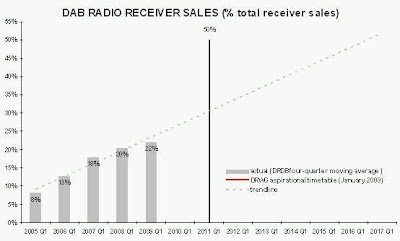
I did not believe it. All the previous data from the radio industry had shown that DAB radios are around 22% of total radio sales, as demonstrated in the graph below.

A year ago, the government’s Digital Radio Working Group had set an ‘aspirational’ target for DAB radios to be 50% of total radios sold by the beginning of 2011. As this graph clearly shows, the odds of successfully coming anywhere close to that target are zero.

Maybe something revolutionary had happened in the consumer market for the proportion of DAB radios sold to have suddenly surged from 22% in Q1 of 2009 to 75% by year-end. It was extremely puzzling.

Then I read an extraordinary letter that Ford Ennals, chief executive of Digital Radio UK, had written to the House of Lords Select Committee on Communications on 15 February 2010. It said in part:

“I thought […] that it might be useful if I wrote with the very latest radio sales data. Encouragingly, it shows that, during 2009, consumers increasingly chose digital sets over analogue ones.

I thought it clearest to present the data in a simple table, which is attached, but it may be useful if I explain a couple of the terms used. Where the data refers to ‘kitchen radios’ it means the kind of sets that you and I would call ‘a radio’ i.e. a set whose sole function is to listen to the radio.

Where it refers to ‘all radios’, these figures include those pieces of electrical equipment which happen to have a radio chip in them (e.g. a hi-fi where the main reason for purchase may be to listen to CDs or an MP3 player where listening to downloaded music is the primary function).

As you can see, by Christmas 2009, 76% of people buying ‘a radio’ chose a digital one…… [emphasis added]”

Aha! Now I think I understand. The only way in which it is possible to contrive that more than three quarters of radios sold are digital radios is to arbitrarily create a completely new definition of ‘radio’. In this brave new world, only a ‘kitchen radio’ will now be called a ‘radio’. (The truth is: 76% of people who purchased a kitchen radio during December 2009 bought a digital radio, though the proportion for the whole of 2009 was 63%.) Every other type of radio is no longer defined as a radio. This new definition of ‘radio’ would completely exclude:
     • Micro systems
     • Clock radios
     • Tuner separates
     • Handhelds
     • Boomboxes
     • In-car radios
     • Audiovisual systems
     • Home cinemas
     • Docking stations
     • Dect phones [?]
     • Mobile phones
     • LCD TVs
     • Record players

This seems like a long list of products which, if they also happen to include a radio, will no longer be defined as having a ‘radio’. How can a ‘clock radio’ not be a radio? How can a ‘tuner’ not be a radio? I know this long list to be a comprehensive definition of ‘radio’ because it was the very definition of ‘radio’ used by the Digital Radio Development Bureau, the forerunner to Digital Radio UK, in its published data. Of course, that was last year. In 2010, ‘radio’ seems now to have a whole new definition.

What can I say? However desperate you might be to try and make DAB radio a success, how is it justifiable to deliberately mis-state data so outrageously in print? And to Parliament?

Criteria and a date for digital radio switchover: where'd they go?

When will the UK government’s proposed ‘digital radio switchover’ happen? For a long time, we had always been told that the pre-requisites were:
• market criteria that had to be reached before switchover could be announced;
• a fixed, single date for switchover to happen.

So both of these must be in the Digital Economy Bill somewhere, surely? Well, it seems that everything (except the Bill itself) points to 2015 as the switchover date. But as for the criteria?

The government’s press release of 20 November 2009 announcing the Digital Economy Bill stated:
• “Digital radio: update the regulatory framework to prepare for moves to digital switchover for radio by 2015”.

The government’s accompanying Factsheet of 20 November 2009 stated:
• “At the centre of our ambition is the delivery of a Digital Radio Upgrade programme by the end of 2015.”

The government’s accompanying Impact Assessments of 20 November 2009 referred to:
• “a switchover to digital radio by 2015”
• “a switchover to digital only radio by 2015”
• “a Digital Radio Upgrade programme, which should be completed by the end of 2015”.

However, the government’s Explanatory Notes to the Digital Economy Bill said:
• nothing about criteria that have to be met;
• nothing explicitly about a switchover date.

Published on 20 November 2009, the Digital Economy Bill itself contained nothing about:
• criteria that have to be met;
• an explicit date for digital radio switchover.

What? Is this not strange? Somewhere along the way, it seems as if the agreed criteria and the switchover date just vanished into thin air. So what happened? Let’s go back and follow the timeline of how we got to where we are now.

JUNE 2008
The Interim Report of the government’s Digital Radio Working Group recommended:
• “Government should agree a set of criteria and timetable for the migration to digital.
• These criteria should include an assessment of:
      * The percentage of listening to DAB enabled devices;
      * Current and planned coverage of DAB and FM; and
• In considering the case for migration we expect the Government will also want to consider the take-up of digital radio in cars, affordability, functionality, and an environmental impact plan.”

DECEMBER 2008
The Final Report of the Digital Radio Working Group recommended:
• “Three broad criteria that must be met in order to trigger the digital migration process:
     * That at least 50% of total radio listening is to digital platforms;
     * That national multiplex coverage will be comparable to FM coverage by time of digital migration;
     * That local multiplexes will cover at least 90% of the population and, where practical, all major roads ….”
• “Government should announce a date for digital migration, ideally two years after the criteria have been met”.

JANUARY 2009
The Interim Report of the government’s Digital Britain recommended:
• “We will create a plan for digital migration of radio, which the Government intends to put in place once the following criteria have been met:
     * When 50% of radio listening is digital;
     * When national DAB coverage is comparable to FM coverage, and local DAB reaches 90% of population and all major roads.”

JUNE 2009
The Final Report of Digital Britain recommended:
• “The delivery of a Digital Radio Upgrade programme by 2015”
• “Included within the Digital Radio Upgrade timetable is our intention that the criteria should be met by the end of 2013”:
     * “When 50% of listening is to digital; and
     * When national DAB coverage is comparable to FM coverage, and local DAB reaches 90% of the population and all major roads”

This Report also included a critically important graph (see below) which, it said, “shows the projected digital share of listening under two scenarios: organic growth and with a concerted drive to digital”.

Shockingly, the historical data in this graph had been ‘doctored’ to make it look as if the faster growth path advocated by Digital Britain was easily achievable [confusingly, the key on this graph labels the lines round the wrong way]. When I queried the source of this false data, the government told me it had been supplied by another party, which I later found to be a report produced by the Digital Radio Development Bureau, but not made public.

Digital Britain’s graph sought to demonstrate that continuation of the current growth trend in digital listening would lead to the 50% criterion being achieved in early 2015, whereas the actual data (from RAJAR) in my graph shows the 50% criterion not being reached until the end of 2018 [the trend line here is automatically generated by Microsoft Excel from all available quarterly data].

Digital Britain proposed policies to accelerate DAB take-up which, it said, would ensure that the 50% criterion would be achieved by year-end 2013, a gain of a little over one year from its natural trend. However, in my graph that uses RAJAR data, the acceleration necessary is shown to be five years, not one year, which would prove an almost impossible task to achieve [I wrote about the false data in June 2009].

JUNE TO DECEMBER 2009
Between the publication of the Digital Britain final report in June 2009 and today, it has slowly dawned on some of radio’s stakeholders that the agreed criteria necessary for digital radio switchover stand zero chance of being achieved by 2013. Neither do they stand a chance of being achieved by 2014 or 2015, nor probably by 2016. It always was pie in the sky, wishful thinking, fiction rather than fact. The manipulation of key data in a significant government report only demonstrates the duplicity.

So, what to do about it now? Admit you were wrong? Admit your culpability? Best to simply pretend that the criteria and the proposed switchover date never really mattered. Botched data – ignore it. Unrealistic targets – lose them. Perhaps nobody will notice the whole, sorry deception.

In the here and now, Digital Radio UK (the new organisation responsible for implementing DAB) explains the current thinking:
• “The [Digital Economy] Bill does not set a definite date for digital radio switchover …”
• “The Government has stated that switchover will not happen until the majority of radio listening is to digital, and until anyone who can currently receive FM is able to receive digital radio” [but fails to address why these criteria are not included in the Bill].

In the here and now, RadioCentre (the commercial radio trade body) explains:
• “[Digital Economy Bill Clause 30] allows the Secretary of State to set a [digital switchover] date, but does not require one to be set, or indicate when the date might be”.
• “The objective that switchover should not occur until certain thresholds have been reached for listening … appears sensible on first reading. However, RadioCentre does not believe it is appropriate for the industry to be tied to any figures in primary legislation. This is a very inflexible mechanism against which to manage our industry going forwards”.

Figures. Numbers. Dates. Criteria. This kind of factual evidence or hard data might obstruct a future decision to force consumers to switch to DAB radio.

So to answer the original question – the criteria and the switchover date that had been agreed upon by stakeholders, over two years of deliberations, have now quietly been relegated to oblivion.

When would digital radio switchover have happened if the agreed criteria had been implemented in law? Probably never.

When will digital radio switchover happen now? Whenever those in power want it to.