DAB in cars: the straw that will break digital radio switchover's back

Speaking today at the Intellect conference in London, broadcasting Minister Ed Vaizey tried to assure us that digital radio switchover was still “on course” to happen in the year twenty something or other:

“On cars, the move to include digital radio as standard in new vehicles has continued over the last year. Around 14% of new vehicles have DAB as standard, up from 4% a year ago.”

Within hours, this news was misinterpreted by one online news source as Vaizey having said:

Forty per cent of cars have DAB [Digital Audio Broadcasting] radios as standard now, up from just four per cent a year ago.”

From ‘14% of new cars’ to ‘40% of all cars’ in a stroke of a keyboard! No wonder the article went on to assert that “the key driver to the take-up of the [DAB] technology looks like it will come from the car industry as manufacturers start to fit digital radios as standard.”

How wrong can this statement be? Fewer than 1% of vehicles on the road currently have a DAB radio. That proportion is not going to increase quickly, even by 2013 or 2015, as the government wants it to. Rather than being “the key driver” for DAB radio take-up, cars will become THE major sticking point for digital radio switchover.
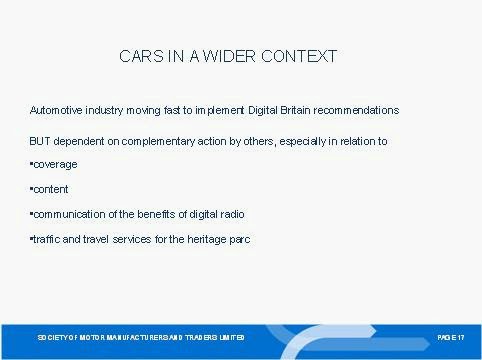
The UK car industry appears to be nearing the end of its tether over the confused information that has been fed to consumers in recent years about the so-called DAB ‘switchover’ and FM ‘switch-off’ date(s). This frustration boiled over at the last government Digital Radio Stakeholders Group meeting on 17 May 2011, when Bob Davis, who heads the Digital Radio Committee of the Society of Motor Manufacturers & Traders [SMMT], stood up to offer what he referred to as a “naughty” comment:

“Jane [Humphreys, Department for Culture, Media & Sport] said earlier ‘around 2015’ for a digital radio switchover. The automotive industry has made it very, very clear, since the process began, that it needs certainty. We’ve got 2013 [as the date for a government decision on switchover] and we think we’re working towards a 2015 switchover date. With respect, Jane, I can already see tomorrow’s headlines that DCMS says ‘digital switchover delayed from 2015’ because you used the phrase ‘around 2015’. That implies a delay. It may be what potentially happens in the market – it may be 2016, it might be a bit later than that – but, for the moment, from an automotive industry perspective, every time there’s a suggestion that 2015 has stopped being the aspirational date – or might stop being an aspirational date – all that happens is [that] the automotive industry, or parts of it, is given another opportunity to say ‘it ain’t going to happen, forget all about it’ and we will end up with the bigger problem of converting vehicles already in the parc to digital, because people will just say ‘if DCMS can’t give us certainty’ – and I accept that, at the moment, you can’t – but if DCMS are saying ‘around 2015’ instead of ‘in 2015’, it reduces the opportunity for SMMT to keep telling its members there’s a deadline, and it’s ‘this’. So please could we have a little bit of caution, from an automotive industry perspective, in (particularly) government references to switchover dates.”

Jane Humpreys: “Thank you, Bob, though I think I’m right in saying that the Minister has never said ‘it will be in 2015’. He too has said that it will be in terms of … that is the target to which we are working, but what is the principal objective is that we have to meet the criteria that have been set out and we have a piece of legislation – unless I’m much mistaken – that says there will be a minimum of two years’ notice. So….”

John Mottram, DCMS: “That’s right. I’m aware of three Daily Mail articles that suggest it’s seven years, two years, five years’ delay depending upon the date, so I think in terms of coverage and it being delayed, I think that delay is already out there. But to Jane’s point, I think the Action Plan and Ed [Vaizey]’s words make it clear that it’s a consumer-led approach. The industry target date is 2015 – we’ve never shifted from that – but that decision is based on the criteria….”

At that point, the meeting was abruptly closed. What had been scheduled to be merely another ‘tick the government box’ faux consultation meeting had suddenly started to spin out of control. The natives had started to get restless. It was time to turn them out onto the street again.
DAB radio switchover: the view from the government bunker

The government’s second stakeholder consultation on DAB radio switchover happened this afternoon. It was held in what felt like an underground government bunker in Victoria. No windows, long corridors, and lots of seemingly identical numbered rooms hidden by massive doors that had no viewing windows. When I tried to go up a staircase to ground level, a man appeared from nowhere and told me not to.

Even if the bomb had dropped, down there, you might not have known it. The cityscape outside could have transformed into a wasteland but, down there, you can be certain that our civil servants would continue planning digital radio switchover regardless, even if the precise date had to be postponed until the contamination had receded. I imagine that the government staff working there hardly need to go out, even at lunchtime, because a little lady with a trolley probably comes around with salmon sandwiches.

In this cosseted environment, it is easier to understand how you might spend your days (or months or years) of servitude, devising schemes that have so little relevance to the real world above your bunker office. Perhaps this is why the afternoon was filled with PowerPoint presentations that all looked great, slides that had lots of action words, and monologues from grey men that were filled with the current jargon. It was a perfectly unreal world.

What the afternoon lacked was realism. Occasionally I had to pinch myself to make sure that this was not a Lemsip-induced slumber. It wasn’t. However, I did witness the Civil Service suggest that asking consumers their opinion about DAB radio switchover would be a good idea, as if it was a novel thought that had just come to them. Not withstanding that the government has been pursuing the notion of the DAB platform since the 1980s but, in all those decades, somehow omitted the ‘consumer’ (or ‘listener’) from its plans.

The following quotes came from our civil servants this very afternoon. I wrote them down. Reading them now, these lines could have been extracted from the script of a lost episode of ‘Yes Minister’ in which the cast cleverly parody government plans for digital radio switchover. Sadly, they did not. This is what stakeholders were told today (amongst many other things):

“We genuinely have seen more progress [on digital radio switchover] in the last eighteen months than we have in the last six or seven years I’ve worked on this issue. But, as far as the consumer is concerned, we’ve never certainly in any way advocated or used 2015 [switchover date] as a ‘stick.’ It’s always been the industry target. And, certainly, when this government came in, it was adamant and clear that the consumer would make the case for switchover by purchasing habits, by the percentage of listening [on digital platforms], the way it absorbs and consumes radio. Now, will I, at this point, say that there has been a cross-pollination of those two things? Has the 2015 [date], which was an industry date, started to creep into the public consensus and been used by the media as a scare tactic? Yes, of course it has. And do we, as an industry, need to look at that? Yes, I think we do. I would say that I don’t think anyone – I think very few people – in this room would welcome the government standing up tomorrow and saying that the [switchover] date is the 31st December 2015. And I don’t think we have any answers to the questions that we need to have the answers to before any such decision can be made, and whether the consumer genuinely believes that this is something they want to do.”

“I don’t think we know what listeners want. I think part of this [Digital Radio] Action Plan process is absolutely understanding the value people put on various parameters of radio – what they want, how they want to consume it. I think that part of understanding this decision is understanding the listener better. And I think, whilst we all have our own views on that, I don’t think there’s enough evidence based [data] for us to make those assumptions about what listeners want.”

“I don’t think the government has never ever said ‘digital radio switchover will happen in 2015’ but we think we need to go away and look at the messaging around the cross-pollination. The one thing I would say is: 2013 and 2015 is used by both sides of people in the debate, those who like to frighten people into the fear of losing their analogue services, and those who like to sell digital radios. For all of us who believe that certainty and clarity and the consumer is important, I think we all need to look at how we use the threat of 2013 and 2015 and have some consistency ourselves about how we talk to the consumer about it.”

Threat? Are radio listeners so malleable that they must be viewed by government like cattle to be herded to slaughter? Maybe I imagined mistakenly that government was FOR the people. Anyway, I suppose we should be grateful at all that the ‘consumer’ has suddenly been pushed centre stage in the long running DAB drama, even it is so late in the show [see 2009 blog and 2010 blog where I predict it would be ideal for bureaucrats to eventually blame DAB’s failure on the consumer rather than themselves].

Is there any difference between the government forcing the population to buy a DAB radio to listen to The Archers, and Sky persuading them to buy Sky Atlantic to watch their favourite HBO shows that used to be free? Is the government’s DAB switchover drive really a policy for public regulation, or simply capitalist radio (© LBC poster campaign 1989)?

This afternoon, while DAB was being discussed in the government bunker, could anyone have actually achieved satisfactory DAB radio reception down there? I think not. Are those government people listening to DAB in their cubicles? They can design as many PowerPoint presentations as they want but, at the end of the day, if DAB radio don’t work properly now, then it don’t work for the consumer.

Which? advises: two of "seven Christmas gifts to avoid" are DAB radios

A reader comment appended to an online newspaper story this week about the decision of some commercial radio station owners to launch an anti-DAB radio marketing campaign said jokingly:

“Now all that’s needed before Christmas is for ‘Which’ to warn consumers of moral hazard in purchasing DAB radios.”

In fact, last month, ‘Which?’ [the UK consumer organisation] published its list of ‘Seven Christmas gifts to avoid’, two of which were DAB radio receivers. According to Which?:

“Argos Value Range CDAB8R digital radio and Roberts CRD-37 digital radio. Sound on both of these DAB radios is disappointingly poor.”

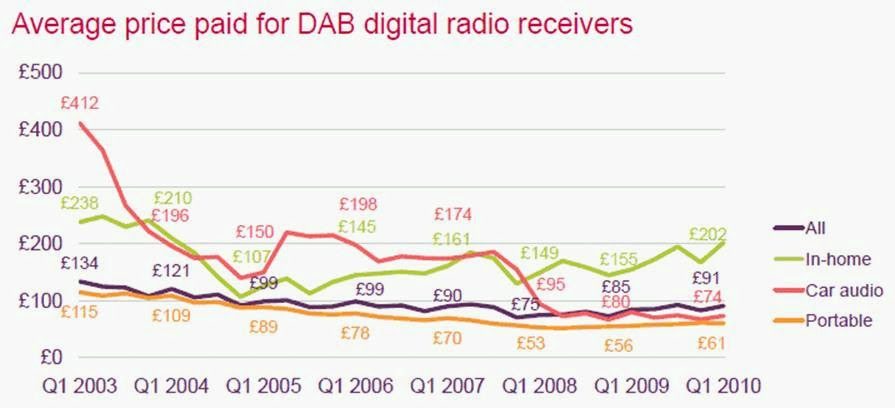
One of the enduring problems that has contributed to the slow take-up of DAB radio in the UK has been the consistently high retail prices of DAB radio receivers compared to analogue models. The radio industry has promised repeatedly over many years that the retail price of DAB radios would fall. It has, but nowhere near as much as hoped.


In order for unit prices to fall further, DAB radio receivers would have to be manufactured in production runs of millions in factories in China. Because the notion of DAB radio has failed to excite consumers during the last decade, not only in the UK but across Europe, those high production runs have not been achieved, so that the unit prices remain relatively high (average price paid in Q1 2010 was £91).

The problem with trying to produce low-price DAB radio receivers is that something inside them has to be sacrificed to keep costs down. Whereas the UK’s FM transmission system is sufficiently robust to permit usable reception of radio stations on even the cheapest hardware, the DAB transmission system is still not robust enough for usable reception in many circumstances. Additionally, with analogue radio, poor reception equals background noise and interference. Whereas, with DAB radio, poor reception equals no audio whatsoever.

This issue has long been known by the UK radio industry, but it proves a lot easier to ignore it than to fix it. So, the £55m marketing campaigns to persuade consumers to purchase DAB radios continue, despite the radio industry being aware that many consumers are likely to have unsatisfactory experiences with their newly purchased DAB radios.

At the Digital Radio Stakeholders Group meeting on 1 November 2010, UK manufacturer Roberts Radio admitted to pulling the plug on several receiver projects, including the industry’s long promised ‘£25 DAB radio’, because they could not meet Roberts’ minimum quality standards. Leslie Burrage, chief executive of Roberts Radio, told the meeting that there had been a 35 to 40% consumer return rate for its in-car DAB radio adapters.

Roberts Radio, unlike competitor Pure Digital, has been outspoken about its concerns that DAB radio is being marketed wrongly to UK consumers. Owen Watters, sales/marketing director of Roberts Radio, told the Digital Radio Stakeholders Group that he felt such campaigns should be advocating the merits of the DAB radio experience, rather than threatening consumers with the prospect of digital radio ‘switchover’.

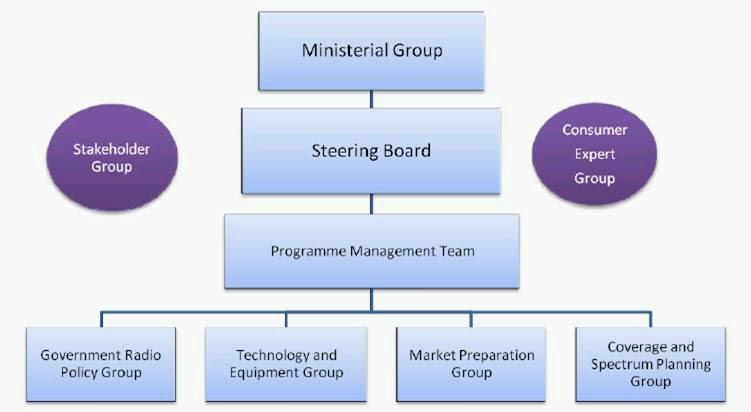
The government’s Consumer Expert Group [CEG] raised these issues in its critical report on DAB for the government in September 2010. The government published its response to those criticisms on 30 November 2010:

Consumer Expert Group: “A clear and balanced public information campaign needs to be implemented through a trusted body, independent of the industry.”
Government: “If a decision is made to implement a digital radio switchover, we agree that a clear and balanced consumer information campaign will be important. A strategic plan for such a campaign is a central component of the Digital Radio Action Plan and we have invited representatives of the CEG to play a key role in advising on its development, for example through representation on the Market Preparation Group.”

Consumer Expert Group: “Emphasis should not be placed on driving down costs unless the sound quality and functionality of cheaper DAB sets are at least equal to analogue.”
Government: “There is clearly a balance to be struck between reducing the cost burden on the consumer of a digital radio switchover, and ensuring devices are of a good standard and offer additional benefits to the listener. We want to see a competitive market for receivers which offers consumers choice on innovation and price.”

These government responses seem to qualify as ‘non-answers’ of exactly the type we have become all too used to when difficult, but important, issues have been raised about DAB radio implementation in the UK. The prevailing philosophy justifying DAB seems to be: ‘ask me no questions, I tell you no lies.’

Roll up! Roll up! Enjoy the radio industry pantomime: 'DAB Radio'

The Ministerial Group for the government’s Digital Radio Action Plan will meet tomorrow. That meeting has all the hallmarks of a radio industry seasonal pantomime, with participants dressed up in their gladrags to play the appropriate parts. A select audience has been hand picked, though the ending of the story has still to be written.

Pantomime often brings out a sense of déjà vu, of having seen the same thing during previous Christmases. This winter’s DAB radio marketing campaign has that feeling. The 2010 slogan is:

“There’s a digital radio for everyone this Christmas”

While the UK radio industry’s Christmas campaign for 2009 had been:

“Struggling to think of the perfect gift for Christmas? There’s a digital radio for everyone …”

Pantomime often stages a sleight of hand, where you are not quite sure if what you saw was real or just some cheap trick. This winter’s DAB radio marketing campaign has that feeling. On 18 November 2010, the press story was:

“The commercial radio campaign [for DAB], which breaks on November 22, covers Global [Radio], Bauer [Radio], Guardian Media Group [Radio], Absolute [Radio], UTV [Radio] and many local commercial stations.”

But, within days, that story had changed so that the campaign:

“… will run across major commercial groups” and “commercial radio stations including Absolute, UTV, Orion.”

What happened to Global Radio, Bauer Radio and Guardian Media Group Radio? Well, every pantomime has its jesters who do their best to spoil the rest of the cast’s fun. This winter’s DAB radio marketing campaign has that feeling. Two days after the Christmas DAB campaign had started, The Telegraph broke the story that:

“Leading commercial radio groups [Global Radio, Guardian Media Group] have refused to promote DAB radio …”

Every pantomime has its bully, who picks on people mercilessly and prevents them from going to the ball. This winter’s DAB shenanigans have that feeling. Commercial radio trade body RadioCentre offered its story as to why its members, Global Radio and Guardian Media Group, had pulled out of the marketing campaign:

“Commercial radio operators are currently in discussions with government about the funding of local DAB coverage. Until those discussions are resolved, we understand that some stations felt it would be inappropriate to run the digital radio Christmas campaign.”

Er, isn’t that blackmail rather than negotiation? Is it not transparent that, if you really cared about making DAB radio a success, you would think twice about cutting off your nose to spite your face by deliberately NOT promoting the very DAB platform that you have been attempting to palm off on the public for the last decade? In essence, you are trying to convince consumers that you care so much about your backward 10-year old offspring that you intend to starve it to death. In pantomime, such a tragedy might give the audience a laugh. In reality, it would be time for Social Services to intervene. It cannot be good PR for the commercial radio industry to be so convincingly playing the part of The Wicked Witch of The West.

RadioCentre’s lack of parenting skills has been evident in recent weeks:
· Its children had refused to attend the government’s Digital Radio Stakeholders Group meeting on 1 November [see earlier blog]
· Last Friday, its children refused to participate in a Westminster conference on ‘the future of UK digital radio’ organised for 7 December, resulting in the event’s postponement until April 2011.

And here is what the school notes said to explain these absences:
· “Following the announcement of the [BBC Licence Fee] settlement, RadioCentre has been in discussions with Government about the funding of local DAB coverage. As these discussions are ongoing, RadioCentre members felt it would be inappropriate to attend the Digital Radio Stakeholder meeting.” [Campaign]
· “Sensitivity of current negotiations on the future of digital radio” for the conference pull-out.

The evident paradox in this radio pantomime is that:
· The radio industry is spending £55m between now and 2015 to try and convince the public that DAB radio is the best thing since the cat’s whisker [see earlier blog]
· The radio industry big boys will not stand up in front of other stakeholders in the media sector, or in front of a conference, and explain what, why or how they are pursuing (or not really pursuing at all) the government’s DAB dreams
· Commercial radio has been demanding for several years that the BBC pays for fixing the deficiencies in commercial radio’s own DAB local transmission system. (Yes, this is the same BBC that RadioCentre has lambasted for years about its interference in commercial activities. Yes, these are the same commercial radio big boys who invested heavily in DAB in the 1990s in the hope of making profits for their shareholders.)

Pantomime is pure theatre, and tomorrow’s meeting will doubtless provide much entertainment for all involved. The only unresolved issue is how it will all end. Will the government Minister play the part of Scrooge, insisting that the commercial radio big boys should work longer hours for their living and must pay for improvements to their DAB system themselves? Or will the government play the wicked stepmother, compromising the BBC’s independence by forcing it to pay for an expensive sticky plaster to fix a commercial media sector DAB problem that has been all of its own making?

My feeling is that, in these austere times, it would be opening up another big black hole for public money to now finance such massive deficiency issues with DAB radio that could and should have been anticipated and fixed a decade ago. It is simply too expensive to commit unknown quantities of cash to transform the ugly DAB frog into a handsome prince who might never be fit enough to rival FM radio. Anyway, the BBC has already made a public commitment to not spend any more Licence Fee money on yet another ‘makeover’ show. In which case, our Cinderella DAB may not be going to the ball.

Or is all of the above just a pantomine within a farce? Is all this play-acting merely intended to allow commercial radio to walk away from DAB altogether, pointing the finger of blame elsewhere (and smug that the Classic FM automatic licence renewal is nearly almost within its grasp)?

Trick or treat? £55m to be spent scaring UK consumers into buying DAB radios

The Daily Mail is the perfect medium to scare middle Britain into reaching for its credit card. So it was no surprise to read in Saturday’s edition that:

“Four out of five car radios are expected to become obsolete in less than five years, experts warn.”

Why? Well, according to the Daily Mail, because “the traditional FM and medium-wave signal is due to be switched off in 2015.” To back up this assertion, the Mail quoted Car magazine associate editor Tim Pollard:

“In four years’ time, 80 per cent of car stereos won’t work and many sat-navs will be unable to receive traffic data. If you’re buying a new car, you must tick the option specifying DAB now.”

Wrong. Wrong. Wrong. As the majority of the 83 Daily Mail readers who commented online about this article pointed out, the facts are:
· FM and AM radio are not going to be switched off
· 2015 has not been agreed as a date by anybody for anything
· FM and AM radios will not become “obsolete.”

So why are these untruths being distributed by Car magazine and the Daily Mail? Because they seem happy to regurgitate propaganda produced by commercial companies who, as a last resort, are reduced to scaring the public into buying DAB radios. UK car audio fitters, UK car radio manufacturers and UK audio retailers would all benefit financially from the public suddenly buying DAB radios en masse. Persuasion has failed as a tactic to grow DAB radio take-up over the last decade … so the strategy now is to scare them into putting their hands in their pockets.
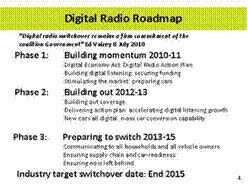
This strategy is all part of a DAB radio ‘roadmap’ developed by lobby group Digital Radio UK. Its ‘Phase 1’ activities for 2010/1 include “stimulating the market: preparing cars” or, in plain English, forcing DAB upon car owners through articles like the Daily Mail’s. Digital Radio UK revels in disinformation, consistently referring to ‘digital radio’ in its recent slide presentation to the Digital Radio Stakeholders Group, when its sole imperative is to push DAB radios.
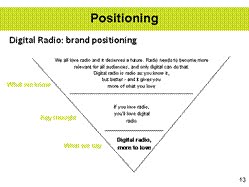
This Digital Radio UK presentation is full of stuff that reads like it was written on the back of an envelope in the pub one lunchtime. The industry has had almost two decades to come up with a powerful ‘brand positioning’ for DAB, yet the best that Digital Radio UK could create is:

· “WHAT WE KNOW. We all love radio and it deserves a future. Radio needs to become more relevant for all audiences, and only digital can do that. Digital radio is radio as you know it, but better – and it gives you more of what you love
· KEY THOUGHT. If you love radio, you’ll love digital radio
· WHAT WE SAY. Digital radio, more to love”

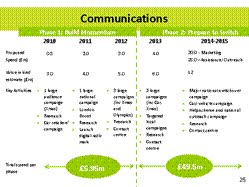
Expect to see these, er, important characteristics of DAB radio espoused in a £0.5m pre-Christmas marketing campaign that will tell consumers: “There’s a digital radio for everyone this Christmas.” Cynics will respond that this is because warehouses are brimming over with crates of unsold DAB radios. 2010 must have been a disastrous year for DAB receiver sales because the industry has kept the figures a closely guarded secret. Pure Digital, which accounts for the lion’s share of DAB receiver sales, said last week that its “revenues are now expected to show a decline compared with the first half of the previous financial year.” In 2009, total UK unit sales of DAB radios had already fallen year-on-year [see my earlier blog].
Between now and 2015, Digital Radio UK plans to spend £55m on campaigns to try and convince consumers once more that DAB radio is a ‘must have.’ At a time when budgets are being slashed in both commercial radio and BBC radio (which fund Digital Radio UK), you might think that somebody somewhere might ask if it is worth throwing more good money after bad. And what is the stated objective of all this effort? According to the final slide of the Digital Radio UK presentation:

“Our ‘destination’ is a healthier radio sector – and that’s good for everyone.”

A healthier radio sector? You must mean a more impoverished UK radio industry, it having already thrown £1bn into the DAB black hole. You must mean digital radio stations, none of which generate a profit because, in aggregate, they attract only 5% of radio listening. You must mean consumers who are being lied to that their FM/AM radios will no longer work in 2015. You must mean frustrated car owners (according to Roberts Radio, a 35-40% customer return rate for in-car DAB radio adapters).

How are these outcomes good for anyone other than the lobbyists and radio receiver manufacturers whose shirts will be saved if, and only if, the public complies by rushing out to buy lots of DAB radios?

[Should you remain unconvinced to buy a DAB radio in December, you can look forward to a January marketing campaign that will proclaim: “If you didn’t get a digital radio for Christmas, now’s the time.” This must be my favourite radio sales pitch of 2010.]