DAB radio in cars by 2013? – "extremely challenging" say car makers

The UK association of car makers, the Society of Motor Manufacturers and Traders [SMMT], has cautiously welcomed the Digital Britain report but has expressed “reservations about the ambitious timetable” to ensure that DAB radios are available in all new cars by 2013. It has also expressed concern about the 32 million vehicles already on the road, of which it says “only a small percentage” already have DAB radios fitted, noting that the timetable to fit them with “aftermarket devices” is “extremely challenging”.

SMMT has emphasised that the government’s ambition to accelerate the take-up of DAB radio will be “contingent on all national and commercial broadcasters investing in content”. Its Chief Executive Paul Everitt said: “The long-term challenge will be for the broadcasters to invest in content and coverage to create demand for these [DAB radio] products to be provided as standard”. The commercial radio industry has yet to make explicit statements, in the wake of the Digital Britain report, as to how it plans to enhance its exclusive digital radio content to accelerate consumer interest in the platform, or how it plans to finance the build-out of necessary DAB infrastructure upgrades to improve UK coverage.

The Digital Britain report had set out a five-point plan to encourage take-up of DAB radio receivers in cars:
· to work with car manufacturers so that vehicles sold with a DAB radio are available by the end of 2013
· to support a common logo for DAB car radios
· to encourage the development of portable analogue-to-digital radio converters
· to promote the introduction of more sophisticated traffic information within DAB broadcasts
· to work with European partners to develop a common European approach to DAB radio in cars

The last of these points has already received a setback, following the decision last week of commercial radio in Germany and Switzerland not to commit investment to the development of DAB as a replacement platform for their existing FM/AM services. An announcement from Austria is anticipated soon.

Asked about the DAB situation with cars, Tony Moretta, Chief Executive of the Digital Radio Development Bureau [DRDB], the agency charged with marketing DAB in the UK, had said on BBC Radio 4’s ‘You & Yours’ show last week:

“One of the things that has held back the car industry slightly with DAB in the UK is that the UK has been ahead of the rest of the world in going to digital radio. Now if you’re a mainstream car manufacturer, you want to be able to manufacture a car with a radio that will work all around Europe. It’s only been relatively recently that you’ve seen France and Germany and other countries commit fully to digital radio. And so the car manufacturers now have a common standard they can build a radio into their car and it can work across the whole of Europe. So you’re starting to see a big change now. Most car manufacturers now offer DAB as standard in a car or as a factory-fitted option starting for as little as £55. So that’s for new cars, and we saw the other day Ford and Vauxhall announce their support for Digital Britain’s recommendations. What we are going to have to do is look at adapting those cars that haven’t been changed by that point.”

The DRDB has cited the more enthusiastic Ford and Vauxhall responses to Lord Carter’s Digital Britain report, but has not yet mentioned the considerably more “cautious” SMMT response. It should be noted that Ford has been a long time minority shareholder in the MXR regional DAB multiplexes, and thus would benefit financially from improved uptake of the DAB platform in the UK, whether in-car or otherwise.

In-car DAB radios are still a rarity in the UK:
· Out of 2.4m new vehicles registered in the UK in 2007, only 20,000 buyers chose to install a DAB radio
· Out of 34m cars on the road in the UK in 2007, it is estimated that between 170,000 to 200,000 had DAB radios fitted.

Warning! Digital radio objectives may appear closer than they are in reality

By coincidence, the Interim Report of Lord Carter’s Digital Britain team was released on the same day as the latest quarterly RAJAR radio ratings data. The former focused optimistically on the inevitability of the UK replacing its existing analogue radio system with the DAB platform. The Digital Britain report stated:
We are making a clear statement of Government and policy commitment to enabling DAB to be a primary distribution network for radio” and “we will create a plan for digital migration of radio…….”

This coincidence of timing between Lord Carter and RAJAR offered a perfect PR opportunity for the radio industry to emphasise just how successful its drive towards digital migration has been to date. But where exactly were the stories of dazzling digital radio success?

The RAJAR press release noted that “digital listening hours [are] up 10% year on year” and “DAB ownership [is] up 35% year on year”. The brief RadioCentre press release avoided mentioning digital radio altogether. The BBC press release only mentioned digital radio in the context of its digital-only stations, but nothing specifically about the DAB platform. The Digital Radio Development Bureau [DRDB] press release was headed “Digital listening and hours up” and noted that “radio listening via a digital platform has increased year on year while remaining stable quarter on quarter”. The Bauer Radio press release avoided all mention of the DAB platform. So, not much evidence today of digital radio’s success.

What about the DRDB’s statement that digital platform usage is “stable quarter on quarter”? Only two months ago, DRDB announced the launch of a joint BBC and commercial radio Christmas marketing campaign “aimed at driving sales of DAB radios this season”. Although DAB radio hardware sales in the final quarter of the year had subsequently proven disappointing, might not the campaign have also encouraged some consumers to use the DAB platform more, if they already owned the DAB hardware?

Apparently not. Whilst it is true that the latest RAJAR data show increases in listener usage of digital platforms year-on-year, that growth is nowhere near fast enough to make DAB “a primary distribution network for radio” anytime soon, as Lord Carter has advocated. The Digital Britain report has simply decided to endorse wholesale the earlier proposals contained in the Digital Radio Working Group’s Final Report, as it stated:
We will create a plan for digital migration of radio, which the Government intends to put in place once….. 50% of radio listening is digital”.

Furthermore, the Report pledged the Government to “work with industry to satisfy the migration criteria by 2015 and, where possible, identify initiatives which could bring forward the migration timetable”.


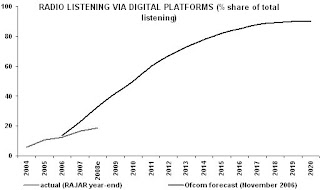
These are bold words. The RAJAR data shows digital platforms’ share of listening was 18.3% in Q4 2008, down from 18.7% the previous quarter, but up from 16.6% year-on-year. If this last year’s rate of growth is projected and compounded into the future, the 50% criterion would not be attained until 2019. To achieve the desired outcome by 2015, let alone before 2015, would necessitate a remarkable change in radio listening habits, the likes of which have not been witnessed to date.

DAB is presently, by far and away, the most significant platform for digital radio listening (the others are digital TV, the internet and ‘digital’ mobile phone). As a result, Lord Carter’s anticipated increase in digital radio listening is heavily dependent upon consumer purchase of DAB radio receivers, rather than simply a switch from one available technology to another. However, the disappointing sales of DAB hardware last quarter point to sales growth being unlikely to move into positive territory during 2009.
DAB receiver sales in 2008 did not meet the forecast made by the DRDB in 2007, let alone the more optimistic forecasts of previous years. The DRDB did not publish a sales forecast in 2008, but there is little doubt that the growth trend is beginning to look more linear than exponential. DAB receiver uptake is presently the main pre-requisite for growth in digital radio usage and one that is looking increasingly uncertain.

The other essential factor is consumer usage, not just ownership, of DAB radios. If owners continue to listen on their other analogue radios (the average household has six radios) rather than via DAB, it will still take a long time to reach the 50% threshold. It surely must be the exclusive content available on the DAB platform that will promote its usage (though other factors such as DAB’s ease of use and signal strength will play a part). However, 2008 saw a significant reduction in available DAB content, precipitated by GCap Media/Global Radio’s decision to withdraw almost entirely from the DAB content market.

Somewhat surprisingly, given this reduction in available content, the DAB platform’s share of commercial radio listening showed a significant increase last quarter (to 9.9% from 9.2% the previous quarter) but the aggregate usage of digital platforms has stayed remarkably flat during 2008 at around 19%. Put simply, we are not seeing much, if any, growth in digital platform usage for commercial radio. (NB: much of the apparent growth in the graphs above and below derives from re-distribution of earlier ‘unspecified’ respondent data in recent quarters.)
If commercial radio’s success with digital platforms seems ‘stuck’, then the BBC could be in an even worse position. In the last quarter, usage of both the DAB and internet platforms declined, leading to old fashioned analogue radio having accounted for a greater proportion of listening than in the previous quarter (up from 68.8% to 69.6%). This is particularly alarming, given the BBC’s much more extensive cross-promotion of its digital platforms across all media, and given the integration of radio into the BBC iPlayer in 2008. It is true that one quarter’s data alone might only prove to be a statistical aberration, but it is worrying news to arrive on the very day that Lord Carter chose to pin his colours to the ‘radio must be DAB’ mast.
Digital-only stations are not proving to be as attractive to listeners as they need to be in order to drive up usage of digital platforms quickly towards the desired 50% criterion. Year-on-year, hours listened to national digital-only stations are down 7%, yet DAB receiver ownership increased by 35% over the same period, according to RAJAR. In aggregate, 16 national digital-only stations accounted for 33 million hours listening per week last quarter, a drop in the ocean compared to radio’s total 1 billion hours listened per week.

So, the reason it might have been so quiet today on the digital radio PR front is that there really was not much good news from RAJAR to be shouting about, from either the BBC or commercial radio perspective. And the plan laid out in the Digital Britain document, which might look great in theory, still depends upon:

  • increased consumer expenditure on DAB radio hardware
  • increased investment in DAB content
  • increased investment in DAB transmission infrastructure

and thus does not appear to be a plan at all steeped in reality, in a time when discretionary expenditure (personal and corporate) is less forthcoming than ever.

The priority for the radio industry in 2009 must be survival, pure and simple. For commercial radio, it is survival in the worsening struggle against the twin evils of falling listening and declining revenues. For the BBC, it is the struggle to ensure that the commercial radio sector survives. Without a successful commercial radio sector, the BBC’s own radio services could be under threat.

Let us hope that the Final Report for Digital Britain incorporates a greater dose of realism and pragmatism, or unfolding events might easily catch up with it even before its publication.

DAB radio receiver sales suffer negative growth

DAB radio receiver unit sales fell by 10% year-on-year in the final quarter of 2008 in the UK, jeopardising the digital platform’s future as a mass market replacement for analogue radio. This is the first quarter to have recorded negative year-on-year growth since DAB sales records began six years ago. It marks a significant setback for DAB stakeholders who had invested in a six-week marketing campaign during the run-up to Christmas which promoted the DAB platform heavily on BBC and commercial radio.

The Digital Radio Development Bureau, the trade body charged with promoting the DAB platform, issued a press release today stating that the “one ray of sunshine in a gloomy Christmas season for retailers was DAB digital radio”. Its statement failed to mention the negative growth experienced in what is traditionally the most critical quarter of the year for DAB radio sales. Retail data collected by GfK for the DRDB clearly show the declining growth rate of DAB radio sales having started in the second quarter of 2008, a trend that is likely to have been further exacerbated by the ‘credit crunch’.

However, this disastrous sales performance has not prevented those UK companies who are pushing the DAB platform from continuing to talk up the success of their technology. Imagination Technologies, the parent company of the Pure Digital brand of DAB radio receivers, today announcedrecord export growth for 2008” and that it “had more than tripled overseas sales in the year ending 31 December 2008”. Hossein Yassaie, Chief Executive of Imagination Technologies, said: “Our strong overseas growth is further evidence that DAB digital radio is gaining traction worldwide, and that the transition to digital radio is inevitable.”

However, overseas markets account for only 15% of Pure Digital sales (half-year to end October 2008), so why did Imagination Technologies feel it worthwhile to issue a press release for a relatively insignificant revenue stream? It is probably because Imagination has to convince Lord Carter that the government should back DAB radio technology as part of his recommendations within the forthcoming Digital Britain report. Imagination Technologies has bet the farm on DAB becoming a successful, global technology. If the UK government does not decide to force radio listeners to migrate to DAB technology, Imagination could lose its shirt.

Imagination Technology’s interim results, published six weeks ago, admitted that revenues from its Pure Digital DAB radio receivers were up only 2% year-on-year, a result it attributed to “the downturn” in the UK market, which still accounts for 85% of its global sales. Chief Executive Hossein Yassaie said there had been a “UK slow-down” of DAB radio receiver sales and noted that “the introduction of lower price radios and the onset of the recession meant that the increase of the UK DAB market was less than 5%”. Pure Digital Marketing Director Colin Crawford said this week: “Our [DAB] sales at Christmas were good, though a little bit down on last year.”

Disappointing sales figures seem only to have encouraged the DAB protagonists to push the boundaries of their government lobbying beyond the limits of truthfulness. In its latest annual report, Imagination Technologies claimed that “DAB has reinvigorated the now rapidly growing UK radio market and effectively replaced analogue radio”. The latter statement is untrue. According to industry data, only 21% of radio receivers sold in the UK during the last twelve months were DAB, the remaining 79% being old fashioned analogue. The overwhelming majority of radios in use in the UK remain analogue, and DAB is nowhere near having “effectively replaced” them.Another corporate victim of over-enthusiastic government lobbying for DAB is Frontier Silicon, whose Chief Executive Anthony Sethill was quoted in a company press release issued in December 2008 as saying: “Digital radio is here to stay, with DAB sets outselling analogue models by six to one”. Once again, the industry data demonstrates this statement to be a blatant untruth, and simply part of a desperate campaign by a clutch of inter-connected companies to convince the government that DAB technology is already a ‘success’ in the UK.

Frontier Silicon is a privately owned UK company which describes itself as “the world’s leading supplier of innovative semiconductor, module and software solutions for digital radio and connected audio systems”. Its electronic modules are in 80% of all DAB radios, making it “the number one supplier to the DAB/DAB+ market”. In 2003, Imagination Technologies took a 17% equity stake and £1.25m of loan stock in Frontier Silicon. Imagination has an 80% share of the worldwide market for the intellectual property on DAB chips, which are then incorporated into Frontier Silicon’s modules. However, in 2008, Imagination’s stake in Frontier Silicon had to be written down from £7 million to £3.6 million, likely a result of slowing DAB take-up.

Another of Frontier Silicon’s ten investors is Digital One, the owner of the UK’s only national commercial radio DAB multiplex. Digital One is controlled by Global Radio, the UK’s largest commercial radio group, owner of one national station, dozens of local stations and with stakes in the majority of local DAB multiplexes. For Imagination Technologies, Frontier Silicon, Digital One and Global Radio, a decision by the UK government to implement a forced consumer migration to DAB radio would have a hugely beneficial impact on their financial performances. For Imagination, which reported its first profitable year in 2007/8 (£1.88 million pre-tax profits), it might even turn the company’s forecast 2010/11 pre-tax profit of £11.84 million into a reality.

More than a decade ago, the idea of a few bright sparks in the government’s Department of Trade & Industry was that DAB radio technology could be quickly made a hit in the home market, take-up would then spread globally, and DAB would become a hugely profitable technological export for the UK. This dream continues to be espoused by Intellect, the trade association of the UK technology industry, which told Lord Carter in December 2008:
The UK is the home of the major chip manufacturer of DAB silicon, as well as two leading receiver manufacturers and, as such, is uniquely positioned to benefit from the potential expansion of DAB not just in the UK, but globally. We believe that this example of high value manufacturing could make a substantial contribution to the UK’s future prosperity………….”

Unfortunately, the dream is not working out as planned. DAB take-up in the UK market has proven laboriously slow and is in danger of being superseded by newer technologies. Worse, overseas markets have shown little interest in DAB. In Europe, only Denmark has a DAB market as developed as the UK’s. Globally, Australia is about to launch DAB but the largest market, the US, has chosen a different digital radio standard. Several countries have experimented with DAB and since abandoned the technology.

With overseas markets looking less likely to prove a source of significant export revenues, the UK technology companies pushing DAB have become increasingly desperate to ensure that their products at least succeed in their home market. Hence, their desperation to persuade the government to force a consumer switchover from FM to DAB. The average household owns six radios, and a government-backed FM switch-off will force all six to be replaced with shiny, new DAB radios. That’s a lot of potential revenue for a select number of UK technology companies.

DAB radio: now you hear it (in-store), now you don't (in-home)

The Digital Radio Development Bureau [DRDB] announced yesterday that, after a one-year trial, Ofcom “has agreed to put in place a permanent licensing regime for all retailers across the country” to install DAB repeaters that will boost the signal in-store. According to DRDB:
“Many electrical retailers suffer from poor analogue and DAB signal strength due to the steel framed infrastructure of the building or their basement location. Installing a DAB repeater on the roof of the store means a signal can be boosted in-store and DAB radios can more easily be demonstrated, thus increasing sales potential.”

Currys owner DSGi’s Trading Manager Amanda Cottrell said:

We know from experience that demonstrating DAB radio in-store is the best way to show consumers the benefits of more station choice, ease of tuning and clean, digital quality sound. Consumers like to get hands-on with new technology and these DAB repeaters will help us to maximise sales in areas where demonstration was a problem.”

I understand the retail sales floor problem, but am I the only one worried that the solution implemented here might not be quite appropriate? I admit it is a very long time since I studied consumer law (1981, Durham Technical College), but my thinking is that these actions could potentially lead to consumer redress under UK legislation. Have the legal eagles at Ofcom considered this fully?

Under Section 15 of the Sale Of Goods Act 1979, when goods are sold by ‘sample’ (ie: consumer sees in-store demonstration sample of DAB radio receiver, but store supplies consumer with sealed, boxed good), “the goods must correspond to the sample in quality”. The law requires “that the goods will be free from any defect, making their quality unsatisfactory, which would not be apparent on reasonable examination of the sample” [my emphasis].

Under the new ‘repeater’ system, when the consumer examines the in-store sample of the DAB receiver, the receiver will be capable of offering ‘perfect’ reception of DAB radio stations. This is due to the installation of special in-store equipment. A fixed antenna has been installed on the roof of the building, pointed directly to the nearest DAB transmitter mast, and its received signal supplies a relay transmitter (transmitting the same stations) placed on the shop floor adjacent to the DAB radio receiver demonstration area.

When the consumer takes the sealed, boxed DAB radio home, they may open it and find that reception of radio stations on their hardware is not as good as it was in-store. This is because their radio is not receiving the DAB signal from a relay transmitter only metres away from the receiver, as it was in-store. Instead, it is receiving signals from the nearest DAB transmitter, probably miles away, and that signal may or may not penetrate the building in which they are using the radio.

The consumer could theoretically apply to Ofcom to install a relay transmitter in their home, in order to replicate the precise conditions in which the sample DAB receiver was demonstrated in-store. Ofcom’s response to the consumer’s application would certainly be ‘no’. Thus, the in-store ‘sample’ DAB receiver was purposefully demonstrated to the consumer under an artificially created environment that cannot ever be reproduced within the consumer’s home.

This would not be the first time that the marketing of DAB radio in the UK has come under legal scrutiny for potentially misleading consumers. In 2004, Ofcom banned an advertisement broadcast on London station Jazz FM which had claimed falsely that DAB radio offers consumers “CD-quality sound”. In 2005, the Advertising Standards Authority upheld a complaint against DAB multiplex owner Switchdigital for a misleading radio advert which had claimed that DAB radio was “distortion free” and “crystal clear”. In its verdict, the ASA said it had “received no evidence to show that DAB digital radio was superior to analogue radio in terms of audio quality”.

The problems concerning the paucity of DAB reception in some circumstances (basements, steel buildings, built-up areas) have been known to the broadcast industry for a long time. At the 2006 TechCon event, Grae Allen, then manager of digital distribution at EMAP Radio, had explained that “[the] Wiesbaden 1995 [radio conference] and all the other DAB planning dealt with mobile reception – in-car and portable outdoors. It made assumptions about aerial heights being just above ground level and, to provide good service to 99% of locations, the conclusion was that it required 58dbųV per metre to maintain that quality of service, and it made some assumptions about the performance of receivers and aerials.” In practice, he said, “some receivers do not quite live up to expectations – some have lossy aerial systems and suffer from self-noise.” Grae said that 2006’s European Regional Radio Conference “[was] moving DAB to become a truly indoor medium. The new planning model has around 10dbųV higher field strength than was envisaged in the original plan.”

In 2006, BT Movio had been about to launch a mobile TV service using DAB spectrum, and Grae said: “That raises a question. We are seeing increasing numbers of hand-held receivers, such as the BT Movio receiver, that do not have an aerial of any significant size. So, in some areas, we may have to go to higher field strengths to deliver to handhelds indoors. So how are we going to improve the coverage? Unfortunately, the people who fill in RAJAR diaries don’t tend to live in large numbers alongside the sheep in the fields [where DAB transmitters are mostly located]. They live in the cities and the urban sprawl, and that’s where we need to deliver the high field strengths that are required for the types of receivers that are becoming popular, and the level of service that is expected. In the future, as I envisage it, we will see a need to put more and more [transmitter] sites inside the cities in areas where we actually need significant power where people are living and working.”

Mark Thomas, then head of broadcast technical policy at Ofcom, admitted at the 2006 TechCon event that the original DAB power allocations had proven too low: “The Radio Authority had no data of how [DAB] receivers performed, so it had to make some very broad-brush assumptions. More recently, now that we have a lot of receivers in the market and we can see how they behave, an industry group has been working under Ofcom’s chairmanship for the last two years to look into the issue in more detail and come up with some modus operandi for new transmitter sites”. Mark concluded: “The Ofcom approach is that the industry co-operates between commercial operators with each other, and with the BBC, in identifying the sites that will improve field strength of DAB services to consumers and will also avoid the issues surrounding Adjacent Channel Interference. ACI also adds to the investment challenge that all of this spectrum development is building.”

Now zoom forward from 2006 to December 2008 and read the Final Report of the Digital Radio Working Group, which said:
“We believe that action is needed to improve the quality and robustness of the existing [DAB] multiplexes’ coverage. We recognise that such a request has significant financial implications for multiplex operators…”

So, it would appear that, from 2004 onwards (when Mark acknowledges Ofcom was aware of the problem), the UK radio industry has continued to market and sell millions of DAB radios to UK consumers, in the full knowledge that its DAB transmission infrastructure requires a significant upgrade to provide consumers with sufficiently robust DAB radio reception in built-up areas and in homes.

The latest DRDB ‘repeater’ sales initiative merely tackles the symptom of poor DAB reception which has existed for years, and the solution is limited entirely to electronics retailers. What is still missing is a solution to the core problem of the “quality and robustness” of DAB radio reception….. for consumers.

Digital Radio Working Group – it must be 'Numberwang'!

The Final Report of the Digital Working Group published today includes an “Aspirational Timetable” which, it says, will “act as a useful guide for those working towards digital migration in the coming months and years”. The projected dates in the timetable include:

  • End 2010 – “DAB sales to exceed sales of analogue radios”
  • 2014 – “All new cars to be fitted with digital radios”
  • 2015 (approx) – “Migration criteria met”

One of three specified “migration criteria” is:

  • “that at least 50% of total radio listening is to digital platforms”

which would look like this by (year-end) 2015:

How likely is this outcome???

It might prove instructive to re-examine earlier forecasts for digital radio take-up published by three leading stakeholders – Ofcom, RadioCentre and the Digital Radio Development Bureau:


This last graph is interesting because the Digital Radio Development Bureau published progressively less optimistic annual forecasts for DAB set sales in 2004, 2005, 2006 and 2007. Its 2007 forecast only projected figures to 2008. When I enquired in September 2007 why the forecast horizon had been reduced by three years, the DRDB told me:

The problem with forecasting a cumulative to 2011 is that there are too many variables. If we based it on what there is available now in the traditional radio market, we could certainly come up with a figure. But if, as suggested in the forecast, DAB moves into other form factors, such as mobile phones, docking stations, MP3, MP4 etc, then that ‘traditional’ figure would be selling the market short and would not be indicative of the potential cumulative market for DAB.”

Fifteen months on, DAB has made slow progress moving into these other ‘form factors’, with mobile phones and cars still on the starting blocks.
Notably, DRDB has yet to publish a 2008 forecast.

None of this statistical evidence offers confidence that the Digital Radio Working Group’s “Aspirational Timetable” is anything more than ‘pie in the sky’.