DAB radio: a national platform that no one wanted

In 1998, the Radio Authority advertised a licence for the “first and only national commercial digital [DAB] multiplex licence.” There was no stampede of applicants. By June 1998, the regulator had to issue a press release with the headline “Radio Authority receives one application ….” The sole applicant was ‘Digital One’, 57% of which was owned by commercial radio’s GWR Group plc, whose chief executive Ralph Bernard later admitted:

“GWR was encouraged to apply for the national [DAB multiplex] licence and was under some pressure to invest in the opportunities for a national licence from the then regulator. Had we not done it, there would be no national DAB platform now. Not only that, [the regulator] did not know what they would have done on the question of national radio stations with regard to the opportunities given by the then government to renew their national licences for a further period of time if they were to commit to going digital. But how can you [do that] if there are no opportunities to go digital because there is no national multiplex? When I put that question to the Radio Authority, I was told that the answer was: ‘We don’t know what would happen – there is no Plan B’. It was just an assumption that someone would go for [the national multiplex].”

Bernard had a hard time convincing his own board that the DAB licence was a worthwhile investment for a radio group that, until then, had owned radio stations rather than transmission infrastructure:

“When we were seduced into believing that this was going to be the only [national DAB] licence, we realised that there would be substantial losses, but the payback would be when you have the opportunity to be the only player in the national market for DAB. When it’s the Radio Authority, an agency of government, you tend to believe what you are told. On that basis, the investment was justified and, at the time, getting it through my Board was not easy. Persuading shareholders, particularly the larger ones, was not easy.”

Now, twelve years later, GWR Group no longer exists, Ralph Bernard is out of the commercial radio business, but the ‘Digital One’ national DAB platform is still there. Nobody really wanted it in 1998, and nobody really seems to want it now. Its ownership has changed hands like pass-the-parcel, GWR Group plc having merged into GCap Media plc, which was then sold to Global Radio which, in 2009, sold its majority stake in Digital One to transmission provider Arqiva. How many millions were thrown at Digital One over the years by GWR, GCap and Global Radio will probably never be known.

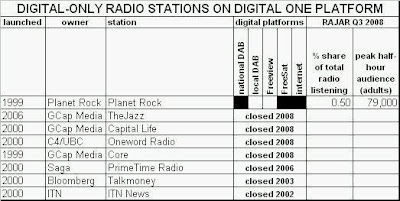
The only thing cheap about Digital One was the cost of its initial 12-year licence, a mere £10,000 per annum paid to the regulator for the radio spectrum it uses. The business model was that Digital One would lease space on the DAB platform to radio stations that would pay it rent (about £1m per year, dependent upon audio quality). Since opening for business in 1999, many digital-only stations have tried using the platform but, to date, almost none have stuck around. No digital radio station has yet made a profit.
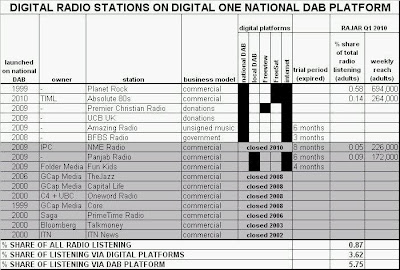
The latest additions to the lengthening list of stations that have failed to make the national DAB platform work for them are NME Radio and Panjab Radio, both of which quit Digital One in June 2010 (see shaded area of table). The reason? Almost no one was listening. Add together the digital-only stations broadcasting on the platform last quarter (and that are measured by RAJAR) and, in total, they accounted for less than 1% of total radio listening.

Yet the radio industry, the receiver manufacturers and their lobby groups are still spending money on campaigns to convince the public that DAB radio is a raging success. Digital One says its radio platform reaches “more than 90%” of the [UK] population,” equivalent to 46m adults. RAJAR tells us that 35% of those adults have a DAB radio. Yet only 226,000 adults per week listened to NME Radio, after nearly two years on-air. If you were in any way persuaded to believe the hype surrounding DAB, your business plan to start a digital radio station might look dangerously over-optimistic.
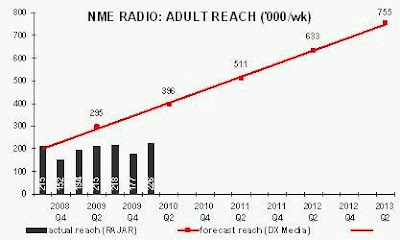
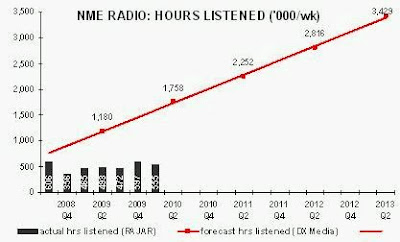
When NME Radio launched in June 2008, it had forecast that its audience would reach 396,000 adults per week by its second year. For most of its life, the station was broadcast on local DAB multiplexes (and online). Then, from 21 December 2009, NME Radio was made available nationally on DAB for an eight-month trial. Broadcasting to a much bigger potential audience, there should have been a positive uplift to the station’s performance in Q1 2010. However, there was no noticeable impact upon adult reach (226,000) or hours listened.

In its forecasts, NME Radio had projected that DAB would be “53%” by 2010. Maybe this referred to Ofcom’s forecast that, by year-end 2010, digital platforms (not DAB alone) would account for 50% of all radio listening. In fact, in Q1 2010, only 15% of listening to all radio was via DAB, and 24% was via all digital platforms (worse for commercial radio at 12% and 23% respectively). Ofcom’s forecast of how digital radio usage would grow was disastrously inaccurate. NME Radio did not stand a chance of commercial success using DAB.

The other digital radio station that quit the national DAB platform in June 2010 was Panjab Radio. Like NME Radio, it had broadcast via local DAB multiplexes (and online), but was then made available nationally on DAB for a six-month trial from 1 December 2009.
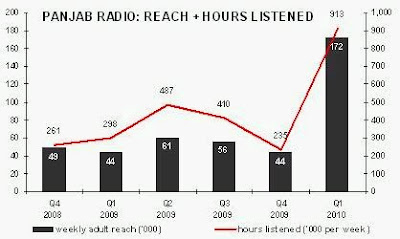
There was no lift to Panjab Radio’s audience in Q4 2009, but the following quarter saw a noticeable increase to 172,000 adult reach and 913,000 hours listened per week. This was almost twice the amount of listening that NME Radio recorded on the national DAB platform, a real achievement for an ethnic radio station.

The day Panjab Radio had joined the national DAB platform, Digital One operations director Glyn Jones said:

“Like Premier Christian Radio and UCB UK, Panjab Radio relied on a fund-raising appeal to pay for the launch of the station. It’s interesting to see the growth of listener-supported stations, and the way they’re extending the range and choice of stations on air via digital radio. These are stations that neither a traditional commercial model nor the BBC have chosen to provide, but which listeners value so much that they’re prepared to help pay for them out of their own pockets.”

The sub-text was that the Digital One national DAB platform cannot support a commercial digital-only radio station because the financial returns are simply insufficient to cover the expense for it to lease space on the platform. If Panjab Radio had managed to sell advertising at the average commercial radio sector rate, it should have generated £1m per annum of revenue. However, an industry study in 2009 found that the average digital radio station generated only £130,000 revenue per annum (and Panjab Radio attracted less listening than others).

When Panjab Radio quit the national DAB platform in June 2010, Digital One’s Glyn Jones issued a press release that seemed over-eager to deflect the blame:

“Panjab Radio’s revenues come from a mix of traditional radio advertising plus fund raising among Britain’s Panjabi and Sikh communities. Following a strategic and financial review the station opted to end its national transmissions but to continue to broadcast on DAB digital radio in three parts of the country with significant concentrations of the target audience – the West Midlands, West Yorkshire and London.”

As the table above demonstrates, the national DAB platform’s history is littered with commercial digital radio stations that failed to make it work for them. Most of the stations currently on the national DAB platform are non-commercial and so do not need to meet their costs from advertising revenues. But religious stations, army radio and unsigned artists do not come close to the mass market purpose for which the platform was originally envisaged. Did GWR Group make its substantial investment in national DAB in the expectation that, after a decade, the platform would be filled with subsidised radio stations attracting tiny audiences?

Two years ago, I had written:

“This sudden flowering of ethnic, religious and publicly-funded radio stations on the DAB platform echoes the fate of the ‘AM’ waveband in the 1990s … The ‘DAB’ platform of 2008, particularly in London, is already starting to resemble the ‘AM’ platform of 1998, suggesting that ‘DAB’ might have already been written off by the sector as a means to reach the ‘mass market’ audiences that national advertisers desire from the medium.”

Since then, this desperate filling of DAB multiplex capacity with non-commercial stations has spread from London to the national platform. Bizarrely, given the overwhelming empirical evidence that this “first and only national commercial” DAB platform is not working, even after a decade of operation, Ofcom is keen to create a second quasi-national DAB platform. Its rationale is that:

“This could help to facilitate the creation of national commercial radio stations to create a consumer proposition analogous to that of Freeview: a wide range of popular and niche services, delivered digitally” because “we believe DAB still offers the best solution for the future growth of radio in the UK.”

This nonsense was written in an Ofcom report less than a year ago, when the writing on the wall could not have been larger that the national DAB platform’s future for commercial radio was doomed. Surely, a regulator that refuses to deal with the reality of the here and now could be a regulator that will eventually find it has no future. For years, Ofcom (and its predecessor) have led the commercial radio sector a merry dance down a DAB blind alley that has proven almost fatal to the industry’s economic health.

If Ofcom publishes one more policy document proclaiming (as if it were still 1998) that ‘the future of radio’ is DAB, rather than it working to bang industry heads together to find a practical route out of the present mess, all it will succeed in doing is writing its own epitaph.

Paying for DAB radio carriage: god only knows

Premier Christian Radio, the London AM station, is planning to broadcast on the national DAB platform from 21 September 2009. In an e-mail to listeners, its chief executive Peter Kerridge explained:

“Beginning in September, we will start to incur the cost to transmit on this digital platform – £650,000 per annum – which is an expense that is over and above our current operating costs. The only way the £650,000 in transmission costs will be covered is through the generosity of friends like you. It is fantastic that God has moved in such an amazing way to provide Premier this national digital licence! Now may you and I be found faithful as we steward this new resource for His glory and for the advancement of His Kingdom!”

DAB carriage remains a costly business. Digital One, the owner of the sole national commercial DAB multiplex, fixes the carriage costs for content providers such as Premier Christian Radio. If £650,000 seems like a lot of money for broadcast on a platform that reaches 33% of adults in the UK and accounts for only 13.1% of radio listening [RAJAR Q1 2009], understand that this is a bargain compared to the expensive contracts some content providers had signed previously. In January 2009, Digital One responded to the government’s Digital Britain initiative by cutting its prices. Acting chief executive Glyn Jones said:

“We’re turning the ideas set out in the Digital Radio Working Group’s report into actions. That includes looking hard at how Digital One can offer lower carriage costs. In turn we’re expecting that stakeholders involved in the Working Group, and other companies with the ambition to launch new national radio stations in 2009, will step up and engage with a view to adding compelling new choice for consumers. We’re expecting that prices will initially be set below Digital One’s 2008 rate card. One reason for that is to help provide an incentive for people to invest in high quality services. But, over time, companies providing new services will be expected to contribute to the costs of a transmitter roll-out plan which was something also identified by the DRWG as important.”

Digital One’s January 2009 press release was ambitiously headlined ‘New National Radio Stations To Launch In 2009’. Seven months later, what stations have stepped forward to take advantage of the Digital One offer? Government-funded BFBS Radio started DAB simulcasting on 20 April 2009, following a three-month trial in 2008. Amazing Radio launched on DAB in June 2009 for a six-month trial period, playing unsigned artists from its music web site. Also in June 2009, Fun Kids, which is normally on DAB only in London, launched a fourteen-week trial simulcast on national DAB. Neither BFBS nor Amazing Radio are participating in RAJAR radio audience research, so it is impossible to know how much listening these services are attracting on the DAB platform.

Have we seen any major media players step forward and put a new mass market radio service on the national DAB platform? Not yet. Why? Because, even at the knockdown rate of £650,000 per annum, it still proves impossible to make a profit from offering radio content on DAB. The table below offers very rough estimates of what digital stations measured in RAJAR (and carried on a mix of broadcast platforms including DAB and digital TV) should and might be earning in revenues. The second column lists the total hours presently listened to each digital station. The third column uses the average commercial radio sector yield (how much revenue was generated from how much radio listening in 2008) to estimate, in theory, what these stations’ revenues should be.


However, the ‘Commercial Radio: The Drive To Digital’ report commissioned from Ingenious Consulting by RadioCentre in January 2009 told us that:

“Incremental revenue from DAB-only stations is negligible at ~£130k per ‘bespoke’ station …”

The list above comprises the 14 digital radio stations that subscribe to RAJAR. Not all of these stations broadcast on DAB (Smash Hits Radio is only on digital TV), not all of them are national (Yorkshire Radio is only on the Yorkshire DAB multiplex, for example), but let us be generous and assume that each station earns revenues of £130,000 per annum. In total, these stations combined would generate £1.82m per annum of revenue. This is substantially less than the £29.7m revenues that would be expected to be generated from them attracting 22.7m hours per week of listening.

The final column in the table estimates how much revenue each station might be earning from the £1.82m total, if revenues were proportionate to hours listened. I must stress again that this only a rough estimate – none of these stations, nor Ofcom, publishes the actual revenues of digital radio stations. What these estimates demonstrate is that, if Planet Rock were (like Premier Christian Radio) paying £650,000 per annum for its carriage on the national DAB multiplex (the financial details of its “long-term” deal with Digital One were not made public), the station is still nowhere near breaking even, not even after ten years on-air.

The Ingenious Consulting report found that DAB-only stations are spending £25m per annum on operating expenses. The above table shows that, if these stations were attracting revenues proportionate to the listening they presently enjoy, collectively they would then be profitable (£29m revenues minus £25m operating expenses). But, in fact, their revenues are presently less than £2m. The Ingenious Consulting report concluded that, as a result, the “annual negative cash flow impact of DAB” on the commercial radio sector is around £27m per annum.

This £27m annual loss attributable to digital radio stations represents around 5% of commercial radio’s revenues, a significant impact on an industry which is only marginally profitable overall at present. The nub of the problem is this: digital radio stations presently account for 5.3% of listening to commercial radio, but digital radio stations attract only 0.3% of commercial radio revenues. Here is a massive economic disconnect that requires much more than a mere increase in productivity or some kind of performance improvement. Doubling or even tripling these stations’ revenues would barely dent the problem.

Maybe DAB is simply not a platform where the traditional commercial radio model can be made to work – the old model of ‘give away free content, pay for it by attracting advertisers to buy on-air spots’. Maybe DAB is not a medium from which traditional UK commercial broadcasters can generate profits from offering content, as they had anticipated in the 1990s. Commercial broadcasters are pushing no commercial product other than their on-air brand (and some music downloads, concert tickets and click-through purchases). Instead, perhaps DAB can only be made to work as a marketing tool to assist companies selling (non-radio) products. So, for example, it would make sense for Universal Music to have a DAB radio station to expose directly to the public the CDs/videos/movies they are currently selling. It would make sense for Amazon to have a DAB radio station to promote all the consumer products it is selling. Then, the £650,000 carriage cost could be considered an additional ‘marketing expense’ for these companies’ core business, rather than a direct operating expense that had to be recouped ON-AIR.

The other possibility is for DAB to be used predominantly by organisations whose objective is something other than breaking even financially. In January 2008, I had written:

“Worryingly, this sudden flowering of ethnic, religious and publicly-funded radio stations on the DAB platform echoes the fate of the ‘AM’ waveband in the 1990s, at a time when the radio industry and the regulator had become convinced that audiences were deserting that platform for the improved audio quality offered by the ‘FM’ waveband. By 2002, declining audiences of ‘AM’ stations had persuaded the regulator to suggest that the platform be used in future “for better serving minority, disadvantaged or currently excluded audience groups, whether defined by their interests, demographics or ethnicity”. The ‘DAB’ platform of 2008, particularly in London, is already starting to resemble the ‘AM’ platform of 1998, suggesting that ‘DAB’ might have already been written off by the sector as a means to reach the ‘mass market’ audiences that national advertisers desire from the medium.”

This trend towards non-commercial content has developed further since then. The national DAB platform has added BFBS Radio (government-funded) and now Premier Christian Radio (religious), but no new permanent digital radio stations operating on a commercial model. Local DAB multiplexes have added Traffic Radio (government-funded), Colourful Radio (ethnic) and UCB (religious). Interestingly, UCB has taken two channels on each of the regional MXR DAB multiplexes, giving it a substantial amount of DAB spectrum. But there have also been ethnic DAB radio casualties since my earlier report – Islam Radio in Bradford closed its DAB service in December 2008, and India’s Zee Radio closed its London DAB service in April 2009. Even for ethnic broadcasters locked out of analogue radio, DAB can prove a struggle.

Premier Christian Radio’s Peter Kerridge hit the DAB nail on the head when Media Week reported:

“Kerridge said Premier Media’s funding meant it was in a better position than other media organisations, as the ‘ad-funded model is smashed’ …..”

The available financial data confirms that, certainly for the DAB platform, an ad-funded model simply is not viable at present. To make DAB work for your content, you need government funding, direct listener financial support, a sugar daddy, or some kind of god smiling benevolently down upon you.

Digital One – an end to wishing and hoping

Today, transmission company Arqiva announced that it had finally acquired the remaining 63% stake that it did not own of Digital One, the national commercial radio DAB multiplex, from Global Radio. Tom Bennie, Arqiva CEO said: “Arqiva now plans to invigorate DAB with new channels and services and, as an independent operator, we’re in a good position to realise the full potential of the Digital One multiplex.”

Let’s go back in time.

In March 2007, National Grid Wireless had applied to Ofcom for a new licence to operate a second national commercial DAB radio multiplex and it noted in its application that:

• “Few of the digital-only services on Digital One have been marketed aggressively”
• “Awareness and reach conversion [of digital-only stations] is not keeping pace with the rise in DAB digital radio penetration”
• “Over the past three years, there is no discernable positive [listening] trend for any of the [digital-only] services on Digital One, except for Planet Rock”
• “Despite increasing DAB penetration, the proportion of listening generated by DAB homes to these [Digital One digital-only] services has not altered significantly”
• “DAB digital radio listeners are primarily using their DAB radios to tune in to established [analogue] services”
• “Newcomers to DAB digital radio are primarily replacement set purchasers who have not been motivated by the prospect of new channels or improved functionality”
• “The lack of development of DAB digital radio in cars is also a possible threat to its development”
• “There is [advertising agency] dissatisfaction not only with the current digital radio offering as an advertising medium …. [but also] that too many of the existing stations sound alike and are trying to appeal to the same people”

National Grid Wireless did not win the licence, as Ofcom awarded it to Channel 4 in July 2007. Then Arqiva acquired National Grid Wireless. Then, in 2008, Channel 4 returned its licence to Ofcom unused. Ofcom has not re-advertised this second DAB multiplex licence, so there remains only one multiplex, owned by Digital One.

Now it has been two years since National Grid Wireless identified the problems with Digital One, and its successor – Arqiva – is suddenly in a position where it owns Digital One and it is in the driving seat to do something to fix it. The question is whether that two-year gap has now made it too late in the day for Arqiva/National Grid Wireless to fix things. Two years is a long time in technology, and time has not been kind to DAB. There are significantly fewer digital radio stations on-air now, there is less appetite for investment in new ventures, and commercial radio is suffering badly from the recession.

One wonders what might have happened subsequently if:
· Ofcom had not advertised a second national DAB multiplex?
· Ofcom had not awarded that licence to Channel 4?
· Channel 4 had not burnt through up to £9m of funding before deciding to scrap radio?
· Commercial radio had got on with the task of fixing DAB itself, instead of hoping that Channel 4 would kick-start the platform?
· Fru Hazlitt had stayed at GCap Media long enough to offload Digital One to Arqiva a year ago for £1?

With hindsight, it is already beginning to look as if that two-year period (March 2007 to July 2009) offered a critical opportunity for DAB. Critical in the sense that a lot needed to be achieved, that there was a lot of wishing and hoping for things that never materialised, and much seemed to eventually go backwards, instead of forwards, during that time. If you re-read the bullet points listed above from National Grid Wireless’ application, you realise that these issues have still not been resolved during the last two years. In many ways, regrettably little of significance has yet changed. We are still waiting.

It’s like a DAB Groundhog Day. Every day you wake up wishing and hoping things will be different, but every day the same issues still need solving, exactly as they were the day before, and everyone ends up talking again about finding solutions, but the day eventually comes to an end. And then tomorrow it starts all over again.

DAB: actions speak louder than keynote speeches

Giving the commercial keynote speech at the Radio Reborn 2009 conference this week in London, Global Radio chief executive officer Stephen Miron banged the drum for the radio medium, banged the drum for Global Radio, and banged the drum for digital radio.

It was the last of these three exhortations that appeared particularly contradictory, given Global Radio’s track record with the DAB platform. However, nothing could stop Miron from proclaiming:

* “At Global, we believe that the government must set a clear and rightfully ambitious programme for digital migration.”
* “As you would expect from the largest commercial radio broadcaster, we plan to play an active role in helping ensure the successful delivery of that [digital] strategy.”
* “We back digital and we back the [Digital Britain] strategy, but we cannot afford to get this wrong.”
* “Digital Britain has made us focus our minds. Now the government must focus theirs.”
* “We have embarked on a clear path to digital, to DAB, and we need to make serious progress and do it quickly.” [emphasis added]
* “This means naming a date for [digital] migration …. A firm date needs to be set.”
* “The future of our sector is intrinsically linked to the successful implementation of the government’s digital strategy and to the successful migration to DAB.” [emphasis added]
* “We need more of this in the coming weeks and months. Not just words, but action.”
* “We need to get our act together to make the best possible case for consumers to switch to digital.”
* “Global is up for the challenge and, as the largest commercial player, we are prepared to lead this charge.”

Miron’s comments seem particularly difficult to reconcile with Global’s ‘actions’ on DAB, which hardly demonstrate confidence in the platform.

1. Global Radio exits DAB multiplex ownership
On 6 April 2009, it was announced that Global Radio sold its 63% stake in the sole commercial radio national DAB multiplex owner Digital One to transmission provider Arqiva. Global Radio also sold its local DAB multiplex business Now Digital to Arqiva. After almost a decade of operation, these multiplexes were still to generate an operating profit. Global Radio’s involvement in DAB multiplexes was thus reduced, at a stroke, from having been the biggest player to zero, writing off a decade’s worth of massive investment in the process, because the transaction is likely to have happened for a nominal amount.


2. Global Radio/GCap Media closes digital stations
Digital stations Capital Life and TheJazz, both of which had been carried on the national Digital One DAB multiplex, were closed on 31 March 2008, the day that Global Radio acquired GCap. (GCap had already closed another national digital station Core in January 2008).

In a recent interview, Tony Moretta, chief executive of the Digital Radio Development Bureau, tried to explain the closures of these stations: “Well, the main stations that went away – aside from all the Channel 4 stuff, which never launched and was nothing to do with DAB – where the GCap stations, such as The Core and thejazz also had nothing to do with digital.” [sic]

3. Global Radio turns digital station The Arrow into music jukebox
In December 2007, Global Radio dropped live presenters from the digital radio station The Arrow which it had acquired from Chrysalis Radio. The Arrow was removed from DAB in London in May 2008, and is now only available over-the-air on the 5 MXR regional DAB multiplexes. However, Global’s recent sale of its share in these multiplexes to Arqiva puts a question mark over the station’s future. Why would Global Radio pay Arqiva to carry a digital station in which it is has demonstrated no interest to develop?

4. Global Radio does nothing with digital station Chill
Part of Global Radio’s acquisition of GCap Media, Chill is also only available over-the-air on the 5 MXR regional DAB multiplexes (and not in London on DAB). Like The Arrow, Chill’s future looks very precarious. However, it would prove embarrassing to close these two digital stations before Lord Carter’s final Digital Britain report is published.

5. Global Radio cancels deal with Sky for digital news radio station
In October 2007, Global Radio cancelled the contract with Sky inherited from its acquisition of Chrysalis Radio that would have created a national Sky News Radio station on DAB. A spokesperson said then that “Global was not prepared to make the necessary investment in this project”.

6. Global Radio scraps digital-only shows on Galaxy Radio
In January 2008, Global Radio dropped dedicated shows from the digital version of its Galaxy Radio brand, instead simply simulcasting its local FM output on DAB multiplexes that also carry it.

So what is going on here? Miron’s speech is a large part of Global Radio’s public campaign to cosy up to Lord Carter ahead of the publication of his final Digital Britain report. Global needs a big favour from Carter if it is to retain a shred of intrinsic value on its corporate balance sheet – an automatic renewal of its Classic FM national analogue licence (see my earlier blog entry). In return for the favour it seeks, Global is responding to Lord Carter’s insistence that the radio industry speak with one voice on the issue of the transition from analogue to DAB radio.

The important thing here is to be seen to be saying the right things publicly about DAB – it’s great, it’s the future, we are committed to it, we love it. Forget the past. Forget our recent ‘actions’. Conveniently forget that, less than a month ago, we transformed our company from the leading player in DAB infrastructure into less than an also-ran. DAB is the future – we are part of that future. Our commitment is to say all the right things, and probably to do absolutely nothing. The endgame is to persuade government to amend primary legislation so that Global Radio can hang on to Classic FM, as Ashley Tabor explained: “It is one of those times when common sense has to prevail. Classic FM is a national treasure and to lose it would be tragic.”

The consumer and trade press willingly obliged by reprinting chunks of Miron’s speech without any kind of critique. This ensures that the press cuttings, demonstrating Global Radio’s glowing confidence in DAB, will land on Lord Carter’s desk and, Global hopes, convince him of the ‘common sense’ of not bothering to auction the Classic FM licence to the highest bidder (which is required by existing legislation). Here is a selection of that press coverage.

Broadcast magazine reported that “Miron’s comments mark the first time that Global Radio – the largest commercial player in the UK radio sector – has come out so strongly in favour of DAB and migration” under the headline “Global Radio chief demands DAB deadline”.

Radio Today reported that “Global Radio has also called on the government this morning to set a switchover date for DAB” under the headline “Industry unites for a DAB future”.

Marketing Week reported that Miron wanted the government “to name a date for a switchover from analogue” under the headline “Radio industry needs to be bold, says Miron”.

Media Week reported: “Global Radio has made one of its biggest interventions in the debate over the future of digital radio, with chief executive Stephen Miron calling on the Government to set a date for digital radio switchover”. The headline was “Global boss Miron calls on Government to name digital radio switchover date”.

The Guardian, to its credit, published the only report which acknowledged Global had “sold its majority stake in national DAB platform Digital One to transmission business Arqiva earlier this month”, though its headline nevertheless read “Government must be bolder on digital radio, says Global chief Stephen Miron”.

But today’s Sunday Times developed the theme by including this comment from Global Radio’s Ashley Tabor about digital switchover: “I am really confident now that all the right things are happening that will get us where we need to be. We are in favour of switch-off, so can we do it quickly please?” Maybe Lord Carter is tiring of Tabor’s persistent phone calls, so Ashley is now having to turn to weekend press puff pieces to labour his point.

The Sunday Times article’s headline, without a hint of irony, is “Global evangelist for digital radio”. Closing digital stations, selling off DAB infrastructure, baling out of DAB development deals – is this some kind of ‘do as I say, not as I do’ evangelist?

The Digital One DAB radio multiplex – fixing 'market failure'… ten years too late

Digital One is the owner of the UK’s first and only national commercial radio DAB multiplex. If you produce commercial radio content that you wish to make available nationally on the DAB platform, you have to go to Digital One and agree a price and a contract. That price is set by Digital One, not by Ofcom or any other regulatory body. Digital One is the national DAB ‘gatekeeper’ and it decides what commercial radio brands we hear and what we don’t hear on DAB. It would be hard not to consider Digital One’s operation monopolistic.

Furthermore, Digital One is part of a vertically integrated business. Its controlling shareholder is Global Radio (formerly GCap Media, formerly GWR Group), the UK’s largest commercial radio group. In this way, Digital One/Global Radio’s business is an end-to-end operation that includes: generating radio content (‘stations’), some of which are carried on the DAB platform; selling advertising space around that content, some of which is carried on the DAB platform; owning the national DAB platform in the UK; and owning the ‘gatekeeper’ role for other radio content providers wanting access to that national DAB platform. (This ‘gatekeeper’ role was bestowed upon the DAB multiplex owner, rather than Ofcom, by the 1996 Broadcasting Act.)

Does Digital One’s business work in the interests of a competitive broadcasting sector or the listening public? Is this not a case where some kind of intervention by the regulator is appropriate? Within Ofcom’s own definition of ‘market failure in traditional broadcasting’, one of the main six reasons it uses to justify regulatory intervention is where:
“Restricted access to spectrum makes entry impossible on market grounds and, without competition, the ability of the market to deliver the most efficient solution is impaired”.

Ofcom then explains this issue in more detail:
“A tendency towards monopoly/oligopoly. Economies of scope and scale are inherent in broadcasting and will tend to encourage the concentration of ownership in large, often vertically-integrated companies. The result of an unregulated market might therefore be reduced competition, less choice for viewers and either higher prices or lower quality than would be available in a competitive market”.

Is this not exactly what has happened with the national commercial radio DAB platform? Digital One seems to have operated its ‘gatekeeper’ monopoly over the platform in a way that that has reduced competition, offered less choice to listeners, and maintained high carriage prices. The end result? After a decade of operation, there is only one radio station that has elected to contract with Digital One to be carried on its DAB platform of its own volition. There is enough bandwidth on the multiplex for a clutch more national stations, but that capacity remains unused.

Digital One was awarded a 12-year DAB licence in June 1998 to operate the “first and only national commercial digital multiplex licence”. It promised to pay the regulator a licence fee of £10,000 per annum. However, until very recently, if you had approached Digital One and asked the cost of putting a radio station on its multiplex, you would have been expected to pay more than £1 million per annum. Furthermore, if your proposed content competed directly with that of Digital One/Global Radio’s own digital radio stations, carriage might not have been offered, even at that price.

Therefore, it proves somewhat surprising to see today that Digital One issued a press release and published an advertisement inviting “expressions of interest from companies ready to contract and launch digital radio stations in 2009” on its DAB multiplex. It is even more surprising to learn that “capacity is available for mainstream stations, as well as more specialist channels appealing to a diversity of tastes and interests”. And it is shocking to read that “Digital One is reviewing its charges for capacity” and that “it is anticipated that prices will initially be set below Digital One’s 2008 rate card, in order to provide an incentive for approved applicants to invest in high quality services….”

The appropriate time to have published such a ‘call for content’ was June 1998, immediately after Digital One was awarded the DAB multiplex licence by the regulator. Perhaps then the sad story of the DAB platform’s slow development in the UK would have turned out differently. By now, Digital One might have fostered a broad range of audio content on the national DAB platform provided by a variety of producers, creating a ‘compelling consumer proposition’ that could have motivated the public to purchase DAB radios in significant numbers. But, unfortunately, it did not turn out that way and now, after a decade, DAB remains barely off the starting blocks.

Instead, for a decade, Digital One has clung on to the notions that:

  • its monopoly over the DAB infrastructure is valuable in itself, even if the capacity is mostly unused (is a rail network valuable without trains?)
  • its ‘gatekeeper’ role enables it to push its own digital services to listeners, at the expense of competitors and potential competitors
  • high carriage fees for external users will quickly put them out of business
  • listeners will lap up its own controlling shareholder’s content on the DAB platform, however little is invested in its production (one computer + 100 CDs = digital radio station)
  • ‘control’ of a broadcast platform is alone sufficient to create a profitable monopolistic business

It hardly inspires confidence in the Digital One DAB platform that Global Radio’s predecessor, GCap Media, closed three of its own digital-only stations carried on its platform last year, and sold Planet Rock to an entrepreneur with no other radio interests. Neither is it a good advertisement for Digital One that its platformproviding coverage to 90% of the population of Great Britain” only succeeds in securing a peak half-hour audience of 79,000 adults for its last remaining digital-only audio contractor, Planet Rock.

Digital One’s licence for the “first and only national commercial digital multiplex licence” will expire on 14 November 2011. Would I sign a contract with a company that has unashamedly hogged the UK DAB national multiplex for its own selfish ambitions since 1998, but now suddenly wants to offer me capacity on its multiplex, just as its own life is expiring? My attitude would be: so you’ve screwed up almost a decade of your 12-year monopoly and lost everything but your shirt in the process, but now, on your deathbed, you want me to pay you good money for carriage on a platform that you yourself have helped ruin?

Digital One’s announcement today reminds me of those grocery stores that put cans of food in a 10p bargain bin that are not only damaged, but are also only a few days away from their expiry date. You expect me to buy these? I guess we will see if there is somebody out there desperate enough to take the bait. I can think of many radio formats unavailable on AM/FM that should have a national platform in the UK. Would any of them work on DAB? Ten years ago, yes, they might have done. Now, no. The DAB platform has proven to be a failure with consumers, and Digital One has played a very large part in making it so. And yet, Digital One has decided now to advertise its newfound enthusiasm for “enhanced choice, variety and innovation” on its DAB platform.

A case of: too much, too little, too late…….