Digital Radio Upgrade & the Digital Economy Bill

Westminster eForum Parliamentary Reception
Terrace Pavilion, House of Commons, London
28 October 2009 @ 1600

“The informal discussion that takes place can be expected to cross a range of current policy issues but the chosen theme is digital switchover and DAB.”

JOHN WHITTINGDALE MP, Chairman, House of Commons Culture, Media & Sport Select Committee:

The future of radio is very much a topic under debate. My Select Committee is currently conducting an inquiry into the future of local and regional media, of which radio is an absolutely critical part. So yesterday we were hearing evidence from Andrew Harrison of RadioCentre, Travis Baxter [of Bauer Media] who is here somewhere today, and Steve Fountain from KM Group. And we are very much aware of the pressures on commercial radio and the difficulties faced. But, at the same time, there are opportunities. And when Digital Britain came out, much of it had been trailed in advance, a lot of it quite controversial – things like top-slicing and file-sharing legislation – but the one bit which came as something of a surprise, I think, was the announcement of the date for Digital Radio Upgrade. Certainly, when I saw that in the Report, my immediate reaction was rather like the ‘Yes Minister’ Permanent Secretary who said: “That is a very brave decision, Minister”.

It is going to be challenging. It is slightly controversial. Not everybody in the industry is 100% yet signed up to it. Equally, there is a cost attached and we can have interesting debates about who is going to pick up the bill for it. And there will be quite a task to persuade people. In the same way that we had to work hard to persuade people that analogue switch-off of television was going to be beneficial, I think the task to persuade people in the case of radio is going to be even greater, particularly whilst we still have the overwhelming majority of cars with analogue radios in them. So there are challenges, but equally there are going to be benefits.

We heard yesterday about the costs to radio of having to transmit simultaneously in both analogue and digital and, clearly, that is something which would be reduced if we managed to get switchover. So this is a very important debate and I am keen that, when we come to debate the Digital Economy Bill when it is introduced, we should not overlook radio. There is always a danger that everybody focuses on television and there will be a huge argument about whether or not the BBC should be the exclusive recipient of the Licence Fee, and whether or not we should be trying to stop teenagers in bedrooms file-sharing, but it is important we should also debate radio and, certainly, that is something which I will try and do my best to ensure happens. But I think this afternoon is a good start to that and it is good to see so many people from the industry assembled in one room. So that’s enough from me, just to say welcome to the reception this afternoon …..

PAUL EATON, Head of Radio, Arqiva:

I would like to welcome you all as well on behalf of Arqiva and Digital Radio UK. Arqiva is part of Digital Radio UK, with the BBC and commercial radio, and I am very pleased to be joined today by Andrew Harrison, chief executive of RadioCentre, and Tim Davie, director of Audio & Music at the BBC.

Digital Radio UK has been formed by the radio industry to get the UK ready for the Digital Radio Upgrade. That upgrade is vital because radio faces a stark choice – we can either stay in the analogue world or we can move forward into the digital one. Both need considerable investment from all of the players but only one, digital, can give radio that exciting future that listeners deserve. Digital radio will mean more choice, a better quality listening experience and the kind of interactivity that we can only dream about today.

We all know that the road ahead is a difficult one. We know that the coverage is not good enough yet, we know that we haven’t got digital radio in enough cars, and we know that we need to get converters onto the market to turn analogue radios into digital ones – set-top boxes for radio, if you like. We know that there is new content and new services that need to go digital. So there’s a lot to do. But, in creating Digital Radio UK, the radio industry is demonstrating that it is serious about the digital future and is determined to address the issues and, in doing so, give the digital future that listeners deserve.….

SIMON MAYO, Presenter, BBC Five Live:

I had one of those “blimey, you’re old” moments this morning. I was talking about radio with my son – my eldest son is eighteen – and I asked him what he listened to and what his friends listen to. He thought for a moment and then he said “none of my friends have got a radio”. I thought that was quite an astonishing moment. Now, obviously, he is an unrepresentative sample of one, that is true. They kind of know about radio and they might listen online, and it’s on in the kitchen and they hear it in the car and they have an opinion of [BBC Radio One breakfast presenter] Chris Moyles, but that was it. It occurred to me that, really, radio has got a bit of a fight on its hands, which is where the kit here [points to display of DAB radio receivers] comes in, I think.

My parents’ generation didn’t need to be told that radio was fantastic. My father, if he was here, would talk about listening to Richard Dimbleby and Wynford Vaughan-Thomas and The Goons. The Goons generation didn’t need to be told that radio was great. The 60s generation didn’t need to be told that radio was great – they had the pirates, then they had Radio One. My generation fell asleep listening to the Radio Luxembourg Top 40 on a Tuesday night. It finished at 11 o’clock and that was quite daring – I see a few people nodding. That was quite daring staying up to 11 o’clock, and the fact that is was sponsored by Peter Stuyvesant cigarettes was even more dangerous. But we remembered it and we fell in love with radio, and I think there is a job to be done to make future generations fall in love with radio.

So enter digital. Partly that has to be done by the broadcasters in coming up with exciting new stations filling gaps that don’t exist. BBC7 is wonderful. Everybody will have their own particular favourites. Absolute Classic Rock is really rather good. If you want Supertramp and Led Zeppelin any time of the day, that’s the place to go. Really good stuff. There are some really big gaps that need to be filled, but that’s exciting. Analogue is full, so digital is the place to be.

But the kit is really exciting. If you have a radio when you are listening to a piece of music …. and you’re listening to the radio and an Angelic Upstarts track comes on, you press a button and it sends you an e-mail that tells you that they have reformed, you can buy their records and this is where they are playing. Or someone is listening to ‘Yesterday In Parliament’ and they hear a speech from a parliamentarian that they like, and they think “he’s interesting, she’s interesting”, press a button, you get sent an e-mail and it tells you who it is, how you can contact them – this sounds quite exciting. If you are listening to one of [presenter] Mark Kermode’s film reviews on Five Live, and you like the sound of the film, you press a button, and its sends you an e-mail, you go to your in-box and it’s got an e-mail telling you where that film is on, how you can go to see it, maybe a link to the trailer. All of that kind of information means that radio has got an exciting future, but it just means that we have to go out and explain it a bit more because people might not get it the way they used to.

Hopefully, there is still a role for the humble presenter. So you do a little bit as well. Thank you very much indeed for coming…..

[A Digital Radio UK factsheet entitled “A briefing on the digital radio upgrade” was distributed at the event. Click here to view.]

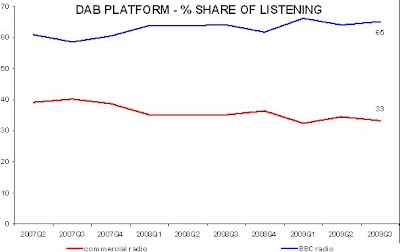
Digital platforms: commercial radio losing share to BBC

Today’s RAJAR data demonstrates that a gulf is opening up between BBC radio and commercial radio in their ability to attract listening to digital platforms. Over the last year, the BBC is accelerating away from commercial radio in its audience’s usage of DAB, digital television and the internet to listen to live radio programmes. The significance of this growing gulf is reinforced when one remembers that the main RAJAR survey, from which the data below is taken, only measures ‘live’ radio listening and does not incorporate listening to either time-shifted, on-demand radio (‘listen again’) or to downloaded podcasts, both forms in which the BBC offers a much greater volume of content than UK commercial radio.

The danger here is that the BBC is poised to dominate listening on digital radio platforms in the long term, exactly as it already dominates listening on analogue radio platforms. One of the main reasons that the commercial radio sector invested so heavily in digital platforms during the last decade was the opportunity it offered to compete more effectively with the BBC for audiences. In the analogue world, the commercial sector has always argued that the BBC (having been there first) was allocated more and better spectrum for its radio stations. ‘Digital’, particularly DAB, seemed to offer the commercial sector a chance to ‘even the score’ with the BBC. The RAJAR data show that this ambition is not succeeding.

Across all digital platforms aggregated, commercial radio is losing ground, with the latest quarter (Q3 2009) reducing its share of listening to 41%, versus the BBC’s 56% share.

Taking each digital platform in turn, commercial radio’s share of listening on the DAB platform fell to 33% in Q3 2009, compared to the BBC’s 65%. This is not surprising because the age profile of DAB purchasers tends to be older listeners who are statistically more likely to listen to BBC stations. However, it does pose a grave question as to the return that commercial radio can expect from its substantial investment to date in DAB infrastructure, if listening on that platform is dominated so much by the BBC.

The digital TV platform is one that commercial radio has long dominated because of the large amount of spectrum it leased in the early days of Freeview. However, the increasing popularity of digital terrestrial television has already substantially increased the cost of spectrum on Freeview for the radio industry when its contracts come up for renewal. Furthermore, the forthcoming re-ordering of the multiplexes to accommodate HD television and new compression codecs is likely to squeeze commercial radio’s access to Freeview spectrum even more so. Before long, it is likely that the BBC will dominate the digital TV platform, just as it already does on DAB. Presently, the BBC has a 45% share, compared to commercial radio’s 51%.

As might be expected, the BBC’s strong online presence has already put it in the commanding position in terms of its share of listening via the internet platform. The integration of BBC radio into the iPlayer has no doubt helped as well, whereas commercial radio’s offerings are relatively more fractured and less heavily marketed, despite the excellent innovation of the RadioCentre Player. The BBC has a 50% share of listening on the internet platform, compared to commercial radio’s 37%.

The significance of commercial radio’s diminishing share of these three digital platforms is demonstrated when we look at the two sectors’ listening shares achieved on the analogue platform alone. Once one removes the digital platforms from the picture, it is evident that the shares of both the BBC and commercial radio have remained relatively stable in recent years. In other words, it is commercial radio’s declining share of listening on digital platforms that is effectively pulling the sector’s total share of listening (analogue + digital) down, particularly as digital platforms are growing as a proportion of total radio listening (21.1% in Q3 2009).

There is a paradox here. The commercial sector invested heavily in the DAB platform, believing that the new technologies would help it INCREASE its overall share of radio listening versus the BBC. In fact, that investment has recently helped to DIMINISH commercial radio’s overall share of listening. Digital television remains the only platform in which commercial radio dominates, and yet this is the very platform where commercial radio will be forced to cede spectrum and face, once more, losing out to the BBC whose spectrum for radio is guaranteed.

It is important to emphasise that these graphs show only the SHARE of listening on these platforms. The volumes of listening on each of these platforms have demonstrated absolute growth for both commercial radio and for the BBC over the same time period. But, more than any other digital platform, it is significant that the DAB platform is dominated by the BBC which now accounts for almost two-thirds of its usage. Such data is important when making decisions about the potential returns on further investments in DAB infrastructure. Will further investment simply maintain the existing imbalance, or will it really improve commercial radio’s share? Does investment in infrastructure also require parallel investment in new content that will appeal directly to the older age groups who own DAB radios?

Some possible reasons for commercial radio’s diminishing share of listening on digital platforms include:

• Commercial radio’s tendency to invest in DAB infrastructure more significantly than in original digital-only content
• Recent closures of many digital-only radio stations in the commercial sector
• The BBC’s relatively stable resource base, at a time when commercial radio revenues are falling precipitously
• The BBC’s long-held policy to invest simultaneously in multiple platforms, whereas commercial radio has focused on DAB and, to a lesser extent, Freeview
• The BBC’s focus on creating exclusive digital-only content unavailable on the analogue platform
• The BBC’s 360-degree music royalty agreements which allow it to use diverse platforms, whereas commercial radio requires separate (and more restrictive) agreements for time-shifted content and podcasts
• The BBC’s long-term, consistent promotion of content and digital platforms across TV, radio and the internet whereas commercial radio is less willing to cross-promote content or digital platforms that migrate listeners away from its core analogue offerings
• Frequent management changes and ownership changes in some parts of commercial radio, where substantial consolidation has often translated into short-term ‘slash and burn’ rather than ‘invest and build’ policies.

Whatever the reasons, we are not where we were meant to be – that is, we are not where it had been anticipated more than a decade ago commercial radio would be when investment in digital platforms, notably DAB, was expected to produce a beneficial outcome for commercial radio audiences versus the BBC. To put it plainly, the strategy conceived in the 1990’s has not worked. Commercial radio offerings do not dominate digital platforms (yes, they are more numerous, but they do not attract more hours listened than the BBC). DAB has become a largely BBC platform.

So, what can be done? Some of the issues noted above require a more level playing field to be established between commercial radio and the BBC. One such example of a practical solution is the Radio Council plan for a new UK Radio Player that will offer BBC and commercial radio content from a single aggregated access point. Other issues remain mostly in the lap of the gods (revenues, for example). Some issues require the BBC to be less predatory (or more regulated) and for the commercial sector to be more focused on strategic, long-term objectives (such as an online strategy that is more than simulcasting).

There is no single answer to this complex problem, though the commercial radio sector is hobbled by both its present lack of profitability and the regulatory strings that are attached to the majority of its analogue radio licences. What is desperately needed in these difficult times is not minor regulatory tinkering (such as adjusting how many hours of local content a local station is required to broadcast) but a wholesale change in strategy to maintain a commercial radio sector that can thrive in the digital marketplace we now inhabit. Will the imminent Digital Economy Bill prove sufficiently forward-thinking in its radio policy proposals?

[Statistical note: The graphs above to do not sum to 100% because the minimal amount of platform data released by RAJAR is ‘rounded’ (hours listened to 1,000,000; listening shares to 0.1%) and the listening apportioned to the BBC and commercial radio sometimes does not add up to the total for a platform. Some of this shortfall may be accounted for by ‘other’ listening (neither the BBC nor commercial radio) which is not itemised by platform. Data for individual quarters are therefore somewhat inconsistent, though the trend over several quarters is likely to be indicative. Additionally, there is an element of radio listening unattributed to any platform, 12.8% of the total in Q3 2009, but which is roughly equally applicable to BBC radio and commercial radio.]