Digital Economy Act 2010: a smokescreen for backroom radio ‘deal’

On 8 April 2010 at 1732, the Digital Economy Act was given Royal Assent by Parliament. Who exactly will benefit from the radio clauses in the Act? Certainly not the consumer.

“The passing of the Digital Economy Bill into law is great news for receiver manufacturers,” said Frontier Silicon CEO Anthony Sethill. As explained by Electronics Weekly: “Much of the world DAB industry revolves around decoder chips and modules from UK companies, in particular Frontier Silicon. These firms can expect a bonanza as consumers replace FM radios with DAB receivers.” Frontier Silicon says it supplies semi-conductors and modules for 70% of the global DAB receiver market.

Sadly, the Bill/Act was not really about digital radio at all. For the radio sector lobbyists, it was all about securing an automatic licence extension for Global Radio’s Classic FM, the most profitable station in commercial radio, so as to avoid its valuable FM slot being auctioned to allcomers. The payback on this valuable asset alone easily justified spending £100,000’s on parliamentary smooching. It was interesting to see one Labour MP acknowledge the true purpose for all this parliamentary lobbying in the House of Commons debate when he congratulated “[Classic FM managing director] Darren Henley for making a cause of the issue.”

The clauses in the Digital Economy Bill on the planned expansion of DAB radio and digital radio switchover were simply promises that Lord Carter had insisted upon as the radio industry’s quid pro quo for government assistance to Global Radio’s most profitable asset. The existence of this ‘deal’ between Lord Carter and Global Radio was confirmed by Digital Radio Working Group chairman Barry Cox in his evidence to the House of Lords:

“Lord Carter did not like to do [the deal] immediately. As I understand, he wanted to get something more back from the radio industry. I think there is a deal in place on renewing these licences, yes.”

However, the quid pro quo promise to develop DAB radio will never come to fruition. Now that Global Radio has got what it wanted, over the coming months, the radio industry’s commitment to continue with DAB will inevitably be rolled back. Every excuse under the sun will be wheeled out – the economy, the expense, the lack of industry profitability (having spent nearly £1bn on DAB to date), consumer resistance, the regulator, the Licence Fee, the government (old and new), the car industry, the French, the mobile phone manufacturers, whatever …….

The reasons that digital radio migration/switchover will never happen are no different now than they were before the Digital Economy Bill was passed into law. For the consumer, who seems increasingly unconvinced about the merits of DAB radio, this legislation changes nothing at all. Those reasons, as itemised in my written submission to the House of Lords in January 2010, are:

• The characteristics of radio make the logistics of switchover a very different proposition to the television medium
• The robustness of the existing analogue FM radio broadcasting system
• Shortcomings of the digital broadcast system, ‘Digital Audio Broadcasting’ [DAB], that is intended to replace analogue radio broadcasting in the UK.

More specifically:

1. Existing FM radio coverage is robust with close to universal coverage
• 50 years’ development and investment has resulted in FM providing robust radio coverage to 98.5% of the UK population

2. No alternative usage is proposed for FM or AM radio spectrum
• Ofcom has proposed no alternate purpose for vacated spectrum
• There is no proposed spectrum auction to benefit the Treasury

3. FM/AM radio already provides substantial consumer choice
• Unlike analogue television, consumers are already offered a wide choice of content on analogue radio
• 14 analogue radio stations are available to the average UK consumer (29 stations in London), according to Ofcom research

4. FM is a cheaper transmission system for small, local radio stations
• FM is a cheaper, more efficient broadcast technology for small, local radio stations than DAB
• A single FM transmitter can serve a coverage area of 10 to 30 miles radius

5. Consumers are very satisfied with their existing choice of radio
• 91% of UK consumers are satisfied with the choice of radio stations in their area, according to Ofcom research
• 69% of UK consumers only listen to one or two different radio stations in an average week, according to Ofcom research

6. Sales of radio receivers are in overall decline in the UK
• Consumer sales of traditional radio receivers are in long-term decline in the UK, according to GfK research
• Consumers are increasingly purchasing integrated media devices (mp3 players, mobile phones, SatNav) that include radio reception

7. ‘FM’ is the global standard for radio in mobile devices
• FM radio is the standard broadcast receiver in the global mobile phone market
• Not one mobile phone is on sale in the UK that incorporates DAB radio

8. The large volume of analogue radio receivers in UK households will not be quickly replaced
• Most households have one analogue television to replace, whereas the average household has more than 5 analogue radios
• The natural replacement cycle for a radio receiver is more than ten years

9. Lack of consumer awareness of DAB radio
• Ofcom said the results of its market research “highlights the continued lack of awareness among consumers of ways of accessing digital radio”

10. Low consumer interest in purchasing DAB radio receivers
• Only 16% of consumers intend to purchase a DAB radio in the next 12 months, according to Ofcom research
• 78% of radio receivers purchased by consumers in the UK (8m units per annum) are analogue (FM/AM) and do not include DAB, according to GfK data

11. Sales volumes of DAB radio receivers are in decline
• UK sales volumes of DAB radios have declined year-on-year in three consecutive quarters in 2008/9, according to GfK data

12. DAB radio offers poorer quality reception than FM radio
• The DAB transmission network was optimised to be received in-car, rather than in-buildings
• Consumer DAB reception remains poor in urban areas, in offices, in houses and in basements, compared to FM

13. No common geographical coverage delivered by DAB multiplexes
• Consumers may receive only some DAB radio stations, because geographical coverage varies by multiplex owner

14. Increased content choice for consumers is largely illusory
• The majority of content available on DAB radio duplicates stations already available on analogue radio

15. Digital radio content is not proving attractive to consumers
• Only 5% of commercial radio listening is to digital-only radio stations, according to RAJAR research
• 74% of commercial radio listening on digital platforms is to existing analogue radio stations, according to RAJAR research

16. Consumer choice of exclusive digital radio content is shrinking
• The majority of national commercial digital radio stations have closed due to lack of listening and low revenues
• After ten years of DAB in the UK, no digital radio station yet generates an operating profit

17. Minimal DAB radio listening out-of-home
• Most DAB radio listening is in-home, and DAB is not impacting the 37% of radio listening out-of-home
• Less than 1% of cars have DAB radios fitted, according to DRWG data

18. DAB radio has limited appeal to young people
• Only 18% of DAB radio receiver owners are under the age of 35, according to DRDB data
• DAB take-up in the youth market is essential to foster usage and loyalty

19. DAB multiplex roll-out timetable has been delayed
• New DAB local multiplexes licensed by Ofcom between 2007 and 2009 have yet to launch
• DAB launch delays undermine consumer confidence

20. Legacy DAB receivers cannot be upgraded
• Almost none of the 10m DAB radio receivers sold in the UK can be upgraded to the newer DAB+ transmission standard
• Neither can UK receivers be used to receive the digital radio systems implemented in other European countries (notably France)

21. DAB/FM combination radio receivers have become the norm
• 95% of DAB radio receivers on sale in the UK also incorporate FM radio
• 9m FM radios are added annually to the UK consumer stock (plus millions of FM radios in mobile devices), compared to 2m DAB radios, according to GfK data

22. DAB carriage costs are too high
• Carriage costs of the DAB platform remain too costly for content owners to offer new, commercially viable radio services, compared to FM
• Unused capacity exits on DAB multiplexes, narrowing consumer choice

23. DAB investment is proving too costly for the radio industry
• The UK radio industry is estimated to have spent more than £700m on DAB transmission costs and content in the last ten years
• The UK commercial radio sector is no longer profitable, partly as a result of having diverted its operating profits to DAB

24. DAB is not a globally implemented standard
• DAB is not the digital radio transmission standard used in the most commercially significant global markets (notably the United States)

These factors make it unlikely that a complete switchover to DAB digital terrestrial transmission will happen for radio in the UK.

With television, there existed consumer dissatisfaction with the limited choice of content available from the four or five available analogue terrestrial channels. This was evidenced by consumer willingness to pay subscriptions for exclusive content delivered by satellite. Consumer choice has been extended greatly by the Freeview digital terrestrial channels, many of which are available free, and the required hardware is low-cost.

Ofcom research demonstrates that there is little dissatisfaction with the choice of radio content available from analogue terrestrial channels, and there is no evidence of consumer willingness to pay for exclusive radio content. Consequently, the radio industry has proven unable to offer content on DAB of sufficient appeal to persuade consumers to purchase relatively high-cost DAB hardware in anywhere near as substantial numbers as they have purchased Freeview digital television boxes.

Additionally, it has taken far too long to bring DAB radio to the consumer market, and its window of opportunity for mass take-up has probably passed. Technological development of DAB was started in 1981, but the system was not demonstrated publicly in the UK until 1993 and not implemented for the consumer market until 1999. In the meantime, the internet has expanded to offer UK consumers a much wider choice of radio content than is available from DAB.

In this sense, DAB radio can be viewed as an ‘interim’ technology (similar to the VHS videocassette) offering consumers a bridge between a low-tech past and a relatively high-tech future. If DAB radio had been rolled out in the early 1990s, it might have gained sufficient momentum by now to replace FM radio in the UK. However, in the consumer’s eyes, the appeal of DAB now represents a very marginal ‘upgrade’ to FM radio. Whereas, the wealth of radio content that is now available online is proving far more exciting.

The strategic mistake of the UK radio industry in deciding to invest heavily in DAB radio was its inherent belief in the mantra ‘build it and they will come.’ Because the radio industry has habitually offered content delivered to the consumer ‘free’ at the point of consumption, it failed to understand that, to motivate consumers sufficiently to purchase relatively expensive DAB radio hardware would necessitate a high-profile, integrated marketing campaign. Worse, the commercial radio sector believed that compelling digital content could be added ‘later’ to DAB radio, once sufficient listeners had bought the hardware, rather than content being the cornerstone of the sector’s digital offerings from the outset.

In my opinion, the likely outcome is that FM radio (supplemented in the UK by AM and Long Wave) will continue to be the dominant radio broadcast technology. For those consumers who seek more specialised content or time-shifted programmes, the internet will offer them what they require, delivered to a growing range of listening opportunities integrated into all sorts of communication devices. In this way, the future will continue to be FM radio for everyday consumer purposes, with personal consumer choice extended significantly by the internet.

Digital radio switchover: legislation is “virtually meaningless,” says Shadow Culture Secretary

House of Commons
6 April 2010 @ 1627
Digital Economy Bill, Second Reading [excerpts]

The Secretary of State for Culture, Media and Sport (Mr. Ben Bradshaw): The switchover to digital radio has probably aroused more interest than any other issue in the Bill except that of unlawful file sharing. The target date of 2015, set by the Government, is an incentive not an ultimatum. We have made it clear that a decision on digital switchover will not be made until national DAB coverage is comparable to that of FM, until local DAB reaches 90 per cent of the population and all major roads and until 50 per cent of listening is through digital means. Once all those criteria have been satisfied, there will be at least two years before switchover takes place, at which point we expect coverage and listening to reach nearly universal levels — that is, about 98.5 per cent judged by television reach.

[…]

Mr. Jeremy Hunt (South-West Surrey) (Conservative): The Government have ducked sorting out digital radio switchover, which the Secretary of State has just talked about. They are giving Ministers the power to switch over in 2015, yes, but without taking any of the difficult measures necessary to make it practical or possible.

[…]

Robert Key (Salisbury) (Conservative): Is my hon. Friend content with clause 31, on the digital switchover? It is estimated that the costs to the consumer will be £800 million, and there is no sign of manufacturers of DAB radios producing cheap radios, no estimate of the cost of throwing away millions of existing FM sets, no sign that the motor car industry is going to come up with the goods — [interruption]. A Labour Back Bencher says, “Yes there is,” but I have read all the papers and although there are one or two pious hopes, there is nothing more than that. This will be extremely expensive, and the 2015 deadline is unattainable. Is my hon. Friend content, therefore, or will we make some further promises?

Mr. Hunt: I share my hon. Friend’s concerns, because I think that clause is so weak that it is virtually meaningless, as it gives the Secretary of State the power to mandate switchover in 2015 but the Government have not taken the difficult steps that would have made that possible, such as ensuring that the car industry installs digital radios as standard, as my hon. Friend suggests, and that there is proper reception on all roads and highways. As a result, a lot of people are very concerned that 110 million analogue radios will have to be junked in 2015. In particular, I would have liked the Government to find out whether we could move from DAB to the DAB+ technology, which most people think will be far more effective. If they had done that, this measure would not threaten smaller local radio stations.

Mr. Siôn Simon (Birmingham, Erdington) (Labour) rose —

Mr. Hunt: I will give way to the former Minister with responsibility for creative industries, and then I will make some progress.

Mr. Simon: Given the hon. Gentleman’s desire to move to DAB+, what does he suggest the 8 million people in this country who have bought very expensive DAB radios should do?

Mr.Hunt: First, let me say that when the hon. Gentleman stepped down as Minister for the creative industries, it was a great shame that he was not replaced. It would have helped in the sensible framing of the Bill if we had had a Minister with that responsibility now, but there is none. The answer to the hon. Gentleman’s question is simply this: when we migrate from one technology to another — whether analogue to DAB, or DAB to DAB+ — we need some kind of help scheme, as we have with TV digital switchover, but there is no mention of a help scheme in this Bill. That serves to highlight why the Government have ducked the important decisions.

[…]

Mr. Don Foster (Bath) (Liberal Democrat): Notwithstanding the many concerns that have been raised over the past few months about the move from analogue to digital radio, broadly speaking there is now consensus about that measure. The Secretary of State has laid down clear criteria that have to be met on listenership and coverage before the two-year starting pistol can be fired. Of course, there have been concerns. For example, some people thought that FM would be dropped, but we know that it will not be dropped; indeed, FM could become a new vibrant platform for local and micro-local radio stations and given more power. Possibly, Ofcom could start to give them even longer licences. With all the conditions that have been inserted, that is another exciting provision that we should acknowledge and accept so that everyone can have the real benefits of the digital radio era, in terms of greater interactivity and so on. The Government have done a disservice by failing to promote the real benefits of digital radio as effectively as they could. It is not surprising that the Committee in their lordships’ House castigated the Government for their failure. The industry could have done more. It is a pity that it has taken so long for FM to be included in all the DAB radios now on sale. It is only very recently that we have heard of the launch of the mechanism that will ensure people can have a single tuner covering DAB and FM — a single EPG, or electronic programme guide. That is welcome, but the work could have been done sooner.

[…]

Mr. John Whittingdale (Maldon and East Chelmsford) (Conservative): I now turn to DAB radio. Commercial radio and the BBC have invested huge amounts in moving to DAB, and commercial radio in particular is now in real economic difficulties, as the report that my Select Committee — the Culture, Media and Sport Committee — issued this morning explains. There is no doubt that one burden on it is having to broadcast in analogue and digital simultaneously, and it would provide some help if it had a firm pathway to a future in which it need only broadcast in DAB. I believe that the 2015 date, which I know is not in the Bill, is unrealistic. It is sensible to set a date, but most people believe that that is probably too ambitious, because of the single problem of car radios. Yes, some manufacturers are beginning to fit DAB radios in cars, but there is a huge reservoir of cars that will not have them for a very long time. We must get to a point at which an in-car radio can easily be converted to DAB. The device that is on the market at the moment, which I have in my car, has so many wires, antennae and bits of equipment that I do not believe it will be taken up with great enthusiasm.

[…]

Mr. Austin Mitchell (Great Grimsby) (Labour): I cannot agree with my hon. Friend the Member for Sittingbourne and Sheppey (Derek Wyatt) in his analysis of the digital radio switchover. Clearly the industry, in the main, supports digital switchover, but of course a switchover to DAB radio by 2015 is wholly impractical and out of the question because that is too soon. It will be much more difficult to switch over to digital radio than it was to switch over to digital TV, because that process was helped by the mass subscription to Sky and by the development of Freeserve. Such provision does not exist in respect of radio, because there are 120 million radios in this country and sales of digital radio have not taken off. Digital radio is quite expensive and if we make it compulsory, that will be a heavy tax on the consumer. One of the lower prices for a digital radio is about £85, and that price has increased with devaluation. So this would be a heavy burden to impose on the consumer, and if we require switchover, it would leave about 120 stations still on FM and locked out in the cold. We do not have to switch over at this speed and we do not have to switch over to DAB because we could move to DAB+, which would allow both services to be run concurrently. I am worried about the digital switchover for radio, because the crucial factor here is car radios, for which the technology is never sold effectively. Like the hon. Member for Maldon and East Chelmsford (Mr. Whittingdale), my experience with DAB in the car has been totally unsatisfactory. Not only is it messy, but it is difficult to pick up a station, and the signal cuts in and out and fades away, so one is constantly having to switch back to FM. Digital car radio sales are crucial, but such sales have been low and there is no sign of their taking off. Only 1 per cent of cars are fitted with a digital radio, and until there is a mass fitting of digital car radios we shall not be able to have an effective switch-off. I am worried about that provision.

[…]

Mr. John Grogan (Selby) (Labour): Two great debates on this Bill, with commercial interests on both sides, have been referred to tonight. I will not rehearse all the arguments, but one of the debates is on digital radio. The Opposition Front-Bench team seems to be saying that it opposes the current model the Government are suggesting. The Opposition spokesman suggested that he was now in favour of DAB+. It is interesting that hundreds of radio stations listened to by our constituents throughout the land, such as Minster FM, are being offered no digital future whatever in this Bill. What they are being offered, at best, is a place on a joint FM and digital electronic programme guide that is still being developed, and even if they get on that device, they will still not have all the advantages of potential and so forth, and they will be very much second-class stations. Under the Bill as currently drafted, that is the future. Helpful amendments were tabled by the Conservatives and the Liberal Democrats in the House of Lords suggesting that before any switchover there should be full consideration of all local and community stations. I will re-table those amendments today; I hope that the hon. Member for Bath will support them, and that they might tempt the Conservative Front Bench, too, in the negotiations for the wash-up. There is another side to the debate, to do with the BBC and some other digital radio interests. This reinforces the point that we should still have a full Committee stage — and if we cannot have that, we should pass the Bill on to our successors.

[debate ended 10pm]

When is an FM radio not a radio? When it’s in a portable media player, says digital switchover group

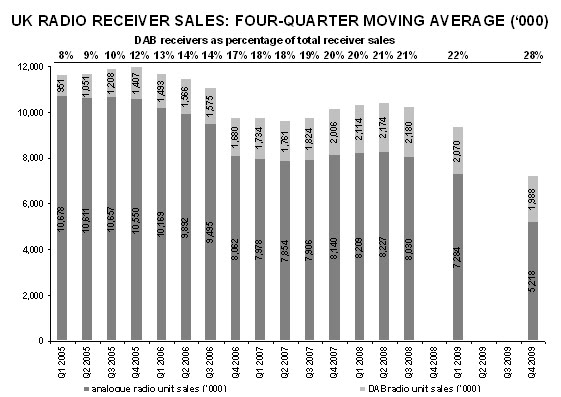
Digital Radio UK is the new organisation funded by the BBC and commercial radio “to ensure that the UK is ready for digital radio upgrade”. In February 2010, Digital Radio UK submitted written evidence to the House of Lords Communications Committee informing it of the latest data for UK retail sales of radio receivers. Amongst other things, the data showed that:

• Sales of digital radios in 2009 were under 2 million units, their lowest annual volume since 2006
• Sales of analogue radios seemed to have dropped dramatically to 5.2 million in 2009 from between 7 and 8 million during 2008
• As a proportion of the total volume of radios sold, digital radios had apparently leapt to 28% in 2009 from 21% only a year earlier.

I was puzzled. Why had sales of analogue radios fallen so dramatically by year-end 2009 (see graph below)? There seemed to be almost no substitution effect by DAB radios, whose volume sales were also down, though not by as much as analogue radios. It appeared as if many consumers had just suddenly decided to stop purchasing radios. I wrote to [*****], the company that [***********************************************] Digital Radio UK, asking why the data had suddenly ‘jumped’ in Q4 2009.

The written response from [*****] was:

“The q4 2009 drop is more about the basket of products included as areas previously included such as set top boxes and portable media players were excluded from the data at that time.”

[*****] defines a ‘portable media player’ as any device that plays music and has a 3.5mm headphone jack: MP3 players, iPods, portable cassette players, portable CD players, etc. From Q4 2009 onwards, when any of these devices are sold in the UK and also include a radio, they are no longer counted as ‘a radio’. Now, every MP3 player sold that includes a radio is simply excluded from these statistics. This is why the number of radios sold appeared to drop so significantly (by around 2m units per annum) in the latest Digital Radio UK data.

Why was this change in definition made? It is hard to understand the logic because a radio within an MP3 player is still used as a radio and has no other purpose. It is a real radio, not a fake radio, but to [*****] it is no longer a radio.

The answer seems to be that a huge number of MP3 players are sold in the UK (value £666m in 2009) but almost none of them incorporate a DAB radio. When an MP3 player does include a radio, it is inevitably an FM radio. MP3 players are manufactured and sold globally by multinational electronics manufacturers who understand that FM remains the universal standard for listening to broadcast radio, while DAB is still confined to no more than a handful of countries. Global manufacturers are reluctant to mass produce an MP3 player incorporating a DAB radio because the sales market would be limited to a few, small territories.

I checked the Argos retail website this week and found it offered 82 models of MP3/MP4 player. None incorporated DAB radio, whereas there were 16 that included an FM radio and 66 that had no radio.

It seems that the last resort for Digital Radio UK to be able to demonstrate to a sceptical public (and increasingly sceptical members of the House of Lords) that DAB radio is ‘taking off’ with consumers is to fix the figures to make it look that way. If you cannot convince the public to stop buying analogue radios, you can ‘bend’ the figures to magically make it appear that the public is buying fewer analogue radios.

Earlier this month, I documented how Digital Radio UK had similarly fixed the same dataset from [*****] to declare in its publicity that “when buying a radio, more than 75% of people choose a digital radio”. This was not at all true. The real fact was that, in December 2009 alone (December always being the peak month for DAB radio sales), 76% of people who bought a kitchen radio bought a digital kitchen radio. That was an attempt to brazenly redefine ‘a radio’ as only ‘a kitchen radio’ so as to exclude clock radios, tuners, in-car radios, boomboxes, etc.

I can only repeat what I said then. However desperate you might be to try and make DAB radio a success, how is it justifiable to deliberately mis-state data so outrageously in print? And to Parliament?

The Digital Economy Bill: let the horse-trading begin, says Shadow Minister

Ed Vaizey MP for Wantage & Didcot
Conservative Party Shadow Minister for Culture
23 March 2010 @ Imperial War Museum North

In today’s radio industry, brands have been shaped more by scarcity of analogue spectrum than necessarily by the market. Brands have been built as much on the frequencies they occupy as much as the characteristics of their content, and commercial revenues have tended to stay limited to local markets.

We very much support the move to digital switchover, both because we believe it is important obviously to upgrade the technology, but because we also think that it will encourage plurality and expand listener choice. We have got to be concerned that people will be ready before any switchover takes place and that there won’t be literally millions of analogue radios which suddenly become redundant. As you know, the government has set a provisional target date of 2015 and we are sceptical about whether that target can actually be met. That is not to say that we are sceptical about digital switchover. We simply think that 2015 might be too ambitious. But we are delighted to see that Ford Ennals is now chief executive of Digital Radio UK, after having steered digital television switchover so successfully, and we hope that all hurdles can be overcome.

We hope that the advent of new digital stations will bring significant new opportunities for independent radio production and it will also free up commercial radio spend. At the moment, as I understand it, the commercial sector spends nearly 10% of its annual revenue on analogue transmission. In the battle for ratings in the new digital world, we would hope that great programming would be at the forefront and that therefore a good proportion of the £40m annual cost of analogue broadcasting will go to independent radio production.

At the moment, the BBC holds four out of the five available national FM licences, and it has the only national digital multiplex. So the aspiration as we move over to digital is as much about making more space for plurality in radio broadcasting as it is about new technology. And if new stations are broadcast, we hope there is plenty of scope for new exciting radio production.

We are also keen obviously not to switch off FM, but to maintain FM as a spectrum particularly for local radio. As you are probably aware, there has been a lot of lobbying during the passage of the Digital Economy Bill about that. I’m pleased to say, as well, that some of the new technology that seems to be coming on-stream, with radios that can switch seamlessly between digital and FM broadcasts, will ensure that there will still be a place for ultra-local FM broadcast stations.

Obviously, many of you will also be interested in what will happen with the Digital Economy Bill as we approach the dissolution of Parliament. My understanding is that the Second Reading will happen on the 6th of April, which I think is also the date that Gordon Brown drives up the Mall to see the Queen to call for the dissolution of Parliament if he wants an election on the 6th of May […] We will have this rather surreal Second Debate in the House of Commons and then we will go straight into what is now called the ‘wash up’ where we horse-trade over the various clauses of the Digital Economy Bill to be passed by the 8th of April. But I can assure you that the deregulation of radio clauses in the Digital Economy Bill have strong cross-party support so, if anything is going to go through, it will be those clauses.

[…]

Q&A

Q: It’s interesting that you touch on digital radio as a platform going forward. Once we find the larger stations, commercial and the BBC, make the switch to digital, and they leave the FM spectrum, do you feel that the majority of listeners will move to digital radio when they vacate their homes, as most cars don’t come with a DAB receiver, so obviously the commercial sector and the BBC are going to be losing listeners because the majority of times listeners tune in to these station is in the car? Furthermore, with DAB, it’s reported and seen by some people in the media/press as being a failed format, competing with new technologies such as DRM. With these changes, do you think that, when people do make the migration to DAB, that smaller stations are going to lose out and that the money from the commercial side is going to be re-invested in programming and we’re not going to lose the quality of the content…

A: Well, I think the problem in the last few years has been a kind of half-way house, so people weren’t really sure what the future of digital radio was going to be, particularly with commercial radios stations that were having to make a double investment which was costing them a lot of money, so we supported the government in making a firm decision that we were going to move over to digital switchover. As I said in my remarks, I think that 2015 might be a bit ambitious.

Your particular point about converting cars to digital radio is, I think, the crucial point. We have got to get to a stage where new cars are fitted – as the French have now mandated, for example – with digital radios and that it gets easy to convert to digital in the car. I think that 2015 is going to be ambitious, but that does not mean that we are sceptical about switchover.

The other point about FM, as against DAB. I think that there will be… There are radios on sale now that switch seamlessly between FM and digital as if you were simply changing channels. I think that, particularly as FM will then be, broadly speaking, a spectrum used by the local radio stations, that won’t be such a problem if you’ve only got a digital radio in your car, as you tend to listen to a local radio station when you’re at home – or you can de-construct that remark. The point you make about whether DAB is the right technology or whether we should be using DAB+, to a certain extent I slightly take the view that we have gone down this road, so let’s leave it. I think the pain of trying to move to DAB+ or beyond will be too much, given how far we’ve come.

Q: I also found it quite interesting that you had the idea that there were going to be more digital-only services. In the past, we have seen digital services such as Capital Life and Core which have come and now gone again because they were not commercially profitable. Do you think that is not going to have an impact when most people make the migration to DAB? Do you think that the local full-scale FM operators are going to suffer?

A: Er, well, er, I hope that they won’t. There will be a distinction between national or big regional radio stations and local stations, and there is already a distinction between local and community which is ultra-local. As I say, we want to put in place a platform that will also enable cross-media ownership at a local level that will enable local media companies to create scale. So, what I hope is that, across the range of media. there will be opportunities for any good radio station that is likely to command a loyal audience – whether that be an ultra-local audience, a regional audience or a national audience – because, in terms of Capital Radio coming and going, I think that was frankly a symptom of that we were in a half-way house about digital. We need to drive digital, which I think is now underway.

[…]

Government: digital radio switchover in 2015 “still on track”

Tony Lloyd MP Manchester Central
Chair of the Parliamentary Labour Party
23 March 2010 @ Imperial War Museum North

One of the commitments that the government has already made is the switchover to digital [radio]. That will go ahead, although it will go ahead dictated by the pace of change that the markets themselves will involve. You know the ground rules for that. I was talking to a multimedia producer who just tells me she can’t get digital radio in her own home. Now this is still one of the big issues because, until we have got 90% coverage of the country and until we see something along the lines of 50% of people using digital, that switchover won’t take place. But all the evidence is that we are still on track for that switchover to take place by 2015.

The second debate within that is how is that paid for, how far will the commercial sector – the commercial radio stations – be prepared to pay to invest in the digital networks and how far will the BBC contribute? Because what is clear is that there always will be a role for the BBC to fund because there will be parts of the country where the commercial sector simply won’t take that process forward.

We know that the analogue [radio transmission] system, even if we do nothing at all to maintain it, will require investment of the order of £200m simply to keep the existing networks up and running and that money frankly is better spent on the switchover to digital and, of course, there will be consequential changes in terms of the licensing framework at the point of switchover.

[…]

This government, the Labour government, once re-elected, probably on May 6th ….

The DAB challenge: most radios stay tuned to one station most of the time

A ‘thought piece’ by Ipsos MediaCT, entitled ‘The Future of Radio’, identified the many challenges for the government’s proposed digital radio switchover to be successfully implemented by the 2015 target date:

• digital listening share has to more than double in just four years
• the UK’s DAB coverage [..] is currently around 90%, but there is now the need to extend it across all the UK population
• a requirement to improve the quality of [DAB] reception and sound
• the issue of people having to replace their analogue radio sets
• less than 1 in 10 of these [existing radio] sets is DAB, so a very significant number of replacements need to be sold
• all manufacturers are committed to producing sub-£20 sets in the next two years
• more digital radios need to be fitted in new cars and more digital converters need to be sold for existing cars
• take-up of digital platforms has been steady, but not remarkable
• digital listening has a long way to go to meet the Government’s targets
• there are a number of barriers to overcome to meet the demands of the Digital Britain Report, which require investment – in a recession – and co-operation between manufacturers and broadcasters
• DAB will have to be marketed properly and quickly

A Capibus study conducted by Ipsos found that a high proportion of radio receivers were tuned to the same station most of the time:
• 86% of kitchen sets
• 79% of bedroom sets
• 74% of living room sets
• 70% of car radios

Ipsos asked:

“What happens when the switchover occurs and the station now only broadcasts on DAB? Do listeners go out and buy a new DAB set for each room in the house or switch their listening to another station or stop listening? This will be a major issue for stations and their audiences. It will be the listener who will be in control of radio’s digital destiny.”

DAB converters for portable analogue radios? It’s a “no no”

All of us would like to invent a ‘killer application’ that could captivate consumers with its usefulness, change the future direction of technology, and make millions. But there is a big difference between inventing one in our heads and turning it into a technical reality in the marketplace.

The converter/adapter that is able to magically transform a portable analogue radio into a DAB radio is one such invention. It exists in the heads of the DAB radio lobby as a means to persuade politicians that mass consumer conversion to DAB is a possibility rather than a pipedream. Unfortunately, it does not exist in reality.

When the notion of such a converter was mentioned last year, I examined the analogue portable radios scattered in almost every room of our home. The only access to their internal electronics that some of them allow is via a headphone socket – and when you insert anything into that, the loudspeaker cuts out. So how exactly could any kind of gizmo be ‘added’ to such radios to transform them into DAB?

My doubts were confirmed when Intellect, the trade organisation that represents UK radio receiver manufacturers, wrote to Parliament in February 2010 and stated: “Whilst it is technically feasible, there are currently no products on the market that can adapt an analogue radio to receive DAB signals.”

Subsequently, Laurence Harrison of Intellect presented evidence in person on this issue to the Lords’ Communications Committee: “A converter would have to include within it pretty much all the components, bar the speakers, of a standard digital radio anyway. Therefore, the cost differential for a converter will be minimal between that and just buying a new digital radio.”

The converter is a prime example of the radio industry’s current pre-occupation with technology being the answer to its problems. Last week, Steve Orchard (former group programme director of GWR, former operations director of GCap) wrote an opinion piece which proclaimed: “DAB is vital to commercial radio’s future.” What?? Sorry?? Surely, it is ‘content’ which is vital to the future of commercial radio, just as it always has been, and just as it always will be. Content = listening = advertising = revenues = profit. Whereas: DAB = platform = infrastructure = investment = risk.

The radio industry desperately needs a strategy that focuses on producing content, rather than focusing on DAB. We already have platform businesses such as Arqiva whose function is transmission infrastructure such as DAB and FM; and we already have consumer electronics companies that produce radio receiver hardware. I don’t see Arqiva or Roberts trying to produce radio shows, so why does the radio industry so desperately want to control platforms and invent hardware?

As ever, the challenge for the radio industry is to create content that is sufficiently compelling, regardless of the platform. Consumers gravitate to content, whatever platform that content is on. The history of radio has demonstrated this time and time again. For example:

• 90% of the population listen to analogue radio for around 20 hours per week (on FM and AM platforms that the radio industry has lobbied to have shut down)
• BBC Five Live and TalkSport attract 5% and 2% shares respectively of all radio listening, despite being broadcast on AM (a platform that commercial radio lobbied the regulator in the 2000s to write off for mainstream formats)
• Pirate radio with poor FM reception continues to attract significant audiences in cities (stations which the radio industry has long lobbied to be shut down, despite itself not offering consumers any comparable content)
• Atlantic 252 attracted a 4% share of all UK radio listening in 1994, despite broadcasting from Ireland on Long Wave (a platform the BBC tried to shut down in 1992)
• Ricky Gervais’ radio show remains the most downloaded podcast ever, despite never having been broadcast and only ever having been made available as an online download (a platform largely ignored by commercial radio).

Sometimes, it seems that parts of the radio industry have stumbled so far away from their core product, content, that the eventual outcome might even be (to adapt Steve Orchard’s comment): ‘DAB is a vital part of commercial radio’s death’. The sector’s profitability is already zero. This is no time for distractions that will not directly put bums on seats.

The quotes below offer more detail on recent dialogue concerning the mythical DAB adapter.
…………………………………………….

“For customers who don’t want to buy a new radio set, it will be possible to convert existing sets to digital instead. An adaptor device will come onto the market soon that will cost around £50 and, in time, conversion may cost less than a new radio set.”
Digital Radio UK
2 December 2009
……………………………………………

House of Lords
Select Committee on Communications
20 January 2010

Witnesses:
Ford Ennals, Chief Executive, Digital Radio UK
Barry Cox, Chairman, Digital Radio Working Group

Lord Gordon of Strathblane: There is, I might suggest, a vital difference. It is comparatively easy and cheap to convert a television set to digital with a set-top box that you can buy from Tesco for £20. Can you do that to an analogue radio set?

Mr Ennals: I fully expect that there will be low-cost converters available. We were talking to companies which were making these last week, and they are talking about DAB adaptors for about £20 or £25. When the DTT Freeview development started, those products were costing over £100. The market will become more competitive, prices will come down. You can replace your radio for £25 with a digital radio. There will be a burden of cost on the consumer, but it is significantly more affordable than it would have been in the past.

Lord Gordon of Strathblane: If it is as cheap to buy a new digital set as it is to buy a converter, there is a fair disposal problem involved in 50 to 100 million radio sets that are good to go to the rubbish dump.

Mr Cox: There is undoubtedly a difference with television because you can keep your old set and put the adaptor on it. I heard what Ford was saying, and it would be useful if some adaptors come on the market, but the likelihood is that many of those analogue sets will have to be disposed of.
……………………………………………

Intellect [UK trade association for the electronics industries]
Written evidence to the House of Lords Communications Committee
1 February 2010

“Converting analogue radios to digital:
Whilst it is technically feasible, there are currently no products on the market that can adapt an analogue radio to receive DAB signals. Our members would undoubtedly produce such devices should a clear market demand ensue following the passing of the Digital Economy Bill.
However, simply adapting an analogue product will not allow listeners to enjoy the full range of benefits that DAB can offer. With some entry level digital radio receivers costing as little as £25, adapter devices are likely to cost more than digital receivers at the start.
……………………………………………

House of Lords
Select Committee on Communications
24 February

Witness:
Laurence Harrison, Director, Consumer Electronics, Intellect

Lord Gordon of Strathblane: What about converters for what are known as ‘kitchen’ sets? [….]

Mr Harrison: Converters – if you like, a set-top box for an analogue radio – are technically possible. I think we need to look at just how appealing that would be for the listener. A converter would have to include within it pretty much all the components, bar the speakers, of a standard digital radio anyway. Therefore, the cost differential for a converter will be minimal between that and just buying a new digital radio.

Lord Gordon of Strathblane: So they are not going to fly off the shelves?

Mr Harrison: It will depend on just how much the individual values their analogue set. Of course, converters would also come into play if you are talking about, for example, a large expensive hi-fi system; they would work for that, and if you like the sound quality of that hi-fi then a converter may be an option, but I do think we need to be careful, purely because we know that the price differential, for example, will not be that great between a converter and a standard digital set.

Lord Gordon of Strathblane: So for big, stand-alone hi-fi sets with colossal speakers and everything else it might make sense but for the small ‘kitchen’ portable a no no?

Mr Harrison: We know that some manufacturers are looking at the possibility of introducing a converter, so it may well be that some of those do come to market. I just think for the context we need to be aware of what that converter will look like, and how appealing it may be. I think your assessment is correct.

[…]

Lord Maxton: There is a major difference; with your existing television all you need is a box.

Mr Harrison: Indeed.

Lord Maxton: A converter, basically. With radios that is not the case.

Mr Harrison: That is true.

Lord Maxton: You do not have to get rid of the televisions but you do have to get rid of the radios.

Mr Harrison: That is absolutely true. All I would say on TVs – you are absolutely right and I do not want to downplay the situation at all ……

Lord Fowler: “There will be a public outcry if we get the radio digital switchover wrong. There could be a very big row indeed about this.”

The Digital Economy Bill was debated in the House of Lords this week in its ‘Report Stage’. Once again, amendments that had been proposed specifically to take into account the views of listeners and small radio stations were rejected by the government. As it stands, the Bill only requires Ofcom and the BBC to be consulted before the government can take a decision about switchover from analogue to DAB radio.

Parallel with the progress of the Bill through the House, Lord Fowler has been chairing a separate Select Committee on Communications inquiry into digital switchover. Through its weekly meetings, where it has collected copious evidence from witnesses, it must be becoming increasingly obvious to the Committee that the government plan for digital radio switchover is an undignified mess. Lord Fowler’s growing displeasure with this situation surfaced during Debate of the Bill:

“I do not intend to pre-empt our [Committee] report, but I must say that it is generally a very important issue with the public and that there will be a public outcry if we get the radio digital switchover wrong. There could be a very big row indeed about this. …. I think I probably speak for the committee when I say that there is public confusion at the moment about what exactly the plans mean to the individual consumer, and I cannot believe that that is a sensible way of proceeding.”

The government’s frosty response, delivered by Lord Davies, conveys everything:

“[Lord Fowler] told me, as if I did not know, that there could be the most enormous row if this switchover went wrong.”

The government simply refuses to listen to commonsense on this issue, even from the chairman of the Lords Communications Committee. As a result, a “very big row” about digital radio switchover is indeed inevitable, probably at Easter, and more so following publication of the BBC Strategy Review.

Here is the ‘radio’ part of the debate in full:

The House of Lords
Parliamentary Debate
3 March 2010

Digital Economy Bill
Clause 30 : Digital [radio] switchover

Amendment 137
Clause 30, page 36, line 33, after “to” insert —
“(a) ”

Amendment 138
Page 36, line 35, at end insert —
“( ) the needs of local and community radio stations; and
( ) the needs of analogue radio listeners”

Lord Howard of Rising: My Lords, I tabled Amendments 137 and 138 again simply to get more detail from the Minister, as his assurances about these points were not wholly convincing. The amendments would give the Government an explicit requirement to take into account the views of radio listeners and local and community stations. The Minister argued that this was unnecessary because of the breadth of the requirements to consult that are already proposed and the commitment to consult widely. The problem with such vague assurances is that they can be quickly forgotten. The [Bill] currently states that the views of the BBC and Ofcom should be given due regard before the Secretary of State nominates a date for the digital switchover. It does not say too much about consulting widely or taking into account in any way those who are most affected by the switchover — the listeners. I hope the Minister can give more encouragement that the listener will not be forgotten in this whole process. I beg to move.

Lord Clement-Jones: My Lords, I commend the amendments, which are a very constructive way of seeking further assurance from the Minister. Indeed, they very much reflect the concerns that I expressed from these Benches in the Clause 30 stand part debate in Committee. Assurances about the future of analogue radio in particular are so important. The noble Lord, Lord Young, and I engaged in a slightly semantic conversation about whether FM’s existence would be perpetual or whether it would simply be there for the long term. I think the assurances were that it would be there for the long term, which did provide some reassurance. However, the interests of the ultra-local stations and the consumers of the product of those stations are extremely important, and I very much hope that the Minister can cast more light on the future of analogue in the face of the digital switchover.

Lord Fowler: My Lords, I congratulate my noble friend on the amendment — I am now rowing back frantically — on a very important issue. It is so important, in fact, that the Select Committee on Communications is currently engaged in an inquiry on precisely this — the digital switchover — although a number of reasons have been adduced as to why it should be called not a switchover but various other names. I do not intend to pre-empt our report, but I must say that it is generally a very important issue with the public and that there will be a public outcry if we get the radio digital switchover wrong. There could be a very big row indeed about this. My only reservation about the amendments is that I can think of quite a number of other issues on which I would like the Government’s assurance. There are, for example, 20 million car radios out there. What will happen to those? How will they be converted? What are the plans? There are so many issues here that either we will have a totally comprehensive list or we will simply have to ask the Minister at this stage for his current views. I think I probably speak for the committee when I say that there is public confusion at the moment about what exactly the plans mean to the individual consumer, and I cannot believe that that is a sensible way of proceeding. My noble friends on the Front Bench have raised a crucial issue to which we will have to return again, and very soon.

Baroness Howe of Idlicote: My Lords, I absolutely agree with what has been said so far. This is one of the greatest eye-openers. As we have proceeded with this Bill — particularly as it has run parallel to the deliberations of the Select Committee which the noble Lord, Lord Fowler, is chairing so ably — we have come to realise just how important radio is to so many people, whether to the disabled or to all of us, listening as we do for a vast amount of our time to the radio. However, this is clearly one of the areas in which there is still a need to reassure people locally. The idea was that analogue transmission could be switched off once 50 per cent of listening is to digital radio. Then there was the business of how long FM would be available once it is more or less accepted that there will be a change. As regards the production and selling of cars, the issue is when there will be sufficient technology to convert radios already in cars and to convert some DAB radios to the right level. No one is trying to argue for a moment that the quality of digital radio will not be valued. But getting to that point will need a lot of reassurance to citizens. I would be grateful, as would I am sure other noble Lords, for further reassurance from the Minister that FM will be available ad infinitum, but certainly well beyond the point of switchover. That would do a great deal to reassure noble Lords who have looked into all this. But much more importantly, the citizens and the consumers — I come back to them because I am looking at this issue from both viewpoints — are crucial. I hope that the Minister will be able to give that reassurance.

Lord Gordon of Strathblane: My Lords, I do not have any problem with the sentiments behind the amendments. The only problem is that if those points are listed, it would look as though that is what the Government or Ofcom should give priority to, but they are only three of a myriad number of conditions to which they must give attention. Specifying that is almost counterproductive.

The Lord Bishop of Manchester: My Lords, I rather echo that point. In Committee, I expressed, as did many noble Lords, concerns about local and community radio stations and about the extension of FM. These are very important matters, but as other noble Lords have indicated in this short debate, there are other areas as well. In all this, I hope that we will continue to recognise that, while it has often been said that the switchover for television has gone very smoothly, the complexities in relation to radio are far greater. While supporting so much that lies behind these amendments, it would be a great shame, in a sense, to wreck it by omitting rather than being inclusive.

Lord Davies of Oldham: My Lords, I am grateful to all noble Lords who have spoken in this short debate, particularly the right reverend Prelate the Bishop of Manchester and my noble friend Lord Gordon, for identifying the weaknesses of the amendment and the nature of the issue on which the Government need to take care. Perhaps I might say that if I was not going to take care after the Opposition Front Bench and the noble Lord, Lord Clement-Jones, had spoken in support of the amendment, I certainly was after listening to the noble Lord, Lord Fowler. First, he told me, as if I did not know, that there could be the most enormous row if this switchover went wrong. I could not agree with him more and I accept entirely what the right reverend Prelate has said. The switchover from analogue to digital for television is much easier than this exercise because of the diversity of radio opportunities and provision. But the noble Lord, Lord Fowler, produced an even greater anxiety for me when he mentioned car owners. He is right that we would not dare to get that wrong. I know that we are not far from a general election, but the idea that the Government are about to alienate 20 million car owners by telling them that their radios are defunct, out of date and will not work is somewhat unrealistic. The conversion of car radios is an important point that has to be established before a digital switchover could conceivably be considered a success. We have been clear that an affordable in-car converter is key to the success of digital radio switchover. There are already devices on the market which will convert an FM car receiver to receive DAB. One would predict that this market will expand very rapidly. Very few markets move quite as quickly as the car accessories market, which helps to guarantee the sale of cars. That point therefore will be taken into account, as will the other points about the importance for the Government of effective consultation before such a switchover could take place. We have made clear that, for the foreseeable future, the Government will consider FM radios to be part of the broadcasting firmament. Radio stations will want to combine to broadcast on FM to take account of the points that the right reverend Prelate drew to the attention of the House. What date will all this be effected? That is a pointed and precise, but nevertheless very difficult, question. We have indicated that 2015 is ambitious, although it is achievable. If we do not set a target, there is no stimulus to all those who can make a contribution to effecting this successfully to get to work and do so. So we want a date and have identified 2015, but we recognise that it is a challenge. However, we accept the concept behind the amendments; namely, that the fullest consultation will be necessary. Otherwise, the almighty row anticipated by the noble Lord, Lord Fowler, will descend upon the Government who get it wrong. Why do I resist the amendments, as we did in Committee? It is simply because consultation is written into the Bill already. We could not dream of going forward or of proposing that the Government could go forward with an issue of such significance to our people without the fullest consultation in order to guarantee that we do not fall into those dreadful traps to which noble Lords have called attention. Again, I am grateful to the Opposition Front Bench for drawing our attention to the necessity for care and consultation. That is part of the Bill and the amendments are unnecessary. Having stimulated a further debate, after the extensive one we had in Committee, I hope that the noble Lord will withdraw his amendment.

Baroness Howe of Idlicote: My Lords, can the Minister clarify the point about which a lot of people are concerned; namely, that whenever the point of switchover occurs, FM will continue beyond that point? A lot of small operators are very concerned about that.

Lord Davies of Oldham: My Lords, I wanted to indicate that. If I did not make it clear enough in my reply, we see FM continuing, but we also see the kind of criteria that will be necessary before we begin the process of significant switchover. As I have indicated, the Government will move with the greatest care with regard to this issue, as we have with television switchover. Noble Lords will know of the care that we have taken to make sure that groups who might not be able to make that switchover effectively because of limited resources are given support. Radio is much more complex and difficult, as the right reverend Prelate made clear. The Government are fully seized of that, which is why consultation is written into the Bill on this issue.

Lord Howard of Rising: I thank the Minister for his comments, and I thank my noble friend Lord Fowler for his support. I was delighted to hear some support from the noble Lord, Lord Clement-Jones, after the sandbagging that I received from the noble Baroness, Lady Bonham-Carter. Having raised the issue and heard how sympathetic the Minister is to the potential problems — even though he dodged with his customary skill committing himself specifically to consulting listeners — I beg leave to withdraw the amendment.

Amendment 137 withdrawn.
Amendment 138 not moved.

[the Report Stage of the Digital Economy Bill continues in the House of Lords on 8 March 2010]

Car industry: “gaps in digital coverage are a major deterrent to [the] introduction of digital radios”

The Society of Motor Manufacturers and Traders [SMMT], representing 500+ companies in the UK car industry, has submitted written evidence to the House of Lords Communications Committee inquiry into digital radio switchover. Its members have itemised a number of concerns about the practicalities of the government proposal that all new cars be offered for sale with DAB radios by 2013:
• “the apparent perception that the markets for in-vehicle radios and domestic radios are similar, if not identical, and that any assumptions about the speed of take up can be applied to both markets
• the timeline for adapting the existing vehicle parc [cars already on the road]
• the continued availability of traffic information after 2015 to those driving vehicles which are not digitally-enabled
• the extent of radio transmitter coverage
• the need for broadcasters to promote the advantages of digital radio to consumers to create demand
• safety and security issues arising from the use of digital convertors
• the need for pan-European approaches to the introduction of digital radios in vehicles.”

The key issue raised by SMMT concerning the necessary robustness of DAB in-car reception across the whole of the UK would require a massive investment from the radio industry to rectify:

“SMMT members are clear that the gaps in digital coverage are a major deterrent to their introduction of digital radios as standard equipment. As outlined [below], any vehicle manufacturer bears the reputational risk if a radio in one of its products appears not to work properly. Drivers have become accustomed to the gradual deterioration in FM reception which occurs throughout parts of the UK and recognise this is not the fault of their radios. At the present stage of digital roll-out, shortcomings tend to be blamed on the vehicle manufacturer.

SMMT members therefore welcome the statements in the [Digital Britain] report that:
• one of the criteria for deciding the date of the Digital Radio Upgrade will be whether national DAB coverage is comparable to FM coverage and that local DAB radio reaches 90% of the population and all major roads
• the BBC should begin an aggressive roll-out of the national multiplex to ensure that its national digital radio services achieve coverage equivalent to FM by 2014.

However, there is also a need for a plan to enable reception on those stretches of road, primarily tunnels and long underpasses, where reception goes ‘dead’ for a short period. At present, for instance, FM coverage in the Dartford Tunnel is addressed by special measures. In shorter tunnels, the FM signal tends to deteriorate but not disappear, whereas the digital signal disappears entirely.

SMMT noted that:

“There appears to be an assumption that the market for in-vehicle radios and that for domestic radios have similar, if not identical, features. In fact, they differ in five main ways:
• in the automotive market, the vehicle itself, not the radio, is the reason for the purchase
• vehicles are required to undergo an approval process which is far lengthier than any applying to consumer goods
• the sizes of the two markets and their dynamics are vastly different, where customers purchase new radios more frequently than they do vehicles
• if a radio in a vehicle fails, or even only appears not to work properly, blame is attached to the vehicle manufacturer, whereas the reputational risk if a domestic radio fails is borne by the radio manufacturer
• in automotive applications, the radio is not static. It moves between transmitters and, therefore, complete and national coverage of the digital radio network will be required.”

SMMT’s concern for new cars is that:

“meeting a deadline of 2013 will be a challenge for vehicle manufacturers who began product development in 2009, but we expect it to be achievable. A bigger challenge is represented by those models already on the market or most of their way through the development cycle, where the manufacturers will have to decide whether to divert engineering resources to the task of digitally-enabling them or provide new vehicles with digital convertors.”

SMMT’s concerns for the cars already on UK roads are:

• “The [Digital Britain] report suggests that the majority of the vehicle parc should be converted to digital by 2015, with low-cost convertors for the remainder.
• Vehicle manufacturers are certain that retrofitting of digital radios on a large scale is impractical. Vehicles’ electronic systems have become increasingly integrated; often, the radio is part of this integration and cannot easily or economically be replaced. A radio has to operate in the vicinity of sensitive electronic components, and poor integration has a detrimental effect on other systems.
• Retrofit also affects the perceived quality of the vehicle:
          *  antennae have to be chosen very carefully – reception from an internal antenna may be poor if a vehicle is fitted with infra-red reflection glass, or if a magnetic antenna base is fitted to an aluminium body
          *  poor refitting of trim items removed to permit a retrofit will cause rattles.
• Drivers will, therefore, be reliant on the use of digital convertors to enable continued use of their analogue radios after 2015. As vehicles have very long lives, most of the vehicles first registered since 2006, if not earlier, will still be in use in 2015. It is likely that over 20 million vehicles will have to be so fitted, and very likely that most of the necessary sales will be made in the few months before the date for digital migration. The commitment for a cost:benefit study to be conducted before any digital migration date is announced is therefore welcomed by vehicle manufacturers because it should firmly identify the progress made towards digitally-enabling the car parc.”

The message from the car industry seems clear – why should they risk their reputations by installing DAB radios that will suffer poor reception due to lack of a robust DAB radio transmission system in the UK?

The bigger question is – why would consumers pay extra for a DAB car radio that offers increasingly little additional mainstream content over a standard FM radio?

Digital radio switchover: a Broadcasting Minister’s last day: "there is nothing that I am trying not to say"

Apologies: this is an extremely long blog entry. I suggest it is worth persevering with because, more than any other ministerial statement, the transcript below illustrates perfectly the government’s mistaken determination to press ahead with its policy to adopt DAB radio. During the weeks it has been sitting, the House of Lords Communications Committee has become increasingly adept at understanding the flaws and contradictions in the Digital Economy Bill’s radio clauses, which is why their dialogue here with the Minister crackles with suspicion.

Siôn Simon handles his government script with the aplomb of a dodgy used car salesman, combined with the smug self-satisfaction of a schoolboy who can proffer a verbal comeback to any question asked of him. In December 2009, Simon had to repay £20,000 in parliamentary expenses for a second home he was renting from his sister between 2003 and 2007. Embarrassingly, the Broadcasting Minister reveals here his mistaken belief that the government’s proposed 2015 digital radio switchover date is written into the Digital Economy Bill. It isn’t.

I could itemise the many flaws in the Minister’s replies to the Committee’s questions, but it would spoil your reading fun. Your starter for ten – Halfords does not stock DAB radios.

House of Lords
Select Committee on Communications
“Digital Switchover of Television and Radio In The UK”
10 February 2010 [excerpt]

Witnesses:
Mr Siôn Simon, a Member of the House of Commons, Minister of State for Creative Industries
Mr Keith Smith, Deputy Director, Media in the UK, Department for Culture, Media and Sport

Chairman: Good morning. Thank you very much for coming, you are very welcome to the Committee. Now, Mr Simon, you are the Broadcasting Minister.

Mr Simon: For the moment, until the end of today.

Chairman: Well, that is what I was going to raise with you. How long have you been in this post?

Mr Simon: I have been in this post since, I think, the beginning of June last year and today is my last day, so this will be my final appearance before a Select Committee and I am looking forward to it tremendously.

Chairman: Well, before you look forward to it too immensely, let me ask you a question, and I ask the question because, on my reckoning, there have now been five broadcasting ministers since May 2006. That is a very high turnover. Do you think that these frequent changes help in making policy?

Mr Simon: I think I should have been appointed in 2005, but —-

Chairman: But Number Ten actually omitted to do so?

Mr Simon: They omitted to do so and, as you know, you will have to ask the Prime Minister about the appointment of ministers because that is his decision, not mine.

Chairman: Well, the resignation of ministers, on the other hand, is very much in the hands of ministers, is it not? You are not even going to take the Digital Economy Bill through?

Mr Simon: I have had great enjoyment and satisfaction dealing with it as it has been through all the various stages of consultation with stakeholders across industry and Parliament since I inherited the White Paper. The White Paper was published the week I was appointed, the Digital Britain White Paper.

Chairman: By your predecessor who also only lasted a year.

Mr Simon: I think he did an outstanding job actually, I must say. Having come in and inherited his output, I think Lord Carter did a very, very sophisticated, subtle and impressive job across a whole range of industry sectors.

Chairman: At any rate, you enjoyed it so much that you are not going to stay for a couple of months?

Mr Simon: It has been an absolutely tremendous pleasure and privilege. I think it is one of the best jobs in Government. I have lots of reasons that I am stepping down as I am deciding to do other things and I am also stepping down from Parliament.

Chairman: What are the other things you are going to do?

Mr Simon: I am going to run, if I can, to be the first elected Mayor of Birmingham, which will probably be a couple of years, but is a job worth doing and worth planning for.

Chairman: Well, as a Birmingham MP for 27 years, I am probably the person round this Committee who has most sympathy with that ambition, although I do not think the job actually exists, let alone you are going to win it. Quite seriously, do you really think that these swift changeovers of ministers actually do the policy process any advantage?

Mr Simon: I do seriously have to tell you that I am a junior minister and junior ministers, as you know with all your experience, are not responsible for the appointment of ministers, the policy towards the appointment of ministers or the length of tenure of ministers. You need to take that up with the Prime Minister; it is not a matter for me.

Chairman: Well, I doubt very much whether the Prime Minister is going to agree to come to this Committee, given all the other things he has got on his mind just at this period in Government, but never mind.

Lord Maxton: Do we know who your successor is going to be?

Mr Simon: I do not know.

Lord Maxton: Presumably, somebody will have to be appointed this afternoon if you are going this afternoon?

Mr Simon: Again, it is a matter for Downing Street, not for me or officials.

Chairman: So you are going this evening and we do not know who is going to take your place?

Mr Simon: I think it is fairly common procedure that it is after the one minister has resigned that the next one is appointed, so I assume there will be an announcement from the Prime Minister in due course about what arrangements will need to be made.

Chairman: Okay, I do not think we are going to get much further on this particular path. Let us ask you about the digital switchover. This is a short inquiry that we have conducted and most complaint, I think, has been about radio. There seems to be enormous uncertainty amongst the public about what is happening and indeed what the case for radio switchover is. We have just been talking to consumer groups and, just to give you some flavour of what they said initially, one said he could not see any advantage, another said it was difficult to see what the benefits are and a third said that they were concerned about the expense of throwing away sets, and I think that is one of the issues that has come through from some of our correspondence as well. What would you say are the advantages of digital switchover as far as radio is concerned?

Mr Simon: I think there are several advantages. Firstly, digital has practical and technical advantages of benefit to the consumer, so there is a whole range of extra functionality and interactivity that you get from a digital radio set that you will not from analogue. It is also the case that the FM infrastructure, the transmission infrastructure of FM, is ageing, FM is an old analogue technology, and the likelihood is that in the medium term the question will arise anyway of whether this infrastructure can economically be renewed and the likelihood is that it probably would not be economic to renew this infrastructure. What you would be faced with in that case would be a piecemeal disintegration of the FM infrastructure in a disorderly way and an inevitable move by the market towards digital. What the Government is, therefore, doing is trying to help manage this move in an orderly and efficient way.

Chairman: So what would you say to the member of the public who has written a not untypical letter to us in which he said, “We have acquired a large number of FM radios over the years, all of which work perfectly. Five of these are used regularly in different rooms. Why should we ditch these for no good reason?”?

Mr Simon: Well, firstly, they will not necessarily have to ditch them; it will depend what services they are using them to listen to, and it may be that there are different members of the family using different sets in different rooms at different times to listen to different services. It is reasonable to assume, therefore, that in a typical family some of those sets in some of those rooms will be used to listen to the kinds of local commercial services or community radio services which will remain on FM, indeed which will be expanded and have their presence secured on FM and remain available. Now, clearly it will be the case that, in order to listen to major national or large regional broadcasters after 2015, consumers will need some kind of upgrade to listen to digital. It is very likely that a relatively cheap, small add-on which converts an analogue set to a digital set will become available before the switchover date. We are talking to manufacturers, and I cannot guarantee what manufacturers will manufacture, but we think it very likely that a small, cheap converter will be available and people will purchase over time new sets.

Chairman: Well, we will come to that point. Can I just ask one broader point though than that. Ofcom commissioned a cost-benefit analysis of digital radio migration from Price Waterhouse. That report found that the benefits might outweigh the costs only after 2026. Is that the basis upon which you are planning as well?

Mr Simon: I think that the report that Ofcom commissioned was into the recommendations of the Digital Radio Working Group, which were different from those which eventually made it into the Digital Britain White Paper and the Digital Economy Bill, so, to be honest, it is not really a straight comparison because the Price Waterhouse report was not into what is going to happen, it was into a different set of recommendations by a different group.

Chairman: I hear what you say, but why has the Price Waterhouse report not been made public?

Mr Simon: Clearly, there has been a little bit of difficulty about this. There is no sense at all in which it was intended not to be made public. It is now on the DCMS website. It should have been on the DCMS —-

Chairman: In a redacted, blacked-out form.

Mr Simon: I believe that the form that it is in on the website is redacted to remove commercially sensitive information, which is the usual practice with commercially sensitive information, but I am told that the Committee has been supplied with an unredacted version by Ofcom, and any stakeholders who have asked for a copy have been sent a copy. We should have put it on the website more quickly. There were technical difficulties to do with the report not having been written internally and being supplied in the wrong format and so on which meant that it did not get on the website. There has been no intent whatsoever, and there is no intention, to keep private the report.

Chairman: Well, we, I gather, have received the report this very morning, so we obviously have not looked through it yet

Lord St John of Bletso: I noticed in the written evidence from DCMS that one of the challenges of the digital radio switchover will be converting the occasional radio listener rather than the avid listener who has already invested in DAB sets. There has been also a commitment to a further cost-benefit analysis of the digital radio upgrade. What is the timetable of this proposed new cost-benefit analysis, and will you wait for the outcome of this analysis before taking further decisions to go forward?

Mr Simon: I think the commitment with the digital radio upgrade is for a full impact assessment and a cost-benefit analysis particularly of the need for, the case for and the design of a possible digital radio help scheme. As to the sense in which there is a cost-benefit analysis of the whole programme, rather than a kind of discrete piece of commissioned work, like the report we were just talking about, this would be a constant, ongoing process of review which is starting this year and will be constantly reviewed, measured and updated as the programme unfolds.

Lord St John of Bletso: We have, as I understand it, 90 per cent still on analogue and ten per cent on digital, but have you estimated the effects of the costs and revenues to the different radio stations and the bodies arising out of digital migration, and how will profitability change and who will benefit? That is really what we are trying to get at.

Mr Simon: I think the percentage already listening on digital is higher than that, I think it is more like 20 per cent, and we are committed to not switching over until listenership on digital is at least 50 per cent and coverage is at least comparable to FM, which would be 98.5 per cent. Can you just tell me a bit more as I was not quite sure exactly what you wanted in your subsequent question?

Lord St John of Bletso: It was just the phasing of the transfer as far as not just the timing of the cost-benefit analysis, but what the effects would be and the costs and revenues for the different radio stations and others.

Mr Simon: The intention is that the radio market be much more distinctly than it currently is organised into three distinct tiers, so a national tier at the top, which would be digital, a large regional tier, which would also be digital, and then at the lowest end a local tier, which would be small, local commercial broadcasters and community radio stations who would remain on FM. The effect would be that some currently medium-small commercial broadcasters would probably grow their broadcast areas and migrate on to digital. Some of that size could potentially shrink slightly and stay on FM, the underlying dynamic being that it is much cheaper to stay on FM than go on to digital, and there would be small commercial broadcasters for whom it would not be economic to migrate to digital which has inherently a much bigger footprint.

Lord Maxton: I am not quite clear where the BBC would fit into that because they provide national and local services.

Mr Simon: If I may say so, my Lord, that is a very good question and the answer is that in the crucial matter of building out extra transmitter infrastructure so that the coverage of digital matches by 2015 the current coverage of FM, which is about 98.5 per cent of the country, the assumption is that the commercial sector and commercial operators would fund that build-out as far as it was commercially and economically viable, and then the assumption is that the BBC, with its obligation to provide a universal service, would fund the probably seven or eight per cent of the build-out which was not commercially viable.

Lord Maxton: But they were only talking about 90 per cent, the BBC were last week.

Chairman: Is it going from 90 to nearly 100 per cent?

Mr Simon: Very roughly. It is between 90 and 98.5 which, it is assumed, would not be commercially viable.

Chairman: But you are assuming that the cost of that will be taken from the licence fee?

Mr Simon: I am assuming that the BBC would be building those transmitters. We are talking about a cost of probably between £10-20 million a year.

Chairman: So it would be taken from the licence fee?

Mr Simon: I think the assumption is that the BBC would be able to absorb that within its current budgets.

Chairman: Well, the BBC said to us that actually they would like to talk to you about the licence fee, so there may be a constructive dialogue to be had there!

Lord Maxton: Obviously, what you are saying does imply a fairly major restructuring of the radio industry. I assume you are going to be consulting on this, are you?

Mr Simon: We are, and have been, consulting continuously. I have had two summits with small commercial operators who, at the beginning of the process of talking to them, were a bit concerned.

Lord Maxton: Can I link this to one of the Government’s other quite right policies, which is extending broadband to everybody. Where does that fit into radio because it seems to me that people are already selling internet-available radios so that you can pick up radio stations from wherever?

Mr Simon: It is all part of the same, I think, pretty relentless drive towards digital, but they are different strands of the same broad movement rather than being directly interlinked or dependent, so internet radio listenership forms part of the digital radio listenership, but it actually forms a very small part of the digital radio listenership and there is still a case and a clear need for an explicitly transmitted-over-the-airwaves radio digital output as well; you
cannot do it all on the internet.

Baroness McIntosh of Hudnall: I just wanted to go back to two things that you said in your last couple of answers, Minister, and the first one was about the 50 per cent target for digital listenership before making the decision to migrate to digital. We had evidence from the witnesses who were here immediately before you that there is a strong likelihood that the 50 per cent of people who, at that point, would not have taken up the digital option may include a high proportion of vulnerable listeners. Do you have any observations, or indeed has your Department done any research, to demonstrate whether or not that is likely to be the case? Also, you made the point about the BBC becoming responsible for making up the shortfall between 90 and 98.5 per cent, and the evidence that they gave us last week demonstrated, or they believe it demonstrates, that the level of investment to produce that last eight to ten per cent’s worth of coverage is enormously much greater than the level of investment that has been necessary, or will be necessary, to arrive at 90 per cent. I think, from memory, they were talking about having 90 transmitters currently and needing to invest in a further 140 in order to meet that remaining ten per cent. That is a pretty big ask, and I just wonder whether you would, in the light of that, be prepared to reconsider your answer to Lord Fowler about where the money is going to come from.

Mr Simon: If I could take those two, in the first case we have not commissioned research about that yet. Intuitively, I suspect that you are probably right and that there will be a disproportionately high number of, for instance, older, disabled or other vulnerable people in the cohort that is not digital by the time we switch over, so, for that reason, we will be commissioning a full impact assessment and cost-benefit analysis, looking into exactly those issues and using that information to determine, and what would be the details of, some kind of digital switchover help scheme in just the same way that we commissioned research which informed the digital TV switchover Help Scheme that we have ultimately put into place and which is, I think, widely held to have been pretty successful. On the second question, we have been talking to the BBC very closely and very recently about this and, no, I am pretty clear that what I said initially was right, that we are talking about costs of somewhere between £10-£20 million.

Baroness McIntosh of Hudnall: Sorry, £10-20 million per annum, you said earlier?

Mr Simon: Per annum, yes.

Baroness McIntosh of Hudnall: Over what period? An additional net £10-20 million spend for the BBC into an indefinite future or over a specified period of time?

Mr Simon: No, over the period of the switchover, after which the BBC’s costs would decline by up to £40 million a year because they will only be transmitting on one platform and the cost of analogue will be deleted. The basic principle is that the market will pay the cost as far as it is viable. For those people who live in areas, presumably almost always more rural areas, where it is not commercially viable to build out digital transmitters, then the BBC, because it has in its Charter an obligation to provide a universal service, will likely be bound to build out those transmitters. In our conversations with them, they have recently seemed to recognise that and I certainly have not had a sense from them that they believe that the cost would be prohibitive.

Chairman: I am bound to say, it is not the flavour of the evidence that they gave to us last week. I think Lady McIntosh makes an extremely good point here. Rather than continuing this, we had better just recheck with the BBC what exactly it is that they want and require here, but, I have to say, your evidence is slightly at variance with what the BBC were telling us.

Baroness Howe of Idlicote: I think quite a number of the questions I was going to ask have been answered, but I am still not clear about this £10-20 million that you are talking about with the BBC. Presumably, this will be extra money over and above what they are getting at the moment that you are negotiating with them?

Mr Simon: This is not money that we anticipate giving to them. It is a cost which we anticipate will accrue to them when they are building out new transmitters in order to meet their obligation in respect of universality.

Baroness Howe of Idlicote: So there will be a difference in that they are prepared to go up to 90, but not beyond that?

Mr Simon: The commercial sector will build out to 90 per cent and for the rural areas, the seven or eight per cent beyond that which the commercial sector would not build to because it would not be commercially viable, the assumption is that the BBC will build out that step further and that that will cost them about £10-20 million a year during the period of switchover, which they will later recoup as they make savings from not transmitting anymore on analogue.

Chairman: So you are cutting the budget of the BBC by £10-20 million in that period?

Mr Simon: Well, I do not have any control over the budget of the BBC.

Chairman: You are telling them what to do!

Mr Simon: I am not telling them. I am just telling you what the assumptions are about where the likely build-out will come from.

Baroness Howe of Idlicote: I also want to go back to this whole business of just when the radio switchover is actually going to happen as there are huge question marks over this. I know the target is 2015, but, as you probably also heard, a lot of people do not even want it to happen. If we are looking at FM and the extension of time that may well be required, is the Government prepared to give a guarantee that FM will remain right the way through whatever period it is, even if it takes another ten years or even longer for the total switchover to take place?

Mr Simon: I think the Government can guarantee that FM will remain for the foreseeable future. The Government cannot give guarantees indefinitely, but for the foreseeable future the part of the FM spectrum which will be used for local commercial and community radio will continue to be available for that.

Baroness Howe of Idlicote: Well, could you please define for me the ‘foreseeable future’? How far beyond 2015 would that be?

Mr Simon: I cannot put a number on it, but I would have said it would be well beyond 2015, well beyond.

Baroness Howe of Idlicote: Well, 2020, say?

Mr Simon: My personal guess, for what it is worth, is probably well beyond that.

Baroness Howe of Idlicote: You are probably aware that there will be, and there are already, efforts to get on the face of the Bill a guarantee that it will stay for as long as that.

Mr Simon: A point I would make is that, as far as we are aware, we cannot find any evidence anywhere that the FM spectrum will be, going forward, of any particular economic value to anybody. We are not aware of anybody being likely to want it and certainly to want to pay anything in order to use it for anything else. As long as it remains viable for people to use it for radio, as long as people want to continue to use it for radio and as long as the infrastructure still works, then there is no reason at all why it should not continue. It could be another 50 years.

Baroness Howe of Idlicote: But you did in fact say that it was an ageing infrastructure. Have you got any guess about how long it would remain a viable infrastructure to be used?

Mr Simon: I honestly do not know. There is no sense whatsoever in which I am prevaricating or equivocating, there is nothing that I am trying not to say, but I simply cannot give you any certainty because there is no certainty.

Baroness Howe of Idlicote: I wonder whether Mr Smith might have an answer.

Mr Smith: I have nothing really to add to what the Minister has said. Again, and it is a personal view, but I would expect FM to be available well into the future and I think I would share the Minister’s view of beyond 2020, but we do not know precisely when. The infrastructure is an ageing infrastructure, but who knows how long it might last.

Lord Inglewood: I would just like briefly to turn back to the question of extending the DAB national network because it has been measured in the discussions so far by reference to the percentage of the population, but, since the population is scattered relatively randomly across the country, of the final ten per cent of the population, how much in terms of the total number of transmitters and transmission stations does that represent? In fact, in terms of the total cost of rolling this out, that last ten per cent is going to cost a great deal more than the first ten per cent, is it not?

Mr Simon: In answer to the first question, nobody knows how many transmitters —-

Lord Inglewood: No, but just an order of magnitude; I am not interested in specifics.

Mr Simon: I do not know.

Lord Inglewood: But it is much more than ten per cent of the total cost of the thing, is it not?

Mr Simon: Certainly, you would expect for the non-commercially viable, rural final percentage that the unit cost would be higher than doing the middle of big cities obviously, yes.

Baroness McIntosh of Hudnall: Just on the question of who is listening, there appears to be some evidence, including from Ofcom’s research, that most people who listen to the radio at the moment are pretty happy with what they have got now and that actually this notion of extensive choice and interactivity, which is the key selling point really of digital radio, as you said yourself at the beginning of your evidence, actually does not weigh that heavily with most consumers. We also have heard evidence from John Myers, who was commissioned by the DCMS to report on this, that there is a considerable oversupply of radio services in the sense that there are too many stations out there fulfilling need which is perhaps not as great as they need it to be to be commercially viable, so are you convinced that there really is the consumer-led demand for a digital switchover, or is this really being driven by the fact that the technology exists and, because we can do it, we will do it?

Mr Simon: In the first instance, I think the clearest evidence that there is a demand for digital radio is that in the last ten years ten million digital radio receivers have been bought, and many of them in the earlier years quite expensively and many of them repeat purchases. For a new technology from a standing start where the existing technology remains in place and is dominant, I think that is clear evidence of significant demand and it is a market that continues to grow.

Baroness McIntosh of Hudnall: Before you go on from that, could you just tell us what the percentage of the absolute number of radio sets is, as far as it can be estimated, in the country?

Mr Simon: It is impossible to say because there are wildly different estimations of how many radio sets —-

Baroness McIntosh of Hudnall: Well, on what do you place reliance?

Mr Simon: The estimations of the number of analogue sets in existence, which I can think of having heard, varies between about 40 million and 100 million plus, and it is a technology that is 100 years old, so that is a massive accumulation of equipment and it is, therefore, very difficult to compare with a ten-year-old technology. Out of maybe 50 million meaningful analogue sets, if there have been ten million digital sets sold in the last ten years, I think that shows significant consumer demand for a new technology. On the second question about whether the market is oversupplied, firstly and fundamentally, the size of the market is a matter for the market and for the consumer and it is not ultimately my job to manage the size of the market. However, one thing that we are trying to do with this move, as I have said, is to stratify the market into large national, large regional and very local services, which should mean that, rather than everybody in their rather disorderly fashion competing perhaps on unequal terms in one chaotic market, people can do business more efficiently in a more discrete market, and local commercial radio stations, for instance, can do local commercial advertising that will not overlap and be in competition with big national chains and so on.

Baroness McIntosh of Hudnall: So, leaving aside just the generality of choice as a benefit in itself, if you had to say what the benefits are to consumers of the particular way in which the Government is driving the digital switchover in radio, what would you put as your two or three most significant benefits? Would it be, for example, an extension of nationally available commercial broadcasters on digital platforms, or what would it be?

Mr Simon: I think it would be, firstly, that the technology offers additional benefits, so it offers for most people more stations more clearly defined and a better mix of the different tiers, additional functionality, interactivity; digital radios do things that analogue radios do not. Secondly, I think it offers the consumer an orderly, consistent and coherent pathway to a digital future which is inevitable. The FM technology is ageing and the economics suggest that it would not be economic for major broadcasters to replace that infrastructure nationally and, rather than let it disintegrate in a piecemeal way and let it be replaced in a piecemeal way and have consumers all over the country who no longer can get the services that they have been used to, I think it is appropriate for the Government to try and manage this transition in a coherent way.

Chairman: What I do not quite understand is that you talk about new services being provided, but they are going to be provided in an industry, or you are relying on them being provided in an industry, a particularly commercial industry, which is going to be competing with the BBC, which obviously one wants to see, but that commercial industry itself is struggling, not to survive, but certainly struggling in very, very difficult economic circumstances at the moment. I do not quite see where this expansion is going to come from.

Mr Simon: I am not saying that the aim of the policy is to expand the market for commercial radio. The aim of the policy is to manage the transition in a way that works both for the businesses of the broadcasters and for the consumers and to manage the experience in a way that works for the consumer. As you say, the commercial radio market in terms of revenue has shrunk by a third over the last ten years as advertising revenues have shrunk for all broadcasters, print media and so on. It is a business in which people are under real pressure and that is why, among the overwhelming majority of commercial broadcasters, there is a strong support and an appetite for a clear, managed, relatively swift, but not rushed, pathway to digital where, although in the first instance they will have some additional cost, they can see a future in which they can do more business and make more money.

Lord Inglewood: Just really arising out of that and something you said earlier, it is not part of your case, is it, that, if the analogue network were not ageing and hence degrading, that would not be the reason for moving to digital? The reason for moving to digital is not because the analogue network is simply breaking down, is it?

Mr Simon: The fact that the FM infrastructure will need to be replaced in the short to medium term and that it looks like that replacement would not be economic is certainly one of the underpinning factors.

Lord Inglewood: But that goes back to the question of Lady Howe’s, does it not, that the foreseeable future is actually defined by the capability of the FM infrastructure to deliver the services it currently does?

Mr Simon: I am not sure I understand the question. I understood her question.

Lord Inglewood: Yes, but she said, “How long is it going to go on for?” and you said, “For the foreseeable future”, which was fair, but I think in fact that the way it is defined is that it will go on, according to the evidence you have subsequently given us, for as long as the FM transmission infrastructure is capable of delivering it. When it collapses, that is —-

Mr Simon: They are two different points though. There is the question of how long it will be possible for some people locally to continue to broadcast on FM, which is a different question from at what point do businesses need certainty about the capital investment decisions they might need to take in the future to renew the major national infrastructures.

Lord Inglewood: Sorry, but I may have misunderstood your evidence, in which case I apologise, but I thought what you said was that you did not believe that the industry was prepared to invest for the further life that the FM infrastructure would require.

Mr Simon: That is correct.

Lord Inglewood: If that is the case, why are they prepared to invest in the infrastructure for digital, which is part of the proposal that you are describing to us?

Mr Simon: Because renewing an old technology with its limited functionality does not make economic sense to them, whereas investing in a new technology with additional functionality does. When it comes to making the investment decisions, they are not going to buy the old kit again, they are going to buy the new kit.

Lord Inglewood: I understand the argument, thank you. The other thing I wanted to ask you about was right at the outset when there was a bit of verbal sparring going on between yourself and our Chairman, reference was made to things, such as cheap sets and set-top boxtype devices that would enable analogue radios to pick up digital and so on, and you used the subjunctive, that they might well become available, it was very likely. Is there any assurance that you have been given by any of the manufacturers about the actual provision of these products and, if there is not, as events move on, if it becomes apparent that a lot of this hardware may not be available, will that delay and/or postpone any digital switchover?

Mr Simon: Their adaptor-type technologies are already available for cars, so you can already buy a little thing in Halfords that you can put on your analogue car radio that will enable it to receive the digital signal. I do not think that you can easily get hold of such a product to adapt a domestic transistor radio, but the technology already exists. I am led to believe that they would not be difficult to manufacture and there is no reason to believe that they would be. We are talking to manufacturers who say that such products are on the way.

Lord Inglewood: Do you know in what sort of price range these things might be?

Mr Simon: I honestly do not off the top of my head.

Lord Maxton: On Amazon, £65.

Mr Simon: Currently?

Lord Maxton: For the car one, and you have to buy an aerial as well.

Mr Simon: We expect all of these prices to come down a lot.

Chairman: They have already come down quite a bit, have they not?

Mr Simon: Yes, they have come down tremendously. Digital radios themselves, the cheaper sets, you can now get a set for less than £25, which is very, very greatly less than the cheapest even a couple of years ago. As the market expands, the costs will come down, and it is expanding all over Europe. We are also working with, and encouraging, manufacturers to use, without being too technical, what is called the ‘World DMB Profile One chip’, which is compatible all across Europe, and that will give them great European economies of scale which again should make it easier for them to produce even cheaper sets and adaptors. In answer to the question, if nobody produces these things at affordable cost, would that delay switchover, I think it would depend what effect that had on the market. If that meant that nobody bought them and nobody bought any digital radios either and we did not get over the listenership threshold, then yes, it would delay. If it simply meant that people did not bother with an adaptor, but bought new digital radios, then it would not.

Lord Inglewood: I sense you sense that this is not actually going to be a problem.

Mr Simon: That is my belief.

Baroness Eccles of Moulton: I think, Minister, it is quite clear to us that there is going to be plenty of equipment around for converting, multi-chip, et cetera, et cetera, but why are we continuing to base the whole of our digital radio switchover on what is becoming an outdated system, which is DAB, as opposed to what other countries have done, which is either to scrap DAB or start off with DAB+? Why have we allowed ourselves to get caught in being committed in an early stage of the development of the switchover to what is now not the most up-to-date and modern form of broadcasting?

Mr Simon: That is a very good question which lots of people ask. The answer is that we were in this country by far the earliest adopters as a market of digital radio and we took it up far more quickly and far earlier than anybody else, as a result of which the amount of stock in the market that you would have to write off in this country is vastly greater than European comparators. There are ten million DAB sets, many of which have been bought at early adopter prices in the market in the UK and, if we abandoned DAB, it would mean that all those early digital adopters had their digital investment written off after a very few years, which just seems really counterintuitive in terms of how to drive the market towards digital and hardly also would seem likely to inspire much confidence in those people to make them very likely to buy another digital radio of the new standard. What we are saying is that the new sets henceforth should have the DMB World Profile One chip in, which is DAB, DAB+ and DMB compatible, and it would mean that you could use it anywhere in Europe and receive all that mix of signals. It does not preclude us in the future from moving to a technology which is greater than DAB, but it is a cost-benefit decision that has had to be taken and the clear consensus, not just in the Government, but of the regulators and stakeholders, has been that writing off the ten million DAB sets that have already been bought would be counterproductive.

Baroness Eccles of Moulton: Is including the new chip in any radio that comes on to the market from hereon going to be mandatory in the same way as fitting seatbelts in cars became mandatory?

Mr Simon: Not in the same way in the sense that, I think, seatbelts in cars was a piece of primary legislation, but mandatory in the sense that we will work with manufacturers in order to draw up the technical specifications for the new generations of sets, and they will be the formal technical specifications which will be adopted, hopefully, European-wide, so in that sense mandatory.

Baroness Eccles of Moulton: So you would not be able to sell the set if it did not meet the technical specifications?

Mr Simon: You would not be able to sell an approved set. It would not be a crime to sell a set, but it would look like a dodgy set.

Lord Maxton: France is setting the law which says that by 2012, I think, all radios sold must be DAB+ and that would include all car radios, which is the market area which we really have not looked at, but it is a very important area. Is it right that 20 per cent of all radio listening is in cars? That is a very large percentage, but it is a very difficult area to switch from FM to digital, even with the device which we have talked about already, is it not?

Mr Simon: Our targets are switchover by 2015 and new cars all being digitally radio-ed by the end of 2013. That is our clear target. Now, obviously, even if all new cars are digital by 2013, that still leaves the majority of the car stock analogue for a while beyond 2015, at which point one hopes that the price of the adapters, which you can already buy in Halfords, has come down considerably from the price that you mentioned on Amazon. I did not think they were that expensive in Halfords.

Lord Maxton: Well, they are £79 in the shop and, to be honest, with the reviews they have had of them, you have to almost buy an external aerial.

Chairman: I would not take him on on this!

Mr Simon: I am not going to, not for a minute am I going to! He is obviously speaking with some authority.

Lord Maxton: It will cost you another £12 or £13 on top.

Mr Simon: All I can say is that manufacturers assure us that this technology will be getting cheaper, better and more widely available over the three years before cars go all digital and over the five years until digital switchover. That is a long time for them to make big improvements.

Lord Maxton: I have not got one yet, by the way!

Mr Simon: I guessed!

Chairman: But you said that the target date is 2015?

Mr Simon: Yes.

Chairman: That remains the target date, does it?

Mr Simon: That is the firm target.

Chairman: That is a firm target date and, therefore, will that go into the Bill as a date, the Digital Economy Bill going through at the moment?

Mr Simon: Is it not on the face of the Bill?

Mr Smith: The Bill sets out the conditions which would have to be met for the target to be set.

Chairman: But I think I am right, am I not, that 2015 is not there as a target?

Mr Smith: It is not on the face of the Bill, you are absolutely right.

Chairman: Why not?

Mr Simon: Because it is a target.

Chairman: An aspiration?

Mr Simon: No, I am happy with the word “target”. It is a firm target, but it is not an inflexible or dogmatic target. It relies on our having met the listenership test, met the coverage test and, if we do not meet those tests, then we will not hit that date. We believe that we can, and should, hit that date.

Lord Inglewood: It will not be brought forward?

Mr Simon: That is very optimistic.

Lord Inglewood: I am just asking, not suggesting.

Mr Simon: I think it is unlikely.

Chairman: So you may miss the target. That is basically what you are saying.

Mr Simon: I am saying that, if we do not satisfy the criteria, then we will not do it if the nation is not ready.

[this is an uncorrected and unpublished transcript]