Digital platforms: commercial radio losing share to BBC

Today’s RAJAR data demonstrates that a gulf is opening up between BBC radio and commercial radio in their ability to attract listening to digital platforms. Over the last year, the BBC is accelerating away from commercial radio in its audience’s usage of DAB, digital television and the internet to listen to live radio programmes. The significance of this growing gulf is reinforced when one remembers that the main RAJAR survey, from which the data below is taken, only measures ‘live’ radio listening and does not incorporate listening to either time-shifted, on-demand radio (‘listen again’) or to downloaded podcasts, both forms in which the BBC offers a much greater volume of content than UK commercial radio.

The danger here is that the BBC is poised to dominate listening on digital radio platforms in the long term, exactly as it already dominates listening on analogue radio platforms. One of the main reasons that the commercial radio sector invested so heavily in digital platforms during the last decade was the opportunity it offered to compete more effectively with the BBC for audiences. In the analogue world, the commercial sector has always argued that the BBC (having been there first) was allocated more and better spectrum for its radio stations. ‘Digital’, particularly DAB, seemed to offer the commercial sector a chance to ‘even the score’ with the BBC. The RAJAR data show that this ambition is not succeeding.

Across all digital platforms aggregated, commercial radio is losing ground, with the latest quarter (Q3 2009) reducing its share of listening to 41%, versus the BBC’s 56% share.

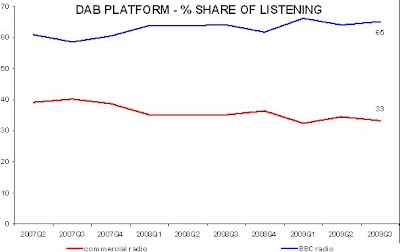
Taking each digital platform in turn, commercial radio’s share of listening on the DAB platform fell to 33% in Q3 2009, compared to the BBC’s 65%. This is not surprising because the age profile of DAB purchasers tends to be older listeners who are statistically more likely to listen to BBC stations. However, it does pose a grave question as to the return that commercial radio can expect from its substantial investment to date in DAB infrastructure, if listening on that platform is dominated so much by the BBC.
The digital TV platform is one that commercial radio has long dominated because of the large amount of spectrum it leased in the early days of Freeview. However, the increasing popularity of digital terrestrial television has already substantially increased the cost of spectrum on Freeview for the radio industry when its contracts come up for renewal. Furthermore, the forthcoming re-ordering of the multiplexes to accommodate HD television and new compression codecs is likely to squeeze commercial radio’s access to Freeview spectrum even more so. Before long, it is likely that the BBC will dominate the digital TV platform, just as it already does on DAB. Presently, the BBC has a 45% share, compared to commercial radio’s 51%.

As might be expected, the BBC’s strong online presence has already put it in the commanding position in terms of its share of listening via the internet platform. The integration of BBC radio into the iPlayer has no doubt helped as well, whereas commercial radio’s offerings are relatively more fractured and less heavily marketed, despite the excellent innovation of the RadioCentre Player. The BBC has a 50% share of listening on the internet platform, compared to commercial radio’s 37%.

The significance of commercial radio’s diminishing share of these three digital platforms is demonstrated when we look at the two sectors’ listening shares achieved on the analogue platform alone. Once one removes the digital platforms from the picture, it is evident that the shares of both the BBC and commercial radio have remained relatively stable in recent years. In other words, it is commercial radio’s declining share of listening on digital platforms that is effectively pulling the sector’s total share of listening (analogue + digital) down, particularly as digital platforms are growing as a proportion of total radio listening (21.1% in Q3 2009).

There is a paradox here. The commercial sector invested heavily in the DAB platform, believing that the new technologies would help it INCREASE its overall share of radio listening versus the BBC. In fact, that investment has recently helped to DIMINISH commercial radio’s overall share of listening. Digital television remains the only platform in which commercial radio dominates, and yet this is the very platform where commercial radio will be forced to cede spectrum and face, once more, losing out to the BBC whose spectrum for radio is guaranteed.

It is important to emphasise that these graphs show only the SHARE of listening on these platforms. The volumes of listening on each of these platforms have demonstrated absolute growth for both commercial radio and for the BBC over the same time period. But, more than any other digital platform, it is significant that the DAB platform is dominated by the BBC which now accounts for almost two-thirds of its usage. Such data is important when making decisions about the potential returns on further investments in DAB infrastructure. Will further investment simply maintain the existing imbalance, or will it really improve commercial radio’s share? Does investment in infrastructure also require parallel investment in new content that will appeal directly to the older age groups who own DAB radios?

Some possible reasons for commercial radio’s diminishing share of listening on digital platforms include:

• Commercial radio’s tendency to invest in DAB infrastructure more significantly than in original digital-only content
• Recent closures of many digital-only radio stations in the commercial sector
• The BBC’s relatively stable resource base, at a time when commercial radio revenues are falling precipitously
• The BBC’s long-held policy to invest simultaneously in multiple platforms, whereas commercial radio has focused on DAB and, to a lesser extent, Freeview
• The BBC’s focus on creating exclusive digital-only content unavailable on the analogue platform
• The BBC’s 360-degree music royalty agreements which allow it to use diverse platforms, whereas commercial radio requires separate (and more restrictive) agreements for time-shifted content and podcasts
• The BBC’s long-term, consistent promotion of content and digital platforms across TV, radio and the internet whereas commercial radio is less willing to cross-promote content or digital platforms that migrate listeners away from its core analogue offerings
• Frequent management changes and ownership changes in some parts of commercial radio, where substantial consolidation has often translated into short-term ‘slash and burn’ rather than ‘invest and build’ policies.

Whatever the reasons, we are not where we were meant to be – that is, we are not where it had been anticipated more than a decade ago commercial radio would be when investment in digital platforms, notably DAB, was expected to produce a beneficial outcome for commercial radio audiences versus the BBC. To put it plainly, the strategy conceived in the 1990’s has not worked. Commercial radio offerings do not dominate digital platforms (yes, they are more numerous, but they do not attract more hours listened than the BBC). DAB has become a largely BBC platform.

So, what can be done? Some of the issues noted above require a more level playing field to be established between commercial radio and the BBC. One such example of a practical solution is the Radio Council plan for a new UK Radio Player that will offer BBC and commercial radio content from a single aggregated access point. Other issues remain mostly in the lap of the gods (revenues, for example). Some issues require the BBC to be less predatory (or more regulated) and for the commercial sector to be more focused on strategic, long-term objectives (such as an online strategy that is more than simulcasting).

There is no single answer to this complex problem, though the commercial radio sector is hobbled by both its present lack of profitability and the regulatory strings that are attached to the majority of its analogue radio licences. What is desperately needed in these difficult times is not minor regulatory tinkering (such as adjusting how many hours of local content a local station is required to broadcast) but a wholesale change in strategy to maintain a commercial radio sector that can thrive in the digital marketplace we now inhabit. Will the imminent Digital Economy Bill prove sufficiently forward-thinking in its radio policy proposals?

[Statistical note: The graphs above to do not sum to 100% because the minimal amount of platform data released by RAJAR is ‘rounded’ (hours listened to 1,000,000; listening shares to 0.1%) and the listening apportioned to the BBC and commercial radio sometimes does not add up to the total for a platform. Some of this shortfall may be accounted for by ‘other’ listening (neither the BBC nor commercial radio) which is not itemised by platform. Data for individual quarters are therefore somewhat inconsistent, though the trend over several quarters is likely to be indicative. Additionally, there is an element of radio listening unattributed to any platform, 12.8% of the total in Q3 2009, but which is roughly equally applicable to BBC radio and commercial radio.]

Culture Secretary speaks about digital radio

The House of Commons Culture, Media & Sport Committee
20 October 2009 @ 1100 in the Thatcher Room, Portcullis House

John Whittingdale MP, Chairman [JW]
Ben Bradshaw MP, Secretary of State, Department for Culture, Media & Sport [BB]

JW: You have announced very ambitious plans to deliver the Digital Radio Upgrade programme by 2015 and have most of the national stations to move off analogue to digital by then. That will require extensive investment in the digital transmission network. What estimate do you have of what it is going to cost to do that?

BB: The current estimate that we are working on is about, I think I’m right in saying, is it £10m per year to build out the DAB multiplexes? Is that the figure that you were interested in?

JW: Actually, the one I’ve heard is rather more than that. Where is that money going to come from?

BB: It will come from a mixture of sources. We expect the BBC to play a significant role in this, commercial radio, and there may be public funds as well.

JW: I think the current state of commercial radio means that their ability to invest any more is almost zero. Do you foresee, therefore, further government investment, maybe from the Licence Fee?

BB: We are not currently intending to spend …. [laughs] That’s one of the things we are not intending to spend a share of the Licence Fee on, but if there is an even bigger underspend in the Digital Switchover Programme than we are currently expecting, who knows, Mr Chairman?

JW: The Digital Switchover Programme appears to be earmarked for quite a large number of purposes.

BB: [laughs] Well, there is quite a significant underspend.

JW: But you are confident that it can be delivered. And what are you going to say to all the people that haven’t bought a new car in the last two years by 2015?

BB: We are working with the motor manufacturers, both to ensure that future new cars do [have DAB radio], but also to ensure that there is this – I can’t remember what it is called – but it is some sort of gadget that you will be able to use in your existing car to make sure that you can pick up digital radio. One of the things we say quite clearly is that we won’t go ahead with this unless, by 2013, certain conditions are reached ie: we have more than 50% digital radio ownership and that [DAB] reception on all of our main roads is not going to be a problem. So we have put conditions down but, at the same time, we felt that it was important to provide market certainty that we specified an end-date by which time this should happen.

[excerpt]

[A further meeting of the Culture, Media & Sport Committee will be held in the same room on Tue 27 October from 1030 to discuss “The future for local and regional media”. Andrew Harrison of RadioCentre, Travis Baxter of Bauer Radio and Steve Fountain of KM Radio will give evidence.]

The demand for DAB radio: where is it?

Most of the current debate on the challenges facing DAB radio seems to be focused on ‘supply side’ issues, such as upgrading existing DAB transmitters, making DAB radio receivers available in cars and the creation of another national DAB multiplex. Surprisingly little of the talk is about the ‘demand side’ issues facing the DAB platform. What are consumers demanding from DAB radio? And how great is that demand?

There are two types of consumer demand for DAB: the demand for content broadcast on the DAB platform, and the demand for DAB radio receiver hardware. The two are inextricably linked. Consumer demand for DAB hardware is largely a function of demand for DAB content. You will only want to buy a DAB radio if you believe there is something interesting enough to listen to on it. Let’s examine some of the available data on these two issues.
  
Consumer demand for DAB content
  
Nobody is going to be motivated to spend money on a DAB receiver for listening to the radio if the platform only offers the same content already available to them on analogue receivers. Therefore, it must be the exclusive digital-only content available on DAB (and other digital platforms) that will persuade consumers to both use the DAB platform and to purchase a DAB radio receiver.

So how dissatisfied are consumers by the radio content choices (the range of radio stations) available to them on existing analogue radio receivers? Ofcom research shows that 91% of adults are satisfied with the existing choice of radio stations offered to them (see chart below), a proportion that has risen in recent years. This demonstrates that dissatisfaction with existing radio provision is extremely low, making it very difficult for any new platform to attract a substantial audience by offering content that will gratify consumers’ few unsatisfied demands.

[In case you are wondering if the increasing satisfaction with radio stations might be a direct result of the exclusive digital-only stations already offered on the DAB platform, it is worth noting that only 3.9% of hours listened to radio are attributed to digital-only stations [RAJAR 2009 Q2].]

Ofcom data shows that the average consumer listens to very few radio stations. Two thirds of the population listen to only one or two different radio stations in an average week, and the majority of these two-thirds listen to only one station. So, not only are the overwhelming majority of consumers satisfied with their existing choice of radio stations, but most people listen to a very narrow menu of stations.

These phenomena are not the outcome of consumers only being offered a limited choice of radio stations on the analogue platform. Ofcom data demonstrates that, in addition to the 5 BBC radio stations and 3 commercial radio stations available nationally on analogue radio (with near universal coverage) in the UK, there are a significant number of local radio stations available to consumers in most areas of the UK. The average consumer in the UK has a choice of 8 national radio stations and 6 local radio stations.

This existing wide choice of radio stations makes the plan for migration to digital platforms very different for the radio medium than it is for the television medium. In the UK, only four (five in some areas) TV stations are available via analogue, making the wider choice available on digital platforms seem very attractive to consumers. Whereas, in radio, an average 14 stations are available to consumers on analogue, and these are already satisfying the vast majority of consumer demands. As a result, there is only a very tiny untapped consumer market for radio content not already available via analogue.

This is demonstrated by analysis of the largest UK radio market, London, in which consumer choice is at its greatest. There are 29 licensed radio stations available on the analogue platform in London (excluding community radio and out-of-area stations), but the top 3 stations account for just under a third of all radio listening in London, and the top 6 stations account for almost half of all radio listening. The radio market in London, as in most of the UK, is dominated by a tiny number of mainstream stations, whilst the remaining radio offerings comprise a ‘long tail’ that fulfils more specialist consumer needs.

 The dramatic consumer skew towards mainstream radio means that, even in a radio market as developed as London, it proves difficult for incremental, digital-only stations to draw significant amounts of listening. The most listened to exclusively digital radio station in London is BBC 1Xtra, which ranks 22nd and attracts only a 0.5% share of listening in the market [RAJAR 2009 Q2]. 1Xtra’s content (UK black music) is barely duplicated by any other legal radio station available in London, and yet its ‘success’ remains slight in a very multicultural market that is already crowded with myriad radio options for consumers. The recent decision by London station Club Asia to enter administration, combined with the closures earlier this year of South London Radio and Time 106.8, demonstrate the challenge for stations to find a ‘monetisable’ audience in London, even on the analogue platform.

It might be easy to assume that Londoners, offered the widest selection of radio stations on the analogue platform, would be more satisfied with their choice in comparison with consumers in other, less well served parts of the UK. The surprising result from Ofcom research is that Londoners are, in fact, less satisfied with their choice of radio than most other parts of the UK. The chart below (extracted directly from a recent Ofcom report) demonstrates that satisfaction with existing radio provision is almost evenly spread across the whole UK, but consumers in London and Northern Ireland are the least satisfied.

In summary, radio in the UK has been a victim of its own success. The universal availability of a range of both BBC and commercial ‘national’ stations, combined with the extensive choice of local stations available in most markets, mean that consumers are already relatively spoilt for choice on the analogue radio platform. There is very little unsatisfied demand for radio content because the UK already has such a comprehensive choice of radio content on offer. As a result, any new radio platform (DAB, satellite, online, etc) is going to find it hard to compete with the high quality and diverse choice of what is already on offer.

This was always going to make it tough for the DAB platform to entice consumers to purchase DAB receivers as anything other than a ‘replacement’ for their existing analogue radios. Unfortunately, the natural replacement cycle for radio receivers is so slow (maybe ten years or more) that it will never prove sufficient for a complete UK digital switchover to be co-ordinated for radio, as is happening in the television market. The UK has some of the best radio in the world – ironically, this has been our digital downfall.

Consumer demand for DAB radio receivers

As noted earlier, consumer demand for DAB hardware is largely a function of demand for DAB content. You will only want to buy a DAB radio if there is something interesting enough you want to listen to on the DAB platform.

Ofcom research demonstrates clearly the lack of interest amongst consumers in purchasing DAB radio receivers. In this year’s survey, only 16% of consumers (without a DAB radio) say they are likely to purchase a DAB radio within the next 12 months. Two years ago, 19% said they would be likely to purchase a DAB radio within the next 6 months. This is very bad news for manufacturers and retailers of DAB radios. Worse, this year not only do 64% of consumers say they are unlikely to purchase a DAB radio, but 20% say they don’t know – a demonstration that a DAB radio is far from being a ‘must have’ gadget on consumers’ wants lists.

The data for current levels of DAB radio receiver ownership are not very helpful in determining the demand for DAB radio receivers. The quarterly survey by RAJAR found in 2009 Q1 that 32.1% of adult respondents claimed to own a DAB radio. However, the annual Ofcom survey found in the same quarter that 41% of adult respondents claimed to have a DAB radio in their household. This disparity between the results from RAJAR and Ofcom would appear to be widening over time.

The uncertainty in the data regarding ownership levels of DAB receivers is not surprising, given the evident level of consumer confusion. Firstly, many radios on the market have the words “digital” or “digital radio” written on them, meaning that they either incorporate a digital clock (for radio alarm clocks) or that they offer ‘digital’ tuning of analogue wavebands, despite them not offering DAB reception. Secondly, the majority of ‘DAB radios’ presently on sale in the UK offer DAB reception in combination with analogue radio and/or internet radio. When DAB radio receivers were first introduced a decade ago, all the models offered were DAB-only. Nowadays, it is harder to find a DAB-only model in shops. Earlier this year, I surveyed the radio hardware on sale from UK retailers (see chart below) and found that the most common DAB consumer proposition is now an ‘FM + DAB’ radio.

In its latest consumer research on take-up of digital radio, Ofcom said that the result of its survey (see below) “highlights the continued lack of awareness among consumers of ways of accessing digital radio”. Consumers have low awareness of their ability to already access digital radio, and It appears that the words “digital radio”, “digital audio broadcasting” and “DAB” are not yet precisely understood. This uncertainty makes the results of market research about ownership levels of DAB radio hardware somewhat unreliable.

One of the targets set by the Digital Radio Working Group at the end of 2008 for the implementation of digital radio was that DAB radios should reach 50% of radio receiver sales by volume by the end of 2010. However, if the current rate of growth continues, this target is unlikely to be reached until 2016 (see chart below).

Besides, this target is largely irrelevant to digital switchover because it seems to assume that consumers are making a definitive choice between the purchase of a DAB radio or an analogue radio. In fact, as the earlier chart shows, the majority of DAB radios presently offered by retailers also include FM radio. Although the DRDB data states that 22% of radios sold in the UK incorporate DAB, the vast majority of those include FM too. So, for every 100 new radios sold, you are probably adding to the UK’s inventory of receivers between 95 and 98 new FM radios, at the same time as adding 22 new DAB radios. In other words, the household penetration level of analogue radio receivers is barely diminishing at all, a fact that will ensure that FM broadcasting remains as vital to our radio system as it has always been.

In summary, the DAB platform seems to be developing slowly as a supplementary platform to existing analogue radio reception. Far from DAB radios ‘replacing’ analogue radios, the overwhelming majority of new radios purchased in the UK are still analogue-only. The remainder are mostly DAB/analogue combination receivers. In this way, DAB has much in common with ‘Long Wave’ radio, where consumers for a long time were offered a choice of ‘FM+AM’ or FM+AM+Long Wave’ receivers in retail stores. Like Long Wave, for a minority of consumers DAB may be a ‘must have’ when purchasing a new radio, but for the majority it is merely an optional extra whose purchase is likely to be very dependent on the comparative prices of available options.

Conclusion

The publicly available data on the demand for DAB is not particularly encouraging for the platform’s future. Much of the implementation of DAB to date in the UK has focused on ‘supply-side’ issues, without seeming to determine whether there is sufficient demand from consumers for new content, and without determining whether that new content would prove sufficiently attractive to lure consumers into shops to purchase DAB radios. Ironically, it appears that if our existing system of analogue radio broadcasting had been less well developed in terms of both the range of available content and its near universal delivery, DAB might have been better able to address any pent-up demand from consumers. As it is, the majority of consumers seem very content with their existing radio options. Our pursuit of excellence in radio over the last 80 years has created something we can be proud of – but it has also made it hard for it to be bettered by a ‘new’ system such as DAB.

[For more data on the challenges facing digital radio in the UK, check out a presentation I made to the European Broadcasting Union Digital Radio Conference in June 2009]

Funding DAB radio infrastructure upgrade: still 'no'

The Media Show, BBC Radio 4, 2 September 2009 @ 1330

Steve Hewlett interviewed Tim Davie, Director of BBC Audio & Music

We talked at the Radio Festival a few months ago and you talked a lot about DAB. The criteria have been stated now for moving forward to switchover, or before anyone contemplates switching off the analogue FM signal, of 50% of listening and 90%+ of coverage. Do you think that’s realistic by 2015?

I use the word ‘ambitious’ and I mean it. I think it’s tough. It is possible. I think the radio industry to date has shown an incremental path towards digital and, unless you get a big step change, you’ll never get there. And, to be fair, the BBC has driven this harder than anyone.

When we last spoke about it, there was a discussion of £100m or so being needed to pay for the rollout of not the BBC stuff but whatever is necessary for the commercial sector to go digital. At that time, I asked you specifically whether there was any money in your budget identified for that purpose and you said ‘no’. Has anything changed since we last spoke?

It’s another ‘no’. No, nothing has changed and until the plan ….

This is not going to happen, is it?

I think that radio will move to digital, and I think that ….

Will it be DAB?

I think at this point, it will be …. I believe in DAB. I say ‘at this point’ because I think we have hurdles to jump over.

Digital radio: Parliamentary Question

House of Commons: Written Ministerial Statements: 9 September 2009

Digital Broadcasting: Radio

Tim Farron: To ask the Secretary of State for Culture, Media and Sport whether his Department’s proposals for the analogue radio switch-off in 2015 have been submitted for rural proofing to the (a) Commission for Rural Communities and (b) Rural Advocate.

Mr. Simon: The Digital Britain White Paper set out our commitment to a full impact assessment of the Digital Radio Upgrade; including consideration of the rural impact. To inform these assessments we will work closely with the relevant stakeholders, such as the Commission for Rural Communities and the Rural Advocate.

Tim Farron: To ask the Secretary of State for Culture, Media and Sport what assessment he has made of the merits of providing financial assistance to (a) low-income households and (b) households in hilly rural areas in respect of the analogue radio switch-off in 2015.

Mr. Simon: The Digital Britain White Paper set out our commitment to conduct a full impact assessment, including a cost benefit analysis of DigitalRadio Upgrade. The results of this impact assessment will help determine whether there is a case for a Digital Radio Help Scheme, and if so, what its scope would be. In addition, the Consumer Expert Group, which brought together key consumer representatives to inform the Digital TV switchover process, has been invited to extend its scope to cover radio and will ensure that the Digital Radio Upgrade programme takes account of the wide range of listener needs.

UK Commercial radio revenues Q2 2009

Commercial radio revenue figures for 2009’s second quarter have been published.

Q1 2009 DATA
£119.7m total revenues – lowest since Q3 1999
£34.8m local revenues – lowest since Q1 2001
£60.0m national revenues – lowest since Q1 1998
£24.8m branded content

YEAR-ON-YEAR
Total revenues – down 10.8%
Local revenues – down 6.0%
National revenues – down 16.1%
Branded content – down 3.7%

QUARTER-ON-QUARTER
Total revenues – down 6.9%
Local revenues – down 5.4%
National revenues – down 12.3%
Branded content – up 6.0%


FOUR-QUARTER MOVING AVERAGE DATA
£514.6m total revenues
Down 13.4% year-on-year (last quarter: down 13.1% year-on-year)


Whatever may be going on elsewhere in the economy, it is hard to see any green shoots of recovery in the UK commercial radio …. yet. Total revenues in Q2 2009 fell by 10.8% year-on-year to £119.7m. Initially, this might look mildly positive compared to the 19.5% year-on-year fall experienced last quarter. But remember that the downturn in UK radio first hit in Q2 2008 and had already reduced that quarter’s revenues 10.1% year-on-year. As a result, Q2 revenues in 2009 are now 20% below what they had been two years ago, a decline so significant that it will prove difficult to recapture even when the economy does improve.

National advertisers remain the weak spot for UK commercial radio, with revenues in Q2 2009 down 16.1% year-on-year. But once again, Q2 in 2008 was the start of the downturn and that quarter showed a 15.9% fall year-on-year. National revenues in Q2 2009 are now 29% below what they had been two years ago. It will be a mighty challenge to recoup such losses.

The notion that UK commercial radio is merely experiencing a cyclical blip and will quickly show recovery once the overall economy improves is a great feelgood story, but one that is not supported by the industry’s own data. Long before the ‘credit crunch’ hit us all, UK commercial radio revenues were already showing structural decline, a trend that the current economic cycle has merely exacerbated.

Nothing demonstrates the long-term trend more starkly than a glance at the year-on-year changes to commercial radio’s total revenues in recent quarters. Of the last 20 quarters, only 7 have demonstrated year-on-year revenue growth (one quarter in 2004, one quarter in 2005, one quarter in 2006, three quarters in 2007 and one quarter in 2008). The most recent quarter’s total revenues were 29% below the peak achieved as long ago as Q4 2003. If these comparisons were adjusted for the effects of inflation, the decline would look even more stark.


For the commercial radio industry, business will never be the same again. The ‘goldrush’ 1990s are never going to happen again, at least not without some kind of radio revolution (such as the BBC wilfully destroying Radio Two’s popularity, as they did with Radio One in the early 1990s). As a result, the commercial radio industry will need to change its modus operandi more substantially than ever before, not to thrive, but in order simply to survive. If it doesn’t change, we won’t have much of a commercial radio industry left at all.

The seemingly widely held belief that commercial radio MUST continue to exist in its present form because it is a highly regulated and licensed industry is simply false. If there was one lesson that should have been learnt from the implementation of DAB radio in the UK, it was that ensuring that a small group of commercial interests control a technology and the access to it counts for nothing if there is almost no demand for it. With DAB, radio broadcasting groups got what they wanted – their cartel became the licensed gatekeeper and owner of DAB. But if nobody wants your DAB, you are left being gatekeeper to a field of nothing.

It’s the same with commercial radio. If advertisers and listeners don’t want your product, there is no reason for it to exist, regardless of you waving around your scarce Ofcom licence. Not so long ago, station owners could still foist crappy radio content on the public because listeners were starved of alternatives, but digital audio and the internet have changed that FOREVER. No longer is there any market for second-rate radio. And, in commercial radio, if unwanted or irrelevant content doesn’t attract listeners, it won’t last long.

In this context, the latest Ofcom radio

consultation (“Radio: the implications of Digital Britain for localness regulation”) is a remarkably disappointing document. At a time when commercial radio is at a crossroads in so many senses (profitability, consolidation, platforms, localness, public service, interactivity, CPM, etc), this latest chapter in Ofcom’s many attempts to map out “The Future Of Radio” is no more than tinkering at the edges of existing radio regulation.

What was needed was a full-blown, courageous effort to overhaul the radio regulatory system in order to ensure that commercial radio continues to exist financially and that the diminishing number of licensees genuinely serves the public’s articulated radio needs. Instead, we have an Ofcom consultation that is no more than a grudging reaction to Lord Carter’s Digital Britain proposals, some of which are now adopted as if they were Ofcom’s own, some of which are watered down, and some of which have been ignored altogether.

The reluctance drips from every page. There are 81 uses of the word ‘if’ in this 82-page document. Almost every one of its proposals is tainted with uncertainty – “if and when new legislation is passed” or “if Parliament decides not to take forward”. Rather than seizing the opportunities that arise from the painful ‘crossroads’ when change is an inevitable necessity rather than a nicety, Ofcom seems happy to sit in the back seat and respond “whatever!” to ideas it receives, rather than grabbing at innovation and pushing it forward. It reads very much as if written by nobody who has ever themselves run a commercial business where painful life and death decisions have to be made, sometimes at breakneck speed and often without the aid of a parachute.

Ofcom continues to treat the commercial radio industry like a naughty child who, although 36 years of age now, cannot be trusted with more than a five pound note. Every Ofcom proposal continues to keep its centralised, London-based decision making about local commercial radio firmly within its own control, without trusting licensees to co-regulate in any meaningful way. For example:
· Proposal 1 requires stations to submit a request every occasion they seek a change
· Proposal 2 will lead to “a short consultation upon receipt of such a request”
· Proposal 3 requires stations to submit a request every occasion they seek a change
· Proposal 4 will lead to “a short consultation in most cases”
· Proposal 5 will lead to “short consultations in most cases”.

Only one thing is certain – Ofcom will be drowning in consultations for the foreseeable future. These five proposals alone (out of eight) multiplied by 300 stations plus DAB multiplexes yields a potential 1,000+ new consultations or requests. And yet the document claims that these Ofcom proposals are “broadly deregulatory”.

Sadly, more than anything else, the Ofcom document completely lacks any kind of vision as to what the commercial radio landscape might look like in the future, the antithesis of what the Digital Britain consultation exercise was trying to achieve. This is a missed opportunity for Ofcom. Not just this latest document, but in 2009 when the whole “what is the future of radio?” debate is probably at the most critical point in commercial radio’s history. It appears to many in the industry that Ofcom has simply disengaged from radio. This is a particular irony for an industry that prides itself on its success in one-to-one communication.

It may seem a stupid question……. If Ofcom still sees itself as the party with the skills necessary to make 1,000 potential individual decisions on the future of individual commercial radio stations, how is commercial radio presently in such a sad state of affairs as a result (partly) of previous regulatory decisions? We tend to respect and trust people who can demonstrate a positive track record. Why would I let a doctor operate on me who had killed almost every patient he had ever consulted?

Paying for DAB radio carriage: god only knows

Premier Christian Radio, the London AM station, is planning to broadcast on the national DAB platform from 21 September 2009. In an e-mail to listeners, its chief executive Peter Kerridge explained:

“Beginning in September, we will start to incur the cost to transmit on this digital platform – £650,000 per annum – which is an expense that is over and above our current operating costs. The only way the £650,000 in transmission costs will be covered is through the generosity of friends like you. It is fantastic that God has moved in such an amazing way to provide Premier this national digital licence! Now may you and I be found faithful as we steward this new resource for His glory and for the advancement of His Kingdom!”

DAB carriage remains a costly business. Digital One, the owner of the sole national commercial DAB multiplex, fixes the carriage costs for content providers such as Premier Christian Radio. If £650,000 seems like a lot of money for broadcast on a platform that reaches 33% of adults in the UK and accounts for only 13.1% of radio listening [RAJAR Q1 2009], understand that this is a bargain compared to the expensive contracts some content providers had signed previously. In January 2009, Digital One responded to the government’s Digital Britain initiative by cutting its prices. Acting chief executive Glyn Jones said:

“We’re turning the ideas set out in the Digital Radio Working Group’s report into actions. That includes looking hard at how Digital One can offer lower carriage costs. In turn we’re expecting that stakeholders involved in the Working Group, and other companies with the ambition to launch new national radio stations in 2009, will step up and engage with a view to adding compelling new choice for consumers. We’re expecting that prices will initially be set below Digital One’s 2008 rate card. One reason for that is to help provide an incentive for people to invest in high quality services. But, over time, companies providing new services will be expected to contribute to the costs of a transmitter roll-out plan which was something also identified by the DRWG as important.”

Digital One’s January 2009 press release was ambitiously headlined ‘New National Radio Stations To Launch In 2009’. Seven months later, what stations have stepped forward to take advantage of the Digital One offer? Government-funded BFBS Radio started DAB simulcasting on 20 April 2009, following a three-month trial in 2008. Amazing Radio launched on DAB in June 2009 for a six-month trial period, playing unsigned artists from its music web site. Also in June 2009, Fun Kids, which is normally on DAB only in London, launched a fourteen-week trial simulcast on national DAB. Neither BFBS nor Amazing Radio are participating in RAJAR radio audience research, so it is impossible to know how much listening these services are attracting on the DAB platform.

Have we seen any major media players step forward and put a new mass market radio service on the national DAB platform? Not yet. Why? Because, even at the knockdown rate of £650,000 per annum, it still proves impossible to make a profit from offering radio content on DAB. The table below offers very rough estimates of what digital stations measured in RAJAR (and carried on a mix of broadcast platforms including DAB and digital TV) should and might be earning in revenues. The second column lists the total hours presently listened to each digital station. The third column uses the average commercial radio sector yield (how much revenue was generated from how much radio listening in 2008) to estimate, in theory, what these stations’ revenues should be.


However, the ‘Commercial Radio: The Drive To Digital’ report commissioned from Ingenious Consulting by RadioCentre in January 2009 told us that:

“Incremental revenue from DAB-only stations is negligible at ~£130k per ‘bespoke’ station …”

The list above comprises the 14 digital radio stations that subscribe to RAJAR. Not all of these stations broadcast on DAB (Smash Hits Radio is only on digital TV), not all of them are national (Yorkshire Radio is only on the Yorkshire DAB multiplex, for example), but let us be generous and assume that each station earns revenues of £130,000 per annum. In total, these stations combined would generate £1.82m per annum of revenue. This is substantially less than the £29.7m revenues that would be expected to be generated from them attracting 22.7m hours per week of listening.

The final column in the table estimates how much revenue each station might be earning from the £1.82m total, if revenues were proportionate to hours listened. I must stress again that this only a rough estimate – none of these stations, nor Ofcom, publishes the actual revenues of digital radio stations. What these estimates demonstrate is that, if Planet Rock were (like Premier Christian Radio) paying £650,000 per annum for its carriage on the national DAB multiplex (the financial details of its “long-term” deal with Digital One were not made public), the station is still nowhere near breaking even, not even after ten years on-air.

The Ingenious Consulting report found that DAB-only stations are spending £25m per annum on operating expenses. The above table shows that, if these stations were attracting revenues proportionate to the listening they presently enjoy, collectively they would then be profitable (£29m revenues minus £25m operating expenses). But, in fact, their revenues are presently less than £2m. The Ingenious Consulting report concluded that, as a result, the “annual negative cash flow impact of DAB” on the commercial radio sector is around £27m per annum.

This £27m annual loss attributable to digital radio stations represents around 5% of commercial radio’s revenues, a significant impact on an industry which is only marginally profitable overall at present. The nub of the problem is this: digital radio stations presently account for 5.3% of listening to commercial radio, but digital radio stations attract only 0.3% of commercial radio revenues. Here is a massive economic disconnect that requires much more than a mere increase in productivity or some kind of performance improvement. Doubling or even tripling these stations’ revenues would barely dent the problem.

Maybe DAB is simply not a platform where the traditional commercial radio model can be made to work – the old model of ‘give away free content, pay for it by attracting advertisers to buy on-air spots’. Maybe DAB is not a medium from which traditional UK commercial broadcasters can generate profits from offering content, as they had anticipated in the 1990s. Commercial broadcasters are pushing no commercial product other than their on-air brand (and some music downloads, concert tickets and click-through purchases). Instead, perhaps DAB can only be made to work as a marketing tool to assist companies selling (non-radio) products. So, for example, it would make sense for Universal Music to have a DAB radio station to expose directly to the public the CDs/videos/movies they are currently selling. It would make sense for Amazon to have a DAB radio station to promote all the consumer products it is selling. Then, the £650,000 carriage cost could be considered an additional ‘marketing expense’ for these companies’ core business, rather than a direct operating expense that had to be recouped ON-AIR.

The other possibility is for DAB to be used predominantly by organisations whose objective is something other than breaking even financially. In January 2008, I had written:

“Worryingly, this sudden flowering of ethnic, religious and publicly-funded radio stations on the DAB platform echoes the fate of the ‘AM’ waveband in the 1990s, at a time when the radio industry and the regulator had become convinced that audiences were deserting that platform for the improved audio quality offered by the ‘FM’ waveband. By 2002, declining audiences of ‘AM’ stations had persuaded the regulator to suggest that the platform be used in future “for better serving minority, disadvantaged or currently excluded audience groups, whether defined by their interests, demographics or ethnicity”. The ‘DAB’ platform of 2008, particularly in London, is already starting to resemble the ‘AM’ platform of 1998, suggesting that ‘DAB’ might have already been written off by the sector as a means to reach the ‘mass market’ audiences that national advertisers desire from the medium.”

This trend towards non-commercial content has developed further since then. The national DAB platform has added BFBS Radio (government-funded) and now Premier Christian Radio (religious), but no new permanent digital radio stations operating on a commercial model. Local DAB multiplexes have added Traffic Radio (government-funded), Colourful Radio (ethnic) and UCB (religious). Interestingly, UCB has taken two channels on each of the regional MXR DAB multiplexes, giving it a substantial amount of DAB spectrum. But there have also been ethnic DAB radio casualties since my earlier report – Islam Radio in Bradford closed its DAB service in December 2008, and India’s Zee Radio closed its London DAB service in April 2009. Even for ethnic broadcasters locked out of analogue radio, DAB can prove a struggle.

Premier Christian Radio’s Peter Kerridge hit the DAB nail on the head when Media Week reported:

“Kerridge said Premier Media’s funding meant it was in a better position than other media organisations, as the ‘ad-funded model is smashed’ …..”

The available financial data confirms that, certainly for the DAB platform, an ad-funded model simply is not viable at present. To make DAB work for your content, you need government funding, direct listener financial support, a sugar daddy, or some kind of god smiling benevolently down upon you.

Digital Britain: the Implementation Plan

The government has published the Implementation Plan for Digital Britain, setting out its action plans for the proposals made in June 2009’s Final Report. These are the sections that directly concern the radio sector:

PROJECT 1: DIGITAL ECONOMY BILL
LEAD: Colin Perry

GOVERNANCE
– Bill Project Board oversees the delivery of the Bill. Members are David Hendon (BIS)/Jon Zeff (DCMS) – joint SROs, Carola Geist-Divver (DCMS legal), Eve Race and Jose Martinez-Soto (BIS legal), Colin Perry (Bill Team Leader), Laura Williams (secretariat)
– Bill Management Group tracks progress and drives delivery of the Bill. Members are Colin Perry (Bill Team Leader) chair, Deputy Directors BIS/DCMS, Carola Geist-Divver (DCMS legal), Eve Race and Jose Martinez-Soto (BIS legal), Laura Williams (secretariat). Other policy leads attend as appropriate.

ACTIONS COVERED FROM THE FINAL REPORT [exceprts]:
􀂃 Amending the Communications Act 2003 to make the promotion of investment in communications infrastructure and content one of Ofcom’s principal duties.

􀂃 Ensure the Board of Ofcom has a statutory obligation to write to the Government alerting Secretaries of State to any matters of high concern regarding developments affecting the communications infrastructure and in any event to write every two years giving an assessment of the UK’s communications infrastructure.

􀂃 Encouraging, where appropriate, adjoining radio multiplexes to merge and extending existing multiplexes into currently un-served areas rather than awarding new licences. Grant Ofcom powers to alter multiplex licences which agree to merge.

􀂃 We will make an amendment to the existing legislation to support a change in the localness regulatory regime to allow location in mini regions defined by Ofcom.

􀂃 Grant a further renewal for up to seven years of analogue radio licences for broadcasters which are also providing a service on Digital Audio Broadcasting (DAB).

􀂃 Grant Ofcom new powers to insert a two year termination clause into all radio licences awarded or further renewed before the Digital Radio Upgrade date.

PROJECT 6: DIGITAL RADIO UPGRADE
LEAD: John Mottram

ACTIONS COVERED FROM FINAL REPORT [in full]:
􀂃 Develop Action Plan for Digital Radio Upgrade, including a Cost/Benefit Analysis.

􀂃 Invite Consumer Expert Group to extend its current scope to inform the development of the Digital Radio Upgrade.

􀂃 Facilitate the roll-out of the BBC’s national multiplex to ensure it achieves coverage comparable to FM by the end of 2014.

􀂃 Encourage, where appropriate, adjoining local multiplexes to merge and extend coverage into currently un-served areas. Grant Ofcom powers to alter multiplex licences which agree to merge.

􀂃 Allow for the extension of multiplex operators’ licences until 2030, if part of an agreed plan towards Digital Radio Upgrade.

􀂃 Consider with Ofcom the case for delaying the implementation of AIP on DAB multiplexes until after the Digital Radio Upgrade is completed.

􀂃 Grant Ofcom new powers to extend the licence period of all national and local licences, broadcasting on DAB, for up to a further seven years, although this decision will be kept under review. In addition, amend the rules under which Ofcom grants analogue licence renewals to ensure that regional stations which do become national DAB stations do not lose their current or future renewal.

􀂃 Grant Ofcom new powers to insert a two year termination clause into all licences awarded or further renewed before the Digital Radio Upgrade date.

􀂃 Work with broadcasters and vehicle manufacturers to implement the ‘Digital Radio in vehicles: a five point programme’.

􀂃 Agree with Ofcom a two-year pilot of a new output regulatory regime.

􀂃 Reduction in number of locally-produced hours in exchange for enhanced commitment to local news.

􀂃 Ofcom to consult on a new map of mini-regions which balances the potential economic benefits but also the needs and expectations of listeners. We will make an amendment to the existing legislation to support this change.

􀂃 Consultation seeking views on proposals for a new licence renewal regime for community radio. This consultation will include proposals to remove the 50% funding limit from anyone source and the restriction preventing a station being licensed in an area overlapping with a small commercial service and extending our commitment to promoting best practice within the community sector and encouraging self-sustainability by allocating a small portion of the Community Radio Fund to support the work of the industry body, the Community Media Association.

􀂃 Insert two year termination clause into all new licences.

􀂃 Grant Ofcom new powers to extend the licence period of all national and local licences, broadcasting on DAB, for up to a further seven years (keep this decision under review). If by the end of 2013 it is clear the Digital Radio Upgrade timetable will not be achieved we will use the powers, set out above, to terminate licences and the existing licensing regimes will apply.

􀂃 Amend the rules under which Ofcom grants analogue licence renewals to ensure that regional stations which do become national DAB stations do not lose their current or future renewal.

Digital radio switchover: 'you can't move faster than the British public want you to move'

Feedback, BBC Radio 4, 31 July 2009 @ 1330

Sir Michael Lyons, chairman of the BBC Trust, interviewed by Roger Bolton and listeners:

[Do you think the principle of moving across to DAB is a good one?]

The BBC has been a strong supporter of digital radio, believing that it will actually offer an improved service, and …

[Improved in what way? The quality of the existing services will be made better? Or it allows you to provide a range of other services as well?]

I think both. But, of course, you only satisfy the first of those two tests when you’ve actually got the same sort of coverage [on DAB] that you’ve got on FM. And indeed, it’s important to say that the BBC has already picked up what commercial radio was going to do in terms of more investment to get to 90% of the population, and that will be achieved by 2011. But I think we’re going to go on to the question of ‘[FM] switch-off’ because actually that’s a different issue altogether ….

[Well, one of the key things of public service is universal access and, clearly, a lot of people are saying [that] until 2015 there won’t be one because, unlike a television set, perhaps we’ve got five or six radios around the house and a different radio in the car. And are you telling us we are going to have to buy five or six new radios and a new radio for the car in order to listen to something we might not want in the first place? That’s the argument.]

Well, let me underline that I’m not saying that. That’s actually in the government’s Green Paper – they propose a date of 2015. The Trust is very clear actually. Who comes first in this? Audiences and the people you pay the Licence Fee. It is an extraordinarily ambitious suggestion, as colleagues have referred to, that by 2015 we will all be ready for this. So you can’t move faster than the British public want you to move on any issue. So there’s no doubt that 2015 looks challenging.

[Chairman, are you prepared to say, on behalf of the listeners, to the government, whichever government is in power, if they are insistent in pushing this through and you believe that listeners will be significantly disadvantaged, are you prepared to say ‘no, the BBC can’t go along with this’?]

Well, as things stand at the moment, [in] the Digital Britain report, it seems that the BBC will find the money for this final stage, so there are serious discussions to be had about how it’s going to be funded, as well as whether actually 2015 is in any way a realistic timescale. Now, what I can say now, is that those have already formed part of our discussion with Ministers and will continue to form part of our discussions with Ministers.

[But, to repeat my question, are you prepared to say at some point, or countenance saying, to a Minister ‘no, we can’t go along with this because, in doing so, we will provide a disservice to our listeners’?]

Well, I think I’ve said as much I need to say today …..

[…. as a diplomatic chairman …..]

…. and also, you know, it’s very important that I don’t try and conduct any discussion I’m having with Ministers over the air.

Digital Radio Switchover: Parliamentary Question

20 July 2009 : Column 561
House of Commons
Monday 20 July 2009
The House met at half-past Two o’clock
Prayers
[Mr. Speaker in the Chair]
Oral Answers to Questions
Culture, Media and Sport
The Secretary of State was asked—
Digital Radio Switchover

1. Sir Nicholas Winterton (Macclesfield) (Con): What his most recent assessment is of progress on digital radio switchover; and if he will make a statement. [287437]

The Parliamentary Under-Secretary of State for Culture, Media and Sport (Mr. Siôn Simon): The “Digital Britain” White Paper set out the Government’s vision for the delivery of the digital radio upgrade by the end of 2015. We have committed to a review of the progress towards that timetable in spring 2010, and we have also asked Ofcom to review and publish progress against the upgrade criteria at least once a year, starting next year.

Sir Nicholas Winterton: Is the Minister not aware that “Digital Britain” has in fact failed to address the inadequacies of digital radio broadcasting coverage? I am sure that he will agree with that comment. Representations made to me so far suggest that the idea of a switchover is currently very unpopular. Instead of rushing ahead with the switchover, will he take positive action to allow people to see some tangible benefits?

Mr. Simon: I am disappointed that the hon. Gentleman thinks that we are rushing ahead. We have said that we will move Britain to digital by 2015. That gives consumers and the industry six years to make the upgrade, which we are doing because we are committed to radio, we believe in radio and we love radio, and radio will not have a future unless it goes digital. We are not switching off FM, and we are putting new services on the FM spectrum that is vacated by the services which move to digital audio broadcasting, because we want to see radio prosper and grow in the digital age.

Mr. Barry Sheerman (Huddersfield) (Lab/Co-op): Is my hon. Friend aware that switchover is affecting valued services on both radio and television? I have been lobbied by Teachers TV, which fears that it will lose an enormous part of its audience because the Department for Children, Schools and Families is stipulating that it must switch over totally to digital.

Mr. Simon: We are ensuring with radio switchover that community organisations and small community radio stations, which might currently be able to broadcast for only two weeks a year, will inherit the FM spectrum currently taken up by big regional and national FM broadcasters. Precisely such small, commercial, local community organisations will be able to flourish in the digital future in a way that they are technologically constrained from doing now.

Adam Price (Carmarthen, East and Dinefwr) (PC): The Minister is a Welsh speaker, so is he aware of the fears for the future of Radio Cymru, the BBC’s Welsh language national service? It is not currently available on digital and will not be available in large swathes of western Wales for reasons of topography.

Mr. Simon: I have, with personal regret, to tell the hon. Gentleman that I am not really a Welsh speaker. [Hon. Members: “Ah!”] Dwi’n dysgu, ’de? I should have been a Welsh speaker. We are alive to the particular problems of Wales. There are serious problems with coverage, not just with respect to Radio Cymru but with digital coverage throughout Wales. We have made it clear that the nations and regions that are furthest behind in digital coverage will be the first priority for the most serious intervention, to ensure that they are not left behind when we move to digital. We have made it clear also that we will not move to digital unless 90 per cent. coverage at the very least is achieved.

Mr. Jeremy Hunt (South-West Surrey) (Con): I start by welcoming you to your post, Mr. Speaker—an elevation that was only marginally more likely than man walking on the moon, which happened 40 years ago today. I offer you my congratulations. I am sure that you will want to join me in offering the congratulations of the whole House to the England cricket team, which won an historic victory today—their first victory over the Australians at Lord’s for 75 years. We would also like to congratulate the Minister on taking up his post in the DCMS team. The Government’s own figures state that there are 65 million analogue radios in circulation, and they hope that the cost of digital radios will fall to £20 a set. That means that the cost of upgrading the nation’s analogue radio stock will surpass £1 billion. Who will pay that £1 billion? Will it be the Government, or will it be consumers?

Mr. Simon: Mr. Speaker, I should apologise for having forgotten to congratulate you; I thought that we were taking your position for granted by now, but it is my first time speaking under your chairmanship. I offer my very sincere congratulations. I never thought that your elevation was unlikely.

Mr. Edward Vaizey (Wantage) (Con): What about cricket?

Mr. Simon: The hon. Gentleman shouts “cricket” from a sedentary position. I can tell him that the Under-Secretary of State for Culture, Media and Sport, my hon. Friend the Member for Bradford, South (Mr. Sutcliffe), was at the cricket, which almost certainly accounts for the first English victory at Lord’s since, I believe, 1934. In response to what we might call the “Tory sums” of the hon. Member for South-West Surrey (Mr. Hunt)— [Interruption.] No, Tory sums. We do not know how many analogue radios are in circulation; it may be 65 million. The first point to make is that those sets will not become redundant. The FM spectrum will be well used for new services that are currently squeezed out. We are working with industry to come up with sets that are consistently priced at £20 or less. That will enable consumers to add to the 9 million digital sets—

Mr. Speaker: Order. May I gently say to the hon. Gentleman, who has been extremely generous in his remarks, that I do not want to have to press the switch-off button, but I am a bit alarmed that he has a second point in mind? It might be better if he kept it for the long winter evenings.

Mr. Hunt: The point is that if people use their analogue sets, they will be able to listen to new radio stations, but not the radio stations that they have been listening to for a very long time. Was it not the height of irresponsibility to announce the phasing out of analogue spectrum without announcing any details or any funding for a help scheme, similar to the one that was in place for TV switchover? Will that not cause widespread concern among millions of radio listeners, who will feel that they are faced with the unenviable choice of either paying up or switching off?

Mr. Simon: I shall try to squeeze in my answer at the end of that extraordinarily long question. We will do exactly the same with radio as we did with television: we will carry out a full cost-benefit analysis of exactly what kind of help scheme might or might not be required, and we will proceed accordingly. There are 9 million digital sets in use already. Consumers have six years to decide how much they want to pay, for what equipment, to receive which services.

http://www.publications.parliament.uk/pa/cm200809/cmhansrd/cm090720/debtext/90720-0001.htm