An elite academy for aspiring rent-a-gob politicians : 1976 : Durham Union Society

“I’m sorry but you must wear appropriate attire to attend,” the usher told me sternly.

I thought I had been dressed normally enough, but apparently not. I was waving my club membership card, having paid the annual subscription during Freshers’ Week. Only then did I learn that it was insufficient merely to be a paid-up member. Nobody had told me I needed additionally to wear an academic gown to be admitted, one of those flimsy black material things belonging to previous centuries or ghost movies. Since my arrival at university, I had spotted a few students wafting around the streets wearing such gowns and I had considered their fashion sense preposterous, particularly in the ‘Year of Punk’. Why would I waste £37 of my Surrey County Council student full grant on such an anachronistic garment? Now, to my frustration, I was being refused entry to the society’s first debate of the academic year and had to walk the mile back to my college in autumnal darkness.

I was unaware then that Durham University was so normalised to its elite status that it even labelled its relationship with the local population ‘town and gown’. Evidently it never had considered itself an integral part of Durham, one of Britain’s poorest working-class regions, because its students were not drawn from the locality but from some of Britain’s poshest families whose offspring had proven insufficiently academic to gain admission to Oxbridge. I recall my shock during a party at fellow student John Cummins’ town centre flat when I learnt that his parents had purchased that property for the duration of his studies. Whilst processing my astonishment, I rudely fell asleep on his sofa in the midst of the revelling. Only later did I discover that such investments by rich parents were commonplace. (Despite showing little interest in the pop music with which I was obsessed, later John landed a job at ‘The Tube’ music TV show and was then appointed Channel 4’s launch head of youth television.)

Clubs had never been for me. At school, the only one I had joined was ‘Strode’s Film Club’, a sixth-form wheeze by classmate and film buff Martin Nichols to legally screen in the main hall X-rated movies such as ‘Straw Dogs’, ‘Lord of The Flies’, ‘Canterbury Tales’, ‘North by Northwest’, ‘Celine and Julie Go Boating’ and ‘Closely Observed Trains’. Now, as a naïve fresher at university, I had been told it was essential to join numerous clubs, particularly the debating society, so I had paid my money, only to be turned away from its first event. A historian had written in 1952:

“When a young man comes into residence in Durham, in seven cases out of ten he decides to become a member of the Union Society. […] And he is then in the succession of many whose first experience in oratory and official administration, gained in the Union Debating Hall and clubrooms, has stood them in good stead for the rest of their lives.”

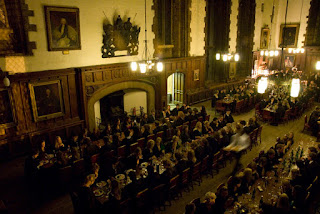
I was unable to benefit from this ‘experience in oratory’ until later in the year when I discovered the club held one annual debate where neither membership nor a gown were necessary to attend in the Great Hall of Durham Castle. It seemed bizarre that the town’s castle operated as neither a tourist attraction nor the home of some wealthy bigwig, but as a college of the university in which 150 students had lived and studied from 1837. Apparently, between the thirteenth and fifteenth centuries, its oversized dining room had been renowned as Britain’s largest ‘Great Hall’. I sat at the back in my usual student-wear to quietly observe a debate dominated by white males wearing gowns.

What I witnessed stunned me. It was difficult to decide what impacted me the most. Adolescents of my age acting as if they were already middle-aged men, seemingly in imitation of their family’s upper-class characteristics. Boys confident enough to stand up and talk loudly and at length on global issues about which they displayed only the most basic understanding. Conversely, their peers not replying with factual corrections because they too were eagerly awaiting a chance to stand up and mouth their own ignorance. Overloud voices and theatrical flourishes as if the debater were the lead actor in a school play. Mob-like cheering and jeering at speakers as if it were some medieval tournament. Rude audience comments shouted out during speeches, eliciting rumbustious laughter. Loud banging of fists on tables and foot stomping like a mob of noisy yobo’s.

What proved most baffling were the moments when a participant whom I vaguely knew would stand up to argue a point of view that I had thought was the opposite of their personal beliefs. It appeared that, in this playground, moral certitude had to be sacrificed to the altar of argument purely for argument’s sake. It was an intellectual game whose purpose was to impress one’s peers with wit and verbosity rather than facts or evidence. The medium WAS the message, not the content that was being spoken … or more often bellowed. During an evening of insufferably posh accents, visions of fencing, guns at dawn and gloves smacked across opponents’ cheeks crossed my mind. It was evident that many of my fellow students must have already practised this parlour game for years in ‘debating societies’ at their private schools … while, in my parallel state school universe, I had been occupied presenting pop music programmes on London pirate radio stations.

At the event’s conclusion, I stumbled outside into the night air, reeling as if I had been returned to Earth after abduction by an alien civilisation. Perhaps you required blue blood to feel at home in there. I resolved not to renew my club membership nor to attend further debates. The academic Sir Walter Moberly had commented in 1950: “Undergraduate debates are not conducted at the deep level at which convictions are really formed.” This notion that an individual can lack personal conviction to debate or argue a point forcefully was a foreign land to me. I could frame an argument for my principles, but why would one propose a point of view that is not one’s own? Unless you never bother with ‘convictions’ and follow a path of merely blowing with the prevailing wind.

It was not until 1990 that Britain’s primary legislature, the House of Commons, allowed its proceedings to be permanently televised, following its eleventh vote on the issue during the preceding twenty-two years. The motion was opposed by then prime minister Margaret Thatcher because “my concern is for the good reputation of this House.” Initially, only close-up shots of the politician holding the floor were permitted because a wider view would have shown the public the faces of their elected representatives jeering, hectoring, desk banging and rabble-rousing during many speeches. This restriction was later relaxed, allowing the rest of the world to witness for the first time the childish habits of grown men who had never moved on from ‘bunfights’ in oak-panelled dining rooms during ‘High Tea’.

Watching those early televised broadcasts vividly recalled the one debate I had attended more than a decade earlier. I suddenly understood that Durham Union Society had been established in 1842 as ‘A Nursery of the [House of] Commons’, as noted a headline in ‘The Guardian’ newspaper. My privileged contemporaries had been in training to become politicians since an early age. Durham had merely been the latest stop on their route to the elevated roles to which they had forever been told they were entitled. Articulating this notion of ‘power’, Sir Winston Churchill had once observed at the Oxford Union: “If you can speak in this country, you can do anything.”

House of Commons rules strictly forbid members to call each other ‘a liar’ or to make an accusation of ‘lying’. As a result, just as I had witnessed in Durham, speakers are permitted to spout any old tosh that comes into their heads and get away with it. How can a critic ‘speak truth to power’ in a forum where the currency of ‘truth’ is not merely devalued but prohibited? Politicians know they can say whatever is expedient in the moment without any recourse, while the rest of us would be sacked from our jobs for what our world considers to be lying.

In my own field, the lack of, ahem, ‘conviction’ of politicians responsible for the British government’s media policy has been evident often. In March 2010 whilst in opposition, Ed Vaizey MP said “the government has set a provisional target date of 2015 [for digital radio switchover] and we are sceptical about whether that target can actually be met.” However, by July that same year and after an election had appointed him the new government’s culture minister, Vaizey conversely said that “2015 is an achievable target date and we will work to support that ambition.” Ho hum.

During the period when I seemed to be the only City analyst covering the radio broadcast industry, I would occasionally be contacted by the BBC to be interviewed for a programme. Before sunrise one day, a BBC car collected me from home to take me to the studios of the ‘Today’ programme on ‘Radio 4’ for a live item about digital radio switchover. On arrival, I was told that I would be answering the presenter’s questions and then the government minister would be introduced and quizzed. However, the minister had insisted that I not be permitted to follow up or respond to what he would be saying. It was obvious that my presence in the studio would suggest a semblance of ‘balance’ whilst not actually allowing genuine debate or argument.

I had arrived at the BBC early and spent an age waiting in the show’s ‘green room’. The minister arrived late, accompanied by a flunky, entered the room and said to me: “So you are the person they have brought here to tell me that everything I am about to say is wrong.”

Just as I had witnessed in Durham, patronising privileged toffs like him function in a world where they insist upon immunity from contradiction or correction to the drivel they shout. Despite my anger at his comment, I followed the instructions for that morning’s appearance, but have refused every BBC invitation since. Where there is purposefully no genuine debate, what would be the point?

Is this the “honourable tradition” maintained by graduates of debating societies like Durham Union Society, the phrase attributed to the club in 1952 by its historian who suggested it:

“… should always retain at least some its present rooms as a gentlemen’s club. There may it long offer to future generations those opportunities for the making of friendships, for argument, and for training in life and thinking …”?

‘Training’ for a ‘life’ as a conviction-free politician?

[Originally published at https://peoplelikeyoudontworkinradio.blogspot.com/2023/11/an-elite-academy-for-aspiring-rent-gob.html]

One door opens, another is closed by someone posh : 2009 : John Myers, Digital Britain

 A posh voice opens doors. Not literally, unless you are royalty, but figuratively. Opportunities seem to fall out of the sky for those who speak in a recognised way that conveys their breeding and their assumed elevated status in British society. I have observed this as someone who has never considered myself posh, as someone who has never been perceived as posh, but as someone who was thrust unprepared into a world of posh people from the age of eleven. Until my first day at grammar school, I had mistakenly believed that ‘people were people’ (to quote Lou Rawls) and that ‘meritocracy’ was a fact rather than a fancy theory. My mum had believed it too, having just bought me a red ‘Harvard’ sweatshirt from Farnborough outdoor market for having passed the eleven-plus exam. I wore it to bed (in the style of Susan Saint James) for the next thirty years until it literally wore out .. but Harvard remained a fantasy.

My claim to have never had a posh, or posh-ish, voice could be challenged by someone who knew me at age four. I was shocked when I revisited a recording of my recital by heart at that age of ‘Winnie The Pooh’, made on a Uher reel-to-reel tape recorder my father had bought second-hand from the pages of ‘Exchange & Mart’ magazine which he would pore over every week. I sounded frighteningly like a distant relative of the Queen and nothing at all like my parents. Maybe I was trying to emulate fellow toddlers at Gay Trees nursery school on Grand Avenue where owner Mrs Potten had insisted I play a reluctant shepherd in the annual Nativity play. In summer, she would lead us all onto the adjacent Recreation Ground to sit on the grass and watch the uncensored violence of her one-woman Punch & Judy show.

During the following seven years, I attended a state school on a council estate where my posh-ish voice must have been modified by a desire to integrate with my new set of peers whose ‘overspill’ families had been relocated there from South London suburbs bombed during the War. From then onwards, the only posh voice evident in our household was my mother habitually answering our phone with “Camberley double one three one”, inexplicably speaking as if she were Mrs Bouquet. Aside from this mannerism, I cannot remember meeting anyone who had a posh voice. It was not until I was aged seventeen that I visited the Ascot home of posh schoolfriend Kate Graves and asked why there was a bell button in every room, only to be told that it was used to call a servant from the scullery. Okay, I thought to myself, I must have passed into a parallel universe.

My first indication that posh people and radio were a match made in heaven arrived when I was sharing a landing with a Durham University final year music student who had heard me regularly rabbit away about my passion for radio. One day he startled me with the news that he had accepted his first job as a producer on BBC radio. I was gobsmacked. Why? Because he had never once shown an interest in radio or demonstrated any understanding of how radio programmes are produced. I was pleased for him … but I was baffled. He had not been hired as a trainee. He had been hired to produce radio programmes without apparently having what might be considered the relevant skills to do the job. Months later, I looked in ‘Radio Times’ and, sure enough, his name was listed as producer of major daytime programmes on BBC Radio Three.

Perhaps this event, which seemed insignificant at the time, had been sent to me as a sign. Perhaps the gods were telling me that I should heed their advice, that I must stop believing in ‘meritocracy’ and that I should find myself a career ambition other than radio. If that was the case, I stupidly ignored their heavenly intervention. As a result, I expended a huge amount of effort during the next three decades, making dozens of applications for BBC radio job vacancies, being interviewed for many of them, but always being rejected. On occasion, I knew the person whom the BBC appointed and I knew the brevity of their CV … but they did possess a posh voice.

Fast forward to 2009. I was crossing London’s Shaftesbury Avenue in the company of John Myers, for whom I was writing a report for the British government’s Digital Britain initiative. Having finished a work meeting together in a nearby café, I was about to catch an Underground train home, whilst John was heading to his chauffeur-driven car. As we stood on the kerb, waiting for the traffic lights to change, John said something casually to me that started with the words: “Posh boys like you …”.

I immediately laughed out loud. Without thinking, my reflex action was to declare to John: “I’m not posh”. The words fell out of my mouth immediately without considering any potential consequences.

“Really?” said John.

“Yes,” I said. “I was born in a council house and went to school on a council estate. I am definitely not posh.”

“Oh,” responded John … and then we moved on to discussing other topics.

On my way home, I reflected on why John might have thought I was posh. He had a broad Lancashire accent and could never himself have been described as posh. He had worked his way up the radio industry from a start as programme assistant in BBC local radio in 1980, ending as chief executive of Guardian Media Group Radio in 2008. I could only guess that most of the people John was meeting at his present level of work were undeniably posh. He had been commissioned by the government, its ministers and its civil servants to produce a significant report on the regulation of the commercial radio industry in the digital age. Almost every one of his contacts for this work must have been posh. Perhaps, to him, I appeared to be just another of these posh ‘boys’.

Whatever the reason for his off-the-cuff comment, I sensed during the weeks and months that followed, that John’s attitude to me altered perceptibly. He continued to hold daily conversations with me by phone, email or in-person, as was necessary for me to ghost-write his report. In parallel, he had regular conversations and meetings with senior people in the radio industry, government and the Civil Service. But I was never invited to meet any of these people, even though it would have proven a lot more productive for me to have taken notes at these meetings rather than having to wait for John to relay me their content and outcomes. John convened and met regularly with a ‘committee’ of seven senior people and with a separate ‘consultation group’, both of which are listed at the end of the written report. I was credited merely with ‘research and support’, despite having transformed John’s handful of pages into a coherent 104-page document.

As a result of the report, John was invited by the radio industry to give the keynote speech at the 2009 Radio Festival event. As with the report, John sent me his drafted notes in advance, which I converted into a speech and an accompanying presentation. He did not invite me to attend the event. One morning, I woke to hear the bedside radio on BBC Radio Four broadcasting a live interview with John concerning the report. Once the written work had been completed, John did not keep me informed of the publicity it was receiving or its impact on government policy.

I was disappointed. John had needed my skills to research and write what came to be known as ‘The Myers Report’. However, after our ‘posh’ conversation, he had been careful to keep me away from the radio industry people who might prove useful contacts for me to find a job in radio, but who might see that it was really me writing the report rather than John himself. I understood how difficult it must be for a significant document bearing your name to be ghosted by someone else who had never been chief executive of a radio business, as he had, and by someone who was not even posh like his peers. 

I consider John an example of how ‘posh’ not only commands respect amongst similarly posh people, but equally from people who are not at all posh. Posh equals clever. Posh equals superior. Posh equals special. Posh equals the ability to make people of every class believe you deserve to be treated as someone who can rule, can manage, can order, can tell the rest of us what we do. Whatever comes out of a posh person’s mouth is believed and, even if evidently untruthful, is retained as ‘gospel’. Posh people maintain their superiority only because the rest of us let them, encourage them and look up to them in the master/servant, upstairs/downstairs deference we have implicitly imbibed since childhood. Posh is superpower.

I had worked with John only as a result of sending him an e-mail attached to an analysis paper for MA studies that I had written earlier about the same regulatory aspect of radio for which his report had been commissioned. He had offered me a £10,000 fee to provide research support. Very quickly, my responsibilities went much further and led to five months full-time work on this report, during which time I had to reject offers of other freelance work. I shared my concerns with John that my work with him had deprived me of income and he promised that, although I was underpaid for this commission, he believed it would lead to further reports on which the two of us could continue to work together. He recognised that we had complementary skills and we worked well together.

The first negative signal arrived when I invoiced John for my fee once the report had been published by the government. I was registered with HMRC for VAT (sales tax) and was legally required to add an additional 17.5% to my invoice. John responded that he was not registered for VAT and therefore could not reclaim any VAT he might pay to me. As a result, he did not want to pay the VAT on my invoice. This response confused me. I had no knowledge of the amount he had been paid by the government to write the report that I had just ghosted for him. I was certain it must be at least ten times the fee he was paying me. He was disputing a payment of £1,750 that was required by tax law, when he had probably earnt one hundred times that sum for the same work. I persisted but he refused steadfastly to pay the VAT of my invoice. I was not at all happy.

In 2010, I read in the news that John had been commissioned by the BBC to write a report about its radio services. This was exactly the kind of further work that John had promised me and which I was hoping to be considerably more lucrative for my contributions. I met him at a café near Broadcasting House to discuss this next project. Initially, he wanted to know about the online blog I had been publishing since 2008.

“How much are you paid for your blog?” John asked me, betraying his lack of understanding of online social media platforms.

I had to explain that a blog pays nothing but its author hopes that their online presence would lead to connections, work and income in the long run. It was a marketing exercise, but intrinsically unprofitable. He still seemed enthusiastic.

“How did you get your book published about DAB?” John asked.

My anthology of blog pieces about DAB radio had just been self-published as a book, so I offered him a free copy and explained the basics of creating a book for sale online and in bookshops. He seemed intrigued by the potential. Finally, our discussion moved on to the BBC report which John had been commissioned to write. My expectations were high. I was excited by the prospect of much needed work.

“You will not be involved in this report,” John said suddenly. “But I hope there will be something we can work on together in future.”

I was in shock. So much shock that I cannot recall the remainder of the meeting. I left feeling disappointed, deflated but mostly … betrayed. I had had to reject work the previous year because of the intensity of work on our last report. I had been paid a pittance. I had been promised work that now had not materialised. Because of the minor contribution with which I had been credited in the last report, I had received no unsolicited approaches to write similar reports. My work had been unacknowledged, unrewarded and now I felt I had been side-lined altogether.

I never received further offers of work from John Myers. But he started publishing his own blog about radio, much like mine. Imitation may be the sincerest form of flattery … but it does not pay the bills. Eventually I noticed that, in his blog, John was citing analyses of radio data that I had done and published in my blog, but he was neither crediting me nor linking to the source. As a result, I stopped publishing further blog entries after August 2011. It seemed pointless offering John further examples of my skills in analysis for him to claim the credit and make money.

In 2011, John Myers was appointed chief executive of The Radio Academy. In 2012 he was appointed visiting professor at the University of Cumbria. He published his own book about radio the same year but did not send me a copy.

At a Tribunal in 2015, John Myers was found guilty of tax evasion on earnings of £6.3m in 2005/6, for which he had paid only £130,000 in tax.

[Originally published at https://peoplelikeyoudontworkinradio.blogspot.com/2023/02/one-door-opens-another-is-closed-by.html]

AM/FM switch-off of national radio stations? An empty threat whose expiry date has long passed

Some of Digital Britain’s radio recommendations were unworkable. However, the notion has remained that FM and AM analogue transmitters of the UK’s national radio stations will be switched off once digital radio listening passes the 50% threshold. This was never practical. It was a ‘threat’ propagated by government to the public in the hope of forcing them into buying more DAB radios, instilling fear that they would otherwise lose their favourite stations. The threat failed.

The problem with any threat is that, once it has failed, it remains difficult for the protagonist to climb down. So the threat continues to be propagated. For what reason now? So as not to make those who issued the threat look completely foolish. The need to save face has locked the government apparatus into a fiction that BBC and commercial radio will willingly throw away half their audiences by closing their FM/AM transmitters. This was never true.

THE BBC

‘Universal’ reception of the BBC’s core public services is mandatory. It would prove impossible to levy the BBC Licence Fee on every UK household if (almost) the entire population could not receive the BBC services for which they pay.

The BBC Charter & Agreement requires:

“12. Making the UK Public Services widely available
(1) The BBC must do all that is reasonably practicable to ensure that viewers, listeners and other users (as the case may be) are able to access the UK Public Services that are intended for them, or elements of their content, in a range of convenient and cost effective ways which are available or might become available in the future.”

Would the BBC switch off analogue transmissions of its national networks once more than 50% of listening was attributed to digital platforms? Of course not. You would be a complete fool to slash your radio audience by half, particularly as such an action would contradict the BBC Charter & Agreement.

Could the government insist that the BBC switched off the analogue transmissions of its national networks? Only if it wanted a revolution on its hands. It would be difficult to think of a policy more likely to lose it the next General Election.

COMMERCIAL RADIO

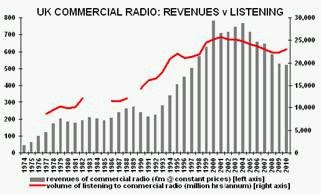
The revenues of commercial radio are directly related to the sector’s volume of listening. If commercial radio switched off its analogue transmitters once digital listening had passed the 50% threshold, at a stroke it would risk losing 50% of its volume of listening and, subsequently, 50% of its revenues. Would it do that? No, of course not.

RadioCentre’s self-interested ‘policy’ has been to argue that the BBC national networks should turn off their analogue transmitters first, years in advance of commercial radio stations. Radio Chicken, anyone? Naturally, RadioCentre failed to mention that the outcome of this proposal would be likely to significantly increase its member commercial radio stations’ analogue audiences and revenues. There is nothing quite like trying to persuade your competitor to commit joint suicide … first.

Additionally, the value of commercial radio companies is vested in the scarcity of their analogue FM/AM licences. Because no new analogue licences are awarded by the regulator, each existing licence has a significant intrinsic value, even if the business using it is not profitable. The same is not true of DAB licences. Anybody can apply to Ofcom for a DAB licence by filling in a form and paying a relatively small fee.

An example of the value of analogue licences to commercial radio owners is Absolute Radio. In 2008, Times of India paid £53.2m for Virgin Radio, comprising one national AM licence and one London FM licence. Having re-launched the station as Absolute Radio, the company lost £4.3m in 2009, but its balance sheet still retains considerable value because of the scarcity of its two analogue radio licences. If Absolute Radio were put up for sale, someone would be interested in buying it because of that scarcity.

By contrast, when DAB commercial radio services such as Zee Radio, Islam Radio, Muslim Radio, Flaunt and Eurolatina no longer wanted their digital radio licences in 2010, there was no queue of potential buyers. They simply handed their licences back to Ofcom because those licences were not scarce.

This is why it would prove financially suicidal for commercial radio to switch off its FM/AM transmitters. It would have to write down the value of those scarce analogue licences to zero in its balance sheets which, at a stroke, would negate almost the entire value of the licence owners. Not a good company strategy.

So, when headlines such as ‘Absolute Radio mulls AM switch-off’ appear in the trade press, they should be read with a bucket of salt. The headline might as well say: ’Absolute Radio mulls destruction of shareholder value.’

And, when yet another DAB proponent appears on radio or television to persuade you, in all seriousness, that the UK’s most listened to national radio services – both BBC and commercial – will imminently be switching off their AM/FM transmitters, please feel justified to laugh in their face.

This is about as likely to happen as Tesco putting security guards at their store entrances to tell the public to shop elsewhere because they want fewer customers.

FOOTNOTE:

It emerged last week that, after the Norwegian state classical music station ‘Alltid Klassisk’ abandoned FM transmission on 1 July 2009 for DAB transmission, its audience contracted from 25,000 to 10,000 per day.

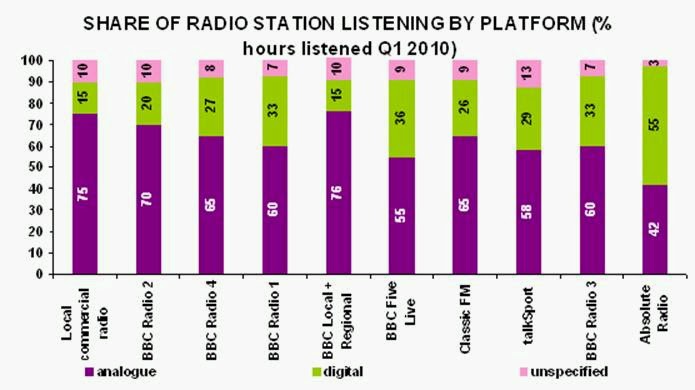
Now, consider that only 20% of listening to BBC Radio 2 is via digital platforms (in Q1 2010), lower than the 24% average for all stations [see Sep 2010 blog]. If that average ever managed to reach the 50% threshold, it might leave 60% of Radio 2’s audience still listening via analogue. That’s 8m listeners that Radio 2 would have to turn its back on as a result of FM switch-off. Time for the BBC to start erecting barricades outside Broadcasting House.

[thanks to Eivind Engberg]

David Blunkett's opinion of DAB radio: BBC is "defending the indefensible"

‘You & Yours’
BBC Radio 4
28 March 2011 @ 1200 [FM only]

Julian Worricker, presenter [JW]
Paul Everitt, chief executive, Society of Motoring Manufacturers & Traders [PE]
Laurence Harrison, technology & market director, Digital Radio UK [LH]

JW: Now, car manufacturers have long prided themselves on arming their vehicles with the latest groundbreaking technology, but there’s one in-car gadget which has remained stuck in the twentieth century. Radios in cars, generally speaking, are FM/AM analogue, and not digital. Around 20% of all radio listening takes place in the car, that’s according to RAJAR, the organisation which counts these things. So, if the UK is to go all-digital and the analogue signal switch is turned off – and that, of course, is the plan – cars need to be equipped with digital radios.

JW: Well, car manufacturers are planning that all new vehicles will have digital radios fitted from 2013. And, now, Ford says it will make digital radios available in its cars a year earlier than that. This will all help achieve the target that 50% of all radio listening should be digital, which is one of the pre-conditions for turning off the analogue signal. We can explore this with Paul Everitt, who is the chief executive of the Society of Motoring Manufacturers & Traders, and with Laurence Harrison, the technology & market director from Digital Radio UK, which is the company set up by broadcasters to help with the switchover. Gentlemen, good afternoon. Paul Everitt, why is the car industry pushing ahead with installing digital radios by 2013?

PE: Well, I think there are two key reasons. The first is because that’s the agreement we had with government as part of the Digital [Radio] Action Plan. They recognised that listening in-car was a key part of radio listenership and, therefore, early introduction of vehicles with digital radio was a key part of the package that needed to be achieved. But, I think, increasingly, what we are seeing, and certainly the announcement from Ford that you mentioned slightly earlier, is actually about the consumer saying that this is something that we want. The consumer now has an increasing opportunity to experience both the listening quality of digital in-car, but also the content, the increasing content, and desirability of the content on digital, as well as gradually and increasingly improving coverage. So, it’s a combination here of ….

JW: [interrupts]: Right, right, I just want to ….

PE: …. both something that we have to do, or we have agreed to do. But I think, increasingly, this is a push that is now coming from consumers.

JW: Okay, I just want to scrutinise that a little, because I don’t doubt that Laurence Harrison will say the same thing because we are told this is consumer led. But, surely, the truth of the matter is that the consumer has been led because of what the government requires you and others to do, so consumer choice only goes so far here.

PE: Well, I think we can argue the finer points of this, if you like. But, from an industry point of view, we began to be involved in this discussion during the course of 2008, obviously the conditions during 2009 with the development of the Digital Britain report brought that forward, or conclusions from that report have been built into vehicle manufacturers’ plans. But, as I say, what we are actually seeing today is, you know, increasing interest in digital from consumers.

JW: Okay. Let me bring Laurence Harrison in on coverage because, as I understand it, at least 90% [population] coverage is a target. That’s part of the targets that will only allow the switchover to take place. Now, 90% sounds positive until you then think about the 10% who can no longer hear what they are listening to now.

LH: Well, I think the key thing on coverage is to become the equivalent of FM coverage. So the 90% figure you refer to is around local coverage. Actually, on the coverage of national services, we are already at just over 90%, and the BBC has just recently committed to build that out to 93% by the end of this year. And the target thereafter is to get to FM equivalence as soon as we can, so that programme is well underway.

LH: And, if we are driving from A to B a significant distance, can we be sure that that coverage will remain consistent over that distance?

PE: So, you’re absolutely right. Of course, for the car market, geographical coverage is vitally important. What we do know now is that the vast majority of motorways and A roads have got good coverage, and significant coverage on B roads and smaller roads. But we are working with broadcasters to try and prioritise the road network going forward.

JW: Paul Everett, what about those who can’t afford to buy a new car after 2013 with a smart digital radio inside it? When that switchover eventually happens, what happens to them?

PE: Well, this has always been our biggest – or one of our biggest – concerns, which is that how do we retro-fit the entire vehicle parc? We are currently looking at something between 25 and 30 million vehicles all up, so it’s quite a challenge. What we have seen over the course of the last year – 18 months – is relatively low-cost adaptors. I think now … I mean the prices vary, but certainly less than £100 to adapt your vehicle, and these are sort of a relatively basic unit, so not desirable for everybody …

JW: What does ‘relatively basic’ mean in terms of what it will actually do?

PE: Well, it means you get a digital reception but you have to kind of plug it into the cigarette lighter and have a bit of an aerial up and …

JW: It’s a bit Heath Robinson, isn’t it?

PE: We would agree with that. From our perspective, we’ve been very much focusing on what we would see as an integrated unit. So, something that you can put into your car or have installed in your car which would effectively mean that you could just use your standard radio to receive digital broadcasts. Now, we’ve seen … I’ve seen first kind of trials of that technology. We hope that that’s going to be available from sort of around the end of this year – the beginning of next year – so we’re already seeing a market begin to develop and, as I say, I think we … well, there are two ways of looking at the problem. One is that we must all prepare because this switchover is going to happen. Or the one which we are focused on is: the more consumers have experience of digital, the more they like it and want it and therefore that’s a market driver, rather than sort of an administrative pull.

JW: No, and that’s a fair point because I read some surveys, Laurence Harrison, that I know you were quoted in in recent weeks. But the point that has just emerged from the last comment, surely, to put to you are that whatever we do here, it is going to cost us and we do not have any choice over that.

LH: Well, I think the stage we are at at the moment, as Paul said, is that we have not got a confirmed switchover date now, so what we are trying to do is build momentum.

JW: But it will happen one day.

LH: It will happen one day, but what’s going to drive people towards digital radio is the great content we’ve got. The same happened on TV. So if you look at the offering now on digital radio, you’ve got the soon to be launched BBC Radio 4 Extra on Saturday, 5 Live Sports Extra, 6 Music, Absolute 80s [and] 90s, Planet Rock, Jazz FM has just announced it is going onto the digital network, so the content offering has frankly never been better and what we do know about people that have digital radio is that once they’ve tried it, they love it.

[The programme was followed with a Yours & Yours blog which invited comments from listeners on their experiences with DAB radio in cars. David Blunkett MP submitted a comment to the programme about his experiences with DAB, upon which listeners made further comments.]

……………………………

‘You & Yours’
BBC Radio 4
1 April 2011 @ 1200 [FM only]

Peter White, presenter [PW]
David Blunkett MP [DB]
Lindsey Mack, senior project manager of digital radio, BBC [LM]

PW: Now, you’ve all been writing in, telling us about your frustrations with digital radios, after Monday’s report on how Ford is planning to install DAB radios as standard in some new cars from next year. Steve told us about his A370 journey between Cardiff and North Wales: perfect listening for 30 miles outside the Welsh capital, then nothing for 150 miles. By contrast, over on Anglesey, Steve tells us the only place that silences his DAB car radio is the Conwy Tunnel. Another correspondent was former Home Secretary, David Blunkett. He’s had trouble getting a DAB signal at his home in Derbyshire. So we brought him together with a senior digital manager for the BBC, Lindsey Mack, and David started by challenging the main claim of digital supporters that DAB achieves 90% coverage.

DB: My thrust was that there are not 90% of the population with access to digital [radio], and many of those who claim to have access have intermittent or interference with the access. And I’m a classic [case] because I can just about get digital radio in North Derbyshire, where I rent a cottage, if I hold the radio up to the roof, or I find one particular spot on the kitchen window sill. Get it out of kilter and either the signal goes or, as quite often I get, even in London, it breaks up.

PW: Right, let me at this point bring in Lindsey Mack. A lot of our e-mails mirrored what David had to say, and particularly this point: that the quality isn’t adequate for many people, even if they’re … it’s said they have reception, and in that so to talk of [FM radio] switch-off at this stage, you know, seems wrong.

LM: Over the last sort of two years, the BBC has been very committed to building out its DAB coverage. We actually are at 90% of the UK population, but that doesn’t mean that everyone’s going to always get a very good reception. A lot of it does depend on the device you have, as well. There are some receivers that are a little bit more sensitive than others. And, in fact, we’ve actually just been doing some tests on the last sort of bestselling sort of ten or dozen receivers in the market.

PW: But what a lot of people said to us, and I suspect David will reiterate this, is that FM, which digital is going to replace, that has a much more stable signal and that, even if you start to lose that signal, you don’t lose it altogether in the way you often lose the digital [signal] or it just goes into sort of burble.

LM: Yes, and with DAB, you usually either get it or you don’t. I mean, looking in Derbyshire, we’ve actually got very good coverage, especially North Derbyshire, so perhaps after this we could actually talk to David about the device he’s actually got, as well, just to see which one he’s actually using. Whilst the BBC has been very committed to DAB and extending the coverage, we are now actually having to make the existing coverage more robust, and that’s actually what we haven’t been doing as much before. What we’ve done before, we’ve concentrated on just rolling out DAB. Now we know we’ve got to really look at the whole way we’re measuring DAB. We’re looking at indoor coverage in particular. You know, originally, when we launched DAB, we actually based all our coverage on car listening and then, obviously, car listening didn’t take off the same way as people are actually listening indoors.

PW: Well, it couldn’t because there weren’t [DAB] radios in cars.

DB [laughs]: Absolutely.

LM [laughs]

DB: It is a problem, Peter, actually, that if you can’t get it and you can’t hear it, you can’t appreciate it. I’ve got no problem with the extra reach and the way in which [BBC] Radio 7 is now going to become Radio 4 Plus or, whatever, Extra. My problem is that there’s a big over-claim for this. Let’s take it steadily, let’s try and get it right, let’s not claim that people have got a service when they haven’t and, particularly, let’s not say – which was what the sell for DAB was – that this is going to be higher quality when, as you’ve just described, the burble, the break-up, the lack of a good sound… I have three DAB radios up north. I’ve tried them all in different places, so it’s: please don’t do to me and to the audience what always happens, which is: it is not the fault of the deliverer, it’s the piece of equipment you’ve got, and they’re pretty good pieces of equipment.

PW: But, David, it was your own government who published Digital Britain and it was your own government that set the 2015 date.

DB: Yeah, and I criticised them at the time. Everybody wants everything now. They want it faster, they want to claim it as the greatest quality. I mean, everything is always ‘the best ever.’ And, frankly, it isn’t and if we just accept that and say ‘lets take it steady and lets try and get it right,’ we’ll all be on the same page.

PW: So it isn’t the principle that you’re against. It’s the practice, really.

DB: Yes, it is. I mean, if FM is better than DAB, let us continue for the time being with FM and, in many parts of this country, it is.

PW: Lindsey Mack, 2015 is supposed to be dependent on, you know, the state of digital [radio listening] and the public’s attitude to it. There’s a report in the papers this week that, in fact, digital sales of digital radio have actually fallen, and fallen for the second year running.

LM: They did fall slightly down last year, compared to the year before but, to be very honest, over the last sort of quarter, the consumer electronic market has been hit very badly. Not just in terms of radio sales, but other consumer electronics as well. You know, the BBC is working very closely with commercial radio and doing a lot of sort of joint promotions. We have to get our messaging right on this.

PW: A lot of our listeners said ‘if it ain’t broke,’ you know, ‘don’t fix it.’ In other words, okay, people quite accept that you’ve got, that you should move on, and that digital probably is the next thing, but why get rid of FM before … in some ways, some people said ‘why get rid of it at all’? Why can’t they exist side by side?

LM: But we’re not getting rid of FM totally. What we’re saying is that the BBC services – the national services – are on FM and DAB, and also we have our digital-only stations on DAB. By 2015, we have to … hopefully, we will have reached 50% digital listening. That’s not [just] DAB. It’s digital listening across all platforms. But there’s a lot that has to be done by, you know, at 2015, and beyond that.

PW: Are you happy about that 2015 date?

LM: 2015 is just … is a date that the industry can focus on. It is not a switchover date. What we have to achieve by then, though, if we can, is obviously digital listening up, we have to have good coverage rollout which has to be robust. People have to be able to turn on their radio and it has to work.

DB: Well, just one final message, Peter, which is that Lindsey’s done a pretty good job at defending the indefensible …

LM: [scoffs]

DB: … and I commend her on it, but don’t get carried away by the anoraks. They’ll tell you anything is working, even if it isn’t.

PW: So what would be your … what’s your solution? What would you want the BBC to do, David?

DB: I’d want them to be absolutely clear and honest and to say: there are problems with this, we’re resolving them, we want people to buy the [DAB] radios because they’ll get the extra coverage of different channels, and we want to keep FM as long as it’s necessary for people to be able to listen to Radio 4 properly.

[thanks to Darryl Pomicter & Luke Shasha]

DAB radio take-up in the UK: the 2010 year-end scorecard

“I think that there is great potential for digital radio, as the UK and Danish experiences demonstrate.”
Neelie Kroes, vice president for the digital agenda, European Commission, 3 March 2011

“This milestone is part of building momentum for the transition to digital radio in the UK …”
Digital Radio UK, December 2010

“I think that there has been a transformation in the last twelve months.”
Ford Ennals, chief executive, Digital Radio UK, February 2011

“2010 was a fantastic year for the DAB family, with much encouraging news and positive activity from individual markets …”
Jørn Jensen, president, World DMB, March 2011

“We are seeing increased momentum and activity as digital radio switchover moves from debate to reality …”
Bernie O’Neil, project director, World DMB, March 2011

“2010 had a real sense of forward momentum and activity …”
Caroline Brindle, project office manager, World DMB, March 2011

“Building momentum”? “Transformation”? “Fantastic year”? “Increased momentum”? “Forward momentum”?

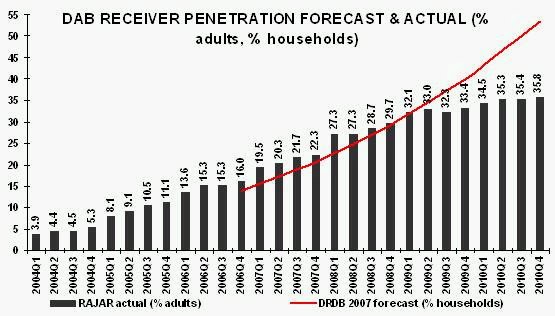
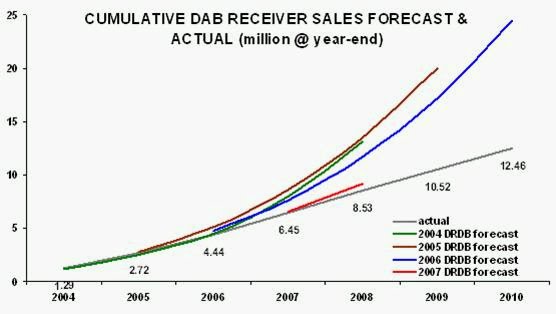
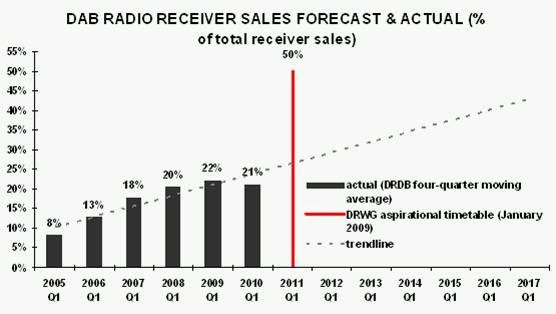
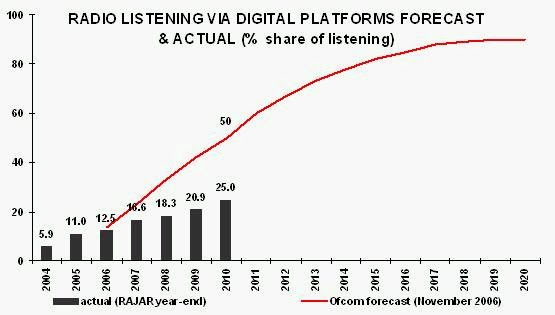
Is this DAB radio that we are talking about? In the UK, at year-end 2010, the picture looked like this:

DAB radio receiver penetration:
· 2010 year-end forecast: 53.4% (Digital Radio Development Bureau, 2007)
· 2010 year-end actual: 35.8%

Cumulative DAB radio receiver sales:
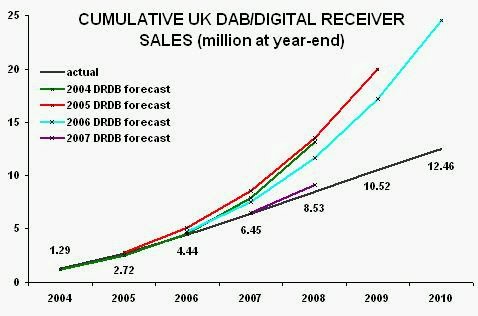
· 2010 year-end forecast: 24.5 million (Digital Radio Development Bureau, 2006)
· 2010 year-end actual: 12.5 million

DAB radio receiver sales as % total receiver sales:
· Q1 2011 forecast: 50% (Digital Radio Working Group, 2009)
· Q1 2010 actual: 21%

Radio listening via digital platforms:
2010 year-end forecast: 50% (Ofcom, 2006)
2010 year-end actual: 25%

Radio listening via digital platforms:
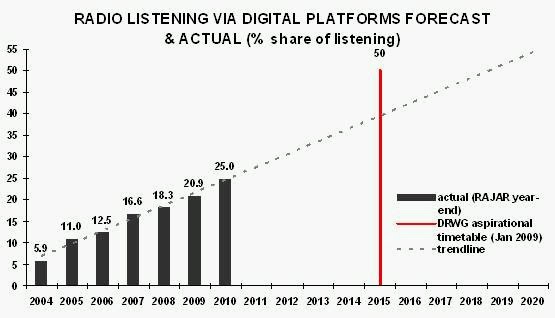
2015 year-end forecast: 50% (Digital Radio Working Group, 2009)
2010 year-end actual: 25%

Radio listening via digital platforms:
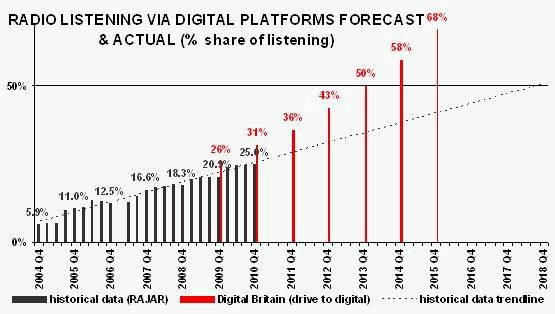
2010 year-end forecast: 31% (Digital Britain: drive to digital, 2009)
2010 year-end actual: 25%

Commercial radio listening via digital platforms:
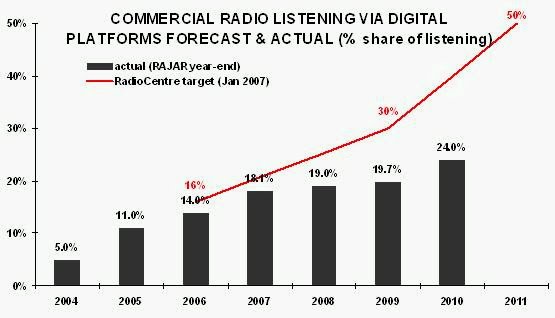
2010 year-end forecast: 40% (RadioCentre, 2007)
2010 year-end actual: 24%

None of the stakeholder forecasts of DAB take-up in the UK have come to pass. In this respect, 2010 was no better a year than any other.

Neelie Kroes is mistaken. Evidence from the UK experience certainly does not demonstrate the “great potential” for DAB radio.

DAB radio numbers: why do they keep making them up?

I’m a numbers man. I can tolerate a little numerical exaggeration, a few rounding ups, or even the odd ‘nearly x million’. But when people invent numbers and stick them in their press releases, I reach for my calculator. Not for the first time, today Digital Radio UK advanced the concept of ‘mind over mathematics’ to a new level.

In its press release of 21 December 2010, Digital Radio UK estimated “that due to strong Christmas sales, over two million digital radios will be sold in 2010.” I questioned how this could be true in my blog. Turns out that it wasn’t.

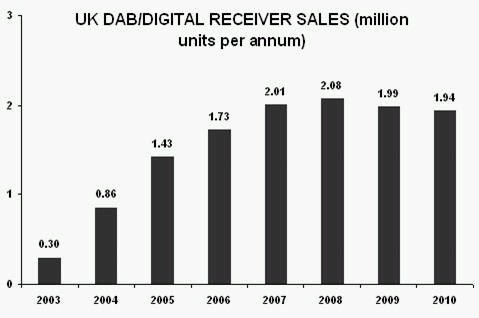
In today’s update, Digital Radio UK admitted that the “increase in digital radio sales” it had heralded in December was, in fact, a decrease because “2010 was slightly down in digital radio sales volumes (-2.3%) compared to 2009.”

In plain English, 1.94m digital radios were sold in 2010, compared to 1.99m in 2009 and 2.08m in 2008. Increase? No. Growth? No. Over 2m in 2010? No. Were these sales figures in the Digital Radio UK update? No.

In another numerical nonsense, today’s Digital Radio UK update said:

“If this annual growth rate [in digital radio listening] is sustained, then the Government criterion of 50% of digital listening will be achieved in 2014.”

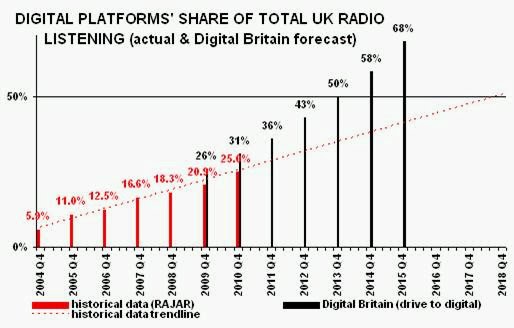
This is mumbo jumbo rubbish from people who like to use numbers to baffle the public and to obscure the truth. The 50% threshold is no more likely to be reached in 2014 than it is in 2013, which had been the original government target. A trendline* through six years of quarterly data (see graph above) shows that the 50% criterion will not be reached until year-end 2018.

So what happened to the original 2013 target for 50% that had been set by the government’s 2009 Digital Britain report? It now seems to have been completely forgotten. No explanation, no apology – just ignored (in June 2009, I had predicted that the 2013 target would prove “impossible”).

So how confident is Digital Radio UK that its new 2014 target is attainable? Enter stage left its CEO, standing next to a PowerPoint chart last week:

“This next chart is the most risky one I have in the pack. I hesitate showing you, particularly given the most recent conversations. But, I think, rather than just looking at a moment in time, there is a value in extrapolating. And all sorts of health warnings around this, you know, you’ve got government economists, you’ve got analysts in the stock market, you know, you can’t ever predict these things correctly. But, just taking the trends of the last three years and of the last year and running them forward – and life won’t be that simple but – just to understand from a mathematical calculation, where would that take you? Well, if we took the three-year compound growth rate, of the last three years, it would run us through to achieving 50% by the end of 2015, if we take the three-year curve. If we took the one-year curve that we’ve seen in 2010, it would take us to the end of 2014. To get to the end of 2013, which was an aspiration of Digital Britain, would require the compound growth rate to rise to 26%. So it needs to take a step change. You could put an argument forward that there are step changes coming, in content, in coverage, in cars, in communications and in consumer electronics. But I think it would be a brave man, or a brave woman, to say that, you know, you are definitely going to hit that grey line, and I wouldn’t say that. What I would say is that, on current trends over the last three or four years, we are likely to hit 50%, you know, in the next five years, I would say.”

So, February 2011 plus five years equals 2016. Well, this does not match the forecast in the ‘real world’ graph above of 50% being attained by year-end 2018. But neither does it match the 2014 date in today’s Digital Radio UK update.

Exactly where that leaves us is unclear. Is it 2014? 2016? Another year? Any old year?

DAB and realism and numbers seem to mix as well as oil and water and … er, more oil.

“Quite where the maths comes from to deliver 2014 is beyond me!” one senior radio executive said to me today. “Why do they put this out when it will surely mean another stick to beat them when it doesn’t happen?”

[* = there is no statistical evidence from historical data to demonstrate that the automated Microsoft Excel trendline is anything other than straight line.]

Q: Who is the government commissioning to produce an objective report on the costs & benefits of DAB radio switchover? A: The government

For two decades, the British government has pursued a policy to replace analogue radio broadcasting with DAB digital radio broadcasting. Why? The real reasons might as well be lost in the mists of time (or maybe were never made public). However, this has not stopped the government and its civil servants continuing to pursue the same digital radio switchover policy since the 1980s, despite overwhelming evidence that the surrounding media landscape has changed beyond recognition in the interim.

Because the government policy to replace AM and FM radio with DAB radio had never been decided on the basis of consumer demand, commercial necessity or global standards, it was unnecessary for officials to produce a document that justified it logically. When a government decides that a particular policy is necessary, it can make legislative change happen without recourse to the consumer market outside of Parliament or the Ministries. Politics and the real world do not inhabit the same space.

In the case of DAB radio switchover, the government made no effort to produce a cost/benefit analysis until 2008, when PricewaterhouseCoopers [PWC] was commissioned by Ofcom. However, the resulting 91-page report did not provide the solid, positive argument for DAB radio switchover that the government had desired. So the PWC report was hidden from the public for a year, eventually to be released and trivialised by civil servants [see blog entry Feb 2010].


In contrast to the government’s unbridled enthusiasm for DAB, the PWC report felt that “the [radio] industry and consumers may fail to see the benefits of digital radio over the longer term.” It concluded that “there are relatively few up-sides to the estimates and several significant downside risks” from its cost/benefit analysis of DAB radio switchover [see
blog entry Jul 2010].

The House of Lords Select Committee on Communications, in a report on digital radio switchover in March 2010, expressed its dissatisfaction with the government’s attempt to bury the evidence from this PWC report:

“We strongly regret that the cost benefit analysis carried out by PricewaterhouseCoopers was not published at the time it was delivered to Ofcom and the Department for Culture, Media & Sport in February 2009.”

The government responded that “technical difficulties” had prevented the report’s publication for nearly a year. As excuses go, it would probably have been better for the government not to have responded at all.

After this embarrassing debacle over the PWC report, the government must have wanted to commission a further report that would conclude what PWC had not: that DAB radio switchover is a wonderful thing and that there are sensible economic arguments to justify forcing it upon the British public.

In June 2009, the government’s Digital Britain report promised: “We will conduct a full Impact Assessment, including a Cost/Benefit Analysis of Digital Radio Upgrade.”

In January 2010, Ofcom’s Peter Davies offered
evidence to the House of Lords Communications Committee that another report would be done:

Baroness McIntosh of Hudnall: “What about your own impact assessment?”

Mr Davies: “We haven’t done an impact assessment yet.”

Baroness McIntosh of Hudnall: “But you have been asked to – correct?”

Mr Davies: “At some point in the future. I think the Digital Britain report said that we would be asked to do one, but we haven’t been asked to do one yet. Obviously we would need to do that and we would need a much fuller cost-benefit analysis before any final decision was taken.”

In June 2010, the government stated:

“We agree that a full impact assessment is an essential part of informing the Government’s decision on whether and when to move from a primarily analogue to a digital radio landscape. Work has already begun to collect the evidence needed to support an impact assessment and analysis should begin shortly.” [emphasis added]

Here we are now, in January 2011, and there remains no sign of the long promised cost/benefit analysis of DAB radio switchover, despite the new government continuing to pursue the digital radio switchover policy of the previous government. However, in December 2010, a document from the Department for Culture Media & Sport [DCMS] (marked “UNCLASSIFIED”) disclosed:

“The Government launched a joint Government and industry Digital Radio Action Plan on 8 July 2010. This Action Plan sets out the process for providing ministers with the information and assurances necessary to make a decision on whether and how to proceed with a Digital Radio Switchover. … Fundamental to the information provided to Government as part of the Action Plan will be a comprehensive Cost Benefit Analysis on the proposals for a digital switchover. … Government is conducting the modelling of the costs and benefits in-house. This research will provide robust evidence of potential costs and benefits to consumers of digital switchover to be incorporated into the Government’s Cost Benefit Analysis.”

So the government has confirmed that the government decision on digital radio switchover will be informed by a government cost/benefit analysis of digital radio switchover that utilises government modelling of the costs and benefits. It appears that, in the case of DAB radio switchover, the government has decided to be judge, jury and executioner too. This smacks more of ‘big brother’ than of the Conservatives’ much touted ‘big society.’

The unclassified DCMS document hinted that the earlier PWC report had not produced the desired results:

“A similar piece of work was carried out by PricewaterhouseCoopers in 2008 to inform the work of the Digital Radio Working Group into the future of digital radio and the potential for switchover. That Cost Benefit Analysis raised a number of caveats, chief among which were the gaps in research into consumer behaviour and willingness to pay. Although the radio ecology has changed since that Cost Benefit Analysis was produced, the document provides useful insights and the recommendations made by PricewaterhouseCoopers on further research remain valid.”

So what will be in the government’s new cost/benefit analysis report? The latest version of the government’s Digital Radio Action Plan explained:

1.4 IMPACT ASSESSMENT
Carry-out an impact assessment of the options and timings of the Radio Switchover. This will include, but not limited to, the following:
· the costs and benefits of any interventions to enable the switching the migration of all national and large local radio stations to DAB and alternative uses for the analogue spectrum vacated after the Radio Switchover;
· the rural impact of implementing the Digital Radio Switchover;
· Impact on energy consumption of a Switchover; and
· Environmental impact of analogue receiver disposal following Switchover.”

Interesting to see that neither the ‘consumer’ nor the ‘listener’ are mentioned here. For this workstream, the “first report to Ministers” is not scheduled until Q4 2011. It is evident that there is little urgency to execute this new cost/benefit analysis or for it to make a significant contribution at this juncture to any government re-evaluation as to whether to proceed with DAB radio switchover. If a cost/benefit analysis were a genuine priority, why was:
· the PWC report buried in February 2009 for a year
· a new cost/benefit analysis promised by Digital Britain in June 2009 but not prioritised subsequently
· the government saying in June 2010 that “work should begin shortly” on the analysis
· a “first report” of this work now not scheduled to be presented until Q4 2011?

If the government’s DAB radio switchover policy were but a minor issue within the DCMS Ministry, all this deceit, delay and manipulation might be considered trivial. It is not. In December 2010, Minister Ed Vaizey admitted that he receives more correspondence from angry consumers about DAB radio than about any other issue within his portfolio.

So why are we witnessing such a continued lack of government transparency on the DAB radio switchover issue, despite prime minister David Cameron’s commitment in November 2010 to make the UK “the most open and transparent government in the world”?

Roll up! Roll up! Enjoy the radio industry pantomime: 'DAB Radio'

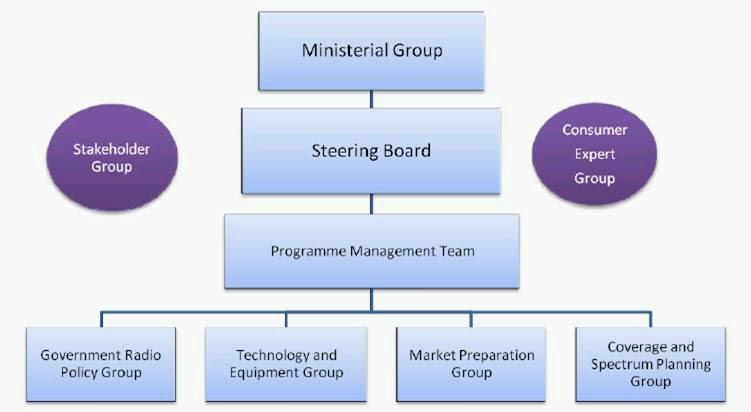
The Ministerial Group for the government’s Digital Radio Action Plan will meet tomorrow. That meeting has all the hallmarks of a radio industry seasonal pantomime, with participants dressed up in their gladrags to play the appropriate parts. A select audience has been hand picked, though the ending of the story has still to be written.

Pantomime often brings out a sense of déjà vu, of having seen the same thing during previous Christmases. This winter’s DAB radio marketing campaign has that feeling. The 2010 slogan is:

“There’s a digital radio for everyone this Christmas”

While the UK radio industry’s Christmas campaign for 2009 had been:

“Struggling to think of the perfect gift for Christmas? There’s a digital radio for everyone …”

Pantomime often stages a sleight of hand, where you are not quite sure if what you saw was real or just some cheap trick. This winter’s DAB radio marketing campaign has that feeling. On 18 November 2010, the press story was:

“The commercial radio campaign [for DAB], which breaks on November 22, covers Global [Radio], Bauer [Radio], Guardian Media Group [Radio], Absolute [Radio], UTV [Radio] and many local commercial stations.”

But, within days, that story had changed so that the campaign:

“… will run across major commercial groups” and “commercial radio stations including Absolute, UTV, Orion.”

What happened to Global Radio, Bauer Radio and Guardian Media Group Radio? Well, every pantomime has its jesters who do their best to spoil the rest of the cast’s fun. This winter’s DAB radio marketing campaign has that feeling. Two days after the Christmas DAB campaign had started, The Telegraph broke the story that:

“Leading commercial radio groups [Global Radio, Guardian Media Group] have refused to promote DAB radio …”

Every pantomime has its bully, who picks on people mercilessly and prevents them from going to the ball. This winter’s DAB shenanigans have that feeling. Commercial radio trade body RadioCentre offered its story as to why its members, Global Radio and Guardian Media Group, had pulled out of the marketing campaign:

“Commercial radio operators are currently in discussions with government about the funding of local DAB coverage. Until those discussions are resolved, we understand that some stations felt it would be inappropriate to run the digital radio Christmas campaign.”

Er, isn’t that blackmail rather than negotiation? Is it not transparent that, if you really cared about making DAB radio a success, you would think twice about cutting off your nose to spite your face by deliberately NOT promoting the very DAB platform that you have been attempting to palm off on the public for the last decade? In essence, you are trying to convince consumers that you care so much about your backward 10-year old offspring that you intend to starve it to death. In pantomime, such a tragedy might give the audience a laugh. In reality, it would be time for Social Services to intervene. It cannot be good PR for the commercial radio industry to be so convincingly playing the part of The Wicked Witch of The West.

RadioCentre’s lack of parenting skills has been evident in recent weeks:
· Its children had refused to attend the government’s Digital Radio Stakeholders Group meeting on 1 November [see earlier blog]
· Last Friday, its children refused to participate in a Westminster conference on ‘the future of UK digital radio’ organised for 7 December, resulting in the event’s postponement until April 2011.

And here is what the school notes said to explain these absences:
· “Following the announcement of the [BBC Licence Fee] settlement, RadioCentre has been in discussions with Government about the funding of local DAB coverage. As these discussions are ongoing, RadioCentre members felt it would be inappropriate to attend the Digital Radio Stakeholder meeting.” [Campaign]
· “Sensitivity of current negotiations on the future of digital radio” for the conference pull-out.

The evident paradox in this radio pantomime is that:
· The radio industry is spending £55m between now and 2015 to try and convince the public that DAB radio is the best thing since the cat’s whisker [see earlier blog]
· The radio industry big boys will not stand up in front of other stakeholders in the media sector, or in front of a conference, and explain what, why or how they are pursuing (or not really pursuing at all) the government’s DAB dreams
· Commercial radio has been demanding for several years that the BBC pays for fixing the deficiencies in commercial radio’s own DAB local transmission system. (Yes, this is the same BBC that RadioCentre has lambasted for years about its interference in commercial activities. Yes, these are the same commercial radio big boys who invested heavily in DAB in the 1990s in the hope of making profits for their shareholders.)

Pantomime is pure theatre, and tomorrow’s meeting will doubtless provide much entertainment for all involved. The only unresolved issue is how it will all end. Will the government Minister play the part of Scrooge, insisting that the commercial radio big boys should work longer hours for their living and must pay for improvements to their DAB system themselves? Or will the government play the wicked stepmother, compromising the BBC’s independence by forcing it to pay for an expensive sticky plaster to fix a commercial media sector DAB problem that has been all of its own making?

My feeling is that, in these austere times, it would be opening up another big black hole for public money to now finance such massive deficiency issues with DAB radio that could and should have been anticipated and fixed a decade ago. It is simply too expensive to commit unknown quantities of cash to transform the ugly DAB frog into a handsome prince who might never be fit enough to rival FM radio. Anyway, the BBC has already made a public commitment to not spend any more Licence Fee money on yet another ‘makeover’ show. In which case, our Cinderella DAB may not be going to the ball.

Or is all of the above just a pantomine within a farce? Is all this play-acting merely intended to allow commercial radio to walk away from DAB altogether, pointing the finger of blame elsewhere (and smug that the Classic FM automatic licence renewal is nearly almost within its grasp)?

The Digital Radio Stakeholders Group: another 'faux consultation'

Did you hear about the inaugural Digital Radio Stakeholders Group meeting held on 1 November 2010 at the government’s DCMS [Department for Culture, Media & Sport] office? Probably not, unless you were one of the couple of dozen people who were in attendance. Otherwise, you were in the majority who were unaware of the event. There was no public pre-announcement of this meeting. Afterwards, there was only one article about it in the media trade press. Google returns ‘no results’ from an internet search for ‘Digital Radio Stakeholders Group’, even though this is the title writ across the top of the agenda circulated for the event.

You have to look in the new government’s Digital Radio Action Plan, published in July 2010, to discover:

“The Government will chair a Stakeholder Group which will be open to a wide range on industry and related stakeholders. The principle purpose of this Group will be to inform external stakeholders of progress against the Action Plan and gather views on emerging findings. We expect that the Group will meet quarterly.”

The government’s project management plan anticipated that, by Q2 2010, it would be able to:

“secure commitment from the Government Digital Radio Group and the Stakeholders Groups to the Action Plan.” [Task 5.1]

This pre-determined outcome was justified on the grounds that:

“Successful implementation of the Digital Radio Switchover programme will only be achieved through close Government-Industry co-operation. […] This will include commissioning and delivery of reports, reviewing progress against key milestones and disseminating information to key stakeholders.”

So, essentially, the Digital Radio Stakeholders Group seems to be an almost non-existent forum that has only been convened to secure some kind of external ‘rubber stamp’ for the government’s proposals on DAB radio. It will allow the government, when challenged as to the democratic basis of its DAB radio policy, to assert confidently: “We convened a stakeholders group and it endorsed our proposals.”

This is cynical government at its worst. A ‘faux consultation’ that pretends to have asked a group of somebodies to endorse a government policy for which no mandate has ever been given by the electorate. It is similar to the manipulation practised by Ofcom in its radio policymaking (viz. Ofcom’s recent decision to permit Smooth Radio to dump its commitment to broadcast 45 hours per week of jazz music, after having acknowledged that 13 of the 15 responses submitted to its public consultation were opposed to this loss of jazz).

According to a government document, the Terms of Reference for the Digital Radio Stakeholders Group are as follows:

“Purpose
To enable a wide range of organisations to contribute to the process of delivering the Digital Radio Action Plan

Objectives
• To inform all stakeholders of progress with the Action Plan
• To seek the views of stakeholders on future progress of the Action Plan
• To provide an opportunity for all stakeholders to share news, views and concerns relevant to the Digital Radio Action Plan

Membership
Any organisation with a valid interest in the objectives of the Digital Radio Action Plan may be a member. Members will include consumer representative bodies, broadcasters, manufacturers, retailers, vehicle manufacturers, transmission network operators, content providers. The Group will be chaired by BIS in the first instance, though in principle the Chair could be any person acceptable to the majority of stakeholders and able to represent the collective views of the stakeholders to the Steering Board.

Mode of operation
The Digital Radio Stakeholders Group will meet quarterly.
The Chair will report the views of the stakeholders, as expressed through the meetings of the Stakeholders Group, to the Steering Board.”

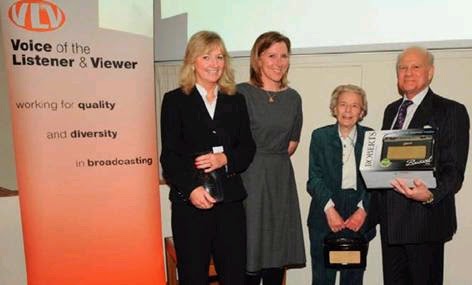
So what happened at the first meeting? Very little, according to some of those who were present. It was a game of two halves. In the first half, the bureaucrats put their case. From the government, Jane Humphreys, head of digital broadcasting & content policy, BIS [Department for Business Innovation & Skills]; John Mottram, head of radio & media markets, DCMS; and Jonny Martin, digital radio programme director, BIS/DCMS. From Digital Radio UK, Ford Ennals, chief executive; Jane Ostler, communications director; and Laurence Harrison, technology & market development director. Then, in the second half, representatives from Age UK, the Consumer Expert Group, Voice of the Listener & Viewer and W4B raised issues on behalf of the consumer.

At the end of it, I guess the government-appointed chairman could return to her government office, tick the box on the government wall planner that says ‘stakeholder commitment’ and be pleased that this ‘rubber stamp’ had cost the taxpayer only an afternoon’s salary plus some tea and biscuits for the ‘stakeholders’. Well worth it!

More interesting than noting those who attended is identifying who was not there:
· No presentation by Ofcom, whose longstanding ‘Future of Radio’ policy has forced the DAB platform upon the public for almost the last decade
· Nobody from the largest commercial radio owners – Global Radio, Bauer Radio and Guardian Media Group – that have considerable investments in DAB multiplex licences

After the meeting, under the headline ‘RadioCentre quits digital radio meeting’, Campaign reported:

“RadioCentre, the commercial radio trade body, has walked out of discussions over the future of digital radio after the BBC licence-fee settlement did not commit BBC funds to roll out DAB radio. The body refused to attend a [Digital Radio Stakeholders] meeting on 1 November after the [BBC Licence Fee] settlement, published last week, included provision only for [BBC] national DAB [upgrade].” [I noted this development in a blog last month]

Whatever RadioCentre’s reason for non-attendance (and the story in Campaign has not been refuted), this kind of stance is a disgrace. Raising two fingers to the people you are supposed to be persuading of your DAB policy is not a clever PR strategy for the commercial radio industry. But I am not surprised. All the organisations pushing for DAB radio have increasingly adopted a ‘bunker’ mentality that precludes any direct contact with the public. What we appear to have now is:
· Ofcom refusing to engage in public discussion about its DAB ‘Future of Radio’ policy
· The government organising a Stakeholder Group to rubber stamp its unrealistic, dictatorial policy on DAB radio
· Digital Radio UK refusing to engage in public explanation of its DAB campaign work, as illustrated by its non-existent web site
· RadioCentre and its members now refusing to attend a meeting to explain just how/why DAB is still being pursued

At the same time, the public – the consumers, the 46,762,000 adults who spend 22.6 hours per week listening to radio – have been omitted altogether from these manoeuvrings that are still focused upon trying desperately to force them to purchase DAB radio receivers. The public had been omitted from the proposals at the very beginning of DAB more than a decade ago, which is precisely why it failed, and they are still being omitted today.

This is not the first time that government ‘stakeholder’ meetings about DAB radio have been organised simply to tick a box. As part of the previous government’s attempts to solve the DAB problem, in 2008 it convened a Digital Radio Working Group with two similar ‘stakeholder meetings’ held at DCMS. I attended and felt they existed purely for the bureaucrats to report back to their superiors that they had done something to ‘disseminate’ their policies. DCMS’ own write-up of the first meeting recounted bluntly:

“A stakeholders meeting was held on 10 March and offered opportunities for a wide range of views to be heard.”

A place where “views” were merely “heard”. The ineffectiveness of these earlier stakeholder meetings is demonstrated by re-visiting the agenda for the first of them. The issues tabled for discussion nearly three years ago (“How to make digital radio the predominant platform for listening to radio in the UK? What are the barriers to this? How can these barriers be overcome?”) still remained the same at this month’s meeting. Worse, none of the DAB technical problems identified then have been solved in the interim. And guess what? All trace of these 2008 meetings ever having happened has been erased from the DCMS website (in 2008, I had had to write to DCMS to get them to add the meeting details to their website).

The next meeting of the Digital Radio Stakeholders Group will be held on 3 February 2011 at DCMS/BSI, 1 Victoria Street, London SW1H 0ET. If you belong to any kind of community group or organisation (even if it is your neighbourhood watch) whose members are likely to be impacted by the government’s policy on digital radio switchover, I suggest you write to Jane Humphreys (e-mail to [first name][dot][second name]@bis.gsi.gov.uk) and ask for an invitation to this next meeting.

‘Stakeholder’ radio listeners should turn up to the February meeting and shout: “I’m mad as hell and I’m not going to take this any more!” … or maybe the DAB plug will already have been pulled by then.

BBC head of radio: DAB not "a clear enough offer to listeners"

The Tony Livesey Show, BBC Radio 5 Live, 28 October 2010 [excerpt]
Stephen Nolan, interviewer (presenter, BBC Radio Ulster) [SN]
Tim Davie, Director, BBC Audio & Music [TD]


SN: There are big problems with the digital spectrum, aren’t there, because we cannot seem to hit any target that we are given for people switching to digital?

TD: I don’t think we’ve had many targets … Let’s be honest, I don’t think we’ve had many targets in the past. Digital stations are doing well. Digital listening – we’ve got to be careful – includes online, which is doing pretty well, there’s more we can do. Then also you’ve got DAB. Now DAB, you’re right, it’s been marginally growing for a while …

SN: Why?

TD: I just don’t think it’s been a clear enough offer, in my language, to listeners. I mean, people love radio. They are very happy with their FM radio. Why on earth would you change? And I think the radio industry has to say: ‘the reason you will change is – here’s a load of content’. And there’s clues like 6 Music, or other …. you know, that people love. And here’s a load of stuff that people love, and here’s a better … this device does something better than the other one.

SN: Or, Tim, it’s for the BBC to take a huge risk, and a controversial risk at that, and to withdraw mainstream programming from the FM spectrum and put it onto DAB. Imagine how the numbers would soar if it had [BBC Radio 1 breakfast DJ Chris] Moyles or …

TD: [interrupts] Imagine my inbox!

SN: Exactly, exactly. It’s a serious point.

TD: Sure.

SN: Imagine if you had Moyles or [BBC Radio 2 breakfast DJ Chris] Evans exclusively on DAB, or a massive programme.

TD: Right! And … we could do that. The issue would be that, with current coverage levels and with the amount of devices – particularly in Northern Ireland – I would basically be saying that you can’t listen to it in your kitchen, and everyone pays the Licence Fee. So I think the strategy for digital, where we are taking things away, is not going to work. My approach would very much be that I do want you to feel a bit of pain for not having a digital radio, but that pain is not about not getting The Archers, or not getting Chris Moyles. It’s about: ‘you could get a bit more over here’, or ‘there’s a bit of [Radio] 4 Extra over here that you could really do with’, and that’s what television did with some of those channels.

SN: Do you think, in terms of the internet, that radio is going to fundamentally change?

TD: I think there will be a lot more on-demand, obviously, so people will expect to be able to call up a programme and …

SN: I’m talking about the [UK] Radioplayer, obviously, which people are describing as the new YouView for radio.

TD: Well, er, yeah. Basically, the Radioplayer is … we’ve got the whole industry together. Only about 3% of listening is online and I can’t understand that, as head of radio. I know I’m biased but, at the end of the day, when I’m shopping and doing my Tesco shop or wherever online, why aren’t I listening to the radio? [to SN] Well, you would relate to this because it means more listeners. I think that one of the things is that I think it’s a bit confusing. You’ve got the BBC on the iPlayer, which is pretty good, and we’ve got other bits and … So we’ve put it all together and there will be a thing called the Radioplayer. Now, it gets a bit complex, but I think the YouView thing that you refer to is when you’ve got an internet connection to your television. Now, when you click your television on, I want one Radioplayer icon where you can go in and listen to all the radio. Now, the …

SN: On the TV?

TD: Yeah. On any screen – sorry to sound ‘new age’ – any screen anywhere, whether it’s a … whatever the size of it, you can go and get all your radio services. We don’t currently have that.