BBC Trust chair notes "the absence of a coherent digital [radio] strategy"

On 8 September 2010, Sir Michael Lyons, chair of the BBC Trust, and Mark Thompson, director general of the BBC, appeared before the government’s Culture, Media & Sport Committee. They were asked about BBC radio policy by a committee member:

David Cairns: It will be brief because it is about radio. Clearly the [BBC Radio] 6 decision has come and gone. Where does this leave you? There seems to be a slight divergence between the Trust and the executive on the vibrancy and distinctiveness of the offer. You wanted to close Radio 6 to make [Radios] 1 and 2 more distinctive. Now 6 is staying open, so a couple of headlines on where we are in terms of the strategy in radio, with particular reference to 1 and 2?

Sir Michael Lyons: It isn’t part of the Government’s structure that the Trust and the Director General have to agree on everything and indeed we’ve had some criticism for not more frequently exposing to public scrutiny the debates which do take place, which are often challenging. I think getting the balance of that right between how much of that discussion is open is I think a matter for reflection.

Now let’s turn to the strategic review: the Trust rejected the proposal to close BBC 6 in its current form believing that the arguments didn’t stand up as a result of the consultation analysis we’ve done. But what that proposal did do was to bring into really quite sharp relief the two big strategic issues sitting behind it. The first of those – the greater distinctiveness of Radio 1 and Radio 2 – very much the subject of the service reviews that the Trust had undertaken earlier in the year, requiring both stations to work more energetically to distinguish themselves from each other and to serve a rather different audience demographic.

The second issue, of course, is the absence of a coherent digital strategy – not an issue for the BBC alone because it immediately brings in the issue of where the Government stands on DAB radio for the future. So where we are at the moment is the Director General is now working on both of those issues, recognising those are the big issues, the big strategic issues, and 6 continues perhaps for ever but certainly until both of those big issues are clear to us.

Mark Thompson: I think Michael answered that very clearly. We have had, I believe, a real success with our television portfolio, including our digital channels, in helping encourage the public to move from analogue to digital television. We are not alone in that, Sky has done a great deal to help with that and so have others. But we know that our digital television channels have made a significant difference in people wanting to take digital television up. We have yet to see the same level of success with digital radio. We are very committed to digital radio. We support the Government’s and indeed the previous Government’s ambitions around moving towards analogue-to-digital switchover in radio as well. The challenge for the BBC is coming up with a portfolio of services which firstly encourages people to sign up on digital radio, but in ways which support the rest of the radio market rather than producing adverse competition.

We need to make sure that the core mainstream channels, like Radio 1 and Radio 2, are sufficiently distinctive, are really doing something different from their commercial counterparts, but also that we have a range of attractive but also distinctive new digital services.

So I think this is a hard Sudoku. It’s not absolutely straightforward because there are a number of different things going on, and I take the BBC Trust’s response on 6 Music I think in the way it is intended which is there are bigger things at stake here. Go back and look at the broad radio strategy and that’s what we’re doing at the moment.

——-

On 14 September 2010, Jeremy Hunt, Secretary of State for Culture, Media & Sport, appeared before the government’s Culture, Media & Sport Committee. He was asked by a committee member about progress with digital radio switchover:

Damian Collins: There was a report in the press this morning claiming that a report to your Department has been published today by the Consumer Expert Group, saying that 2015 is too early as a target date for digital radio switchover, and even questioning the consumer demand for it. I wonder what your views are on that?

Mr Hunt: On 8 July Ed Vaizey published a digital radio action plan. We made it very clear that we think when it comes to radio, the future is digital. We aspire to the 2015 date but there need to be some changes in consumer patterns of radio consumption before we would agree to a switch-off of the analogue spectrum. Those include a greater-than-50% market share for digital radio listening. At the moment it is about 25% and DAB is only 16%. It includes, for national radio stations, coverage that is as good as FM and, for local stations, 90% coverage and coverage on all major roads. So until we are confident that those conditions are met, we won’t be signing the bit of paper that says there will be switchover in 2015.

Damian Collins: But do you still see 2015 as a date the industry should be aiming for?

Mr Hunt: I hope that we can deliver it by then but they need to work much harder to persuade consumers of the benefits of digital radio. I would much rather this was a process similar to the transition from records to CDs and from CDs to iPods, which was driven by changes in consumer behaviour, rather than something that we change as a sort top-down mechanism.


[these transcripts are uncorrected and are not yet an approved formal record of proceedings]

The exit strategy for DAB radio switchover: the Consumer Expert Group addresses Vaizey’s “big if”

When you are looking for an exit route from a product you have been developing for nearly two decades, and which has consumed hundreds of millions of pounds, you need to find a damn good reason that will deflect the blame elsewhere. You need a report, an organisation or some bona fide research that screams out ‘no’ at the highest volume. Then your response can be: “I would be a fool to ignore the warning signs voiced by X” when what you are really saying is: “Blame them, not me! It’s them that made me do it.”

DAB radio and digital radio switchover presently seem to be at this point. But there is a big problem for a radio industry that is belatedly trying to find a way ‘out’. Almost all previous reports produced by the government, the regulator, the radio industry, the electronics industry, the working groups, Digital Britain and the car manufacturers have been overwhelmingly positive about DAB and have painted an amazingly rosy future. There has been almost nothing published about DAB by agencies of the state that has said plainly: “Stop this crazy plan.”

So whose fault can it be that DAB radio and digital switchover has not worked? Given the sheer number of agencies that have been so gung-ho for so long about DAB, the fickle finger of fate naturally had to point elsewhere and so it landed upon ‘the consumer’. It becomes much easier to decide that the general public is the reason for a masterplan’s lack of success when everybody sat around the government’s conference table is feeling a little guilty about their shared role in a wasted £1bn investment.

A change of regime is always a useful point at which to invoke such a change. In July 2009, less than a year into his first radio job, the BBC’s top radio manager Tim Davie explained that digital radio switchover would be determined by listeners, not by the BBC:

“From a BBC perspective, whether it be ‘Feedback’ or our constant audience research, the idea that we would move to formally engaging switchover without talking to listeners, getting listener satisfaction numbers, all the various things we do, would be not our plan in any way. We would be – we are – in dialogue now for the next six years. … I think we are pretty committed to digital. Having said that, since I have arrived at the BBC, I certainly haven’t seen it as inevitable that we move to DAB.”

The following month, BBC Trust chairman Sir Michael Lyons reinforced this notion:

“Who comes first in this? Audiences and the people who pay the Licence Fee. It is an extraordinarily ambitious suggestion, as colleagues have referred to, that by 2015 we will all be ready for this. So you can’t move faster than the British public want you to move on any issue.”

The change of government then provided an opportunity for the Department for Culture, Media & Sport [DCMS] to similarly invoke the will of the people in determining digital radio switchover. In July 2010, culture minister Ed Vaizey said:

“If, and it is a big if, the consumer is ready, we will support a 2015 switchover date. But, as I have already said, it is the consumer, through their listening habits and purchasing decisions, who will ultimately determine the case for switchover.” [emphasis added]

For both the BBC and the government, the problem with belatedly putting the consumer at the centre of digital radio switchover is that almost no organisation, over the course of a decade of DAB, has done any significant consumer research about DAB. Why? Because the implementation of DAB radio in the UK had always been a top-down policy initiative by civil servants, regulators, trade organisations and commercial opportunists, without ‘the man on the Clapham omnibus’ having ever been consulted.

There was one notable exception. When the government’s Digital Radio Working Group considered the issue of DAB radio switchover during 2007/8, a sub-committee named the Consumer Impact Group had prepared a report. However, this report was not made public until almost a year after the Working Group had been wound up. The report had been highly critical that consumers’ viewpoints were not being considered:

“The group is concerned that the case for digital [radio] migration has not been made clearly enough from the point of view of the consumer. While it is clear what the rationale is for the radio industry, the group would like to see a compelling argument as to why digital migration is desirable for consumers and what its benefits would be for consumers.”

But that was then, this is now. Then, digital radio was considered by the previous government to be a real possibility, and that is why dissent from consumer groups was buried. Now, that same consumer dissent could provide the perfect nail on which to hang any number of DAB exit strategies. A new report outlining the massive consumer challenge of digital radio switchover would be a perfect ‘get out of jail free’ card for many long-term DAB stakeholders.

So today, a new report has been published by the government’s Consumer Expert Group [CEG] which asks the pertinent question ‘Digital radio switchover: what is in it for consumers?’ Moreover, rather than it being embarrassedly added to the depths of the DCMS web site a year later, today’s report was circulated to the press and stakeholders in advance of publication. Its introduction states:

“This report was not requested by Government but the CEG have taken the initiative to attain a thorough understanding of the consumer issues surrounding digital radio and bring them to the Government’s attention as preliminary policy decisions are made.”

In other words, this new report just happens to directly address the “big if” cited in the culture minister’s speech about digital radio switchover nine weeks earlier. If its publication were not startling enough, its conclusions are damning in almost every respect about the lack of progress made to date with digital radio switchover. But, before that, the report is quick to invoke the role of consumers in what it admits is “new” government policy:

“Setting a date, or a firm commitment to a date, would have had the effect of scaring consumers to switch. Clearly this would not be compatible with Government policy to support a switchover when enough listeners voluntarily adopt digital radio. Government’s new emphasis on consumers should provide the focus to ensure consumer concerns and needs regarding digital radio are addressed, thereby reducing the barriers to voluntary take-up.”

However, if these “consumer concerns and needs” were to prove simply too onerous and costly for the government to address in the current economic climate, the choice is now there to opt out of pursuing the DAB switchover policy altogether. The Film Council … the Audit Commission … DAB radio switchover. Chop chop chop. The first two might have seemed a bit arbitrary to voters. Now, at least this one has a consumer report to back it up.

So this new report reiterates and elaborates the same arguments made in the previous consumer report to the Digital Radio Working Group two years earlier, and adds some more. Its recommendations are worth quoting in full:

“The consumer costs and consumer benefits of digital radio
• A full cost benefit analysis from a user perspective must be carried out as a matter of urgency;
• Consumer benefits need to be clear and demonstrable before an announcement for a digital switchover is made;
• A workable system for the disposing and recycling analogue radios, which consumers are likely to implement must be introduced;
• Emphasis should not be placed on driving down costs unless the sound quality and functionality of cheaper DAB sets are at least equal to analogue;
• There must be more emphasis on improving the basic usability, rather than the advanced functionality, of digital radio to encourage take-up;
• Both the BBC and the commercial sector need to offer new and compelling digital content to convince consumers to adopt digital radio;
• Research into consumers’ willingness to pay and into their concerns and needs relating to digital radio needs to be carried out as a matter of urgency.

Take-up
• The take-up criterion should compare like-for-like listening platforms and measure DAB listening only;
• A digital switchover date should only be announced when no more than 30 per cent of listening remains on analogue;
• The target date for a digital switchover should be revised upwards as 2015 is realistically far too early for the necessary preparations to be put in place for consumers. Any target date set should be looked upon as secondary to consumer issues such as willingness to adopt the technology, voluntary take-up and digital radio reception as an instigator for switchover;
• Measures need to be taken to introduce a more inclusive methodology for measuring take-up.

Coverage
• The fair allocation of coverage build-out costs between the BBC and the commercial sector must be made once build-out plans are agreed;
• The coverage criterion should be measured by signal strength, not just population, so that indoor and mobile reception are considered;
• The coverage criterion must be geographically weighted to ensure rural communities are not left behind;
• The switchover roadmap must include plans for DAB+;
• DAB+ compatible chips must be installed as standard to “future-proof” receivers as a matter of urgency;
• The reception time delay between receivers should be standardised.

Vehicles
• A Digital Radio Switchover date cannot be announced until DAB radios have been standard in vehicles for a minimum of 2 years, in other words by 2015 at the earliest;
• An affordable in-vehicle converter needs to be developed urgently which works with a vehicle’s external aerial, is safe, easy to fit and aesthetically pleasing;
• A switchover date cannot be announced until there is a solution to in-vehicle conversions, providing the majority of motorists with the opportunity to have a digital radio in their vehicle;
• A solution for the continuation of traffic and travel services on FM for a transitional period following digital switchover needs to be agreed;
• An accreditation scheme for dealers and other installers of retrofit digital devices must be developed.

Accessibility
• Digital switchover should not go ahead without suitable equipment being available for all listeners including older and disabled people;
• Digital radios which incorporate voice output technology must be available for blind and partially-sighted people preferably via the mainstream market or, if that is not feasible, through a channel made affordable by Government intervention, such as a help scheme;
• Appropriate information and support on the enhanced features of accessible digital radios should be available from retailers;
• Appropriate usability requirements should be included in minimum receiver specifications and a kitemarking scheme;
• The proposed integrated station guide must be consumer tested before any decision on its inclusion in devices is made.

Consumer information
• A clear and balanced public information campaign needs to be implemented through a trusted body, independent of the industry;
• Once a switchover date is announced, sales of analogue-only radio must stop;
• A post-announcement information campaign to target vulnerable groups should be developed;
• The digital tick should be adopted for digital radio and adapted as necessary;
• A ‘scorecard’ should be displayed on all products to convey more information about the available features at the point of sale;
• A digital radio pre-purchase checklist should be widely available and at point of sale;
• An effective training and “accredited adviser” scheme needs to be developed for retailers;
• The CEG must be involved in the minimum specification for digital radio;
• The CEG must be involved in the design and development of any public information campaigns.

Consumer support and a help scheme
• Any Digital Radio Switchover must be accompanied by a help scheme to assist those who would find it disproportionately difficult to switch;
• The eligibility criteria of a help scheme should include people registered blind or partially sighted, those on low incomes, the over 65s and those with learning disabilities and other cognitive difficulties such as Alzheimer patients;
• A help scheme for digital radio should provide appropriate accessible equipment and include as many instructional home visits as necessary;
• A help scheme should be publicised early on in the information process on a national level and the publicity should coincide with the start of the national information campaign for a switchover;
• The CEG must be consulted in the preparation of printed material and publicity on the help and support available;
• The engagement of the voluntary sector in providing assistance with a digital radio switchover should be properly supported and funded;
• Government should ensure that charities, such as Wireless for the Blind Fund and W4B, are not undermined financially or strategically by a help scheme or any of its components, as these charities will be left with providing the ongoing of support, assistance and help people need once a help scheme has finished.”

These recommendations seem to divide into: those that would require considerable time to implement, those that would require considerable money to implement, those that would require both time and money, and those that would be almost impossible to implement. Such recommendations should have been considered and acted upon before DAB transmitters even started to be built-out in the 1990s. Their presence in 2010 only serves to highlight the ineptitude of the 1990s ‘plan’.

No organisation escapes unscathed from the critique of the Consumer Expert Group (some are not named): BBC radio, commercial radio, Ofcom, RadioCentre, receiver manufacturers, the Digital Radio Development Bureau, Digital Radio UK, etc. By spreading the criticism so widely, no single stakeholder gets to feel singled out or isolated for DAB’s failure.

Now it is left to the government to decide to pull down the shutters on DAB radio switchover. That will not require the immediate death of DAB. But it will provide the BBC with something that it can sacrifice down the line to budget cuts in the assault on its Licence Fee. For commercial radio, it will provide relief from expensive dual transmission costs, once a settlement has allowed it to keep its coveted licence renewals invoked by this year’s Digital Economy Act. For consumers, it will offer certainty that FM radios will continue to work. There will be sighs of relief all around.

I started writing about DAB radio as a news editor in 1992 and today’s report is the first government distributed document I have seen that sensibly articulates the multitude of barriers and obstacles to digital radio switchover happening in the UK. The very first words of the report summarise the current situation perfectly:

“Despite the introduction of digital radio in the UK in 1998, analogue radio is still a key feature in many households.”

Now we await the fat lady.

Lies, damned lies and … Ofcom’s first digital radio progress report

Ofcom quietly published its first Digital Radio Progress Report in July 2010, without fanfare or a press release. This report has been a remarkably long time coming, given that DAB radio has been with us more than a decade. During that time, Ofcom has published 26 Digital Television Progress Reports, starting in 2003.

Here was an opportunity for Ofcom to demonstrate that it is acting in the public interest by publishing solid, objective data about the progress of digital radio in the UK. Did it take that opportunity? No. Instead, Ofcom published a set of data that are so selective and so distorted that they misrepresent the progress (or lack of it) made to date in advancing the UK towards the ‘digital radio switchover’ that our government is determined to execute. Why? Because Ofcom (like the government’s DCMS department) seems determined to persuade us that its totally unrealistic plan for DAB radio has not been an unmitigated disaster with the citizen/consumers on whose behalf it is supposed to be working.

It might appear pedantic to pick over the details of data represented in this feeble 24-page Ofcom report. However, it must be stressed that this is no nitpicking exercise. The Digital Economy Act 2010 insists that this very document submitted by Ofcom (and another by the BBC) to the government will decide whether the UK will progress to ‘digital radio switchover’. It is these data that will decide whether we can continue to receive BBC network radio stations on the 100 million analogue radios that are out there. It is these data that could mean we have to replace perfectly satisfactory analogue radio receivers in every household across the country, at a cost of millions to consumers.

To note the issues in the order they appear in the Ofcom report:

FIGURE 1
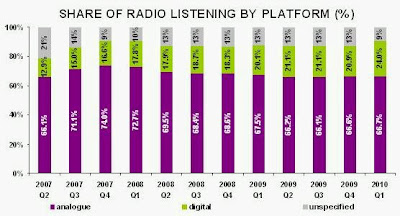
This Ofcom graph purports to show that:
• Digital platforms’ share of radio listening increased from 12.8% to 24.0% between 2007 and 2010 (this is TRUE)
• Analogue platforms’ share of listening decreased from 87.2% to 76.0% between 2007 and 2010 (this is FALSE)

The four figures cited in Figure 1 for the analogue platform – 87.2% in 2007, 82.2% in 2008, 79.9% in 2009 and 76.0% in 2010 – are an Ofcom invention. These false data seek to demonstrate that a rapid decline in analogue listening has taken place. This is not true. As the graph below shows, analogue listening has remained remarkably static over this timeframe.


The situation is complicated by two facts: a significant proportion of radio listening remains ‘unspecified’ by respondents in RAJAR listening surveys, and that this proportion has varied greatly in size in different surveys. However, this does not detract from the falsehood of Ofcom’s attempt to demonstrate that analogue listening is in sharp decline.

FIGURE 2
This Ofcom graph purports to show that:
• 54% of 15-24 year olds use digital radio
• 57% of 25-34 year olds use digital radio
• 56% of 55-64 year olds use digital radio
• 46% of 65-74 year olds use digital radio
• 29% of 75+ year olds use digital radio.

In fact, the fine print explains that Ofcom had asked the question ‘Have you ever used digital radio?’ This ensured that the results were almost meaningless because they tell us nothing whatsoever about current usage of digital radio. For example, a 68-year old who, on a single occasion ten years ago, had listened to digital radio for 10 minutes will have answered ‘yes’, despite having made no further usage during the last decade.

Ofcom’s objective here seems to have been to highlight the large size of the resulting numbers, without indicating that they derive from an almost useless question (garbage in, garbage out). If you were to ask people ‘Have you ever bought a banana?’, almost 100% would respond ‘yes’. Their answers tell you absolutely nothing about the current market for bananas. Exactly the same is true of digital radio usage. In this context, the resulting numbers seem remarkably low because only half the population has ever tried digital radio (even once in their lifetime).

FIGURE 3
This Ofcom graph purports to show that:
• 53% of adults use digital radio
• 63% of adults in socio-economic groups AB use digital radio
• 55% of adults in socio-economic group C1 use digital radio
• 48% of adults in socio-economic group C2 use digital radio
• 42% of adults in socio-economic groups DE use digital radio.

Just as in Figure 2, the fine print explains that Ofcom had asked the question ‘Have you ever used digital radio? The same issues apply here as with Figure 2.

FIGURE 5
This Ofcom graph shows digital platforms’ share of total radio listening, but the data omit:
• A comparison with the analogue platform
• A time sequence to show how fast the market is changing.

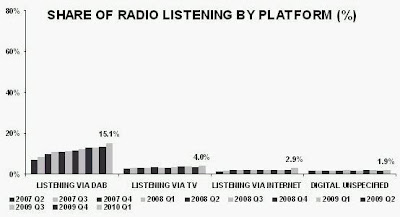
The following graph demonstrates the slow growth of digital platforms and their low level in comparison with analogue. It also demonstrates that a proportion of the growth in digital platform usage is the result of a statistical technicality caused by a reduction of ‘unspecified’ listening in recent quarters.

The following graph demonstrates the slow growth of individual digital platforms since 2007, using the same scale as applied in the preceding graph.

FIGURE 8
This Ofcom graph purports to show that:
“five digital-only services generated a weekly reach of 1 million+ listeners in Q1 2010.”

However, the fine print explains that the Ofcom data refer to “all listeners [aged] 4+”, whereas the radio industry’s standard metric is and always has been ‘adults 15+’. Indeed, all RAJAR audience data used in this same Ofcom report refer to ‘adults 15+’, except for Figure 8.

Once the graph is re-worked using ’15+’ instead of ‘4+’ data (see above), it is evident that:
• Only three digital-only radio stations generate a weekly reach of 1m+ adult listeners
• BBC World Service was included in the Ofcom graph (and was one of the five stations cited as exceeding 1m weekly reach) even though it is not digital-only, being available across a large part of the UK on 648AM
• BBC Asian Network was omitted from the Ofcom graph (also available on analogue but limited to the Midlands)
• Not only are Panjab Radio and NME Radio no longer available on the national DAB platform (as the Ofcom text notes), but Q Radio is no longer on DAB, and the BBC has proposed the closure of Asian Network
• These weekly reach data for digital-only stations should be considered in the context of analogue radio stations – for example, BBC Radio 2 has a weekly adult reach of 14.6m.

FIGURE 9
This Ofcom graph purports to show that:
• Digital radio’s current share of listening is “broadly in line with the organic growth outlined on the [government’s] forecast chart.”

Bizarrely, the Ofcom graph displays the government forecasts but has omitted the historical data that would show how successfully the forecast has been achieved to date.

The forecast published in June 2009 predicted that, by year-end 2009 (a mere six months later), digital platforms would account for 24% or 26%, the latter the result of a concerted ‘drive to digital.’ In fact, the year-end figure was 21%. The likely reason that Ofcom has failed to include the historical data is that neither of the two forecasts (‘organic growth’ or the ‘drive to digital’) has any chance of being realised. If the current growth rate is extrapolated, the 50% criterion will be reached by year-end 2018, and certainly not by either 2013 or 2015, as the forecast (credited to Value Partners) predicted.

FIGURE 14
This Ofcom graph and accompanying text assert that:
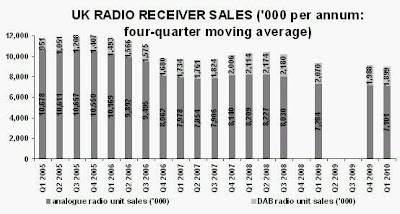
• “DAB sets made up over a fifth (21%) of all radio sales by volume” in the year to Q1 2010
• “In the portable market, DAB sets accounted for 65% of sales.”

However, Ofcom omitted to point out that:
• Fewer DAB radios had been sold in 2009 than in 2008
• DAB radios were a lower proportion of total radios sold in 2009 than in 2008
• Its reference to “the portable market” is limited strictly to ‘portable radios’ of the type used in kitchens. There is not a single mobile phone on sale in the UK that includes DAB radio, and the vast majority of portable media players that include radio do not have DAB radio.

In fact, the data in the graph above demonstrate that:
• DAB radio receiver sales volumes peaked in 2007/8 at 2.2m per annum and have declined 13% since then to 1.9m per annum
• Analogue radios contributed a greater proportion of total radio receiver sales in 2009 (79%) than they had in 2008 (78%)
• DAB has not invigorated the market for radios, with fewer radios sold now than ever, perhaps due to evident consumer confusion about ‘digital radio switchover’.

FIGURE 17
The Ofcom graph shows that:
• 17% of adults say they are likely to buy a DAB radio in the next 12 months.

However, the Ofcom graph does not offer a historical perspective. The graph above demonstrates that the propensity to purchase a DAB radio has diminished over time. In 2006, 17% of respondents said they would be likely to buy a DAB radio within the next six months. In 2010, 17% said they would be likely to buy a DAB radio within the next 12 months. This would translate into a significant reduction in DAB radio receiver sales. Additionally, the proportion of respondents who say they do not know if they will purchase a DAB radio continues to increase over time, perhaps a further symptom of market confusion or DAB indifference.
————
Given that Ofcom has had the luxury of several years to prepare this first Digital Radio Progress Report, the result is a travesty. It should not be the regulator’s role to selectively highlight and distort data that support its own policies in a document specifically requested by government in order to inform a parliamentary decision on digital radio switchover. We deserve better from our public servants. Otherwise, they might as well go and work for Digital Radio UK, the lobby group (funded by commercial interests and the BBC) busy pumping out propaganda to try and persuade consumers that they need DAB radio.

On page 5 of this first Digital Radio Progress Report, Ofcom notes:

“Our principal general duty, when carrying out our radio functions, is … to further the interests of citizens in relation to communications matters.”

Exactly how are citizens’ interests being furthered by Ofcom distorting the facts about digital radio take-up?

Cost/benefit analysis of DAB radio: Murdoch rushes in where governments fear to tread

Governments have had plenty of practice, over many years, of hiding reports from the electorate. In some cases, they might justify this as a matter of national security or military expedience. However, it is hard to understand how the UK government thought it could justify hiding from the public a cost/benefit analysis of digital radio switchover it had commissioned and then, a year later, have believed the matter had been successfully buried. But so it was, until the House of Lords Communications Committee intervened in early 2010.

On 6 February 2009, PricewaterhouseCoopers [PWC] delivered a 91-page report entitled ‘Cost Benefit Analysis of Digital Radio Migration’ to Ofcom. It contained a number of serious reservations that any benefits would arise from switchover to DAB radio, even by the year 2030:

“The results suggest that there are relatively few up-sides to the estimates, and several significant downside risks. … The results suggest that there is a very long pay-back from the Digital Radio Working Group [DRWG] policy ‘investment’ – the Net Present Value [NPV] turns positive after 2026. This result assumes that the existing multiplex licences are extended to 2030, as per the DRWG recommendations. Without the licence extension or any other policy instruments that provide clarity on the long term future of commercial radio, the industry and consumers may fail to see the benefits of digital radio over the longer term. Our analysis suggests that the NPV is negative should either of these two proposals not be implemented.” [emphasis added]

Since then, parliamentary policy has failed to provide “clarity on the long term future of commercial radio,” as evidenced by last week’s wholly ambivalent government statement about digital radio switchover. As a result, just as PWC predicted, industry and consumers increasingly “fail to see the benefits of digital radio over the longer term.”

The PWC report, and its verdict that digital radio switchover offers almost no benefits, remained hidden from public view from February until November 2009, when an appendix to the government’s Digital Economy Bill mentioned it casually. That citation raised questions: what was this PWC report, and why could not the public see it?

When the House of Lords Select Committee on Communications convened in January 2010 to consider the digital switchover issue, it asked those same questions of the Ofcom officers it invited to present evidence:

Baroness McIntosh of Hudnall: We understand that you commissioned a report from PWC last year into the costs and benefits of digital switchover in radio, but you didn’t publish it. We know, therefore, what we have learned from the Department for Culture, Media & Sport about what it said. It appears that it found, for example, that the benefits could – and I emphasise the word “could” – outweigh the costs by £437 million after 2026, but that conclusion is hedged about with quite a lot of caveats to do with what would have to happen in order for that good outcome to eventuate, and that if those things didn’t happen, then quite quickly you would get into a position where the costs would outweigh the benefits. Can you tell us a bit about that report? In particular, can you tell us why you haven’t published it? Do you think that, given what it appears to say – I choose my words carefully – about the constraints on potential for benefit, that it should have been available to inform the Government’s digital policy? ….. [edited]

Mr Peter Davies [Director of Radio Policy & Broadcast Licensing, Ofcom]: We were asked to commission it by the Government. We then commissioned it from PWC with a lot of input from various government departments and then submitted it to the Secretary of State.

Chairman: So you decided not to publish it.

Mr Stewart Purvis [Partner for Content & Standards, Ofcom]: …. [edited] On this particular occasion, it was decided in conjunction with the Department that work would be sent to the Department. Perhaps the most important thing is for Peter to respond to your characterisation of the work, but, in a sense, we have not hidden the piece of work. Indeed, I think it is now available to you. Is that right?

Baroness McIntosh of Hudnall: In, as they say, a redacted form.

Chairman: Just to be absolutely clear, the Department asked you to commission the work from PWC. Is that what you are saying?

Mr Purvis: They asked us to commission the work. Did they ask us specifically from PWC?

Mr Davies: Not specifically from PWC.

Chairman: The Department said to Ofcom, “Ofcom, you go and commission this particular work.” Is that the position?

Mr Davies: Yes.

Chairman: You then got the work which then came back to you and then you sent it to the Government and the Government said, “We’re not going to publish this in full.”

Mr Davies: I think they have certainly made it available to various groups. I think consumer groups have had it for some time.

Chairman: Fine. There will be no problem, therefore, in this Committee having the full report. …. [edited]

Baroness McIntosh of Hudnall: The thing that is slightly troubling – perhaps only to me, but a bit – is that when you see what appears to be evidence that the costs and benefits are, let’s say, finely balanced, or could be, that the drive towards digital migration, one might think, was driven more by the technology than by the needs either of the broadcasters or the consumers.

The Committee’s displeasure with Ofcom and the government was evident both in this exchange and in its subsequent report on digital switchover, published in March 2010, which stated:

“We strongly regret that the cost benefit analysis carried out by PricewaterhouseCoopers was not published at the time it was delivered to Ofcom and the Department for Culture, Media & Sport in February 2009.”

The government’s response to the Committee’s statement, published in June 2010, was:

“The Cost Benefit Analysis produced by PricewaterhouseCoopers, to accompany the work of the Digital Radio Working Group, was widely distributed amongst broadcasters and consumer representatives. However, there were technical difficulties which prevented the initial publication of the report on the DCMS website; these were rectified and the report published in February 2010.”

“Technical difficulties” for a whole year? As excuses go, this really takes the biscuit. It seems unlikely that the PWC report would ever have been made public, if not for the intervention of the House of Lords Communications Committee in January 2010 (first publication of the report’s findings was in this blog a few days later).

The PWC report did not offer the government the support for its digital radio switchover strategy that it had anticipated, so now it has to commission a further cost/benefit analysis which it hopes will produce a more favourable outcome. Is the government in a hurry to complete another study evaluating the supposed benefits of digital radio switchover? Hardly, judging by the evidence.

In June 2009, the government’s Digital Britain report had promised:

“We will conduct a full Impact Assessment, including a Cost/Benefit Analysis of Digital Radio Upgrade.”

In January 2010, Ofcom’s Peter Davies had offered evidence to the House of Lords Communications Committee:

Baroness McIntosh of Hudnall: What about your own impact assessment?

Mr Davies: We haven’t done an impact assessment yet.

Baroness McIntosh of Hudnall: But you have been asked to – correct?

Mr Davies: At some point in the future. I think the Digital Britain report said that we would be asked to do one, but we haven’t been asked to do one yet. Obviously we would need to do that and we would need a much fuller cost-benefit analysis before any final decision was taken.

Most recently, in June 2010, the government stated:

“We agree that a full impact assessment is an essential part of informing the Government’s decision on whether and when to move from a primarily analogue to a digital radio landscape. Work has already begun to collect the evidence needed to support an impact assessment and analysis should begin shortly.” [emphasis added]

Why bother with yet another report at this late hour in DAB’s history? Someone else has already done the sums. News International has just run its sliderule over the idea of launching a national digital radio station ‘SunTalk’ (a brand extension of its national daily newspaper ‘The Sun’) on the DAB platform. Its result was: DAB radio is not a viable commercial platform.

According to The Guardian: “News International management were considering extending the [SunTalk] station’s reach by launching it nationally on DAB digital radio. But it is understood they baulked at the extra cost.”

If Murdoch cannot see a way to make a profit from a broadcast platform that is crying out for compelling content, then how exactly does any other content owner think it can make a financial return from DAB radio?

It’s the platforms Rupert Murdoch rejects ….

Digital radio switchover: talk is cheap, action will never happen

Politics is the art of flip-flop policymaking (and justifying it convincingly). This is evident in the new UK government’s first statement about DAB radio and digital radio switchover, published this week. What is its new policy? Well, there is no new policy. The Conservatives are simply continuing the previous Labour government’s ill-advised determination to foist digital radio switchover on an increasingly resistant public. A critic might even be so bold as to say of new Secretary of State for Culture, Media & Sport, Jeremy Hunt:

“The Government have ducked sorting out digital radio switchover…. They are giving Ministers the power to switch over in 2015, yes, but without taking any of the difficult measures necessary to make it practical or possible.”

But wait! In fact, these were the words of Jeremy Hunt himself, in April 2010, criticising his predecessor, Ben Bradshaw, during the previous Labour government. Now that the boot is on the Right foot, Hunt seems to have simply dusted off the Labour policy he had previously lambasted, crossed out Bradshaw’s name and written in his own instead.

In his same speech to the House of Commons, Hunt had been scathing about the digital radio switchover clause in the Digital Economy Bill:

“I think that clause is so weak that it is virtually meaningless, as it gives the Secretary of State the power to mandate switchover in 2015 but the Government have not taken the difficult steps that would have made that possible, such as ensuring that the car industry installs digital radios as standard [….] and that there is proper reception on all roads and highways. As a result, a lot of people are very concerned that 110 million analogue radios will have to be junked in 2015.”

That was ‘opposition’ Hunt then. Three months later, ‘government’ Hunt appears to see nothing problematic with the digital radio switchover clause. Indeed, the new government has committed itself to exactly the same fantastical strategy for DAB radio as the old government:

• digital radio listening will somehow reach 50% of the total by 2012
• someone somewhere will pay to upgrade the DAB transmission system to render it as robust as FM
• someone somewhere will launch lots of fab new digital radio stations
• consumers will somehow be persuaded to replace all six or more of their household’s radios with new DAB ones
• analogue radio transmitters will somehow be switched off in 2015
• all cars will somehow be fitted with DAB radios by 2015
• mobile phones and portable devices will somehow all suddenly include DAB, rather than FM, radio receivers.

All these objectives always had been, and still are, pure fantasy. None, and I literally mean ‘none’, of the available evidence and data demonstrate that these things will happen. Definitely not by 2012, certainly not by 2015, and probably never.

A year ago, Hunt was very clear in marking out his party’s strategy for digital radio as more realistic than the ruling Labour government’s:

“I think the most important thing is not something the government can do, but something the industry can do is, which is to develop new services on digital platforms that actually mean there is a real consumer benefit to DAB. At the moment, the benefits are marginal. I mean, there are some benefits in terms of quality, but your batteries get used up a lot more quickly, the reception is a lot more flaky, and a lot of the things that make digital switchover attractive on TV don’t apply to radio in the same way. So I think the industry needs to do a lot more to make it in consumers’ interests to have that switchover…..

We have also got to think about consumer anger. Consumers are people that the radio sector needs. It’s going through a very tough patch. We don’t want to switch off listeners by suddenly saying that we are not going to – that we are going to force you to have a new radio, and there’s a real danger, if we do that, that they might start listening to their iPods and their CD players instead. … At the moment, we seem to be getting into this mindset where we want to force it on the public, even though the public can’t really see what the benefits are.”

So, between then and now, who is it that has convinced Hunt to backtrack and instead to endorse the status quo? The civil servants in his Department who hitched their wagon to the ‘DAB is the future’ train too long ago to let go now? The Ofcom radio staff who were appointed years ago on the strength of their promise to deliver digital radio switchover? The commercial lobbyists who still fantasise about the huge profits to be made (for Britain!) from global exports of their European DAB technology? All of them are nothing more than dreamers.

At the same time, many of these same parties are already distancing themselves from responsibility for DAB so as to save their own skins once DAB’s ‘fall from grace’ inevitably arrives:

• the government is saying that digital radio switchover depends upon the public’s take-up
• the regulator is saying that digital radio switchover depends upon the radio industry’s commitment
• the commercial radio industry is saying that digital radio switchover depends upon the BBC paying
• the BBC is saying that digital radio switchover depends upon its audiences
• the BBC Trust is saying that digital radio switchover depends upon the commercial radio sector’s commitment.

For years now, the stakeholders assembled around the table in those endless DAB committee meetings have been occupied identifying DAB’s problems yet, at the same time, every one of them has expected somebody somewhere else to fix them. But there is no sugar daddy out there. There is no cavalry about to ride over the horizon. It is you stakeholders who created such a mess of DAB and either you must fix it….. or throw in the towel.

This week’s announcement about digital radio switchover demonstrated that the new government does not have the guts to do what many, including the House of Lords Communications Committee chaired by Lord Fowler, had asked of them. To commission an objective analysis of why DAB was introduced in the first place, how close we really are to digital switchover, whether we will ever get there, what the costs have been to the radio sector to date, and to evaluate whether it is still worth pursuing these objectives thirty years after the DAB technology was invented.

Instead, the government has decreed that the present DAB unreality will continue … probably until one of these stakeholders eventually is forced by circumstance to kick the entire digital radio switchover issue into the long grass. In the meantime, the poor consumer is still on the end of misleading campaigns to persuade them that they will need to buy new DAB radios (which are mostly British), throw out their old radios (which are mostly foreign) and somehow get used to the sub-standard quality of DAB radio reception that most of us experience. No wonder they are asking in increasing numbers: ‘What was wrong with FM?’ And the correct answer is: ‘Nothing at all’.

This week’s government statement by Ed Vaizey, the new Culture Minister, was so woolly and vague that the media were able to write it up from wholly contradictory viewpoints.

“Government abandons 2015 target date for switching radio to digital signal,” said the Bloomberg News headline.

“Radio industry welcomes Tory backing for digital switchover in 2015”, said The Guardian headline.

Those two headlines cannot both be true. All the government has done this week is leave everyone more confused than ever. So why did it bother saying anything at all? A critic of Ed Vaizey’s announcement might be moved to say:

“We have got to be concerned that people will be ready before any switchover takes place and that there won’t be literally millions of analogue radios which suddenly become redundant. As you know, the government has set a provisional target date of 2015 and we are sceptical about whether that target can actually be met.”

But wait! In fact, those were the words of Ed Vaizey himself, in March 2010, criticising the then Labour government’s digital switchover plans.

Meet the new boss, same as the old boss.