DAB in cars: the straw that will break digital radio switchover's back

Speaking today at the Intellect conference in London, broadcasting Minister Ed Vaizey tried to assure us that digital radio switchover was still “on course” to happen in the year twenty something or other:

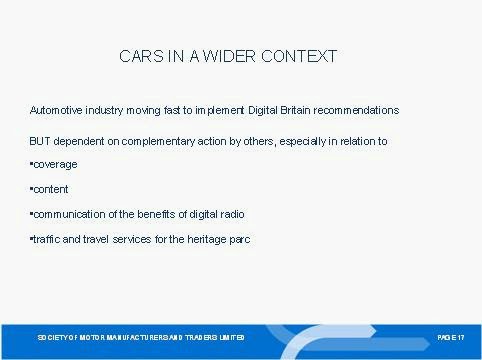
“On cars, the move to include digital radio as standard in new vehicles has continued over the last year. Around 14% of new vehicles have DAB as standard, up from 4% a year ago.”

Within hours, this news was misinterpreted by one online news source as Vaizey having said:

Forty per cent of cars have DAB [Digital Audio Broadcasting] radios as standard now, up from just four per cent a year ago.”

From ‘14% of new cars’ to ‘40% of all cars’ in a stroke of a keyboard! No wonder the article went on to assert that “the key driver to the take-up of the [DAB] technology looks like it will come from the car industry as manufacturers start to fit digital radios as standard.”

How wrong can this statement be? Fewer than 1% of vehicles on the road currently have a DAB radio. That proportion is not going to increase quickly, even by 2013 or 2015, as the government wants it to. Rather than being “the key driver” for DAB radio take-up, cars will become THE major sticking point for digital radio switchover.

The UK car industry appears to be nearing the end of its tether over the confused information that has been fed to consumers in recent years about the so-called DAB ‘switchover’ and FM ‘switch-off’ date(s). This frustration boiled over at the last government Digital Radio Stakeholders Group meeting on 17 May 2011, when Bob Davis, who heads the Digital Radio Committee of the Society of Motor Manufacturers & Traders [SMMT], stood up to offer what he referred to as a “naughty” comment:

“Jane [Humphreys, Department for Culture, Media & Sport] said earlier ‘around 2015’ for a digital radio switchover. The automotive industry has made it very, very clear, since the process began, that it needs certainty. We’ve got 2013 [as the date for a government decision on switchover] and we think we’re working towards a 2015 switchover date. With respect, Jane, I can already see tomorrow’s headlines that DCMS says ‘digital switchover delayed from 2015’ because you used the phrase ‘around 2015’. That implies a delay. It may be what potentially happens in the market – it may be 2016, it might be a bit later than that – but, for the moment, from an automotive industry perspective, every time there’s a suggestion that 2015 has stopped being the aspirational date – or might stop being an aspirational date – all that happens is [that] the automotive industry, or parts of it, is given another opportunity to say ‘it ain’t going to happen, forget all about it’ and we will end up with the bigger problem of converting vehicles already in the parc to digital, because people will just say ‘if DCMS can’t give us certainty’ – and I accept that, at the moment, you can’t – but if DCMS are saying ‘around 2015’ instead of ‘in 2015’, it reduces the opportunity for SMMT to keep telling its members there’s a deadline, and it’s ‘this’. So please could we have a little bit of caution, from an automotive industry perspective, in (particularly) government references to switchover dates.”

Jane Humpreys: “Thank you, Bob, though I think I’m right in saying that the Minister has never said ‘it will be in 2015’. He too has said that it will be in terms of … that is the target to which we are working, but what is the principal objective is that we have to meet the criteria that have been set out and we have a piece of legislation – unless I’m much mistaken – that says there will be a minimum of two years’ notice. So….”

John Mottram, DCMS: “That’s right. I’m aware of three Daily Mail articles that suggest it’s seven years, two years, five years’ delay depending upon the date, so I think in terms of coverage and it being delayed, I think that delay is already out there. But to Jane’s point, I think the Action Plan and Ed [Vaizey]’s words make it clear that it’s a consumer-led approach. The industry target date is 2015 – we’ve never shifted from that – but that decision is based on the criteria….”

At that point, the meeting was abruptly closed. What had been scheduled to be merely another ‘tick the government box’ faux consultation meeting had suddenly started to spin out of control. The natives had started to get restless. It was time to turn them out onto the street again.

DAB Radio Downgrade: how is '90% of FM coverage' a sensible target for DAB to replace FM?

“Makin’ a good t’ing bad!”

Moving the goalposts. Governments are adept at doing just that to help them achieve their targets or to make figures look better than they really are. Digital radio switchover is no exception. Given the technical and financial impossibility of the task plotted twenty years ago to completely replace analogue radio broadcasting with DAB radio, it has became necessary in recent months for the civil servants and digital radio lobbyists to move the goalposts.

In a blog in April 2011, I had outlined Ofcom’s latest ruse to deliberately plan to make DAB reception worse than existing FM reception for many radio listeners. Nevertheless, Ofcom will still declare this a victory for the technical superiority of the DAB platform.

The latest proposal under consideration is to make coverage of local DAB transmitters equivalent to 90% of existing FM coverage. On the one hand, this represents a belated admission that DAB radio cannot realistically achieve the same robust coverage as FM. On the other, it is a massive kick in the teeth to radio listeners – an attempt to purposefully replace something good (FM) with something worse (DAB). Madness!

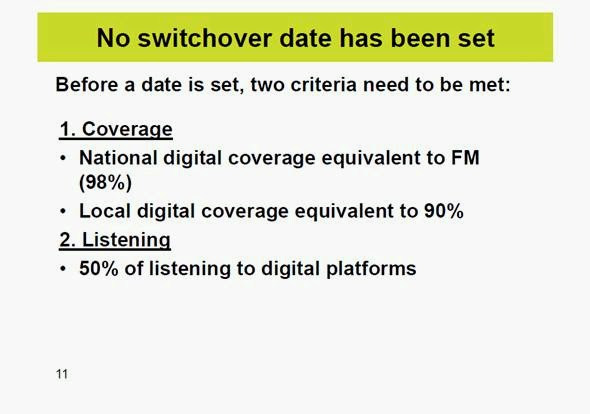
A recent presentation by DAB lobbyist organisation Digital Radio UK invoked a new, vague “local digital coverage equivalent to 90%” criterion [see below]:

“90%” of what? The government’s Digital Britain report in June 2009 had fixed the digital radio switchover criteria as:
• “When 50% of listening is to digital; and
• When national DAB coverage is comparable to FM coverage, and local DAB reaches 90% of the population and all major roads.” [emphasis added]

There was never anything in Digital Britain about achieving “90% of existing FM coverage.” It was always “90% of the population.” The goalposts are being moved to make it easier for the government and DAB lobbyists to declare that DAB has achieved the criteria. Despite this outcome making the consumer experience of radio evidently worse.

We were told that one result of the Digital Radio Summit meeting on 31 March 2011 between government, regulator and the radio industry was:

“It is understood that it will cost around £20-30m to extend the local DAB signal to 90% of the FM signal in the UK…”

At a Westminster Media Forum conference on 5 April 2011, the topic of this newly created “90% of FM” criterion was raised by several speakers:

Jimmy Buckland, director of strategy, UTV Media: “There’s a DCMS [Department for Culture, Media & Sport] plan that’s been referred to today that’s currently on the table that would take local multiplexes to just 90% of what FM already delivers, with no commitment on major roads. If that plan’s agreed, it just about gets us to base camp.”

[…]

Neil Midgley, assistant media editor, The Daily Telegraph: “Now the briefing that we were getting last week was somewhere below £30 million for a build out to about 90% of current FM coverage. “

[…]

Daniel Nathan, director, Brighton & Hove Radio: “Just leading on from that, in Jimmy’s slide we saw the figure being an aspiration of ‘90% of the population’ and I was quite disturbed to hear that now that they are kind of moving away from ‘90% of the population’ to ‘90% FM coverage.’ When was that decided and by whom?”

[…]

Jimmy Buckland: “There were two different figures, there was originally a figure which was the criterion, at which point you would make a decision about switchover which was that the Government said that once we had ‘90% population coverage’ and ‘coverage of all major roads,’ you could make a decision and there were a couple of other criteria that go with that. The second figure which was ‘90% coverage of current FM’ for local DAB concerns what would be delivered by a proposal which is currently on the table. So to tie in with the previous point, what that £30 million delivers is a little bit more coverage at the local level, aggregated to 90% on a UK wide basis, so in some local markets it could be comfortably less than 90%, in other markets it could be higher and it doesn’t get you to the universality that you need for switchover.”

So, two questions remain unanswered:
• Who came up with the idea of ‘90% of FM coverage’ to be sneaked in as an easier criterion?
• Why are large parts of the radio industry (including RadioCentre and the BBC) not publicly campaigning against this ridiculous proposal intended to make reception of their radio stations on DAB WORSE for listeners than existing reception on FM?

It is hard not to conclude that the parties involved in this latest wheeze seem happy to treat the UK’s 46,727,000 radio listeners with utter contempt.

DAB Radio Downgrade? The new masterplan to deliver DAB radio reception worse than FM

When something works well, it just works. You do not need to analyse why it works. It just works. And nobody asks questions as to why or how. That is the case with FM radio. During half a century of development, more and more FM transmitters have been built across the UK (2,100 currently in operation) so as to reach the point now where almost the entire population receives an FM signal (maybe not always perfect, but some reception rather than none at all).

DAB radio was intended to replace FM radio. However, it must only be worth replacing FM with DAB if DAB is actually better than FM. Why replace a transmission system that has taken 50 years to perfect with something that is going to be worse? Unfortunately, nobody thought to conduct a cost/benefit analysis during the last two decades to determine what the cost would be of making DAB radio reception as good as FM radio, let alone better. As a result, DAB radio was foisted upon the public in 1999 without a roadmap to ensure that reception was even as good as FM radio for consumers.

Twelve years later, DAB reception remains worse than FM reception in many places, or is non-existent. Whereas poor FM reception gives the consumer a poor quality listening experience, poor DAB reception provides no listening experience whatsoever. With DAB, a poor signal is the same as no signal.

Instead of Ofcom valiantly admitting defeat over DAB radio – which might infer that the regulator and its predecessor, the Radio Authority, had screwed up the implementation of DAB in the UK – Ofcom presses ahead with increasingly desperate attempts to try and salvage this technological and regulatory disaster.

Ofcom’s latest ‘project’ is to try and understand why FM radio, more than half a century after its introduction, gives consumers acceptable radio reception. Intrinsically, the work is redundant. If FM works well, why bother to analyse why it works? The answer is: because DAB radio does not work. In order to make DAB work, an understanding is deemed necessary of why the system it was intended to replace – FM radio – does work.

Belatedly, it has been understood by the bureaucrats that the expense of making DAB as good as FM will prove too costly. It requires too many DAB transmitters, too many DAB power increases, at too great a cost for the radio industry. Might this not be a good time for them to back away from the notion of DAB radio REPLACING FM radio because it is simply too costly, even just to make it AS GOOD?

Not for the bureaucrats involved. Instead, the philosophy within Ofcom and the government is a new plan to deliberately make DAB radio NOT AS GOOD as FM radio. But still to persuade consumers that DAB is intended to replace FM radio for national and large local radio stations. Madness? Yes. Self-defeating? Yes. Contempt for radio listeners? Totally.

Peter Davies, who is responsible for radio at Ofcom, explained part of this 1984-style philosophy to replace ‘good’ FM with ‘worse’ DAB to the Digital Radio Stakeholders Group meeting in the calmest of tones on 3 February 2011. Although his presentation is lengthy, I have included Davies’ words in full below so that you too can try and decipher the logic of a solution for DAB radio that is purposefully sub-par.

Perhaps the Digital Radio UK marketing slogan next winter will be: ‘Buy a DAB radio! Worse reception than FM guaranteed. But better than no radio at all.’

Peter Davies, Ofcom: “The Coverage Planning Working Group is chaired by Ofcom, but we have effectively two groups that are feeding into this. There is the actual Working Group that is doing all the sort of hard grind of doing the planning work, and that consists of Ofcom, Arqiva and the BBC. There is also a Planning Advisory Group which consists of all the [DAB] multiplex operators, with Digital Radio UK and RadioCentre as well. So what I’m going to run you through this afternoon, quite quickly because of the time, is just what we’re doing in terms of FM. What is it we are trying to match? Secondly, how you then do that with DAB. Thirdly, looking at what we need to do to the frequency plan in the UK to achieve that. And then just onto the next steps.

So, FM coverage. I should say we are doing this for national services as well as local. So it’s both BBC and commercial national services, as well as the local. But I’m going to focus this afternoon on the local because that’s, in a way, where some of the more difficult issues are. This is a map of Manchester. I know you won’t be able to see the detail on that, but it gives you an impression, at least. So what we’ve done in each part – in fact, in the whole country – is define a set of ‘editorial areas.’ So that’s shown on this map by that dotted line – you can see around the edge, a sort of dark purple dotted line – so that everywhere in the country is covered by one or more areas – there are some overlaps – but at least everywhere is covered by one area. So the editorial areas are areas that have been agreed by the BBC and by the [DAB] multiplex operator and commercial radio operators as being the sort of area that they would, in an ideal world, like to cover. It’s also based on [DAB] multiplex areas, so it’s a bit of a compromise.

So, if you look at the actual coverage of BBC Radio Manchester [GMR] within this, that’s shown in the sort of standard way of measuring – 54 db – is shown in green but, actually, editorially BBC Radio Manchester would like to cover the bits within the dotted line. So there is coverage beyond the editorial area where people can pick up the service, but it’s not really intended for them. And, equally, there are bits within the existing editorial area which aren’t covered terribly well on FM but which, nevertheless, the station would like to think it serves.

In terms of the actual [FM] coverage, it’s been quite difficult to determine what that is. The ‘54db’ is the standard internationally agreed planning measure. So that’s 54db per μv per metre, but I’m not an engineer so don’t ask me any more detail than that. But it’s a definition that was drawn up back in the 1950s and is really about reception 10m above the ground, using a rooftop aerial and it sort of tells you whether you can get a signal on your radiogram, which is not terribly useful [now]. So we know that people use radios in very different ways, but we sort of know that this works, but it has never actually been tested. So it’s a planning definition, which is very old and slightly messy.

So what we’ve been doing as part of this work is drawing up what’s known as a ‘link budget ‘, which is effectively taking the signal strength as it leaves the transmitter and then adjusting it all the way along until it actually gets to the receiver. So, in other words, you adjust it because it’s a distance from the transmitter going over some hilly ground, going down into buildings, loss within the receiver itself and so on. So that you can work out what signal strength you will need to work to get decent FM coverage. So we’ve looked at three different strengths because we know that the 54db is probably a little bit conservative, so we also looked at 48db and 42db, again because conditions vary between what you can receive on a portable kitchen radio and what you can get in your car. We are also looking at coverage not only of households, but also of major roads as well, so it’s not just an indoor measurement we’re looking at.

What we have seen so far is actually that the link budget we have developed is that these numbers are probably about right. So 42db is probably about right for cars. But you can see that there’s not actually very much yellow on that map, so that most places either get a good solid indoor signal, or the signal’s not good at all, basically. So, for each area, we have looked at both the BBC local service – so that’s BBC Manchester – and also the commercial coverage, and we’ve taken the largest commercial station in each area. So, for Manchester, this is ‘Key 103.’ As you can see, the coverage is very different, mainly because they are using different transmitter sites and different powers on FM. But, of course, both of those services and others are on the same multiplex for DAB, so you have to think ‘what exactly is it on FM that we are trying to match?’ It’s no good just matching Key 103, you can’t just match to Key 103 because then you would be missing out BBC Manchester and other services. In this case, commercial [radio coverage] is smaller. In other cases that we have looked at, the commercial [stations] cover one part of the county but not another, but the BBC [station] will do the opposite.

So, what we’ve then done is to look at the composite coverage of both BBC local [radio] and the largest commercial station. So this is what we think people in the area would expect to be able to hear as a local service on FM. So you get either the BBC or the commercial radio [station] or both. So that’s the basis of what we think we should be trying to match. So it would be sort of green or blue for indoor, and the yellow bits for road coverage. As I say, we’ve done that for basically every area in the country, including the Nations services – so Radio Scotland, Radio Wales, etc for the BBC – and for the national services as well.

The question then is ‘how do we match DAB [to FM]?’ So the approach to that again has been to build up a link budget for DAB, starting with the transmitter and going right the way through to the receiver. And we’ve been doing receiver tests as part of that. And what we tried to do – because that sort of coverage is slightly debatable on FM – is [identify] where exactly is that band, and where exactly is that field strength? The approach we have taken is, first of all, to say that, within the editorial area, let’s plan for absolutely universal coverage. So how many transmitters – if you wanted to cover it as near as possible to 100% – how many transmitters would you need, both to get indoor coverage and road coverage as well? And we’ve tried to do that in a sort of commonsense way by starting with where the existing FM transmitters are. So rather than just look for new sites, because actually if coverage from FM is good from that site, so you should get decent coverage from DAB from that site as well. And then we’ve added on transmitters at decreasing levels of coverage until you get as close as we can to 100%.

Then, once we’ve done that, we’ve said ‘okay, actually some of those are now covering areas which aren’t covered by FM’ so actually you might not need them. So then you can then sort of roll back from that full universal coverage. The question then is ‘where do you draw the line?’ So, if you look at Manchester. Again, you’ve got the editorial area, which is a bit hard to see on this, but is the solid purple line around the edge. That is the existing local DAB coverage in Manchester, so you see 66.4% of households at the moment. In terms of households [for FM coverage], we have got 96.2% indoor at the moment, 98.2% (that’s a slightly sort of spurious measurement because it’s not actually a road measurement, but it’s households), so 96.2% for FM. So 66.4% existing [DAB] coverage from the two transmitters which are currently operating from the Manchester multiplex. It is one in central Manchester – sort of there – and there is one at Winter Hill at the top in the northwest corner.

We then looked at ‘okay, what would you do if you just increased the power of the existing transmitters and moved them up the mast a bit?’ And, actually, that gets you, as you can see, quite significantly increased coverage. In order to do that, we need to change the frequency plan, and I’ll come back to that in a minute. So that gets you up to 82% [DAB coverage] and then we keep adding on transmitters until we get as close as we can to 100%. This goes to 99% and that means 15 transmitters which are shown by the crosses dotted all over that map.

But then, as I say, you look at it and you say ‘well, actually, the two smallest of these – which are these two up here – actually have no household coverage at all, and the smallest one only adds 8km of road coverage.’ Now, obviously, if you’re driving and you lose your radio reception, then that’s a problem. But there’s a question as to whether that is essential for local coverage – it might be for national, but is it for local? So the question is ‘where do you draw that line in terms of a sort of cost/benefit analysis,’ if you like? You might decide, actually, you wouldn’t bother with those, but the question is ‘how far down the list of 15 [transmitters] do you go,’ as to what’s commercial viable and what provides an acceptable level of service to consumers?

So that’s the approach that we’ve taken. As I say, in order to do that, we need to change the frequency plan. Those are the big [frequency] blocks we use for DAB at the moment, dotted around the country. And you can see that they – the colours represent frequencies – so you can see that we have to reuse the same frequencies over and over again around the country. And that does cause interference so, at the moment, Manchester uses the same frequency as Birmingham. And, because of that, we can’t increase the power of the Manchester transmitters to get beyond that 66% to the 82% [coverage]. And that problem is repeated around the country. So what we’d like to do is re-draw the frequency map, which means that, as far as consumers are concerned, means doing a re-scan of their radio but does then allow us to boost the coverage quite significantly from existing transmitters and reduces that problem of interference which, in same places, can be quite significant. In order to that, it’s quite a long process – we need international co-ordination – but that part of the planning process we are going through at the moment.

So, the next steps are to finalise that frequency plan and begin the international co-ordination. We’ve got to complete the FM coverage maps and just check that link budget for FM, both for local and national [stations]. And then, for each of the local DAB areas and for the BBC national multiplex and for Digital One, the commercial multiplex, to produce the coverage maps and the household count and the road count as well for all of these existing multiplexes. Once we have done all of that, we plan to publish the whole thing later in the spring or early summer in a consultation so that we can then begin a debate as to whether this approach is actually right or not, and where it gets us.

Obviously, one of the big questions in all of that is actually ‘how much does it cost the broadcasters?’ I should say that that’s not something the Coverage Planning Group is looking at. It’s not something that we’ve been asked to look at, so it’s purely a technical approach at this stage but we think, sort of by the end of April, we should have the answers of how many extra transmitters you would need in order to achieve switchover.”

So the overarching question posed by the forthcoming Ofcom consultation seems to be: how poor can DAB coverage be made but still be accepted by consumers? If Peter Davies’ workplan, as explained here in February 2011, sounds vaguely familiar, it might be because he had addressed the Radio Festival in July 2008 and promised:

“Once we have defined what existing DAB coverage is, we then have to work out what it would take to get existing DAB coverage up to the level of existing FM coverage. Now, we have already done a lot of work on this, and certainly enough to inform the interim report, and the whole thing will be finalised in time for the Digital Radio Working Group final report later this year.” [see Dec 2008 blog]

Incredibly, three years late[r], the promised work is only just being completed. An amazing lack of urgency has been demonstrated by Ofcom, despite DAB radio resulting in more correspondence from angry consumers to the broadcasting minister Ed Vaizey than any other issue.

What most astonishes me is that the digital radio sector is still trying to persuade people living in Manchester to purchase a DAB radio, just as it has for the last twelve years, when it knows that there is a one-in-three chance that a Manchester household will be unable to receive ANY local stations via DAB, according to Davies. I assume a similar situation prevails in other cities.

Time for a class action by disappointed DAB radio receiver buyers?

[no accompanying graphics because DCMS explained: “Peter Davies’ Ofcom presentation is not attached as the content is still work in progress. Ofcom plan to publish all of the data later in the year.”]

Culture Secretary: "digital radio industry needs to do a lot more work … to carry the public with it"

House of Commons Culture, Media & Sport Committee
30 March 2011 @ 1006 [excerpt]
Committee Room 15

Jeremy Hunt MP, Secretary of State for Culture, Olympics, Media & Sport

Q: What are your expectations now with regard to digital radio switchover?

A: Well, I think the future is digital. I think the future is DAB. But I think the digital radio industry needs to do a lot more work to boost the penetration of DAB and to carry the public with it. And I think that it has not been nearly as successful as that, as the TV industry has been, in persuading the public of the benefits of digital switchover. And that’s why, at the moment, the industry is having to bear the costs of running two systems [analogue and DAB] in parallel. I very much hope that they won’t have to do that. We want to do everything we can to help the industry migrate smoothly, but we would like it to be user-led, so we have said that we are not going to have an arbitrary 2015 deadline. We will make a decision in due course as to whether we can have switchover in 2015, but we want the radio industry to step up to the plate in making sure there are better products and services available, and that consumers really can see the benefit of DAB.

Q: Would your expectation be that the financial commitment of the BBC to expand the radio coverage in rural areas will remain the same or might that be affected by their review of spending?

A: Well, the BBC are committed in the [Licence Fee] Agreement I did to national availability of national DAB channels. There is still a discussion to be had about the funding of local DAB channels, which is an additional cost. And I am closely involved in discussions with the radio industry, and very keen to resolve this as soon as possible because I think it’s a very, very important next step.

DAB radio switchover: the view from the government bunker

The government’s second stakeholder consultation on DAB radio switchover happened this afternoon. It was held in what felt like an underground government bunker in Victoria. No windows, long corridors, and lots of seemingly identical numbered rooms hidden by massive doors that had no viewing windows. When I tried to go up a staircase to ground level, a man appeared from nowhere and told me not to.

Even if the bomb had dropped, down there, you might not have known it. The cityscape outside could have transformed into a wasteland but, down there, you can be certain that our civil servants would continue planning digital radio switchover regardless, even if the precise date had to be postponed until the contamination had receded. I imagine that the government staff working there hardly need to go out, even at lunchtime, because a little lady with a trolley probably comes around with salmon sandwiches.

In this cosseted environment, it is easier to understand how you might spend your days (or months or years) of servitude, devising schemes that have so little relevance to the real world above your bunker office. Perhaps this is why the afternoon was filled with PowerPoint presentations that all looked great, slides that had lots of action words, and monologues from grey men that were filled with the current jargon. It was a perfectly unreal world.

What the afternoon lacked was realism. Occasionally I had to pinch myself to make sure that this was not a Lemsip-induced slumber. It wasn’t. However, I did witness the Civil Service suggest that asking consumers their opinion about DAB radio switchover would be a good idea, as if it was a novel thought that had just come to them. Not withstanding that the government has been pursuing the notion of the DAB platform since the 1980s but, in all those decades, somehow omitted the ‘consumer’ (or ‘listener’) from its plans.

The following quotes came from our civil servants this very afternoon. I wrote them down. Reading them now, these lines could have been extracted from the script of a lost episode of ‘Yes Minister’ in which the cast cleverly parody government plans for digital radio switchover. Sadly, they did not. This is what stakeholders were told today (amongst many other things):

“We genuinely have seen more progress [on digital radio switchover] in the last eighteen months than we have in the last six or seven years I’ve worked on this issue. But, as far as the consumer is concerned, we’ve never certainly in any way advocated or used 2015 [switchover date] as a ‘stick.’ It’s always been the industry target. And, certainly, when this government came in, it was adamant and clear that the consumer would make the case for switchover by purchasing habits, by the percentage of listening [on digital platforms], the way it absorbs and consumes radio. Now, will I, at this point, say that there has been a cross-pollination of those two things? Has the 2015 [date], which was an industry date, started to creep into the public consensus and been used by the media as a scare tactic? Yes, of course it has. And do we, as an industry, need to look at that? Yes, I think we do. I would say that I don’t think anyone – I think very few people – in this room would welcome the government standing up tomorrow and saying that the [switchover] date is the 31st December 2015. And I don’t think we have any answers to the questions that we need to have the answers to before any such decision can be made, and whether the consumer genuinely believes that this is something they want to do.”

“I don’t think we know what listeners want. I think part of this [Digital Radio] Action Plan process is absolutely understanding the value people put on various parameters of radio – what they want, how they want to consume it. I think that part of understanding this decision is understanding the listener better. And I think, whilst we all have our own views on that, I don’t think there’s enough evidence based [data] for us to make those assumptions about what listeners want.”

“I don’t think the government has never ever said ‘digital radio switchover will happen in 2015’ but we think we need to go away and look at the messaging around the cross-pollination. The one thing I would say is: 2013 and 2015 is used by both sides of people in the debate, those who like to frighten people into the fear of losing their analogue services, and those who like to sell digital radios. For all of us who believe that certainty and clarity and the consumer is important, I think we all need to look at how we use the threat of 2013 and 2015 and have some consistency ourselves about how we talk to the consumer about it.”

Threat? Are radio listeners so malleable that they must be viewed by government like cattle to be herded to slaughter? Maybe I imagined mistakenly that government was FOR the people. Anyway, I suppose we should be grateful at all that the ‘consumer’ has suddenly been pushed centre stage in the long running DAB drama, even it is so late in the show [see 2009 blog and 2010 blog where I predict it would be ideal for bureaucrats to eventually blame DAB’s failure on the consumer rather than themselves].

Is there any difference between the government forcing the population to buy a DAB radio to listen to The Archers, and Sky persuading them to buy Sky Atlantic to watch their favourite HBO shows that used to be free? Is the government’s DAB switchover drive really a policy for public regulation, or simply capitalist radio (© LBC poster campaign 1989)?

This afternoon, while DAB was being discussed in the government bunker, could anyone have actually achieved satisfactory DAB radio reception down there? I think not. Are those government people listening to DAB in their cubicles? They can design as many PowerPoint presentations as they want but, at the end of the day, if DAB radio don’t work properly now, then it don’t work for the consumer.

Q: Who is the government commissioning to produce an objective report on the costs & benefits of DAB radio switchover? A: The government

For two decades, the British government has pursued a policy to replace analogue radio broadcasting with DAB digital radio broadcasting. Why? The real reasons might as well be lost in the mists of time (or maybe were never made public). However, this has not stopped the government and its civil servants continuing to pursue the same digital radio switchover policy since the 1980s, despite overwhelming evidence that the surrounding media landscape has changed beyond recognition in the interim.

Because the government policy to replace AM and FM radio with DAB radio had never been decided on the basis of consumer demand, commercial necessity or global standards, it was unnecessary for officials to produce a document that justified it logically. When a government decides that a particular policy is necessary, it can make legislative change happen without recourse to the consumer market outside of Parliament or the Ministries. Politics and the real world do not inhabit the same space.

In the case of DAB radio switchover, the government made no effort to produce a cost/benefit analysis until 2008, when PricewaterhouseCoopers [PWC] was commissioned by Ofcom. However, the resulting 91-page report did not provide the solid, positive argument for DAB radio switchover that the government had desired. So the PWC report was hidden from the public for a year, eventually to be released and trivialised by civil servants [see blog entry Feb 2010].


In contrast to the government’s unbridled enthusiasm for DAB, the PWC report felt that “the [radio] industry and consumers may fail to see the benefits of digital radio over the longer term.” It concluded that “there are relatively few up-sides to the estimates and several significant downside risks” from its cost/benefit analysis of DAB radio switchover [see
blog entry Jul 2010].

The House of Lords Select Committee on Communications, in a report on digital radio switchover in March 2010, expressed its dissatisfaction with the government’s attempt to bury the evidence from this PWC report:

“We strongly regret that the cost benefit analysis carried out by PricewaterhouseCoopers was not published at the time it was delivered to Ofcom and the Department for Culture, Media & Sport in February 2009.”

The government responded that “technical difficulties” had prevented the report’s publication for nearly a year. As excuses go, it would probably have been better for the government not to have responded at all.

After this embarrassing debacle over the PWC report, the government must have wanted to commission a further report that would conclude what PWC had not: that DAB radio switchover is a wonderful thing and that there are sensible economic arguments to justify forcing it upon the British public.

In June 2009, the government’s Digital Britain report promised: “We will conduct a full Impact Assessment, including a Cost/Benefit Analysis of Digital Radio Upgrade.”

In January 2010, Ofcom’s Peter Davies offered
evidence to the House of Lords Communications Committee that another report would be done:

Baroness McIntosh of Hudnall: “What about your own impact assessment?”

Mr Davies: “We haven’t done an impact assessment yet.”

Baroness McIntosh of Hudnall: “But you have been asked to – correct?”

Mr Davies: “At some point in the future. I think the Digital Britain report said that we would be asked to do one, but we haven’t been asked to do one yet. Obviously we would need to do that and we would need a much fuller cost-benefit analysis before any final decision was taken.”

In June 2010, the government stated:

“We agree that a full impact assessment is an essential part of informing the Government’s decision on whether and when to move from a primarily analogue to a digital radio landscape. Work has already begun to collect the evidence needed to support an impact assessment and analysis should begin shortly.” [emphasis added]

Here we are now, in January 2011, and there remains no sign of the long promised cost/benefit analysis of DAB radio switchover, despite the new government continuing to pursue the digital radio switchover policy of the previous government. However, in December 2010, a document from the Department for Culture Media & Sport [DCMS] (marked “UNCLASSIFIED”) disclosed:

“The Government launched a joint Government and industry Digital Radio Action Plan on 8 July 2010. This Action Plan sets out the process for providing ministers with the information and assurances necessary to make a decision on whether and how to proceed with a Digital Radio Switchover. … Fundamental to the information provided to Government as part of the Action Plan will be a comprehensive Cost Benefit Analysis on the proposals for a digital switchover. … Government is conducting the modelling of the costs and benefits in-house. This research will provide robust evidence of potential costs and benefits to consumers of digital switchover to be incorporated into the Government’s Cost Benefit Analysis.”

So the government has confirmed that the government decision on digital radio switchover will be informed by a government cost/benefit analysis of digital radio switchover that utilises government modelling of the costs and benefits. It appears that, in the case of DAB radio switchover, the government has decided to be judge, jury and executioner too. This smacks more of ‘big brother’ than of the Conservatives’ much touted ‘big society.’

The unclassified DCMS document hinted that the earlier PWC report had not produced the desired results:

“A similar piece of work was carried out by PricewaterhouseCoopers in 2008 to inform the work of the Digital Radio Working Group into the future of digital radio and the potential for switchover. That Cost Benefit Analysis raised a number of caveats, chief among which were the gaps in research into consumer behaviour and willingness to pay. Although the radio ecology has changed since that Cost Benefit Analysis was produced, the document provides useful insights and the recommendations made by PricewaterhouseCoopers on further research remain valid.”

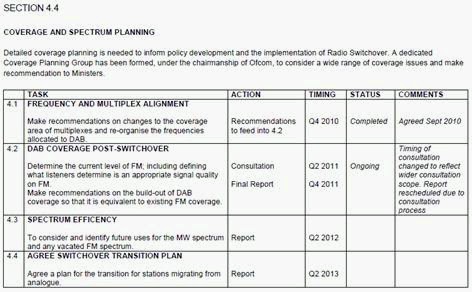
So what will be in the government’s new cost/benefit analysis report? The latest version of the government’s Digital Radio Action Plan explained:

1.4 IMPACT ASSESSMENT
Carry-out an impact assessment of the options and timings of the Radio Switchover. This will include, but not limited to, the following:
· the costs and benefits of any interventions to enable the switching the migration of all national and large local radio stations to DAB and alternative uses for the analogue spectrum vacated after the Radio Switchover;
· the rural impact of implementing the Digital Radio Switchover;
· Impact on energy consumption of a Switchover; and
· Environmental impact of analogue receiver disposal following Switchover.”

Interesting to see that neither the ‘consumer’ nor the ‘listener’ are mentioned here. For this workstream, the “first report to Ministers” is not scheduled until Q4 2011. It is evident that there is little urgency to execute this new cost/benefit analysis or for it to make a significant contribution at this juncture to any government re-evaluation as to whether to proceed with DAB radio switchover. If a cost/benefit analysis were a genuine priority, why was:
· the PWC report buried in February 2009 for a year
· a new cost/benefit analysis promised by Digital Britain in June 2009 but not prioritised subsequently
· the government saying in June 2010 that “work should begin shortly” on the analysis
· a “first report” of this work now not scheduled to be presented until Q4 2011?

If the government’s DAB radio switchover policy were but a minor issue within the DCMS Ministry, all this deceit, delay and manipulation might be considered trivial. It is not. In December 2010, Minister Ed Vaizey admitted that he receives more correspondence from angry consumers about DAB radio than about any other issue within his portfolio.

So why are we witnessing such a continued lack of government transparency on the DAB radio switchover issue, despite prime minister David Cameron’s commitment in November 2010 to make the UK “the most open and transparent government in the world”?

Which? advises: two of "seven Christmas gifts to avoid" are DAB radios

A reader comment appended to an online newspaper story this week about the decision of some commercial radio station owners to launch an anti-DAB radio marketing campaign said jokingly:

“Now all that’s needed before Christmas is for ‘Which’ to warn consumers of moral hazard in purchasing DAB radios.”

In fact, last month, ‘Which?’ [the UK consumer organisation] published its list of ‘Seven Christmas gifts to avoid’, two of which were DAB radio receivers. According to Which?:

“Argos Value Range CDAB8R digital radio and Roberts CRD-37 digital radio. Sound on both of these DAB radios is disappointingly poor.”

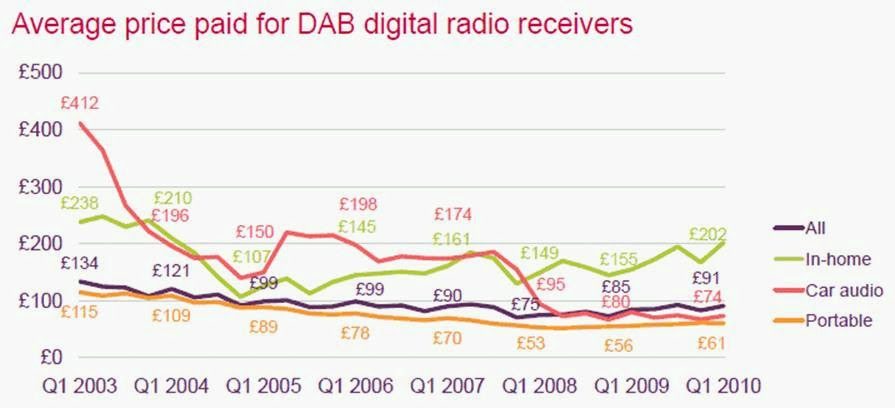
One of the enduring problems that has contributed to the slow take-up of DAB radio in the UK has been the consistently high retail prices of DAB radio receivers compared to analogue models. The radio industry has promised repeatedly over many years that the retail price of DAB radios would fall. It has, but nowhere near as much as hoped.


In order for unit prices to fall further, DAB radio receivers would have to be manufactured in production runs of millions in factories in China. Because the notion of DAB radio has failed to excite consumers during the last decade, not only in the UK but across Europe, those high production runs have not been achieved, so that the unit prices remain relatively high (average price paid in Q1 2010 was £91).

The problem with trying to produce low-price DAB radio receivers is that something inside them has to be sacrificed to keep costs down. Whereas the UK’s FM transmission system is sufficiently robust to permit usable reception of radio stations on even the cheapest hardware, the DAB transmission system is still not robust enough for usable reception in many circumstances. Additionally, with analogue radio, poor reception equals background noise and interference. Whereas, with DAB radio, poor reception equals no audio whatsoever.

This issue has long been known by the UK radio industry, but it proves a lot easier to ignore it than to fix it. So, the £55m marketing campaigns to persuade consumers to purchase DAB radios continue, despite the radio industry being aware that many consumers are likely to have unsatisfactory experiences with their newly purchased DAB radios.

At the Digital Radio Stakeholders Group meeting on 1 November 2010, UK manufacturer Roberts Radio admitted to pulling the plug on several receiver projects, including the industry’s long promised ‘£25 DAB radio’, because they could not meet Roberts’ minimum quality standards. Leslie Burrage, chief executive of Roberts Radio, told the meeting that there had been a 35 to 40% consumer return rate for its in-car DAB radio adapters.

Roberts Radio, unlike competitor Pure Digital, has been outspoken about its concerns that DAB radio is being marketed wrongly to UK consumers. Owen Watters, sales/marketing director of Roberts Radio, told the Digital Radio Stakeholders Group that he felt such campaigns should be advocating the merits of the DAB radio experience, rather than threatening consumers with the prospect of digital radio ‘switchover’.

The government’s Consumer Expert Group [CEG] raised these issues in its critical report on DAB for the government in September 2010. The government published its response to those criticisms on 30 November 2010:

Consumer Expert Group: “A clear and balanced public information campaign needs to be implemented through a trusted body, independent of the industry.”
Government: “If a decision is made to implement a digital radio switchover, we agree that a clear and balanced consumer information campaign will be important. A strategic plan for such a campaign is a central component of the Digital Radio Action Plan and we have invited representatives of the CEG to play a key role in advising on its development, for example through representation on the Market Preparation Group.”

Consumer Expert Group: “Emphasis should not be placed on driving down costs unless the sound quality and functionality of cheaper DAB sets are at least equal to analogue.”
Government: “There is clearly a balance to be struck between reducing the cost burden on the consumer of a digital radio switchover, and ensuring devices are of a good standard and offer additional benefits to the listener. We want to see a competitive market for receivers which offers consumers choice on innovation and price.”

These government responses seem to qualify as ‘non-answers’ of exactly the type we have become all too used to when difficult, but important, issues have been raised about DAB radio implementation in the UK. The prevailing philosophy justifying DAB seems to be: ‘ask me no questions, I tell you no lies.’

Roll up! Roll up! Enjoy the radio industry pantomime: 'DAB Radio'

The Ministerial Group for the government’s Digital Radio Action Plan will meet tomorrow. That meeting has all the hallmarks of a radio industry seasonal pantomime, with participants dressed up in their gladrags to play the appropriate parts. A select audience has been hand picked, though the ending of the story has still to be written.

Pantomime often brings out a sense of déjà vu, of having seen the same thing during previous Christmases. This winter’s DAB radio marketing campaign has that feeling. The 2010 slogan is:

“There’s a digital radio for everyone this Christmas”

While the UK radio industry’s Christmas campaign for 2009 had been:

“Struggling to think of the perfect gift for Christmas? There’s a digital radio for everyone …”

Pantomime often stages a sleight of hand, where you are not quite sure if what you saw was real or just some cheap trick. This winter’s DAB radio marketing campaign has that feeling. On 18 November 2010, the press story was:

“The commercial radio campaign [for DAB], which breaks on November 22, covers Global [Radio], Bauer [Radio], Guardian Media Group [Radio], Absolute [Radio], UTV [Radio] and many local commercial stations.”

But, within days, that story had changed so that the campaign:

“… will run across major commercial groups” and “commercial radio stations including Absolute, UTV, Orion.”

What happened to Global Radio, Bauer Radio and Guardian Media Group Radio? Well, every pantomime has its jesters who do their best to spoil the rest of the cast’s fun. This winter’s DAB radio marketing campaign has that feeling. Two days after the Christmas DAB campaign had started, The Telegraph broke the story that:

“Leading commercial radio groups [Global Radio, Guardian Media Group] have refused to promote DAB radio …”

Every pantomime has its bully, who picks on people mercilessly and prevents them from going to the ball. This winter’s DAB shenanigans have that feeling. Commercial radio trade body RadioCentre offered its story as to why its members, Global Radio and Guardian Media Group, had pulled out of the marketing campaign:

“Commercial radio operators are currently in discussions with government about the funding of local DAB coverage. Until those discussions are resolved, we understand that some stations felt it would be inappropriate to run the digital radio Christmas campaign.”

Er, isn’t that blackmail rather than negotiation? Is it not transparent that, if you really cared about making DAB radio a success, you would think twice about cutting off your nose to spite your face by deliberately NOT promoting the very DAB platform that you have been attempting to palm off on the public for the last decade? In essence, you are trying to convince consumers that you care so much about your backward 10-year old offspring that you intend to starve it to death. In pantomime, such a tragedy might give the audience a laugh. In reality, it would be time for Social Services to intervene. It cannot be good PR for the commercial radio industry to be so convincingly playing the part of The Wicked Witch of The West.

RadioCentre’s lack of parenting skills has been evident in recent weeks:
· Its children had refused to attend the government’s Digital Radio Stakeholders Group meeting on 1 November [see earlier blog]
· Last Friday, its children refused to participate in a Westminster conference on ‘the future of UK digital radio’ organised for 7 December, resulting in the event’s postponement until April 2011.

And here is what the school notes said to explain these absences:
· “Following the announcement of the [BBC Licence Fee] settlement, RadioCentre has been in discussions with Government about the funding of local DAB coverage. As these discussions are ongoing, RadioCentre members felt it would be inappropriate to attend the Digital Radio Stakeholder meeting.” [Campaign]
· “Sensitivity of current negotiations on the future of digital radio” for the conference pull-out.

The evident paradox in this radio pantomime is that:
· The radio industry is spending £55m between now and 2015 to try and convince the public that DAB radio is the best thing since the cat’s whisker [see earlier blog]
· The radio industry big boys will not stand up in front of other stakeholders in the media sector, or in front of a conference, and explain what, why or how they are pursuing (or not really pursuing at all) the government’s DAB dreams
· Commercial radio has been demanding for several years that the BBC pays for fixing the deficiencies in commercial radio’s own DAB local transmission system. (Yes, this is the same BBC that RadioCentre has lambasted for years about its interference in commercial activities. Yes, these are the same commercial radio big boys who invested heavily in DAB in the 1990s in the hope of making profits for their shareholders.)

Pantomime is pure theatre, and tomorrow’s meeting will doubtless provide much entertainment for all involved. The only unresolved issue is how it will all end. Will the government Minister play the part of Scrooge, insisting that the commercial radio big boys should work longer hours for their living and must pay for improvements to their DAB system themselves? Or will the government play the wicked stepmother, compromising the BBC’s independence by forcing it to pay for an expensive sticky plaster to fix a commercial media sector DAB problem that has been all of its own making?

My feeling is that, in these austere times, it would be opening up another big black hole for public money to now finance such massive deficiency issues with DAB radio that could and should have been anticipated and fixed a decade ago. It is simply too expensive to commit unknown quantities of cash to transform the ugly DAB frog into a handsome prince who might never be fit enough to rival FM radio. Anyway, the BBC has already made a public commitment to not spend any more Licence Fee money on yet another ‘makeover’ show. In which case, our Cinderella DAB may not be going to the ball.

Or is all of the above just a pantomine within a farce? Is all this play-acting merely intended to allow commercial radio to walk away from DAB altogether, pointing the finger of blame elsewhere (and smug that the Classic FM automatic licence renewal is nearly almost within its grasp)?

The Digital Radio Stakeholders Group: another 'faux consultation'

Did you hear about the inaugural Digital Radio Stakeholders Group meeting held on 1 November 2010 at the government’s DCMS [Department for Culture, Media & Sport] office? Probably not, unless you were one of the couple of dozen people who were in attendance. Otherwise, you were in the majority who were unaware of the event. There was no public pre-announcement of this meeting. Afterwards, there was only one article about it in the media trade press. Google returns ‘no results’ from an internet search for ‘Digital Radio Stakeholders Group’, even though this is the title writ across the top of the agenda circulated for the event.

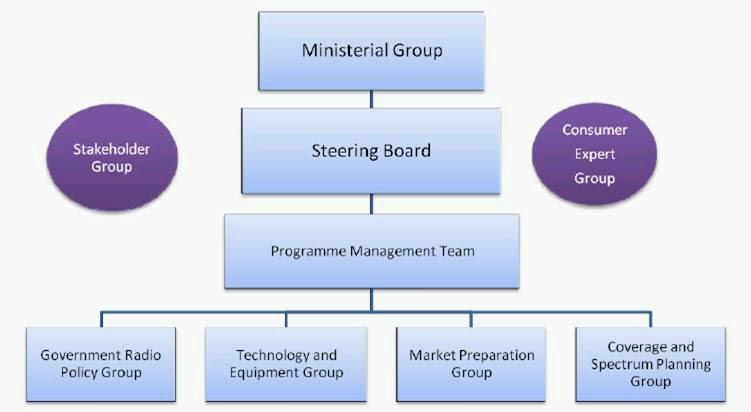
You have to look in the new government’s Digital Radio Action Plan, published in July 2010, to discover:

“The Government will chair a Stakeholder Group which will be open to a wide range on industry and related stakeholders. The principle purpose of this Group will be to inform external stakeholders of progress against the Action Plan and gather views on emerging findings. We expect that the Group will meet quarterly.”

The government’s project management plan anticipated that, by Q2 2010, it would be able to:

“secure commitment from the Government Digital Radio Group and the Stakeholders Groups to the Action Plan.” [Task 5.1]

This pre-determined outcome was justified on the grounds that:

“Successful implementation of the Digital Radio Switchover programme will only be achieved through close Government-Industry co-operation. […] This will include commissioning and delivery of reports, reviewing progress against key milestones and disseminating information to key stakeholders.”

So, essentially, the Digital Radio Stakeholders Group seems to be an almost non-existent forum that has only been convened to secure some kind of external ‘rubber stamp’ for the government’s proposals on DAB radio. It will allow the government, when challenged as to the democratic basis of its DAB radio policy, to assert confidently: “We convened a stakeholders group and it endorsed our proposals.”

This is cynical government at its worst. A ‘faux consultation’ that pretends to have asked a group of somebodies to endorse a government policy for which no mandate has ever been given by the electorate. It is similar to the manipulation practised by Ofcom in its radio policymaking (viz. Ofcom’s recent decision to permit Smooth Radio to dump its commitment to broadcast 45 hours per week of jazz music, after having acknowledged that 13 of the 15 responses submitted to its public consultation were opposed to this loss of jazz).

According to a government document, the Terms of Reference for the Digital Radio Stakeholders Group are as follows:

“Purpose
To enable a wide range of organisations to contribute to the process of delivering the Digital Radio Action Plan

Objectives
• To inform all stakeholders of progress with the Action Plan
• To seek the views of stakeholders on future progress of the Action Plan
• To provide an opportunity for all stakeholders to share news, views and concerns relevant to the Digital Radio Action Plan

Membership
Any organisation with a valid interest in the objectives of the Digital Radio Action Plan may be a member. Members will include consumer representative bodies, broadcasters, manufacturers, retailers, vehicle manufacturers, transmission network operators, content providers. The Group will be chaired by BIS in the first instance, though in principle the Chair could be any person acceptable to the majority of stakeholders and able to represent the collective views of the stakeholders to the Steering Board.

Mode of operation
The Digital Radio Stakeholders Group will meet quarterly.
The Chair will report the views of the stakeholders, as expressed through the meetings of the Stakeholders Group, to the Steering Board.”

So what happened at the first meeting? Very little, according to some of those who were present. It was a game of two halves. In the first half, the bureaucrats put their case. From the government, Jane Humphreys, head of digital broadcasting & content policy, BIS [Department for Business Innovation & Skills]; John Mottram, head of radio & media markets, DCMS; and Jonny Martin, digital radio programme director, BIS/DCMS. From Digital Radio UK, Ford Ennals, chief executive; Jane Ostler, communications director; and Laurence Harrison, technology & market development director. Then, in the second half, representatives from Age UK, the Consumer Expert Group, Voice of the Listener & Viewer and W4B raised issues on behalf of the consumer.

At the end of it, I guess the government-appointed chairman could return to her government office, tick the box on the government wall planner that says ‘stakeholder commitment’ and be pleased that this ‘rubber stamp’ had cost the taxpayer only an afternoon’s salary plus some tea and biscuits for the ‘stakeholders’. Well worth it!

More interesting than noting those who attended is identifying who was not there:
· No presentation by Ofcom, whose longstanding ‘Future of Radio’ policy has forced the DAB platform upon the public for almost the last decade
· Nobody from the largest commercial radio owners – Global Radio, Bauer Radio and Guardian Media Group – that have considerable investments in DAB multiplex licences

After the meeting, under the headline ‘RadioCentre quits digital radio meeting’, Campaign reported:

“RadioCentre, the commercial radio trade body, has walked out of discussions over the future of digital radio after the BBC licence-fee settlement did not commit BBC funds to roll out DAB radio. The body refused to attend a [Digital Radio Stakeholders] meeting on 1 November after the [BBC Licence Fee] settlement, published last week, included provision only for [BBC] national DAB [upgrade].” [I noted this development in a blog last month]

Whatever RadioCentre’s reason for non-attendance (and the story in Campaign has not been refuted), this kind of stance is a disgrace. Raising two fingers to the people you are supposed to be persuading of your DAB policy is not a clever PR strategy for the commercial radio industry. But I am not surprised. All the organisations pushing for DAB radio have increasingly adopted a ‘bunker’ mentality that precludes any direct contact with the public. What we appear to have now is:
· Ofcom refusing to engage in public discussion about its DAB ‘Future of Radio’ policy
· The government organising a Stakeholder Group to rubber stamp its unrealistic, dictatorial policy on DAB radio
· Digital Radio UK refusing to engage in public explanation of its DAB campaign work, as illustrated by its non-existent web site
· RadioCentre and its members now refusing to attend a meeting to explain just how/why DAB is still being pursued

At the same time, the public – the consumers, the 46,762,000 adults who spend 22.6 hours per week listening to radio – have been omitted altogether from these manoeuvrings that are still focused upon trying desperately to force them to purchase DAB radio receivers. The public had been omitted from the proposals at the very beginning of DAB more than a decade ago, which is precisely why it failed, and they are still being omitted today.

This is not the first time that government ‘stakeholder’ meetings about DAB radio have been organised simply to tick a box. As part of the previous government’s attempts to solve the DAB problem, in 2008 it convened a Digital Radio Working Group with two similar ‘stakeholder meetings’ held at DCMS. I attended and felt they existed purely for the bureaucrats to report back to their superiors that they had done something to ‘disseminate’ their policies. DCMS’ own write-up of the first meeting recounted bluntly:

“A stakeholders meeting was held on 10 March and offered opportunities for a wide range of views to be heard.”

A place where “views” were merely “heard”. The ineffectiveness of these earlier stakeholder meetings is demonstrated by re-visiting the agenda for the first of them. The issues tabled for discussion nearly three years ago (“How to make digital radio the predominant platform for listening to radio in the UK? What are the barriers to this? How can these barriers be overcome?”) still remained the same at this month’s meeting. Worse, none of the DAB technical problems identified then have been solved in the interim. And guess what? All trace of these 2008 meetings ever having happened has been erased from the DCMS website (in 2008, I had had to write to DCMS to get them to add the meeting details to their website).

The next meeting of the Digital Radio Stakeholders Group will be held on 3 February 2011 at DCMS/BSI, 1 Victoria Street, London SW1H 0ET. If you belong to any kind of community group or organisation (even if it is your neighbourhood watch) whose members are likely to be impacted by the government’s policy on digital radio switchover, I suggest you write to Jane Humphreys (e-mail to [first name][dot][second name]@bis.gsi.gov.uk) and ask for an invitation to this next meeting.

‘Stakeholder’ radio listeners should turn up to the February meeting and shout: “I’m mad as hell and I’m not going to take this any more!” … or maybe the DAB plug will already have been pulled by then.

Digital Radio Upgrade? More like Digital Radio Groundhog Day.

It was the Radio Festival, the industry’s annual get together. Everyone wanted to talk about how wonderful the DAB future of radio would be. But nobody wanted to explain how ‘Digital Radio Upgrade’, the government policy to make the UK’s DAB transmission system fit for purpose, will be paid for. It is the radio sector’s favourite parlour game: pass the DAB Upgrade parcel.

The first player is the BBC:

Q: “Very briefly, a one-word answer. Do you have any money set aside now to spend on [Digital Radio Upgrade]?”

Tim Davie, director of BBC Audio & Music: “No.”

Second is commercial radio:

Q: “Does commercial radio have any money to spend on [Digital Radio Upgrade]? […] What’s your guess?”

Phil Riley, chief executive of Orion Media: “‘No’ is the answer at the moment.”

Third are the politicians:

Jeremy Hunt MP: “I think the most important thing is not something the government can do, but something the industry can do …”

But hold on. This dialogue came from the Radio Festival in 2009…. We need to fast forward one year.

It was the Radio Festival, the industry’s annual get together. Everyone wanted to talk about how wonderful the DAB future of radio would be. But nobody wanted to explain how ‘Digital Radio Upgrade’, the government policy to make the UK’s DAB transmission system fit for purpose, will be paid for. It is still the radio sector’s favourite parlour game: pass the DAB Upgrade parcel.

The first player is the BBC:

“It remains to be seen who will pick up the £100m tab [for Digital Radio Upgrade], with [Tim] Davie saying he did not have the necessary funds.” [from The Guardian]

Second is commercial radio:

“[Global Group chief executive Ashley] Tabor said the commercial [radio] sector will only pay for the rollout of those local DAB multiplexes that are commercially viable.” [from The Guardian]

Third are the politicians:

Ed Vaizey, Minister for culture, communications & creative industries: “The BBC has to work with me on coverage. I am talking to the BBC and I hope to accelerate the pace of digital radio coverage.”

Déjà vu, anyone? Delegates paid £899 to witness this repeat performance. I have already placed my bet on precisely the same sentiments being made at the Radio Festival in 2011, though the odds offered by the bookie were not at all good. On the coach home from the Festival, everyone must have joined in the usual radio industry singsong:

“When do we want digital radio switchover? Now!
Who do we want to pay for DAB Upgrade?
Somebody else!”

And while we are on the topic of déjà vu, I am reminded of an analyst report about DAB from June 2008, in which I had written:

“The digital switchover of radio is so far into the future as to be intangible.”

I was swiftly rebuked for this viewpoint in an e-mail from a radio sector CEO.

Now fast forward to the 2010 Radio Festival. Andrew Harrison, chief executive of commercial radio trade body Radio Centre, said:

“There is no doubt if [digital take-up] carries on at its current projectory we will never get there.” [sic]

The current RadioCentre strategy remains inexplicably that the BBC should pay not only for improvements to the BBC’s DAB radio transmitters, but also for the commercial radio sector’s (see earlier blogs here and here). The nails seem to have been hammered firmly into that coffin by this week’s speed-axing session between the government and the BBC.

Although subsequent press reports have implied that the cost of the (previous) government’s Digital Radio Upgrade policy will now be underwritten wholly by the BBC, the available evidence says otherwise. The resulting four-page letter from the government to the BBC Trust set out in detail all the new items to which the BBC’s funds will have to be applied in future. The World Service? Yes. BBC Monitoring? Yes. S4C TV? Yes. Local television? Yes. DAB radio? No….

Oh, hold on. In the penultimate paragraph on the final page there is a single sentence about DAB penned by Secretary of State Jeremy Hunt:

“I also welcome the BBC’s plans to enhance its national DAB coverage in the period of this agreement, and to match its national FM coverage as a switchover date draws near.”

But while the rest of the letter is littered with the oft repeated phrase “The BBC will …”, this solitary mention of DAB radio is couched only in terms of “BBC plans” without a hint of compulsion. DAB is an obvious afterthought here and, much to RadioCentre’s chagrin, it refers only to the BBC improving its own DAB transmitter coverage and not to improving commercial radio’s.

In the coming months, when the inevitable axe falls sharply across BBC budgets as a result of this week’s gobsmacking (© Ray Snoddy) agreement between the BBC and the government, DAB radio must be an obvious short straw. Lose BBC local radio, or lose DAB? BBC local/regional radio accounts for 15% of BBC radio listening. BBC digital radio stations account for 4%. Here comes the chopper ….