FRANCE: digital radio report for government identifies 'the paradox of DAB'

David Kessler, former chief executive of Radio France, submitted a 22-page interim report on the planned launch of digital terrestrial radio in France to the government on 23 October 2010. The report was made public last week. This is the third such report on the topic that the government has commissioned in the last year. Most of Kessler’s report summarised the existing positions of the main players in France (public radio, commercial radio networks, local stations, etc.), but it also outlined some wider market issues. France has yet to launch digital terrestrial radio, despite many start dates having come and gone over the years. The commercial FM radio networks have argued that the cost would be prohibitive and the expected financial returns insufficient.


The following are excerpts from the report:

1.6 Manufacturers
“Both equipment manufacturers (Simavelec and Secimavi) have focused on the renewal of television receivers (digital TV, flat screens, 3D TV, connected TV) and, at this stage, have invested little in radio receivers. This is evidenced by the IFA [consumer electronics trade fair] held in Berlin in September 2010, where radio receivers were virtually absent from the stands of the main manufacturers. Although, at this international show, the big manufacturers are present in markets where DAB has already launched, they do not consider it sufficiently beneficial to manufacture and sell digital radio receivers. Manufacturers consider that the improvement in sound quality offered by digital radio will be harder [for consumers] to appreciate than the improvement in quality for digital television.”

2.3 The situation in other European countries
“A review of the situation overseas illustrates the same problem: many countries have launched DAB and have long experience of it, but none have been able to implement it as the dominant model for terrestrial broadcasting. This demonstrates what could be called ‘the paradox of DAB radio’ – it is a sufficiently attractive technology to be launched successfully, but it is insufficiently attractive to successfully allow FM broadcasts to cease.”

4.0 Conditions to launch DAB
“Difficulties surrounding the launch of DAB:
· Uncertainties about the economic model
· The consumer benefit is uneven between towns and country
· The existence of IP as a competing platform, even if it is discounted, already exists and can appear to be a real alternative
· Finally, little interest by telecom owners to use the FM band – it is too low frequency (unlike the spectrum released by analogue TV) – which makes it very difficult to monetise it and removes any global interest in accelerating towards digital switchover.”

4.1 How could DAB conquer the public?
“For DAB to be a success with consumers, several conditions must be met:
· DAB radio receivers must be widely available, there must be an incentive for consumers to buy them, and they must be installed in vehicles […]
· The sound quality of DAB must be at least equal, or superior, to that of existing FM radio
· DAB radio must be known to the public and must be made attractive. This requires a powerful, dynamic launch campaign.
· Radio offerings to listeners must be enriched. Since the launch has to be a lesson in effective marketing, it must be huge from the outset in those areas where the media regulator has identified that the increase in the number of radio stations is relatively tangible and quite impressive.”

The report noted that the transmission cost for a national radio station to broadcast to 90% of the population in France, using the digital T-DMB standard, will be €4.4m per annum. Some existing national commercial networks have suggested that the cost of digital transmission would only prove economically viable if it were reduced to between €0.5m and €1m per annum and achieved coverage of 90% to 95% of France.

Kessler’s full report to the government will be published by year-end.

[I have used ‘DAB’ as shorthand for ‘digital terrestrial radio’ though France decided to adopt a technical standard other than DAB]

SPAIN: DAB enters the last chance saloon

DAB radio in Spain has been a disaster, not least for those commercial broadcasters who invested in new technology and distribution contracts, but who have generated no additional listeners or revenues. “Zero,” said Agustin Ruiz de Aguirre, technical director of Cadena SER. “The audience is zero.” He explained that a non-existent audience generates no revenues or profits because “who would want to advertise on a medium that does not deliver any consumers?”

Spanish broadcasting law requires stations that embarked upon DAB to continue broadcasting for the duration of their licences, regardless of whether anyone is listening or not. Ruiz de Aguirre said that all the commercial broadcasters are united with a single goal: to stop having to broadcast on DAB. To date, the government has not relented, though the current licences end in 2010 and 2011.

“I do not think analogue radio switch-off will happen in either the short or medium term,” said Xosé Ramón Pousa, professor in the Faculty of Communication Sciences at the University de Santiago de Compostela. “In this scenario, DAB is at a dead end.”


“We are a rarity”,
said Pere Vilas, who heads Spain’s drive for digital radio (and is the managing director of technology at state broadcaster RTVE). State radio has been simulcasting on DAB since 1998. Spanish broadcasting law has required a technical plan for DAB radio to be in place for the last year and a half, though nothing exists as yet. Such a plan is seen as DAB’s last chance to redeem itself in Spain.

“Work began a long time ago, even before digital television switchover,” admitted Xavier Redón, product marketing manager of transmission infrastructure provider Abertis Telecom. “But it is about to begin again.” Like DAB lobbyists elsewhere, Redón was quick to claim that the rest of Europe was already well down the road to DAB radio switchover. He asserted that, in France, all radios would have to be digital by 2013, and that Germany was creating a national DAB+ network in 2011.

Redón predicted that 2011 would be “key” to laying the groundwork for the re-launch of DAB in Spain. A glance at the website for DAB radio in Spain elicits a similarly optimistic stance. It states boldly: “Digital radio is a fact. It is not the future. It is the present.”

Until you realise that this latest news item was posted in April 2008.

NETHERLANDS: government forces DAB upon commercial radio

The Dutch government has adopted a ‘carrot and stick’ approach to its plans to improve the take-up of DAB digital radio. This week, it offered existing national commercial radio stations automatic renewals of their licences for a further six years until 2017, if they agree to broadcast on the DAB platform for the next six years and to cover at least 80% of the country. This renewal will avoid the licences being re-auctioned in 2011, as required by existing law. The industry response? “Commercial radio reluctantly goes digital,” said one headline.

National station Radio 538 director Jan-Willem Brüggenwirth commented: “Our digital [DAB] transmitters have been running at a loss for three years.” Radio 538 reaches 400,000 listeners per week via its internet platform, and Brüggenwirth said he expects an explosion of listening via mobile phones to internet delivered radio stations.

Martin Banga of Vereniging Commerciële Radio, the commercial radio trade body (and chief executive of Sky Radio), said: “You’re talking about millions of [radio] devices in the coming years having to be replaced, not only in homes but also in cars, which is slower than most people think.”

Banga
added: “Digitalisation is costly and offers little benefit, because almost nobody has a digital receiver. It produces no additional listeners yet, so there is no additional advertising revenue. I estimate that 2,000 people have the equipment actually to be able to receive DAB, so it only goes to the handful of people that have digital radios. Compare that to the 40 million listeners who can receive FM. This means that switching to DAB is relatively costly, and produces little income.”

Originally, there had been a government plan to turn off FM radio broadcasts completely by 2015, but this has been dropped. Instead, the government will auction two national FM frequencies that had previously been licensed to failed station Arrow FM. These licences will similarly require a commitment to broadcast on DAB.


The government’s announcement
stated:

“Digital radio has many advantages, such as better quality, more radio stations and the possibly of adding new services to the radio offering. In time, digital radio is intended to replace the current FM radio. To do this, however, the groundwork must first be fulfilled. The existing stations could make an important contribution through this [licence] extension.”

Government commissioned research in May 2010 had determined that the licence of each national FM commercial radio station in Holland was worth around €30 million.

[with thanks to Paul Rusling]

The Digital Radio Stakeholders Group: another 'faux consultation'

Did you hear about the inaugural Digital Radio Stakeholders Group meeting held on 1 November 2010 at the government’s DCMS [Department for Culture, Media & Sport] office? Probably not, unless you were one of the couple of dozen people who were in attendance. Otherwise, you were in the majority who were unaware of the event. There was no public pre-announcement of this meeting. Afterwards, there was only one article about it in the media trade press. Google returns ‘no results’ from an internet search for ‘Digital Radio Stakeholders Group’, even though this is the title writ across the top of the agenda circulated for the event.

You have to look in the new government’s Digital Radio Action Plan, published in July 2010, to discover:

“The Government will chair a Stakeholder Group which will be open to a wide range on industry and related stakeholders. The principle purpose of this Group will be to inform external stakeholders of progress against the Action Plan and gather views on emerging findings. We expect that the Group will meet quarterly.”

The government’s project management plan anticipated that, by Q2 2010, it would be able to:

“secure commitment from the Government Digital Radio Group and the Stakeholders Groups to the Action Plan.” [Task 5.1]

This pre-determined outcome was justified on the grounds that:

“Successful implementation of the Digital Radio Switchover programme will only be achieved through close Government-Industry co-operation. […] This will include commissioning and delivery of reports, reviewing progress against key milestones and disseminating information to key stakeholders.”

So, essentially, the Digital Radio Stakeholders Group seems to be an almost non-existent forum that has only been convened to secure some kind of external ‘rubber stamp’ for the government’s proposals on DAB radio. It will allow the government, when challenged as to the democratic basis of its DAB radio policy, to assert confidently: “We convened a stakeholders group and it endorsed our proposals.”

This is cynical government at its worst. A ‘faux consultation’ that pretends to have asked a group of somebodies to endorse a government policy for which no mandate has ever been given by the electorate. It is similar to the manipulation practised by Ofcom in its radio policymaking (viz. Ofcom’s recent decision to permit Smooth Radio to dump its commitment to broadcast 45 hours per week of jazz music, after having acknowledged that 13 of the 15 responses submitted to its public consultation were opposed to this loss of jazz).

According to a government document, the Terms of Reference for the Digital Radio Stakeholders Group are as follows:

“Purpose
To enable a wide range of organisations to contribute to the process of delivering the Digital Radio Action Plan

Objectives
• To inform all stakeholders of progress with the Action Plan
• To seek the views of stakeholders on future progress of the Action Plan
• To provide an opportunity for all stakeholders to share news, views and concerns relevant to the Digital Radio Action Plan

Membership
Any organisation with a valid interest in the objectives of the Digital Radio Action Plan may be a member. Members will include consumer representative bodies, broadcasters, manufacturers, retailers, vehicle manufacturers, transmission network operators, content providers. The Group will be chaired by BIS in the first instance, though in principle the Chair could be any person acceptable to the majority of stakeholders and able to represent the collective views of the stakeholders to the Steering Board.

Mode of operation
The Digital Radio Stakeholders Group will meet quarterly.
The Chair will report the views of the stakeholders, as expressed through the meetings of the Stakeholders Group, to the Steering Board.”

So what happened at the first meeting? Very little, according to some of those who were present. It was a game of two halves. In the first half, the bureaucrats put their case. From the government, Jane Humphreys, head of digital broadcasting & content policy, BIS [Department for Business Innovation & Skills]; John Mottram, head of radio & media markets, DCMS; and Jonny Martin, digital radio programme director, BIS/DCMS. From Digital Radio UK, Ford Ennals, chief executive; Jane Ostler, communications director; and Laurence Harrison, technology & market development director. Then, in the second half, representatives from Age UK, the Consumer Expert Group, Voice of the Listener & Viewer and W4B raised issues on behalf of the consumer.

At the end of it, I guess the government-appointed chairman could return to her government office, tick the box on the government wall planner that says ‘stakeholder commitment’ and be pleased that this ‘rubber stamp’ had cost the taxpayer only an afternoon’s salary plus some tea and biscuits for the ‘stakeholders’. Well worth it!

More interesting than noting those who attended is identifying who was not there:
· No presentation by Ofcom, whose longstanding ‘Future of Radio’ policy has forced the DAB platform upon the public for almost the last decade
· Nobody from the largest commercial radio owners – Global Radio, Bauer Radio and Guardian Media Group – that have considerable investments in DAB multiplex licences

After the meeting, under the headline ‘RadioCentre quits digital radio meeting’, Campaign reported:

“RadioCentre, the commercial radio trade body, has walked out of discussions over the future of digital radio after the BBC licence-fee settlement did not commit BBC funds to roll out DAB radio. The body refused to attend a [Digital Radio Stakeholders] meeting on 1 November after the [BBC Licence Fee] settlement, published last week, included provision only for [BBC] national DAB [upgrade].” [I noted this development in a blog last month]

Whatever RadioCentre’s reason for non-attendance (and the story in Campaign has not been refuted), this kind of stance is a disgrace. Raising two fingers to the people you are supposed to be persuading of your DAB policy is not a clever PR strategy for the commercial radio industry. But I am not surprised. All the organisations pushing for DAB radio have increasingly adopted a ‘bunker’ mentality that precludes any direct contact with the public. What we appear to have now is:
· Ofcom refusing to engage in public discussion about its DAB ‘Future of Radio’ policy
· The government organising a Stakeholder Group to rubber stamp its unrealistic, dictatorial policy on DAB radio
· Digital Radio UK refusing to engage in public explanation of its DAB campaign work, as illustrated by its non-existent web site
· RadioCentre and its members now refusing to attend a meeting to explain just how/why DAB is still being pursued

At the same time, the public – the consumers, the 46,762,000 adults who spend 22.6 hours per week listening to radio – have been omitted altogether from these manoeuvrings that are still focused upon trying desperately to force them to purchase DAB radio receivers. The public had been omitted from the proposals at the very beginning of DAB more than a decade ago, which is precisely why it failed, and they are still being omitted today.

This is not the first time that government ‘stakeholder’ meetings about DAB radio have been organised simply to tick a box. As part of the previous government’s attempts to solve the DAB problem, in 2008 it convened a Digital Radio Working Group with two similar ‘stakeholder meetings’ held at DCMS. I attended and felt they existed purely for the bureaucrats to report back to their superiors that they had done something to ‘disseminate’ their policies. DCMS’ own write-up of the first meeting recounted bluntly:

“A stakeholders meeting was held on 10 March and offered opportunities for a wide range of views to be heard.”

A place where “views” were merely “heard”. The ineffectiveness of these earlier stakeholder meetings is demonstrated by re-visiting the agenda for the first of them. The issues tabled for discussion nearly three years ago (“How to make digital radio the predominant platform for listening to radio in the UK? What are the barriers to this? How can these barriers be overcome?”) still remained the same at this month’s meeting. Worse, none of the DAB technical problems identified then have been solved in the interim. And guess what? All trace of these 2008 meetings ever having happened has been erased from the DCMS website (in 2008, I had had to write to DCMS to get them to add the meeting details to their website).

The next meeting of the Digital Radio Stakeholders Group will be held on 3 February 2011 at DCMS/BSI, 1 Victoria Street, London SW1H 0ET. If you belong to any kind of community group or organisation (even if it is your neighbourhood watch) whose members are likely to be impacted by the government’s policy on digital radio switchover, I suggest you write to Jane Humphreys (e-mail to [first name][dot][second name]@bis.gsi.gov.uk) and ask for an invitation to this next meeting.

‘Stakeholder’ radio listeners should turn up to the February meeting and shout: “I’m mad as hell and I’m not going to take this any more!” … or maybe the DAB plug will already have been pulled by then.

Shameless Book Plug

Apologies for the interruption to my normal radio sector analyses, but I wanted to let you know that a book of my writings about DAB radio was published this week. It collects together 99 of the essays that have appeared in this blog over the last two years concerning the digital radio switchover issue in the UK. The period between 2008 and 2010 was a critical ‘make or break’ time for DAB which ended with the legislation of the Digital Economy Act. But have any of the committees, consultations, working groups, reports and recommendations from this period made any difference to the slowing take-up of DAB in the UK? No.

Leslie Burrage, chief executive of Roberts Radio, one of the main UK manufacturers of radio receivers, said recently:

“I’ve been surprised by how many of my peers at the golf club have adopted internet radio and some of those are people who can’t even get a decent FM signal, never mind DAB. The key issue with DAB and the migration to FM is going to be dictated by the speed at which at the motor car can be migrated, and there is no easy solution. If the migrations takes 20 or 25 years to go as it did from FM, the future is just possibly wi-fi.”

Digital radio switchover seems doomed and the only people still talking it up are those who have a direct stake in it, either through their financial investments, or from earning their living from talking it up. Because the UK started on the DAB switchover trail earlier than other European countries, our experiences have relevance to markets that started later on the DAB journey.

This week, it has been interesting to see the interest my book has spurred in markets such as Norway, Denmark and Italy where, like the UK, DAB is still being pursued despite widespread consumer indifference. In Norway, a news story about the local receiver market appeared in the newspaper Aftenposten headlined ‘Customers do not want DAB: FM is still selling like hotcakes’. The buyer at a Norwegian electronics store said that DAB was already a flop and he was quoted: “So far, this year, according to industry sales statistics to which I have access, only one DAB radio has been sold for in-car installation”.

Many countries are awaiting some kind of government decision as to whether digital radio switchover will still be a policy goal. In Norway, a government report on the DAB issue is to be published later this year. In France, a government report on the financial model for digital radio was meant to have been unveiled this week, but was not. In Germany, the 21 September deadline by which state and commercial radio was meant to have submitted a joint plan for government funding to re-launch a national DAB+ multiplex passed without agreement and has had to be extended to 15 December 2010. One German
report said “it is highly doubtful whether the negotiating parties will agree by the [new] deadline.” Another report said: “experts suspect that this is the last chance for DAB+.”

In Italy, radio stations that have started broadcasting in DAB and DRM are angry at the lack of digital radio receivers in their shops and have
turned to UK manufacturer Pure Digital for help. One Italian report asked: “Do people feel the need to replace their old FM radios? Especially in the era of the smartphone, internet radio and applications, the answer seems obvious.” In Spain, the existing DAB radio licences that were initially issued for a ten-year period in 2000 have just been extended to fifteen years, in the face of widespread consumer apathy towards DAB radio.

It is evident that the digital radio switchover issue continues to generate a lively debate in many European countries. My hope is that our experience in the UK can help other countries make an informed decision about the adoption of a realistic plan for ‘the future of radio’ in their own markets.

DAB DIGITAL RADIO: LICENSED TO FAIL
GRANT GODDARD
Radio Books, London
ISBN 978 0 9564963 0 0
paperback 297×210 mm, 314 pages
1 October 2010
book excerpts here
more information http://www.radiobooks.org
available from online book retailers including Amazon

Book plug over.

Having DAB cake and eating it: temper tantrums in the Global Radio playpen

Most of us mere mortals spend our lives trying to persuade people to give us what we want. We have to persuade our parents to buy us a new toy, persuade a potential employer to offer us a job, persuade the bank manager to give us a business loan. To make these things happen, we are taught to always be careful what we say – “Mind your P’s and Q’s”, our parents told us.

For the wealthy, there is little need for self-control over what comes out of their mouths. Whereas our only power derives from what is in our head, the power of the wealthy derives from what is in their offshore bank accounts. “P’s and Q’s” are barely a necessity when a platinum credit card can be flashed. Money obviates the need for persuasion. So the wealthy can pretty much say what they like, knowing that ‘money talks’ on their behalf, and it certainly seems to talk more loudly than any persuasion that the rest of us can muster.

This week we saw an outburst in The Guardian that would have done any rich, spoilt brat proud. But no, this was the founder and CEO of Global Group, Ashley Tabor, which owns Global Radio, the UK’s largest commercial radio group, demanding that the BBC “put their money where their mouth is” and invest more in DAB radio:

“Tabor said his company, which owns Heart, Classic FM, Capital and LBC, would not invest in new digital services until the DAB signal was sufficiently strong and widespread to match that currently provided by FM. He said the cost of the rollout of DAB and the strengthening of the signal in areas which can already receive it – estimated at between £150m and £200m – was the sole responsibility of the BBC. […]

‘Global has stepped up and said we are absolutely doing it, we have great new ideas of things we could do on digital but we are not going to bloody do it until our listeners can hear it in decent quality and that is something that we have been clear from the start the Beeb will need to do,’ said Tabor, the Global Group founder and chief executive. ‘They have always said yes [and] now is the time to do it. A lot of pressure is building on them to now actually put their money where their mouth is. It’s not actually a lot of money because it’s amortised over 10-12 years. I think it will happen’” [The Guardian removed ‘bloody’ from later editions].

Was I the only one baffled by Ashley’s line of argument? Although commercial interests own the lion’s share of DAB in the UK, the largest commercial radio group is insisting here that the cost of fixing DAB to make it work properly is the “sole responsibility” of the publicly funded BBC. Furthermore, Global Radio will only launch new commercial digital radio stations, from which it must expect to make a profit, once the BBC has underwritten the huge cost of making the DAB system fit for purpose using public funds. I remain baffled.

This was by no means the first time, and will probably not be last, that Global Radio has talked rubbish publicly about DAB radio. In its PR, Global paints itself as a driving force behind digital radio and is constantly demanding that DAB switchover be implemented as quickly as possibly. However, in practice, Global has shown no interest in developing DAB as a replacement for FM, having sold off the majority of its DAB licences. This hypocrisy has been documented on previous occasions in this blog, during which time Global’s attitude towards the BBC has shifted from ‘carrot’ to ‘stick’. History speaks volumes.

In October 2007, Global Radio cancelled the contract with Sky inherited from its acquisition of Chrysalis Radio that would have created a national Sky News Radio station on DAB. A Global spokesperson said then that “Global was not prepared to make the necessary investment in this project.”

In December 2007, Global Radio dropped live presenters from the digital radio station The Arrow which it had also acquired from Chrysalis Radio. The Arrow was removed from DAB in London in May 2008, removed from DAB in Scotland in February 2009, removed from satellite and cable TV in June 2009, and removed from DAB in the West Country in February 2010. It is now available over-the-air on only 5 local DAB multiplexes.

In January 2008, Global Radio dropped dedicated shows from the digital version of its Galaxy Radio brand, replacing them with simulcasts of local FM output.

On 31 March 2008, the day after Global Radio’s offer to acquire GCap Media had been accepted, the latter’s two remaining national DAB radio stations Capital Life and TheJazz were closed. GCap had already closed another national DAB station, Core, in January 2008.

In March 2009, Global Radio dropped digital-only station Chill from DAB multiplexes in Leicester, Nottingham and West Wiltshire. Chill was then removed from further local DAB multiplexes in July 2009, and from cable TV in July 2010. It is now available over-the-air on DAB only in London and Birmingham.

However, in April 2009, Ashley said that he appreciated that the BBC had the capacity to make a significant contribution to facilitate Digital Britain from a radio perspective, and that Global Radio was prepared to play a leading role. Confusingly, this was the same month it was announced that Global Radio had agreed terms to sell the majority of its DAB multiplex licenses.

In May 2009, in an interview bizarrely headlined ‘Global evangelist for digital radio: Ashley Tabor has a clear vision for his group…’, he said:

“I am really confident now that all the right things are happening that will get us to where we need to go. We are in favour of [analogue radio] switch-off, so can we do it quickly please?”

That same month, Ashley’s right-hand man at Global Radio, Stephen Miron, told a radio conference:

• “The future of our sector is intrinsically linked to the successful implementation of the government’s digital strategy and to the successful migration to DAB”
• “We need more of this in the coming weeks and months. Not just words, but action”
• “We need to get our act together to make the best possible case for consumers to switch to digital”
• “Global is up for the challenge and, as the largest commercial player, we are prepared to lead this charge.”

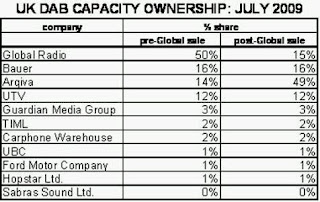
In July 2009, Global announced the completion of the sale of its DAB licences, the largest ever transaction of its type, which drastically shifted the dominant ownership of the UK’s commercial radio DAB system from the commercial radio sector itself to transmission specialist Arqiva.

Global Radio sold:
• its 63% shareholding in Digital One, the sole national DAB multiplex for commercial radio
• its 100% shareholding in Now Digital Ltd and Now Digital (Southern) Ltd, its local DAB multiplexes
• 12% of MXR Holdings Ltd.

These transactions left Global Radio with a 51% shareholding in MXR, owner of five regional DAB multiplexes, a half-stake in 3 CE Digital local multiplexes and a minority stake in Digital Radio Group, owner of one London multiplex. At a stroke, Global’s role in DAB had been reduced from the dominant player to an also-ran. However, this did not prevent Ashley from stating in the press release announcing these disposals:

“As a company we are leading the commercial radio industry in its drive to digital.”

Neither this press release, nor the Annual Accounts, revealed how much Global Radio commanded for its sale of these assets. All we know is that the last, shortlived chief executive at GCap Media, Fru Hazlitt, was so disenamoured of DAB that she had planned to sell the company’s controlling stake in the DAB national multiplex licence for £1 in January 2008 (the transaction was halted by Global’s offer for GCap).

None of these closures and disposals seemed to change Global Radio’s public enthusiasm for DAB radio. In July 2010, a government press release on digital radio included a quote from Ashley saying:

“We look forward to working with the government and other partners to bring the benefits of digital radio to a growing group of listeners.”

So what precipitated the change of heart in Ashley’s previously collaborative noises to the BBC from a ‘carrot’ into the ‘stick’ evident in his interview this week? Well, less than 24 hours earlier, the government had published a report on DAB radio switchover that was critical of many radio sector stakeholders for the lack of progress that had been made during the last decade. Those criticised included commercial radio, its trade body RadioCentre, the Digital Radio Development Bureau and its successor, Digital Radio UK. Some people can take measured criticisms like this in their stride. But others cannot.

Not only does Global Radio account for 38% of UK commercial radio listening, but the group funds a substantial portion of RadioCentre (£2.8m in subscriptions between September 2007 and March 2009) and of the Digital Radio Development Bureau and Digital Radio UK. Even so, why did this new government report exercise Ashley so much? Because:
• Global Radio needs DAB switchover to succeed for the company to hang on to its valuable analogue radio licences
• The responsibility for making DAB switchover happen now lies elsewhere, so Ashley has decided to pin the tail on the BBC.

Maybe Ashley is a graduate of the Malcolm McLaren and Stevo school of negotiation. This is the strategy where you make the most outrageous demands and the other person caves in for fear of not being invited to your party. This might work in the unregulated music business, where excess is viewed as a virtue, but in the radio industry there are laws and rules governing large parts of the business.

What would be the response of record companies if a radio owner were to march in and tell them that they should pay radio stations for playing their music, rather than the other way around? Or if you were to tell record companies that your radio stations would no longer play ‘hit’ records that line their coffers but, instead, would deliberately play unpopular songs that they did not want on the radio. Record company bosses would probably laugh in your face and ask their legal department to show you a filing cabinet full of royalty agreements with commercial radio dating back to 1973.

Getting your own way, all the time, only works when you have been given absolute power over your fag. Ashley phoning a journalist, stomping his feet at the BBC and demanding that it do this or that will have no effect whatsoever. His demands about DAB must have had BBC radio managers laughing their socks off on Wednesday morning. As Scott Taunton, the straight-talking managing director of UTV Radio, said of Ashley in 2009:

“He is a guy who is used to getting his own way. He isn’t from the same school of business, the same school of negotiation, that I am.”

So why exactly does Global Radio need DAB switchover to happen? Because:
• Global Radio was created by Ashley’s millionaire father for a son who is a radio obsessive (“I would literally have a radio in my [school] bag and the second I was allowed to put it on I would actually phone [presenter] Pat Sharp in the studio at whatever time, 10.30, 11.30, just to say hello and develop a relationship with him. He thought I was nuts,” said Ashley)
• Global Radio overpaid to acquire GCap Media in June 2008 for £375m, a mis-managed company whose performance was dropping like a stone, and whose market capitalisation had fallen from £711m in 2005 to £200m by year-end 2007
• Global Radio has already had to write down its assets by £194m in March 2009, reducing the group’s net book value to £351m from the total £545m it had paid for Chrysalis and GCap in 2007 and 2008 respectively
• Global Radio “is primarily funded by debt”, its accounts state, and external bank debt was £110m in October 2009, an amount that must be repaid in quarterly instalments by October 2012
• Global Radio has been hit hard in 2010 by the new government’s sudden 50% cut to its advertising spend (“The COI change has been larger than expected, very abrupt. It’s been pretty severe, more than 50%,” said Ashley)
• Ofcom is presently re-evaluating the price of Global Radio’s Classic FM licence, the most profitable in commercial radio and, if DAB switchover is abolished, the cost of that licence could be increased from its current £50,000 per annum to nearer £1m per annum from 2011 to 2018
• The Digital Economy Act 2010 renewed commercial radio licences for a further seven years only on the basis that DAB switchover will happen. If switchover does not happen, the government has the power to terminate all renewed licences by 2015 (or by two years’ notice, if later). However, in its accounts, Global decided to write off the ‘goodwill’ of its GCap acquisitions over twenty years.

For Global Radio, which owns more analogue licences than any other commercial radio group, this means that the value of its business could be reduced drastically if DAB switchover does not happen. Its one national licence would become a lot more expensive and then might have to be publicly auctioned, while its dozens of local licences could be terminated earlier than anticipated. Global needs DAB switchover to happen at all costs.

However, at every opportunity, Global decided to forgo investment in the DAB platform and, instead, to dispose of the majority of its DAB assets. This has left it with almost no remaining leverage to ensure that DAB switchover will ever happen. Furthermore, Ashley has alienated commercial radio competitors such as UTV, precipitating its resignation from the trade body RadioCentre in 2009. UTV’s Scott Taunton described Ashley as a “rich man’s son” and explained:

“For us it came down to Global, as the largest funder of the RadioCentre, making sure that the policies of the RadioCentre were in the interests of Global Radio. At times, for me, that meant the [trade body] was pursuing an agenda that wasn’t necessarily in the interests of all its members.”

So, Global Radio needs DAB switchover to happen in order to maintain the value of its analogue radio business. But it can do little itself directly, its biggest competitor Bauer is unlikely to help, and its smaller competitors have been alienated. Global had succeeded in wrangling a very beneficial deal from Lord Carter in the Digital Economy Act, but Carter exited quickly and the whole government has changed since then. The sting in the tail was that parliament included a get-out clause (if DAB switchover does not happen …) and now that clause looks more likely than ever to be invoked.

The pheasants look as if they might be coming home to roost at the Tabor estate. And what does a young man do when the train set his father made for him is not working the way he wants? He stomps his feet. He shouts. He issues demands. This week, the BBC has been on the receiving end. It should feel honoured. Ashley has demonstrated his belief that the BBC can do more to fix the DAB disaster than the whole of the commercial radio sector and its trade and marketing agencies added together. But, remind me, why should part of my BBC Licence Fee go to fix his plaything?

And what might Ashley think of doing next if the BBC does not bow to exactly what he wants? Will he be demanding that BBC director general Mark Thompson stands on his head in the corridor during short break, or runs around the perimeter of White City in his underwear fifty times in the pouring rain, or sits in the BBC library after work copying out chapters of ‘Paradise Lost’ by hand?

Are any of these shenanigans a strategy for the future of radio? All they demonstrate to the world is that large parts of the UK commercial radio sector seem to have completely lost the plot.

[declaration of interest: I was paid to advise DMGT on the offer made for GCap Media by Global Radio in 2008]

The exit strategy for DAB radio switchover: the Consumer Expert Group addresses Vaizey’s “big if”

When you are looking for an exit route from a product you have been developing for nearly two decades, and which has consumed hundreds of millions of pounds, you need to find a damn good reason that will deflect the blame elsewhere. You need a report, an organisation or some bona fide research that screams out ‘no’ at the highest volume. Then your response can be: “I would be a fool to ignore the warning signs voiced by X” when what you are really saying is: “Blame them, not me! It’s them that made me do it.”

DAB radio and digital radio switchover presently seem to be at this point. But there is a big problem for a radio industry that is belatedly trying to find a way ‘out’. Almost all previous reports produced by the government, the regulator, the radio industry, the electronics industry, the working groups, Digital Britain and the car manufacturers have been overwhelmingly positive about DAB and have painted an amazingly rosy future. There has been almost nothing published about DAB by agencies of the state that has said plainly: “Stop this crazy plan.”

So whose fault can it be that DAB radio and digital switchover has not worked? Given the sheer number of agencies that have been so gung-ho for so long about DAB, the fickle finger of fate naturally had to point elsewhere and so it landed upon ‘the consumer’. It becomes much easier to decide that the general public is the reason for a masterplan’s lack of success when everybody sat around the government’s conference table is feeling a little guilty about their shared role in a wasted £1bn investment.

A change of regime is always a useful point at which to invoke such a change. In July 2009, less than a year into his first radio job, the BBC’s top radio manager Tim Davie explained that digital radio switchover would be determined by listeners, not by the BBC:

“From a BBC perspective, whether it be ‘Feedback’ or our constant audience research, the idea that we would move to formally engaging switchover without talking to listeners, getting listener satisfaction numbers, all the various things we do, would be not our plan in any way. We would be – we are – in dialogue now for the next six years. … I think we are pretty committed to digital. Having said that, since I have arrived at the BBC, I certainly haven’t seen it as inevitable that we move to DAB.”

The following month, BBC Trust chairman Sir Michael Lyons reinforced this notion:

“Who comes first in this? Audiences and the people who pay the Licence Fee. It is an extraordinarily ambitious suggestion, as colleagues have referred to, that by 2015 we will all be ready for this. So you can’t move faster than the British public want you to move on any issue.”

The change of government then provided an opportunity for the Department for Culture, Media & Sport [DCMS] to similarly invoke the will of the people in determining digital radio switchover. In July 2010, culture minister Ed Vaizey said:

“If, and it is a big if, the consumer is ready, we will support a 2015 switchover date. But, as I have already said, it is the consumer, through their listening habits and purchasing decisions, who will ultimately determine the case for switchover.” [emphasis added]

For both the BBC and the government, the problem with belatedly putting the consumer at the centre of digital radio switchover is that almost no organisation, over the course of a decade of DAB, has done any significant consumer research about DAB. Why? Because the implementation of DAB radio in the UK had always been a top-down policy initiative by civil servants, regulators, trade organisations and commercial opportunists, without ‘the man on the Clapham omnibus’ having ever been consulted.

There was one notable exception. When the government’s Digital Radio Working Group considered the issue of DAB radio switchover during 2007/8, a sub-committee named the Consumer Impact Group had prepared a report. However, this report was not made public until almost a year after the Working Group had been wound up. The report had been highly critical that consumers’ viewpoints were not being considered:

“The group is concerned that the case for digital [radio] migration has not been made clearly enough from the point of view of the consumer. While it is clear what the rationale is for the radio industry, the group would like to see a compelling argument as to why digital migration is desirable for consumers and what its benefits would be for consumers.”

But that was then, this is now. Then, digital radio was considered by the previous government to be a real possibility, and that is why dissent from consumer groups was buried. Now, that same consumer dissent could provide the perfect nail on which to hang any number of DAB exit strategies. A new report outlining the massive consumer challenge of digital radio switchover would be a perfect ‘get out of jail free’ card for many long-term DAB stakeholders.

So today, a new report has been published by the government’s Consumer Expert Group [CEG] which asks the pertinent question ‘Digital radio switchover: what is in it for consumers?’ Moreover, rather than it being embarrassedly added to the depths of the DCMS web site a year later, today’s report was circulated to the press and stakeholders in advance of publication. Its introduction states:

“This report was not requested by Government but the CEG have taken the initiative to attain a thorough understanding of the consumer issues surrounding digital radio and bring them to the Government’s attention as preliminary policy decisions are made.”

In other words, this new report just happens to directly address the “big if” cited in the culture minister’s speech about digital radio switchover nine weeks earlier. If its publication were not startling enough, its conclusions are damning in almost every respect about the lack of progress made to date with digital radio switchover. But, before that, the report is quick to invoke the role of consumers in what it admits is “new” government policy:

“Setting a date, or a firm commitment to a date, would have had the effect of scaring consumers to switch. Clearly this would not be compatible with Government policy to support a switchover when enough listeners voluntarily adopt digital radio. Government’s new emphasis on consumers should provide the focus to ensure consumer concerns and needs regarding digital radio are addressed, thereby reducing the barriers to voluntary take-up.”

However, if these “consumer concerns and needs” were to prove simply too onerous and costly for the government to address in the current economic climate, the choice is now there to opt out of pursuing the DAB switchover policy altogether. The Film Council … the Audit Commission … DAB radio switchover. Chop chop chop. The first two might have seemed a bit arbitrary to voters. Now, at least this one has a consumer report to back it up.

So this new report reiterates and elaborates the same arguments made in the previous consumer report to the Digital Radio Working Group two years earlier, and adds some more. Its recommendations are worth quoting in full:

“The consumer costs and consumer benefits of digital radio
• A full cost benefit analysis from a user perspective must be carried out as a matter of urgency;
• Consumer benefits need to be clear and demonstrable before an announcement for a digital switchover is made;
• A workable system for the disposing and recycling analogue radios, which consumers are likely to implement must be introduced;
• Emphasis should not be placed on driving down costs unless the sound quality and functionality of cheaper DAB sets are at least equal to analogue;
• There must be more emphasis on improving the basic usability, rather than the advanced functionality, of digital radio to encourage take-up;
• Both the BBC and the commercial sector need to offer new and compelling digital content to convince consumers to adopt digital radio;
• Research into consumers’ willingness to pay and into their concerns and needs relating to digital radio needs to be carried out as a matter of urgency.

Take-up
• The take-up criterion should compare like-for-like listening platforms and measure DAB listening only;
• A digital switchover date should only be announced when no more than 30 per cent of listening remains on analogue;
• The target date for a digital switchover should be revised upwards as 2015 is realistically far too early for the necessary preparations to be put in place for consumers. Any target date set should be looked upon as secondary to consumer issues such as willingness to adopt the technology, voluntary take-up and digital radio reception as an instigator for switchover;
• Measures need to be taken to introduce a more inclusive methodology for measuring take-up.

Coverage
• The fair allocation of coverage build-out costs between the BBC and the commercial sector must be made once build-out plans are agreed;
• The coverage criterion should be measured by signal strength, not just population, so that indoor and mobile reception are considered;
• The coverage criterion must be geographically weighted to ensure rural communities are not left behind;
• The switchover roadmap must include plans for DAB+;
• DAB+ compatible chips must be installed as standard to “future-proof” receivers as a matter of urgency;
• The reception time delay between receivers should be standardised.

Vehicles
• A Digital Radio Switchover date cannot be announced until DAB radios have been standard in vehicles for a minimum of 2 years, in other words by 2015 at the earliest;
• An affordable in-vehicle converter needs to be developed urgently which works with a vehicle’s external aerial, is safe, easy to fit and aesthetically pleasing;
• A switchover date cannot be announced until there is a solution to in-vehicle conversions, providing the majority of motorists with the opportunity to have a digital radio in their vehicle;
• A solution for the continuation of traffic and travel services on FM for a transitional period following digital switchover needs to be agreed;
• An accreditation scheme for dealers and other installers of retrofit digital devices must be developed.

Accessibility
• Digital switchover should not go ahead without suitable equipment being available for all listeners including older and disabled people;
• Digital radios which incorporate voice output technology must be available for blind and partially-sighted people preferably via the mainstream market or, if that is not feasible, through a channel made affordable by Government intervention, such as a help scheme;
• Appropriate information and support on the enhanced features of accessible digital radios should be available from retailers;
• Appropriate usability requirements should be included in minimum receiver specifications and a kitemarking scheme;
• The proposed integrated station guide must be consumer tested before any decision on its inclusion in devices is made.

Consumer information
• A clear and balanced public information campaign needs to be implemented through a trusted body, independent of the industry;
• Once a switchover date is announced, sales of analogue-only radio must stop;
• A post-announcement information campaign to target vulnerable groups should be developed;
• The digital tick should be adopted for digital radio and adapted as necessary;
• A ‘scorecard’ should be displayed on all products to convey more information about the available features at the point of sale;
• A digital radio pre-purchase checklist should be widely available and at point of sale;
• An effective training and “accredited adviser” scheme needs to be developed for retailers;
• The CEG must be involved in the minimum specification for digital radio;
• The CEG must be involved in the design and development of any public information campaigns.

Consumer support and a help scheme
• Any Digital Radio Switchover must be accompanied by a help scheme to assist those who would find it disproportionately difficult to switch;
• The eligibility criteria of a help scheme should include people registered blind or partially sighted, those on low incomes, the over 65s and those with learning disabilities and other cognitive difficulties such as Alzheimer patients;
• A help scheme for digital radio should provide appropriate accessible equipment and include as many instructional home visits as necessary;
• A help scheme should be publicised early on in the information process on a national level and the publicity should coincide with the start of the national information campaign for a switchover;
• The CEG must be consulted in the preparation of printed material and publicity on the help and support available;
• The engagement of the voluntary sector in providing assistance with a digital radio switchover should be properly supported and funded;
• Government should ensure that charities, such as Wireless for the Blind Fund and W4B, are not undermined financially or strategically by a help scheme or any of its components, as these charities will be left with providing the ongoing of support, assistance and help people need once a help scheme has finished.”

These recommendations seem to divide into: those that would require considerable time to implement, those that would require considerable money to implement, those that would require both time and money, and those that would be almost impossible to implement. Such recommendations should have been considered and acted upon before DAB transmitters even started to be built-out in the 1990s. Their presence in 2010 only serves to highlight the ineptitude of the 1990s ‘plan’.

No organisation escapes unscathed from the critique of the Consumer Expert Group (some are not named): BBC radio, commercial radio, Ofcom, RadioCentre, receiver manufacturers, the Digital Radio Development Bureau, Digital Radio UK, etc. By spreading the criticism so widely, no single stakeholder gets to feel singled out or isolated for DAB’s failure.

Now it is left to the government to decide to pull down the shutters on DAB radio switchover. That will not require the immediate death of DAB. But it will provide the BBC with something that it can sacrifice down the line to budget cuts in the assault on its Licence Fee. For commercial radio, it will provide relief from expensive dual transmission costs, once a settlement has allowed it to keep its coveted licence renewals invoked by this year’s Digital Economy Act. For consumers, it will offer certainty that FM radios will continue to work. There will be sighs of relief all around.

I started writing about DAB radio as a news editor in 1992 and today’s report is the first government distributed document I have seen that sensibly articulates the multitude of barriers and obstacles to digital radio switchover happening in the UK. The very first words of the report summarise the current situation perfectly:

“Despite the introduction of digital radio in the UK in 1998, analogue radio is still a key feature in many households.”

Now we await the fat lady.

Without local commercial radio, switchover to DAB will not happen

I am often asked why I believe that digital radio switchover will never happen in the UK. My answer is always this – the available statistics and data on consumer take-up of DAB radio fail to demonstrate that it will grow sufficiently to become the mass medium for radio broadcasting. I can see nothing in more than a decade of figures to offer an inkling that DAB radio will ever become anything more than a minority interest, compared to FM/AM.

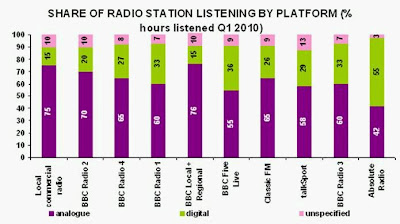
Audience data published by Ofcom in its latest Communications Market report (page 219, Figure 3.34) help us to understand the current roadblock with DAB consumer take-up. Ofcom divulged the proportion of listening to individual stations by platform, data that has not been made public by RAJAR (see graph below).

The information demonstrates that a few stations, notably AM broadcasters BBC Five Live and Absolute Radio, are making significant headway with attracting audiences on digital platforms. However, in order to put these data in a market perspective, it is necessary to understand the relative importance of each of these stations.

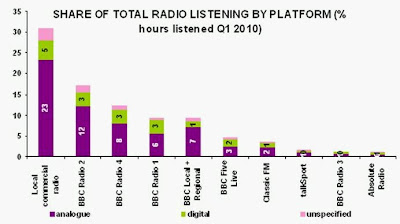
The above graph helps put the planned transition from analogue to digital in a proper market perspective. For example, Absolute Radio has made much of the fact that more than 50% of its listening is already attributed to digital platforms. However, in the context of digital radio switchover, its audience is so small that it has little overall impact. The volume of listening to some local London stations is greater than to national Absolute Radio.

The government has stated that it will not consider ‘switchover’ until at least 50% of radio listening is via digital platforms. Digital listening to the ten stations and station types shown in the above graph add up to only 20%, even after ten years of DAB (digital-only stations bring the total to 24%). There is a reason that it will prove an impossible challenge to get this up to the 50% government target.

Around 300 local commercial radio stations account for 31% of all radio listening. Their success in convincing audiences to migrate to digital platforms will be a vitally important part of the aim to achieve the 50% criterion. However, only 15% of local commercial radio listening is attributed to digital platforms, the lowest proportion (along with BBC local radio) of the ten stations/types in the graph. The task to improve this performance from 15% to the 24% national average is likely to prove impossible, let alone to grow it to the 50% criterion.

This is because many stations in the local commercial radio sector cannot and will not ever be available on DAB because:
• The economics of DAB transmission make it too costly
• The unavailability of any local DAB multiplex in some areas
• The unavailability of space for stations on some local DAB multiplexes
• The industry grand plan to amalgamate existing local multiplexes into regional multiplexes makes DAB transmission, for small local radio stations, more irrelevant and more costly.

These issues had been identified by the government in its Digital Britain consultation in June 2009:
• “merging [DAB] multiplexes will reduce the overall capacity available for DAB services, therefore reducing the potential for new services”
• “reduced capacity on local multiplexes might result in some services losing their current carriage on DAB.”

The government’s decision to ignore these outcomes is now coming back to bite it on the bum. Not having a plan to ensure that all local commercial radio stations can be made available on DAB will only ensure that the government’s 50% criterion can never be met.

At the same time, the determination of the largest players in the commercial radio sector to forge ahead with DAB, regardless of these unresolved issues, has created a serious schism between them and the smaller local radio groups and independent local stations who have no digital future. These issues were raised in parliamentary debate of the Digital Economy Act but were ignored and trivialised by the DAB lobbyists.

Some local commercial radio owners are seriously alienated by the way their predicaments have been ignored by large radio groups and their trade organisations – RadioCentre, Digital Radio Development Bureau and Digital Radio UK. One such group owner, UKRD, has taken direct action by running a campaign on-air and on its stations’ websites against the government’s proposed switchover to DAB.

A page entitled ‘Love FM’ on the Wessex FM website says:

“As you probably know Wessex FM proudly broadcasts to this area on the FM frequencies 96 & 97.2, and had been hoping to for many years to come. However, recent developments mean that we may not be able to broadcast in this way for much longer. In fact, the current plan from parliament is to switch off the use of FM for many stations in 2015. That means, soon, you may not be able to listen to us on FM.”

William Rogers, UKRD Group chief executive officer explained:

“We are not prepared to encourage any of our listeners to go and replace their perfectly satisfactory analogue radio set with a DAB one which may not be able to pick up a DAB signal at all and if it can, it may be a signal which may be wholly inadequate. Even worse, the very station that the listener may have heard the [DAB marketing] advertisement on may not be on DAB or even have a DAB future.”

Pam Lawton, managing director of another UKRD-owned station, KL.FM in King’s Lynn, said:

“We are not on DAB at the moment and currently most of the DAB digital platforms have been snapped up. As things stand, West Norfolk does not have a digital platform because there are limitations about how many there can be and there will only be one station that will serve Norfolk. That station will probably be based in Norwich so once the government decides to turn off FM, we will have to switch off for good.”

The paradox is that the radio sector stakeholders who have been pushed aside and ignored by the DAB movers and shakers are some of the very ones who hold the key to enabling digital radio switchover to happen. Unless the huge audience for local commercial radio can be persuaded to migrate its listening to DAB, the 50% criterion cannot be achieved.

At the same time, some stakeholders who are making the most noise about DAB switchover matter the least in the scheme of things. Absolute Radio can trumpet its individual success with digital listening, but it is contributing less than 1% to the 50% criterion that has to be reached, despite being a national station. It is the hundreds of local commercial radio stations that, collectively, matter the most. Yet, many of these have been denied any seat at the DAB table.

As politicians have learnt through the ages, unless you can convince the little guys (the local radio station owners) and the ‘man in the street’ (the radio listener) to endorse your grand scheme, a scheme is all it will remain. Fancy words in boardrooms, lengthy documents from corporate consultants and detailed project management timelines will inevitably come to nothing, without involving and bringing on board the people who really matter.

It is the radio industry data, particularly for local radio, that tell the real story of DAB and why it can never become the mass radio medium for UK consumers. That is why digital radio switchover will not happen.

[all RAJAR data are Q1 2010, as used by Ofcom]

GERMANY: “The over-40’s will be listening to radio on FM for the next 40 years”

On the afternoon of 10 August 2010, a group of radio people from Germany, Austria and Luxembourg gathered in Erfurt, Germany to discuss the future of radio in the digital age. They had been invited there by the media regulator for Thüringer state (TLM) and some of the region’s broadcasters. The event was entitled ‘Radio 2020: a radio future between optimism and pessimism’ and followed on from a similar event held a year earlier.

This year, the final conference session tackled the topic ‘Radio and the day after tomorrow: new possibilities for distribution and exploitation of radio content on the internet’. A presentation by Dr. Klaus Goldhammer, managing director of the Goldmedia Group in Berlin, included the assertion:

“Radio broadcasting and internet radio are different markets.”

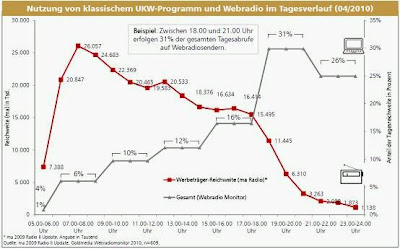
Goldhammer plotted the flow of daytime audiences in Germany for broadcast radio and internet radio on the same graph. It demonstrated that the peak broadcast radio audience between 0700 and 0800 corresponded with the lowest daytime audience for internet radio. Conversely, the peak audience for internet radio was between 1800 and 0000, corresponding with broadcast radio’s lowest audience of the day (see the slide below from his presentation).

Goldhammer noted that 31% of internet radio’s daily hours listened were consumed between 1800 and 2100. This appears to be very different from the US experience where a significant volume of listening to internet radio takes place during office hours in workplaces. In Europe, listening to radio (any radio) at work is still nowhere near as common as it is in North America.

Goldhammer noted that the growth of internet radio listening was still very slow in Germany, compared to the growth in available internet bandwidth. He concluded that:

“The over-40’s will be listening to radio on FM for the next 40 years”

Lars Gerdau, managing director of LandesWelle Thüringen, a regional rock/pop radio station broadcast on 14 FM frequencies, commented:

“We see the whole [internet radio] thing has become much more complicated than a year ago. Firstly, it is very expensive to stream a lot of radio programmes and, secondly, we have no claim to be first [in the internet space]. We have time and will focus first on FM.”

After the conference, Inge Müller-Seibel, a German radio sector commentator, noted that neither was DAB radio replacing FM as the main listening platform:

“After two decades of experimentation in Germany, the future of digital [terrestrial] radio remains uncertain. It was 1987 when the new DAB transmission technology was presented for the first time at the IFA in Berlin. Some ten years later, the German states listened to Brussels and recommended the closure of their terrestrial FM frequencies by 2015 at the latest. But almost nobody believes it will happen, and now the radio stations are putting more hope in new distribution technologies via the internet.”

And a reporter at this year’s IFA consumer electronics fair wrote:

“Digital radio is not a success story in Germany. Little more than 500,000 digital receivers have been purchased, a tiny number compared to the several million analogue FM receivers.”

A recent article in Die Welt newspaper asked ‘When will FM radio die?’ and explained:

“In fact, the [FM] technology should no longer exist. Originally, the abolition of FM was planned for this year. Instead, radio listeners across the country should have been receiving only digital signals. But the outcome has been different because most people are completely satisfied with the quality of good old FM stereo, and because of the inertia from an estimated 300 million FM radio receivers in Germany. Only a few geeks have so far bought digital radios with DAB technology.

Additionally, it is mobile phones, a symbol of the triumph of digital technology, that have supported the continuation of analogue FM radio. This is because most phones have a built-in FM radio receiver.”

[thanks to Katrin Penzel]

Back to the future of radio – the FM band

Help seemed to have arrived for those consumers who are confused by the contradictory messages they are receiving about DAB radio, digital switchover and the future of FM/AM radio. The government created a ‘hot topic’ web page that addresses these issues in the form of a ‘FAQ’. Does it help clarify things?

The government FAQ states:
“We support 2015 as a target date for digital radio switchover” but, in the next sentence, it says that 2015 is “not the date for digital radio switchover”
“FM will not be ‘switched off’ … and will continue for as long as it is needed and viable” but then it fails to explain the reason the government is calling it ‘switchover’
“We believe digital radio has the potential to offer far greater choice and content to listeners” but then it asserts that “quite simply the listener is at the heart of this [switchover] process”
“11 million DAB sets [have] already [been] sold” but, in the next sentence, it deliberately confuses ‘DAB radio’ with ‘digital radio’ which, it states, “accounts for around a quarter of all radio listening” [DAB accounts for only 16% of all radio listening]
“Car manufacturers have committed to fit DAB as standard in all new cars by 2013” but it does not explain that only 1% of cars currently have DAB radio
“Some parts of the country are not served well by DAB” but it then admits that “switchover can only occur when DAB coverage matches [existing] FM [coverage].”

Well, that makes everything crystal clear now. Switchover is not switchover. 2015 is the date but is not the date. It is the government that is insisting upon digital ‘switchover’ but it is a consumer-led process. Almost no cars have DAB now but, in 2+ years’ time, magically they all will. In parts of the UK, DAB reception is rubbish or non-existent, but ‘switchover’ will not happen until somebody spends even more money to make DAB coverage as good as FM … even though FM is already serving consumers perfectly well.

Sorry, what was the point of DAB?

While the UK government ties itself in increasingly tighter knots trying to explain the unexplainable, and to justify the unjustifiable, most of the rest of the world carries on regardless, inhabiting reality rather than a fictional radio future. In May 2010, a meeting in St Petersburg of the European Conference of Postal & Telecommunications Administrations considered the future usage of the FM radio waveband [which it refers to as ‘Band II’] in Europe. Its report stated:

“Band II is currently the de facto analogue radio broadcasting band, due to its excellent combination of coverage, quality and low cost nature both in terms of current networks available and receivers in the market. It is well suited to local, regional and national programming and has been successfully used for over forty years now. FM receivers are part of our daily lives and millions of them populate our households. FM radios are cheap to manufacture and for the car industry FM still represents the most important medium for audio entertainment.”

Its report concluded that:
• “Band II is heavily used in all European countries
• For the current situation the FM services are still considered as satisfactory from the point of sound quality but the lack of frequencies hinders further development
• There are no wide-spread plans or strategies for the introduction of digital broadcasting in Band II
• No defined final switch-off dates are given so far.”

Two paragraphs in the 28-page report seemed to sum up the present UK situation:

“The FM band’s ability to provide high-quality stereo audio, the extremely high levels of receiver penetration and the relative scarcity of spectrum in the band combine to make this frequency band extremely valuable for broadcasters.”

“As FM in Band II is currently, and for the foreseeable future, the broadcasting system supporting the only viable business model for radio (free-to-air) in most European countries, no universal switch-off date for analogue services in Band II can be considered.”

In the UK, we have just seen how “extremely valuable” FM radio licences still are to their owners. Global Radio was prepared to promise DAB heaven and earth to Lord Carter to ensure that a clause guaranteeing automatic renewal of its national Classic FM licence was inserted into the Digital Economy Act 2010. It got what it wanted and therefore avoided a public auction of this licence. Then, when expected to demonstrate its faith in the DAB platform, Global sold off its majority shareholding in the national DAB licence and all its wholly-owned local DAB licences.

Now the boot is on the other foot. Having succeeded in persuading the government to change primary legislation to let it keep commercial radio’s most valuable FM licence for a further seven years, Global Radio has now had to argue to Ofcom that analogue licences will become almost worthless in radio’s digital future. Why? In order to minimise the future Ofcom fee for its Classic FM licence. The duplicity is breathtaking.

When it last reviewed its fee for the Classic FM licence in 2006, Ofcom reduced the price massively because, it explained, it took

“the view that the growth of digital forms of distribution meant that the value associated with what was considered to be the principal right attached to the licence – the privileged access to scarce analogue spectrum – was in decline.”

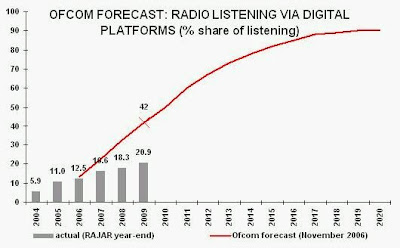
In 2006, Ofcom had published a forecast for the growth of digital radio platforms which has since proven to have been wildly over-optimistic. It had predicted that 42% of listening would be digital by year-end 2009, whereas the outcome was 21%. In 2006, as a result of the steep decline it was forecasting in analogue radio’s usage, Ofcom reduced the cost of Classic FM’s licence fee by 95% from £1,000,000 to £50,000 per annum (an additional levy on the station’s revenues was also reduced from 14% to 6% per annum). The losers were UK taxpayers – the licence fees collected by Ofcom are remitted to the Treasury. The winners were Classic FM’s shareholders, who were gifted a cash cow by Ofcom bureaucrats who misunderstood the radio market.

Fast forward to 2010, and Ofcom is undertaking yet another valuation of how much Classic FM (plus the two national AM commercial stations) will pay during the seven years of its new licence, following the expiry of the current one in September 2011. Has Ofcom apologised for getting its sums so badly wrong in 2006? Of course not. Will it make a more realistic go of it this time around? Well, the signs are not good.

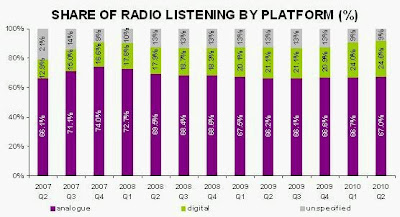
In its consultation document on this issue, Ofcom has repeated the same errors it made in other recent publications about the take-up of digital radio. In Figure 1, Ofcom claims that analogue platforms’ share of all radio listening has fallen from 87% in 2007 to 76% in 2010. This is untrue. As noted in my previous blog entry, listening to analogue radio has remained remarkably static over this time period. Ofcom’s graph has completely ignored the existence of ‘unspecified’ platform listening, the volume of which has varied significantly in different surveys. The graph below plots the actual numbers from industry RAJAR data.

Exactly the same issue impacts the accuracy of Figure 3 in the Ofcom consultation, which purports to show that analogue listening to Classic FM fell from 86% to 72% between 2007 and 2010. Once again, this must be factually wrong. Once again, the volume of ‘unspecified’ listening to Classic FM has simply been ignored and the decline of analogue listening to Classic FM has probably been overstated by Ofcom.

Confusingly, the platform data for Classic FM cited in Figure 3 differ from data in a different Ofcom document [Figure 3.34 on page 33 of The Communications Market 2010] which state that, in Q1 2010, 65% of listening to Classic FM was via analogue, 26% was via digital and 9% was unspecified. In Figure 3, the values for the same quarter are stated as 72%, 28% and 0% respectively. It is impossible for both assertions to be correct.

These inaccuracies have the impact of painting a quite different picture of Classic FM’s transition from analogue to digital listening than the market reality. These matters are not academic. They will have a direct and significant impact on the perceived value of the Classic FM licence over the duration of its next seven-year period. Sensible decisions about the value of the station’s licence cannot be made on the basis of factually inaccurate market data published by Ofcom.

Undeniably, Ofcom is between a rock and a hard place:
• An admittance that, in 2006, Ofcom got its digital radio forecast and its sums badly wrong and, as a result, has already lost the Treasury millions of pounds in radio licence fees, would require humility (and humiliation)
• Not admitting that, in 2006, Ofcom got it wrong would necessitate it to now fix the Classic FM licence fee at the same low rate as in 2006, or even lower, denying the Treasury millions more in lost revenue between 2011 and 2018
• Increasing the cost of Classic FM’s licence fee would be a tacit admittance by Ofcom that its entire DAB ‘future of radio’ policy is simply not becoming reality and that FM spectrum will still remain “extremely valuable for broadcasters”.

In 2006, the low valuation of Classic FM’s licence fee was built upon a top-down bureaucratic strategy which insisted that the UK radio industry was ‘going digital’, whether or not consumers wanted to or not. Now, it is even more evident than it was then that consumers are not taking up DAB radio at a rate that will ever lead to ‘digital switchover’ (whatever that phrase might mean).

However, reading the Ofcom consultation document, it is also evident that the regulator remains wedded to its digital radio policy, however unrealistic:

“We consider that this [Digital Radio] Action Plan is relevant when considering future trends in the amount of digital listening since it represents an ambition on behalf of the industry and Government to increase the amount of digital listening in the next few years.”

In the real world, Classic FM’s owner understands precisely what the international delegations who met in St Petersburg also knew – FM will remain the dominant broadcast platform for radio. Only the UK government and Ofcom seem not to accept this reality, still trying to go their own merry way, while the rest of Europe has already acknowledged at this meeting that:

• The FM band is “extremely valuable for broadcasters”
• The FM band is “currently, and for the foreseeable future, the broadcasting system supporting the only viable business model for radio (free-to-air) in most European countries”
• “No universal switch-off date for analogue services in Band II can be considered.”

[thanks to Eivind Engberg]