Digital Radio Working Group – it must be 'Numberwang'!

The Final Report of the Digital Working Group published today includes an “Aspirational Timetable” which, it says, will “act as a useful guide for those working towards digital migration in the coming months and years”. The projected dates in the timetable include:

  • End 2010 – “DAB sales to exceed sales of analogue radios”
  • 2014 – “All new cars to be fitted with digital radios”
  • 2015 (approx) – “Migration criteria met”

One of three specified “migration criteria” is:

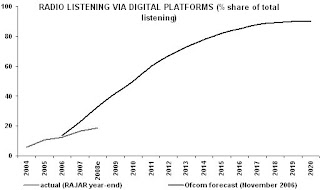
  • “that at least 50% of total radio listening is to digital platforms”

which would look like this by (year-end) 2015:

How likely is this outcome???

It might prove instructive to re-examine earlier forecasts for digital radio take-up published by three leading stakeholders – Ofcom, RadioCentre and the Digital Radio Development Bureau:


This last graph is interesting because the Digital Radio Development Bureau published progressively less optimistic annual forecasts for DAB set sales in 2004, 2005, 2006 and 2007. Its 2007 forecast only projected figures to 2008. When I enquired in September 2007 why the forecast horizon had been reduced by three years, the DRDB told me:

The problem with forecasting a cumulative to 2011 is that there are too many variables. If we based it on what there is available now in the traditional radio market, we could certainly come up with a figure. But if, as suggested in the forecast, DAB moves into other form factors, such as mobile phones, docking stations, MP3, MP4 etc, then that ‘traditional’ figure would be selling the market short and would not be indicative of the potential cumulative market for DAB.”

Fifteen months on, DAB has made slow progress moving into these other ‘form factors’, with mobile phones and cars still on the starting blocks.
Notably, DRDB has yet to publish a 2008 forecast.

None of this statistical evidence offers confidence that the Digital Radio Working Group’s “Aspirational Timetable” is anything more than ‘pie in the sky’.

Nokia – a 'Man Friday' for radio?

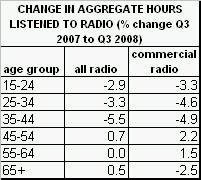
Radio has a problem. Young people are listening less to radio in aggregate. This is the result of two main factors: their declining numbers within the population (there will be fewer than 8m 15-24 year olds in the UK by 2014, compared to 8.2m in 2008); and the increasing competition for young people’s leisure time. Radio as a whole is losing listening amongst 15-44 year olds, but commercial radio is losing proportionately more than the BBC. This is disastrous for the commercial sector, which defines 15-44 year olds as its ‘heartland audience’ for advertisers.

[source: RAJAR]

So who is working the hardest to enable and promote the notion of radio listening amongst young people? Could it be Nokia?

Nokia had a 38% market share last quarter of mobile devices globally. In Q3 2008, Nokia sold a staggering 118m mobile devices worldwide, 27.4m of which were in Europe. In the UK, of the 94 Nokia models available, 70 include FM radios and 24 include Wi-Fi capability (19 have both FM radio and Wi-Fi). As a result, the overwhelming majority of new Nokia devices sold in the UK offer consumers listening to either FM broadcast radio and/or IP-delivered radio connected via Wi-Fi. Does this make Nokia the biggest selling brand of radio receivers in the world?

Would not a generic campaign to promote radio listening on mobile phones prove a worthwhile marketing project to be funded jointly by commercial radio and the BBC? The mobile phone hardware is (literally) already sitting in millions of people’s pockets, offering them the capability to listen to radio. Of course, mobile phone operators are never going to promote the radio listening function on the handsets they sell, for the simple reason that it earns them no revenues, and every quarter-hour spent listening to the radio is a quarter-hour lost of phone usage.

Is the UK radio industry capitalising on this huge volume of FM receivers incorporated into phones with which Nokia and its competitors are flooding the market, but whose radio function seems to sit mostly unused in people’s pockets and handbags? Seemingly, no. Instead, the industry is wedded to the notion of spending millions of marketing pounds trying to convince consumers to purchase yet another piece of hardware that enables them to receive the ‘DAB’ digital radio platform. The hurdle is that the average retail price of a DAB radio receiver is still £90+.

In this converged world, is there a mobile phone available in the UK that incorporates the DAB platform? No. Why not? Because ‘FM radio’ is a long established, global broadcast platform used in almost every country, whereas the ‘DAB radio’ system is only commercially underway in the UK, Denmark, Norway and, imminently, Australia and China. Will ‘DAB radio’ ever become a global system that replaces ‘FM radio’? No, because the US (the biggest consumer electronics market in the world) has already adopted a completely different digital radio standard. Would Nokia make a phone that includes DAB? Despite a recent report, it would seem highly unlikely. The consumer market for DAB simply isn’t big enough for a global player like Nokia.

Which is precisely why UK receiver manufacturers, such as Pure and Roberts, continue to dominate our domestic market for DAB radio hardware – the addressable market is simply not big enough for most global brands to be interested in ‘DAB radio’. But neither Pure nor Roberts will ever make mobile phones or cool-design i-Pods that include DAB radio and which might appeal to fashion-conscious, brand-obsessed, young people. As a result, the DAB platform is condemned to be largely the province of older demographics who listen at home on DAB ‘kitchen radios’. And, importantly, they are mostly listening to their same, favourite analogue stations via DAB platform simulcasts that they used to listen to on FM/AM. New, digital-only radio stations barely get a look-in in the radio ratings.

Neither do the UK sales figures of DAB hardware look particularly impressive, compared to Nokia’s success in pumping FM radios into the market. In the decade since DAB was introduced, more than 7m DAB receivers have been sold. But, during the last year alone, more than 8m analogue radios were sold in the UK. Amazingly, 79% of new radios sold in the UK during the last year were analogue, rather than DAB. Despite a landmark pronouncement in 2006 by online electronics retailer Dixons that it would no longer sell analogue radios, consumers have continued to demonstrate their interest in purchasing inexpensive AM/FM radios. Dixons has been forced to eat humble pie and now stocks four models of analogue portable radio, the cheapest of which is £8.79, alongside 38 models of DAB radio, the cheapest of which is three times that price.

In the face of consumer reticence, the UK commercial radio industry, supported by Ofcom and the government, has been busy the last decade desperately trying to persuade the public to migrate its radio listening to the DAB platform. The sticking point here is the pre-requisite for consumers to spend considerable sums replacing all the analogue radios they own with more expensive, new digital ones. Meanwhile, global heavyweights like Nokia, pursuing their own strategy to satisfy consumer needs, continue to supply the market with millions of analogue FM radios incorporated into a myriad of converged, portable devices. Could the UK government ‘persuade’ Nokia not to push its FM radios in the UK market? Er, probably not. In which case, its proposed analogue radio ‘switch-off’ remains a completely lost cause.

Perhaps instead of viewing Nokia and its ilk as an irrelevancy to its long-held digital migration plans, the UK radio industry needs to simply capitalise on the massive penetration of FM-enabled (and now IP-enabled) phones already within the consumer electronics market. These phones are the ‘sleeping giant’ that could potentially reinvigorate radio listening, particularly amongst the young demographics. All their owners need is a ‘call to action’ – a marketing campaign to make them realise that they already have the world’s most immediate, live, portable broadcast medium in their pocket.

[many thanks to Daniel for the idea for this post]

DAB v internet: the tortoise and the hare

On Wednesday 10 December, Lord Carter told the Parliamentary Culture, Media & Sport Committee:

“Radio can be received on mobile phones and through the television. Could you have digital radio without DAB? Yes, you probably could. If we do want DAB, we need to push it along a bit or technology will drive it out”.

Push it along a bit” probably means state intervention and/or state subsidy.

Technology will drive it out” probably means technologies such as IP-delivered radio via the internet, Wi-Fi, Wi-Max, 3G and 4G, as well as broadcast radio delivered via Freeview, Freesat, Sky and cable.

The same day, evidence was published that demonstrates how one of these platforms – internet-delivered radio – is already poised to eclipse DAB radio. “With broadband internet access rising from 51% of UK households in 2007 to 56% in 2008 and the high profile launch of the BBC iPlayer, listening to the radio online has never been easier or more popular”, said the new RAJAR internet radio listening report. Its definition of internet listening is:

  • listening live via the internet
  • listening again via the internet
  • personalised online radio
  • podcasts.

The most informative graph in the RAJAR report was the one that wasn’t there….. the one that compares the weekly adult (15+) reach of the DAB platform with the internet platform:


Unfortunately, usage data for the DAB platform is not available on a comparable basis prior to Q2 2007. Suffice to say that commercial radio launched its national Digital One DAB multiplex on 15 November 1999, which could be considered “Year Zero” for DAB (although it was some time before DAB receivers filtered into shops). What is startling is that the reach of internet radio is so close behind that of DAB. If you were to add up the market value of all the marketing spots promoting the DAB platform that have run on BBC TV and radio and commercial radio over the last decade, their total would run into £m. Add the cost of the sterling efforts of the Digital Radio Development Bureau, jointly funded by the BBC and commercial radio, since 2001 to convince us of the value of DAB radio.

Now compare this with the marketing cost to date spent persuading us to listen to radio via the internet (lots of mentions within BBC radio programmes, but fewer on commercial radio), and it pales by comparison. And yet, listening via the internet is way up there, just behind DAB, driven largely by consumer demand rather than by public intervention.

The other interesting statistic in the RAJAR report was the glaring difference between the online impact of the BBC and the commercial radio sector. Of those who listen to radio via the internet,

  • 71% listen via a BBC radio website
  • 25% listen via a UK commercial radio website
  • 13% listen via a non-BBC, non-UK commercial radio website

This merely confirms something that was evident already – in the 1990s, the biggest players in the UK commercial radio industry decided to put all their ‘future of radio’ eggs in the ‘DAB’ basket and, as a result, neglected to make a comparable investment in the online platform. The BBC has been much more careful (and, admittedly, has the immense resources available) to develop content across a number of platforms simultaneously, and is now reaping the return. Commercial radio could have developed its own ‘last.fm’ but chose instead to invest huge sums in the DAB platform infrastructure, rather than content, and is now paying the price.

Lord Carter will have to make a difficult (and potentially expensive) political recommendation between now and January 2009 about the future of the DAB platform:

OPTION 1 – Massive state financial intervention to prop up the expensive DAB transmission infrastructure. Who benefits? UK industry. The end result is a closed, almost UK-exclusive system (just like right-hand drive cars). UK radio set manufacturers sell lots of DAB radios in the UK because it is not worthwhile for the global consumer electronics groups to manufacture DAB radios for such a small addressable market. The large UK commercial radio groups and the BBC benefit because they already own both the entire DAB multiplex infrastructure and most of the content broadcast on it, ensuring that most radio listening in the UK remains under their control. Who loses? The consumer. They get a marginally increased choice of radio content that, so far, has failed to propel the DAB platform to mass take-up.

OPTION 2 – No state intervention to support the DAB platform. Who loses? UK industry. DAB remains economically unviable (just as it has been for a decade), forcing commercial radio groups to withdraw from the platform (with substantial balance sheet write-downs). DAB becomes the province of the BBC to offer minority interest services. UK radio set manufacturers lose most of their promised UK market for DAB radios. 7m DAB radio owners complain to Ofcom that all they can receive now on DAB are BBC stations. End result. The UK joins the rest of the world in accepting that IP-delivered radio is an emerging global platform from which the UK benefits from economies of scale (cheap receivers, evolution and innovation). The UK has to admit that DAB seemed like a promising technology in the pre-broadband late 1980s, but its slow implementation was overtaken by technological developments elsewhere and the globalisation of content.

As recently as 2004, The Guardian reported:

“The DTI hopes digital radio will become a rare British industry success story; Ofcom thinks it could get some juicy spectrum to sell off; manufacturers and retailers see rich pickings (“the flat-screen TV of tomorrow”, as the man from Dixons told me). Everyone, that is, except the British consumer, who is showing worrying signs of being dazzled by the new technology. According to Stephen Carter, Ofcom chief executive and digital radio owner, most Britons would be on my wife’s side – pretty sure that DAB is a good thing, but not quite sure what it is. Last Thursday, in a drum-beating speech to the Social Market Foundation, Carter described the radio industry’s foray into digital platforms as at a tipping point between a Sky-style digital success story and an industry-wide egg-on-face scenario.”

Four years later, are we any more certain about DAB? There may be a lesson to be learnt from Taiwan:

“The development of DAB in Taiwan passed through three stages: planning, preparation and a final stage characterized by setbacks. It now looks like it may disappear altogether…… After two years of trials, DAB experienced problems, partly because of a lack of promotion, inadequate public knowledge of the technology and high-priced DAB radios that few were willing to purchase. As a result there were too few consumers to keep DAB up and running. In July this year, Taiwan Mobile announced that Tai Yi would be dissolved, and the outlook for other DAB providers is not very bright. The biggest problem for Taiwan’s DAB industry was a lack of forward-looking policies……”

DAB: fiddling while Rome burns?

The planned migration of radio broadcasting from analogue to digital platforms in the UK currently sits on a knife-edge. After a decade of existence, the DAB platform is still struggling. Only 9.2% of commercial radio hours listened are via DAB [RAJAR Q3 2008]; while 79% of new radios sold in the UK are still old-fashioned analogue rather than DAB [DRDB/GfK Q2 2008 four-quarter moving average]. The financial pressures on commercial radio owners are already immense, and the burden of continuing to simulcast on both analogue and digital terrestrial transmitters cannot be borne much longer. When I wrote about this dire situation in October, I noted that “Ofcom [is] threatening to revoke the analogue licence of any [simulcasting] station giving up on DAB” and I asserted that the regulator’s “once carrot-and-stick approach to digital regulation now looks like a hostage situation.” If stations who had accepted an automatic analogue licence renewal are still forced to continue simulcasting on DAB (some at a cost of many times their analogue transmission) by the regulator, many will simply go out of business.

My attention was drawn this morning [thanks, Daniel] to a speech made by Ofcom’s Director of Radio, Peter Davies, at the recent Voice of the Listener & Viewer Conference in London, as quoted in The Radio Magazine (headline: “Ofcom: Hundreds more DAB transmitters needed”):

“We need to build a lot more transmitters than we currently have. The BBC currently has around 100 DAB transmitters. It may need four or five times that number in order to achieve the equivalent coverage of analogue. But, in the end, if it builds those transmitters, the DAB network would probably still be cheaper to run than today’s FM network. It’s just too early to set a [switchover] date and far more needs to be done to improve the service before that can become a reality”.

However, the costs of such a DAB build-out programme are significant. The BBC’s existing single national DAB multiplex network of 96 transmitters covering 86% of the population costs £6m per annum. To extend that multiplex to 230 transmitters covering 90% of the population would cost an additional £5m per annum. To extend the existing multiplex to the 1,000 transmitters necessary to cover 99% of the population would cost an additional £34m per annum. Now remember that the BBC only has one single national DAB network, whereas the commercial radio sector has one national DAB network, plus a separate layer of local DAB multiplexes that cover most of the UK, plus a further layer of regional DAB multiplexes in the most populous areas. Now imagine what the costs to the commercial sector might be to extend and improve coverage in all these areas.

Although Peter was talking explicitly about the BBC situation, the implication is that the commercial sector too should invest even further in DAB transmission infrastructure, and yet Ofcom must be aware that station owners can barely afford the present network of DAB multiplexes that already cover 90% of the population. It might appear that Ofcom is pre-occupied with burdening the commercial radio sector with even more transmission costs, at a time when the industry is already fighting for its life as a result of falling audiences and declining revenues (even before the advertising downturn).

I am reminded of Peter’s speech about DAB to The Radio Festival in July 2008:

“Increased coverage of DAB will be absolutely essential if it is ever to become a full replacement for FM for most services…… That brings us to the tricky part – defining what existing coverage is and how we improve it. This is still work in progress but we are approaching it in three stages. Firstly, we need to define what existing FM coverage is. That’s not nearly as simple as it might sound. Radio is not like television where you stick an aerial on the roof and you get reception or you don’t. Radio is used in every room in the house, usually with a portable aerial. It’s used outdoors on a wide variety of devices and it’s listened to in cars. So we need to look at geographic coverage as well as population coverage, and we need to look at indoor coverage in different parts of the house. FM coverage gradually fades as you move around, so we need to decide how strong the signal needs to be to be usable. And, surprisingly, this work has never really been done in any kind of consistent manner for the UK as a whole, so it has taken a little while to agree a framework and calculate the numbers. Having done that, we then to do the same for existing DAB coverage. Now DAB has all the same issues as FM, but it also has different characteristics. It doesn’t fade in the same way – you either get it or you don’t – so we need a different set of definitions here. Once we have defined what existing DAB coverage is, we then have to work out what it would take to get existing DAB coverage up to the level of existing FM coverage. Now, we have already done a lot of work on this, and certainly enough to inform the interim report, and the whole thing will be finalised in time for the [DCMS] Digital Radio Working Group final report later this year.”


Undoubtedly, these are all important DAB technical issues that (belatedly) demand attention. However, in the grand scheme of things, with the commercial radio sector poised on a precipice of viability, how exactly will this work by Ofcom do anything but add to the sector’s existing financial problems?

[PS: Just a reminder that Ofcom’s own research in 2007 found that 50% of UK commercial radio licensees either made a loss or an annual profit of less than £100,000.]