Parliamentary debate on local radio: Minister reads from the government DAB script

“The Future Of Local Radio” [excerpts]
Private Members’ Debate
Westminster Hall, House of Commons
12 January 2010 @ 1330

The Parliamentary Under-Secretary of State for Culture, Media and Sport (Mr. Siôn Simon): Local radio is, without question, important to the Government and to communities, playing an important role in binding together the social fabric. We take it very seriously.

Dan Rogerson (North Cornwall) (Liberal Democrat): On the point about the importance the Government place on local radio, it seems that local radio stations, and certainly those in my constituency, Pirate FM and Atlantic FM, do not necessarily feel that they have had the opportunity to get their points across at an early stage. That is why they are now contacting local Members to look at some of the issues when the Digital Economy Bill is debated on the Floor of the House. What sort of consultations are taking place with local radio stations?

Mr. Simon: The hon. Gentleman is quite right; there is undoubtedly some concern in the industry. There has been a bit of a campaign, led by UTV. I recently met, at RadioCentre, representatives of many local commercial local radio stations from across the country, and some of them will have been those he mentioned from his constituency. There was extensive consultation when the Bill was drafted, so we do take it seriously. During my remarks, I hope to allay some of the fears which may have emerged through misunderstanding.

Bob Spink (Castle Point) (Independent): There are genuine fears that the Bill will lead to a two-tier system, so would the Minister address a couple of those fears? Will Clause 34 genuinely lead to deregulation for smaller local radio? Will digital be affordable for smaller local radio, and how can we achieve that? Will smaller local radio get more access to higher-quality FM while it is still around?

Mr. Simon: I am pretty confident that I shall address all those points in my brief remarks. Let me make some progress before I take any more questions. Digital switchover provides new opportunities and increases functionality. It is an essential part of securing the long-term future. The total revenue of the commercial sector has fallen from £750 million in 2000 to £560 million now. At the same time, transmission costs have gone up, with stations now bearing the cost of carriage on FM, DAB, online and digital TV. A market facing such rising costs and falling revenue is unsustainable and puts the health of the entire sector under threat. Although the path to digital may not be easy, we are convinced that it is the only route for securing the long-term future of radio, and that is a view shared by the vast majority of the sector, notwithstanding some of the reservations raised by hon. Members. Therefore, rather than a catalyst for decline, the changes set out in the Digital Economy Bill are essential to secure the survival of local radio. For the first time, we will have three distinct tiers. First, there will be a tier of national services, both commercial and BBC, with a wide range of content. It will allow the commercial sector to compete more effectively with the BBC, employ high-profile presenters and attract high value national advertising and sponsorship. Secondly, a regional or large local tier, again comprising commercial and BBC services, will provide a wide range of programmes, including regional news, traffic and travel. The tier will increase the coverage size and potential revenue of many large local stations which, in turn, will increase the opportunity for linked advertising between regions so that regional commercial operators can benefit from quasi-national advertising. The hon. Member for Orkney and Shetland mentioned the issue of advertising being badly commissioned by the Scottish Government, which I understand. None the less, the benefits of linked advertising for regional radio can be very great if commissioned sensitively. Most important in the context of today’s debate, there will be a tier of local and community radio stations with the specific focus of informing and reflecting the communities they serve. They will be distinct from the national and regional tiers because of the very local nature of their content and they will benefit from less competition for local advertising funding.

Mr. Oliver Letwin (West Dorset) (Conservative): People in my constituency and elsewhere who depend on radios will not be able to get local radio if it is purely digitised.

Mr. Simon: Local radio will not be purely digitised. That tier will stay on FM for the foreseeable future, but it will not be an FM ghetto; it will be an accessible FM, as I shall explain.

Mr. Brian H. Donohoe (Central Ayrshire) (Labour): Given the time constraints, will the Minister agree to meet Members who are interested in the subject?

Mr. Simon: Yes, I am happy to meet Members who are interested. I have another meeting scheduled with local radio operators from all over the country, which will be under the same auspices as my recent meeting with them. (I am not sure whether I have enough time to continue. I do.) So, let me be clear: we see a digital future for all radio eventually. However, with more than 50 BBC services, nearly 350 commercial stations, 200 licensed community stations, the current infrastructure will not support a move to digital for everybody. For small commercial and community stations, the coverage area and the cost of carriage of a digital multiplex are too great. That is one reason why, for the time being, we believe that those stations are best served by continuing to broadcast on FM.

Malcolm Bruce (Gordon) (Liberal Democrat) rose —

Mr. Simon: I am nearly coming to my point, but I give way to the right hon. Gentleman.

Malcolm Bruce: Some of the small stations have already invested in being on digital. Are they not in danger of being kicked off to FM, having made that investment, and would that be a fair outcome?

Mr. Simon: No, small stations are not in such danger. Stations that are already on digital are not in danger of being kicked off digital, but they are suffering the extra cost of running on two platforms. That is one of the reasons why we need an orderly, managed and reasonably speedy transition to an affordable single platform for as many people as can afford to be on it. The idea of stations on more than one platform is not new, which moves us to a key point that has not been widely understood — it is really important. Listeners have for decades moved between FM and Medium Wave, and historically also to Long Wave. The current generation of DAB sets has tended to make that move a rather sharp distinction, which has led to the fear that FM will end up being a second-class ghetto tier. To avoid that, we are committed to ensuring the implementation of a combined station guide, which is similar to an electronic programme guide, that will allow listeners to access all sets will simply have a list of station names. The listener will not distinguish between FM and digital stations, but will simply select the station by name. We are already working with the industry on that system and encouraging its development and introduction as quickly as possible. That is a crucial difference that has not been widely promulgated or understood. It means that people can stay on FM and the new sets can service the same market. Only 5 per cent of the digital radio receivers currently on sale cannot receive FM. It is our intention that all digital receivers should be able to receive FM as well as complying with the World DMB profile, which will ensure that they can support other technologies to accommodate future changes. That crucial distinction has not been widely understood. When I explained it to people in the industry, it made a big difference. The hon. Member for Orkney and Shetland asked whether we could upgrade to DAB+ from the beginning. I understand why he says that, but we are not right at the beginning. There are 10 million DAB sets out there for which people have laid out large amounts of money. The BBC completed a study into the issue last year, and concluded that, on balance, it was not worth writing off that technology because of the impact on the 10 million people who had bought DAB sets. We have said that all new technology should be DAB+ and future compatible so that further change is future-proofed and DAB+ is not excluded. As for the switchover date of 2015, the hon. Gentleman asked whether it was the only way we would get things moving. The Government believe that 2015 is an achievable date. The actual date that switchover happens will depend on the criteria for listenership and coverage being satisfied. We think it can be done by 2015, and that it is important to set a challenging target. The issue of £20 sets was raised. There are already some £30 sets. We have five years to go until 2015, so we remain confident that we will have £20 sets by then.

Miss Anne Begg (Aberdeen, South) (Labour): I am interested to hear what my hon. Friend says about the 2015 date. Can I take it from what he said this morning that 2015 is an aspiration to encourage the industry to move towards digital — to put their house in order and get things ready? However, if the coverage is not there in places such as the constituencies of the hon. Member for Orkney and Shetland (Mr. Carmichael) and the right hon. Member for Gordon (Malcolm Bruce) where there are a lot of hills, will the Government look at the date again? That date is not already fixed.

Mr. Simon: As I said, we believe it is an achievable date. If more than 50 per cent of listeners are not on digital by then, and if coverage is not similar to FM — 98.5 per cent — it will not happen on that date. If for any other unforeseen reason, we are not, as a nation, in good shape to do it by then, we will not do it. We will not switch over at an inappropriate time, but we believe that it can and should be done in 2015. As time ticks on, let me say that a relatively small and cheap piece of hardware will be available to convert in-car sets to something that works in the future as well as the present.

[Sitting adjourned without Question put (Standing Order No. 10(11)).]

Criteria and a date for digital radio switchover: where'd they go?

When will the UK government’s proposed ‘digital radio switchover’ happen? For a long time, we had always been told that the pre-requisites were:
• market criteria that had to be reached before switchover could be announced;
• a fixed, single date for switchover to happen.

So both of these must be in the Digital Economy Bill somewhere, surely? Well, it seems that everything (except the Bill itself) points to 2015 as the switchover date. But as for the criteria?

The government’s press release of 20 November 2009 announcing the Digital Economy Bill stated:
• “Digital radio: update the regulatory framework to prepare for moves to digital switchover for radio by 2015”.

The government’s accompanying Factsheet of 20 November 2009 stated:
• “At the centre of our ambition is the delivery of a Digital Radio Upgrade programme by the end of 2015.”

The government’s accompanying Impact Assessments of 20 November 2009 referred to:
• “a switchover to digital radio by 2015”
• “a switchover to digital only radio by 2015”
• “a Digital Radio Upgrade programme, which should be completed by the end of 2015”.

However, the government’s Explanatory Notes to the Digital Economy Bill said:
• nothing about criteria that have to be met;
• nothing explicitly about a switchover date.

Published on 20 November 2009, the Digital Economy Bill itself contained nothing about:
• criteria that have to be met;
• an explicit date for digital radio switchover.

What? Is this not strange? Somewhere along the way, it seems as if the agreed criteria and the switchover date just vanished into thin air. So what happened? Let’s go back and follow the timeline of how we got to where we are now.

JUNE 2008
The Interim Report of the government’s Digital Radio Working Group recommended:
• “Government should agree a set of criteria and timetable for the migration to digital.
• These criteria should include an assessment of:
      * The percentage of listening to DAB enabled devices;
      * Current and planned coverage of DAB and FM; and
• In considering the case for migration we expect the Government will also want to consider the take-up of digital radio in cars, affordability, functionality, and an environmental impact plan.”

DECEMBER 2008
The Final Report of the Digital Radio Working Group recommended:
• “Three broad criteria that must be met in order to trigger the digital migration process:
     * That at least 50% of total radio listening is to digital platforms;
     * That national multiplex coverage will be comparable to FM coverage by time of digital migration;
     * That local multiplexes will cover at least 90% of the population and, where practical, all major roads ….”
• “Government should announce a date for digital migration, ideally two years after the criteria have been met”.

JANUARY 2009
The Interim Report of the government’s Digital Britain recommended:
• “We will create a plan for digital migration of radio, which the Government intends to put in place once the following criteria have been met:
     * When 50% of radio listening is digital;
     * When national DAB coverage is comparable to FM coverage, and local DAB reaches 90% of population and all major roads.”

JUNE 2009
The Final Report of Digital Britain recommended:
• “The delivery of a Digital Radio Upgrade programme by 2015”
• “Included within the Digital Radio Upgrade timetable is our intention that the criteria should be met by the end of 2013”:
     * “When 50% of listening is to digital; and
     * When national DAB coverage is comparable to FM coverage, and local DAB reaches 90% of the population and all major roads”

This Report also included a critically important graph (see below) which, it said, “shows the projected digital share of listening under two scenarios: organic growth and with a concerted drive to digital”.

Shockingly, the historical data in this graph had been ‘doctored’ to make it look as if the faster growth path advocated by Digital Britain was easily achievable [confusingly, the key on this graph labels the lines round the wrong way]. When I queried the source of this false data, the government told me it had been supplied by another party, which I later found to be a report produced by the Digital Radio Development Bureau, but not made public.

Digital Britain’s graph sought to demonstrate that continuation of the current growth trend in digital listening would lead to the 50% criterion being achieved in early 2015, whereas the actual data (from RAJAR) in my graph shows the 50% criterion not being reached until the end of 2018 [the trend line here is automatically generated by Microsoft Excel from all available quarterly data].

Digital Britain proposed policies to accelerate DAB take-up which, it said, would ensure that the 50% criterion would be achieved by year-end 2013, a gain of a little over one year from its natural trend. However, in my graph that uses RAJAR data, the acceleration necessary is shown to be five years, not one year, which would prove an almost impossible task to achieve [I wrote about the false data in June 2009].

JUNE TO DECEMBER 2009
Between the publication of the Digital Britain final report in June 2009 and today, it has slowly dawned on some of radio’s stakeholders that the agreed criteria necessary for digital radio switchover stand zero chance of being achieved by 2013. Neither do they stand a chance of being achieved by 2014 or 2015, nor probably by 2016. It always was pie in the sky, wishful thinking, fiction rather than fact. The manipulation of key data in a significant government report only demonstrates the duplicity.

So, what to do about it now? Admit you were wrong? Admit your culpability? Best to simply pretend that the criteria and the proposed switchover date never really mattered. Botched data – ignore it. Unrealistic targets – lose them. Perhaps nobody will notice the whole, sorry deception.

In the here and now, Digital Radio UK (the new organisation responsible for implementing DAB) explains the current thinking:
• “The [Digital Economy] Bill does not set a definite date for digital radio switchover …”
• “The Government has stated that switchover will not happen until the majority of radio listening is to digital, and until anyone who can currently receive FM is able to receive digital radio” [but fails to address why these criteria are not included in the Bill].

In the here and now, RadioCentre (the commercial radio trade body) explains:
• “[Digital Economy Bill Clause 30] allows the Secretary of State to set a [digital switchover] date, but does not require one to be set, or indicate when the date might be”.
• “The objective that switchover should not occur until certain thresholds have been reached for listening … appears sensible on first reading. However, RadioCentre does not believe it is appropriate for the industry to be tied to any figures in primary legislation. This is a very inflexible mechanism against which to manage our industry going forwards”.

Figures. Numbers. Dates. Criteria. This kind of factual evidence or hard data might obstruct a future decision to force consumers to switch to DAB radio.

So to answer the original question – the criteria and the switchover date that had been agreed upon by stakeholders, over two years of deliberations, have now quietly been relegated to oblivion.

When would digital radio switchover have happened if the agreed criteria had been implemented in law? Probably never.

When will digital radio switchover happen now? Whenever those in power want it to.

GERMANY: government proposes to re-launch DAB in 2011, if sufficient interest

In Germany, the Commission for the Approval & Supervision of State Media Authorities, ZAK, has published a new directive today that attempts to stir interest in resuscitating the country’s DAB radio system. It requires the media authority of each German state to issue a common tender by 22 January 2010, calling for applications by 12 March 2010 from those who want to provide national radio services on DAB.

This new plan involves re-launching DAB radio in Germany in early 2011, but only “if sufficient qualified commercial applicants” show interest in acquiring licences, according to ZAK. Two-thirds of national DAB multiplex capacity has been allocated by the government to commercial radio, with the remainder for state broadcaster Deutschlandradio.

ZAK says it is seeking proposals for new digital stations that “strengthen the diversity of viewpoints in Germany” by offering information, business, sport, religion and specialist music formats. However, this suggestion flies in the face of evidence from other countries where it has not proven commercially viable to offer specialist radio formats on a national DAB platform, even after many years of consumer hardware take-up. For example, in the UK, many radio formats have come and gone on the DAB platform over the last ten years, including:

• news (ITN News 2000-2002)
• business (Talkmoney 2000-2003)
• 50s/60s music (PrimeTime 2000-2006)
• country music (3C 2000-2007)
• teenagers (Capital Disney 2002-2007)
• contemporary pop music (Core 1999-2008)
• soul music oldies (Virgin Groove (2000-2008)
• pop music for young women (Capital Life 1999-2008)
• book readings & talk (OneWord 2000-2008)
• jazz music (TheJazz 2006-2008)
• extreme rock music (Absolute Xtreme 2005-2009)

The worst thing a nascent or potential business can do is fail to learn from the experiences of those who have attempted the same proposition previously and failed. Continually re-inventing the wheel is a waste of human and financial capital. The agencies that are charged with promoting DAB broadcasting could do the global broadcast industry a massive favour by analysing and documenting why each of these stations, and others like them in other countries, failed. There is much more to be learnt from the 95% of business failures than from the 5% of successes.

Propagating the notion globally that DAB radio has been nothing other than a huge success in the UK is horribly irresponsible. More than £600m has been sunk into DAB in the UK over the last decade, but not one content provider has yet generated an operating profit from the platform. Actively encouraging and promoting implementation of DAB radio overseas as a means for broadcast entrepreneurs to emulate the ‘success’ achieved in the UK is as immoral an export as selling cigarettes to developing countries as a ‘luxury’ good.

Judged by their previous rejections of the DAB platform (see my July 2009 blog), radio stakeholders in Germany have demonstrated that they are not so easily duped.

Radio in the Digital Economy Bill: three more amendments tabled

The following amendments to the Digital Economy Bill will be considered at Committee Stage in the House Of Lords, scheduled for 20 December 2009 and 6, 12 , 18 January 2010.

CLAUSE 30: DIGITAL [RADIO] SWITCHOVER

What does Clause 30 do? According to the government’s Explanatory Notes:

“Clause 30 allows the Secretary of State to give notice to OFCOM of a date by which digital switchover must occur for services specified in the notice. In making a decision to nominate a switchover date, the Secretary of State must take account of any reports by the BBC and OFCOM about the future of analogue broadcasting.
The date for digital switchover is the date after which it will no longer be appropriate for the service in question to be broadcast in analogue form.
The Secretary of State may nominate different switchover dates for different types of radio services and may withdraw a nomination of a switchover date.
After a switchover date has been set, OFCOM are required to vary the licence periods of all licences for the services specified by the Secretary of State so that they end on or before that date. However, OFCOM cannot shorten the duration of a licence so that it would end less than 2 years from the date on which OFCOM give notice of the variation, unless the licence-holder consents.
OFCOM may not vary a licence period so that it ends after the switchover date.”

A.      Lord Clement-Jones and Lord Razzall have proposed an amendment to Clause 30:

Page 33, line 19, at end insert—
“(2A) The Secretary of State may not nominate a date for switchover—
(a) unless it can be established that all local commercial radio stations will have the opportunity to move to digital audio broadcasting,
(b) until the proportion of homes in each of the four nations of the UK able to receive—
(i) national BBC services,
(ii) national commercial radio services,
(iii) local BBC services, and
(iv) local commercial radio radio services [sic],
via digital audio broadcasting is equal to the proportion able to receive them via analogue broadcasting.
(c) until digital audio broadcasting accounts for at least 67 per cent of all radio listening, and
(d) until digital audio broadcasting receivers are installed in 50 per cent of private and commercial vehicles.”

Page 33, leave out line 21 and insert—
“(a) must ensure that all commercial and BBC radio services broadcasting in the UK have the opportunity to switchover on the same date,”

Page 34, line 1, leave out “2” and insert “4”

In (my) plain English, this amendment would prevent the government from announcing a single digital radio switchover date until:
• Listening via DAB accounts for two-thirds of all radio listening
• DAB radios are installed in 50% of cars
• 50% of households in each nation have access to a DAB radio
• All BBC and commercial stations, large and small, have been offered the opportunity to migrate from analogue to DAB.
In practice, none of these criteria could possibly be met within the next decade, which would effectively scupper the notion of a digital switchover date. Additionally, a four-year termination notice period would be inserted into renewed commercial radio licences (instead of the government’s proposed two-year period).

B.      Lord Cotter has proposed a separate amendment to Clause 30:

Page 33, line 33, at end insert—
“97AA Disposal and recycling of domestic analogue radios
(1) Following a decision to give notice to OFCOM under section 97A of a date for digital switchover, the Secretary of State must devise a scheme for the disposal and recycling of domestically owned analogue radios.
(2) The scheme must include provision for a financial incentive for domestic owners of analogue radios to purchase a radio suitable for digital audio broadcasting following disposal and recycling of their analogue radios.
(3) The financial incentive must be based on any profit made from the disposal and recycling of analogue radios and must not be derived from public funds.”

In plain English, consumers will have to be paid something for all those analogue radios they will be expected to no longer use.

CLAUSE 31: RENEWAL OF NATIONAL RADIO LICENCES

What does Clause 31 do? According to the government’s Explanatory Notes:

“Clause 31 allows the further renewal of national analogue licences for a period of up to seven years. All of these licences have already been granted a renewal of 12 years under the powers in section 103A of the Broadcasting Act 1990 (“the 1990 Act”). ……”

Lord Clement-Jones and Lord Razzall have proposed an amendment to Clause 31:

“The above-named Lords give notice of their intention to oppose the Question that Clause 31 stand part of the Bill.”

In plain English, this amendment would delete the proposal in the Bill to automatically renew the three national commercial radio licences for a further seven years. Instead, the licences would have to be auctioned individually to the highest bidder, as required by existing legislation. The greatest impact would be on Classic FM, whose licence would have to be advertised by Ofcom in 2010, if this amendment were passed. Its owner, Global Radio, would be faced with Hobson’s choice – either to bid a significantly higher amount (maybe £10m+ per annum rather than the present £2m+ per annum) to win/retain the licence, thus diminishing its ‘cash cow’ status, or to lose the single most profitable licence in commercial radio. Either option might seriously undermine Global Radio’s ability to trade profitably and to service its debt.

Internet radio: denigrate it, ignore it, marginalise it … consumers will still listen

It was a surprise to find that the entire front page of the most recent issue of the World DMB Forum’s global newsletter (‘Eureka!’) was filled with an article that did not extol the virtues of the DAB/DMB platform, but instead tackled the online radio platform and drew the conclusion that the internet “will NOT replace traditional broadcasting”. The article, entitled “The Future Of Radio”, sought to debunk the assertion that “the internet is the future of radio”.

It stated that the BBC iPlayer “allows the UK public to access almost all of its radio and TV programmes broadcast during the previous seven days”. This is inaccurate. The iPlayer offers nothing like “almost all” the BBC’s radio and TV output. Indeed, for some of the BBC’s radio and TV networks, the selection of content remains remarkably thin (mostly due to rights issues).

The article continued: “Given the outstanding success of the BBC’s iPlayer, it is surprising to learn from RAJAR’s latest audience figures that ‘radio via the Internet’ (in all its forms: live streaming; on-demand services and podcasting) accounts for only 2.2% of radio listening in the UK.

This is untrue. The RAJAR 2.2% share figure ONLY includes simulcast live streams of the BBC and UK commercial broadcasters. It does not include on-demand services; it does not include podcasts; it does not include listening to online radio services such as Last.fm, Spotify and Rhapsody; and it does not include listening to audio from overseas broadcasters. There is a detailed section on the RAJAR web site that explains these facts. RAJAR has never claimed that its data for ‘internet’ listening includes anything other than simulcast live streams of BBC and UK commercial radio stations.

The article then drew the conclusion: “Taking these differences in penetration into account shows that DAB listening in the UK is 10 times more popular than listening via digital TV or via the internet.” However, it is unclear what the phrase “10 times more popular” is trying to imply. Is that ‘10 times more listening’? Or maybe ‘10 times more reach’?

Interestingly, exploring the latter metric, RAJAR’s own research (as part of its MIDAS survey, rather than the main diary survey) found in December 2008 that the weekly reach of all internet-delivered radio content in the UK was 14%, compared to the DAB platform’s weekly reach of 17.8% during the same quarter (see graph below). Ten times more popular? The platforms were almost neck-and-neck in the ‘reach’ metric. I wrote about this research a year ago. It is the closest we have for now to a like-for-like comparison that includes all forms of audio delivered by the internet.


The most recent reach data for the internet platform in the above graph derives from Q3 2008 because RAJAR has not publicly released comparative data derived from its two subsequent MIDAS surveys (which are now only available on subscription).

RAJAR was keen to stress in its press release accompanying this week’s latest MIDAS 5 survey that:

74% of those Listen Again http://on-demand listeners said the service has no impact on the amount of live radio to which they listen, while half said they are now listening to radio programmes to which they did not listen previously”.

Somehow, the Daily Mail managed to mangle this factual statement into something that, yet again, portrayed the internet platform as an aggressor against DAB:

Rajar says the figures do not mean people are abandoning traditional or DAB radio sets but that more Britons are trying and using online stations as well.”


The problem the radio industry faces with the RAJAR audience metric is that it cannot have its cake and eat it. Either it chooses:

• to restrict RAJAR to measuring ‘traditional’, live radio and accepts that, as a result, the data will inevitably show that listening to ‘traditional’ radio is in continuing decline (which is RAJAR today, see graph above); or

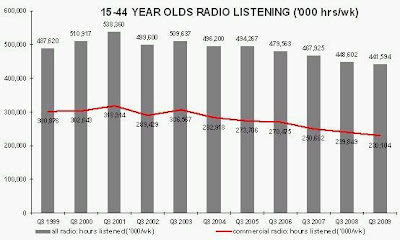
• to expand the RAJAR metric to measure ‘audio’ consumption that includes on-demand and podcast content, as well as non-traditional radio such as Spotify and Last.fm, thus demonstrating that total listening is not at all in decline but, on the contrary, has been enhanced by audio content increasingly consumed via non-broadcast platforms and ‘on the go’.

For the BBC, Director of Audio & Music Tim Davie hinted at the last RadioCentre conference that he would be interested to see RAJAR extended to encompass time-shifted and downloaded audio, both of which account for an increasing proportion of BBC radio listening.

For its part, commercial radio has shown no interest in advocating such a re-definition of the RAJAR metric. Not only do its offerings of time-shifted and downloadable audio remain miniscule compared to the BBC, but it is locked into a strategy to maintain its ‘walled garden’. Understandably, it has no desire to demonstrate to the world that it is losing listening to competitors’ time-shifted audio and online ‘radio’. UK commercial radio has enjoyed a nice little over-the-air duopoly from 1973 until recently – best just to pretend that it remains one of only two games in town.

The paradox here is that commercial radio is busy presenting advertising agencies and potential advertisers with RAJAR data that only tell part of the story of how and what audio people are listening to in 2009. However, once their meetings with commercial radio people are over, those same advertisers and agencies will inevitably be busy booking advertising with all sorts of online media, including Last.fm and Spotify. They know precisely what opportunities are out there in the wide world beyond traditional broadcasting.

Simply ignoring new businesses that are competing for your listeners’ attentions is not going to make them go away. Sticking your head in the sand can only have the effect of devaluing RAJAR as a useful and accurate metric in the long term.

Remember King Canute.

Local government unhappy about digital radio switchover

The Local Government Association, representing 424 local government authorities in England and Wales, is backing a campaign to lobby the government to re-think its proposal for digital radio switchover.

I’m urging the Government not to confirm the 2015 switchover date from analogue to digital radio until proposals have been properly rural proofed,” said Peter Phillips, Liberal Democrat councillor for Bishop’s Castle in Shropshire. “The proposed switchover will also have significant carbon footprint implications, as DAB radios consume more power than transistor sets. Waste authorities will be affected in having to dispose of analogue radio sets.”

Phillips presented a report to a September 2009 board meeting of the Local Government Association, at which he “raised a number of important issues for both the Association and Local Authorities to consider in preparing for any switchover to digital radio”, according to the minutes.

The Association is reported to be contacting the government, Ofcom and Digital Radio UK to express its concerns about the proposal in the Digital Economy Bill for digital radio switchover.

Digital radio switchover: amendment to ‘consider the needs’ of listeners and small stations

Clause 30 of the government’s Digital Economy Bill sets out the process for determining the date for radio ‘digital switchover’:

97A: Date for digital switchover
(1) The Secretary of State may give notice to OFCOM nominating a date for
digital switchover for the post-commencement services specified or
described in the notice.
(2) When nominating a date, or considering whether to nominate a date,
the Secretary of State must have regard to any report submitted by
OFCOM or the BBC under section 67(1)(b) of the Broadcasting Act 1996
(review of digital radio broadcasting).

An amendment has been tabled by Lord Howard of Rising and Lord de Mauley which would require the government additionally to consider:

• the needs of local and community radio stations
• the needs of analogue listeners

as well as any reports submitted by Ofcom and the BBC. This amendment will be considered, along with many others not concerned with radio, when the Bill is debated by a House of Lords committee on 6 January 2010.

Although this amendment does not suggest a specific mechanism for canvassing the opinions of listeners or local radio stations, it nevertheless acknowledges implicitly that the consumer and small commercial/community radio stations need to have a voice in the process. It is about time.

From its earliest formulation, the proposal for radio broadcasting to be switched from FM/AM to DAB seemed to have been intended to create:
• a ‘walled garden’ under the control of the UK’s largest commercial radio owners and the BBC who, between them and transmission provider Arqiva, not only own the entire DAB infrastructure but also act as ‘gatekeeper’, deciding which station has access to the platform.
• a ‘walled garden’ on DAB that would hopefully stop consumers listening to content not produced or approved by the BBC or the largest commercial radio companies, such as online radio (most of which originates or is owned overseas), pirate radio, community radio and small independent stations.

Massive consolidation in commercial radio since then has resulted in a more divided industry than ever, in which the biggest commercial players are eager to ‘nationalise’ or ‘regionalise’ what had been licensed as local radio stations, whereas most of the smaller commercial and community owners want to keep local radio as local as they can.

There is no longer likely to be a single organisation that can embrace the full range of stakeholders in the radio sector. Even government agencies such as Ofcom and DCMS seem wilfully to be ignoring the wider picture, as if seduced by notions that ‘DAB must happen’, ‘bigger must be better’, ‘Britain must lead the way’ and ‘consumers don’t know what’s good for them’.

Inevitably, it will end in tears. You can pass all the laws you want but, if you cannot get the consumer interested in DAB, it will fail. And, to date, the consumer seems largely disinterested and could not care less that manufacturers of DAB radios are mostly British (though they manufacture outside the UK) or whether they listen to British radio content.

Ofcom’s most recent market research shows the stark reality: 64% of households say they are unlikely to buy a DAB radio in the next 12 months, and a further 20% say they don’t know.

You ignore consumer opinion at your peril.

Radio in the Digital Economy Bill: House of Lords Second Reading

Digital Economy Bill
2 Dec 2009 @ 1539
Second Reading, House of Lords [excerpts]

The First Secretary of State, Secretary of State for Business, Innovation and Skills and Lord President of the Council (Lord Mandelson):
We have also set out our vision for the future of digital radio, which will see the country shift to digital, when transmission coverage and audience numbers are wide enough, by the end of 2015.

The Lord Bishop of Manchester:
The switchover to digital radio may produce more problems than expected. Of course there is much to welcome in the creation of platforms for new content to meet the needs of specialist audiences. I think, for example, of Premier Christian Radio’s recent acquisition of a national DAB licence. However, there may be much to be concerned about over the plan to cut off national stations and many local services as early as 2015. While the Government have indicated that that will not be finalised until digital services account for 50 per cent of all radio listening and can reach 90 per cent of the population, it is also clear that without an early deadline, sufficient pressure may not build on radio manufacturers and retailers to shift to selling DAB sets only for cars as well as homes. The radio switchover again underlines the risk of creating another two-tier system where significant swathes of the country could lose their favourite national stations from the FM dial, including the BBC stations they pay for through the licence fee. Surely that cannot be right.
What government support will there be for the switchover to digital radio, which is likely to be not only more problematic but, generally, more expensive across the population than the TV switchover has been? Will the Minister accept that over-rushing towards analogue switch-off will not allow proper time for the Government, this House and the other place to think through the unintended consequences? Is there anything that the Government can learn from the German Government’s experience and their postponements of switchover plans?
….. On voluntary supported broadcasting, do the Government intend to keep some of the analogue spectrum going, for example, for hospital radio?
This country must, of course, embrace the opportunities offered by a digital economy, but the advantages must be shared by the widest possible number of citizens. Some, if not all, of the unintended consequences that could unfairly disadvantage people might be avoided by not being trapped in too rigid a timetable. If that happens, I fear that this country will not benefit from the best rewards that a digital economy offers.

Lord Carter of Barnes:
Secondly, in the critical areas of investment, infrastructure, spectrum liberalisation and the digitalisation and deregulation of sound radio, it provides a framework for innovation, development and investment.

Baroness Howe of Idlicote:
My Lords, when the noble Lord, Lord Carter of Barnes, introduced Digital Britain a little while ago we all recognised that things were beginning to happen and there were some very welcome realisations, for example, on the need to move forward with digital radio…….
I welcome those parts of the Bill which incorporate the Digital Britain promise to speed up delivery of a fully operational DAB digital radio platform. I spend a lot of time in cars and have had hearing difficulties since the arrival of my first child, so it is a real pleasure to enjoy the quality and clarity of digital sound, especially when listening to music-whether it is Radio 3 or Classic FM, both of which are excellent stations. The plank for Ofcom to be able either to terminate analogue licences without consent, subject to a minimum two years’ notice, or where appropriate to extend analogue licences up to and beyond switchover, on condition that digital services are also provided, will no doubt help to build in the much-needed flexibility to enable radio switchover. I very much hope and have confidence in the plans that have been outlined that it will happen by 2015. It is important that it does.

Lord Roberts of Llandudno
Today, I looked at the figures for radio listeners in Wales who have ever listened to digital audio broadcasting. I shall not go through the whole list, but in Cardiff, it was 27 per cent, while in the valleys, it was only 4 per cent. That is the difference. The most needy areas will not have the opportunity to benefit from these new high-tech developments. There is a pressing need for an extension of broadband, not least because of the commitment already made by the Government that fibre optic broadband should be prioritised in “notspots”, where other technologies have also failed.

Lord Clement-Jones:
I move on again, to independent radio services. We broadly welcome the provisions for digital switchover. Of course, full switchover will only happen on a specified date if certain criteria for uptake are met, and the only way that one will get further adoption is by setting a firm date. I hope that the Minister will confirm that we are currently working off a 2015 date, but there are concerns among smaller radio stations that the digital multiplex regions that have been defined are too large. Small, local stations will be broadcast across the whole of a large region covered by a multiplex, and may be expected to pay a rental reflecting that. That would be unfair on some of those small stations. Many of them are arguing for DAB Plus, a technology which would be, I believe, much more in tune with their requirements. I would be grateful to hear what the Minister says in that respect.

Lord Howard of Rising:
While we on these Benches support the switch from analogue to digital radio, it is a sensitive area. It would be good if the Government could give some assurances of what criteria will be used to decide when will be the appropriate time for the changeover. Will the Government be guided by the criteria set out in the Digital Britain White Paper, referred to by the right reverend Prelate the Bishop of Manchester? If so, we remain unconvinced that the 2015 target date is realistic and worry that millions of listeners and hundreds of local stations will be disadvantaged.
There are many for whom the digital switchover will cause problems: the elderly or the lonely, who may have had a wireless for many years which has become almost a companion; the blind person who will not be able to work the digital radio because the instructions are on a screen that they will not be able to see. I hope that the Secretary of State can reassure the House that proper care and attention will be paid to the needs of those who will encounter difficulties with the transition.

Lord Davies of Oldham:
The right reverend Prelate the Bishop of Manchester indicated the issues that arise with the digital switchover. I emphasise that we will not make the switchover for radio until there is already 90 per cent coverage in the United Kingdom and until 50 per cent of hours of radio are listened to via digital stations. We have criteria before we actually make the move. This follows on from points about the switch from analogue to digital television. I take on board his point that it is important that any changes that are made benefit people and do not shock them with a possible loss of services and extra cost. That point has to be addressed.

[next stage: House of Lords Committee, 6 January 2010]

DAB radio UK sales: 10m in 10 years is “an incredible achievement”?

The Digital Radio Development Bureau [DRDB] published a press release yesterday trumpeting the “incredible achievement” that 10 million DAB receivers had been sold to date in the UK which, it said, “proves that digital radio is here to stay”. The press release was notable not for what it said, but for what it omitted.

Ten million radios sounds like a big number until you realise that this has been achieved over more than a decade of DAB product sales in the UK. There are 51.3 million adults (aged 15+) in the UK. So, averaged over the decade, roughly one out of every fifty adults bought a DAB radio each year. Not so impressive.

Revisit the DRDB’s own forecasts for DAB receiver sales. In 2004, it forecast 13.15m DAB radios would be sold by year-end 2008 (the reality was 8.53m). In 2005, it forecast 19.96m to be sold by year-end 2009. In 2006, it forecast 17.2m sold by year-end 2009. In 2007, it was too embarrassed to revise its year-end 2009 forecast (but even its year-end 2008 forecast of 9.16m was overstated, as the reality was 8.53m). In 2008 and 2009, understandably, the DRDB did not publish its forecasts. The DRDB forecasts of the very consumer market in which it is specialising have consistently been shown to be wildly inaccurate.

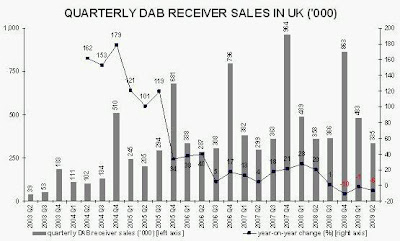
The DRDB press release also claimed that “for the past three years, sales of digital radio sets have remained solid”. ‘Solid’ is an interesting choice of word to describe the present situation of declining sales. Sales in Q2 2009 were the lowest in two years and were down 6% year-on-year. Sales in the previous two quarters, Q1 2009 and Q4 2008, were also down 1% and 10% respectively year-on-year. Three consecutive quarters of negative sales growth can hardly be described as ‘solid’.

As the graph above shows, the rot set in at the end of 2005, when year-on-year DAB radio sales growth fell from triple to double digit figures. Both 2006 and 2007 included quarters of single digit growth. Now, in 2009, growth has been negative all the way. This is no temporary blip caused by the recession. The writing was already on the wall by 2006 – the DAB party is over. Now we are merely waiting for the last few guests to leave.

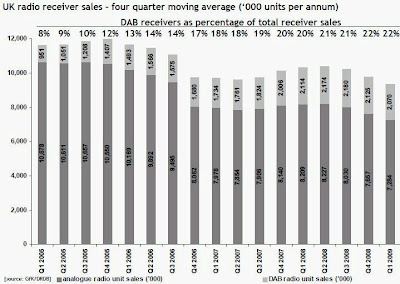
The other remarkable statement in the DRDB press release is its satisfaction that sales of “all categories of analogue radio showed significant decline”. As I have pointed out previously (see graph below), sales of radio receivers generally are in long-term decline in the UK. Is this a fact that a stakeholder within the radio broadcast industry should be crowing about? It’s like two passengers on the Titanic fighting over which has the bigger cabin – does it really matter if the whole ship is slowly going down?

It should be pointed out that the DRDB data excludes sales of mobile phones, despite the fact that the majority of current models sold in the UK include FM radios, whilst not one model includes a DAB radio. More than 30m mobile phones were sold in the UK in 2008, which puts the 2m DAB radios sold in stark perspective (see recent blog entry).

Also, it should be pointed out that the vast majority of what the DRDB calls ‘DAB radios’ on sale in the UK also incorporate analogue FM. It is increasingly difficult to find a DAB-only radio to purchase in UK shops. This renders the DRDB’s proclaimed digital versus analogue victory completely hollow. For every ‘DAB radio’ sold that the DRDB hopes will automatically lead us to some kind of digital heaven, in probably 90%+ of purchases, yet another FM radio is also being added to the millions already in UK households (see recent blog entry).

Finally, recall that 8m analogue radios (without DAB) are still being sold annually in the UK. Now add to that the 30m mobile phones purchased, most of which include FM radio. Then compare it with the “incredible achievement” of 2m DAB radios sold per year, most of which include analogue radio anyway. The future of radio is looking less and less like a DAB world. Rather, analogue radios are probably multiplying faster in the UK marketplace than they have ever done, thanks to mobile phone manufacturers. This is good news for radio, bad news for investors in DAB.

These facts might not conveniently fit the DRDB ‘story’. But they are the facts.

DAB radio: the customer is always wrong?

Politicians, government, civil servants, regulators. We pay their wages. They work for us, don’t they? So why does the voice of the consumer, the citizen, the customer so often seem to be ignored or become lost when the government makes new policies or passes new legislation. DAB radio seems to be a case in point.

The government had convened the Digital Radio Working Group [DRWG] in 2007 to consider:
• what conditions would need to be achieved before digital platforms could become the predominant means of delivering radio?
• what are the current barriers to the growth of digital radio?
• what are the possible remedies to those barriers?

The Group met for a year and published its Final Report six days before Christmas 2008. It had created a number of sub-groups to examine specific aspects of digital radio. One of these, the Consumer Impact Group, submitted its own report to the Working Group in November 2008 to inform its Final Report.

The Consumer Impact Group’s recommendations about DAB radio make sober reading and carry as much gravitas, maybe more, now as when they were written a year ago. To quote directly and extensively from its report:

“The group is concerned that the case for digital [radio] migration has not been made clearly enough from the point of view of the consumer. While it is clear what the rationale is for the radio industry, the group would like to see a compelling argument as to why digital migration is desirable for consumers and what its benefits would be for consumers.”

“The group also considers that the proposed migration criteria of 50% of all listening through digitally enabled devices is too low, and disproportionately affects disadvantaged groups who are less likely to be represented in the first 50% to take up digital radio. The group would therefore like to see the 50% figure analysed in more detail and a stronger case made for it, before it is adopted by the full DRWG, to ensure this is not the case.”

“The group notes that neither the market nor consumers are currently prepared for migration at this stage. Information provided to the group shows that take-up varies from region to region and amongst demographic groups. Therefore, the group recommends that if digital migration proceeds, a help scheme will be essential to assist those where the cost of migration is significantly greater than the benefit. The information provided by the cost benefit analysis for the more vulnerable social groups will be an essential element in considering where and how a help scheme is best delivered.”

“The group believes that further research should be undertaken to examine the extent of ownership and usage of analogue and digital radio particularly amongst disabled people, older people, people whose first language is not English and consumers from low income households. The research must be structured and use appropriate methodology to capture information on those over 65 and those over 75. The findings should be fed into plans to protect the consumer interests, i.e. for a help scheme, for effective labelling, for information and education campaigns and for the development of easy-to use products.”

“The group urges caution with migration to digital radio should the uptake amongst older people, disabled people and low-income households be found to be low or should the costs be found to be prohibitive for these groups.”

Commenting on DAB radio take-up and the proposed digital migration criteria, the report said:

“The RadioCentre was asked to present figures, drawn from the existing Rajar and DRDB figures, setting out the current information on the number of DAB sales, household penetration and listening, defined by region, age and social class.”

“The figures, which are annexed to this report at B [but excluded from the published version], show a number of interesting trends. For example sales, penetration and listening to DAB vary across the UK. Generally speaking, listening and awareness of DAB is highest in London and the South East, and the English Midlands. These have been the areas of longest DAB broadcasts and the widest choice of stations.”

“When awareness and penetration are broken down by Socio-Economic Group and age, there does appear to be a divide. The figures show that consumers in lower income groups are considerably less likely to own a DAB set than other social groups. Even when owning a DAB, in some areas weekly listening to DAB by the over 65s is very low at less than 10%.”

“The main conclusions to be drawn from this research is the general low level of ownership and listening by the over 65s compared to other age groups, and the low listening figures for consumers in the lower socio economic groups. This perhaps reflects that financially lower income groups are finding the price of sets a barrier, whilst for older groups, despite having sets, over 65’s may find DAB radio’s less easy to use than analogue sets, or perhaps prefer the traditional use of their analogue sets.”

“Whilst recognising that universal DAB coverage is not achievable, the group considered that after migration, DAB coverage for UK-wide stations and stations for the nations should be equivalent or better than that available for analogue radio at present.”

“The group stressed the importance of encouraging availability and use in cars, and noted that it would be virtually impossible to meet any listening criteria without addressing the issue of take up in cars. The group feels this should be a priority for the full DRWG.”

On the topic of research, the Consumer Impact Group commented:

“More and wider research is required, particularly about the ownership and usage of analogue and digital radio amongst those people with disabilities, people whose first language is not English, older people (both over 65s and over 75s) and those in low income groups. This additional research, when used together with the RadioCentre research and Rajar figures should be used to guide future work in this area, particularly around take-up, equipment features, programming and a help scheme. The group feels that there is an opportunity here to ensure that future work is based on comprehensive and reliable evidence and analysis. The findings should be fed into plans for any help scheme, for effective labelling, for information and education campaigns and for developing easy-to use products. Where it doesn’t already, this research should also take into account ways of listening to digital radio other than through a DAB enabled set, for example via the internet, digital terrestrial and satellite television, which may provide a significant proportion of the growth in the future.”

The Consumer Impact Group’s recommendations included:

• “We believe, that before migration could begin, additional research into radio users who are disabled, older people (both over 65 and over 75) and consumers from low income households is essential, since these people are likely to require particular assistance with migrating to DAB. This research should inform the development of plans for a help scheme, for effective labelling, for information and education campaigns and for developing easy to use products.”
• “In the absence of the finalised cost benefit analysis at this point in time, the group recommends that the cost of converting to digital radio for the average household, as well as the affordability for low income groups should be investigated. In addition, the current take-up amongst older people, disabled people and low-income households needs to be investigated. The group urges extreme caution with migration to digital radio should the uptake in these groups be found to be low or should the costs be considered to be prohibitive by any of these groups, unless an appropriate help scheme is in place.”

Analysis. Research. Cost benefit analysis. Comprehensive and reliable evidence. All were considered to be very important by the Consumer Impact Group.

However, when the 26-page Final Report of the Digital Radio Working Group was published in December 2008, it did not include a single graph, a single numerical table or the results of any commissioned consumer research. Neither were such data attached in appendices.

The Final Report of the Digital Radio Working Group did recommend that “the government should conduct a cost benefit analysis of digital migration”. The government accepted this recommendation. One might think that this would be an urgent imperative, given that proposed legislation on DAB radio in the Digital Economy Bill is about to be debated in Parliament.

Wrong! The government has stated explicitly that it is “committed to a full cost benefit analysis of the Digital Radio Upgrade programme before any Digital Radio Upgrade is set” which would include “the timings and costs to consumers”. But the government has stated that “this is likely to begin in 2011”.

What? The government wants a huge (some would say impossible) commitment from the UK radio sector and from the British public to forge ahead with migration of radio listening to DAB, even though its own full cost benefit analysis of pursuing that policy will not be STARTED until 2011.

Is this not mad? Are our public servants working for us? Does the consumer viewpoint on these issues count for nothing?