DAB Radio Downgrade: how is '90% of FM coverage' a sensible target for DAB to replace FM?

“Makin’ a good t’ing bad!”

Moving the goalposts. Governments are adept at doing just that to help them achieve their targets or to make figures look better than they really are. Digital radio switchover is no exception. Given the technical and financial impossibility of the task plotted twenty years ago to completely replace analogue radio broadcasting with DAB radio, it has became necessary in recent months for the civil servants and digital radio lobbyists to move the goalposts.

In a blog in April 2011, I had outlined Ofcom’s latest ruse to deliberately plan to make DAB reception worse than existing FM reception for many radio listeners. Nevertheless, Ofcom will still declare this a victory for the technical superiority of the DAB platform.

The latest proposal under consideration is to make coverage of local DAB transmitters equivalent to 90% of existing FM coverage. On the one hand, this represents a belated admission that DAB radio cannot realistically achieve the same robust coverage as FM. On the other, it is a massive kick in the teeth to radio listeners – an attempt to purposefully replace something good (FM) with something worse (DAB). Madness!

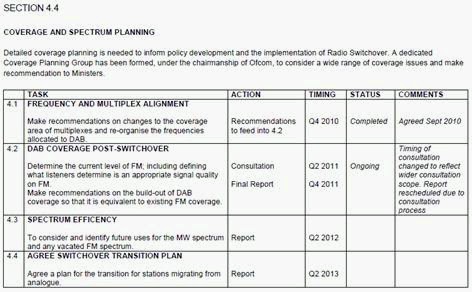
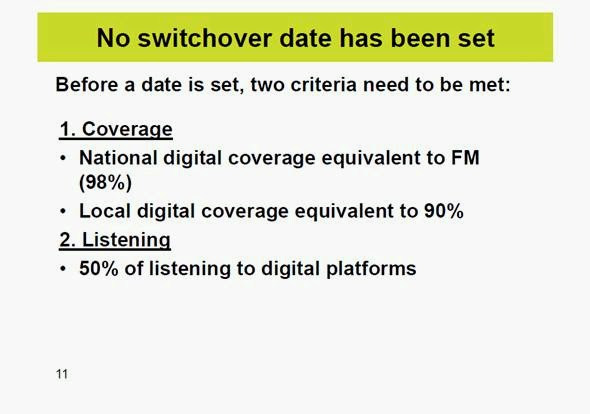
A recent presentation by DAB lobbyist organisation Digital Radio UK invoked a new, vague “local digital coverage equivalent to 90%” criterion [see below]:

“90%” of what? The government’s Digital Britain report in June 2009 had fixed the digital radio switchover criteria as:
• “When 50% of listening is to digital; and
• When national DAB coverage is comparable to FM coverage, and local DAB reaches 90% of the population and all major roads.” [emphasis added]

There was never anything in Digital Britain about achieving “90% of existing FM coverage.” It was always “90% of the population.” The goalposts are being moved to make it easier for the government and DAB lobbyists to declare that DAB has achieved the criteria. Despite this outcome making the consumer experience of radio evidently worse.

We were told that one result of the Digital Radio Summit meeting on 31 March 2011 between government, regulator and the radio industry was:

“It is understood that it will cost around £20-30m to extend the local DAB signal to 90% of the FM signal in the UK…”

At a Westminster Media Forum conference on 5 April 2011, the topic of this newly created “90% of FM” criterion was raised by several speakers:

Jimmy Buckland, director of strategy, UTV Media: “There’s a DCMS [Department for Culture, Media & Sport] plan that’s been referred to today that’s currently on the table that would take local multiplexes to just 90% of what FM already delivers, with no commitment on major roads. If that plan’s agreed, it just about gets us to base camp.”

[…]

Neil Midgley, assistant media editor, The Daily Telegraph: “Now the briefing that we were getting last week was somewhere below £30 million for a build out to about 90% of current FM coverage. “

[…]

Daniel Nathan, director, Brighton & Hove Radio: “Just leading on from that, in Jimmy’s slide we saw the figure being an aspiration of ‘90% of the population’ and I was quite disturbed to hear that now that they are kind of moving away from ‘90% of the population’ to ‘90% FM coverage.’ When was that decided and by whom?”

[…]

Jimmy Buckland: “There were two different figures, there was originally a figure which was the criterion, at which point you would make a decision about switchover which was that the Government said that once we had ‘90% population coverage’ and ‘coverage of all major roads,’ you could make a decision and there were a couple of other criteria that go with that. The second figure which was ‘90% coverage of current FM’ for local DAB concerns what would be delivered by a proposal which is currently on the table. So to tie in with the previous point, what that £30 million delivers is a little bit more coverage at the local level, aggregated to 90% on a UK wide basis, so in some local markets it could be comfortably less than 90%, in other markets it could be higher and it doesn’t get you to the universality that you need for switchover.”

So, two questions remain unanswered:
• Who came up with the idea of ‘90% of FM coverage’ to be sneaked in as an easier criterion?
• Why are large parts of the radio industry (including RadioCentre and the BBC) not publicly campaigning against this ridiculous proposal intended to make reception of their radio stations on DAB WORSE for listeners than existing reception on FM?

It is hard not to conclude that the parties involved in this latest wheeze seem happy to treat the UK’s 46,727,000 radio listeners with utter contempt.

Digital Radio UK on DAB radio switchover: talkin' loud and saying nothin'

DAB radio receiver sales

“Ford Ennals, Digital Radio UK’s chief executive, remains optimistic and says that the DAB [receiver] market will grow by 8-10% this year [2011].” [source]

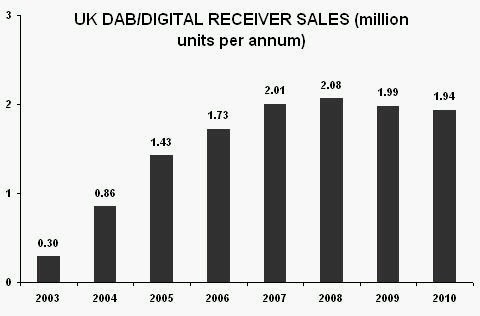
FACTS: DAB/digital radio receiver sales volumes in 2010 were down on 2009, and in 2009 were down on 2008, although stakeholders disagree about the precise volumes and the percentage change:
“2010 was slightly down in digital radio sales volumes (-2.3%) compared to 2009” [Digital Radio UK update]
“’[DAB] volume sales were only marginally lower than the previous year (-0.7%) at 1.92 million units,’ explains Simon Foy, GfK senior account manager, CE.” [source]
• “DAB sales for 2010 were 1.91 million pieces” [source]

Digital radio listening reaching the 50% criterion

Ford Ennals: “I think you can see the listening criteria’s certainly being met in the next five years.” [WMF]

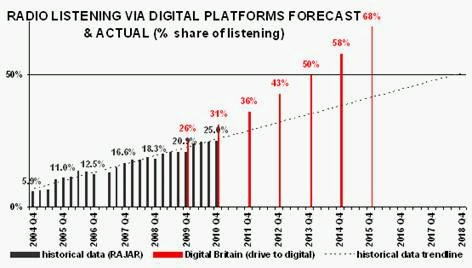
“Despite two thirds of listeners still using analogue radio, Ennals believes that, if you extrapolate digital radio’s recent growth pattern, the 50% target could be achieved by the end of 2014.” [source]

Ford Ennals: “We are likely to hit 50%, you know, in the next five years, I would say.” [DRS]

FACTS: When you extrapolate the radio industry’s RAJAR dataset, the 50% criterion is reached:
• Not by the government’s target of year-end 2013
• Not by Ford Ennals’ new, seemingly variable, targets of “the end of 2014” or “in the next five years”
• By year-end 2018, IF growth in digital listening is maintained at the current rate

Growth in DAB/digital radio listening

Ford Ennals: “We’ve seen overall in this year, in the last 12 months, each quarter, we’ve seen a 20% year-on-year growth of digital listening.” [WMF]

Ford Ennals: “We’ve seen 19 to 20 per cent listening growth in the year [2010].” [DRS]

Ford Ennals: “We see about 20% growth in 19 … sorry, in 2010, it was 14% growth in 2009 and there was about 10% growth the previous year. So, you know, we see solid growth.” [WMF]

FACTS: According to the radio industry’s RAJAR dataset:
• 20%+ growth in digital listening was only evident in the last two quarters of 2010, not in “each quarter”
• Part of this apparent growth spurt in digital listening was the result of a sudden 5% to 6% increase in TOTAL radio listening recorded in the last two quarters of 2010

Consumer satisfaction with analogue radio

“DRUK’s Ennals is not convinced by the argument that most consumers are more than satisfied with analogue radio.” [source]

Ford Ennals: “FM is full and I think almost half of the FM spectrum is taken by 5 national services, there’s only 1 national commercial service, so it’s, you know, in terms of the ability to give consumers more choice, it is somewhat limited …” [WMF]

FACTS: Ofcom research has consistently demonstrated the high level of consumer satisfaction with existing radio services:
• Around 90% of consumers were ‘satisfied’ with the choice of radio stations in their area in 2006, 2007, 2008 and 2009

The 2015 digital radio switchover date

Ford Ennals: “I’m confident [digital radio switchover] is going to happen in the near future but I don’t think there’s a need to have a date and certainly we won’t be communicating a date.” [WMF]

FACTS: Ennals and Digital Radio UK have been busy “communicating a date” for digital radio switchover to anyone who would listen. Just a few of many examples:
• Ford Ennals: “We are confident digital listening can reach 50 per cent by 2013.” [source]
• Ford Ennals: “We have set a course to double listening and expand coverage by 2013, and to switchover by the end of 2015.” [source]
• Ennals stressed that a target date of 2015 was “challenging but achievable” [source]
“Ford Ennals CEO of Digital Radio UK had positive comments for the 2015 switchover date set by government and told guests to Radio Festival that plans were already in motion to meet the ambitious date.” [source]
• Ford Ennals: “The radio industry believes that these two criteria can be met at the end of 2013, for a proposed switchover to take place in 2015.” [source]
“2015 is ‘achievable’ for an analogue-to-digital switchover, according to industry body Digital Radio UK.” [source]

[sources: WMF = Westminster Media Forum, 11 April 2011; DRS = Digital Radio Stakeholders, 3 February 2011] [thanks to Darryl Pomicter]

Which? says: DAB radio switchover must be "consumer led or not at all"

What would have to be done to make DAB radio successful?

“What there does need to be, as Freeview and digital satellite has shown in television, is simply a sufficient combination of services, technology, simplicity and price or discount to provide a value proposition for the consumer,” suggested Stephen Carter in 2004, when he was chief executive of Ofcom.

“….. for the consumer” were the key words. They were also the words that became forgotten. The consumer was ignored in the radio industry’s pursuit of the radio industry’s own agenda for DAB radio. As a consequence, DAB radio has still not succeeded … with consumers. The failings were acknowledged by Quentin Howard, one of the architects of DAB radio in the UK:

“The mistake by broadcasters was in not understanding that ‘build it and they will come’ is no longer practical in this integrated technological age.”

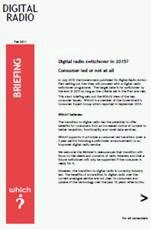
Which?, the UK consumer advocacy, noted the radio industry’s lack of attention to the consumer in a February 2011 briefing paper entitled ‘Digital Radio Switchover in 2015? Consumer Led Or Not At All’:

“The transition to digital radio is currently industry led. The benefits of a transition to digital radio over the current analogue service are not clear to consumers, and the uptake of the technology over the past 10 years reflects this.”

Which? suggested that, before the government can announce a date for digital radio switchover, the following criteria should be met:

• “Uptake should be a minimum of 70% of all FM radio listening transferred to digital, leaving 30% still listening on analogue (FM/LW/MW/SW) (the Government’s Digital Radio Action Plan suggests 50%)
• The transition to digital must not be announced until coverage, including a measure of signal quality, is better than that of FM radio
• DAB must have been fitted as standard in all new cars for at least two years and an effective and affordable solution to in-car conversion must be available prior to the announcement of a switchover (which costs no more than for in-home conversion)
• Government must conduct a full cost-benefit analysis from a consumer perspective as a priority because increasing consumer desire for DAB should not focus on cost alone
• Minimum standards associated with a kite mark must be ambitious and future-proofed and any incentive scheme to switch to DAB should offer only kite marked receivers
• Consumer group representatives must be involved in the development of an information campaign independent from industry to raise awareness of the digital switchover by consumers and ensure guidance and training tools are available to retailers. In this regard, any lessons from the Digital TV switchover should be acted upon
• In its assessment of the environmental impact of a switchover to digital radio, the Government must tackle the full range of issues around recycling of analogue sets and the energy impacts of DAB”

However, in some of these areas of concern, current policy on DAB radio appears to be moving in the opposite direction to that advocated by Which?:

• The 50% criterion (50% of radio listening via digital platforms before switchover can be announced) is not mandatory because it was never included in the Digital Economy Act [see Jan 2010 blog]
• The latest plan for DAB is not to deliver reception even as good as FM, but to make it worse than FM [see recent blog]
• Only 1% of cars have DAB radios fitted and future take-up will inevitably be slow [see recent blog]
• Roberts Radio reported a 35-40% customer return rate for its in-car DAB radio adaptors [see Nov 2010 blog]
• The cost benefit analysis of DAB radio to be considered by the government will also be authored by the government, rather than commissioned independently [see Jan 2011 blog]
• Roberts Radio admitted having had to pull the plug on several DAB receiver projects, including the industry’s promised ‘£25 DAB radio’, because they could not meet Roberts’ minimum quality standards

In July 2010, after the formation of the new coalition government, culture minister Ed Vaizey had said:

“If, and it is a big if, the consumer is ready, we will support a 2015 switchover date. But, as I have already said, it is the consumer, through their listening habits and purchasing decisions, who will ultimately determine the case for switchover.” [see Sep 2010 blog]

So, it might appear that the Minister and Which? are, in fact, both lined up in agreement that digital radio switchover can only happen if it is supported by consumers. So why has the government not yet recognised that consumers already seem to have given the thumbs down to DAB?

Because there are middle men (Ofcom, DCMS, Digital Radio UK, Arqiva, DAB multiplex licence owners) who persist in keeping the DAB dream alive in Whitehall. Yet again, consumers are being drowned out by the clamour of agencies eager to pursue their own narrow objectives. And the mantra of the middle men is: DAB crisis, what crisis?

DAB Radio Downgrade? The new masterplan to deliver DAB radio reception worse than FM

When something works well, it just works. You do not need to analyse why it works. It just works. And nobody asks questions as to why or how. That is the case with FM radio. During half a century of development, more and more FM transmitters have been built across the UK (2,100 currently in operation) so as to reach the point now where almost the entire population receives an FM signal (maybe not always perfect, but some reception rather than none at all).

DAB radio was intended to replace FM radio. However, it must only be worth replacing FM with DAB if DAB is actually better than FM. Why replace a transmission system that has taken 50 years to perfect with something that is going to be worse? Unfortunately, nobody thought to conduct a cost/benefit analysis during the last two decades to determine what the cost would be of making DAB radio reception as good as FM radio, let alone better. As a result, DAB radio was foisted upon the public in 1999 without a roadmap to ensure that reception was even as good as FM radio for consumers.

Twelve years later, DAB reception remains worse than FM reception in many places, or is non-existent. Whereas poor FM reception gives the consumer a poor quality listening experience, poor DAB reception provides no listening experience whatsoever. With DAB, a poor signal is the same as no signal.

Instead of Ofcom valiantly admitting defeat over DAB radio – which might infer that the regulator and its predecessor, the Radio Authority, had screwed up the implementation of DAB in the UK – Ofcom presses ahead with increasingly desperate attempts to try and salvage this technological and regulatory disaster.

Ofcom’s latest ‘project’ is to try and understand why FM radio, more than half a century after its introduction, gives consumers acceptable radio reception. Intrinsically, the work is redundant. If FM works well, why bother to analyse why it works? The answer is: because DAB radio does not work. In order to make DAB work, an understanding is deemed necessary of why the system it was intended to replace – FM radio – does work.

Belatedly, it has been understood by the bureaucrats that the expense of making DAB as good as FM will prove too costly. It requires too many DAB transmitters, too many DAB power increases, at too great a cost for the radio industry. Might this not be a good time for them to back away from the notion of DAB radio REPLACING FM radio because it is simply too costly, even just to make it AS GOOD?

Not for the bureaucrats involved. Instead, the philosophy within Ofcom and the government is a new plan to deliberately make DAB radio NOT AS GOOD as FM radio. But still to persuade consumers that DAB is intended to replace FM radio for national and large local radio stations. Madness? Yes. Self-defeating? Yes. Contempt for radio listeners? Totally.

Peter Davies, who is responsible for radio at Ofcom, explained part of this 1984-style philosophy to replace ‘good’ FM with ‘worse’ DAB to the Digital Radio Stakeholders Group meeting in the calmest of tones on 3 February 2011. Although his presentation is lengthy, I have included Davies’ words in full below so that you too can try and decipher the logic of a solution for DAB radio that is purposefully sub-par.

Perhaps the Digital Radio UK marketing slogan next winter will be: ‘Buy a DAB radio! Worse reception than FM guaranteed. But better than no radio at all.’

Peter Davies, Ofcom: “The Coverage Planning Working Group is chaired by Ofcom, but we have effectively two groups that are feeding into this. There is the actual Working Group that is doing all the sort of hard grind of doing the planning work, and that consists of Ofcom, Arqiva and the BBC. There is also a Planning Advisory Group which consists of all the [DAB] multiplex operators, with Digital Radio UK and RadioCentre as well. So what I’m going to run you through this afternoon, quite quickly because of the time, is just what we’re doing in terms of FM. What is it we are trying to match? Secondly, how you then do that with DAB. Thirdly, looking at what we need to do to the frequency plan in the UK to achieve that. And then just onto the next steps.

So, FM coverage. I should say we are doing this for national services as well as local. So it’s both BBC and commercial national services, as well as the local. But I’m going to focus this afternoon on the local because that’s, in a way, where some of the more difficult issues are. This is a map of Manchester. I know you won’t be able to see the detail on that, but it gives you an impression, at least. So what we’ve done in each part – in fact, in the whole country – is define a set of ‘editorial areas.’ So that’s shown on this map by that dotted line – you can see around the edge, a sort of dark purple dotted line – so that everywhere in the country is covered by one or more areas – there are some overlaps – but at least everywhere is covered by one area. So the editorial areas are areas that have been agreed by the BBC and by the [DAB] multiplex operator and commercial radio operators as being the sort of area that they would, in an ideal world, like to cover. It’s also based on [DAB] multiplex areas, so it’s a bit of a compromise.

So, if you look at the actual coverage of BBC Radio Manchester [GMR] within this, that’s shown in the sort of standard way of measuring – 54 db – is shown in green but, actually, editorially BBC Radio Manchester would like to cover the bits within the dotted line. So there is coverage beyond the editorial area where people can pick up the service, but it’s not really intended for them. And, equally, there are bits within the existing editorial area which aren’t covered terribly well on FM but which, nevertheless, the station would like to think it serves.

In terms of the actual [FM] coverage, it’s been quite difficult to determine what that is. The ‘54db’ is the standard internationally agreed planning measure. So that’s 54db per μv per metre, but I’m not an engineer so don’t ask me any more detail than that. But it’s a definition that was drawn up back in the 1950s and is really about reception 10m above the ground, using a rooftop aerial and it sort of tells you whether you can get a signal on your radiogram, which is not terribly useful [now]. So we know that people use radios in very different ways, but we sort of know that this works, but it has never actually been tested. So it’s a planning definition, which is very old and slightly messy.

So what we’ve been doing as part of this work is drawing up what’s known as a ‘link budget ‘, which is effectively taking the signal strength as it leaves the transmitter and then adjusting it all the way along until it actually gets to the receiver. So, in other words, you adjust it because it’s a distance from the transmitter going over some hilly ground, going down into buildings, loss within the receiver itself and so on. So that you can work out what signal strength you will need to work to get decent FM coverage. So we’ve looked at three different strengths because we know that the 54db is probably a little bit conservative, so we also looked at 48db and 42db, again because conditions vary between what you can receive on a portable kitchen radio and what you can get in your car. We are also looking at coverage not only of households, but also of major roads as well, so it’s not just an indoor measurement we’re looking at.

What we have seen so far is actually that the link budget we have developed is that these numbers are probably about right. So 42db is probably about right for cars. But you can see that there’s not actually very much yellow on that map, so that most places either get a good solid indoor signal, or the signal’s not good at all, basically. So, for each area, we have looked at both the BBC local service – so that’s BBC Manchester – and also the commercial coverage, and we’ve taken the largest commercial station in each area. So, for Manchester, this is ‘Key 103.’ As you can see, the coverage is very different, mainly because they are using different transmitter sites and different powers on FM. But, of course, both of those services and others are on the same multiplex for DAB, so you have to think ‘what exactly is it on FM that we are trying to match?’ It’s no good just matching Key 103, you can’t just match to Key 103 because then you would be missing out BBC Manchester and other services. In this case, commercial [radio coverage] is smaller. In other cases that we have looked at, the commercial [stations] cover one part of the county but not another, but the BBC [station] will do the opposite.

So, what we’ve then done is to look at the composite coverage of both BBC local [radio] and the largest commercial station. So this is what we think people in the area would expect to be able to hear as a local service on FM. So you get either the BBC or the commercial radio [station] or both. So that’s the basis of what we think we should be trying to match. So it would be sort of green or blue for indoor, and the yellow bits for road coverage. As I say, we’ve done that for basically every area in the country, including the Nations services – so Radio Scotland, Radio Wales, etc for the BBC – and for the national services as well.

The question then is ‘how do we match DAB [to FM]?’ So the approach to that again has been to build up a link budget for DAB, starting with the transmitter and going right the way through to the receiver. And we’ve been doing receiver tests as part of that. And what we tried to do – because that sort of coverage is slightly debatable on FM – is [identify] where exactly is that band, and where exactly is that field strength? The approach we have taken is, first of all, to say that, within the editorial area, let’s plan for absolutely universal coverage. So how many transmitters – if you wanted to cover it as near as possible to 100% – how many transmitters would you need, both to get indoor coverage and road coverage as well? And we’ve tried to do that in a sort of commonsense way by starting with where the existing FM transmitters are. So rather than just look for new sites, because actually if coverage from FM is good from that site, so you should get decent coverage from DAB from that site as well. And then we’ve added on transmitters at decreasing levels of coverage until you get as close as we can to 100%.

Then, once we’ve done that, we’ve said ‘okay, actually some of those are now covering areas which aren’t covered by FM’ so actually you might not need them. So then you can then sort of roll back from that full universal coverage. The question then is ‘where do you draw the line?’ So, if you look at Manchester. Again, you’ve got the editorial area, which is a bit hard to see on this, but is the solid purple line around the edge. That is the existing local DAB coverage in Manchester, so you see 66.4% of households at the moment. In terms of households [for FM coverage], we have got 96.2% indoor at the moment, 98.2% (that’s a slightly sort of spurious measurement because it’s not actually a road measurement, but it’s households), so 96.2% for FM. So 66.4% existing [DAB] coverage from the two transmitters which are currently operating from the Manchester multiplex. It is one in central Manchester – sort of there – and there is one at Winter Hill at the top in the northwest corner.

We then looked at ‘okay, what would you do if you just increased the power of the existing transmitters and moved them up the mast a bit?’ And, actually, that gets you, as you can see, quite significantly increased coverage. In order to do that, we need to change the frequency plan, and I’ll come back to that in a minute. So that gets you up to 82% [DAB coverage] and then we keep adding on transmitters until we get as close as we can to 100%. This goes to 99% and that means 15 transmitters which are shown by the crosses dotted all over that map.

But then, as I say, you look at it and you say ‘well, actually, the two smallest of these – which are these two up here – actually have no household coverage at all, and the smallest one only adds 8km of road coverage.’ Now, obviously, if you’re driving and you lose your radio reception, then that’s a problem. But there’s a question as to whether that is essential for local coverage – it might be for national, but is it for local? So the question is ‘where do you draw that line in terms of a sort of cost/benefit analysis,’ if you like? You might decide, actually, you wouldn’t bother with those, but the question is ‘how far down the list of 15 [transmitters] do you go,’ as to what’s commercial viable and what provides an acceptable level of service to consumers?

So that’s the approach that we’ve taken. As I say, in order to do that, we need to change the frequency plan. Those are the big [frequency] blocks we use for DAB at the moment, dotted around the country. And you can see that they – the colours represent frequencies – so you can see that we have to reuse the same frequencies over and over again around the country. And that does cause interference so, at the moment, Manchester uses the same frequency as Birmingham. And, because of that, we can’t increase the power of the Manchester transmitters to get beyond that 66% to the 82% [coverage]. And that problem is repeated around the country. So what we’d like to do is re-draw the frequency map, which means that, as far as consumers are concerned, means doing a re-scan of their radio but does then allow us to boost the coverage quite significantly from existing transmitters and reduces that problem of interference which, in same places, can be quite significant. In order to that, it’s quite a long process – we need international co-ordination – but that part of the planning process we are going through at the moment.

So, the next steps are to finalise that frequency plan and begin the international co-ordination. We’ve got to complete the FM coverage maps and just check that link budget for FM, both for local and national [stations]. And then, for each of the local DAB areas and for the BBC national multiplex and for Digital One, the commercial multiplex, to produce the coverage maps and the household count and the road count as well for all of these existing multiplexes. Once we have done all of that, we plan to publish the whole thing later in the spring or early summer in a consultation so that we can then begin a debate as to whether this approach is actually right or not, and where it gets us.

Obviously, one of the big questions in all of that is actually ‘how much does it cost the broadcasters?’ I should say that that’s not something the Coverage Planning Group is looking at. It’s not something that we’ve been asked to look at, so it’s purely a technical approach at this stage but we think, sort of by the end of April, we should have the answers of how many extra transmitters you would need in order to achieve switchover.”

So the overarching question posed by the forthcoming Ofcom consultation seems to be: how poor can DAB coverage be made but still be accepted by consumers? If Peter Davies’ workplan, as explained here in February 2011, sounds vaguely familiar, it might be because he had addressed the Radio Festival in July 2008 and promised:

“Once we have defined what existing DAB coverage is, we then have to work out what it would take to get existing DAB coverage up to the level of existing FM coverage. Now, we have already done a lot of work on this, and certainly enough to inform the interim report, and the whole thing will be finalised in time for the Digital Radio Working Group final report later this year.” [see Dec 2008 blog]

Incredibly, three years late[r], the promised work is only just being completed. An amazing lack of urgency has been demonstrated by Ofcom, despite DAB radio resulting in more correspondence from angry consumers to the broadcasting minister Ed Vaizey than any other issue.

What most astonishes me is that the digital radio sector is still trying to persuade people living in Manchester to purchase a DAB radio, just as it has for the last twelve years, when it knows that there is a one-in-three chance that a Manchester household will be unable to receive ANY local stations via DAB, according to Davies. I assume a similar situation prevails in other cities.

Time for a class action by disappointed DAB radio receiver buyers?

[no accompanying graphics because DCMS explained: “Peter Davies’ Ofcom presentation is not attached as the content is still work in progress. Ofcom plan to publish all of the data later in the year.”]

DAB radio sector rubbishes its own digital radio receiver sales figures

When UK companies that had once anticipated they were poised to make a mint out of ‘DAB radio’ realise that things are not going the way they had wanted, they lash out. That seems to be what happened yesterday. ‘Shoot the messenger’ appeared to be the digital radio industry’s reflex response when backed against a wall of facts that tell an unpalatable story.

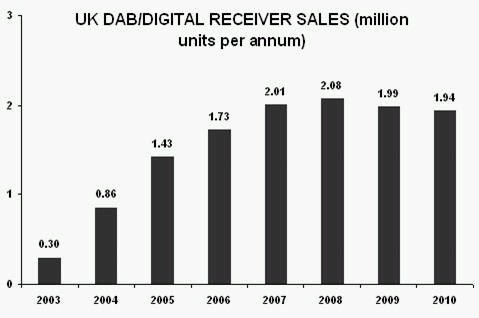
At the Westminster Media Forum conference on digital radio, a graph of DAB/digital radio receiver sales was displayed in a presentation by The Guardian’s Jack Schofield (see below):

The graph clearly showed that 2010 unit sales were down on 2009, and that 2009 unit sales were down on 2008. This data was collected by GfK.

Anthony Sethill, founder and chief executive of Frontier Silicon, took exception to this graph’s narrative of declining consumer interest in DAB radio receivers. He commented:

“My company supplies the chipsets that drive about 80% of digital radios on the market today. So, I think the panel today, with the exception of Andrew [Harrison, RadioCentre chief executive] is a wonderful example of how the minority seem to take the stage and voice the negativity and things. And, if we were to re-run Jack’s presentation again, put some facts in the correct order, and the correct facts, I think we would have a very different read. You know, it’s very difficult, when you have people like Jack that have a national platform in terms of a national newspaper, to voice these views.

So we’ll start with the GfK data. Now, GfK is actually a retail audit and, over the years, has been used by the consumer electronics and the retail trade in the UK to measure the sales of consumer electronic devices. In the last few years, GfK has been dying. The reason it has been dying is that it relies on the data – sales out data – from national retailers such as Dixons and John Lewis and Tesco and so on. Last year, Dixons pulled the plug on supplying data to GfK. That meant the largest retailer in the UK, which accounts for 25% of all sales, actually stopped giving them data. To carry on selling that data, [GfK] then had to formulate panels and most people in the industry know that, statistically, it’s not valid and that, basically, it’s falling apart. Now, you’ve quoted GfK [DAB/digital radio receiver] sales falling and I’ve given you the reasons why that data is not accurate. […]

This is a practical example of discrediting the data, which a number of people use to bash DAB. So this is one small example of how you’re misinterpreting and you’re misleading people. I don’t know if you understand what GfK is, or what it has done, or why it has fallen apart but, if you do, then that’s really poor. And if you don’t, before you quote it, you should learn the facts.”

The graph to which Sethill was referring was created by me and published in this blog last weekend (Jack Schofield had asked before the conference if he could use it in his presentation). I had first published these DAB/digital radio receiver sales data in a blog in January 2011, in which I wrote:

“1.94m digital radios were sold in 2010, compared to 1.99m in 2009 and 2.08m in 2008. Increase? No. Growth? No. Over 2m in 2010? No.”

In March 2011, these same sales figures were reprinted in The Telegraph newspaper, which wrote that “new figures showed that sales of digital radio equipment actually fell last year.”

It should be noted:
• The sales data in my graph were distributed by Digital Radio UK, the radio industry organisation marketing DAB radio in the UK
• Digital Radio UK purchases these data concerning DAB/digital radio receiver sales from GfK
• Digital Radio UK has regularly quoted these GfK data in its press releases (most recently on 23 Dec 2010 and 21 Dec 2010) and in its newsletters
• Digital Radio UK has never publicly challenged the validity of the GfK sales data that it is distributing and using in its marketing campaigns
• Until now, these data on DAB/digital radio receiver sales have been widely reported in the public domain without challenge from the wider digital radio sector.

So what is eating Frontier Silicon? It seemed wholly inappropriate for Anthony Sethill to beat up panellist Jack Schofield in public for using the digital radio industry’s OWN DATA in his presentation. If Frontier Silicon has an issue with the digital radio industry’s sales data, it should take that up with Digital Radio UK, which purchased the data from GfK and distributed them.

Perhaps the real issue is that the rewards from DAB radio have evidently still not materialised for the digital radio industry. By year-end 2009, Frontier Silicon Limited had an accumulated loss of £28m. In financial year 2009, it generated an operating loss of £536,000 on turnover of £22m. Its shareholders include Digital One (owned by Arqiva) and Imagination Technologies (which owns Pure Digital). Imagination owns 9.3% of Frontier Silicon, a stake that it wrote down by £3.4m in 2008, and then finally wrote down by a further £3.6m in 2010. As Imagination’s accounts explained:

“Due to the lower resulting valuation of the business and the impact of Frontier’s capital structure, the Group’s investment [in Frontier Silicon] has been revalued to £nil.”

I guess it must be tough for Frontier Silicon to see a shareholder value its business at “£nil.” That is no reason for its unprovoked attack on Jack Schofield’s presentation which had merely used the industry’s own data.

…………….
 
I contacted GfK for its response to the comments from Frontier Silicon. Its response was (in full):

Date: 6th April 2011

GfK Retail and Technology UK response:

GfK Retail and Technology UK currently track over 100 individual technology product categories and partner with major UK multiple retailers within every single audited channel they report on, to complement this research and to ensure GfK cover the overall market they also have a representative sample of independent retailers working with them. This means GfK are receiving weekly data from over 24,000 individual stores within the UK. The majority of these retailers deliver weekly EPOS data on their complete sales and this allows GfK to report to a detailed level on the performance of all the leading technology categories. If faced with a retailer who is not willing to participate GfK employ a widely used global research methodology to ensure they are representing the overall market.

When challenged on the GfK reported performance of the DAB market Commercial Director Anthony Norman commented “the overall technology markets have all come under increasing pressure in the last 12 months, the austerity measures announced and now being implemented by the coalition government have had a major impact on consumer confidence which has in turn impacted on retail sales of technology areas”. Norman continued in specific reference to the DAB market “the reported data by GfK is based on over 70% live reported sales by retailers, rather than focussing on the downturn of this market it would be more beneficial to put the whole picture in perspective. The overall technology market has experienced only 4 months of growth in the last 33 months. The average decline in this area is 6%, for DAB the market in 2010 declined by only 2%. Given the overall sector performance this is something that should be recognised. As a business GfK are committed to delivering actionable insight to the industries they operate within”

The GfK Group

The GfK Group offers the fundamental knowledge that industry, retailers, services companies and the media need to make market decisions. It offers a comprehensive range of information and consultancy services in the three business sectors of Custom Research, Retail and Technology and Media. The no. 4 market research organization worldwide operates in more than 100 countries and employs over 10,000 staff. In 2009, the GfK Group’s sales amounted to EUR 1.16 billion. For further information visit http://www.gfkrt.com or www.gfkrt.com/uk