KISS FM rejected, government awards first London-wide radio station in 16 years to its jazz codger chums : 1989 : Jazz FM, London

 Alongside the revolution in television broadcasting, a similar battle of the airwaves is being waged on the radio. Will this forever wipe away the narrow choices offered by existing stations? Or is it possible to have faith in a revolution being waged from Downing Street? Grant Goddard examines the background to the first franchise application in London and looks at the way ahead for both winners and losers.

It was a little after 6am when Gordon Mac made his first phone call to the Independent Broadcasting Authority [IBA]. This was the long-awaited day when it would be announced whether his station ‘KISS FM’ had won the new London radio licence. But, despite an assurance that someone would be at work in the IBA’s Radio Division at this time, a recorded message merely told him to call again during normal office hours.

Mac was bursting to know whether the last seven month’s work making a huge written application to the IBA had been a success. KISS FM had earned an enviable reputation as London’s best dance music station during four years of pirate broadcasting.

But transmissions had been stopped from December ’88, in line with the government’s demands, to try and win the single London FM licence advertised by the IBA.

Mac left home in a hurry and drove across town to the KISS FM office in Finsbury Park. The rail strike had already clogged the streets with traffic, leaving him too much time to ponder the outcome of this crazy licence lottery.

By the time he reached the office just after 8am, the day’s post had already been delivered. The embossed IBA envelope enclosed a two-page letter, but the second sentence said it all: “I am afraid the decision is, for you and your colleagues, a disappointing one.”

Thirty other applicants were opening similarly apologetic letters across the city, but there was one group who could now celebrate in style – ‘London Jazz Radio’ [LJR] had just won the first new city-wide music radio licence since ‘Capital Radio’ in 1973.

The IBA’s press conference that afternoon was a strangely defensive affair. There were not many questions about LJR, but plenty of time was spent discussing why KISS FM had failed to win. Though the IBA refused to elaborate on the relative placings of the 31 losers, KISS FM was definitely in the short-list of five or six, and most probably the runner-up.

The awkward sensitivity shown towards KISS FM’s rejection reflects an awareness that they were certainly the public’s choice for a new London station. KISS FM was the only applicant to have already established a strong awareness among Londoners of its name, its music and its presenters.

The recent success of KISS FM team members ColdcutJazzie BRichie Rich and Derek B in the pop charts has confirmed the station’s role as an important catalyst in the growth of home-produced dance music.

A further embarrassment was caused as this affair was the second occasion in recent years when a carrot has been dangled in front of pirate broadcasters to induce them to quit the airwaves. And the second time the carrot has been unexpectedly pulled away at the last minute.

The first voluntary pirate shutdown happened in 1985 when the Home Office encouraged them to apply for experimental community radio licences. Then, after lengthy prevarication and the receipt of 286 applications, the plan was abandoned.

The second carrot was offered last year with the unveiling of the IBA’s ‘incremental contract’ scheme for 21 new stations. Only those pirates who quit the airwaves before 1 January 1989 would be allowed to apply, so several stations (including KISS FM) duly complied and shut down. So now that the London licence has been awarded to a wholly non-pirate group, it was hardly surprising to see yet another carrot pulled out of the bag and shoved in KISS FM’s face.

“KISS FM put in a very strong application,” admits Peter Baldwin, the IBA’s director of radio. “IBA members felt very strongly that there were a number of applicant groups who could have been offered a contract, and we are seeking the government’s agreement to release additional frequencies so we can broaden the offers to these applicant groups.”

So KISS FM could be given a licence soon as a sort of prize for runners up?

“One has no idea where KISS FM will come in that,” says Baldwin, “but I’m bound to say that, given the government’s attitude towards pirate broadcasting, I think it would be imprudent for anyone to go back on the air if they have an aspiration towards broadcasting [legally].”

But this third carrot sounds equally precarious if it depends on the IBA’s success in evincing government agreement to more stations.

“Two more FM frequencies could be available in a short space of time – six to nine months,” explains Baldwin. “It would be for the government to decide. The IBA’s view is ‘should the listeners of London who haven’t got certain genres of broadcasting have to wait 18 months for that moment to arrive?’”

So the message to KISS FM is: sit tight, don’t do anything stupid (like return to piracy) and, some day soon, you may yet win a licence if we can persuade the Home Secretary of its political expediency.

Back in the KISS FM office, the disappointment of not winning is evident in the grim faces of a small group of station staff and presenters who are answering a stream of phone calls from well-wishers and listeners wanting to know the outcome. Three bottles of champagne sit unopened on the corner of Gordon Mac’s desk, where they remain unnoticed for the next week.

Mac himself is busy supplying quotes to enquiring journalists and does a live phone interview on the BBC London station ‘GLR’ with sympathetic soul DJ Dave Pearce. Some members of the KISS FM team who are not so close to the sharp end of the operation are unenthused by the carrot consolation prize, but Mac understands the need for cautious diplomacy now more than ever.

Seven months have already been spent raising more than £1million in capital, and a five-figure sum has been sunk into the application procedure to date.

A carefully worded press release is prepared, expressing “extreme disappointment” that KISS FM did not win the licence, but backing the IBA’s demand for more frequencies to be allocated to further London stations. KISS FM’s campaign focuses on 104.8 FM which becomes free in November when ‘Radio 1’ vacate their temporary London channel.

KISS FM presenter Heddi still feels the need for more direct action to satisfy the dozens of listeners who have phoned up asking what they can do to help. Over the next weekend, she visits several London clubs and solicits more than 3,000 letters of support addressed to the Home Office demanding the release of further frequencies for stations such as KISS FM. Gordon Mac delivers them personally to Douglas Hurd’s office exactly a week after the IBA’s fatal announcement. No acknowledgement or response is returned.

Mac seems to be treading a fine emotional line between huge personal disappointment at the outcome of several years’ hard work and cautious optimism that a licence still remains within the realms of possibility.

“Whether it takes three months or three years,” he says to GLR, “we will carry on campaigning until we are given the chance to be a legal radio station in London.”

In a more salubrious part of town, champagne bottles are being put to good use. London Jazz Radio’s nine-year campaign for a licence has paid off handsomely, particularly with its development of an all-party parliamentary lobby to argue the merits of its case.

The station’s founder, David Lee, is a 59-year-old jazz musician whose distinguished career has included TV themesjingles and the writing of Peter Sellers and Sophia Loren’s 1960 hit ‘Goodness Gracious Me’. He wrote to the IBA suggesting the idea but received a faintly dismissive reply explaining (wrongly, in retrospect) that new legislation would be necessary before such a station could be introduced.

So Lee started on the road for the necessary legislation to be enacted. “I happened to bump into a guy I’d known but hadn’t seen for over 20 years, who was an amateur drummer but also a member of the Gilbey’s Gin family and working as a board member of Grand Metropolitan Hotels.” This was Jasper Grinling, ex-managing director of International Distillers, ex-director of corporate affairs with Grand Met, and now chairman of LJR.

“He happened to know an MP by virtue of his high rank,” continues Lee, “so we asked him and, in a very short time, we had a 14-strong all-party group. I call it my ‘Parliamentary Jazz Band’. Based upon that parliamentary support, we felt we could start to move. We would literally have got nothing without it. It allowed us to get the ear of people of reason.”

The MP Bowen Wells is now a director of LJR, as is Lord Rayne, ex-chairman of London Merchant Securities plc. Fellow shareholders include Lord ColwynLord DormandEarl Alexander of TunisViscount Portman and four other MPs – Jim LesterTom PendryJohn Prescott and Nicholas Scott.

The “people of reason” Lee reached included the Home Secretary himself. Before the award of the licence, Lee admitted: “I have great admiration for Douglas Hurd and, if it hadn’t been for his understanding, we wouldn’t be in the position we are today.”

“He was one of the first people to realise that it is quite wrong for a place the size of London not to have a station to represent so large a minority. He realised it and made sure those ‘people who know’ realised it.”

Indeed, Hurd on several occasions cited a London jazz station as an example of the new type of radio service he was intending to introduce. In retrospect, this should have been observed as an omen that parliamentary lobbying had already proven effective, long before the contract for the new London service was advertised.

The IBA are understandably keen to stress it was their decision to award the licence to LJR, based upon their assertion that the station will cater for a wide variety of musical tastes. Paul Brown, the IBA’s head of programming, explains: “LJR is a jazz radio station but, in assembling their application, they did a lot of research which told them that an audience would prefer to have a jazz radio station that provided a wide spectrum of jazz including, for example, Afro-Caribbean rhythms, salsa and also some of the big band performances.”

The station’s research showed that 41 per cent of those adults sampled liked to hear jazz on its own, while 63 per cent preferred to hear it mixed in with other styles of black music. But LJR’s own programme plans actually reject these findings and propose a fairly narrow jazz-dominated music policy.

A computerised playlist system is planned which will schedule one Afro-Caribbean record every two hours, one boogaloo/soul record every two hours, and one R&B record every 12 hours. Hardly a great concession to broader tastes.

Yet the IBA insist that LJR’s intended schedule also include “a good range of music styles derived from and related to jazz, including big band music, vocal standards, R&B and forms of Latin American jazz.” This statement is inconsistent with LJR’s own description of their output as “20th century jazz and jazz influenced music” in their ‘Promise of Performance’ – the legally binding statement of their programme plans.

Selecting such a specialised music station would have proven a hard decision for the IBA to defend, particularly when other applicants such as KISS FM were proposing to integrate jazz alongside many other styles of music. So have the IBA now insisted that LJR adopt a more catholic music policy in order to make their choice more politically acceptable?

“We are specifying that there must be a broad spectrum of output,” says the IBA’s Peter Baldwin, “and therefore what LJR accept will be a Promise of Performance that the IBA will write for them and not necessarily reflecting exactly what they applied for.”

Confidence in LJR’s ability to incorporate diverse and newer styles of ‘jazz-influenced music’ is not instilled by the station’s choice of senior staff. Apart from the presence of DJ Gilles Peterson on the board, the average age of the other nine directors is 56.

All this political manoeuvring is pretty galling for the unsuccessful bidders for the licence, who see accommodations being made for LJR’s shortcomings and the IBA adopting a defensive attitude towards their choice of winner. Several applicants made a positive commitment to jazz programmes alongside other neglected forms of music. KISS FM had already enrolled Gilles Peterson as a member of their own jazz presentation team.

When LJR comes on-air in February [1990], the proof of their commitment to these diverse music styles will be evident from their first day’s programmes. In the meantime, KISS FM can only wait for a Home Office decision as to whether additional frequencies will be allocated to further London stations. The KISS FM team will not return to pirate broadcasting, but will continue to campaign for the right to have a legal dance music station in London.

A week after the IBA’s announcement, Gordon Mac called a meeting of KISS FM’s staff and presenters to explain the whole situation. There was righteous indignation among many of those present that, once again, the government had pulled a fast one and made empty promises to the pirate community, while at the same time rewarding their own friends.

There were predictions that pirate activity in London would increase as a consequence of general ill-feeling towards the authorities. There was even an undercurrent that KISS FM had been duped by the second carrot-on-a-stick and would be foolish to wait for the outcome of a further open ended half-promise. Several members of the KISS FM team were absent from the meeting. Jonathan More and Matt Black (alias Coldcut), Hardrock Soul Movement, Jazzie B and Norman Jay were all in New York attending the ‘New Music Seminar’. It’s a dreadful irony that, while many of the individuals involved in KISS FM’s championing of British dance music have recently reaped huge popular success, the station itself is now off-air and still waiting for its day to come.

Last Monday, Home Secretary Douglas Hurd finally agreed to licence two more London-wide FM radio stations. After taking legal advice, the IBA has determined that it must publicly advertise these two new contracts, inviting bids from previous applicants and new groups by a November deadline. KISS FM will be one of more than 50 likely applicants, and the outcome will be announced by the end of the year.

The writer is a supporter of KISS FM’s campaign to secure the new London waveband.

[First published as ‘Kissed Off’, New Musical Express, 26 August 1989, p.31]

[This was a small part of the bigger story recounted in my book ‘KISS FM: From Radical Radio to Big Business’ about pirate radio, the station’s subsequent licence win and successful relaunch]

[First blog published at https://peoplelikeyoudontworkinradio.blogspot.com/2025/05/kiss-fm-rejected-government-awards.html ]

The genesis of black music radio in London … still unfulfilled : 1970-1984 : Radio Invicta 92.4

 I only knew ‘Roger Tate’ (real name Bob Tomalski) through listening to his programmes on the radio. He was a DJ on ‘Radio Invicta‘, London’s first soul music radio station, launched in 1970. Invicta was a pirate radio station. Back then, there were no legal radio stations in the UK other than the BBC.

The notion of a campaign for a soul music radio station for London had been a little premature, given that no kind of commercial radio had yet existed in Britain. But that is exactly what Radio Invicta did. As Roger Tate explained on-air in 1974:

“Who are Radio Invicta? You may well be asking. Well, we’re an all-soul music radio station. We’re more of a campaign than a radio station, I suppose. We believe in featuring more good soul music on the radio.”

By 1982, ‘Black Echoes‘ music paper reported that Radio Invicta was attracting 26,000 listeners each weekend for its broadcasts. By 1983, Radio Invicta had collected a petition of 20,000 signatures in support of its campaign for a legal radio licence. There was sufficient space on the FM band for London to have dozens more radio stations. By then, local commercial radio had existed in the UK for a decade. But nobody in power wanted to receive the station’s petition and Invicta’s Mike Strawson commented:

“I have tried to speak to the Home Office about it, but it shuts the door.”

Radio Invicta eventually closed for good on 15 July 1984, the date that the new ‘Telecommunications Act’ had dramatically increased the penalties for getting caught doing pirate radio to a £2,000 fine and/or three months in jail. By then, ‘Capital Radio’ had enjoyed its licence as London’s only commercial radio music station for eleven years. Its monopoly reign was still to run for a further six years.

It might have seemed in 1984 that Radio Invicta’s fourteen-year struggle to play soul music on the radio in London had come to absolutely nothing. The Invicta team went their separate ways after the pirate station’s closure. Roger Tate continued his career as a successful technology journalist. After his death in 2001, aged only forty-seven, one of his friends, Trevor Brook, spoke of Tate’s determination to play soul music on the radio in the face of opposition from the government and the radio ‘establishment.’ His eulogy at the funeral of his friend included these comments:

“The government told the story that there were no frequencies available. Now Bob was not stupid. He had enough technical knowledge to know that this was simply not true. So, either government officials were too dim to realise the truth of the situation … or they were just lying. Nowadays, we have 300 independent transmitters operating in those same wavebands, so you can probably work out which it was. Anyway, in Britain, the result was that any proper public debate about the possible merits of more radio listening choice was sabotaged by this perpetual claim that it was impossible anyway.

So, we had pirates. Other countries which had not liberalised the airwaves had pirates as well, but some of them took the refreshingly realistic approach that no harm was being caused, and they permitted unlicensed operations to continue until they got round to regularising the situation. Ambulances still reached their destinations and no aeroplanes fell out of the sky. Not so in this country though. The enforcement services here were too well funded and the established orthodoxy too well entrenched. That ‘frequency cupboard’ was going to be kept well and truly locked!

Bob had thrown himself into running a regular soul station, Radio Invicta. He built a studio, tore it apart and built a better one. He eventually sectioned off part of the flat as a separate soundproofed area. He built transmitters – and got them working. But Bob was nothing if not multi-skilled, and he excelled in producing the programmes themselves. Using nothing more impressive than an old four-track reel-to-reel tape recorder, Bob would create highly polished jingles and station identifications. ‘Roger Tate, super soul DJ.’ Other stations, both official and unofficial, listened to what Bob and his colleagues did and their ideas were copied or imitated.

Faced with the authorities, Bob was remarkable, because he was absolutely fearless. He was certain they were in the wrong and, given enough time, were going to lose the battle. It was a war of attrition and only perpetual piracy was ever going to bring about change. And he was quite right about that. The government kept winning the battle in the courts but began to lose the moral one. Eventually the law was changed. 

Do we have free radio now? In the sense that anybody can decide to start up a new magazine, find the finance and get on with it, no, we don’t have that for radio. The process is bound up with a longwinded regulation and approval process involving a statutory body which has had its fingers burnt in the past by the odd bankruptcy and the odd scandal. So they play safe and issue more licences to those who already have stations. The consequence is that originality and creativity get crushed into blandness and mediocrity. My own teenagers constantly flip between stations in the car, but they don’t care enough about any of them to listen indoors. Fresh people don’t get to control stations. Behind boardroom doors, they might think it privately, but in what other industry would the chairman of the largest conglomerate in the market dare to say publicly that even the present regime was too open and, I quote, ‘was out of date and was letting inexperienced players into the market’? That is a disgraceful statement. Where would television, theatre, comedy, the arts, and so on be, if new and, by definition, inexperienced people didn’t get lots of exposure? The industry is stale, complacent and rotten. Bob, there are more battles out there and we needed you here.”

Ten years later, these words are just as pertinent. It is hard to believe that a bunch of enthusiastic soul music fans who wanted to play their favourite music to their mates could have posed such a threat to the established order. But the history of radio broadcasting in the UK has demonstrated repeatedly that ‘the great and the good’ consider the medium far too important to let control fall out of their hands. Their arguments, however ridiculous, were taken completely seriously because they were the establishment.

Peter Baldwin, deputy director of radio at the ‘Independent Broadcasting Authority’ [regulator], said in 1985:

“We wouldn’t want to be dealing with two current local stations [in one area]. If it’s Radio Yeovil [operating as the only commercial station in Yeovil], well, that’s okay … But we couldn’t subscribe to competition [for existing local commercial pop music station Swansea Sound] from Radio Swansea, unless it was in Welsh or concentrated on jazz – and there probably wouldn’t be sufficient demand for that kind of service.”

James Gordon (now Lord Gordon), then managing director of ‘Radio Clyde‘, wrote in ‘The Independent‘ newspaper in 1989:

“It has to be asked whether there is really evidence of pent-up demand from listeners for more localised neighbourhood stations … Eight to ten London-wide stations would be enough to cater for most tastes.”

David Mellor MP told the House of Commons in 1984:

“The government do not believe that it would be sensible or fair to issue pirate broadcasters with licences to broadcast. To do so, on the basis suggested by the pirate broadcasters, would be progressively to undermine the broadcasting structure that has evolved over the years.”

However, within five years, the government did indeed license a pirate radio station to broadcast in London. Once Invicta had disappeared in 1984, it was superseded by newer, more commercially minded, more entrepreneurial pirate radio stations – ‘JFM’, ‘LWR’, ‘Horizon’ – that played black music for Londoners. In 1985, a new pirate station called ‘KISS FM’ started, quite hesitantly at first. Its reign as a London pirate proved to be much shorter than Invicta’s but, by the time KISS closed in 1988, it was probably already better known than Invicta.

KISS FM went on to win a London radio licence in 1989 and re-launched legally in 1990. It carried with it the debt of a twenty-year history of black music pirate radio in London started by Radio Invicta and then pushed forward by hundreds of DJ’s who had worked on dozens of London black music stations. KISS FM would never have existed or won its licence without those pirate pioneers.

Sadly, the importance of KISS FM’s licence as the outcome of a twenty-year campaign seemed to be quickly forgotten by its owners and shareholders. The lure of big bucks quickly replaced pirate ideology during a period of history when ‘get rich quick’ was peddled by government as the legitimate prevailing economic philosophy. KISS FM lost the plot rapidly and soon became no more than a money-making machine for a faceless multimedia corporation.

Right now, there remains as big a gap between pirate radio and the licensed radio broadcasters as existed twenty years ago or even forty years ago. London’s supposedly ‘black music’ stations, KISS FM and ‘Choice FM‘, now sound too much of the time like parodies of what they could be. Whereas pirate radio in London still sounds remarkably alive, unconventional and creative. More importantly, only the pirates play the ‘tunes’ that many of us like to hear.

The issue of how black music was ignored by legal radio in London, and then betrayed by newly licensed black music radio stations, is on my mind because of my new book ‘KISS FM: From Radical Radio To Big Business.’ It documents a small part of the history of black music pirate radio in London, and it charts the transformation of KISS FM from a rag tag group of black music fanatics into a corporate horror story. I was on the inside of that metamorphosis and it was an experience that, even twenty years later, remains a sad and terrible time to recall.

In 1974, Roger Tate had wanted more black music to be heard on the radio in London. Ostensibly, that objective has been achieved. But the black music I hear played on white-owned stations in London (there is no black-owned station) is a kind of vanilla ‘K-Tel‘ ‘black music’ that is inoffensive and unchallenging.

If Croydon is the dubstep capital of the world, how come there is no FM radio station playing dubstep in Croydon, or even in London? How come I never hear reggae on the radio when London is one of the world cities for reggae? How come I had to turn to speech station ‘BBC Radio Four‘ to hear anything about the death of Gil Scott-Heron in May? Why is it that Jean Adebambo’s suicide went completely unremarked by radio two years ago?

Legitimate radio in London seems just as scared of contemporary cutting-edge black music as it was in the 1970’s when Roger Tate was trying to fill the gaping hole with Radio Invicta. Nothing has really changed. Except now there exists the internet to fill that gaping hole. And FM pirate radio in London continues to satisfy demands from an audience that legitimate radio has demonstrated time and time again that it doesn’t give a shit about. Is it any surprise that young people are deserting broadcast radio?

Forty years ago, I listened to Roger Tate and London pirates like Radio Invicta because they played the music I wanted to hear. Forty years later, I find it absolutely ridiculous that I am still listening to a new generation of London pirates because they still play the music I want to hear. As Trevor Brook suggested at Roger’s funeral, our radio system is so consumed by “blandness and mediocrity” that “the industry is stale, complacent and rotten.”

Roger Tate R.I.P. You may be gone, but you and your campaign at Radio Invicta are as necessary as ever today. Sad but true.

[First published by Grant Goddard: Radio Blog as ‘Radio Invicta: The Genesis Of Black Music Radio In London … Still Unfulfilled‘, 1 July 2011. Available as download.]

[Republished at https://peoplelikeyoudontworkinradio.blogspot.com/2024/05/the-genesis-of-black-music-radio-in.html ]

Walking on the Chinese glass ceiling : 2004 : FM 102 Radio, Women’s Media Centre of Cambodia

 I was standing over the motionless body of my line manager. He was dead to the world, naked under the sheet on his bed. Neither my arrival in his studio apartment through its wide-open front door, nor the chatter of little ‘street boys’ passing up and down the building’s internal staircase, nor the morning sunshine streaming through the open windows, nor the noise of rush hour traffic on the road below seemed to have stirred him. Should I call out? Should I nudge him? Since the limit of my responsibilities to the BBC had already been sorely tested by a recent health & safety ‘issue’, I decided that playing butler to my boss would stretch my patience one step too far. I turned around, leaving him asleep, walked out and descended the stairs to rejoin the driver waiting out front in the BBC SUV.

It was the ‘big day’ in March when my trainees were to interview candidates for two radio presenter jobs. Charles ‘Chas’ Hamilton had asked to attend too, so I had arranged a detour at eight o’clock to pick him up en route from my hotel to the radio station. This was unusual because, to date, he had demonstrated scant interest in my 28 hours per week of sessions training teams at two Phnom Penh radio stations in production skills, apparently preferring to remain at his desk in the air-conditioned, open-plan BBC office. On my arrival in Cambodia, rather than having furnished a training plan or schedule, Hamilton had invited me for an evening meal in his apartment, bending my ear with gossip about the BBC World Service Trust’s recently arrived Canadian manager. Now I was having to spend what remained of my seven-day working week determining which skills I needed to demonstrate to my teams and how to instruct them when I understood not one word of Khmer. 

Hamilton was oblivious to the supreme irony of my bedside presence that morning. Before departing London, BBC management had confided that, only after having signed contracts in December 2003 to supply radio training to two Cambodian stations, had it understood that its prior internal appointee to head the country’s radio projects had no experience producing live radio programmes. Having been hurriedly headhunted as a result of my international track record in radio production and presentation during three decades, my latest mission was necessary solely to bail out a consequence of the Corporation’s arcane appointment system. Meanwhile, in spite of my radio experience, my own applications over two decades for 43 BBC vacancies had resulted in thirteen interviews but not a single job offer.

Although the BBC contract required me primarily to train in radio production, it quickly became evident that, in order for my young but enthusiastic trainees to appoint inexperienced presenters for the station’s new youth phone-in programme, I needed to teach them how to word a job vacancy advertisement, shortlist applicants, interview candidates and take personnel decisions. They were fortunate that, after a decade assisting in my father’s self-employed architectural business, I had taken my first management post in 1978, hiring and firing people since then and managing teams of more than fifty. In Cambodia, my role became necessarily upgraded to informal ‘management consultant’ despite having had to accept a BBC freelance pay rate lower than the mediocre job at Ofcom from which I had just resigned in the UK … and undoubtedly lower than Hamilton’s pensioned salary as head of radio.

On arrival at the Women’s Media Centre that morning, I found my trainees already assembled in the first-floor radio studio to commence job interviews. I waited in the downstairs lobby to greet the candidates (a bow accompanying ‘hello’ the limit of my Khmer communication skills) and usher them upstairs. However, as Hamilton had yet to arrive, the schedule soon started to run over and resulted in successive applicants seated together in the reception area, a situation I had hoped to avoid. Eventually appearing apologetically an hour late, Hamilton would never be told about that morning’s ‘sleeping beauty’ encounter. It was more important to proceed with the tasks at hand.

During previous weeks’ sessions, the trainees had agreed upon three candidate tasks: an interview by the production team with a prepared list of questions allocated to each member; a script I had written and had translated, to be read into a studio microphone for recording; and a faked phone conversation recorded with a production member pretending to be a caller, to test each potential presenter’s spontaneity and improvisation skills. None of the candidates had prior radio experience, which it why it was imperative to identify ‘potential’ rather than ‘accomplishment’. The planned radio show was destined to become Cambodia’s first live youth phone-in, for which we needed one male and one female presenter.

Having completed the interview round, we broke for the mandatory two-hour lunch, me and Hamilton returning to the BBC office by car. I shared lunch with local staff at the kitchen table, while Hamilton took his usual sojourn with the ex-pat employees to a local restaurant. Afterwards, he did not accompany my return to the radio station for the afternoon session in which my trainees discussed and contrasted the candidates’ performances, assisted by BBC translator Keo Sothearith. I was incredibly impressed by the professionalism with which they ranked the candidates against criteria we had previously decided and then unanimously agreed upon the most suitable pair of applicants.

I was pleased that the whole interview process had been done and dusted so competently and quickly. However, just as I was ready to pat myself on the metaphorical back, a passionate conversation broke out amongst my trainees that the translator seemed reluctant to explain in English. I had to press him repeatedly to tell me what new issue had arisen, since there had been undivided agreement only a few minutes earlier.

“They say it is not possible to employ the woman because she is Chinese,” he explained embarrassedly. “They agree she is the most competent … but the job has to be given to a Khmer woman.”

I was shocked. Clarification was necessary for me to understand this issue. Though I could not discern the distinction, I was told the woman was ethnically Chinese (0.6% of Cambodia’s population) though not a recent immigrant, apparently speaking Khmer perfectly. Wikipedia explains:

“Most Chinese are descended from 19th–20th-century settlers who came in search of trade and commerce opportunities during the time of the French protectorate.”

I had read about ethnic tensions in Cambodia, but primarily involving neighbouring Thailand with which there had long been territorial disputes. In January 2003, following an alleged remark by Thai actress Suwanna Konying that Cambodia’s Angkor Wat temple actually belonged to Thailand, a mob in Phnom Penh had burnt down the Thai embassy and attacked Thai businesses, forcing the evacuation by military aircraft of 400 Thai citizens to their homeland. I had recently passed Thailand’s newly opened replacement embassy in Phnom Penh, surrounded by high walls for improved security.

A 2021 academic paper reported:

“Although anti-Chinese riots are rare in Cambodia, the ethnic Chinese in Cambodia during the Khmer Rouge era experienced some of the most severe repression in the world. The situation had improved by the 1990s, following the Hun Sen government’s abolishment of discriminatory policies towards them.”

The Minority Rights Group noted:

“After 1990, [the Chinese] were allowed to celebrate Chinese festivals and religious practices, then to re-establish Chinese associations and conduct business activities. They subsequently started operating their own schools…”

For the next hour, I felt compelled to argue that it was morally wrong to discriminate against a job applicant purely on the grounds of their ethnicity. It was essential to appoint the best candidate for the job. I told my trainees that the BBC would never countenance such behaviour and, since the BBC was funding their training, it was essential to follow guidelines set out within the BBC editorial handbook (a copy of which I usefully brandished from my briefcase). The trainees had already written a sign that said ‘BBC office’ (in Khmer) on their production room within the radio station, even though they were not BBC employees (as neither was freelance me).

However, I was internally conflicted by my own argument. As a 43-time applicant to the BBC who had been rejected 43 times, I was well aware from personal experience that discrimination was alive and well and living inside the Corporation. Following one of my post-interview rejections at the end of a three-month wait, I had phoned the BBC to ask precisely why I had been rejected yet again and was informed that it would be necessary for me to prove to interviewers that I was “one of us”. The unspoken implication was that I could not join the BBC ‘club’ unless either I was posh, spoke a certain way, had attended private schools or been educated at Oxford or Cambridge. Perhaps I needed a relative who was already employed there. None of the above qualified me.

Even BBC director general Greg Dyke had commented in 2001:

“I think the BBC is hideously white. […] The figures we have at the moment suggest that quite a lot of people from ethnic backgrounds that we do attract to the BBC leave. Maybe they don’t feel at home, maybe they don’t feel welcome.”

Though I had the advantage of being white, it was evident that the BBC discriminated on multiple levels. During the decades since my love of radio had blossomed at primary school, my ambition had always been to work in BBC radio. Apart from my current freelance contract, dispatched to the opposite side of the world due to the Corporation’s ineptitude, my dream was never to be realised.

In the end, I had to give up arguing with my trainees. Cambodia was not my country. I could not pretend to understand its culture or heritage. Its history was turbulent. The people’s identity was complex. I gave in to their desire to appoint the second-best female candidate for the job. I hated myself for giving in. I had been on the receiving end of discrimination on too many occasions over too long a period in several countries. But I had lost the argument. I returned to the BBC office with the names of the two presenters whom the team had chosen. Yes, I confirmed, they were the best candidates (cringe). Both quickly became astoundingly competent radio presenters.

Later that month, Charles Hamilton arrived in our Phnom Penh office one morning and explained that he had lost a BBC laptop computer on the journey from home. It would need to be replaced. Within the hour, the number of laptops he said he had lost that day had increased to two. His comments, combined with the memory of my early morning visit to his apartment, made me contemplate that the BBC staff induction programme should be appended with an additional topic: ‘How to close and lock the front door of your accommodation’.

https://drive.google.com/file/d/1glfc6ziCi-9bWg4buIj-29rSK-1hV88f/preview

During the decade following my extended mission in Cambodia, I applied for a further twenty BBC job vacancies and was rejected for all.

[Originally published at https://peoplelikeyoudontworkinradio.blogspot.com/2024/04/walking-on-chinese-glass-ceiling-2004.html ]

One good turn deserves a cold shoulder? : 2004 : BBC World Service Trust, Phnom Penh

“I understand you’re an expert in messaging,” said the woman sat behind the desk.

I looked blank. I had absolutely no idea what she was talking about. If she meant SMS text messaging, I did not even own a mobile phone!

“I was told you are experienced in capacity building,” continued the woman, undeterred.

I looked even more blank. What on earth was she talking about? I had just flown half way around the world. This was my first meeting with the boss of the project where I was to work. Yet I had zero understanding of what she had just said. I began to wonder if the office back in London had mistakenly sent the wrong person (me) to the wrong location (Phnom Penh, Cambodia). Did she think I was someone else? I had been sent here to do radio training. Had the international wires become crossed somewhere?

It took me several weeks to understand that Giselle Portenier, manager of Cambodia’s BBC World Service Trust project, had been addressing me in ‘NGO-speak’, an esoteric language I had never before encountered. People working in such ‘Non-Governmental Organisations’ (er, international charities) apparently use terminology that substitutes long words for concepts which the rest of the world refer to with short words. Some might call this professional obscurantism.

During my first week, Portenier insisted I attend a two-day workshop organised by the Centre for Disease Control concerning drama programmes created to communicate health issues to the population. My takeaways were that NGO staff love the sound of their own voices and try their utmost to turn simple tasks into overcomplicated diagrams and flow charts. I strained to stay awake in Cambodia’s oppressive daytime heat and quickly tired of hearing NGO people talk to each other in a language that was apparently English, but might as well have been Mongolian for all I could understand. Luckily, I managed to excuse myself from a similar two-day workshop about ‘messaging’ the following week.

Why was I in Cambodia? In July 2002, I had been unemployed and applied in desperation for an advertised role with the BBC World Service Trust in Ethiopia. The only thing I recall about that interview was sitting alongside dub poet Benjamin Zephaniah (born two days before me!) in the lobby of Bush House. Having neither attended Oxbridge nor benefited from a family member or acquaintance employed in the Corporation, I was hardly surprised to receive my thirty-seventh consecutive BBC rejection letter. The Holy Grail I had coveted since childhood was receding further over my horizon with every CV submitted.

Fast forward to December 2003. I was in a dead-end job at Ofcom where my line manager Neil Stock had met me on Christmas Eve to say “there is nothing for you to contribute to” the media regulator’s work schedule during the first quarter of the next year. I had just discovered a voicemail message on my work phone from the BBC, asking if I was the ‘Grant Goddard’ who had applied for a job the previous year. My contact details had proven a dead-end and it had resorted to contacting a referee in the United States I had listed who advised that I now worked for ‘The Radio Authority’ … which was found to have closed. I phoned back, confirmed it was me and explained that I had since changed address. Would I be interested in a consultancy role lasting two to three months? Though I had accrued eight weeks’ unused holiday at Ofcom, it refused me paid or unpaid leave to pursue this opportunity … so I resigned.

Roy Head, director of the BBC World Service Trust’s health division, explained by phone that a contract had recently been signed between the Cambodia government and the Corporation to train local staff at two radio stations to produce phone-in shows around health issues. A decade earlier, he had managed the United Nations’ radio station ‘UNTAC’ in Cambodia. Head confided that, only after signing this contract had he discovered that the BBC’s ‘executive producer, radio’ in Cambodia, despite having held numerous posts within the Corporation since 1987, apparently had no experience producing a live radio programme. Neither had the Cambodia project manager who had produced television documentaries for the BBC since 1986. I respected Head’s honesty when he admitted my involvement would help him out of a very large hole. The Cambodia government was becoming increasingly impatient for the training to start, necessitating my arrival as quickly as possible. Yes, the pay (£750 plus US$100 pocket money per week) was not great because it had had to be unexpectedly eked out of an existing budget, but Head promised me better paid similar BBC work afterwards if I would solve his pressing problem.

I nearly never made it to Cambodia. The nurse I was mandated to visit at BBC White City could not locate the required ‘BCG’ vaccination on my left arm and threatened to block my departure for several weeks to redo it. Was I born in Britain? Yes. Did I have paperwork proving I had received the vaccine? Er, I was a child. Where did I receive it? In a health clinic, long gone, at the corner of Upper College Ride and Saddleback Road on the Old Dean Estate in Camberley, 200 metres from the house in which I had been born. After an extended interrogation, as a last resort she inspected my right arm and found a faint tell-tale circular mark there, and expressed astonishment that I was the first person she had encountered with it on the ‘wrong’ arm. All I could presume was that some nurse in the 1960’s had decided it would never matter as council estate children were destined to go nowhere anyway.

On arrival in Phnom Penh, my line manager Chas Hamilton invited me to homemade dinner in his flat and filled my head with gossip about his BBC colleagues. He was particularly incensed that his boss Portenier, before her recent arrival, had allegedly demanded her flat be remodelled at considerable public expense to include, shock horror, a sunken bathtub. As a short-term consultant (given BBC contract number WST001), I preferred to avoid such office politicking. I chose to keep my burning question – how is a BBC employee promoted to a radio management role without having produced a live radio programme? – to myself. The Corporation evidently worked in mysterious ways.

After a morning visit to one of the radio stations in Phnom Penh at which I would be working, the Cambodian BBC driver was en route to the office when I requested he stop for me to buy a takeaway lunch.

“I will take you to a hotel for lunch, sir,” he kindly offered.

“No, thank you,” I said. “I can buy something at one of these roadside shacks and eat it at the office.”

“But they only serve noodles, sir,” he explained patiently.

“Yes, and that is what I want for lunch,” I insisted.

Despite his complete puzzlement, he parked the BBC four-wheel-drive alongside a random food stall, translated my order into Khmer and, minutes later, I left clutching a knotted transparent plastic bag containing my freshly stir-fried order for less than a dollar. At the BBC office, I went to the kitchen, requested a plate, emptied out my food and sat at the dining table to eat it, much to the amazement of the Cambodian staff. My new colleagues found it hard to believe that I ate noodles at home all the time.

From that day forward, I joined the local staff for lunch daily in the BBC kitchen, with between five and fifteen of us gathered around the large dining table for the mandatory two-hour break inherited from French colonialists. Each of us paid the BBC kitchen manager a dollar a day to take our preferences and venture out to numerous street stalls to fulfil our orders. The food was always fantastic and the company was excellent, though I could not understand the Khmer chatter. The project’s Cambodian receptionist sidled up to me and explained with awe:

“In all the time we have been here, not one of the foreigners working here has sat down and ate our food with us, except on special occasions such as Chinese New Year.”

So where did all the ‘foreigners’ go every day? On one occasion, sat at the kitchen table ready to eat lunch, Portenier approached me and insisted I accompany her and the other ex-pats ‘out’. We were driven in several cars to an international hotel that appeared completely devoid of guests, where we were offered menus and then waited over an hour in the lobby for our dishes to arrive. The food, the surroundings and the conversation were all mediocre, though I presume that the BBC was picking up the tab for its employees’ daily lunchtime jollies to various Phnom Penh hotels. Thankfully, I was never invited again.

The BBC had initially ordered my air ticket to return to London three months later. As my work was still far from complete, I had to spend three hours sat uncomfortably on a long wooden bench in a tiny Phnom Penh travel agency that attempted to change the date … unsuccessfully. I decided unilaterally to use the ticket (rather than waste it) to fly home for a quick visit, only to discover that Roy Head, having sent me to Cambodia, was no longer with the BBC, reportedly having become ill after a work trip to Brazil. Back in London, I was called to a meeting with his successor at Bush House, a brusque woman who demonstrated little interest in my work but asked me to spy on my line manager Chas Hamilton and report what he was or was not doing. I refused. I had been hired as a consultant solely to train people in radio, not indulge in espionage. The BBC booked my new ticket to return to Cambodia a week later and gave me boxes of radio equipment to transport in my heavily surcharged, overweight suitcases.

Returned to Phnom Penh, when one of my station projects was about to launch its new weekly live youth phone-in show, I drafted a press release and asked Portenier to approve it, transpose it onto BBC notepaper and circulate it through established PR channels. She refused. I was perplexed. Surely it was positive news to herald the successful completion of part of the BBC’s contract with the Cambodia government. Apparently not. In order not to disappoint the radio station’s production team with whom I had worked so closely for months, I was reduced to secretly commandeering a BBC car and driver when Portenier was absent from the office in order to hand deliver to each of Phnom Penh’s newspapers my press releases in Khmer and English that omitted mention of the BBC’s involvement.

This negative response was very dispiriting as it appeared that neither my local project manager, nor my local line manager, nor the replacement BBC manager in London seemed even vaguely appreciative of my success saving their bacon. My second radio station project was almost ready to launch too but I considered now was a good time to return home, having already spent twice as long in Cambodia as my contract had required. The local BBC staff organised a fantastic farewell party for me in the office and gave me presents. Neither Portenier nor Hamilton attended. To be accurate, Hamilton arrived at work after it had finished. At the airport, several of the wonderful Cambodian radio station staff I had trained arrived unexpectedly to see me off. They cried. I cried. They and the lovely local office staff had made my work worthwhile.

By the time I landed in London, my BBC e-mail account had already been cancelled, preventing continuing contact with my colleagues in Cambodia. I sent Portenier an email apologising (ahem!) for not having seen her before I left and thanking her for “all her help”. Her reply lacked a shred of gratitude:

“I know you were planning to do a handover report for David. Did that happen? I know he tried to get in touch in England, but failed.”

My BBC contract had not required me to write a report. Besides, in Cambodia I had been fully occupied each week spending four days from 8am to 5pm training two teams, one day in the radio studio and two days preparing materials for my next sessions, without any BBC input. Meanwhile, the project’s head of radio seemed to have spent most of his time sat in his cosy BBC office. Neither did I know who ‘David’ was. Nevertheless, I offered my services to help out for free in the BBC’s Bush House office, hoping to avail myself of future opportunities. I submitted six applications for advertised vacancies in the BBC World Service Trust during 2004 and 2005, for one of which I was interviewed, but without success. Nobody in the BBC thanked me for my work bailing it out in Cambodia or offered me the better paid, follow-on opportunities I had been promised. I had no idea how to contact Roy Head once he had left the BBC.

When I signed on for Unemployment Benefit, my most recent work in Phnom Penh was viewed suspiciously because, whilst I had been away, British tabloid newspaper front pages had splashed stories about 1970’s pop star ‘Gary Glitter’s exploits with underage boys in Cambodia. The young ‘JobCentre’ officer instructed me to apply for a radiology vacancy in a local hospital, not comprehending it was totally unrelated to radio production.

Giselle Portenier completed one year in charge of the Cambodia project before leaving the BBC and returning to Canada.

In 2006, Chas Hamilton lauded the youth phone-in radio show I and my trainees had created as the project’s “most popular”, noting that “all members of the production team … had no previous media experience before we plucked them from university and trained them.” His invisible ‘executive production’ role while I was there had apparently proven so successful that the BBC promoted him to manage their entire Cambodia project. I hope he enjoyed the accompanying apartment’s sunken bathtub he had seemed to envy so much.

[Originally published at https://peoplelikeyoudontworkinradio.blogspot.com/2023/11/things-you-say-you-love-youre-gonna.html]

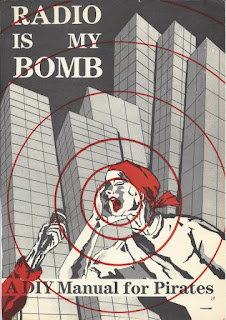
Radio is my bomb? : 2003 : the DAB digital radio customer complaint hotline, The Radio Authority

 The Bomb Squad arrived in vans, ran into the Holborn office block and up its staircase to the eighth floor. We watched events unfold from the car park below, the assembly point to which our organisation of forty-odd people had been evacuated an hour earlier.

That humdrum morning had been interrupted by a large cardboard box delivered by Royal Mail to our office. It was not particularly heavy but had lots of stamps on the outside with a ‘Belfast’ postmark. If you were a celebrity or public figure whose opinions were widely distributed, you might anticipate threats would occasionally be made against your life. If you had a desk job in a little-known British government quango, your greatest work challenge might normally be choosing where to lunch. However, that morning, the box’s addressee Soo Williams was taking no chances. The emergency services were called.

Eventually, the ‘suspicious package’ was removed by ordnance experts and exploded elsewhere. It was found to contain nothing but paper. Printed petitions signed by hundreds of Belfast citizens demanding that religious community radio stations be licensed locally. Williams’ name had been written on the box due to her recent promotion by The Radio Authority to manage the launch of ‘community radio’. Returning to our desks after the false alarm, I ruminated what those god-fearing citizens who had toiled to gather so many signatures might have thought of having been suspected by the recipient of being terrorists.

That morning’s event exemplified the disconnect between the regulator of the radio industry and the public it was supposed to serve. Someone with an interest in the UK community radio movement would have known that tiny unlicensed radio stations had existed for years on both sides of the Irish border, broadcasting church services and information to their communities. Indeed, one history argues that the Catholic Church in Ireland was “the world’s largest pirate radio operator”. However, few of The Radio Authority’s desk-bound administrators demonstrated interest in the medium they were employed to regulate. I was the only employee to have worked in a community radio station (licensed in a 1970’s experiment), having been a founder member of the Community Radio Association two decades previously. But now, within this dysfunctional workplace, I was regarded as the office junior … at the age of forty-four.

Back at my desk, I returned to taking regular phone calls from members of the public dissatisfied with the new-fangled DAB ‘digital radio’ receiver they had just purchased. I never quite understood why the switchboard regularly passed such calls to me, as I bore no responsibility for DAB radio, and my colleagues in the Development office suffered no such impositions. It was already self-evident to me that the rollout of this new radio technology had been disastrous for listeners, though I was expected to defend the system, and worse … to blame the listener for its inadequacies.

Staff were issued with a ‘helpful’ sheet of topics to raise with complainants about DAB. Suggestions to be made to members of the public experiencing difficulties tuning into stations on their new receiver included:

  • move your radio nearer a window
  • listen to the radio in an upstairs room
  • your residence might be constructed of the wrong materials
  • your residence might be located in a valley
  • your residence might be located in a dense urban area
  • your residence might be in an apartment block or a basement
  • you may need to install a rooftop antenna.

Many callers were understandably baffled and annoyed by these ‘answers’ to their problems, proffering a torrent of abuse or hanging up. Many had spent around £90 on a portable DAB receiver and expected it to deliver what the industry’s marketing had promised – ‘crystal clear’ reception of a wide choice of radio stations. The most popular receiver, the ‘Pure Evoke-1’, had been designed to be portable and had no socket to even attach the suggested external antenna, let alone the connectivity to update and improve its software. And why did it resemble a wooden post-war radio in an era when connected mobile phones were looking increasingly futuristic?

One of my callers’ commonest gripes was the result of DAB radios having been marketed and sold nationwide, even though many parts of Britain had yet to be connected to the DAB transmission system. In this instance, all I could suggest was that the consumer return their receiver to the shop and demand a refund because no digital stations were yet audible locally. I too shared this problem because, although The Radio Authority had denied me its Christmas cash bonus in 2002, I had received the DAB radio gifted to all staff. It remained in its box as I was living in Brighton, where DAB transmissions had yet to arrive.

The root of the dissatisfaction with DAB radio was not the technology itself, which had been a smart European innovation, but the way it had been implemented by Britain. Those critical roll-out decisions had been made by people like the ones in my workplace: administrators who had no experience working within the radio industry, encouraged by technologists keen to promote anything ‘digital’ with an evangelical fervour, oblivious as to whether consumer demand was evident. At the top of this unholy group of conspirators were government civil servants who mistakenly believed that Britain and British industry could dominate global markets by adopting a technological standard in which the rest of the world had shown scant interest. Meetings of this cabal seem to have merely intensified their cult-like determination.

The stumbling block their paper plan faced was the disinterest of the commercial radio industry itself which, at that time, was profitable and had expressed no dissatisfaction with its existing, robust FM radio transmission system. When The Radio Authority advertised the first national DAB multiplex licence in 1988, it faced the very real possibility that no radio companies would submit bids. To avoid this embarrassment, the regulator had to ‘strongarm’ Britain’s largest radio group into making the only application. GWR Group plc’s then chief executive Ralph Bernard later admitted:

“GWR was encouraged to apply for the national [digital] licence, and was under some pressure to invest in the opportunities for a national licence from the then regulator [The Radio Authority]. Had we not done it, there would be no national DAB platform now. Not only that, [the regulator] did not know what they would have done on the question of national radio stations with regard to the opportunities given by the then government to renew their national licences for a further period of time if they were to commit to going digital. But how can you [do that] if there are no opportunities to go digital because there is no national multiplex? When I put that question to The Radio Authority, I was told that the answer was: ‘We don’t know what would happen – there is no Plan B’. It was just an assumption that someone would go for [the national DAB multiplex].”

“When we were seduced into believing that this was going to be the only [national digital] licence, we realised that there would be substantial losses, but the payback would be when you have the opportunity to be the only player in the national market for DAB. When it’s The Radio Authority, an agency of government, you tend to believe what you are told. On that basis, the investment was justified and, at the time, getting it through my Board was not easy.”

Having rescued the regulator from potential embarrassment in its ill-judged pursuit of the DAB dream, Bernard naturally now held some sway over The Radio Authority and its decisions. There evidently did exist such a thing as a free lunch for its senior managers when Bernard would invite them to The Ivy restaurant in anticipation of outcomes coincidentally beneficial to his business. On two occasions at the regulator, my actions threw a spanner into this cosy relationship and I suffered consequences (see blogs here and here) from my bosses, despite me having acted in what I believed was the public’s interest. I learnt to my professional cost that I was supposed to be a ‘civil servant’ to commercial interests, not to our citizens.

How did the story end for commercial radio? Badly. GWR Group plc’s subsequent merger with Capital Radio Group plc, both profitable public companies prior to their investment in DAB, proved a financial disaster, their DAB assets were divested for a song, an offshore investor acquired the merged business and Bernard exited the industry. This tragedy was repeated in the lower echelons of the radio business when the entire UK commercial radio industry had to be rescued by private investors. Most local radio stations that had existed since the 1970’s were replaced by national ‘brands’. Local content all but disappeared. Thousands of radio professionals lost their jobs.

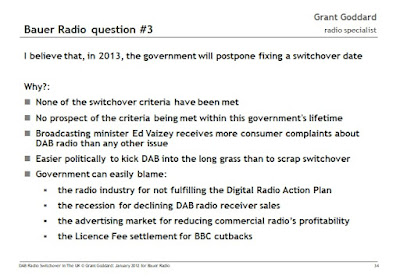
How did the story end for DAB radio? Even worse. In a presentation I was commissioned to make to the board of the second largest radio group in 2012, I predicted that the government would kick the much heralded ‘digital radio switchover’ date into the long grass. I was pooh-poohed by the company’s technologists at the meeting, but my predictions came to pass … while theirs turned to dust. Naturally, I was never invited back. British commercial radio’s enormous investment in the disastrous DAB platform impoverished the entire sector, reducing it to little more than a jukebox music service for listeners who lacked Spotify accounts.

The deluded dream finally died in 2016 when ‘Pure Digital’, the ‘great white hope’ of British designed DAB radio receivers (though manufactured in China), was sold to Austrian company ‘Aventure AB’ for £2.6m, following its £7.9m loss during 2015/6 as a result of declining sales and its “significant stock” of unsold radio inventory so old that it “needs to be assessed for risk of obsolescence.”

With the advantage of hindsight, the entire DAB debacle now seemed like a rehearsal for the similar self-harm caused by Brexit a decade later. Men in suits with little or no experience of working in the real world of commerce pursued a fever dream regardless of its practicality, oblivious to its outcomes but buoyed by their mistaken sense of superiority. Their project was to foist a uniquely ‘British’ solution on the population that would purposefully diverge the UK from the rest of the world (British DAB radios would not even function in France). Their words and documents were stuffed with misinformation and downright lies that supposedly supported their theories. Without their posh accents, they could have been mistaken for used car dealers.

Despite the wilful destruction of the commercial radio sector’s economic value, talent, creativity and public service that they had fomented, many of Britain’s DAB ‘protagonists’ went on to be lauded with industry awards, honours and lucrative jobs. For anyone who followed the Brexit disaster, it will sound like all too familiar a story.

[Originally published at https://peoplelikeyoudontworkinradio.blogspot.com/2023/10/radio-is-my-bomb-2003-dab-digital-radio.html]

Don’t play that song for me : 2004 : unusual FM radio formats, Phnom Penh

 Here in Phnom Penh, there are seventeen radio stations on the FM dial, even though Cambodia’s capital city has a population of less than a million. But you are more likely to hear a song by Britney Spears or Madonna on the ‘BBC World Service’ (100 FM here) than on any of the local FM stations. Only one, ‘Love FM’ 97.5, plays Western music and its playlist stretches solely from the obscure (‘Pretty Boy’ seems to be the most requested song) to the bizarre (New Kids On The Block?). The rest of the local stations play exclusively Cambodian music. It’s radio, Jim, but not as we know it. Several hundred hours of radio listening suggest two Cambodian programme formats that could be adopted in the West:

KARAOKE CALL-IN RADIO

Most stations in Phnom Penh have a daily show or two of karaoke call-in. Each station employs a pair of singers (one male, one female) who sit in the radio studio with a standard karaoke CD machine plugged into the mixing desk. Listeners call in to a mobile phone number which is also routed to the desk. Most stations have no Telephone Balance Units or ‘clean feed’ system, so callers can only hear the presenter by keeping the volume of their radio turned up, which leads to howling feedback (considered normal here) during every call. Stations with Optimod-style audio processing suffer ever worse feedback loops.

There is no pre-screening of callers. There is no delay system. You hear the mobile phone ring in the studio. The presenters answer the phone on-air, ask the caller’s name, where they are calling from, and the song they wish to sing. While one presenter finds and cues the appropriate karaoke CD, the other chats amiably with the caller about the reasons they have chosen the particular song. The song starts, one of seemingly hundreds of Cambodian love songs that are all male/female duets. If the caller is female, the station singer sings the male verses, and prompts the caller to sing the female verses. If the caller is male, the reverse applies.

The karaoke machine adds echo to the singer’s voice. It is no exaggeration to say that most callers have no sense of either melody or rhythm. The majority are absolutely appalling singers and seem to have no sense of shame exhibiting their complete lack of ability on-air. Conversely, all the radio station singers are excellent, not only at singing but also at treating every caller with dignity and respect. Each caller is allowed to complete their selected song, despite their obvious lack of talent, the howling feedback and the poor-quality audio (most callers use analogue mobile phones). At the end of the song, the presenters thank the caller and, as soon as they end one call, you hear the mobile phone ring again, and they move immediately to the next caller.

Because there is no pre-screening, some callers inevitably are put directly on-air who want a different radio programme, a different radio station, or the local pizza delivery service. The presenters treat even the mistaken callers with the same respect. Each karaoke show continues in this fashion for several hours, punctuated only by batches of hideous commercials, each lasting two minutes and using more voice echo than the average King Tubby dub plate. At the end of the show, the two station singers get to sing a song together, without the humiliation of having to duet with an out-of-tune, out-of-sync caller bathed in feedback.

GRIEVANCE DROP-IN RADIO

In a country where the legal system rarely delivers results that resemble natural justice, the majority of the population look elsewhere for ways to resolve their problems. What better medium than a radio station? At the same time, in a country where the news agenda is dominated by ruling politicians’ pre-occupations, what content can journalists safely use to fill time in their news bulletins? The answer for both the people and the journalists is to air relatively minor grievances from the population that in no way threaten the government’s rule.

For state radio, this means sending journalists to distant provinces to interview farmers about agricultural problems or minor disputes with their neighbours. The results are passed off on-air as ‘news’. Imagine if ‘You & Yours’ replaced the ‘Today’ programme on ‘BBC Radio Four’. In Phnom Penh, where hard-pressed commercial radio stations can barely afford to employ journalists, some stations sympathetic to opposition parties operate an open-lobby system. Citizens who have grievances to air simply turn up at the radio station, their complaint is recorded, and then broadcast unedited and without context. The results are startling for a Westerner accustomed to hearing only carefully produced ‘packages’ of balanced opinions or only short sound bites of real people’s voices emanating from cosy UK radio stations.

This week I heard a woman sobbing and moaning her way through an unedited ten-minute monologue, explaining how her husband had allegedly been abducted by a criminal gang and disappeared. Last week, on another station, I heard a widow sobbing uncontrollably and threatening to set fire to herself and her children because ownership of the radio station belonging to her dead husband had just been awarded to another man by the municipal court. Both broadcasts moved me to tears, despite being in a language I cannot understand. Why? Because I cannot remember hearing such raw emotion spilling out of my radio set (except in drama) for a very long time.

The majority of our phone-in shows have become carefully packaged entertainment while our grievances seem trivial compared to the tribulations suffered by people here. Because the majority in Cambodia still have no access to a telephone, the radio station drop-in provides an important forum for aggrieved citizens to voice their anger and emotion. Listening to these raw, unedited voices has reminded me of the potential emotional power embodied in the radio medium, and the need for programme producers back home to play less safe, allowing more real voices on the radio that can move listeners to tears.

——

After several more months on this diet of karaoke and tear-jerking stories, I anticipate that my return home to a menu of ‘BBC Radio One’ and ‘Capital FM‘ will quickly reveal such ‘professional’ stations to be wearing the Emperor’s New Clothes. All faux excitement and faux dialogue with listeners, but nary a raw emotion in sight … or sound.

[First published in ‘The Radio Magazine‘, May 2004]

[Originally published at https://peoplelikeyoudontworkinradio.blogspot.com/2023/08/dont-play-that-song-for-me-2004-unusual.html]

Sit-in here in limbo : 1986 : Community Service Volunteers & Radio Thamesmead

 “It’s just like the multinational pharmaceutical businesses deliberately designing toothpaste tubes so that you cannot squeeze out the last bit of toothpaste,” I blurted.

There was stunned silence while my colleagues seated on a circle of chairs in the middle of a low-ceiling conference room stared at me blankly. Was this young man mad? Perhaps I was. I cannot recall to which discussion topic my poorly chosen conspiracy theory analogy was intended to refer, but I clearly remember the reaction. I was present because a letter from Ric, our manager, had instructed me to attend. I had no comprehension what this meeting was intended to achieve. By the time I opened my mouth, the gathering had seemed somewhat pointless.

I had already been employed for several months of a one-year contract by the two-decade old charity Community Service Volunteers [‘CSV’], but this half-day event was the first time I had visited its sprawling offices in King’s Cross. Like me, each of the dozen people present was supervising a job creation scheme within a local radio station. Their ‘Action Desks’ were funded by government and sponsored by CSV, each employing a couple of low-wage staff to answer phone enquiries from the public about lost dogs, community events and volunteering opportunities. Unlike me, every invitee present was female because, in the pre-desktop-computer dark ages, scripts had to be prepared by Action Desk staff on a typewriter in order to be read on-air by professional radio presenters. In essence, CSV offered broadcasters its staff at zero cost to generate the ‘community’ content required by their stations’ broadcast regulations.

I was different, not just because I was male and talked crazy ideas, but because it quickly emerged that I was the only person present with prior radio experience, and I was not operating one of these ancillary Action Desks. Instead, I was supervising a larger team of paid CSV staff who worked alongside non-professional volunteers managing London’s only legal community radio station, ‘Radio Thamesmead’. Although ‘history’ (a.k.a. Wikipedia) records Britain’s ‘first’ community radio station as not having launched until 2002, significant but little-known antecedents did exist. In 1976, many of Britain’s 28 post-war ‘new towns’ had been resourced with a community radio station, initially funded by each location’s New Town Development Corporation to broadcast on a then state-of-the-art analogue cable system.

However, by 1986, only two of those pioneering radio stations had survived. Why? Having myself lived/worked in these new towns, I witnessed first-hand the grand objectives of the 1946 New Towns Plan having never been completed, leaving residents without the promised shopping centres, community facilities and sportsgrounds. Their local cable systems suffered poor maintenance and many households now subscribed to satellite TV delivery instead. In the 1980’s, Development Corporations were wound up by government and their funded projects, including community radio, were abandoned. Did the Cable Authority, which inherited regulation of the remaining community radio stations, publish an evaluation of the evident failure of the 1970’s ‘cable radio experiment’? If so, I never saw one. Its sole statement on the subject was that “community cable radio stations tended to be longer-lived than the [cable] television stations, and two still survive”.

Radio Thamesmead had endured only as a result of its job creation staff and partial funding of overheads provided by CSV. A government agency named Manpower Services Commission operated the station’s ‘Community Enterprise Programme’ for which staff were recruited from the ranks of the unemployed and contracted to CSV, whose expenses it then reimbursed monthly. In this way, money flowed from government to the Commission, then to CSV which then paid me and my team’s monthly salaries in arrears. However, there was one month when our pay failed to arrive on time. I phoned CSV which explained there had been a temporary problem and it would come soon. One week later, still none of us had been paid. This created a practical problem because our low pay was barely sufficient to cover our work expenses. I had to endure a daily commute of more than two hours each direction by coach and train which ate up the majority of my salary. I phoned CSV again and was offered only more excuses.

The following Monday morning, instead of commuting to Thamesmead, I arrived unannounced at the CSV office and demanded to meet its finance director. How could I manage a team of staff who were essential for keeping this little community radio station on-air if they were not being paid for their work? After initially being offered further excuses, it was eventually confided in me that the CSV staff member responsible for managing the finances of these job creation schemes had disappeared from its headquarters along with the funds received from government to pay our wages. I was angry. I had a responsibility to ensure my team was paid. CSV had a responsibility to fulfil its employment contracts by paying me and my team. Otherwise, it would breach those contracts and open itself to legal action.

I told the finance director that I intended to stay in his office until a solution was organised in order for us to be paid. Mine was a one-man sit-in protest. I made myself comfortable in the low chair for guests in his office, listening to my Walkman and reading a book I had brought along. Due to my long daily commutes, I was familiar with sitting for hours alone, entertaining myself with cassette recordings of the ‘John Peel Show’ from ‘BBC Radio One‘. That day, as every weekday, at daybreak I had caught the first scheduled coach into London from the London Road bus stop in Camberley. After a further two hours having sat in this office, which had been unoccupied after my tirade, I needed to use the toilet. I rose from the chair …

The next thing I remembered was opening my eyes, feeling the carpet beside my face and realising I was laid out on the floor of the office. I had no idea what had happened. My head was hurting like crazy. I felt very dizzy. I managed to crawl along the floor on all fours into the corridor where I could hear voices talking. I headed in their direction and crawled through the doorway of an office where my sudden appearance at floor level must have shocked the two women sat inside at their desks. Something catastrophic must have happened, but what exactly?

It transpired that, when I had risen from my chair in the finance office, my head had hit a bookshelf drilled into the wall directly above me which, in my initial anger, I had not noticed when starting my sit-in several hours earlier. I must have suffered concussion, though it was unknown how long I had been unconscious because nobody seemed to have entered or passed the office despite its open door. All I could recall was a vision in my head of my spirit travelling through space with bright lights passing rapidly to left and right, similar to a sequence in the film ‘2001: A Space Odyssey’. I could now feel a large bump on the top of my head and I remained dizzy and incoherent. An ambulance was called and I was whisked away for tests in a London hospital. Following several hours under observation, I was released in late afternoon.

CSV had offered to pay for a taxi to take me home from the hospital. When I told them my destination would be my mother’s house thirty miles away in Surrey, they initially told me they could only deliver me to “my home”, not to a relative’s. I had to insist that I was commuting that distance daily as a result of having failed to find an affordable home to rent in London. They were putting up resistance but finally paid for my long £50 black cab ride all the way to Camberley. I rested the next day and took the painkillers prescribed by the hospital. When I phoned my workplace to explain my absence, my team were somewhat shocked and surprised to learn the bizarre outcome of my sit-in.

A few days later I felt well enough to return to work and, by Friday that week, my team were belatedly paid our overdue salaries by CSV. The problem never repeated. I never revisited the CSV office.

[Originally published at https://peoplelikeyoudontworkinradio.blogspot.com/2023/05/sit-in-here-in-limbo-1986-community.html]

This is your early morning trunk call : 2004 : BBC World Service Trust, Cambodia

[Malene, BBC World Service Trust, Phnom Penh, 2004]

 I pull back the bedroom curtains and, from my window, see a huge elephant ambling along the promenade above the Mekong River. I know it must be 6:30 a.m. Every day at this time Sam Bo, the only elephant in Phnom Penh, walks to his day-job giving rides to children around the base of the city’s only hill. The street beside him is already filled with rush-hour traffic, since most shops and offices open daily at seven. Weaving in and out between huge chrome-clad and tinted windscreen four-by-fours driven by NGO staff and government officials are hundreds of motorbikes, which have totally replaced the humble bicycle as Cambodians’ preferred mode of transport. If there is a Highway Code, nobody seems to have read it. Confusingly, traffic travels in both directions on both sides of the road and often on the pavement too.

You see young schoolchildren riding motorbikes to school, and parents carrying three or four children precariously on a single bike. I have seen a motorbike carrying a full-size palm tree, another loaded with an iron girder which could easily have decapitated someone, and a bike carrying three dogs, one of which had its paws on the handlebars. Few people wear crash helmets, but most wear surgical masks (available in various colours from market stalls) to keep the dust, pollution and bugs out of their mouth and nose. Phnom Penh is the L.A. of Asia – nobody walks. What were once pavements are now clogged with parked cars, row upon row of parked bikes, impromptu shops, and families sat on plastic patio chairs selling petrol in old soft drink bottles from the kerb. The few people who walk around this city – the very poor and foreigners – are forced to negotiate the gutter, where we risk being hit by bikes coming at us from all directions.

In the morning, I work at the Women’s Media Centre of Cambodia where I am training four enthusiastic staff to produce a youth phone-in show that launches in May. They are very excited that the Centre has just been nominated for this year’s One World Broadcasting Trust Special Award for Development Media. The team share an office in the Centre which they have proudly designated the ‘BBC Office’, even though they are not BBC staff. The only drawback to working in this beautifully airy, purpose-built broadcast centre is that we are shadowed by a massive transmitter mast in the car park that broadcasts the Centre’s radio station ‘FM 102’ to 60% of Cambodia’s population. Although the custom is to remove one’s shoes before entering the building, staff have to don flip-flops to use electrical equipment such as the photocopier, or risk electrocution from the mast’s 10kW electrical field (as I found out to my peril).

At lunchtime, almost everyone goes home for a two-hour siesta that offers slight relief from the constant 35-degree daytime heat. I take lunch at the real BBC office – a villa whose walled garden includes luscious banana and mango trees – with the handful of the thirty local staff who live too far away to return home. Malene, one of two BBC housekeepers, purchases our food from the plethora of nearby pavement snack stalls, according to our culinary preferences, at a cost of less than a dollar each. Dishes are always accompanied by boiled rice or noodles, though Malene once glowed with pride when she presented me with a plate of chips procured from who knows where.

After a productive afternoon working at the Women’s Media Centre, I walk home past a school when a girl, aged about eleven and dressed in regulation white blouse and navy skirt, rushes out of the school gates, runs across the road and, without a hint of self-consciousness, starts a conversation with me in perfect English. After a minute, she sees a motorbike taxi stop outside her school gates, bids me farewell, jumps on the back (side-saddle, as is customary for girls) and waves goodbye as she disappears down the street. She inspires confidence that the future of this country will be bright in her generation’s hands.

[First published in ‘Ariel’, 11 May 2004, p.3]

[Originally published at https://peoplelikeyoudontworkinradio.blogspot.com/2023/04/this-is-your-early-morning-trunk-call.html]

Whoah, I'm going to Guyana : 1986 : Mary Strong, Radio Thamesmead


People don’t just disappear, do they? I don’t mean a clothes-on-beach John Stonehouse sort of disappearance. Nor a dead-nanny-on-floor Lord Lucan type of crime. Those were elaborate, doing-a-runner schemes. As was my father disappearing for good with the teenage bride of a neighbour. That had simply been middle-aged madness, but I digress. No, I mean a person who achieves a vanish-into-thin-air disappearance, leaves no trace whatsoever and is never heard from again. Sometimes it does happen.

There were only a few of us who lived as far away from our school as a thirty-minute train journey. We would gather on the train platform in our bottle-green blazers, kids surrounded by bowler-hatted grey men with briefcases who had been passing their entire grey lives riding the 8:10 train to grey jobs in The City. Being children, we always boarded the eighth carriage, the last that fitted onto our station’s platform, and walked through the long connecting corridor to the empty twelfth carriage which served as our pre-school playground. Spending an hour each day travelling back and forwards on trains meant we got to know each other well.

Then, one day, one of us was not on the platform. Maybe a doctor’s appointment? But the next day it was the same. If a family holiday had been imminent, surely he would have told us? A week passed. No sign of our friend. Another in our group phoned his home and learned that he had been killed in a car accident. It was a huge shock. Aged twelve, we always imagined we would live forever. Until then, the most tragic incident witnessed at school had been Marina Hirons’ screams on breaking her arm in a playground fall during netball. The school failed to acknowledge our friend’s death. His name was hurriedly deleted from the morning class register. No announcement was made at morning assembly. Counselling? What was that? We were expected to demonstrate stiff upper lips. But I never forget our young schoolfriend and the way he suddenly disappeared from our lives.

After that loss, I witnessed further disappearances. Did I mention my father walking out the following year, taking with him everything he had ever bought for his family? Or my girlfriend fifteen years later who, after admitting to sex with a teenage work colleague, then disappeared while I was away with half the contents of the flat we had jointly furnished. (Maybe a pattern here?) Or the female tenant who disappeared in 1986 from my ten-person Deptford Housing Co-operative house. After several months’ absence, I requested the key to her top-floor bedroom which I coveted as less noisy than mine on the first floor. I opened her door with trepidation and the scene uncannily resembled a TV detective entering the bedroom of a missing person. All her possessions had been left in situ, except that she had gone. It took me a week to clear it all out in black bin bags before I could move in. Sorting through her personal stuff, I began to feel I knew her life, even though she might possibly be dead.

The most memorable disappearance happened that same year in my workplace. Mary Strong was an affable middle-aged woman employed as full-time secretary at Radio Thamesmead community station. She lived locally, was very outgoing and chatty with everyone who worked in or visited our office. It seemed as if she had worked at the station forever because she knew everyone who had passed through its doors. We saw her as a reliable, responsible fixture in the building, someone who was adept at solving problems and making things happen. Then, one day, she did not come to work. She would always phone if there was a problem. Now her home phone remained unanswered. Nothing was heard from her. A week passed. Someone at the station visited her Thamesmead flat. There was no answer and no sign of her.

Mary’s boss at Radio Thamesmead was the station’s formidable volunteer chairwoman, Lesley Pullar, whom I respected immensely. She took me aside at work and confided how extremely worried she had become about the sudden disappearance of her previously reliable, right-hand woman. She explained that Mary had long been entrusted with administration of the station’s finances and had held the organisation’s cheque book to pay its bills. Then Lesley suddenly and uncharacteristically became sombre and tears started to well up in her eyes.

“Last week,” she admitted, “Mary asked me unusually to sign a blank cheque to pay a bill because she knew I was going to be away … and I have to admit that I did what she asked.”

The gravity of her words hung in the air. I looked at her in shock. Surely the disappearance of such a reliable mainstay of our tiny radio station could not be connected to this blank cheque. We had to consider all possibilities. Lesley regularly came to the radio station but, as I worked there full-time, she requested my input to understand what might have happened. We attempted to figure out what events might have led up to the day of Mary’s disappearance. I consulted my diary and subtly asked my team if they had observed anything untoward in recent weeks.

At that time, only four local radio stations had been licensed in London, of which Radio Thamesmead was the smallest and the only one to broadcast solely on a local cable system, rather than on the FM or AM wavebands. Despite the station’s audience probably never having exceeded a hundred listeners, in the minds of people seeking publicity we were worth a visit. It was a relatively simple task for Mary Strong to arrange their on-air interview. As a result, whilst I was there, politicians such as former British prime minister Edward Heath were happy to visit Radio Thamesmead for an interview, as were musicians such as legendary reggae singer Alton Ellis who lived locally.

One such visitor was musician Rudolph Grant, younger brother of superstar Eddy Grant who was probably the most successful black singer/songwriter/producer in Britain during that time. Rudolph had recorded a popular reggae song ‘Move Up Starsky’ in 1977 under the name The Mexicano (which I had bought as a single), despite him having been born in Guyana and having no apparent connection with Mexico. By the early 1980’s, he was recording under the name Rudy Grant, had secured a contract with renowned producer Mickie Most’s RAK Records but, having failed to find commercial success, was no longer with the label. Rudy had visited Radio Thamesmead recently to promote his music and had been a big hit with Mary Strong, who then talked about him regularly to station staff. It was apparent to those of us working in the office that the two had struck up a friendship that had extended beyond his promotional visit.

Mary had a desk in the Radio Thamesmead office, where Lesley told me the station’s cheque book was kept locked in its top drawer. Problem was that only Mary had the key. We searched for a duplicate in the office but found none. I asked Lesley if I should break open the desk. She reluctantly agreed. I took a letter opener to the top drawer and broke the lock. Inside we found the station’s cheque book. Lesley was too terrified to open it. I picked it up. Inside there was no blank cheque. It had been torn out. With Mary’s usual efficiency, every cheque stub had been inscribed with the date, the payee and its amount … except for the final cheque stub which had been left blank. Our worst suspicions had now been confirmed.

Lesley contacted the bank and was told that the entire balance of the account had been withdrawn with that one cheque she had signed. This would be as much a disaster for Lesley as for the radio station. She contacted the police. They explained that there was little they could do because Lesley had signed the blank cheque and given it to Mary, but they would investigate. I felt immense sympathy for Lesley. She had trusted a long-time salaried employee and this is how her confidence had been repaid. Now she had the difficult task of explaining to the station’s management committee that its funds had suddenly disappeared, along with its most trusted member of staff.

Eventually Lesley heard back from the police that it was believed Mary Strong had taken a flight to the Caribbean immediately after her disappearance from Radio Thamesmead. There was nothing we could do. I do not recall reading anything about Mary’s disappearance in the press. Understandably, the incident was too embarrassing for the radio station, and for Lesley Pullar, to court public attention. By the end of 1986, when I moved on from working at Radio Thamesmead, Mary had not reappeared.

Now, whenever I recall colleagues I knew at Radio Thamesmead, I imagine Mary Strong could have been lounging on a deserted sandy beach drinking iced cocktails in the shade of palm trees by the sunny Caribbean Sea … leaving the rest of the station’s team volunteering for free or working for peanuts in two cramped, terraced houses on one of the most deprived council estates in London. As Hughie Green would say: Opportunity Knocks!

According to Wikipedia, Rudy Grant’s “single [record] ‘Mash in Guyana’ proved a major success in his country of birth” and “he wrote the song on a visit to Guyana in 1986,” only his second return trip since his family had emigrated to Britain in 1960.

[Originally published at https://peoplelikeyoudontworkinradio.blogspot.com/2023/02/whoah-im-going-to-guyana-1986-mary.html]

The year of living namelessly : 1986 : Grant Pearson, Radio Thamesmead

[pic: Lorraine Holloway, The Radio Thamesmead Survivors’ Forum]

 What’s in a name? Well, first impressions are lasting impressions (as The Impressions’ song goes). When our names are usually the first thing that strangers know about us, we are judged solely on the basis of two words. So many people have met me and said “I thought you were American”, a belief based on nothing other than my name. I recall a colleague at The Radio Authority, Janet Lee, confiding that when some people met her for the first time, they would admit “I thought you would be Asian”. All our prejudices and preconceptions are poured into imagining who someone is, even before we know anything about them beyond their name. If you have an unusual or foreign-sounding name, in Britain you are much less likely to be selected for a job interview and your career will be considerably more difficult to pursue in many professions.

In radio broadcasting, your name takes on even more importance. Most radio presenters do not use their real name on-air because it is either too boring, too common or, conversely, too difficult to enunciate easily. Sometimes, like former Metro Radio colleague ‘Giles Squire’, they might choose their on-air name to match a voice that is supposed to convey authority and superiority. So many radio presenters I have worked with have asked me “What is your real name?”, anticipating that I must really be called something quite plain. They are surprised when I respond that ‘Grant Goddard’ is my real name and always has been. The only exception was, as a fourteen-year-old, I had used the name ‘Kid Grant’ when presenting shows on London pirate radio stations, mainly because I thought it would avoid the Post Office tracking me down and prosecuting me. It was also a childish homage to Kid Jensen on Radio Luxembourg, one of my favourite presenters on one of my favourite radio stations of the time.

I have always had difficulty making people understand my name. Grant was an unknown first name in the 1960’s and 1970’s. I never discovered anyone who shared my name until I was amazed to meet another Grant in Durham in 1977, a fellow student with whom I instantly shared a bond of name difficulty. Names I have mistakenly been called include Graham, Grunt, Gram, Gran, Great, Green and Greet. As an adult, I have given up correcting people who call me ‘Mister Grant’ in their belief that it must be my surname. I thought that this identity problem was going to be my life forever. Then, unexpectedly, the landscape changed after February 1990 when Grant Mitchell was introduced as a character on popular British TV soap ‘Eastenders’. The power of television suddenly created an avalanche of people named Grant. I have always wondered why the show’s writers chose this particular name. Was it connected to me having just appeared as the subject of the lead story on the front page of Broadcast magazine, the weekly trade paper for the TV and radio industries?

So why was I named Grant? Once my father had returned from National Service in the Suez, my parents decided they would emigrate to Canada. Had they visited Canada? No. Did they know anyone who had emigrated or visited Canada? No. But, in the 1960’s, no paperwork was required by Canadian authorities. You just booked a flight to Canada and there you were, ready to start a ‘new life’. In preparation for this family adventure, my younger brother and I were both given what my parents believed to be common North American names, thinking it would help their children integrate. However, by 1966, my parents had changed their minds and, instead of emigrating, they decided to buy a plot of land in Britain and build their own Frank Lloyd Wright-style house. Do I mean they contracted builders to construct their house? No. They built their house literally with their own hands. It took years … but that is a story for another day. Anyway, the outcome was that my brother and I were saddled with ‘foreign’ names that would forever elicit “Can you spell that?” in phone calls to customer service staff.

After a lifetime of name difficulties, I was totally resigned to owning a name which had been designed for an existence elsewhere that my parents believed would somehow resemble lifestyles seen in ‘Bewitched’ (our dog had been named Samantha), ‘I Dream of Jeannie’ and ‘The Dick Van Dyke Show’. It was now January 1986. I desperately wanted a job working in radio. My applications to the BBC and commercial radio stations had all been rejected. I took a job as programme manager at a tiny community station called Radio Thamesmead. The pay was so low that I barely broke even. I was living at my mother’s house 30 miles west of London and spent four hours per day commuting to and from its location 10 miles east of London. It was crazy … but it was work.

I arrived for the first day in my new job and was greeted by Radio Thamesmead’s station manager, Grant Pearson. He was only the second person I had ever met with my name. Quite a coincidence, I had thought. Sat behind his desk, this older man explained the basics of my work and then suddenly said something that I could never have anticipated in a million years.

“It would be too confusing to have two Grant’s working here. You will have to choose a different name,” he said. There was a gap of silence. I thought I must have misheard him.

“Sorry?”, I said eventually.

“Your name,” he repeated. “We cannot have two people working here with the same name. Do you have a middle name you can use instead?”

“I have no middle name,” I replied truthfully. I was still baffled. Never in all my years had anyone told me I could not be called by my real name. I stared at him, sitting behind his desk in the former living room of a converted flat on a council estate in one of the most deprived areas of London, managing one of Britain’s smallest radio stations. He was strangely wearing a suit in a community project where everyone else I had seen (including myself) was dressed casually. He resembled a salesman in a Bexley hi-fi shop. I later learnt that this had in fact been his previous job. He apparently had no prior experience in radio. Whereas my resume had shown that my career in radio had started more than a decade earlier, during which time I had worked at stations with audiences measured in millions.

“Do you have a nickname that you can use instead of Grant?” he asked, continuing to press his point.

“No, I have never had a nickname,” I replied. “Everyone has always called me Grant.” In the bafflement of the moment, I believed this to be completely true. I was momentarily too floored to delve so far back as to recall that Mrs Keep, the very elderly lady who lived next door when I was a toddler, insisted on calling me Little Jo. She had heard my father calling “Jo” in our garden and had assumed it must be the baby’s name, whereas it was my mother’s pet name (but not her given name). To this one neighbour, I remained Little Jo until we moved house when I was aged ten. But, now sat opposite this seemingly bizarre man in his smart suit, I was too preoccupied with the here and now to access memories from almost thirty years earlier.

“You will have to choose a name you want to be called,” said the man who evidently enjoyed flexing his powers in this miniscule community project. My new role did not even report to him. My salary was to be paid from a job creation scheme funded by a national charity commissioned by the government, not from the project’s own resources. My line manager, who I had never met, apparently worked in an office located miles away in central London. I reflected that it would not be a good start to this new job to argue with someone in my workplace with whom I would have to work so closely. I could judge in my mind that this was not the day to start a name war.

“I have always been called Grant. How can I choose another name?” I asked him, sounding somewhat desperate but accepting of my fate. I was wondering what other craziness I would have to endure in this job, beyond this jumped-up man in a suit. Should I leave now? No. I knew I needed a job, any job right now, and I would have to suffer the humiliation that he seemed eager to direct my way.

“You need to choose a name right away,” he insisted. “I am about to write a press release to post on our noticeboards. In a few minutes, I will introduce you to each of the team working here and I need to know how I should introduce you.” I considered what name to choose. It was a task I had never imagined I would be required to do in the first hour of my first day. His insistence was so illogical that I decided I would substitute one of the most uncommon first names with the one that was the most common in Britain.

“If I have to change my name,” I replied, “then I will be called John.” My logic was that there must be someone else in this workplace who was named John. Would that prove to be an equally problematic choice in the mind of this evidently crazed man? Would he reject John too? Or was this just a case of him flaunting his egoistic power over his own name?

“Okay,” he said. “Here you will be called John Goddard.” Question answered. It was apparently all about his inflated ego. That day, he went on to introduce me as John to everyone at the radio station. He put my new name on the noticeboard. For that entire year of 1986, I was known at Radio Thamesmead as John Goddard. Nobody else and nowhere else knew me by that name. It was confusing for me. At first, when one of the staff I was managing called “John”, I thought they were addressing someone else. The madness continued until, by December, my one-year contract ended and I left to join what I thought might be a less bizarre employer, London’s Capital Radio. Grant Pearson was still working at Radio Thamesmead when I left. I had moved on, he had not. Did I ever run in to him again in subsequent decades? No, I did not.

During the following three years, I never gave another thought to this strange episode in my career. By 1989, I was involved in London black music pirate radio station KISS FM with whom I was preparing a licence application. I was attending a radio industry conference in Birmingham with some of my new colleagues. After one seminar in a lecture theatre had ended, our group got up and joined the crowd in the aisle headed towards the exit. I noticed that someone who looked familiar was rushing up to us.

“John, it’s good to see you again,” said this person. Close up I recognised him as Cemal Hussein, the chief engineer (and much more) of Radio Thamesmead. He was one of the cleverest people and also one of the friendliest of the wonderful team I had worked with there. We hugged and chatted a little. It was great to see him again. After he left, my colleagues from KISS FM looked at me quizzically.

“John?” one of them asked.

“It’s a long story,” I responded.

This is that story.

[Originally published at https://peoplelikeyoudontworkinradio.blogspot.com/2023/01/the-year-of-living-namelessly-1986.html]