What is RAJAR’s function? Cheerleader or research bureau?

This week’s publication of the latest UK radio listening figures begs the question as to what RAJAR’s function is:

• Is RAJAR a cheerleader for radio, to convince Licence Fee payers and advertisers how successful radio is? Or,
• Is RAJAR a serious research agency providing objective data to advertisers and advertising agencies about radio audiences?

I ask because this week’s media coverage of the latest RAJAR results seemed to result entirely from the cheerleader role, while the objective data role was nowhere to be seen.

The Guardian headline said: “Radio’s booming”. The BBC News headline said: “Radio listening soars”. The Media Week headline said: “Radio industry buoyed by strong Q1”. The Drum headline said: “All time radio high”.

So the radio sector is apparently performing better than ever? Well, if you believe the opening statements of the RAJAR press release:
• “Radio listening reaches an all time high as 46.5 million adults tune in to radio”
• “Radio listening in the UK has reached an all time high as 46.5 million adults, or 90.6% of the UK population (15+), tuned in to their favourite radio station each week”

The question is: who is this press release for? Certainly, it is not for the people who use RAJAR data for their work – buyers in advertising agencies and advertisers – who know from their daily examination of the detailed numbers that “radio listening” is certainly not at all at an all-time high. Rather, the volume of radio listening has been in decline since 2003, a long-term trend that shows no sign of abating.

The RAJAR press release is deliberately misleading in its use of wording. This is by no means the first time. Previous RAJAR press releases have claimed that radio listening has hit some kind of high. In RAJAR-land, every day seems to be a sunny day. This is the kind of PR puff we come to expect from commercial companies. But RAJAR is not selling anything. It is meant to be providing objective radio listening data to the media sector. It is funded jointly by the BBC Licence Fee and commercial radio.

In fact, the “all time high” assertion in the RAJAR press release derives solely from the fact that more people are listening to radio than ever before. This is good news, but the number of people listening to radio is at an “all time high” for the same reason that hospitals have more patients than ever, schools have more children than ever, and public transport has more users than ever. The adult population of the UK is increasing by around 1% per annum. More people = more people using things.

So from where does the RAJAR assertion “radio listening reaches an all time high” derive? It is nothing more than hot air. If, in using the phrase “radio listening”, RAJAR had meant to imply “the volume of radio listening”, then it is a plain lie.

More people are listening to the radio, but they are listening for less and less time. The volume of radio listening, the total number of hours that all UK adults spend listening to the radio, has been declining since 2003. Here is a graph of RAJAR’s own data that shows it:

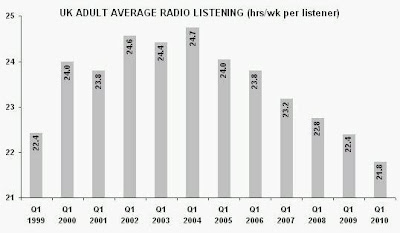
The average amount of time adult radio listeners spend listening to the radio has been declining dramatically over the same period. Here is a graph of RAJAR’s own data that shows it:

Are either of these facts, from the same research, mentioned in the latest RAJAR press release? Of course not. Why? Because RAJAR’s cheerleader role seems to require it to publicise a metric for radio listening that shows an increase: the absolute number of people listening, in this press release.

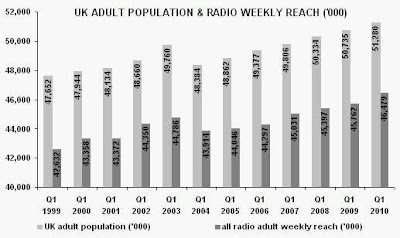
Here is a graph that shows the increase in the UK adult population and the number of people listening to radio. When the estimated population goes up, the estimated number of radio listeners goes up!

The airtime buyers in advertising agencies who have to use RAJAR data on a day-to-day basis probably chuckle at the preposterousness of the RAJAR press releases, laugh at how gullible the media are to simply reprint their headlines, and then go back to their work.

For some people (like me, having analysed radio audience data for 30 years), it creates market confusion. Clients are understandably puzzled and baffled when they see a presentation that clearly shows radio listening is in decline in the UK. They inevitably ask with suspicion: “But didn’t RAJAR just say that radio listening is at an all-time high?”

So why is RAJAR hell bent on this policy of trying to pull the wool over people’s eyes? Why does it need to be a public cheerleader for radio when we already have RadioCentre, the Radio Advertising Bureau and the BBC Press Office, each issuing their own PR puff on the RAJAR results? The RAJAR press releases might convince journalists, but they certainly don’t fool the media industry players. Instead, the opposite effect is probably the case.

How can the radio industry expect to be treated seriously within the wider media sector when its industry ratings body, charged with publishing objective listening data, insists upon grabbing headlines with misleading facts about radio audiences?

Digital radio station listening: a blip in time saves 6?

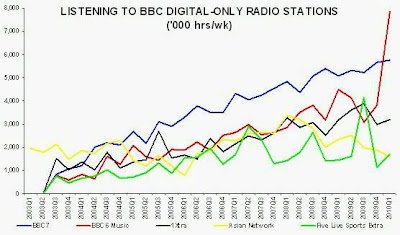
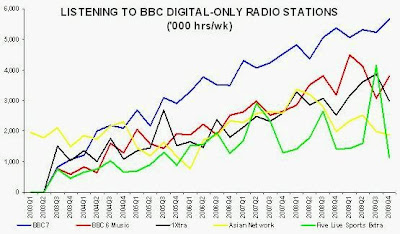
The dramatic upswing in BBC 6 Music’s listening during the first quarter of 2010 did not appear to have a knock-on effect on the BBC’s other digital stations [see graph]. 1Xtra was up slightly but still lower than it was in 2009. Asian Network dropped further and is now listened to less than part-time station Five Live Sports Extra.

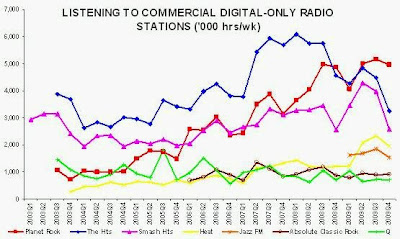
In the commercial radio sector, Planet Rock recorded its best quarter yet and cemented its lead over all its digital-only competitors (BBC 6 Music excepted) [see graph]. Its continuing success only confirms that consumers prefer real programme content to the digital music jukeboxes whose performances are little more than limping along.

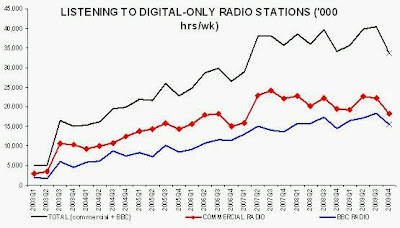
Even with this most recent quarter’s boost from BBC 6 Music and Planet Rock, total listening to digital-only stations has still shown almost no growth for three years [see graph]. Without the coincidence of those two successes, the latest quarter would have proven another disaster.

The question is what the next quarter will look like. We have seen listening to BBC 6 Music rise temporarily before at times when the channel has been in the press. Attracting listeners is only half the job. Keeping listeners is the much harder part.

Does the BBC 6 Music listening blip change the bleak outlook for digital radio stations? Not at all. Why? Because, even after this sudden upswing, 6 Music still attracts only two-thirds of the volume of listening to Radio 3, the BBC’s least listened to analogue national network. 207% of almost nothing still equals very little.

UK commercial radio’s growing reliance on public sector funds

The UK radio industry divides into two main sectors: BBC radio and commercial radio. BBC radio is funded by the Licence Fee, whereas commercial radio is funded by advertising and sponsorship. Each adult (aged 15+) pays around £13 per annum for BBC radio via the household Licence Fee. What is not so obvious is that each adult also contributes financially to commercial radio by around £2 per annum via their taxes, which are then used by government and public bodies to buy advertising time on commercial radio stations.

Commercial radio’s largest advertiser is neither BT (ranked second), nor Sky TV (third), Specsavers (fourth) or Unilever (fifth). It is the Central Office of Information [COI], the government’s marketing and communications arm, which spent £58m on radio advertising (25% of its budget) on UK commercial radio in the 12 months to February 2010. To illustrate just how significant the COI has become to the revenue base of commercial radio, it now spends twice as much on radio advertising as the aforementioned BT, Sky TV, Specsavers and Unilever added together. In 1999, COI expenditure had accounted for only 2% of commercial radio revenues whereas, by 2009, it was 10%.

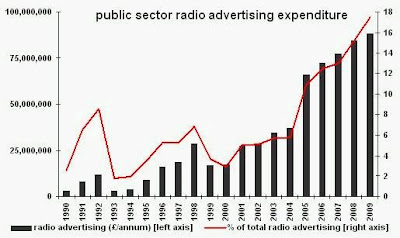
The COI’s financial support of commercial radio is not the whole story. Additionally, other public bodies such as local authorities, health authorities and development corporations also spend money on radio advertising. In 2009, the public sector in aggregate spent £88m with commercial radio, 18% of sector revenues [see graph]. The growth over the last decade has been enormous – in 1999, public sector spend was only £17m or 4% of commercial radio revenues.

This massive increase in public expenditure on commercial radio advertising during the last decade creates three issues:
• The commercial radio sector has become more dependent on the continuing input of public funds: public bodies now spend more on commercial radio than the car industry, or retailers, or the finance sector
• It becomes harder for commercial radio to argue about the public funding of BBC radio, when the commercial radio sector itself has become increasingly reliant upon public funds
• Governments change, government budgets change, government policies change, making this revenue stream more unreliable for commercial radio in the long term than commercial advertising.

The issue with revenue reliability is particularly pertinent now. The Conservative Party pledged in its manifesto to reduce advertising expenditure by government departments, if elected. The planned cuts would be significant, 40% of the COI 2008/9 budget of £540m, according to one press report.

This policy is nothing new. In 2008, Conservative Shadow Chancellor George Osborne promised at the Party Conference that he would more than half the COI budget from £391m to £163m. In 2005, then Conservative Shadow Chancellor Oliver Letwin promised to cut the COI advertising and marketing budget by more than half from £308m to £108m.

For commercial radio, the impact of such cuts would prove disastrous in the wake of its recent structural and cyclical revenue declines. A 50% budget cut to COI expenditure on radio would lose commercial radio £26m to £29m per annum, 6% of total sector revenues. A 50% budget cut to all public sector expenditure on radio would lose commercial radio £44m to £48m per annum, 9% of total sector revenues.

In 2009, commercial radio revenues were down 10% year-on-year. A year earlier, commercial radio revenues had been down 6% year-on-year. A further 9% cut to sector revenues would reduce them to the level they were ten years ago. Already, once prices are adjusted for inflation, commercial radio revenues are at their lowest annual level since 1997 in real terms.

Commercial radio’s growing reliance on national advertisers, of which government advertising is now the most significant part, has increased the sector’s economic vulnerability. In 1993, local advertisers had still constituted the majority of commercial sector revenues. By 2009, local advertising was down to 29% of total revenues.

Furthermore, if a government were to return to the post-War COI policy of using public broadcasters to air its Public Service Announcements, rather than paying commercial rates for airtime, up to 18% of commercial radio revenues would disappear at a stroke.

It must be a major concern that, in these times of inevitable government budget cuts (whichever political party is in power), the commercial radio sector’s reliance on public funds has never been so great.

DENMARK: government contemplates DAB radio’s future

Politicians in Denmark are presently considering what to do about digital terrestrial radio. The next funding period for state radio runs from the beginning of 2011 to the end of 2014 and will have to take into consideration a political decision taken in June 2009 to forge ahead with the migration from analogue radio to the DAB platform. Presently, only state radio stations are available on DAB.

The governing Liberal Party says it “wants to create real competition in the radio market” because state broadcaster Danmarks Radio has “a de facto monopoly over radio in Denmark and so the diversity and choice in radio remains limited.” The party decided in 2009 that it would support FM switch-off as a means to create a “new start” for radio in Denmark. To ensure that DAB will prove an attractive investment proposition for commercial radio, FM would be switched off between 2016 and 2018. The Liberal policy document states:

“An expansion of DAB radio allows for a potentially very large number of different radio channels. This expansion is in full swing in all major European countries, several of which already offer between 60 and 100 digital radio channels, while Denmark currently only offers 20 channels in total. The technological opportunities need to be exploited for the benefit of listeners. And development of DAB also provides the opportunity to create a balanced radio market, where there are real opportunities for development of commercial radio, which has proven not to be possible on the FM band. We should therefore concentrate on the offensive deployment of DAB. England has the full support of all radio operators in the country who decided to work for the switch to DAB in 2015. Recently, France decided that DAB radios must be in all French cars from 2014 and, in March 2009, the German Broadcasting Commission decided to roll out DAB+ in Germany. Although progress has been slow, and in some places has become completely stagnant, there is no longer the same uncertainty that DAB (Eureka147 standard) is the future of radio.”

The Liberal Party document goes on to cite the ‘success’ of DAB in the UK and mistakenly believes that UK government policy is to switch off FM (a fallacy shared by many):

“Today, around 8% of total radio listening [in Denmark] is on DAB. In England, that figure is 12.7% and soaring. To ensure that DAB is an attractive platform for both listeners and investors, it is important that DAB radios are made attractive by adding more unique content. This is the same set of conditions which must be present in other countries that anticipate the same trends. For example, Norway has estimated that at least half of the population must have a DAB radio before [analogue] switch-off can be announced. England will switch to DAB in 2015. Moreover, it is recommended that all cars sold in England from 2013 must be equipped with DAB radios. This decision is backed by both the public service and commercial radio stations. The assumption is that DAB listening will reach 50% in 2015 and coverage will reach 90% of the country and all main roads. Lord Carter’s report ‘Digital Britain’ in January 2009 also defined a set of criteria that must be met in order to close [analogue radio] permanently.”

Ellen Trane Nørby, media spokesperson for the Liberals, said: “Danmarks Radio is proposing that we switch off analogue radio in 2015, but they offer no viable way to get Danes to listen more to DAB.” Nørby believes that the biggest driver for DAB take-up will be when state radio channels are progressively removed from FM: “The people who listen to DAB are heavy listeners to the channels they cannot find anywhere else. If the offerings on DAB are not unique, why would you buy a DAB radio?”

Nørby said that the transition to DAB needs to adopt a realistic timescale: “Today, we are in a situation where most listening takes place on FM and each of us has about five FM radio receivers, compared to only 1.5 million DAB radios [sold in total]. Therefore, it is important that we have a real debate over the future of digital radio, and how we progress safely from FM to DAB. The honest discussion we propose is in contrast to others who say simply that we must switch off [analogue radio] but do not explain how.”

Although the Liberal policy document is resolute about digital radio switchover, Nørby appears more circumspect in interviews. In December 2009, she said: “It is not enough simply to say that FM will be switched off in 2015 without considering a discussion on content. …. Driving the take-up of digital television was the Danish desire to have a flat-screen TV. I have seen no Christmas boom – and we have not seen this for many years – in the sales of DAB radios. That’s why we Liberals have been so critical of the migration plan, because DAB has not won as much grassroots support as you could ask for.”

The government proposals drew a critical response from Michael Christiansen, chairman of Danmarks Radio. He said: “The Liberal Party proposal is a barely disguised attempt to destroy Danmarks Radio’s stations. … The proposal totally disregards modern Danish music by moving the P3 channel over to DAB at a time when it its coverage is not enough. … Replacing P3 [on FM] with a more or less indifferent foreign [commercial] radio channel, I cannot take seriously. We want to help the drive towards DAB, just as we have driven the migration to digital TV. But no one thought of closing down DR1 or DR2 [TV stations] on analogue until digital TV signals were available [to all]. The notion is so far out that I find it hard to relate to.”

European commercial radio trade group says ‘no’ to universal FM switch-off date

At the start of its annual conference held in Brussels on 11/12 February 2010, the Association of European Radios [AER], the trade group representing 4,500+ European commercial radio stations (including RadioCentre members in the UK), issued the following press statement:

“AER considers that setting a date for the switch-off of analogue radio services is currently impossible. Indeed, the question of which kind of technology will be used should be solved first. Hence, broadcasting in FM and AM shall remain the primary means of transmission available for radios in all countries, with the possibility to simulcast in digital technology, until market developments enable a potential time-frame for general digitisation of radio. Transition to any digital broadcasting system should benefit from a long time-frame, unless there is industry agreement at national level to move at a faster rate.”

This statement followed on from a policy paper the Association had published a few days earlier, responding to the European Commission’s Radio Spectrum Policy Group plans for its draft Work Programme. The paper said, in part:

“It should be underlined that, in most of Europe, currently and for the foreseeable future, there is only one viable business model: free-to-air FM broadcasting on Band II. Thus, Band II is the frequency range between 87.5-108 MHz and only represents 20.5 MHz. Across Europe, nearly every single frequency is used in this bandwidth. Thanks to the broad receiver penetration and the very high usage by the listeners, this small bandwidth is very efficiently used. On-air or internet-based commercially-funded digital radio has indeed not yet achieved widespread take up across European territories. These two means of transmission will be part of the patchwork of transmission techniques for commercially-funded radios in the future, but it is hard to foresee when.

So no universal switch-off date for analogue broadcasting services can currently be envisaged and decision on standards to be used for digital radio broadcasting should be left to the industry on a country-by-country basis.

Radio’s audience is first and foremost local or regional. Moreover, spectrum is currently efficiently managed by European states and this should remain the case: national radio frequency landscapes and national radio broadcasting markets are different, with divergent plans for digitization, diverse social, cultural and historical characteristics and with distinct market structures and needs…..”

“Finally, AER would like to recall that European radios can only broadcast programmes free of charge to millions of European citizens, thanks to the revenues they collect by means of advertising. These revenues are decreasing all through Europe due to two factors: the shift towards internet-based advertising, and the recent financial crisis. For 2009, radio advertising market shares were forecast to decrease by 3 to 20% all across Europe, compared to 2008.

In some countries (e.g. France and the UK), a part of the revenues derived from the TV digital switchover was supposed to be allocated to the support of digitisation schemes for radio. This is no longer the case. In most countries, it is still unclear who will bear the costs of the digitisation process.

However, any shift towards digital radio broadcasting entails very long-lasting and burdensome investments. Nevertheless, some individual nations may wish to proceed with a move to greater digital broadcasting at a faster rate, as there will be no ‘one-size-fits-all’ approach.

So, any shift towards digital radio broadcasting will most likely require a very long process. Decision on the adequate time-frame should be left to each national industry: as a matter of principle, transition to any improved digital broadcasting system should benefit from a long time-frame, unless there is industry agreement to move at a faster rate.

It should also be recalled that commercially-funded radios are SMEs, and are in no position to compete for access to spectrum with other market players. So, market-based approaches to spectrum (such as service neutrality or secondary trading) should not be enforced in bands where commercially-funded radios broadcast or may broadcast.

To end up with, AER would like to recall that, in most of Europe, currently and for the foreseeable future, there is only one viable business model: free-to-air FM broadcasting on Band II; hence:

• no universal switch-off date for analogue broadcasting services can currently be envisaged
• now and for a foreseeable future, commercially-funded radios need guaranteed access to spectrum, in all bands described above. Besides, no further change to the GE 84 plan [the 1984 Geneva FM radio broadcast frequencies agreement] should be suggested, but the plan should be applied with consideration to the technological development (and its enlarged scope of possibilities) throughout the past 25 years
• any shift towards digital radio broadcasting should benefit from a long and adequate time-frame.”

Digital radio stations: listeners abandon ship

The latest RAJAR radio audience data demonstrated one thing clearly: the UK radio industry’s strategy for its digital stations is in tatters. Audiences for digital radio fell off a cliff during the last quarter of 2009. This did not appear to be the result of any specific strategy shift (no station closures, only one minor format change) but more the result of increasing public malaise about the whole DAB platform and the radio content that is presently being offered on it (plus a little Q4 seasonality) . The figures speak for themselves.

Total listening to digital radio stations is back down to the level it achieved in 2007, following a period of sustained growth between 2000 and 2007. Far from moving towards some kind of exponential growth spurt as the industry had expected, total listening now seems to have plateau-ed. It appears that market saturation has already been reached for much of the content presently available on digital radio platforms, considerably earlier than had been anticipated, and at a level of listening that cannot justify these stations’ existences for their commercial or BBC owners.

In the commercial sector, only Planet Rock has maintained its momentum, probably a reflection of its commitment to offering its listeners genuinely unique content. Elsewhere, the jukebox music stations have suffered massive falls in listening, possibly a result of their ease of substitution by online offerings such as Spotify and Last.fm, and of owner Bauer’s policy to curb investment in digital radio broadcast platforms and content.

Commercial radio has talked the digital talk for years about striving to make DAB a successful platform, vaguely promising new digital radio ‘content’ that it has still not delivered. Instead, it has spent the last few years cutting costs, consolidating, lobbying the government, complaining about the BBC, closing its digital stations and contracting out its DAB capacity to marginalised broadcasters (religious, ethnic, government-funded and listener-supported stations) that will never attract mainstream audiences to the platform (and whose listening is not even measured in the RAJAR audience survey).

From the listener’s perspective, the only thing that has happened to the DAB platform in recent years is the disappearance of commercial digital stations such as OneWord, TheJazz, Core, Capital Life and Virgin Radio Groove. For the average consumer, the arrival of Traffic Radio, Premier Christian Radio or British Forces Broadcasting Service are hardly replacements.

A report commissioned by RadioCentre from Ingenious Consulting in January 2009 concluded:

“Commercial radio is now at a crossroads with respect to DAB. It needs either to accept that the commercial challenges of DAB are insuperable and retreat from it – such a retreat, because of contractual and regulatory commitments, would be slow and painful; or strongly drive to digital.”

In the year since this report was prepared, commercial radio has done neither. Instead, it has spent a small fortune on parliamentary lobbying, not one iota of which has had a direct impact on 10 million increasingly baffled DAB radio receiver owners. These latest RAJAR data convey their clear message that content is their only concern.

For the BBC, the problem is somewhat similar. With the exception of Radio 7, listening to its digital radio stations remains unimpressive, despite them benefiting from massive BBC cross-promotion over many years. Some stations are outright disasters – Asian Network is listened to less now than it was almost seven years ago, when only 158,000 DAB radios had been sold. Some stations are simply not suited to the DAB platform – 1Xtra targets a youth audience who listen to a lot of radio online and via digital TV, but who have little interest in DAB (particularly as DAB is not available in mobile phones). Some stations will become redundant in an increasingly on-demand world – Radio 7 would eventually be little more than a shopfront for the huge pick’n’mix BBC radio archive to be made available to consumers online.

For the BBC, it is becoming increasingly hard to justify spending, for example, £12.1m per annum on the Asian Network when its peak audience nationally is only 31,000 adults. Broadcast platforms such as FM attract huge audiences for a fixed cost, making them the most efficient distribution system for mass market live content. As a result, Radio 1 costs us only 0.6p per listener hour. By comparison, the Asian Network is costing 6.9p per listener hour, probably making it more expensive to ‘broadcast’ than to send each listener a weekly e-mail attaching the five hours of Asian Network shows they enjoy.

The BBC should still be congratulated for creating new digital radio services in 2002 that attempted to fill very specific gaps in the market which commercial radio was unlikely to ever find commercially attractive. This is precisely why we value a public broadcaster in the UK. However, the BBC digital radio strategy over the last decade has suffered from:
•   The BBC’s evident inability to successfully execute the launch of genuinely creative, innovative radio channels that connect with listeners (GLR, the ‘new’ Radio 1, the original Radio 5)
•   The BBC pre-occupation with constantly creating new ‘broadcast channels’ when most niche content is more suited to narrowcasting and delivery to its audience via IP (live, on-demand or downloaded).

For the UK radio industry, its digital ‘moment of truth’ has belatedly arrived. A new strategy now has to be adopted which does not continue to raise the DAB platform to the level of a ‘god’ that has to be worshipped above all others. The future of radio is inevitably multiple-platform and the industry’s focus has to be returned to producing content, rather than trying to control the platforms on which that content is carried.

I suspect that Tim Davie, director of BBC Audio & Music, will eventually lead these winds of change, following in the wake of director general Mark Thompson’s pronouncements at the end of this month as to where the internal financial axe will fall. Where the BBC leads, commercial radio will inevitably (have to) follow.

The future digital radio strategy is likely to be ‘horses for courses’. Rather than all radio content being delivered via all available platforms, it will in future be delivered only where, how and when it is most demanded by listeners. Our economic times make this mandatory. The DAB platform’s mass market failure will make it necessary.

Criteria and a date for digital radio switchover: debated in the House of Lords

The news that the government’s proposed ‘digital radio switchover’ will no longer involve ‘FM switch-off’ was first reported in this blog in June 2009, which stated:

“In the 13-page radio section of the Digital Britain Final Report published yesterday, there was not one mention of the word ‘switchover’ in the context of ‘digital radio switchover’. Neither was there a single mention of the word ‘switch-off’, as in ‘FM radio switch-off’. Throughout the document’s radio section, the new buzz phrase is ‘Digital Radio Upgrade’, meaning a drive to make DAB radio better and improve its consumer take-up. In Digital Britain, the notion of switching off FM radio broadcasting, notably for local stations, has been buried for good.”

However, between June 2009 and now, this issue – that the government will NOT switch off FM broadcasting – has been clouded by continuing statements from some radio lobbyists and in many media outlets which imply that FM radios will no longer work after switchover. If I were cynical, I might think the motivation is to panic citizens into buying DAB radios – a consumer response which would itself help the industry reach the criteria necessary for ‘switchover’ to happen.

As for those criteria, and the government’s favoured switchover date of 2015, I have consistently predicted that the criteria stand absolutely no chance of being reached by 2015. For a long time, the government and large parts of the radio industry loyally stuck with these targets, imagining that somehow, if you say something frequently enough in public, it will come to pass of its own accord. However, in recent months, with 2015 rapidly approaching, there has been a sudden U-turn. Until then, the radio industry had been vociferous in demanding the government fix a ‘switchover’ date as early as possible. Now, suddenly, a date – any date – is no longer deemed desirable.

A blog entry here last month noted that neither the criteria, nor the 2015 date for ‘switchover’, are mentioned anywhere in the Digital Economy Bill:

“Figures. Numbers. Dates. Criteria. This kind of factual evidence or hard data might obstruct a future decision to force consumers to switch to DAB radio.

……… the criteria and the switchover date that had been agreed upon by stakeholders, over two years of deliberations, have now quietly been relegated to oblivion.

When would digital radio switchover have happened if the agreed criteria had been implemented in law? Probably never.

When will digital radio switchover happen now? Whenever those in power want it to.”

A debate on Wednesday night in the House of Lords (see below) considered several amendments to the Digital Economy Bill which would have put specific criteria back onto the legislative table and would have ensured that all radio stations (large and small, BBC and commercial) are given an opportunity to migrate from analogue to DAB transmission. These amendments were eventually withdrawn, after the government Minister offered vague assurances that FM would not be switched off “for the foreseeable future”.

As a result, on paper, if the Digital Economy Bill is ever legislated, ‘digital radio switchover’ (which no longer involves FM switch-off) can be made to happen whenever and however the government wants it to.

In practice, digital radio switchover will inevitably never happen. Consumers appear increasingly disinterested in DAB radio. Besides, we have yet to hear one radio station owner promise they will turn off their analogue transmitters forever and, in that instant, cut their listenership by half just because the other half are thought to be listening via a combination of DAB, digital TV and the internet. You would have to be mad to do that. And, yes, the radio industry could be considered ‘crazy’ for continuing to go along with this bizarre notion that it is prepared to cut off its own nose to spite its face.

Eventually, it will end in tears.

Amendments 238, 239 & 241
Moved by Lord Clement-Jones

238: Clause 30, page 33, line 19, at end insert —
“(2A) The Secretary of State may not nominate a date for switchover —
(a) unless it can be established that all local commercial radio stations will have the opportunity to move to digital audio broadcasting,
(b) until the proportion of homes in each of the four nations of the UK able to receive —
        (i) national BBC services,
        (ii) national commercial radio services,
        (iii) local BBC services, and
        (iv) local commercial radio services,
via digital audio broadcasting is equal to the proportion able to receive them via analogue broadcasting,
(c) until digital audio broadcasting accounts for at least 67 per cent of all radio listening, and
(d) until digital audio broadcasting receivers are installed in 50 per cent of private and commercial vehicles.”

239: Page 33, leave out line 21 and insert —
“( ) must ensure that all commercial and BBC radio services broadcasting in the UK have the opportunity to switchover on the same date,”

241: Page 34, line 1, leave out “2” and insert “4”

Lord Clement-Jones: In moving Amendment 238, I shall speak to Amendment 239 and 241. It is a wonderful thing to make one’s debut at 8.30 pm. I will try to do it with some brio. This amendment is designed for two particular purposes: not only to explore some of the detail of this clause, which seeks to implement a very important part of the Bill, but to test the coherence of the Government’s policies and objectives in this respect. On these Benches we recognise many of the benefits of moving from analogue to digital; of course we do. However, we believe the Government have been fundamentally poor in the way in which they have communicated their objectives and in the way in which they described both those and the processes involved in switching over. We are particularly concerned about the impact on local FM radio and what one might call ultra-local radio in that respect. A great deal of reassurance is needed about the future of FM. It is not just purely about freeing up space on the analogue spectrum for FM by migration from analogue to digital. The Government need to explain other aspects too. Why are we adopting DAB rather than DAB+, which would allow a much more local feel to our radio experience and enable many more ultra-local radio stations to migrate? The Government also need to explain — the Minister has made an attempt to do so — why the target of 2015 has been set. There are other details involved. One of the great forms of reassurance that the Government have tried to give to ultra-local radio FM stations is this notion of a common electronic programme guide. That is a great idea, but what is its practicality? What timescale is envisaged? The Government need to deliver much more clarity in this respect and other aspects. Will there be adequate supplies of radios that enable listeners to tune in to both FM and digital radio? It is fairly basic: will the domestic consumer be able to have access to those, or will most manufacturers switch over to pure digital? The availability of digital car radios is a particular concern. I shall illustrate where I believe there is some incoherence in this regard. It is almost as if two separate hands wrote Chapter 3b of the White Paper. That chapter is headed “Radio: Going Digital”. Paragraph 20 of that chapter states: “However, it has always been our intention that the ultra-local services which remain on FM after the Digital Radio Upgrade should only do so temporarily”. Later on, the paper — I leave the Minister to find his own copy — is written in very different terms. It talks about a much longer-term future for FM. Which is it? Will FM be a permanent or temporary part of the radio landscape? These things need sorting out as part of the Bill. Even if you talk to those intimately involved in the digital switchover, you will not get a precise answer about whether FM is here for the long term. As I understand it, technically, ultra-local radio is far better staying on FM almost in perpetuity, provided the two forms of spectrum can be afforded, and provided the receivers allow the receipt of both FM and digital for the foreseeable future. There is no particular reason why some of these ultra-local stations should indeed switch over. Why should they not be encouraged to stay where they are? That would seem to me to be a very coherent way of expressing government policy. However, of course, many operators want to have a broader canvas for their stations. That is entirely acceptable too. Where they wish to make that investment and have a broader scope for their radio services, that seems to be entirely right and proper. The Digital Britain White Paper talked about the triggers for the switchover to digital radio. In referring to those, the Minister said that it was not simply the case that half of all listening should be to digital and that the relevant date should not be set until national DAB coverage matches that of FM and 90 per cent of the population have access to local DAB. The clause we are discussing — this is what Amendment 238 is designed to do — does not refer to any of that. All it does is talk about the report submitted by Ofcom, to which the noble Lord, Lord Howard, referred. It does not give any direction to Ofcom. One assumes that Ofcom will refer to the government policy as set out in the White Paper, but there seems to be no duty on it to do that. That seems to constitute a gap in the provisions. We on these Benches believe that the Government need at least to give reasons why some conditions are not appropriate. We do not necessarily believe that all of these additional conditions are the right ones, but we do believe that certain of those should be additional to those stated, so that all local stations have digital migration pathways. Currently, more than 120 stations lack viable digital migration pathways. All categories of commercial and BBC stations should be treated equally, creating a level playing field going forward. The switchover date — 2015 — is based on an assessment of DAB listening rather than digital listening, which includes digital television and the internet, as this will replace FM and AM as radio’s broadcast backbone. People are listening more and more to radio over the internet. As regards the whole issue of vehicle reception, I think that less than 1 per cent of cars can receive digital signal at the moment. I think the Government estimate that only 10 per cent of vehicles will be able to receive it in 2015. We are trying to get a more coherent policy and a switchover that accords more to the reality of what listeners are doing. There is absolutely no point in the Government being so far ahead of what listeners want to do that they create a reaction against their own plans. Amendment 239 is another measure designed to test the earnest of the Government. The Government have rather arbitrarily decided that switchover should take place two years after notice of it is given. Amendment 241 seeks to change that. There are concerns about the speed of switchover. Amending the notice period would allow more time to solve the issues around consumer take-up, such as those involving vehicles, and would allow digital solutions to be provided for all stations which want them. A four-year period would be far more realistic in terms of recognising the considerable challenges involved in the digital switchover. Amendment 239 states that the Secretary of State “must ensure that all commercial and BBC radio services broadcasting in the UK have the opportunity to switchover on the same date”. That is another way of testing the Government’s proposals in this respect. Are they saying that, at the end of the day, all these stations need to switch to digital, or are they saying that FM has a future in the long term? What is the purpose behind the switchover? It seems to me that the Government have not expressed their intentions very clearly. I hope that this is an opportunity for them to do so. I beg to move.

The Lord Bishop of Manchester: My Lords, Amendment 238 has been put eloquently by the noble Lord, Lord Clement-Jones, and with all the promised brio. However, he has set in that amendment probably rather an ambitious goal. Some may say that it is too ambitious. It may, of course, have the impact of delaying the switchover date from the much bandied-about year of 2015. However, as we heard from the Minister earlier, that is not a precise date. The amendment may also effectively force something of a reappraisal of how digital radio is rolled out between now and switchover. But, that said, I believe that neither of those consequences would be to the detriment of the well-being of the radio industry. The noble Lord referred to Ofcom. In order to make switchover manageable and help local stations remain viable in these challenging economic times, Ofcom has proposed a series of defined areas within which stations in the same commercial family will have more flexibility to share resources and locations. As your Lordships will know, that has been welcomed as a helpful step by many of the large and small commercial stations. Nevertheless, it throws up anomalies, especially where radio groups would be barred from broadcasting to some of their network from locations that are actually far closer to their listeners than those from which they are allowed to broadcast. I say this not to criticise Ofcom’s sterling efforts in coming up with solutions to try to make life easier for these vital local stations. The regulator is trying to be flexible and responsive in a rapidly changing arena. Yet that is precisely the point. It is almost as if, at the moment, we are rushing towards a finishing line when the course has not even yet been chalked out. This amendment helpfully acknowledges that the route to an appropriate digital platform is not yet entirely clear, especially for many smaller stations. I have concerns over the specific proposal that sets a target of two-thirds of listening on DAB before switchover simply because it does not quite recognise the mixed radio economy that we are moving towards, to which the noble Lord, Lord Clement-Jones, referred. If a growing proportion of us are listening to radio via our computers, mobile phones and digital TV sets, with only a small remnant still listening on analogue, it would be unfortunate if the wording of primary legislation made it such that we could not set a switchover date just because DAB was specified as the only non-analogue platform. But, with those reservations, on the whole I support Amendment 238.

Baroness Howe of Idlicote: My Lords, I will briefly add my support for these amendments. There clearly has to be a rethink on this whole area. There are so many different interests and people who have been hoping and planning. At Second Reading, I remember my enthusiasm for immediate digital switchover as far as radio was concerned. It would be a splendid way for me to be able to enjoy my journeys up and down to Warwickshire without having to fiddle around and change the frequency on the radio, which is presumably a fairly dangerous practice anyhow. So, although one may not agree with every word, this points out to the Government that there is going to have to be a more up-to-date assessment of where we are and how quickly, if at all, we are going to reach the desired goal of switchover and meet the needs of local radio stations, particularly the commercial ones.

Lord Young of Norwood Green: My Lords, the proposed amendment inserts specific switchover criteria into the Bill which must be satisfied before the Secretary of State can nominate a date for switchover. We agree that it is important for the Government to consider a wide range of issues and views before setting a date for digital switchover. We seem to be referring to 2015 as though we have set a date. I reiterate that that is a target. As with TV switchover, the announcement of a target date is essential in uniting the industry in creating the impetus to ensure that progress towards switchover conditions is made. For example, within six months of 2015 being published in the White Paper, progress with car manufacturers had advanced further than in the previous six years. We still believe that 2015 is an achievable deadline and the certainty of a timeframe is in the best interests of listeners and the industry as a whole. However, I stress that it is still a target. We expect broadcasters and network operators to work towards that deadline but a final date will only be set when progress measured against consumer-led criteria is clearly on target. We do not believe it is appropriate to insert the level of detail proposed by this amendment into legislation as it would fail to grant sufficient flexibility to address the inevitable changes in the market over the next five years. As this amendment raises a number of themes, I will take each of the issues raised in turn. It was an omnibus address delivered with brilliant brio. First, the proposed amendment requires a DAB network large enough to accommodate all commercial radio stations before a switchover date is nominated. We believe that this is the right ambition, but impractical in the short term. With over 50 BBC services, nearly 350 commercial stations, and 200 licensed community stations, the current DAB infrastructure cannot support a wholesale move to digital. We believe a mixed landscape of FM and DAB, as set out in the Digital Britain White Paper, is a better solution. It will allow small commercial stations and community radio stations to remain on FM, which was a point of concern expressed by the noble Lord, Lord Clement-Jones. In the case of community radio stations, it will allow for more services to be launched. On the question of whether FM is temporary or permanent, FM is the right technology for community and small local radio stations for the foreseeable future, following switchover.

Lord Clement-Jones: My Lords, it is permanent.

Lord Young of Norwood Green: I feel I am being lured into saying “never say never” or “never say ever”. We certainly see it for the foreseeable future following switchover. That is pretty generous. We are trying to reassure the noble Lord. It is the right technology for community and small local radio stations. We cannot predict exactly how technology will develop for ever and ever, but we are saying “for the foreseeable future, following switchover”. That is a pretty good guarantee. Secondly, this amendment would require DAB networks in the UK to reach the same number of households as analogue. Again, we agree with the principle and we are working with the industry to secure this outcome as quickly as is feasible. However, the definition of analogue coverage is too broad, encompassing long wave, medium wave and FM. It also provides no clarity as to whether it is a high-quality stereo signal or a low-quality mono signal. This amendment would result in multiplex operators and broadcasters bearing the full cost of a near universal DAB network for the longest possible time. Thirdly, the amendment proposes to require that 67 per cent of all radio listening be to DAB before a switchover date can be set. We agree that the digital radio switchover should be market-led and dependent on the take-up and usage of digital radio. However, this criterion places too great an emphasis on DAB over other digital technologies. The issue is not whether listeners choose to consume radio via DAB, the internet or digital TV, but the extent to which they have access to digital radio technology and are using it. Also required in this amendment is that DAB receivers are installed in 50 per cent of private and commercial vehicles. We believe there would be significant challenges in measuring success against such a criterion. In addition, such a legal requirement would fail to take account of the adoption of in-car radio converters or future technological developments. Just as we had the development of the Digibox in relation to enabling analogue TVs to carry on working, so it is obvious that we will see the price of in-car converters come down and that technology developed. All DAB radios include FM: that was another point that was raised. We are working with car manufacturers with the aim that, by 2013, all radios sold with vehicles will be digitally enabled. There are already devices on the market that will convert an FM car receiver so that it can receive DAB, and the market in this area is likely to grow considerably. It is huge: there are millions of analogue car radios. We are trying to cover all the areas of concern. Amendment 239 would also require that all commercial and BBC stations have the opportunity to switch over on the same date. It removes the flexibility granted to the Secretary of State to nominate different switchover dates for different services. Although it remains the Government’s intention that all services specified by the Secretary of State should switch over on the same date, flexibility is needed to ensure that the switchover can be delivered most appropriately for listeners. With TV, the gradual approach is working well, so we are making a plea here for flexibility. Amendments 241 would increase the minimum notice period from two to four years. We believe that this would unnecessarily extend the costs of dual transmission for broadcasters, and slow down the rollout of the DAB network. The noble Lord, Lord Clement-Jones, asked about our motivation. Part of it is the most effective use of the spectrum; another part is to ensure that people are given the best possible service. The noble Baroness, Lady Howe, said she had to fiddle with the knob on her car radio. It is time that she updated it to one with RDS, which will automatically change the frequency for her as she drives along. I cannot guarantee her a government handout, but it is well worth it. The right reverend Prelate was concerned about local radio and defined areas, and made a number of interesting points. We will look carefully at his remarks in Hansard and write to him on the issue. We will make copies available to all noble Lords who have contributed to the debate, because these are points of common interest. I apologise for going on at length, but this is an important debate that encompasses a wide range of issues. I have tried to address all the points raised and understand the concerns, and I hope that, given my response, the noble Lord will withdraw his amendment.

Lord Clement-Jones: My Lords, I thank the Minister for that comprehensive reply, particularly since it was on the run: it was not obvious from the amendments how broad the debate was going to be. He has addressed almost all the issues, except the one that I raised about DAB+. I forgive him for that, although if he does have an answer —

Lord Young of Norwood Green: I do have an answer, but forgot to make a note of the question. The advantage of DAB+ over DAB is the greater capacity that it provides for services on the same frequency, allowing a digital multiplex to broadcast around 20 rather than 10 services, thereby giving more stations the opportunity to move to digital. However, we believe that the benefits of DAB+ are more than outweighed by the negative impact on existing DAB listeners. Only a very small fraction of the 10 million digital receivers that have been sold are capable of receiving DAB+, and any technology change would make these receivers effectively redundant. That would significantly delay the switchover timetable and increase the time during which broadcasters would bear the burden of dual transmission costs. Nevertheless, the Government have been clear about their intention to promote receivers that are capable of receiving DAB+ and other digital technologies that are used across Europe. This will protect receivers against any change of technology in the future. We are trying to take into account the concern in that area. I apologise if I put that over quickly, but it will be on the record.

Lord Clement-Jones: My Lords, I thank the Minister for that suite of answers to the various points raised. I also thank those who took part in the debate; the right reverend Prelate and the noble Baroness, Lady Howe. Not every jot and tittle of the amendment necessarily carries all the weight that it should. We are looking for pointers from the Government. Although some of the White Paper sets out the conditions and criteria, they are not in the Bill and there is uncertainty, albeit among a minority of radio operators. The future of FM has not been made clear. I take the words “foreseeable future” in these circumstances to mean semi-permanent. There is a fear that FM stations “left behind” on analogue will be second-class citizens who will not be there for long — they will be hustled across into digital — when actually, in terms of cost and reception, ultra-local radio is probably best left on FM. It may be that the Government wish to release that spectrum, have a fire sale and flog off FM to the highest bidder — I know not. The Government need to be crystal clear about those issues. The use of the “mixed landscape” wording by the Minister was very healthy; no wholesale move in the circumstances is healthy, as it has been described to us that digital will be a great advantage to the larger national radio stations but not to the smaller ones. I understand what the Minister was saying about the vehicle aspect. I hope that he is correct in saying that the ability to convert to digital by various gizmos, which will not cost the public an arm and a leg, will be increasingly possible. I think he mentioned the 2015 gate but I do not know what percentage of in-car use was associated with that. Clearly, there is some considerable optimism about the switch taking place within the next three or four years. That is ambitious. On two years versus four years, I cannot help reflecting that the two-year period is more, not for the listeners’ or the radio operators’ convenience, but for the Government’s convenience because they want a decision made and they want to be able to consider the future of FM after that. That is the impression given to date. In a sense, two years is a very aggressive period, once the notice has been given, in which to expect that migration to take place. That is the fear behind that short period. Basically it is for the Government’s convenience rather than for allowing things to take place in an orderly fashion. This has been a very useful debate. I thank the Minister for what he has said. Obviously, some reflection is required. We have all had an enormous amount of correspondence from radio operators and no doubt we shall reflect with them between now and Report about whether further tweaks are required to this part of the Bill. In the mean time, I beg leave to withdraw the amendment.

Amendment 238 withdrawn.
Amendment 239 not moved.
Amendment 241 not moved.

[For the purpose of transparency, I was one of the parties invited to present evidence before the House of Lords Select Committee on Communications the morning of this debate.]

Small local stations & the Digital Economy Bill: debated in the House of Lords

The issue of the potential impact on small, local radio stations of the government’s proposed ‘Digital Radio Upgrade’ was first raised in this blog in July 2009, which stated:

“… the potential losers from Digital Radio Upgrade would seem to be:
• commercial stations presently carried on local DAB multiplexes who might have to be bumped because there is no longer the capacity after amalgamation
• local commercial stations presently carried on their local DAB multiplex who will have to quit DAB because they do not wish to serve the enlarged geographical area after amalgamation of multiplexes (for example, the cost of DAB carriage for Kent/Sussex/Surrey is likely to be considerably higher than Kent alone)
• new entrants

In the rush to frame proposals in Digital Britain that respond to the circumstances of the large radio players with substantial investments in DAB infrastructure, it might appear that the voices of the smaller local commercial radio stations have got lost in the stampede of lobbying. These stations might be small in number but many of them remain standalone, so they will not benefit financially from the relaxation of co-location rules. Digital Britain is condemning many of them to remain on FM (or AM), leaving the large radio groups to dominate the DAB platform.

Although the proposals in Digital Britain have been framed to ‘help’ local commercial radio, overwhelmingly they will reduce the financial burden of group radio owners with local station operations in adjacent areas, and of group owners who have invested in DAB infrastructure. There is little in the way of financial benefits for independent local commercial stations, or for potential new entrants, both of whom face being crowded out of the DAB platform.”

Last night, the House of Lords debated three amendments, amongst several, to the Digital Economy Bill which proposed that the voices of small, local FM radio stations and their listeners should be considered before the government commits the UK to digital radio switchover.

These amendments were eventually withdrawn after debate (see below) during which the government minister, Lord Young, made vague assurances that the views of listeners and others would be canvassed.

RadioCentre, the commercial radio trade body, subsequently commented: “Clause 30 (which relates to the switchover powers) was debated in detail, with proposed amendments withdrawn following debate and assurances from Government.”

Amendments 236 & 237
Moved by Lord Howard of Rising

236: Clause 30, page 33, line 17, after “to” insert “ — (a)”
237: Page 33, line 19, at end insert “; and
( ) the needs of local and community radio stations; and
( ) the needs of analogue radio listeners.”

Lord Howard of Rising: My Lords, in moving this amendment, I will also speak to Amendment 237. The amendments are designed to ensure that attention is paid to the local and community radio sectors and the many millions of analogue radio listeners — to which I should add the providers of satellite systems about which the noble Lord, Lord Maxton, spoke. They should all be listened to before any decision is taken about switchover. We on these Benches have not hidden the fact that we remain unconvinced that the Government’s plans to switchover in 2015 are realistic. We do not believe that audiences will be ready by then. The audience must remain at the forefront of all our considerations when we debate these parts of the Bill. As drafted, the Secretary of State will have to pay heed only to Ofcom and the BBC. Despite the BBC’s dominance in the radio industry, there is a strong argument that it would be helpful for community and local radio stations to be consulted. Indeed, the whole commercial radio sector should be included. It does not seem unreasonable to suggest that the Secretary of State consult the other parts of the industry that will be affected. It would also seem both reasonable and important for the Secretary of State to consider the needs of those who listen to analogue radio. The Government stated in their final Digital Britain report that they would start the countdown to switchover once digital listening made up 50 per cent of radio listening. That seems far too low. It would still mean that there were millions of listeners not using digital. Our amendment would ensure that the needs of those listeners were taken into account before the Secretary of State could nominate a switchover date. The amendment is simply an attempt to ensure that all who will be affected by switchover are considered before the Secretary of State nominates a date. As I have said, it does not seem unreasonable to ensure that listeners are placed at the forefront of these considerations. I hope that the Committee will agree. I beg to move.

Lord Gordon of Strathblane: My Lords, I think that I can offer some reassurance to the noble Lord opposite. Unless all those targets were going to be met, virtually the entire commercial radio industry would not support the clause, which it does, with one minor exception. The feeling is that this is an empowering clause that does not oblige the Secretary of State to set a date. Indeed, he can set a date and then withdraw it if precisely those targets mentioned by the noble Lord are not met. The radio industry seems to feel that the Government have got it right. I hope that that reassures him.

The Lord Bishop of Manchester: My Lords, in speaking to the amendment moved by the noble Lord, Lord Howard of Rising, I recall that in an earlier debate this evening, the noble Lord, Lord De Mauley, expressed deep disappointment that I was not supporting an amendment that stood in the names of the noble Lords. I hope that they will now feel slightly happier, because I support this particular amendment. I do so because the Bill as it stands provides very little safeguard for those who are living in remote areas, some of them perhaps still relying on long wave, let alone FM, for their radio reception. I take the point that the noble Lord, Lord Howard, made about the Digital Britain report. If I recall correctly the point was made at Second Reading that, when 90 per cent has been reached, there will still be one in 10 people — some of whom would presumably lose access via their radio to all the national, BBC and commercial radio stations — for whom we really ought to have the greatest concern. Short of listening via the internet — which I know the noble Lord, Lord Maxton, though no longer in his place, would be urging us to do — or Freeview, there is nothing that the 10 per cent would be able to do until the DAB signal catches up with the FM one. Through this and other similar amendments, I hope the Government will come to recognise that there are some very serious reservations about giving the Secretary of State the power to set the switchover date without proper statutory consideration of the wider impact of that decision on those communities who are often disconnected from British society physically, and those small stations that serve them. I am much in sympathy with the amendment.

Baroness Howe of Idlicote: My Lords, we shall come to rather more detail about this aspect shortly. I, too, support the amendment and the basis on which it is being put forward. We spent this morning taking evidence from the commercial radio stations, both from those which disagreed with the main grouping and those which had done some amount of research over time. The more one looks at this whole area, it is quite clear that there is a big problem about when this is going to happen, stretching into the future, causing a considerable number of problems. At the very least, this amendment requires others — those concerned and those involved — to be consulted. So, like the right reverend Prelate, I certainly support the amendment.

Lord Young of Norwood Green: My Lords, Clause 30 states that before nominating a switchover date, the Secretary of State must have regard to any reports submitted by Ofcom or the BBC under the terms of Section 67(1)(b) of the Broadcasting Act 1996. The purpose of these reports is to review how long it would be appropriate for radio services to continue to be broadcast in analogue form. These reports should have regard to the provision of digital radio multiplexes, availability of digital radio services and the ownership of digital receivers. In order to produce these reports, Ofcom is required to consult multiplex licence holders and digital radio service providers. In addition — here I address the concerns of the noble Lord, Lord Howard, the noble Baroness, Lady Howe, and the right reverend Prelate the Bishop of Manchester — the Secretary of State must, on requiring these reports, consult such persons representing listeners and such other persons as he thinks fit, as provided in Section 67(4). The noble Lord, Lord Howard, talked about plans to switchover in 2015. That is a target that we have set, not a precise date, as I hope he will recognise. The experience that we had with the TV switchover, which in some ways was even more fraught with difficulty, has been an outstanding success so far. One of the largest switchovers, in the Manchester area, recently went over without a hitch. We had a lot of preparation, help and assistance. We want to adopt a similar approach. It is not just about the 50 per cent of listeners. We have also talked about DAB achieving the same coverage as FM, which is something like 95 per cent these days. We are well aware of the importance of that. I also point out another factor which I think is important. The prices of reasonable quality DAB radios have been coming further and further down. That is important for less advantaged parts of our population. We are aware of the concerns expressed. We believe that the clauses have got it right. We understand the concerns, which is why I have taken time to give some further assurance. Given the breadth of the requirements to consult already proposed in the draft Bill and our commitment to consult widely before setting a date, we believe that the amendment is unnecessary. With the explicit assurances I have given, I hope that the noble Lord will feel able to withdraw the amendment.

Lord Howard of Rising: I thank the Minister for his remarks. I am grateful to the right reverend Prelate the Bishop of Manchester and to the noble Baroness, Lady Howe, for their support for the amendment and to the noble Lord, Lord Gordon, for his reassurance. All I am doing is asking the Government to pay attention to and listen to the listeners before they take too drastic an action and leave a lot of people very unhappy. From his remarks this would appear to be the case, so I beg leave to withdraw the amendment.

Amendment 236 withdrawn.
Amendment 237 not moved.

Amendment 239A
Moved by The Lord Bishop of Manchester

239A: Clause 30, page 33, line 21, after “services,” insert “while retaining the use of the FM Band for those local and community radio services, including special interest services, for which digital transmission using DAB is not a suitable method due to —
(i) the size of local DAB multiplex areas, or
(ii) the unavailability of capacity on the local DAB multiplex,”

The Lord Bishop of Manchester: This amendment pursues further the issue about retaining the use of the FM band for local and community radio services. I invite your Lordships to put yourselves in the shoes of someone running a small FM radio station, serving a population of 100,000 people in and around, let us say, King’s Lynn. As it stands, that station’s future seems to be to bid for a space on a local multiplex. That would mean that it would begin broadcasting to almost 600,000 people. Such a shift would significantly change the character of that station. Listeners from a much wider area would start to phone in to programmes and would, for instance, start to demand their own slice of news output. The station manager would be forgiven for wishing to stay on the FM band as long as possible, until a better solution was found for smaller stations to find a home on the digital spectrum. Consider then the prospect of the only way of going digital to be to join an even larger regional multiplex which covers the whole of East Anglia and serves well over 1 million listeners. That is the kind of situation that is faced by a number of small commercial radio stations if digital rollout continues as planned. Their pathway towards a digital future seems shrouded in a kind of fog, partly because of the large size of DAB multiplex areas and the lack of capacity on some multiplexes .Forcing those small-scale stations to broadcast to much larger areas than their current coverage would alter their feel and alter their connection with their audience. It would undermine the integrity that they hold as local broadcasters and potentially damage their ability to service platforms which stimulate and reflect local democracy and social action. There is also a danger that counter-intuitively such stations would struggle to attract advertising spend from local businesses which do not wish to market themselves to audiences up to 100 miles away. So, socially and commercially, beaming local stations to regional audiences is, frankly, not in anyone’s interests. As for the lack of space on DAB in some areas of the country, take, for example, the multiplexes currently covering Humberside or, in my own area, of Manchester where there is virtually no space available. Even with just the larger stations currently on board, capacity is running out in some areas. I understand that some stations that gain access are broadcasting in mono rather than in stereo in order to preserve bandwidth. The limitations of DAB for local and community stations are well acknowledged by Ofcom. Indeed, it is already planning for small-scale commercial and community stations to stay on FM in the medium term as the most appropriate technology for those stations in terms of both coverage and cost. The vacation of FM band space by the removal of national and large local stations would free up more capacity for smaller stations. Ofcom sees this as a natural staging post in radio’s digital evolution. Nowhere, however, is this halfway house given a firm legal footing. In case my amendment is misinterpreted as a luddite attempt to hold back the march of progress, let me make clear that it is intended as a temporary but crucial platform to support the transition to digital of small-scale local stations, which not only serve geographically defined areas, but also identity-defined and interest-defined groups. Your Lordships may remember the furore caused when in 1992, BBC Radio 4 proposed to transfer use f its long-wave frequency to a rolling news service. The BBC reckoned that FM reception was good enough and the vast majority of the country could pick it up without a problem. But those living in remote parts of the United Kingdom, and even in exceptionally hilly inland parts, knew different. The determination to push ahead with cutting Radio 4 from the long wave was met with purposeful if well-mannered resistance, as one might expect from Radio 4 listeners. In fact, I am told that the sight of 200 protestors in tweed and twinsets marching down Upper Regent Street was enough to help the BBC to see the error of its ways. Let us not make a similar mistake. After all, FM had at that point been around for almost 40 years. We have had DAB for less than a decade. The future of local radio — which is so crucial to forging community cohesion and identity, and promoting local social action and democracy — should not be left to chance. That must mean embracing a multi-platform ecology which creates a pathway towards digital broadcasting for local radio, retaining space for them on FM until such time as a digital platform offers them the right environment to continue what they do best. I beg to move.

Lord Clement-Jones: My Lords, the right reverend Prelate has said so much of huge value — an absolute tour de force on behalf of ultra-local radio. Of course from the remarks made in the previous amendment, I not only put my name to this amendment, but fully endorse what he said. It is that kind of certainty which is crucial, and this is a very elegant way of keeping it in the Bill. I hope consideration will be given to that, because — and this is not intended as a pun — a signal is needed in this area. We need a very strong signal — not just a digital or political signal — to FM radio, to ultra-local radio, that they have a future which is secure. That is exactly what the right reverend Prelate, whom nobody could accuse of being a luddite, has advocated.

Baroness Howe of Idlicote: My Lords, the right reverend Prelate has put it beautifully: “multi-platform ecology”. I like that and it sets the pattern for the future rather well. Clearly, this amendment hits on the crucial area of what will happen in the mean time and what is to be done concerning FM. We need some reassurance on this point; I think the Minister said that it would be around indefinitely. At the moment, we know that Ofcom grants only short licences. There have been quite a number of complaints from the radio stations that not to have the certainty granted to them by, say, a 10-year licence means that their likelihood of failure is considerable. That side of things would be helped if the Minister could confirm that FM will definitely be there, and that licences can be given as people gradually go over to digital and more space on FM becomes available. We know that there are minimal alternative uses for the FM spectrum besides transmitting radio. It is not therefore likely that the Treasury will want to make vast sums out of it, as it clearly did when it realised its potential. It has already had its fair share from that — or unfair share, depending on how you look at it. Please can we therefore have two assurances from the Minister? We should all try to move as fast as possible and with all encouragement towards the digital switchover, because we can see the disadvantages in having that laggard time that many seem to envisage. Indeed, one person giving us evidence today said that, concerning radio, there was really no possibility of a digital switchover; he was as dispirited as anyone could have been about the process. Any form of encouragement that the Minister can give would be welcome, certainly on the future use of FM and on longer licences. Those two things were very much endorsed by the people who gave evidence this morning to the Select Committee on Communications.

Lord De Mauley: My Lords, it is late and I shall be brief, but when we finally switch over to digital transmission it is important to be sure that the Government stay true to their promise that the FM spectrum will remain available for use by local and community radio stations. The Digital Britain report said that that was the Government’s plan, but it would give a great deal more reassurance if such a promise was contained in the legislation.

Lord Young of Norwood Green: I thank the noble Lord, Lord de Mauley, for his brevity. It is not as if I am not paying attention, or giving this less than its due, but we have already travelled over some of this terrain. However, I shall endeavour to reiterate the assurances. For small, local commercial and community stations, both the coverage area of a digital multiplex and the cost of its carriage are too great at present. That is one reason why we believe that those stations are best served by continuing to broadcast on FM. We have also committed to retaining FM for radio after the digital radio switchover. Of course, the Government will not stop any station that wants to and can move to digital, but we will reserve capacity on FM for those which have no obvious route there. I want to address a couple of the concerns that the right reverend Prelate expressed. How will we support those stations which remain on FM? In order to ensure that stations on FM can operate and compete with services on digital after switchover, the Government have already said that we are committed to establishing a combined electronic programme guide for radio. That will allow listeners to access stations via the station name, irrespective of the platform carrying the service. Listeners will therefore move seamlessly between bands, selecting stations simply by name; that is currently not the case when listening to FM and AM stations on an analogue radio receiver. We are working with the industry on that issue and encouraging its development.

Lord Clement-Jones: We have been given that assurance on a number of occasions. The Minister in the Commons, who recently announced his resignation, sadly, has given that assurance about the electronic programme, but no date was put on it. It is simply that they are working on it. This is a crucial aspect in retaining people’s ability to tune in to FM.

Lord Young of Norwood Green: I will see whether I can find any further information. This is a genuine commitment. It is all part of the backdrop against which this debate is taking place. We have set 2015 as a target, but there is not a headlong rush to it. We are trying to ensure a number of things, and this is one of them. I can give a progress report on where we are: it is a clear commitment. The right reverend Prelate asked about making FM continue to be attractive to advertisers and listeners. The key to the switchover of radio will be establishing three distinct tiers of radio — local, regional and national — which will provide unique content and are sustainable in their markets. The services that will populate FM will have a distinct role in providing very local material and reflecting the communities they cover. Due to the very local nature of their content and the refocusing of the large regional stations, these services will benefit from less competition for local advertising funding. I hope that is of some help. The noble Baroness, Lady Howe, asked whether Ofcom will offer analogue licences for longer than five years. The duration of analogue licences is a matter for Ofcom. However, it has suggested that, subject to the outcome of the Bill, it will consult on this issue. We support this process as there is clearly a strong argument for allowing analogue licences over a longer licence period. I, too, rather like the elegant phrase “multi-platform ecology”. I wish I had thought of it myself. We have not included in the legislation a commitment to retain FM because the Bill is not intended to set out all the details of the digital radio switchover but to enable a switchover to take place how and when that is appropriate. We agree with the right reverend Prelate’s phrase “a multi-platform ecology” — imitation will soon be the sincerest form of flattery on this one. To do this, Clause 30 provides for changes in the licensing terms of those services for which it will no longer be appropriate to continue on analogue once the switchover date is nominated. For those licences where analogue broadcasting is the most appropriate or only means of broadcasting, these powers need not apply and their terms will be unaffected, including the right to broadcast on an analogue frequency. The continuation of FM is therefore already provided for in this legislation and should be read alongside the commitments in Digital Britain. In the interests of time, I shall not say any more. I have tried to give as many assurances as I can. We share noble Lords’ concerns. We want this to be successful. We should take heart from how successfully we have handled the switchover to digital TV. That has been a success story. Lots of concerns were expressed at the beginning, and we had to work to ensure that people who had fears about handling the new technology were assisted. We got it right. I am not saying that that should be a blanket assurance for everything, but we should not forget how well we handled that. It gives us a good background of experience upon which we can build. I thank the right reverend Prelate for this part of the debate. I trust that the assurances that I have given will enable him to withdraw the amendment.

The Lord Bishop of Manchester: I thank the Minister for his response to this debate. I am also grateful to the noble Lords, Lord Clement-Jones and Lord De Mauley, and the noble Baroness, Lady Howe, who made very helpful comments. I welcome the Minister’s assurances about the continued provision for local stations to use the FM band. He said that we had been over this ground several times, but we have done so partly because of the seriousness of the issue and partly, as the noble Lord, Lord Clement-Jones, said later in the debate, because of the need to pin the Government down to get the precise assurance that people need. I am sure that those who run and who listen to these media services will feel encouraged by the general direction in which all this is going. Again, the noble Lord, Lord Clement-Jones, was absolutely right to say — it may have been a parlance, but it is a very good way of saying it — that these people really do need a clear signal from the Government that is very much along the lines of what the Minister has said. Having said that, I suspect that this needs to be repeated and to be made even clearer. As those of us who have the privilege of sitting on the House of Lords Select Committee on Communications know, there is a huge difference between the switchover to digital television — this has indeed gone very smoothly, although it is not without its teething problems — and the digitalisation of radio. It has been made very clear to us in the evidence that we have received that the whole business of the digitalisation of radio is much more complex. While the Government and all the digital facilitators need to be congratulated on what they have done in the switchover to digital television, let us not think that because that went so easily it will be the same for radio. There are some very different and deeper issues that we must look at. That said, I utterly agree with the Minister and all noble Lords who have contributed to the debate that we want to keep up the momentum. We really do want to go along with what the Digital Britain report has said and get ourselves going in the technological direction in which we are set. Unnecessary delays are certainly not welcome. Finally — I think the Minister alluded to this in an earlier debate — there is the issue of manufacturers moving towards products that use a combined station guide, rather as Freeview and satellite television do for television, so that people can choose stations by name, whatever the band they are using. This kind of mixed economy of stations, both analogue and digital, will be the simplest way of getting through the many complexities that are on our path. I am most grateful to the Minister, and I beg leave to withdraw the amendment.

Amendment 239A withdrawn.

[For the purpose of transparency, I was one of the parties invited to offer evidence before the House of Lords Select Committee on Communications yesterday morning.]

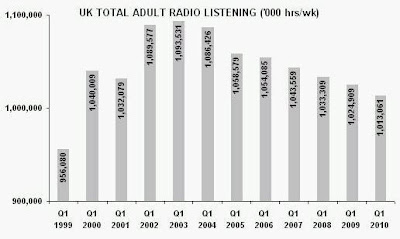
Government: agreement to finance DAB radio upgrade “not expected until late 2010”

Recent government correspondence (see below) has confirmed that:
• DAB upgrade is “unlikely to be an easy task”
• DAB upgrade is unlikely “to be resolved quickly”
• DAB upgrade requires agreement about the current levels of FM coverage
• DAB upgrade requires agreement of a plan for building out DAB
• DAB upgrade still requires agreement on the level of investment required
• the government “hopes to have a comprehensive plan by the end of 2010”
• the DAB upgrade funding issue still has to be agreed between the BBC and the commercial radio sector, which is not expected until late 2010.

House of Lords
Delegated Powers & Regulatory Reform Committee
Second Report of Session 2009-10 [excerpt]
re: Digital Economy Bill
17 December 2009

Clause 36
20. Section 58 of the Broadcasting Act 1996 makes provision for the duration and renewal of national and local radio multiplex licences, and in particular specifies the grounds on which an application may be refused. Section 58 is in Part 2 of the 1996 Act.
21. Clause 36 inserts a new section 58A into the 1996 Act enabling the Secretary of State by regulations subject to affirmative procedure to “amend section 58 and make further provision about the renewal of radio multiplex licences” and for that purpose to amend other provisions of Part 2 of the 1996 Act. There is a “sunset” provision preventing the power being exercised after 31 December 2015.
22. It is impossible to tell from the Bill whether the policy is that the licences should or should not be renewable at all, let alone for what period or on what grounds. Indeed, paragraph 56 of the memorandum candidly admits that the relevant policy decision has yet to be made. We draw attention to the skeletal nature of the power in clause 36, to enable the House to examine it further and determine whether it is justifiable in this context.

Attached is the Memorandum by the Department for Culture, Media and Sport and the Department for Business, Innovation and Skills which explained:

Clause 36: Renewal of radio multiplex licences: Amendment of Broadcasting Act 1996
Powers conferred on: Secretary of State
Power exercised by: Regulations
Parliamentary procedure: Affirmative resolution

Clause 36 adds a new section 58A into the Broadcasting Act 1996. That provision contains a power to amend Part 2 of the Broadcasting Act 1996 (and in particular section 58) by regulations for the purpose of making further provision about the renewal of radio multiplex licences. In particular, regulations made under this power may make provision about the circumstances in which OFCOM may renew a licence, the period of such renewal, the information that OFCOM may require from an applicant, the requirements that an applicant must meet, the grounds for refusal of an application, payments to be made and further conditions that may be included in a renewed licence.
The reason for providing for a power to amend Part 2 of the Broadcasting Act 1996 by order in this way, rather than making amendments in the Bill, is that the decisions about whether or not to extend radio multiplex licences are dependent on an agreed industry wide plan for rolling-out DAB to match FM coverage. This planning process can only begin when (a) OFCOM have the power to allow multiplexes to merge, which requires the new powers to change the frequencies allocated to multiplexes set out elsewhere in the Digital Economy Bill, and (b) when funding issues between the BBC and the commercial sector are agreed; which is not expected until late next year. The power conferred on the Secretary of State will be subject to a sunset provision, so that it cannot be exercised after 31 December 2015.
Given that the power provides for amendment of primary legislation relating to the regime for renewals of licences, we consider it appropriate that any order made under this power should be subject to the affirmative procedure.

Letter from the Rt Hon Lord Mandelson, Secretary of State, Department for Business, Innovation and Skills to the Chairman of the Delegated Powers & Regulatory Reform Committee [excerpts]
January 2010

1. I am writing in response to the Committee’s Second Report of Session 2009-10 published on 17 December which addresses the Digital Economy Bill…….

Independent radio services
Report paragraph 22: clause 36: Renewal of radio multiplex licences

22. The Committee considers that it is impossible from the Bill to determine whether the policy is for licences to be renewable and, if so, for what period and on what grounds. The Committee draws attention to the “skeletal nature of the power in clause 36, to enable the House to examine it further and determine whether it is justifiable in this context”.
23. The Department notes that the Committee does not recommend removal or amendment of this provision. The Government intends to further explain the rationale for the clause during the Committee stage of the Bill.
24. It is the Government’s aim to work with broadcasters and multiplex operators to agree how to build out the Digital Audio Broadcasting (DAB) infrastructure to meet FM coverage levels, one of the criterium that needs to be met in setting a date for digital switchover for radio. This is unlikely to be an easy task, or indeed to be resolved quickly. Among other things, it will require agreement about the current levels of FM coverage, the plan for building out DAB and the level of investment required. The Government hopes to have a comprehensive plan by the end of 2010.
25. The Government believes that a key component of this planning will be the ability to alter the terms of multiplex licence renewals. The existing section 58 of the Broadcasting Act 1996 allows OFCOM to renew radio multiplex licences granted prior to 30 September 2006 for periods of 12 or 8 years (depending on when the licence was granted). However, the Government recognises the need to reduce, as much as possible, the impact of infrastructure build-out on digital stations.
26. One way this can be achieved is to allow multiplex operators to spread the cost of any new investment over a longer licence period. This is why the Government has proposed new powers in section 58A to amend the provisions about the renewal of multiplex licences. The reason that the power is not more specific is because it will not be clear exactly how it will be most appropriately applied until the plan for the build-out of DAB is developed.
27. Exercise of the power will, in any event, be subject to parliamentary scrutiny due to the fact that any regulations will require resolutions of both Houses before being made.

FRANCE: “2010 will be the last chance” to launch digital radio

2010 will be the last chance for digital terrestrial radio” to launch in France, said Alain Mear, vice chairman of the CSA [media regulator] digital radio working group. “If digital radio does not start in 2010, there will be no digital radio.” He was speaking at a roundtable meeting held 15 January at the Senate to discuss the future of radio, according to RadioActu. Mear argued that the government needed to set a deadline for the ending of radio broadcasting on FM and AM. “This is the moment of truth”, he said.

However, the view of some radio groups represented at the meeting was that radio in future would be delivered to listeners via a mix of platforms. Concern was also expressed about the financial cost of launching a new digital broadcast platform. Michel Cacouault, representing the commercial radio trade body Bureau de la Radio, predicted that there could be “no development without an economic assessment”. He stressed that the sector’s declining advertising revenues in 2009, resulting from the global economic crisis, had required “all the big groups to face re-organisation and downsizing.”

Arnaud Decker, director of corporate relations at media group Lagardere Active, said that “the authorities must ask themselves how the competitiveness of the national music radio networks can be maintained” when the launch of digital radio would increase broadcasters’ costs.

Jacques Donat-Bouillud, director of radio at transmission provider TDF, said that the cost of providing digital terrestrial radio to a population of 40m would be around 500m Euros per annum. For a single station requiring national coverage in France, he said that digital transmission would cost 3m Euros per annum, compared to 6m Euros per annum for FM transmission.

Pierre Bellanger, CEO of commercial station Skyrock, pointed out that “60% of mobile handsets are internet enabled” and cautioned that “there is no single correct answer to the question about the future of radio. The solution is a hybrid and, ultimately, the listener will be the winner.”

Bruno Patino, director of state radio station France Culture, agreed: “[State] Radio France must participate in the digitalisation of broadcasting. Digital radio delivered by IP will be there, but that will not kill the broadcast platform.”