UK commercial radio revenues Q3 2010: still no sign of "renewed growth"

2008 had been a bad year for commercial radio revenues, down 6% year-on-year. 2009 was a worse year, when revenues fell a further 10% year-on-year. So how is 2010 shaping up? Radio Advertising Bureau data for Q3 2010 demonstrate that, although revenues are likely to be up marginally for the calendar year, they have yet to regain the substantial losses suffered during those previous two years.

Why? Because commercial radio’s falling revenues are largely the result of structural decline, something that the ‘credit crunch’ of 2008/9 merely exacerbated. Adjusted for the impact of inflation, commercial radio revenues peaked in 2000 and, by 2009, were down 32% in real terms. The single-digit improvements we might see in 2010 will claw back only a tiny part of these enormous losses.
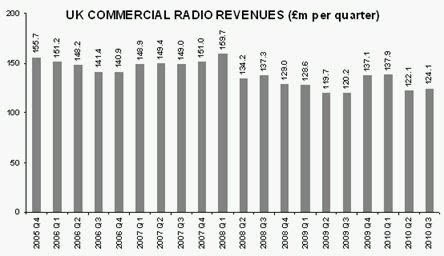

Q3 2010 TOTAL REVENUES
· Up 3.2% year-on-year to £124.1m, but remember that Q3 2009 had been the sector’s second lowest this millennium

In May 2010, the Radio Advertising Bureau had told us that “the [commercial radio] sector has turned a corner and not only halted [revenue] decline, but moved into renewed growth …”

Industry data has yet to validate this assertion. The last two quarters produced the third and fourth lowest revenue totals of the decade, showing that the radio sector is certainly not out of the woods yet. More than anything, the industry’s revenues still seem to be bumping along the bottom. “Renewed growth” is not on the horizon yet.
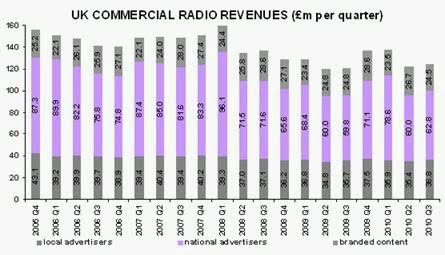


Q3 2010 NATIONAL REVENUES
· Up 5.0% year-on-year to £62.8m

Q3 2010 LOCAL REVENUES
· Up 3.1% year-on-year to £36.8m

Q3 2010 BRANDED CONTENT REVENUES
· Down 1.2% year-on-year to £24.5m
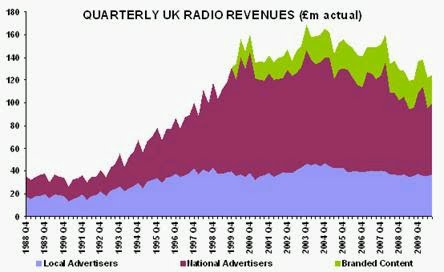

The revenue data for the long term [see graph above] illustrate clearly the transformation of the commercial radio sector from a healthy growth industry in the 1990s to one that stagnated after 2000, and which has subsequently moved into decline. Whilst revenues from local advertisers have simply stalled in recent years, revenues from national advertisers seem unlikely to ever recover from substantial declines suffered since their peak in 2000. This has necessitated significant restructuring of the commercial radio sector in recent years.

For those larger commercial radio stations that depend upon national advertisers the most, the outlook continues to look bleak. Data from Nielsen estimated that advertising spend by the government’s Central Office of Information [COI] fell by 47% in 2010 year-on-year. COI expenditure has been a greater proportion of commercial radio revenues than of any other medium, making radio particularly vulnerable. In May 2010, I had predicted:

“A 50% budget cut to COI expenditure on radio would lose commercial radio £26m to £29m per annum, 6% of total sector revenues. A 50% budget cut to all public sector expenditure on radio would lose commercial radio £44m to £48m per annum, 9% of total sector revenues.”

Not only have these cuts been realised, but the Cabinet Office is continuing to pursue a plan for the BBC to carry public service messages for free, rather than pay commercial broadcasters for airtime [also predicted here in May 2010]. This could lose commercial radio a further 6% to 9% of revenues.

In 2009, even before these drastic cuts to government expenditure on advertising, commercial radio was attracting only 4% of total display advertising expenditure in the UK, one of the lowest proportions globally [see Ofcom report]. What is UK radio doing so wrong that Ireland, Spain and Australia achieve more than double that amount? And why was that percentage already falling before the COI cuts, demonstrating the radio medium’s comparative lack of appeal to potential advertisers?

There could not be a worse time to be a commercial radio station dependent upon national advertising. Yet now is the precise time when several large commercial radio owners are busy transforming their local and regional stations into national ‘brands.’ As a response to the sector’s structural challenges, this is tantamount to cutting off your nose to spite your face. ‘Localness’ has consistently been shown to be the most important Unique Selling Point of local commercial radio, according to Ofcom research. Throw that localness out the window and all that remains is a music playlist which can be generated by any computer application.

UK commercial radio has always been good at making ‘cheap and cheerful’ local radio, but has been rubbish at making national radio that could compete with the BBC’s incredibly well resourced national networks. The recent decisions of commercial radio owners to switch from production of local radio services with a track record of success to production of ‘national’ ones that have a history of relative failure create massive risks for an industry already in decline.
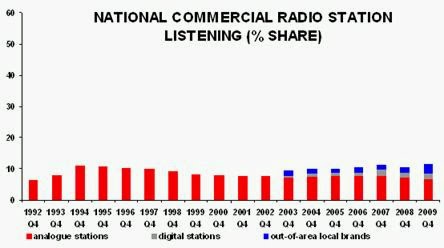

History tells its own story. The launch of the UK’s first three national commercial radio stations between 1992 and 1995 had much less of an impact on radio listening than had been anticipated. By 1997, Richard Branson had decided to sell Virgin Radio (for £115m) – it was obvious that national commercial radio was not going to be a massive moneyspinner. In 1997, Virgin Radio’s listening share had been 2.6%. Last quarter (Q3 2010), it had fallen to 1.2% (renamed Absolute Radio after another sale in 2008 for £53m), while the combined share of the three national stations was 6.8%. [source: RAJAR]


BBC national networks account for almost half of all radio listening. The only time that their share has not exhibited long-term growth was during the early 1990s, when Radio 1 self-destructed under the management of Matthew Bannister. Since that disaster, the BBC’s national networks have been successfully clawing back listening year-on-year.

The current scenario in which the owners of commercial stations that were licensed to serve local audiences have decided to subvert that purpose to take on the might of the BBC national networks is either brave, or madness, depending upon your viewpoint. What I see is a monolithic BBC that has existed continuously for nearly a century, and then I see three national commercial radio stations that have had a succession of at least three owners each during their almost twenty-year struggle to attract listeners.

National commercial radio. Just why are parts of the commercial radio industry so eager to emulate an idea that has only led to well documented failure?
Commercial radio local DAB build-out "not the BBC's responsibility" says BBC Trust chairman

Culture Media & Sport Select Committee, House of Commons
15 December 2010
BBC Annual Report & Accounts 2009-10 [excerpt]

Sir Michael Lyons, Chairman, BBC Trust
Mark Thompson, Director General, BBC

Damian Collins, MP Folkestone & Hythe (Con): Has the [Licence Fee] settlement affected the amount of support you can give to digital radio switchover and the build-out of digital radio in local services within the regions?

Sir Michael Lyons: What you see in yesterday’s announcement is a clear message that the BBC remains committed to DAB and will continue to build out up to FM equivalents. That is clear. It is involved in discussions with the commercial radio industry and Government about local build-out, for which it is not responsible and for which there are not funds currently identified. They were expected to be undertaken by the commercial operators of those Mux [DAB multiplex] licences.

I don’t think I should add very much to that, other than that, clearly, the Government has determined on a switchover date. Whether that can be achieved is, in our view, whether the audience is ready for it to be.

Damian Collins: I suppose whether it can be achieved ought to be linked to the level of coverage as well. The Government has been clear about that, too. In those negotiations you are having with Government and the commercial stations, is the amount of money you have on the table a smaller amount, as a result of the settlement, than it was before?

Mark Thompson: No.

Sir Michael Lyons: It is clearly another one of the pressures that we have to balance in a tighter envelope; that is the important thing.

Mark Thompson: I think it is fair to say that the underlying commitment that we have made and the focus we have on the building out of our own national multiplex, is unchanged by the settlement.

Sir Michael Lyons: Absolutely. It is a reference to local, I think, that I was …

Mark Thompson: Quite. But the BBC’s focus has always been … the issue about local is that we only have in England, and only intend to have, a single BBC local radio station per region. With each local multiplex that has been opened so far, we have taken a place on that multiplex; we decided that we should do that.

I have no reason to believe we would not continue to do that as they are built out. But whereas the national multiplex, obviously, is a way of getting additional BBC services to the public – the digital services – there is no such increase in BBC services that we can offer if you are taking a single station which is analogue and putting it on digital as well. So our focus is on national build-out, and the broad policy and the commitment over time to absolutely keeping pace with the audience, building out nationally, is unchanged by the settlement.

Damian Collins: Your commitment is clear, and you made that again today, but is it going to take longer to get there now, as a consequence of finding some other issues you have to deal with?

Mark Thompson: I don’t think so. If you say something slightly different, which is, “Would some people have liked some level of additional commitment in the settlement?”, perhaps they would, but it is not there.

Damian Collins: But as far as you are concerned, your commitment is the same?

Mark Thompson: It is exactly the same.

Damian Collins: In the document put to us yesterday, you talk about preparing for any potential radio switchover. That does not sound like it is going to happen within the next five years.

Sir Michael Lyons: That is not a judgment for the BBC; that is a judgment for Government. The BBC is very clear that it is doing its bit in these national investments. There remain unresolved issues about where the investment comes from at a local level. That is not the BBC’s responsibility, but we are part of those discussions. And then, very critically, as the Government has conceded, switchover can only take place … I do take your point that audience preparedness will to some extent depend on coverage, but it also depends on choices made about replacement television sets, investment in cars and a whole series of other things, which are not in our gift.

[This is an uncorrected transcript of evidence taken in public and reported to the House. The transcript has been placed on the internet on the authority of the Committee, and copies have been made available by the Vote Office for the use of Members and others. Any public use of, or reference to, the contents should make clear that neither witnesses nor Members have had the opportunity to correct the record. The transcript is not yet an approved formal record of these proceedings.]

GERMANY: planned 2011 re-launch of national DAB "solved a problem that did not exist"

On 15 December 2010, five commercial radio stations in Germany – New Wave Radio, Lounge.fm, ERF Medien, Radio Energy in Hamburg and Regiocast Digital – signed contracts with transmission provider Media Broadcast to broadcast on the new national DAB+ platform, scheduled for launch in 2011.

One week earlier, British company Frontier Silicon, “market leading supplier of digital radio technology worldwide”, had announced that, in order to persuade four commercial radio broadcasters in Germany to persevere with DAB, it had promised them it would purchase an unspecified amount of their advertising airtime for the next four years.

Anthony Sethill, Frontier Silicon CEO, put a positive spin on an act that some might perceive as little more than legalised bribery in the face of desperation to sell DAB hardware in Germany: “We are delighted that our innovative approach to supporting the roll out will help everyone working on this new radio service to bring their efforts to fruition.”


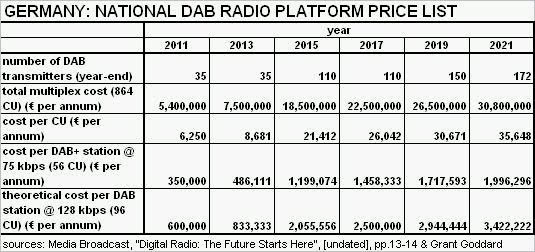
For years, German transmission provider Media Broadcast has been eager to put into action its masterplan to lock new DAB+ broadcasters into minimum 10-year contracts, for which it will be charging €2m per annum per station by 2021. The combination of Media Broadcast’s enthusiasm for the financial returns from DAB transmission contracts, and Frontier Silicon’s enthusiasm for the potential sales in Germany of DAB receivers that incorporate its technology, plus the offer of an amount of cash, persuaded a few commercial broadcasters to take on the risk of using the DAB+ platform.

Helmut Egenbauer, CEO of Media Broadcast, said: “Having introduced Frontier Silicon to the commercial broadcasters, we are delighted to see that their discussions have led to this important commitment to DAB+ radio services.”

Those five German commercial broadcasters should understand that even Frontier Silcon’s subsidy might not prevent them losing money hand over fist for the entire ten years of their transmission contract with Media Broadcast. The evidence is already there from the UK market. Not one commercial digital-only radio station has yet made an annual operating profit from the DAB platform in the UK, even after eleven years, let alone come close to recouping its investment.

Research commissioned by RadioCentre in 2009 found that the average annual revenues of a digital radio station were around £130,000 per annum. By then, 10m DAB receivers had been sold in the UK. Yet Germany is still at Year Zero with DAB+ radio penetration. The same report for RadioCentre had noted that the “annual negative cash flow impact of DAB” on the UK commercial radio industry was around £27m per annum, or 5% of sector revenues. Can German commercial radio afford to deplete its profitability by that sort of amount, year-on-year, for the next decade?

Frontier Silicon’s press release quoted Helmut G. Bauer as a “representative of the commercial broadcasters,” saying what a fantastic deal it was and promising that “2011 will be year that DAB+ is successfully launched in Germany.” However, Bauer is not associated with the German commercial broadcasting trade body, VPRT, which has been outspoken in its condemnation of plans for digital radio switchover in Germany. Bauer is a Cologne-based lawyer who has long made pro-DAB presentations at media conferences, and pro-DAB statements to the press, as a ”consultant.”

In fact, VPRT had
commented: “As we know, DAB failed in the market. Against this background, plans for the closure of FM – originally scheduled for as early as 2015, but now postponed – are absurd from an economic and social perspective and are therefore unacceptable.”

Noting the developments in Germany this week, Berlin-based Christoph Lemmer wrote in Radioszene magazine:

“With this decision, DAB will now actually be introduced by those who have succeeded, smelling a quick buck, in selling Germans a new sort of equipment, with millions to be sunk into to a new transmission network. Our old radios will be useless for DAB. Those who want to continue listening to the radio will need a new receiver.“

“It does not take a prophet to suspect that the private radio industry has shot itself in the foot by agreeing to sign the DAB contracts. A few shekels subsidy from a chip manufacturer who wants to install as many of its chips in DAB receivers – that is what has led to this. You, dear people, were not considered in the end. Do you really believe that devices with DAB will ever be as numerous as FM radios are today?”

“No one will understand what [DAB] is and why it is good. Because, with DAB, you have solved a problem that did not exist. The existing technological distribution of radio programmes is excellent and widely used. You did not have to change anything. The argument that DAB will create new radio channels with lower entry barriers is specious, as long as media regulators continue not to award licences for technically available [analogue] frequencies because they do not want additional competition in the market.”

This week, World DMB, the body marketing DAB radio globally, was so excited by developments in Germany that its web site posted seven news stories about it on 15th, nine on 16th and a further four on 17th. The overkill speaks volumes. Lacking any upturn in DAB receiver sales, the only positive news that DAB lobbyists can muster is this second attempt in Germany to launch a DAB technology that was first developed in 1981.

It is hard to recall a comparable technology whose proponents were still pushing for its launch three decades after its invention. DAB proponents argue that, simply because DAB is ‘digital’, it is inevitable that it will replace analogue radio. History indicates otherwise.

Digital Audio Tape. Introduced 1987. Abandoned 2005.
Digital Compact Cassettes. Introduced 1992. Abandoned 1996.

Roll up! Roll up! Enjoy the radio industry pantomime: 'DAB Radio'

The Ministerial Group for the government’s Digital Radio Action Plan will meet tomorrow. That meeting has all the hallmarks of a radio industry seasonal pantomime, with participants dressed up in their gladrags to play the appropriate parts. A select audience has been hand picked, though the ending of the story has still to be written.

Pantomime often brings out a sense of déjà vu, of having seen the same thing during previous Christmases. This winter’s DAB radio marketing campaign has that feeling. The 2010 slogan is:

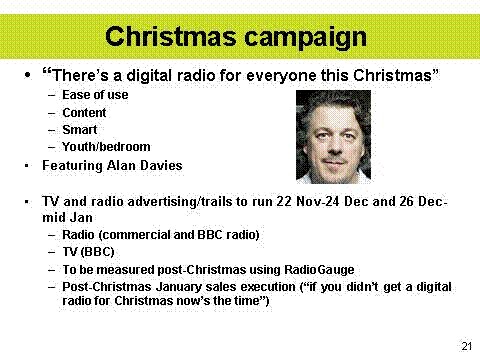
“There’s a digital radio for everyone this Christmas”

While the UK radio industry’s Christmas campaign for 2009 had been:

“Struggling to think of the perfect gift for Christmas? There’s a digital radio for everyone …”

Pantomime often stages a sleight of hand, where you are not quite sure if what you saw was real or just some cheap trick. This winter’s DAB radio marketing campaign has that feeling. On 18 November 2010, the press story was:

“The commercial radio campaign [for DAB], which breaks on November 22, covers Global [Radio], Bauer [Radio], Guardian Media Group [Radio], Absolute [Radio], UTV [Radio] and many local commercial stations.”

But, within days, that story had changed so that the campaign:

“… will run across major commercial groups” and “commercial radio stations including Absolute, UTV, Orion.”

What happened to Global Radio, Bauer Radio and Guardian Media Group Radio? Well, every pantomime has its jesters who do their best to spoil the rest of the cast’s fun. This winter’s DAB radio marketing campaign has that feeling. Two days after the Christmas DAB campaign had started, The Telegraph broke the story that:

“Leading commercial radio groups [Global Radio, Guardian Media Group] have refused to promote DAB radio …”

Every pantomime has its bully, who picks on people mercilessly and prevents them from going to the ball. This winter’s DAB shenanigans have that feeling. Commercial radio trade body RadioCentre offered its story as to why its members, Global Radio and Guardian Media Group, had pulled out of the marketing campaign:

“Commercial radio operators are currently in discussions with government about the funding of local DAB coverage. Until those discussions are resolved, we understand that some stations felt it would be inappropriate to run the digital radio Christmas campaign.”

Er, isn’t that blackmail rather than negotiation? Is it not transparent that, if you really cared about making DAB radio a success, you would think twice about cutting off your nose to spite your face by deliberately NOT promoting the very DAB platform that you have been attempting to palm off on the public for the last decade? In essence, you are trying to convince consumers that you care so much about your backward 10-year old offspring that you intend to starve it to death. In pantomime, such a tragedy might give the audience a laugh. In reality, it would be time for Social Services to intervene. It cannot be good PR for the commercial radio industry to be so convincingly playing the part of The Wicked Witch of The West.

RadioCentre’s lack of parenting skills has been evident in recent weeks:
· Its children had refused to attend the government’s Digital Radio Stakeholders Group meeting on 1 November [see earlier blog]
· Last Friday, its children refused to participate in a Westminster conference on ‘the future of UK digital radio’ organised for 7 December, resulting in the event’s postponement until April 2011.

And here is what the school notes said to explain these absences:
· “Following the announcement of the [BBC Licence Fee] settlement, RadioCentre has been in discussions with Government about the funding of local DAB coverage. As these discussions are ongoing, RadioCentre members felt it would be inappropriate to attend the Digital Radio Stakeholder meeting.” [Campaign]
· “Sensitivity of current negotiations on the future of digital radio” for the conference pull-out.

The evident paradox in this radio pantomime is that:
· The radio industry is spending £55m between now and 2015 to try and convince the public that DAB radio is the best thing since the cat’s whisker [see earlier blog]
· The radio industry big boys will not stand up in front of other stakeholders in the media sector, or in front of a conference, and explain what, why or how they are pursuing (or not really pursuing at all) the government’s DAB dreams
· Commercial radio has been demanding for several years that the BBC pays for fixing the deficiencies in commercial radio’s own DAB local transmission system. (Yes, this is the same BBC that RadioCentre has lambasted for years about its interference in commercial activities. Yes, these are the same commercial radio big boys who invested heavily in DAB in the 1990s in the hope of making profits for their shareholders.)

Pantomime is pure theatre, and tomorrow’s meeting will doubtless provide much entertainment for all involved. The only unresolved issue is how it will all end. Will the government Minister play the part of Scrooge, insisting that the commercial radio big boys should work longer hours for their living and must pay for improvements to their DAB system themselves? Or will the government play the wicked stepmother, compromising the BBC’s independence by forcing it to pay for an expensive sticky plaster to fix a commercial media sector DAB problem that has been all of its own making?

My feeling is that, in these austere times, it would be opening up another big black hole for public money to now finance such massive deficiency issues with DAB radio that could and should have been anticipated and fixed a decade ago. It is simply too expensive to commit unknown quantities of cash to transform the ugly DAB frog into a handsome prince who might never be fit enough to rival FM radio. Anyway, the BBC has already made a public commitment to not spend any more Licence Fee money on yet another ‘makeover’ show. In which case, our Cinderella DAB may not be going to the ball.

Or is all of the above just a pantomine within a farce? Is all this play-acting merely intended to allow commercial radio to walk away from DAB altogether, pointing the finger of blame elsewhere (and smug that the Classic FM automatic licence renewal is nearly almost within its grasp)?

BBC head of radio: "I'm not going to give you a date" for digital radio switchover

Feedback, BBC Radio 4, 26 November 2010 @ 1330 [excerpt]

Roger Bolton, interviewer [RB]
Tim Davie, director of BBC audio & music [TD]

RB: Tim Davie is the BBC’s director of audio and music. I asked him if the campaign to get decent DAB coverage in 90% of the country by 2015 is still realistic.

TD: I think 2015, and I’ve said it before, is highly ambitious. The BBC would not want to see any [digital radio] switchover unless you had clear evidence of mass listening to digital, and good penetration of digital devices. I think the idea that we force a lot of listeners to a situation where they have to get rid of FM devices and not have something to listen to on digital is clearly not in the interests of the head of BBC radio [laughs].

RB: When would you say, without doubt, we will have digital switchover …

TD: [interrupts] I’m not going to give you a date. I’m not going to give you a date. I’m …

RB: … not ten years, not fifteen years, not twenty years?

TD: I think there will be a switchover. I think it’s been extremely helpful to put a stake in the ground and say ‘could we get to 2015?’ I say that’s ambitious. I quite like ambitious targets. We’ll see how we go.

RB: And there’s concern about coverage. What about quality? Because there are still a lot of our listeners who are not persuaded that the quality [of DAB] is superior, in that digital is actually sometimes worse than FM.

TD: In terms of the areas that are covered by a digital signal, I would be the first to say that we’re not there yet. So, you know, I know some of the listeners out there will say ‘well, I just can’t get a good signal’. Let’s be clear. Before the radio industry would say to people ‘we’re moving away from FM’, we must have full coverage of a DAB signal …

RB: And yet, despite this, you are running a campaign, or rather supporting a campaign, which says ‘digital radio: more to love’ [and] pushing it hard. You’re pushing something …

TD: [interrupts] Absolutely.

RB: … which you have reservations about.
TD: When you say ‘reservations’, I don’t think it’s quite the right word. I’m saying we’re building out coverage. I would not endorse a switchover unless coverage were as good as FM. At this point, I think it is utterly appropriate for me, as the BBC head of radio, to say: those people in areas of coverage – and it is important, by the way, when people buy radios, they check that they are in an area of coverage, we absolutely say that repeatedly – but, if they are in an area of coverage, I would absolutely say ‘buy a digital radio’ because you can get Radio 7, the joys of 6 Music, etcetera.

RB: But, in terms of this campaign, let me quote something said by William Rogers, the UKRD chief executive – part of the commercial radio network. He says it was ‘fundamentally immoral and dishonest to run the campaign, knowing that DAB infrastructure is not good enough, and knowing full well that when people buy a DAB radio, it may not work when they get it home. The BBC should be ashamed of themselves for running this ad. They are telling their listeners to buy something which they know isn’t ready for us yet.’

TD: Well, I mean, it is one voice, and I say ‘one voice’ among many in commercial radio and …

RB: [interrupts] And there are quite a few others who, again, refuse to run the ad.

TD: Absolutely. And, well, I think their beef is, by the way, slightly different to that articulated by William, but it’s really straightforward. 88% of the people in the country can get a signal. If you can’t get a good signal, I wouldn’t recommend digital radio. If you get that coverage, we would absolutely recommend – I think it’s utterly appropriate – to say to people: ‘go and get a digital radio to enjoy the full range of services.’

RB: But the commercial radio sector, or some of it anyway, is saying ‘this is precisely the thing the BBC should be doing. It should be investing and spending so that everybody can get digital coverage.’

TD: Mmm. We’ve said, in the last few weeks, and part of the BBC [Licence Fee] Agreement with the government was to build out national coverage of DAB services. The debate with local radio – just to be clear, and this is a bit complex, so apologies, but – is around the local layer of DAB. And we are negotiating out those costs at the moment. While that negotiation goes on in pretty tough financial circumstances for the BBC, it’s understandable that people say ‘well, we need a bit more clarity.’ I agree with them.

RB: Can I ask you, though, whether the BBC’s enthusiasm for the potential of digital, in terms of stations, is waning. For example, you did propose the closure of 6 Music and the end of the Asian Network, at least as a national station. Are you still in love with digital?

TD: It’s a fair point. The idea around looking at the line-up of stations was never about taking money off the table for digital. We want to keep investing in digital and, I think, in terms of our commitment to digital, this not just about DAB, this is about internet services. We’ve just said, on Radio 3, we’re launching HD sound, which will be a wider signal through internet radio. I think, as the head of BBC radio, I really want to see radio develop into a more competitive marketplace so that it can grow. The idea that the BBC just sits on FM spectrum, and there’s no growth in radio, to me, seems a pretty limited vision of the future for the industry.

RB: So there’s no doubt about the destination, only the amount of time, the speed of getting there?

TD: Radio’s going digital.

DAB radio lies: lobbyist claims 40% of listening to Radio 4's 'Today' show is via DAB

The Today Programme, BBC Radio 4, 22 November 2010 @ 0735
Ford Ennals, chief executive, Digital Radio UK [FE]

Q: Doubts persist over this particular digital standard [DAB], don’t they? Let’s just go through some. First of all: that it’s a stop-gap and that we’d all be better off with internet radio, which will become possible in cars and all over the place, and that there will really be no need for DAB at all.

FE: Well, look, what is certain is that the future of radio in the UK, and right across Europe, is digital. And what that’s going to bring is more choice, more competition, and more innovation …

Q: [interrupts] But your particular ‘digital’ is DAB digital, isn’t it …

FE: [interrupts] Well, no. It’s …

Q: … and there are other technologies available?

FE: No, not at all. We’re here to support and promote the transition to digital radio in all its forms, whether it be online, whether it be on TV, or whether it be DAB. DAB is one of those platforms. But, what we do see is great certainty that DAB is, if you like, the broadcast transmission backbone of radio, not just in the UK, but in Europe. There are 40% of all your listeners this morning listen to this programme, are listening on a DAB radio. And, I think, the simple fact is that, if they were all listening online, it couldn’t be supported and the internet would crash. So, right now, IP, as you call it, or online, just isn’t the right technology. It can’t sustain broadcast transmission of radio, and it’s not cost-effective, and it isn’t an option in the short or medium term.

Q: [incredulous] 40% of our listeners are listening on digital? Does that include listeners in cars, because I don’t know a single person who has got a digital radio in their car, I don’t think?

FE: Well, I think you have highlighted the real opportunity here. Car manufacturers have been slow to put digital radios in cars but, since the passage of the Digital Economy Act and the launch of the Digital Radio Action Programme [sic], they’ve now committed to having all new cars with digital radios in by 2013, and we’ve started to see Ford and Vauxhall and Mini putting them in. And I think that’s very important because …

Q: [interrupts] The ‘40%.’ Sorry, though. The ‘40%’ figure – did that include people in cars?

FE: Yes, urm. The 40% does include people in cars …

Q: Really?

FE: … and the targets that government have set also includes people in cars. So, what government is saying is, and I think supported by industry, is that we want to see 50% of listening to a digital platform, including DAB, before we take a firm decision about a switchover date.

Q: Mmm. Last quarter, digital listening was actually down, wasn’t it? It sort of implies that the message isn’t getting through.

FE: Well, actually, as I said, 40% of listeners are listening on digital. That’s over 20 million people every week listening to digital. This year, we’ve seen it grow by 20%. So, typically, what we see is growth in the first half-year, it slows down in the second half, and then steps up again in the second half [sic]. So, actually, quarter-on-quarter, we’ve seen moderate growth, but 20% growth year-on-year, and we’re looking for a major step at the beginning of next year. And, what I would say to people, if you’re buying a radio for a present this Christmas, make sure it’s a digital radio.


…………………………………………………..

Dear ‘Today’

I was shocked to hear Ford Ennals, chief executive of lobby group Digital Radio UK, proclaim on your programme that:

“there are 40% of all your listeners this morning listen to this programme, are listening on a DAB radio.”

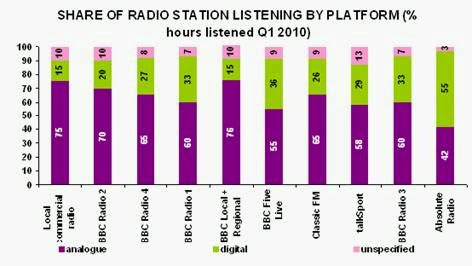
This statement is not merely an exaggeration, it is wholly untrue. The radio industry’s audience data (produced by RAJAR, published by Ofcom for Q1 2010) show that 27% of listening to Radio 4 is via all digital platforms, which include digital television, the internet … and DAB. See graph below.


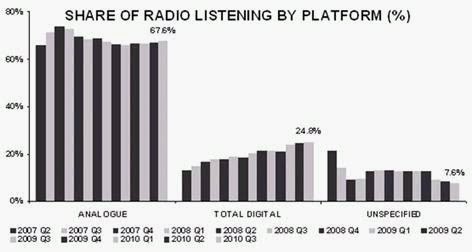
In-car listening accounts for 19% of total radio usage, but this proportion is likely to be considerably higher during the morning commute period. Because DAB radios are installed in less than 1% of cars, it is probable that much, much less than 27% of listening to the ‘Today’ programme is via DAB.

Ford Ennals’ untruthful statement is only the latest in a long line of disinformation perpetuated by commercial forces that will gain financially from DAB take-up, and which are designed to mislead the public into buying DAB radios.

Yours

Grant Goddard

SPAIN: DAB enters the last chance saloon

DAB radio in Spain has been a disaster, not least for those commercial broadcasters who invested in new technology and distribution contracts, but who have generated no additional listeners or revenues. “Zero,” said Agustin Ruiz de Aguirre, technical director of Cadena SER. “The audience is zero.” He explained that a non-existent audience generates no revenues or profits because “who would want to advertise on a medium that does not deliver any consumers?”

Spanish broadcasting law requires stations that embarked upon DAB to continue broadcasting for the duration of their licences, regardless of whether anyone is listening or not. Ruiz de Aguirre said that all the commercial broadcasters are united with a single goal: to stop having to broadcast on DAB. To date, the government has not relented, though the current licences end in 2010 and 2011.

“I do not think analogue radio switch-off will happen in either the short or medium term,” said Xosé Ramón Pousa, professor in the Faculty of Communication Sciences at the University de Santiago de Compostela. “In this scenario, DAB is at a dead end.”


“We are a rarity”,
said Pere Vilas, who heads Spain’s drive for digital radio (and is the managing director of technology at state broadcaster RTVE). State radio has been simulcasting on DAB since 1998. Spanish broadcasting law has required a technical plan for DAB radio to be in place for the last year and a half, though nothing exists as yet. Such a plan is seen as DAB’s last chance to redeem itself in Spain.

“Work began a long time ago, even before digital television switchover,” admitted Xavier Redón, product marketing manager of transmission infrastructure provider Abertis Telecom. “But it is about to begin again.” Like DAB lobbyists elsewhere, Redón was quick to claim that the rest of Europe was already well down the road to DAB radio switchover. He asserted that, in France, all radios would have to be digital by 2013, and that Germany was creating a national DAB+ network in 2011.

Redón predicted that 2011 would be “key” to laying the groundwork for the re-launch of DAB in Spain. A glance at the website for DAB radio in Spain elicits a similarly optimistic stance. It states boldly: “Digital radio is a fact. It is not the future. It is the present.”

Until you realise that this latest news item was posted in April 2008.

The Digital Radio Stakeholders Group: another 'faux consultation'

Did you hear about the inaugural Digital Radio Stakeholders Group meeting held on 1 November 2010 at the government’s DCMS [Department for Culture, Media & Sport] office? Probably not, unless you were one of the couple of dozen people who were in attendance. Otherwise, you were in the majority who were unaware of the event. There was no public pre-announcement of this meeting. Afterwards, there was only one article about it in the media trade press. Google returns ‘no results’ from an internet search for ‘Digital Radio Stakeholders Group’, even though this is the title writ across the top of the agenda circulated for the event.

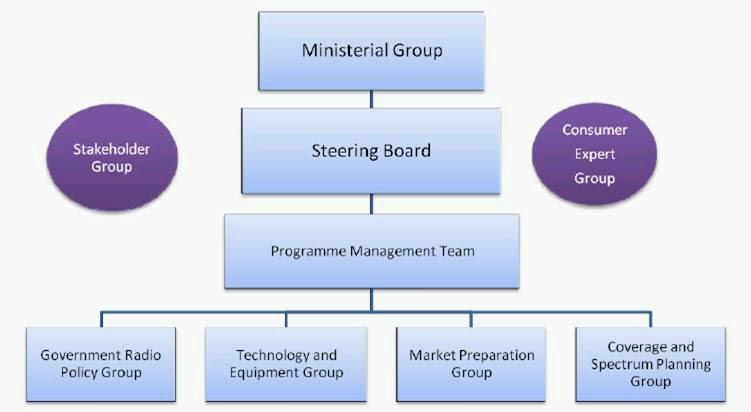
You have to look in the new government’s Digital Radio Action Plan, published in July 2010, to discover:

“The Government will chair a Stakeholder Group which will be open to a wide range on industry and related stakeholders. The principle purpose of this Group will be to inform external stakeholders of progress against the Action Plan and gather views on emerging findings. We expect that the Group will meet quarterly.”

The government’s project management plan anticipated that, by Q2 2010, it would be able to:

“secure commitment from the Government Digital Radio Group and the Stakeholders Groups to the Action Plan.” [Task 5.1]

This pre-determined outcome was justified on the grounds that:

“Successful implementation of the Digital Radio Switchover programme will only be achieved through close Government-Industry co-operation. […] This will include commissioning and delivery of reports, reviewing progress against key milestones and disseminating information to key stakeholders.”

So, essentially, the Digital Radio Stakeholders Group seems to be an almost non-existent forum that has only been convened to secure some kind of external ‘rubber stamp’ for the government’s proposals on DAB radio. It will allow the government, when challenged as to the democratic basis of its DAB radio policy, to assert confidently: “We convened a stakeholders group and it endorsed our proposals.”

This is cynical government at its worst. A ‘faux consultation’ that pretends to have asked a group of somebodies to endorse a government policy for which no mandate has ever been given by the electorate. It is similar to the manipulation practised by Ofcom in its radio policymaking (viz. Ofcom’s recent decision to permit Smooth Radio to dump its commitment to broadcast 45 hours per week of jazz music, after having acknowledged that 13 of the 15 responses submitted to its public consultation were opposed to this loss of jazz).

According to a government document, the Terms of Reference for the Digital Radio Stakeholders Group are as follows:

“Purpose
To enable a wide range of organisations to contribute to the process of delivering the Digital Radio Action Plan

Objectives
• To inform all stakeholders of progress with the Action Plan
• To seek the views of stakeholders on future progress of the Action Plan
• To provide an opportunity for all stakeholders to share news, views and concerns relevant to the Digital Radio Action Plan

Membership
Any organisation with a valid interest in the objectives of the Digital Radio Action Plan may be a member. Members will include consumer representative bodies, broadcasters, manufacturers, retailers, vehicle manufacturers, transmission network operators, content providers. The Group will be chaired by BIS in the first instance, though in principle the Chair could be any person acceptable to the majority of stakeholders and able to represent the collective views of the stakeholders to the Steering Board.

Mode of operation
The Digital Radio Stakeholders Group will meet quarterly.
The Chair will report the views of the stakeholders, as expressed through the meetings of the Stakeholders Group, to the Steering Board.”

So what happened at the first meeting? Very little, according to some of those who were present. It was a game of two halves. In the first half, the bureaucrats put their case. From the government, Jane Humphreys, head of digital broadcasting & content policy, BIS [Department for Business Innovation & Skills]; John Mottram, head of radio & media markets, DCMS; and Jonny Martin, digital radio programme director, BIS/DCMS. From Digital Radio UK, Ford Ennals, chief executive; Jane Ostler, communications director; and Laurence Harrison, technology & market development director. Then, in the second half, representatives from Age UK, the Consumer Expert Group, Voice of the Listener & Viewer and W4B raised issues on behalf of the consumer.

At the end of it, I guess the government-appointed chairman could return to her government office, tick the box on the government wall planner that says ‘stakeholder commitment’ and be pleased that this ‘rubber stamp’ had cost the taxpayer only an afternoon’s salary plus some tea and biscuits for the ‘stakeholders’. Well worth it!

More interesting than noting those who attended is identifying who was not there:
· No presentation by Ofcom, whose longstanding ‘Future of Radio’ policy has forced the DAB platform upon the public for almost the last decade
· Nobody from the largest commercial radio owners – Global Radio, Bauer Radio and Guardian Media Group – that have considerable investments in DAB multiplex licences

After the meeting, under the headline ‘RadioCentre quits digital radio meeting’, Campaign reported:

“RadioCentre, the commercial radio trade body, has walked out of discussions over the future of digital radio after the BBC licence-fee settlement did not commit BBC funds to roll out DAB radio. The body refused to attend a [Digital Radio Stakeholders] meeting on 1 November after the [BBC Licence Fee] settlement, published last week, included provision only for [BBC] national DAB [upgrade].” [I noted this development in a blog last month]

Whatever RadioCentre’s reason for non-attendance (and the story in Campaign has not been refuted), this kind of stance is a disgrace. Raising two fingers to the people you are supposed to be persuading of your DAB policy is not a clever PR strategy for the commercial radio industry. But I am not surprised. All the organisations pushing for DAB radio have increasingly adopted a ‘bunker’ mentality that precludes any direct contact with the public. What we appear to have now is:
· Ofcom refusing to engage in public discussion about its DAB ‘Future of Radio’ policy
· The government organising a Stakeholder Group to rubber stamp its unrealistic, dictatorial policy on DAB radio
· Digital Radio UK refusing to engage in public explanation of its DAB campaign work, as illustrated by its non-existent web site
· RadioCentre and its members now refusing to attend a meeting to explain just how/why DAB is still being pursued

At the same time, the public – the consumers, the 46,762,000 adults who spend 22.6 hours per week listening to radio – have been omitted altogether from these manoeuvrings that are still focused upon trying desperately to force them to purchase DAB radio receivers. The public had been omitted from the proposals at the very beginning of DAB more than a decade ago, which is precisely why it failed, and they are still being omitted today.

This is not the first time that government ‘stakeholder’ meetings about DAB radio have been organised simply to tick a box. As part of the previous government’s attempts to solve the DAB problem, in 2008 it convened a Digital Radio Working Group with two similar ‘stakeholder meetings’ held at DCMS. I attended and felt they existed purely for the bureaucrats to report back to their superiors that they had done something to ‘disseminate’ their policies. DCMS’ own write-up of the first meeting recounted bluntly:

“A stakeholders meeting was held on 10 March and offered opportunities for a wide range of views to be heard.”

A place where “views” were merely “heard”. The ineffectiveness of these earlier stakeholder meetings is demonstrated by re-visiting the agenda for the first of them. The issues tabled for discussion nearly three years ago (“How to make digital radio the predominant platform for listening to radio in the UK? What are the barriers to this? How can these barriers be overcome?”) still remained the same at this month’s meeting. Worse, none of the DAB technical problems identified then have been solved in the interim. And guess what? All trace of these 2008 meetings ever having happened has been erased from the DCMS website (in 2008, I had had to write to DCMS to get them to add the meeting details to their website).

The next meeting of the Digital Radio Stakeholders Group will be held on 3 February 2011 at DCMS/BSI, 1 Victoria Street, London SW1H 0ET. If you belong to any kind of community group or organisation (even if it is your neighbourhood watch) whose members are likely to be impacted by the government’s policy on digital radio switchover, I suggest you write to Jane Humphreys (e-mail to [first name][dot][second name]@bis.gsi.gov.uk) and ask for an invitation to this next meeting.

‘Stakeholder’ radio listeners should turn up to the February meeting and shout: “I’m mad as hell and I’m not going to take this any more!” … or maybe the DAB plug will already have been pulled by then.

Digital Radio Upgrade? More like Digital Radio Groundhog Day.

It was the Radio Festival, the industry’s annual get together. Everyone wanted to talk about how wonderful the DAB future of radio would be. But nobody wanted to explain how ‘Digital Radio Upgrade’, the government policy to make the UK’s DAB transmission system fit for purpose, will be paid for. It is the radio sector’s favourite parlour game: pass the DAB Upgrade parcel.

The first player is the BBC:

Q: “Very briefly, a one-word answer. Do you have any money set aside now to spend on [Digital Radio Upgrade]?”

Tim Davie, director of BBC Audio & Music: “No.”

Second is commercial radio:

Q: “Does commercial radio have any money to spend on [Digital Radio Upgrade]? […] What’s your guess?”

Phil Riley, chief executive of Orion Media: “‘No’ is the answer at the moment.”

Third are the politicians:

Jeremy Hunt MP: “I think the most important thing is not something the government can do, but something the industry can do …”

But hold on. This dialogue came from the Radio Festival in 2009…. We need to fast forward one year.

It was the Radio Festival, the industry’s annual get together. Everyone wanted to talk about how wonderful the DAB future of radio would be. But nobody wanted to explain how ‘Digital Radio Upgrade’, the government policy to make the UK’s DAB transmission system fit for purpose, will be paid for. It is still the radio sector’s favourite parlour game: pass the DAB Upgrade parcel.

The first player is the BBC:

“It remains to be seen who will pick up the £100m tab [for Digital Radio Upgrade], with [Tim] Davie saying he did not have the necessary funds.” [from The Guardian]

Second is commercial radio:

“[Global Group chief executive Ashley] Tabor said the commercial [radio] sector will only pay for the rollout of those local DAB multiplexes that are commercially viable.” [from The Guardian]

Third are the politicians:

Ed Vaizey, Minister for culture, communications & creative industries: “The BBC has to work with me on coverage. I am talking to the BBC and I hope to accelerate the pace of digital radio coverage.”

Déjà vu, anyone? Delegates paid £899 to witness this repeat performance. I have already placed my bet on precisely the same sentiments being made at the Radio Festival in 2011, though the odds offered by the bookie were not at all good. On the coach home from the Festival, everyone must have joined in the usual radio industry singsong:

“When do we want digital radio switchover? Now!
Who do we want to pay for DAB Upgrade?
Somebody else!”

And while we are on the topic of déjà vu, I am reminded of an analyst report about DAB from June 2008, in which I had written:

“The digital switchover of radio is so far into the future as to be intangible.”

I was swiftly rebuked for this viewpoint in an e-mail from a radio sector CEO.

Now fast forward to the 2010 Radio Festival. Andrew Harrison, chief executive of commercial radio trade body Radio Centre, said:

“There is no doubt if [digital take-up] carries on at its current projectory we will never get there.” [sic]

The current RadioCentre strategy remains inexplicably that the BBC should pay not only for improvements to the BBC’s DAB radio transmitters, but also for the commercial radio sector’s (see earlier blogs here and here). The nails seem to have been hammered firmly into that coffin by this week’s speed-axing session between the government and the BBC.

Although subsequent press reports have implied that the cost of the (previous) government’s Digital Radio Upgrade policy will now be underwritten wholly by the BBC, the available evidence says otherwise. The resulting four-page letter from the government to the BBC Trust set out in detail all the new items to which the BBC’s funds will have to be applied in future. The World Service? Yes. BBC Monitoring? Yes. S4C TV? Yes. Local television? Yes. DAB radio? No….

Oh, hold on. In the penultimate paragraph on the final page there is a single sentence about DAB penned by Secretary of State Jeremy Hunt:

“I also welcome the BBC’s plans to enhance its national DAB coverage in the period of this agreement, and to match its national FM coverage as a switchover date draws near.”

But while the rest of the letter is littered with the oft repeated phrase “The BBC will …”, this solitary mention of DAB radio is couched only in terms of “BBC plans” without a hint of compulsion. DAB is an obvious afterthought here and, much to RadioCentre’s chagrin, it refers only to the BBC improving its own DAB transmitter coverage and not to improving commercial radio’s.

In the coming months, when the inevitable axe falls sharply across BBC budgets as a result of this week’s gobsmacking (© Ray Snoddy) agreement between the BBC and the government, DAB radio must be an obvious short straw. Lose BBC local radio, or lose DAB? BBC local/regional radio accounts for 15% of BBC radio listening. BBC digital radio stations account for 4%. Here comes the chopper ….

David vs Goliath: commercial radio spends £27 per hour on programmes, BBC Radio 2 spends £4,578

There has been an abundance of fighting talk from the commercial radio sector in the press in recent weeks. Commercial radio seems determined to pick another fight with BBC Radios 1 and 2, two of the three most listened to radio stations in the UK.

Guardian Media Group Radio announced that “by broadcasting on National DAB, Sky, Freeview and Freesat, Smooth Radio will provide a strong commercial alternative to BBC Radio 2.” Chief executive Stuart Taylor said:

“We are still at war with the BBC and we still compete for listeners tooth and nail, as we always will.”

The press headlines affirmed:
· “New national network makes a Smooth attack on Radio 2” (Telegraph)
· “Forget Radio 2: in five years’ time, we’ll all be going Smooth” (
Independent)
· “Smooth Radio takes on Radio 2 in national rollout” (
Marketing Week)
· “Radio Two faces fight, warns new Smooth news chief” (
Press Gazette)

Then, Global Radio announced that its local FM stations will be re-branded ‘Capital Radio’ in 2011. Chief executive Ashley Tabor said:

“With the launch of the Capital network, there will now be a big national commercial brand seriously competing with Radio 1.”

The press headlines responded:
· “Capital Radio will go national in bid to challenge Radio 1” (Evening Standard)
· “Capital Radio set to rival BBC Radio 1 in move to broadcast nationally” (
Daily Mail)
· “Global to take on Radio 1 with Capital Network” (
Marketing Week)
· “Capital Radio to form first national commercial radio station” (
ITN)

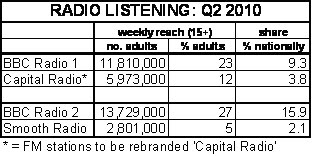
Both the GMG and Global Radio statements achieved the intended sabre-rattling headlines in the press though, for me, these sentiments are remarkably hollow. This ongoing phoney war between the BBC and commercial radio is like a war between a one-eyed giant and an over-exuberant mobile phone salesman. The giant will win every time. Commercial radio can huff and puff all it wants, but the BBC knows it is perfectly safe in its house built from Licence Fees. It can afford to chuckle loudly at every challenge like this lobbed at it by commercial radio. Why?

Firstly, you could only ever hope to seriously compete with the existing formats of BBC Network radio stations if you had access to their same abundance of resources. This is something that Channel 4 belatedly realised after having promised for two years that it would invent a new commercial radio station to compete with BBC Radio 4. Then it scrapped its radio plans altogether.


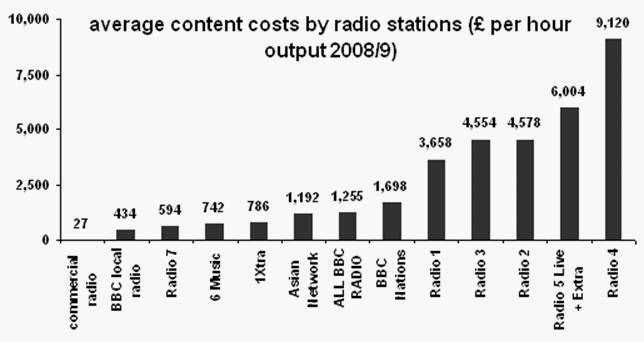
The huge gulf between the funding of commercial radio content and BBC Network Radio content makes direct competition simply pointless. In a recent report for the BBC Trust, I noted that commercial radio spends an average £27 per hour on its content, while BBC Radio spends an average £1,255 per hour. There is no way that commercial radio can make programmes that will sound like Radio 2 on a budget that is 170th of the latter’s £4,578 per hour.

Secondly, what sort of message do these press headlines send to consumers? To me, they say ‘we realise that Radios 1 and 2 are fantastically successful, so we want a slice of their action’. Or maybe even ‘you really like Radios 1 and 2, don’t you? Try us, because we want to be just like them.’ So where is the Unique Selling Point [USP] for your own product? Don’t you have enough faith in it to tell us why it is so good, rather than comparing it to your much bigger, much more successful rival? Or is this the Dannii Minogue method of marketing?

I had always been taught that the cardinal sin of radio was to mention your competitors to your audience. Every reference to your competitor tells the audience how much you respect them and their success. Ignore them! Pretend your competitor does not even exist! Plough your own furrow and concentrate on making a radio station that is genuinely unique. Then you will create a brand that has a genuine USP, rather than being merely a pale imitation of Radio 1 or 2 without their big budgets. ‘I can’t believe it’s not Radio 2’ is not a tagline to which to aspire.

Thirdly, neither Capital Radio nor Smooth will be genuinely ‘national’ stations, as in capable of being received on an analogue FM/AM radio from one end of the country to the other. So why pretend to consumers and advertisers that they are ‘national’? In the case of Capital, its proposed FM network presently covers 57% of the UK adult population. In the case of Smooth, RAJAR tells us that DAB receiver penetration is presently 35%. Just how little of the UK population can you cover and yet still describe yourself as ‘national’?


Fourthly, don’t keep looking at Radio 1 and 2’s huge audience figures and dreaming of how much money you could make if only you could monetise their listenership. Part of the reason older listeners probably like Radio 2 is because there are no advertisements. Accept the fact that Radios 1 and 2 together account for a quarter of all radio listening in the UK. Compared to those mammoths of radio, both Capital and Smooth are mere termites. Live with that fact and, instead, seek out commercial clients who are not merely frustrated because they cannot advertise on BBC Radio, but who actively want to use your radio station because your audience is intrinsically valuable to them.

Finally, invest the time and money to develop your own on-air talent rather than simply hanging on the coattails of others’ successes. Whatever his next gig might be, Chris Moyles will forever be remembered as ‘the saviour of Radio 1’, just as Chris Evans will always be remembered for his Radio 1 breakfast show, not for his subsequent time at Virgin Radio. Find new people who are good at radio and put your faith in them. Why does Smooth’s schedule have to resemble Frankenstein’s monster, stitched together with a bit here from Radio 1 in the 80s, and a bit there from Radio 2 last month?

What your radio station should be doing is not competing with Radio This or Radio That for listeners, but competing directly for consumers to spend time with you because you are ‘you’. Radio is not like selling soap powder or yoghurt pots, where your business model can be built upon undercutting the price of a competitor’s product, however low-quality your own cheapo version might be. There is no price of admission in radio. Your content needs to be ‘different’ rather than ‘the same’ and it needs to create its own unique place in the market.

You should not think of your market competitors as radio stations, but as each and every opportunity a consumer is presented with to pass their leisure time. A winning station must be able to convince a consumer to listen to it, rather than watch television, read a book or simply sit in silence. Because radio is ‘free’, the competition for radio is everything else that is also free to consumers at the point-of-use.

To offer a practical example, when I worked on the launch of India’s first commercial radio network, Radio City, the advertising agency produced an excellent marketing campaign that extolled the virtues of the station over other radio stations. But the campaign had to be rejected and the agency briefed in more detail. Why? Because we were launching the very first radio station on the FM dial in a city such as Bangalore, so the overriding challenge was to persuade people to use ‘radio’ at all, or to persuade people to buy an FM radio for the first time, or to persuade people to switch off their television and turn to radio instead.

This philosophy seems to be a million miles away from the current UK commercial radio strategy which seems to focus on berating BBC radio for being too successful, whilst wanting to somehow achieve part of that success through osmosis. If only half this war effort was put into developing policies to make the commercial sector’s stations successful on their own account, the BBC would soon cease to matter.

Instead, RadioCentre is now demanding that commercial radio be allowed to re-broadcast old Proms concerts recorded by BBC Radio 3. But how many of our 300 commercial radio stations play classical music? One. And which Proms concert do you recall that would fit into Classic FM’s playlist of short musical extracts? What next? Will Capital FM be asking the BBC for the rights to re-broadcast some old Zoe Ball Radio 1 breakfast shows?

In September 2010, the government’s Consumer Expert Group criticised RadioCentre for having proposed a policy for the BBC’s Strategy Review that, it felt, would have “bullied” listeners.

Trying to bully listeners? Trying to bully the BBC? This is the war of the playground, not of a mature media industry that has a strategy of its own making, a plan, a roadmap for its future success. “It’s not fair. Your willy is bigger than mine.” No, it probably isn’t fair, but life deals you a hand, you have to stop whining, get on with it and make the best of what you’ve got.

Just accept this reality: commercial radio’s willy is never going to be as big as the BBC’s. So competing directly on size alone is a complete waste of time when, instead, you should be developing your own individual ‘technique’.