Having DAB cake and eating it: temper tantrums in the Global Radio playpen

Most of us mere mortals spend our lives trying to persuade people to give us what we want. We have to persuade our parents to buy us a new toy, persuade a potential employer to offer us a job, persuade the bank manager to give us a business loan. To make these things happen, we are taught to always be careful what we say – “Mind your P’s and Q’s”, our parents told us.

For the wealthy, there is little need for self-control over what comes out of their mouths. Whereas our only power derives from what is in our head, the power of the wealthy derives from what is in their offshore bank accounts. “P’s and Q’s” are barely a necessity when a platinum credit card can be flashed. Money obviates the need for persuasion. So the wealthy can pretty much say what they like, knowing that ‘money talks’ on their behalf, and it certainly seems to talk more loudly than any persuasion that the rest of us can muster.

This week we saw an outburst in The Guardian that would have done any rich, spoilt brat proud. But no, this was the founder and CEO of Global Group, Ashley Tabor, which owns Global Radio, the UK’s largest commercial radio group, demanding that the BBC “put their money where their mouth is” and invest more in DAB radio:

“Tabor said his company, which owns Heart, Classic FM, Capital and LBC, would not invest in new digital services until the DAB signal was sufficiently strong and widespread to match that currently provided by FM. He said the cost of the rollout of DAB and the strengthening of the signal in areas which can already receive it – estimated at between £150m and £200m – was the sole responsibility of the BBC. […]

‘Global has stepped up and said we are absolutely doing it, we have great new ideas of things we could do on digital but we are not going to bloody do it until our listeners can hear it in decent quality and that is something that we have been clear from the start the Beeb will need to do,’ said Tabor, the Global Group founder and chief executive. ‘They have always said yes [and] now is the time to do it. A lot of pressure is building on them to now actually put their money where their mouth is. It’s not actually a lot of money because it’s amortised over 10-12 years. I think it will happen’” [The Guardian removed ‘bloody’ from later editions].

Was I the only one baffled by Ashley’s line of argument? Although commercial interests own the lion’s share of DAB in the UK, the largest commercial radio group is insisting here that the cost of fixing DAB to make it work properly is the “sole responsibility” of the publicly funded BBC. Furthermore, Global Radio will only launch new commercial digital radio stations, from which it must expect to make a profit, once the BBC has underwritten the huge cost of making the DAB system fit for purpose using public funds. I remain baffled.

This was by no means the first time, and will probably not be last, that Global Radio has talked rubbish publicly about DAB radio. In its PR, Global paints itself as a driving force behind digital radio and is constantly demanding that DAB switchover be implemented as quickly as possibly. However, in practice, Global has shown no interest in developing DAB as a replacement for FM, having sold off the majority of its DAB licences. This hypocrisy has been documented on previous occasions in this blog, during which time Global’s attitude towards the BBC has shifted from ‘carrot’ to ‘stick’. History speaks volumes.

In October 2007, Global Radio cancelled the contract with Sky inherited from its acquisition of Chrysalis Radio that would have created a national Sky News Radio station on DAB. A Global spokesperson said then that “Global was not prepared to make the necessary investment in this project.”

In December 2007, Global Radio dropped live presenters from the digital radio station The Arrow which it had also acquired from Chrysalis Radio. The Arrow was removed from DAB in London in May 2008, removed from DAB in Scotland in February 2009, removed from satellite and cable TV in June 2009, and removed from DAB in the West Country in February 2010. It is now available over-the-air on only 5 local DAB multiplexes.

In January 2008, Global Radio dropped dedicated shows from the digital version of its Galaxy Radio brand, replacing them with simulcasts of local FM output.

On 31 March 2008, the day after Global Radio’s offer to acquire GCap Media had been accepted, the latter’s two remaining national DAB radio stations Capital Life and TheJazz were closed. GCap had already closed another national DAB station, Core, in January 2008.

In March 2009, Global Radio dropped digital-only station Chill from DAB multiplexes in Leicester, Nottingham and West Wiltshire. Chill was then removed from further local DAB multiplexes in July 2009, and from cable TV in July 2010. It is now available over-the-air on DAB only in London and Birmingham.

However, in April 2009, Ashley said that he appreciated that the BBC had the capacity to make a significant contribution to facilitate Digital Britain from a radio perspective, and that Global Radio was prepared to play a leading role. Confusingly, this was the same month it was announced that Global Radio had agreed terms to sell the majority of its DAB multiplex licenses.

In May 2009, in an interview bizarrely headlined ‘Global evangelist for digital radio: Ashley Tabor has a clear vision for his group…’, he said:

“I am really confident now that all the right things are happening that will get us to where we need to go. We are in favour of [analogue radio] switch-off, so can we do it quickly please?”

That same month, Ashley’s right-hand man at Global Radio, Stephen Miron, told a radio conference:

• “The future of our sector is intrinsically linked to the successful implementation of the government’s digital strategy and to the successful migration to DAB”
• “We need more of this in the coming weeks and months. Not just words, but action”
• “We need to get our act together to make the best possible case for consumers to switch to digital”
• “Global is up for the challenge and, as the largest commercial player, we are prepared to lead this charge.”

In July 2009, Global announced the completion of the sale of its DAB licences, the largest ever transaction of its type, which drastically shifted the dominant ownership of the UK’s commercial radio DAB system from the commercial radio sector itself to transmission specialist Arqiva.

Global Radio sold:
• its 63% shareholding in Digital One, the sole national DAB multiplex for commercial radio
• its 100% shareholding in Now Digital Ltd and Now Digital (Southern) Ltd, its local DAB multiplexes
• 12% of MXR Holdings Ltd.
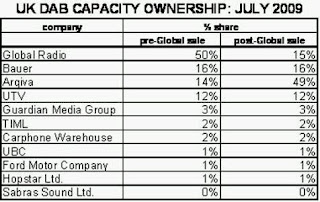
These transactions left Global Radio with a 51% shareholding in MXR, owner of five regional DAB multiplexes, a half-stake in 3 CE Digital local multiplexes and a minority stake in Digital Radio Group, owner of one London multiplex. At a stroke, Global’s role in DAB had been reduced from the dominant player to an also-ran. However, this did not prevent Ashley from stating in the press release announcing these disposals:

“As a company we are leading the commercial radio industry in its drive to digital.”

Neither this press release, nor the Annual Accounts, revealed how much Global Radio commanded for its sale of these assets. All we know is that the last, shortlived chief executive at GCap Media, Fru Hazlitt, was so disenamoured of DAB that she had planned to sell the company’s controlling stake in the DAB national multiplex licence for £1 in January 2008 (the transaction was halted by Global’s offer for GCap).

None of these closures and disposals seemed to change Global Radio’s public enthusiasm for DAB radio. In July 2010, a government press release on digital radio included a quote from Ashley saying:

“We look forward to working with the government and other partners to bring the benefits of digital radio to a growing group of listeners.”

So what precipitated the change of heart in Ashley’s previously collaborative noises to the BBC from a ‘carrot’ into the ‘stick’ evident in his interview this week? Well, less than 24 hours earlier, the government had published a report on DAB radio switchover that was critical of many radio sector stakeholders for the lack of progress that had been made during the last decade. Those criticised included commercial radio, its trade body RadioCentre, the Digital Radio Development Bureau and its successor, Digital Radio UK. Some people can take measured criticisms like this in their stride. But others cannot.

Not only does Global Radio account for 38% of UK commercial radio listening, but the group funds a substantial portion of RadioCentre (£2.8m in subscriptions between September 2007 and March 2009) and of the Digital Radio Development Bureau and Digital Radio UK. Even so, why did this new government report exercise Ashley so much? Because:
• Global Radio needs DAB switchover to succeed for the company to hang on to its valuable analogue radio licences
• The responsibility for making DAB switchover happen now lies elsewhere, so Ashley has decided to pin the tail on the BBC.

Maybe Ashley is a graduate of the Malcolm McLaren and Stevo school of negotiation. This is the strategy where you make the most outrageous demands and the other person caves in for fear of not being invited to your party. This might work in the unregulated music business, where excess is viewed as a virtue, but in the radio industry there are laws and rules governing large parts of the business.

What would be the response of record companies if a radio owner were to march in and tell them that they should pay radio stations for playing their music, rather than the other way around? Or if you were to tell record companies that your radio stations would no longer play ‘hit’ records that line their coffers but, instead, would deliberately play unpopular songs that they did not want on the radio. Record company bosses would probably laugh in your face and ask their legal department to show you a filing cabinet full of royalty agreements with commercial radio dating back to 1973.

Getting your own way, all the time, only works when you have been given absolute power over your fag. Ashley phoning a journalist, stomping his feet at the BBC and demanding that it do this or that will have no effect whatsoever. His demands about DAB must have had BBC radio managers laughing their socks off on Wednesday morning. As Scott Taunton, the straight-talking managing director of UTV Radio, said of Ashley in 2009:

“He is a guy who is used to getting his own way. He isn’t from the same school of business, the same school of negotiation, that I am.”

So why exactly does Global Radio need DAB switchover to happen? Because:
• Global Radio was created by Ashley’s millionaire father for a son who is a radio obsessive (“I would literally have a radio in my [school] bag and the second I was allowed to put it on I would actually phone [presenter] Pat Sharp in the studio at whatever time, 10.30, 11.30, just to say hello and develop a relationship with him. He thought I was nuts,” said Ashley)
• Global Radio overpaid to acquire GCap Media in June 2008 for £375m, a mis-managed company whose performance was dropping like a stone, and whose market capitalisation had fallen from £711m in 2005 to £200m by year-end 2007
• Global Radio has already had to write down its assets by £194m in March 2009, reducing the group’s net book value to £351m from the total £545m it had paid for Chrysalis and GCap in 2007 and 2008 respectively
• Global Radio “is primarily funded by debt”, its accounts state, and external bank debt was £110m in October 2009, an amount that must be repaid in quarterly instalments by October 2012
• Global Radio has been hit hard in 2010 by the new government’s sudden 50% cut to its advertising spend (“The COI change has been larger than expected, very abrupt. It’s been pretty severe, more than 50%,” said Ashley)
• Ofcom is presently re-evaluating the price of Global Radio’s Classic FM licence, the most profitable in commercial radio and, if DAB switchover is abolished, the cost of that licence could be increased from its current £50,000 per annum to nearer £1m per annum from 2011 to 2018
• The Digital Economy Act 2010 renewed commercial radio licences for a further seven years only on the basis that DAB switchover will happen. If switchover does not happen, the government has the power to terminate all renewed licences by 2015 (or by two years’ notice, if later). However, in its accounts, Global decided to write off the ‘goodwill’ of its GCap acquisitions over twenty years.

For Global Radio, which owns more analogue licences than any other commercial radio group, this means that the value of its business could be reduced drastically if DAB switchover does not happen. Its one national licence would become a lot more expensive and then might have to be publicly auctioned, while its dozens of local licences could be terminated earlier than anticipated. Global needs DAB switchover to happen at all costs.

However, at every opportunity, Global decided to forgo investment in the DAB platform and, instead, to dispose of the majority of its DAB assets. This has left it with almost no remaining leverage to ensure that DAB switchover will ever happen. Furthermore, Ashley has alienated commercial radio competitors such as UTV, precipitating its resignation from the trade body RadioCentre in 2009. UTV’s Scott Taunton described Ashley as a “rich man’s son” and explained:

“For us it came down to Global, as the largest funder of the RadioCentre, making sure that the policies of the RadioCentre were in the interests of Global Radio. At times, for me, that meant the [trade body] was pursuing an agenda that wasn’t necessarily in the interests of all its members.”

So, Global Radio needs DAB switchover to happen in order to maintain the value of its analogue radio business. But it can do little itself directly, its biggest competitor Bauer is unlikely to help, and its smaller competitors have been alienated. Global had succeeded in wrangling a very beneficial deal from Lord Carter in the Digital Economy Act, but Carter exited quickly and the whole government has changed since then. The sting in the tail was that parliament included a get-out clause (if DAB switchover does not happen …) and now that clause looks more likely than ever to be invoked.

The pheasants look as if they might be coming home to roost at the Tabor estate. And what does a young man do when the train set his father made for him is not working the way he wants? He stomps his feet. He shouts. He issues demands. This week, the BBC has been on the receiving end. It should feel honoured. Ashley has demonstrated his belief that the BBC can do more to fix the DAB disaster than the whole of the commercial radio sector and its trade and marketing agencies added together. But, remind me, why should part of my BBC Licence Fee go to fix his plaything?

And what might Ashley think of doing next if the BBC does not bow to exactly what he wants? Will he be demanding that BBC director general Mark Thompson stands on his head in the corridor during short break, or runs around the perimeter of White City in his underwear fifty times in the pouring rain, or sits in the BBC library after work copying out chapters of ‘Paradise Lost’ by hand?

Are any of these shenanigans a strategy for the future of radio? All they demonstrate to the world is that large parts of the UK commercial radio sector seem to have completely lost the plot.

[declaration of interest: I was paid to advise DMGT on the offer made for GCap Media by Global Radio in 2008]
Back to the future of radio – the FM band

Help seemed to have arrived for those consumers who are confused by the contradictory messages they are receiving about DAB radio, digital switchover and the future of FM/AM radio. The government created a ‘hot topic’ web page that addresses these issues in the form of a ‘FAQ’. Does it help clarify things?

The government FAQ states:
“We support 2015 as a target date for digital radio switchover” but, in the next sentence, it says that 2015 is “not the date for digital radio switchover”
“FM will not be ‘switched off’ … and will continue for as long as it is needed and viable” but then it fails to explain the reason the government is calling it ‘switchover’
“We believe digital radio has the potential to offer far greater choice and content to listeners” but then it asserts that “quite simply the listener is at the heart of this [switchover] process”
“11 million DAB sets [have] already [been] sold” but, in the next sentence, it deliberately confuses ‘DAB radio’ with ‘digital radio’ which, it states, “accounts for around a quarter of all radio listening” [DAB accounts for only 16% of all radio listening]
“Car manufacturers have committed to fit DAB as standard in all new cars by 2013” but it does not explain that only 1% of cars currently have DAB radio
“Some parts of the country are not served well by DAB” but it then admits that “switchover can only occur when DAB coverage matches [existing] FM [coverage].”

Well, that makes everything crystal clear now. Switchover is not switchover. 2015 is the date but is not the date. It is the government that is insisting upon digital ‘switchover’ but it is a consumer-led process. Almost no cars have DAB now but, in 2+ years’ time, magically they all will. In parts of the UK, DAB reception is rubbish or non-existent, but ‘switchover’ will not happen until somebody spends even more money to make DAB coverage as good as FM … even though FM is already serving consumers perfectly well.

Sorry, what was the point of DAB?

While the UK government ties itself in increasingly tighter knots trying to explain the unexplainable, and to justify the unjustifiable, most of the rest of the world carries on regardless, inhabiting reality rather than a fictional radio future. In May 2010, a meeting in St Petersburg of the European Conference of Postal & Telecommunications Administrations considered the future usage of the FM radio waveband [which it refers to as ‘Band II’] in Europe. Its report stated:

“Band II is currently the de facto analogue radio broadcasting band, due to its excellent combination of coverage, quality and low cost nature both in terms of current networks available and receivers in the market. It is well suited to local, regional and national programming and has been successfully used for over forty years now. FM receivers are part of our daily lives and millions of them populate our households. FM radios are cheap to manufacture and for the car industry FM still represents the most important medium for audio entertainment.”

Its report concluded that:
• “Band II is heavily used in all European countries
• For the current situation the FM services are still considered as satisfactory from the point of sound quality but the lack of frequencies hinders further development
• There are no wide-spread plans or strategies for the introduction of digital broadcasting in Band II
• No defined final switch-off dates are given so far.”

Two paragraphs in the 28-page report seemed to sum up the present UK situation:

“The FM band’s ability to provide high-quality stereo audio, the extremely high levels of receiver penetration and the relative scarcity of spectrum in the band combine to make this frequency band extremely valuable for broadcasters.”

“As FM in Band II is currently, and for the foreseeable future, the broadcasting system supporting the only viable business model for radio (free-to-air) in most European countries, no universal switch-off date for analogue services in Band II can be considered.”

In the UK, we have just seen how “extremely valuable” FM radio licences still are to their owners. Global Radio was prepared to promise DAB heaven and earth to Lord Carter to ensure that a clause guaranteeing automatic renewal of its national Classic FM licence was inserted into the Digital Economy Act 2010. It got what it wanted and therefore avoided a public auction of this licence. Then, when expected to demonstrate its faith in the DAB platform, Global sold off its majority shareholding in the national DAB licence and all its wholly-owned local DAB licences.

Now the boot is on the other foot. Having succeeded in persuading the government to change primary legislation to let it keep commercial radio’s most valuable FM licence for a further seven years, Global Radio has now had to argue to Ofcom that analogue licences will become almost worthless in radio’s digital future. Why? In order to minimise the future Ofcom fee for its Classic FM licence. The duplicity is breathtaking.

When it last reviewed its fee for the Classic FM licence in 2006, Ofcom reduced the price massively because, it explained, it took

“the view that the growth of digital forms of distribution meant that the value associated with what was considered to be the principal right attached to the licence – the privileged access to scarce analogue spectrum – was in decline.”

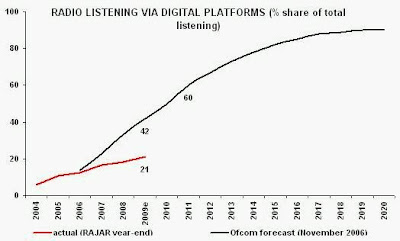
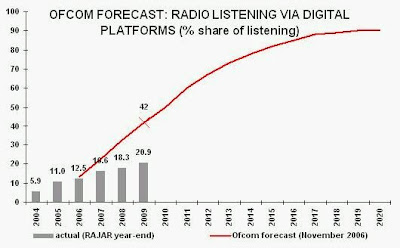
In 2006, Ofcom had published a forecast for the growth of digital radio platforms which has since proven to have been wildly over-optimistic. It had predicted that 42% of listening would be digital by year-end 2009, whereas the outcome was 21%. In 2006, as a result of the steep decline it was forecasting in analogue radio’s usage, Ofcom reduced the cost of Classic FM’s licence fee by 95% from £1,000,000 to £50,000 per annum (an additional levy on the station’s revenues was also reduced from 14% to 6% per annum). The losers were UK taxpayers – the licence fees collected by Ofcom are remitted to the Treasury. The winners were Classic FM’s shareholders, who were gifted a cash cow by Ofcom bureaucrats who misunderstood the radio market.

Fast forward to 2010, and Ofcom is undertaking yet another valuation of how much Classic FM (plus the two national AM commercial stations) will pay during the seven years of its new licence, following the expiry of the current one in September 2011. Has Ofcom apologised for getting its sums so badly wrong in 2006? Of course not. Will it make a more realistic go of it this time around? Well, the signs are not good.

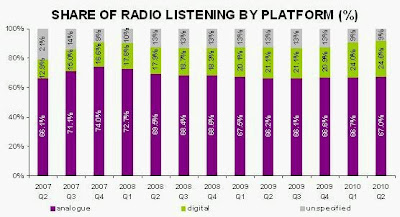
In its consultation document on this issue, Ofcom has repeated the same errors it made in other recent publications about the take-up of digital radio. In Figure 1, Ofcom claims that analogue platforms’ share of all radio listening has fallen from 87% in 2007 to 76% in 2010. This is untrue. As noted in my previous blog entry, listening to analogue radio has remained remarkably static over this time period. Ofcom’s graph has completely ignored the existence of ‘unspecified’ platform listening, the volume of which has varied significantly in different surveys. The graph below plots the actual numbers from industry RAJAR data.

Exactly the same issue impacts the accuracy of Figure 3 in the Ofcom consultation, which purports to show that analogue listening to Classic FM fell from 86% to 72% between 2007 and 2010. Once again, this must be factually wrong. Once again, the volume of ‘unspecified’ listening to Classic FM has simply been ignored and the decline of analogue listening to Classic FM has probably been overstated by Ofcom.

Confusingly, the platform data for Classic FM cited in Figure 3 differ from data in a different Ofcom document [Figure 3.34 on page 33 of The Communications Market 2010] which state that, in Q1 2010, 65% of listening to Classic FM was via analogue, 26% was via digital and 9% was unspecified. In Figure 3, the values for the same quarter are stated as 72%, 28% and 0% respectively. It is impossible for both assertions to be correct.

These inaccuracies have the impact of painting a quite different picture of Classic FM’s transition from analogue to digital listening than the market reality. These matters are not academic. They will have a direct and significant impact on the perceived value of the Classic FM licence over the duration of its next seven-year period. Sensible decisions about the value of the station’s licence cannot be made on the basis of factually inaccurate market data published by Ofcom.

Undeniably, Ofcom is between a rock and a hard place:
• An admittance that, in 2006, Ofcom got its digital radio forecast and its sums badly wrong and, as a result, has already lost the Treasury millions of pounds in radio licence fees, would require humility (and humiliation)
• Not admitting that, in 2006, Ofcom got it wrong would necessitate it to now fix the Classic FM licence fee at the same low rate as in 2006, or even lower, denying the Treasury millions more in lost revenue between 2011 and 2018
• Increasing the cost of Classic FM’s licence fee would be a tacit admittance by Ofcom that its entire DAB ‘future of radio’ policy is simply not becoming reality and that FM spectrum will still remain “extremely valuable for broadcasters”.

In 2006, the low valuation of Classic FM’s licence fee was built upon a top-down bureaucratic strategy which insisted that the UK radio industry was ‘going digital’, whether or not consumers wanted to or not. Now, it is even more evident than it was then that consumers are not taking up DAB radio at a rate that will ever lead to ‘digital switchover’ (whatever that phrase might mean).

However, reading the Ofcom consultation document, it is also evident that the regulator remains wedded to its digital radio policy, however unrealistic:

“We consider that this [Digital Radio] Action Plan is relevant when considering future trends in the amount of digital listening since it represents an ambition on behalf of the industry and Government to increase the amount of digital listening in the next few years.”

In the real world, Classic FM’s owner understands precisely what the international delegations who met in St Petersburg also knew – FM will remain the dominant broadcast platform for radio. Only the UK government and Ofcom seem not to accept this reality, still trying to go their own merry way, while the rest of Europe has already acknowledged at this meeting that:

• The FM band is “extremely valuable for broadcasters”
• The FM band is “currently, and for the foreseeable future, the broadcasting system supporting the only viable business model for radio (free-to-air) in most European countries”
• “No universal switch-off date for analogue services in Band II can be considered.”

[thanks to Eivind Engberg]

Renewal of national commercial radio licences: debated in the House of Lords

House of Lords
8 February 2010 @ 1723
Digital Economy Bill
Committee (7th Day)

Clause 31 : Renewal of national radio licences
Debate on whether Clause 31 should stand part of the Bill.

Lord Clement-Jones: My Lords, before I propose that the clause not stand part, I must apologise. As a result of the way in which the business of the House has been organised today, I shall not be able to be here for about two hours of the Committee’s proceedings. I very much regret that, as many important matters remain to be debated. However, since the business was switched at extremely short notice — I hope that the Whips are whipped for it in some future incarnation —

Lord Davies of Oldham: Oh!

Lord Clement-Jones: I am of course not referring to the noble Lord, Lord Davies. Moving this business from Tuesday to Monday at very short notice is not a happy situation. I therefore hope that Ministers will give full and frank responses as if I were present. I am very grateful to my noble friend Lord Addington, who has kindly agreed to step into the breach when I am not able to put the arguments. I propose that Clause 31 should not stand part. Under this clause, the national analogue radio stations talkSPORT, Classic FM and Absolute Radio are receiving valuable seven-year extensions to their licences. In exchange, the existing licensees have been asked to give their support to an early switchover, with the proposed 2015 date coming much earlier than that recommended by the Government’s 2008 Digital Radio Working Group. However, there is a view among some operators that extensions to these licences are not worth the damage to radio of a digital switchover policy which assumes an unrealistic timetable for digital switchover and which fails to provide solutions that allow all local radio stations to move to digital. They do not accept that as a reasonable quid pro quo for an early switchover. They believe, on the contrary, that the industry’s engagement with the digital radio switchover proposal has been distorted by its interest in licence extensions which are essentially to do with the attractiveness of the current analogue model for radio rather than the proposed digital model. Their view is that Clause 31 will deprive the Government of revenue due from re-auctioning the licences for these national analogue stations. However, the Government have failed to publish an assessment of how much revenue will be lost to the Treasury under this approach. The Government need to justify the advantage of the clause against the background of the following factors: that the sums lost to the Treasury will clearly amount to tens of millions of pounds over the lifetime of the extended licences; and the lack of evidence about whether digital investment by the holders of these licences will continue without the extensions. On the face of it, many are already, contractually or otherwise, committed to digital even without this.

Lord Howard of Rising: My Lords, although I share a number of the noble Lord’s concerns, I do not think that removing the clause would be helpful. It is a facilitating clause that enables the move to switchover at a later date, and it does not set in stone when the switchover will take place or indeed that it must happen. It is more important that the Secretary of State considers a range of issues before nominating a switchover date than that the process in its entirety is stopped. I believe that the level of digital radio listening should be much higher than the Government have suggested. It would also be very much better if the fact that the FM spectrum will remain in use for local and community radio stations was on the face of the Bill. More progress should be made in creating a help scheme and a recycling scheme. We should be focusing on these issues rather than on an attempt to derail the digital switchover process completely.

The Lord Bishop of Manchester: My Lords, I recall that last week the noble Lord, Lord Clement-Jones, and I supported each other’s amendments, but sadly that relationship is about to be broken albeit, I hope, temporarily. To allow the Bill to pass without this clause would pose a real problem for the entire digital radio project. The three commercial stations currently granted national analogue licences cater for a broad range of tastes, from Beethoven and Brahms to Bon Jovi, via the latest soccer score from Bolton Wanderers. Their collective appeal has been vital to encouraging digital take-up by listeners, with around a fifth of their current audiences now listening via a digital platform. To disrupt that migration would be rather unwise. Re-advertising these national licences with just a few years to run before we expect to switch off the service seems to be sending the wrong signal to both the industry and to listeners. It seems to suggest that we are not fully committed to digital as the future, that we doubt whether we will be in a position to switch over the bulk of national stations in seven years, and that we can expend less energy on the steps that are undoubtedly still needed to get listeners to switch to digital, especially through pushing down the cost of DAB radio sets and through getting DAB into more cars as standard. I do not think that any of those things are the right course. If, as I understand it, the message from the legislature to the private sector is to be, “We want you to invest in this new technology, market it to your listeners and encourage them to adopt the new listening platforms”, surely we cannot keep expecting these companies to keep on writing blank cheques. We all appreciate that digital platforms are still in their relatively early days. It has to be remembered that not one digital radio station has yet posted a profit. For their pioneering endeavours, they deserve the stability that this reprieve offers them. One does not often hear pleas for breaks for business from these Benches, but this is a case of tidying up the licensing regime to make it serve the purposes of the digital age.

Lord Eatwell: My Lords, I declare an interest as chair of the consumer panel of Classic FM. This panel is entirely independent of the company. It is devoted to maintaining the standards of Classic FM and the widespread broadcasting of classical music by the independent sector. If this clause does not stand part of the Bill, your Lordships should be aware that the future of Classic FM will be severely compromised because it is a requirement of existing law that the analogue licences are auctioned. As at present conceived, analogue licences do not have a clear format specification. There is not a licence for classical music. There is simply a licence for non-speech, which is the licence held by Classic FM. If these national stations were to be auctioned in the near future, I would be willing to bet the noble Lord who is opposing that Clause 31 shall stand part of the Bill at least a bottle of claret that this licence would be secured by a pop music station, and that Classic FM would disappear. I wonder whether the noble Lord has taken into account that possibility in his proposal.

Lord Young of Norwood Green: My Lords, key to supporting the drive to digital is to encourage and to allow broadcasters to invest in their digital futures. Experience shows that licence renewals, which are linked to the provision of a digital service, are a key incentive. At a time when the Government are asking the industry to contribute to a focused and intense drive towards digital, we believe that it would be wrong to remove this incentive. Clause 31, alongside Clause 32, would allow Ofcom to grant a further renewal period of up to seven years to analogue licence holders who also provide a digital service. Clause 31 relates specifically to the national analogue licences, although the rationale for the decision for extending the renewal is identical for both national and local licences. I do not want to take up too much time because noble Lords who have contributed to this debate have put many of the arguments excellently. The noble Lord, Lord Howard, talked about the necessity to maintain the clause. The right reverend Prelate displayed a very catholic — I hope he does not mind me using the word — taste in music from Beethoven to Bon Jovi, which I liked. In his analysis of the need for Clause 31, he is absolutely right. As he said, we cannot expect companies to carry on writing blank cheques. We need to give them an incentive. My noble friend Lord Eatwell’s analysis of Classic FM was exceedingly apposite. We believe that this clause is essential for the reasons stated by a number of noble Lords. In those circumstances, I support the Motion that this clause stands part of the Bill.

Lord Clement-Jones: My Lords, I thank the Minister for that reply. I also thank other noble Lords for contributing to the debate with some fairly bloodcurdling prospects. However, I do not think that the Minister has answered the question about why these extensions are required. I put this proposal somewhat as a devil’s advocate. By and large, I believe that the majority of the radio industry is behind the scheme as put forward by the Government, but there is a significant minority of interest which is not. That is why I put forward the clause stand part debate. But if I was in their shoes, listening to what the Minister had to say, I would consider that his arguments were entirely circular and that the Government have done this because they needed to and that this was the best way forward. I do not think that any real forensic argument has been put forward by the Minister. I could probably put forward rather better arguments than the Minister has. I certainly could have put my finger on areas where investment is needed, since I have been briefed by some of the major radio players. The Minister has been extremely half-hearted in responding. This is the one bit of this Bill which is the Government’s opportunity to set out their stall in terms of their digital radio policy, other than the amendments we have already dealt with. We had quite a useful debate on our last Committee day, but the Minister has not really answered the questions in a robust way. Certainly, he has not set out the stall for the Government’s policy in terms of the extensions of these national analogue radio stations. We are talking about digital radio switchover. What is it about these extensions that will make those radio stations invest more when they migrate to digital? That is what it is all about. The Minister did not even attempt to talk about the amount of money that the Treasury would forgo. Some estimates have put that as high as £73 million, which is a large amount of money. I do not think that the Minister dealt with that either. The Minister has been extremely disappointing. I do not think that that minority of radio stations will be particularly happy to hear the Minister’s lack of engagement with their arguments. It is almost as if he has taken a view that only a minority of radio stations is concerned, that the bulk of the radio industry is quite happy and that therefore that minority will be overridden without so much as a buy your leave. That is an unfortunate position to be in. This House, above all, is about rational debate and about putting forward the arguments. To be frank, in previous amendments to this clause, the Minister put forward some useful points — he certainly did in response to some of mine — but when I have tried to elicit an overarching policy, he has been lacking and I have been somewhat disappointed.

Clause 31 agreed.
Clause 32 agreed.
Amendment 241B not moved.
Clauses 33 and 34 agreed.

Clause 35 : Local radio multiplex services: frequency and licensed area

Amendment 241C
Moved by Baroness Howe of Idlicote
241C: Clause 35, page 39, line 3, leave out “local”

Baroness Howe of Idlicote: My Lords, this amendment, which relates to the provisions for digital radio, seeks to allow for the efficient use of the radio spectrum and for a potential increase in radio listening choice for the people of Northern Ireland. Although national BBC services are available via digital radio in all four parts of the United Kingdom, the national commercial multiplex is unavailable in Northern Ireland. The reasons for that are historical and technical, and relate to how the same frequencies were used in the Republic of Ireland. The result is that stations, including Absolute Radio, Planet Rock, BFBS radio and Premier Christian Radio, cannot be heard digitally in Northern Ireland. There is some hope that the spectrum position will change. However, as currently worded, even if that spectrum were to become available, Ofcom would not have the powers to allow it to be used by the national commercial multiplex. That is clearly an anomaly and, I suspect, an oversight. It would result in the inefficient use of spectrum and an artificial restriction on the radio-listening choice for some citizens. This amendment seeks to correct the situation and, without obliging, would enable Ofcom to increase the coverage of the national commercial multiplex. Were this to become technically possible, Ofcom would follow the process already proposed for similar expansion of local digital radio or multiplexes using the framework already in the Bill. This amendment, while modest and not contentious, will have benefits for the people of Northern Ireland and clearly will be welcomed by the radio industry, so I hope that the Government will be prepared to accept it. I beg to move.

Lord Young of Norwood Green: My Lords, this amendment would allow Ofcom to vary the frequency or licensed area of national, as well as local, radio multiplex licences. On the face of it, this is not an unreasonable change and would potentially enable the national commercial radio multiplex to extend its coverage to Northern Ireland. However, Clause 35 was structured specifically with reference to local radio multiplexes so as to allow them to merge or be extended in order to close the gaps in local radio multiplex coverage in the UK not currently served by DAB. Simply removing the word “local” from the text may not be the best way to achieve the desired result. Consideration needs to be given to what variation powers Ofcom should have with regard to national multiplex licences and to the basis on which such powers should be exercised. We have some sympathy with what the noble Baroness is trying to achieve and the Government will consider this issue before Report. With that assurance, I hope that the noble Baroness will feel able to withdraw the amendment.

Baroness Howe of Idlicote: My Lords, I am pleased to hear that, even if this amendment is not entirely appropriate according to the Minister, serious consideration is going to be given to how this can be made possible. Under those circumstances, I beg leave to withdraw.

Amendment 241C withdrawn.
Amendments 241D to 241F not moved.
Clause 35 agreed.

Clause 36 : Renewal of radio multiplex licences
Debate on whether Clause 36 should stand part of the Bill.

Lord Clement-Jones: My Lords, Clause 36 deals with the renewal of radio multiplex licences and it inserts a new Section 58A after Section 58 of the Broadcasting Act 1996. The House of Lords Delegated Powers and Regulatory Reform Committee, which we always listen to with some respect, had some interesting words to say about this clause: “It is impossible to tell from the Bill whether the policy is that the licences should or should not be renewable at all, let alone for what period or on what grounds. Indeed, paragraph 56 of the memorandum candidly admits that the relevant policy decision has yet to be made. We draw attention to the skeletal nature of the power in clause 36, to enable the House to examine it further and determine whether it is justifiable in this context”. I am merely a humble hand maiden of this House in tabling this clause stand part debate, and I hope that the Minister can give us further enlightenment.

Lord Young of Norwood Green: I have never had to respond to a hand maiden before in this House. I am still wrestling with that analogy. The Government stated in the Digital Britain White Paper that we would work with the industry to agree a plan to build out the DAB infrastructure to current FM coverage. We recognise the need to limit as much as possible the impact of such build-out on radio stations. One way this can be achieved is to allow multiplex operators to spread the cost of the investment in the new infrastructure by extending the period of their licence. We have suggested that licences could be extended up to 2030. The renewal of multiplex licences as a means to support digital radio was first introduced in the Broadcasting Act 1996. However, these renewal powers only apply to licences which were granted within 10 years of the 1996 Act coming into force. Therefore, there are a number of multiplex licences which are currently not eligible for a renewal. If renewals are to provide a real support to the build-out of DAB coverage to FM levels, they need the flexibility to achieve three objectives: first, to allow the extension of the licence period for those licences which are already eligible for, and in some cases have already been awarded, a renewal under the existing terms; secondly, to allow the renewal to apply to all multiplex licences, including those not currently eligible within the existing provisions; and thirdly, to ensure that any further renewals are awarded with conditions which link them to the progress to digital radio switchover, and more specifically to an agreed build-out plan and timetable. The link to a DAB coverage plan for switchover, which is likely to take a year to agree, is why we believe these powers are most appropriately applied via an affirmative order. I note concerns about the breadth of the order-making powers and I hope that I have satisfied noble Lords that they are justified because of the range of changes needed to implement this policy.

Lord Clement-Jones: I thank the Minister for that brief but — I hope to discover on reading Hansard — informative statement. As somebody who is not fully conversant with the radio multiplex licence variations, that was not the clearest possible answer I could have asked for. I hope that it will make sense on further consideration. It seemed to tell me that the Government need the maximum possible flexibility without having determined exactly which licences require extension. I am not sure that takes us a great deal further than what the House of Lords Delegated Powers and Regulatory Reform Committee said, but perhaps, as I say, on reading Hansard it will all become blindingly obvious.

Clause 36 agreed.
Clause 37 agreed.

Radio in the Digital Economy Bill: the tail wagging the dog

The government’s forthcoming Digital Economy Bill will be the most significant legislation for the UK radio industry since the passage of the Communications Bill in 2002. Published at the end of November 2009, the Digital Economy Bill will propose ‘primary’ legislation that sets out a new regime for the licensing and regulation of commercial radio in all its forms – national analogue stations, local analogue stations and local DAB multiplexes.

The main thrust of the new legislation for commercial radio was contained in the Digital Britain final report published in June 2009. According to the Department of Culture Media & Sport, Lord Carter’s almost year-long consultation was intended to set out “the Government’s strategic vision for ensuring that the UK is at the leading edge of the global digital economy” and would introduce “policies to maximise the social and economic benefits from digital technologies”. Indeed, some of the changes proposed for the radio industry are forward-looking and designed to place the sector in a multimedia future in which it could survive and thrive.

However, some of the recommended changes to existing radio legislation are there only because parts of the commercial radio industry have lobbied for them to be there. At the time, these interested parties might have claimed that such changes would be beneficial to the commercial radio industry as a whole. Increasingly, other parts of that industry have realised that some Digital Britain proposals were lobbied for inclusion only because they suit the interests of a particular player, offering little or no benefit to the wider industry.

Worse, one proposal ties the future of the whole industry to a dangerous poker game with the government which commercial radio is unlikely to win. This is the Digital Britain proposal [page 102, paragraph 44] to automatically extend the existing licenses of the three national commercial radio stations for a further seven years. Why is this proposal there, and what does it have to do with the UK’s digital future? What price is the commercial radio industry being forced to pay for its inclusion?

During the Digital Britain consultation period, Global Radio had lobbied intensively to have the licence of its national analogue station, Classic FM, automatically renewed beyond its 2011 expiry date. In January 2009, I had written:

Classic FM’s licence expires on 30 September 2011 and it cannot be automatically renewed. This is a big problem. Whereas local commercial radio licences are still awarded (and re-awarded) by Ofcom under a ‘beauty contest’ system, national commercial radio licences are not. The system for national commercial radio licences is simple. Sealed bids are placed in envelopes. Ofcom opens the envelopes. The bidder willing to pay the highest price wins the licence. That’s it. This system is enshrined in legislation. Even if Ofcom wants a different system, it cannot change it without legislation.

As Classic FM’s new owner, Global Radio definitely wants a different system that will enable it to hang on to this most valuable asset. Global has been busy bending the ears of anybody and everybody who it might be able to persuade to interpret the broadcasting rules in a way that lets it keep Classic FM after 2011. Even Ofcom has had its lawyers busy examining the legislation to see what flexibility it has to interpret the rules in a way that might maintain the status quo.

Unfortunately, the legislation in the Broadcasting Act 1990 is quite specific:
“[Ofcom] shall, after considering all the cash bids submitted by the applicants for a national licence, award the licence to the applicant who submitted the highest bid.”

The solution for Global Radio was to lobby, lobby and lobby some more for the current legislation detailing the licensing system for national commercial radio to be revoked, changed, amended – whatever needed to be done to ensure that Global could hang on to its valuable Classic FM licence. When Digital Britain was published, it was evident that the phone calls and meetings had paid off handsomely. Lord Carter had listened and offered a solution – a significant change to primary legislation that would allow Global Radio to retain its Classic FM licence for a further seven years, replacing the existing legal requirement that it be re-awarded by Ofcom to the highest bidder in an auction in 2010.

Why exactly is Global Radio so desperate to hang on to Classic FM?

Firstly, Classic FM is a ‘cash cow’ and has always been the most successful of the UK’s three national commercial radio stations launched in the early 1990s. It attracts 40m hours listening per week which, at current sector yields, would earn it around £50m per annum revenues. However, its earning power is further enhanced by the affluence of its audience. Of its hours listened, 66% derive from ABC1 adults, 85% from ‘housewives’, and 68% from adults aged 55+, a target age group that very little commercial radio reaches. As a result, Classic FM is likely to be attracting more than 10% of total UK commercial radio revenues, significant for a single player out of 300 commercial stations. [RAJAR, Q3 2009]

Global Radio overpaid to acquire GCap Media for £375m in 2008. The challenge for Global is that the radio business is dominated by fixed costs. In other words, however many listeners an individual station has within its service area, that station’s costs are relatively static. Many of the stations in Global’s portfolio are medium-sized local operations, whereas Classic FM is a ‘giant’ with national coverage. Its profit margin probably far outstrips every other commercial station in the UK. Classic FM alone probably generates more operating profit than all Global’s other radio stations added together.

Classic FM occupies a unique position in the radio market (the only competitor in the classical music format is BBC Radio Three) and its market power has proven relatively stable over time, with a current listening share of 3.7%, only slightly down from 4.1% a decade ago. By comparison, GCap Media’s prime local radio assets also acquired by Global Radio have lost immense market power over the same period – the market share of London’s Capital FM down from 13.0% to 6.2%, and Birmingham’s BRMB down from 17.1% to 4.8%, for example. Thus, Classic FM is very much a ‘rock’ at a time many local commercial stations occupy a ‘hard place’. [RAJAR, Q3 2009 & Q3 1999]

Global Radio desperately does not want to partake in an auction for the Classic FM licence. It might under-bid and lose. It might over-bid and win. Either outcome would be a disaster, the former losing it the ‘crown jewels’, the latter allowing it to keep the licence but at a price that could lose the station its ‘cash cow’ status. Because there has been no auction of a national commercial radio licence auction since the early 1990s, nobody knows what the winning bid price might be. Worse, in the 1990s, the field had been open only to European Union companies. Legislation since then has opened up the bidding to the global market. Thus, a licence auction would be an extremely dangerous game for Global to play and, if it lost, would force it to write off its entire Classic FM balance sheet valuation only two years after it acquired the station.

Global Radio has a bargain on its hands in the current Classic FM licence. Not only does this one radio station attract more than a tenth of all commercial radio revenues, but its Ofcom-issued broadcast licence costs very little by market standards. The present cost is fixed at £50,000 per annum + 6% of revenues, probably amounting to around £3m per annum, not a huge expense for a station that generates around £50m. Why is the licence fee so little?

It is the regulator (initially the Radio Authority, now Ofcom) that sets the price of the licence, in the first instance according to the amount that the applicant has bid in its licence application to win the right to broadcast. The price of the licence is collected by the regulator but remitted directly to the Treasury in payment for the scarce FM radio spectrum used by the station.

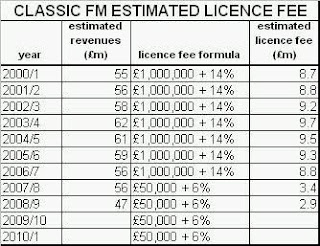
In 1991, when it won the licence at auction, Classic FM had bid £670,000 per annum plus 14% of its revenues. In 1999, the Radio Authority increased this to £1m per annum plus 14% of revenues. However, in 2006, Ofcom reviewed the Classic FM licence payment and slashed it to £50,000 per annum plus only 6% of revenues. As the table below shows (using estimated amounts because the advertising revenues generated by Classic FM are not published), Global Radio purchased Classic FM just at the time when its licence started to cost significantly less than in previous years.

Why did Ofcom decide to reduce the cost of Classic FM’s licence so substantially? Because Ofcom believed that the analogue FM spectrum used by Classic FM would become less and less important with time, as listening via digital platforms, mostly DAB, rapidly replaced FM listening. Ofcom’s own forecast, made in November 2006, anticipated that digital platforms would account for 60% of all radio listening by 2011, the date when Classic FM’s licence expires. Quite how this justified a 95% cut in the licence fee, alongside a 57% cut in the revenue charge, was not explained by Ofcom. Essentially, Ofcom offered Classic FM’s owner the bargain analogue radio licence deal of a lifetime.

Ofcom’s forecast of digital radio listening turned out to be wildly over-optimistic, appearing to be based more on wishful thinking than on available evidence. Whilst Ofcom had forecast that digital platforms would account for 42% of radio listening by year-end 2009, industry data show the present outcome to be 21% for all radio and 20% for commercial radio. [RAJAR Q3 2009]

The inaccurate Ofcom forecast for consumer uptake of digital radio (never subsequently updated publicly) merely confirmed the belief within a large part of the radio industry that digital radio was about to exhibit exponential growth. This Ofcom forecast, accompanied by supporting comments from the regulator (for example, six months later, Ofcom director of radio Peter Davies said: “we are potentially at a Freeview moment with digital radio”), proved significant in misleading stakeholders into believing that the death of analogue radio was just around the corner. The regulator could not have got it more wrong.

Ofcom’s inability to forecast the radio market it regulated has resulted in a loss of millions of pounds of potential commercial radio licence fees for the Treasury, not only from Classic FM, but from the other two national commercial stations whose licence fees were also reduced. By Ofcom’s own estimate, under the previous formula the three stations combined had paid £7m per annum, but were now being charged less than £1.5m per annum. Over the four-year period until the three stations’ licences expire in 2011/2, the total revenue foregone to the Treasury will be around £22m. The Digital Britain proposal to extend these national radio licences for a further seven years, if the present licensing payment scheme is continued, would increase the total potential revenue lost to the Treasury to more than £50m.

Neither RAJAR nor Classic FM release data publicly showing the proportion of the station’s listening derived from digital platforms, but it presently seems unlikely that the station would voluntarily give up using FM for broadcasts after 2011 (when the present licence expires), and probably not even after 2018 (the revised expiry date if Digital Britain’s proposed seven-year licence extension were legislated). Effectively, the Digital Economy Bill would merely enable the largest player in the commercial radio sector not only to hang on to its ‘cash cow’, but to continue paying its present low licence payments to the Treasury for the FM radio spectrum it uses.

The losers from this arrangement are:
• taxpayers who, thanks to Ofcom’s poor forecasting, are now effectively subsidising the FM spectrum used by the commercial radio sector’s single most profitable asset
• the rest of the commercial radio sector who will never be able to match Classic FM’s operating margin because their own costs and revenues are considerably more constrained
• new entrants to the radio sector who wish to bid for the Classic FM licence when it expires in 2011 and are willing to pay a realistic, market price for the licence, but will be denied the opportunity by the government’s offer of an automatic licence renewal.

Politically, the proposals in the Digital Britain final report could not have isolated Classic FM as the sole commercial radio station to have its licence automatically renewed through new legislation. So the renewal proposal was extended not only to all three national commercial stations, but also to all local analogue stations that are broadcasting on the DAB platform. In July 2009, I suggested that this Digital Britain proposal was still iniquitous to the remaining local commercial stations that cannot or will not broadcast on DAB. It appears now that the Digital Economy Bill is likely to extend the proposed licence extension to all analogue commercial radio stations (whether or not they simulcast on DAB).

So every analogue commercial radio station will now be offered an automatic licence extension! Is that not a universal ‘good thing’? Well, no, because there is rarely a ‘free lunch’. Lord Carter was determined to extract a price from the entire commercial radio sector for bowing to persistent demands from Global Radio for new legislation to renew its Classic FM licence. The strings he attached are related to the government’s insistence that the whole radio industry use DAB as its main broadcast platform. This is why two entirely unrelated issues – Classic FM’s licence and DAB consumer uptake – have now become so intertwined in the proposed legislation.

In the seven-year renewal offered to every commercial radio licence, the government proposes to insert a clause that will allow it (via Ofcom) to terminate that licence extension with two years’ notice if the radio industry as a whole (commercial radio and the BBC) does not achieve these goals:
• 50% of radio listening to be via digital platforms by 2013
• DAB transmission infrastructure to be upgraded significantly.

It is a ‘carrot and stick’ approach: ‘We the government will give you all a free licence extension if you collectively promise to make DAB work. But, if we find you do not succeed in making DAB work, we will take your licences (and hence your businesses) away altogether’. The problem here is that the buck has been passed on to a wide and varied constituency of 300 commercial radio stations, many of whom have very little or no control over whether DAB can be turned into a successful delivery platform.

It is the entire commercial radio industry that will be expected to potentially pay the price with its own lives in exchange for changes to primary legislation that allow Global Radio to hang on to its ‘cash cow’ Classic FM licence. What seems even more unfair is that the entire DAB platform is owned and controlled by a mere handful of the largest UK commercial radio companies who, between them (and the BBC and transmission company Arqiva), wield the power to make DAB a success or failure.

If the largest commercial radio owner, Global Radio, had demonstrated incredible confidence in the DAB platform, maybe it might instil confidence in the rest of the radio sector that DAB could be made a consumer success by 2013. However, although Global Radio has regularly talked the DAB talk, it has hardly walked the DAB walk. Global had been the largest owner of commercial DAB infrastructure until, in April 2009, it sold its 63% stake in the national DAB multiplex and its wholly owned group of local DAB multiplexes. At the same time, it has sold or closed all but two of its digital-only radio stations, which exist now only as music jukeboxes.

Of course, for Global Radio, none of the DAB ‘strings’ really matter. It thinks it has got exactly what it wanted in the forthcoming Digital Economy Bill – to keep its valuable Classic FM licence. This is its significant short-term goal and may be the only thing that can keep the group afloat financially. Who knows? If the media ownership rules are relaxed, Global might be able to sell its entire radio business to Murdoch or RTL or MTG before the 2013 date of judgement on DAB is even reached.

For a while, many in the industry had seemingly been happy to line up behind Global Radio, uncertain of their own futures and relatively uninformed on these complex regulatory and legislative issues. But the truth is dawning on many – what is good for Global Radio is not necessarily good for the rest of the commercial radio industry. The future of commercial radio should remain in the collective hands of the industry itself, not be determined by one individual owner. And the issue of radio licence renewals should not have to be linked to the future performance of the DAB platform.

Digital Britain and the Digital Economy Bill offer a rare opportunity to update the regulatory regime for the entire commercial radio sector, rather than merely to offer one company a ‘phone a friend’ millionaire lifeline.

[For the purpose of transparency, I contributed sector analysis to two documents that were part of the Digital Britain process – a pre-consultation overview and the regulation of local radio.]

[Note to the table: the estimated costs of the Classic FM licence fee are simplified. Firstly, the cash amount paid increases annually from £1,000,000 in 1999 to £1,161,000 in 2006 and subsequently, in line with the Retail Price Index. The £50,000 cash payment will similarly be adjusted. Secondly, the revenue percentage paid is applied only to “advertising and sponsorship revenue attributable to national analogue listening hours”, but this data is not published, so 100% of estimated revenues have been assumed to derive from the FM platform.]

DAB: actions speak louder than keynote speeches

Giving the commercial keynote speech at the Radio Reborn 2009 conference this week in London, Global Radio chief executive officer Stephen Miron banged the drum for the radio medium, banged the drum for Global Radio, and banged the drum for digital radio.

It was the last of these three exhortations that appeared particularly contradictory, given Global Radio’s track record with the DAB platform. However, nothing could stop Miron from proclaiming:

* “At Global, we believe that the government must set a clear and rightfully ambitious programme for digital migration.”
* “As you would expect from the largest commercial radio broadcaster, we plan to play an active role in helping ensure the successful delivery of that [digital] strategy.”
* “We back digital and we back the [Digital Britain] strategy, but we cannot afford to get this wrong.”
* “Digital Britain has made us focus our minds. Now the government must focus theirs.”
* “We have embarked on a clear path to digital, to DAB, and we need to make serious progress and do it quickly.” [emphasis added]
* “This means naming a date for [digital] migration …. A firm date needs to be set.”
* “The future of our sector is intrinsically linked to the successful implementation of the government’s digital strategy and to the successful migration to DAB.” [emphasis added]
* “We need more of this in the coming weeks and months. Not just words, but action.”
* “We need to get our act together to make the best possible case for consumers to switch to digital.”
* “Global is up for the challenge and, as the largest commercial player, we are prepared to lead this charge.”

Miron’s comments seem particularly difficult to reconcile with Global’s ‘actions’ on DAB, which hardly demonstrate confidence in the platform.

1. Global Radio exits DAB multiplex ownership
On 6 April 2009, it was announced that Global Radio sold its 63% stake in the sole commercial radio national DAB multiplex owner Digital One to transmission provider Arqiva. Global Radio also sold its local DAB multiplex business Now Digital to Arqiva. After almost a decade of operation, these multiplexes were still to generate an operating profit. Global Radio’s involvement in DAB multiplexes was thus reduced, at a stroke, from having been the biggest player to zero, writing off a decade’s worth of massive investment in the process, because the transaction is likely to have happened for a nominal amount.


2. Global Radio/GCap Media closes digital stations
Digital stations Capital Life and TheJazz, both of which had been carried on the national Digital One DAB multiplex, were closed on 31 March 2008, the day that Global Radio acquired GCap. (GCap had already closed another national digital station Core in January 2008).

In a recent interview, Tony Moretta, chief executive of the Digital Radio Development Bureau, tried to explain the closures of these stations: “Well, the main stations that went away – aside from all the Channel 4 stuff, which never launched and was nothing to do with DAB – where the GCap stations, such as The Core and thejazz also had nothing to do with digital.” [sic]

3. Global Radio turns digital station The Arrow into music jukebox
In December 2007, Global Radio dropped live presenters from the digital radio station The Arrow which it had acquired from Chrysalis Radio. The Arrow was removed from DAB in London in May 2008, and is now only available over-the-air on the 5 MXR regional DAB multiplexes. However, Global’s recent sale of its share in these multiplexes to Arqiva puts a question mark over the station’s future. Why would Global Radio pay Arqiva to carry a digital station in which it is has demonstrated no interest to develop?

4. Global Radio does nothing with digital station Chill
Part of Global Radio’s acquisition of GCap Media, Chill is also only available over-the-air on the 5 MXR regional DAB multiplexes (and not in London on DAB). Like The Arrow, Chill’s future looks very precarious. However, it would prove embarrassing to close these two digital stations before Lord Carter’s final Digital Britain report is published.

5. Global Radio cancels deal with Sky for digital news radio station
In October 2007, Global Radio cancelled the contract with Sky inherited from its acquisition of Chrysalis Radio that would have created a national Sky News Radio station on DAB. A spokesperson said then that “Global was not prepared to make the necessary investment in this project”.

6. Global Radio scraps digital-only shows on Galaxy Radio
In January 2008, Global Radio dropped dedicated shows from the digital version of its Galaxy Radio brand, instead simply simulcasting its local FM output on DAB multiplexes that also carry it.

So what is going on here? Miron’s speech is a large part of Global Radio’s public campaign to cosy up to Lord Carter ahead of the publication of his final Digital Britain report. Global needs a big favour from Carter if it is to retain a shred of intrinsic value on its corporate balance sheet – an automatic renewal of its Classic FM national analogue licence (see my earlier blog entry). In return for the favour it seeks, Global is responding to Lord Carter’s insistence that the radio industry speak with one voice on the issue of the transition from analogue to DAB radio.

The important thing here is to be seen to be saying the right things publicly about DAB – it’s great, it’s the future, we are committed to it, we love it. Forget the past. Forget our recent ‘actions’. Conveniently forget that, less than a month ago, we transformed our company from the leading player in DAB infrastructure into less than an also-ran. DAB is the future – we are part of that future. Our commitment is to say all the right things, and probably to do absolutely nothing. The endgame is to persuade government to amend primary legislation so that Global Radio can hang on to Classic FM, as Ashley Tabor explained: “It is one of those times when common sense has to prevail. Classic FM is a national treasure and to lose it would be tragic.”

The consumer and trade press willingly obliged by reprinting chunks of Miron’s speech without any kind of critique. This ensures that the press cuttings, demonstrating Global Radio’s glowing confidence in DAB, will land on Lord Carter’s desk and, Global hopes, convince him of the ‘common sense’ of not bothering to auction the Classic FM licence to the highest bidder (which is required by existing legislation). Here is a selection of that press coverage.

Broadcast magazine reported that “Miron’s comments mark the first time that Global Radio – the largest commercial player in the UK radio sector – has come out so strongly in favour of DAB and migration” under the headline “Global Radio chief demands DAB deadline”.

Radio Today reported that “Global Radio has also called on the government this morning to set a switchover date for DAB” under the headline “Industry unites for a DAB future”.

Marketing Week reported that Miron wanted the government “to name a date for a switchover from analogue” under the headline “Radio industry needs to be bold, says Miron”.

Media Week reported: “Global Radio has made one of its biggest interventions in the debate over the future of digital radio, with chief executive Stephen Miron calling on the Government to set a date for digital radio switchover”. The headline was “Global boss Miron calls on Government to name digital radio switchover date”.

The Guardian, to its credit, published the only report which acknowledged Global had “sold its majority stake in national DAB platform Digital One to transmission business Arqiva earlier this month”, though its headline nevertheless read “Government must be bolder on digital radio, says Global chief Stephen Miron”.

But today’s Sunday Times developed the theme by including this comment from Global Radio’s Ashley Tabor about digital switchover: “I am really confident now that all the right things are happening that will get us where we need to be. We are in favour of switch-off, so can we do it quickly please?” Maybe Lord Carter is tiring of Tabor’s persistent phone calls, so Ashley is now having to turn to weekend press puff pieces to labour his point.

The Sunday Times article’s headline, without a hint of irony, is “Global evangelist for digital radio”. Closing digital stations, selling off DAB infrastructure, baling out of DAB development deals – is this some kind of ‘do as I say, not as I do’ evangelist?

Classic FM – always check the expiry date before purchase

When Global Radio paid £375 million for GCap Radio in 2008, the portfolio of stations it acquired included Classic FM, the most listened to and most profitable of the UK’s three national commercial radio stations, and the only one of the three on FM. Classic FM was almost the only jewel remaining in GCap’s tarnished crown, after its management had destroyed the audiences/revenues of Capital FM and its other city FM stations by implementing disastrous content and commercial strategies. Classic FM presently has an 11% reach, a 3.8% share, 66% of its adult hours listened derive from the desirable ABC1 demographic, whilst 85% derive from ‘housewives’. Its only competitor in the classical music format is national BBC Radio Three, which has only a 4% reach and a 1.2% share but, of course, carries no commercials. Classic FM is a cash cow. [ratings: RAJAR]

There is only one problem for Global Radio. Classic FM’s licence expires on 30 September 2011 and it cannot be automatically renewed. This is a big problem. Whereas local commercial radio licences are still awarded (and re-awarded) by Ofcom under a ‘beauty contest’ system, national commercial radio licences are not. The system for national commercial radio licences is simple. Sealed bids are placed in envelopes. Ofcom opens the envelopes. The bidder willing to pay the highest price wins the licence. That’s it. This system is enshrined in legislation. Even if Ofcom wants a different system, it cannot change it without legislation.

As Classic FM’s new owner, Global Radio definitely wants a different system that will enable it to hang on to this most valuable asset. Global has been busy bending the ears of anybody and everybody who it might be able to persuade to interpret the broadcasting rules in a way that lets it keep Classic FM after 2011. Even Ofcom has had its lawyers busy examining the legislation to see what flexibility it has to interpret the rules in a way that might maintain the status quo.

Unfortunately, the legislation in the Broadcasting Act 1990 is quite specific:
“[Ofcom] shall, after considering all the cash bids submitted by the applicants for a national licence, award the licence to the applicant who submitted the highest bid.”

There is one, and only one, caveat in the legislation:
“[Ofcom] may disregard the requirement imposed by subsection (1) [above] and award the licence to an applicant who has not submitted the highest bid if it appears to them that there are exceptional circumstances which make it appropriate for them to award the licence to that applicant; and where it appears to [Ofcom], in the context of the licence, that any circumstances are to be regarded as exceptional circumstances for the purposes of this subsection, those circumstances may be so regarded by them despite the fact that similar circumstances have been so regarded by them in the context of any other licence or licences” [emphasis added].

Nothing more explicit is mentioned in the legislation about these possibly “exceptional circumstances”. The problem facing Ofcom is that, if it were to award the licence to Global Radio in a hypothetical situation where it had not been the highest bidder, whoever was the highest bidder would be likely to seek a judicial review, forcing Ofcom to explain in front of a set of judges the precise nature of the “exceptional circumstances” it had invoked. This would not be a pretty sight. There are no precedents because this part of the legislation has never been used before.

So what is the precise meaning of the ‘cash bid’ that has to be submitted to Ofcom in a sealed envelope? It is an amount to be paid annually by the winner throughout the licence period (increased annually by the rate of inflation). When Classic FM won the licence in 1991, it agreed to pay £670,000 per annum, plus 4% of its revenues as demanded by the regulator.

Later on, the Broadcasting Act 1996 allowed the regulator to extend Classic FM’s licence once, but on new terms, if the station agreed to simulcast its output on DAB. The regulator set Classic FM’s new licence payment as £1 million per annum plus 14% of its revenues from 1999. This new licence would have expired in 2007.

Then, the Communications Act 2003 allowed Ofcom to extend Classic FM’s licence again for a further four years but, once again, it could re-set the terms. Ofcom reduced Classic FM’s licence payment to £50,000 plus 6% of its revenues from 2007. This is the licence that expires in 2011.


Why did Ofcom decide to reduce the payments so substantially in its 2006 decision? It argued that the growth of listening via digital platforms was “leading to a decline in the scarcity value of the analogue spectrum”. Additionally, it argued that the licensee’s “share of advertising, derived as a result of access to the analogue spectrum, is likely to fall.”


Ofcom had forecast in November 2006 that digital platforms would account for 33% of radio listening by 2008, and 50% by 2010. By the time the Classic FM licence was due to expire in 2011, Ofcom anticipated that digital platforms would be responsible for 60% of radio listening overall. In other words, the FM licence would, by 2011, be accountable for only the minority of listening to Classic FM.

Ofcom’s forecast proved to be extremely wide of the mark. By Q3 2008, only 18.7% of radio listening accrued from digital platforms, little more than half of what Ofcom antcipated. The 50% threshold is unlikely to be reached even by 2015, and certainly not by Ofcom’s target of 2010. As a result of these forecasting failures, Classic FM (along with the other two national commercial stations) is now paying Ofcom an amazingly discounted rate for the licence fee to use analogue spectrum. The combined licence fees of the three national licensees would have been £7 million per annum under the previous regime, whereas these were reduced by Ofcom to less than £1.5 million (by Ofcom’s own estimate).

The net result of these changes is that Global Radio has a bargain licence on its books. Classic FM probably generates more than £20 million revenues per annum, but Global now pays only £1.3 million for its licence. The bad news is that Global Radio’s cash cow will end in September 2011. If Global does not win the re-advertised national FM licence, the value of its balance sheet could be up to halved. On the other hand, to keep this prize asset it will have to bid significantly more than the £50,000 annual licence fee it is paying now, so that Classic FM’s future profitability would be impacted anyway, even if Global managed to keep the licence.

However, there are plenty of other media owners out there who would like to have the UK’s only national commercial radio FM licence in their portfolio. The fact that the DAB platform has not grown anywhere near as quickly as anticipated in the UK simply makes this FM licence more valuable. The last time the licence was advertised in 1991, bids were only open to European Union applicants. Since then, legislation has opened up the bidding process worldwide. The licence format does not have to be classical music – the licensee can operate any format of its choice, apart from pop music (this caveat is in the legislation).

The fly in the ointment is that Ofcom adopted a new policy in 2007 that all its analogue local and national radio licences would be scheduled to expire on 31 December 2015, or five years from their commencement, whichever is longer. For Classic FM, this means that its next licence period would theoretically run only from 1 October 2011 to 1 October 2016. If a new bidder won the licence by offering the highest cash bid, five years is hardly enough time for a nascent business to establish itself and become profitable, particularly if it were to adopt a format other than classical music. The Ofcom policy seems unworkable in practice, and also seems biased in the incumbent’s favour.

Now, with an understanding of Global Radio’s desperation to hang on to its Classic FM licence almost at any cost, it is useful to re-read Paragraph 2.3 of the Final Report of the Digital Radio Working Group. Remember that Global Radio owns about 50% capacity of the UK’s commercial radio DAB transmission capacity and Global Radio accounts for 39% of commercial radio listening. The Report said:

“In exchange for its ongoing and future commitment to DAB, we believe the radio industry must have greater certainty and control of its future. Therefore, we propose that the government must relax some of the existing legislative and regulatory burdens placed on the radio industry, which will require parliamentary time, as outlined below and Ofcom should consider how to reduce some of the existing regulatory burdens.

First, the commercial radio industry must be granted a further renewal of its analogue services which are carried on DAB, and of DAB multiplex licences. [emphasis added]”

Now read this quote once more but replace the phrase ‘the radio industry’ or ‘the commercial radio industry’ with ‘Global Radio’. Aha! Wouldn’t it be great for Global Radio if the government could be persuaded to step in and somehow automatically renew its “analogue service” Classic FM licence, thus avoiding a licence auction in 2010? Even moreso if Global could be allowed to continue paying only £50,000 per annum (plus 6% of revenues) for the FM spectrum it uses? If you were Global, would you not be eager to offer the government a deal whereby you maintain your costly DAB infrastructure (and maybe even extend it) as the price you have to pay for securing the future of your most significant balance sheet asset?

From reading its Final Report, it certainly looks as if the Digital Radio Working Group bought into this argument. The next hurdle for Global Radio is to persuade Lord Carter and his Digital Britain team to buy into the same deal, which is: we promise to keep the DAB platform alive, despite it losing us a small fortune, if you ‘arrange’ legislation that enables us to keep the Classic FM licence for another decade. Thus, the government avoids the embarrassment of the DAB platform failing in the UK, and Global Radio might stand a better chance of staying in business.

To date, the other commercial radio owners have seemed happy to go along with this plan. They, like Global, would get to renew their radio licences automatically too (although none of their licences are as individually valuable as Classic FM’s). On the other hand, they too will be burdened with the continued costs of simulcasting their services on the DAB platform, with almost no financial return. However, despite most radio owners’ private dislike of the whole DAB ‘fiasco’, publicly they continue to stress their continuing support. Nobody turns down a ‘free lunch’, and a free licence renewal is an enticing offer for a radio industry still built upon oligopoly power rather than open competition.

The only question now is whether the government considers it politically worthwhile to ‘help’ the commercial radio sector with new legislation that would extend the licence status quo, in return for forcing onto consumers a ‘new’ DAB radio technology that is more than a decade old and has long been superseded by innovation.

Lord Carter’s pronouncements during the next fortnight might give us an idea of how important/unimportant it is to the government to: 1) bale out privately held Global Radio; 2) force further investment in improving/developing the DAB platform.