One little indie music show : 1980-1981 : Saturday night 10 to midnight, Metro Radio

“You will present a weekly two-hour rock music show on Saturday night,” my manager informed me.

No if’s or but’s. No offer over which to mull. No demo tape to produce. No question asked about previous experience. Without warning, I was appointed as presenter on one of Britain’s largest commercial radio stations. I had just started a full-time backroom job at ‘Metro Radio’ but had never asked to present a show. This was my first paying job in radio and suddenly I was also to be put on-air. The start of my radio career seemed to be heading in a positive direction.

Some aspiring DJs spend their whole life trying to secure a presenting job on radio, often without success. I felt slightly guilty that this opportunity had fallen into my lap without effort. My employer did not even realise that I had started presenting for various London pirate stations seven years earlier, as such lawbreaking activities were not productive additions to a CV then. A decade into the future, employed as programme director of London’s ‘KISS FM’, one young hopeful desiring a DJ job would sit in the station’s reception area day after day, awaiting his opportunity to buttonhole me on my way to lunch at the ‘greasy spoon’ on Highbury Corner. Little did he know that we already had the largest DJ roster of any British radio station, or that management had just cut payments per show by half, or that several loyal presenters had been made redundant within months of launch. Oblivious, he was not so much ‘networking’ as ‘stalking’.

Management at Metro Radio seemed not to care one jot what was broadcast evenings and overnight because commercial stations then believed their advertisers were only interested in daytime shows and that their most significant audience was housewives. My small additional payment for the rock show was eaten into by the cost of driving twenty miles to the studio on Saturday night and then back again in the early hours of Sunday. Nevertheless, the station would jump at any chance to cut its minor expenses, such as the occasion excellent overnight presenter Tony Crosby was replaced in 1981 by a new DJ who offered to do the same show for free. Never mind the quality, feel the penny-pinching! (Tony went on to train as a solicitor.)

No direction was offered me as to what to do in my show. Whereas daytime presenters were required to wait outside programme controller Mic Johnson’s office for individual appointments to hear his critique whenever a JICRAR ratings book was published, management expressed zero interest in what I was doing on-air. There were already two other rock shows on the station. My line manager Malcolm Herdman played two hours of heavy metal and hard rock. Full-time producer John Coulson used his two hours to play an esoteric mix of mainstream rock and read passages from ‘beat generation’/‘new journalism’ authors. I decided to fill the evident gap for the ‘indie’ music that had emerged after several years of punk.

Music trade weekly ‘Record Business’ had published its first weekly ‘indie’ chart in January 1980, following a suggestion by Iain McNay, founder of London’s ‘Cherry Red Records’. I decided to use one hour of my show to run down this chart, playing the new entries and highest climbing singles. As far as I know, mine was the first ever British radio ‘indie’ chart show and was soon mentioned in the ‘indie’ columns of the music trade press. Most ‘indie’ releases were not supplied to commercial radio stations because there was zero possibility of them being playlisted, necessitating me to establish contact with the main ‘indie’ distributor, ‘Rough Trade’ in London, to receive copies. Each week, I would phone its very helpful director and head of promotions Scott Piering to request records that he would then mail to me (later that decade I worked in Scott’s office).

In the other hour of my show, I would play a selection of newly released album tracks, both indie and mainstream. Working full-time in the station’s record library, I had access to all major label releases that arrived either by post or from weekly visits by record company promotion staff. I would place interesting new albums in a holdall I carried back and forward to the show although, with only time to play around fifteen tracks within an hour, my hoard of unplayed recent releases grew heavier by the week. My running order ranged from ‘Steely Dan’ to ‘Joy Division’ to ‘Crass’, none of which were exposed elsewhere within the station’s output.

Although the Tyneside local band scene then was dominated by heavy metal bands and record labels such as ‘Neat’ and ‘Guardian’, there were a few ‘indie’ bands that were recording good quality demo’s or releasing their records independently. I received a nice letter from Paddy McAloon asking me to play his group ‘Prefab Sprout’s first self-published single. I had already been the lone person not walking straight past the stage when the band had performed at the Durham Miners’ Gala, so I was happy to oblige. There were some excellent local bands, including ‘Dire Straits’ and ‘The Police’ who were quickly signed by major labels, but also many that went largely unnoticed until ‘Kitchenware Records’ launch in Newcastle in 1982. I tried to play any local band recordings I found or received.

Because my two hours on-air were so precious, I talked minimally between records and rarely featured interviews. I recall receiving a telegram at home from the station one day asking me to phone it urgently. Our house had no phone so I had to walk to the one phone box in Sherburn Village and call in. Was I interested in recording an interview for my show with ‘Duran Duran’ who were promoting their first single release ‘Planet Earth’? I turned down this opportunity because the group was not local, were not ‘indie’ (having already signed to ‘EMI’) and their music was audibly more ‘pop’ than ‘rock’. However, I did interview local artists such as Pauline Murray from Ferryhill whose first solo album (after the punk group ‘Penetration’) sounded remarkably innovative and remains one of my favourite recordings.

I spent quite a lot of time each week compiling a local ‘gig guide’ from adverts in local newspapers (pre-internet newsprint) and flyers. I would update it each week, type it out myself, pin it on the radio station’s noticeboard and mail copies to all the local record shops. In my show, I would read out the following week’s concerts though I never heard any other presenter refer to my list because, beyond Malcolm and myself, the station seemed to be disconnected from the local music scene. On occasional visits to ‘Volume Records’, the only ‘indie’ record shop in Newcastle, I would secretly feel proud to see the latest A4 sheet of gigs I had mailed out pinned to its noticeboard. Like my show’s content, the reason for undertaking this research-intensive work was because nobody else seemed to be exposing this information at the time. There was no ‘what’s on’ publication for the region.

Although I had competently operated radio studio equipment myself since my days at school recording pirate radio shows, management at Metro Radio insisted I sat in a soundproofed studio in front of the microphone while a ‘technical operator’ facing me from an adjoining control room played the records, advertisements and mixed the audio. I was unfamiliar with this arrangement, which the station’s managers had brought with them from overstaffed BBC local radio stations at which they had worked previously. I was extremely lucky to have had John Oley assigned as my ‘T.O.’, one of the most professional and enthusiastic people I have had the pleasure to work with in radio. His contribution to my show was enormous and freed me to talk my rubbish on-air and answer the phone line when I occasionally held competitions.

Metro Radio showed no interest in promoting my show so it seemed a miracle when I started receiving letters from listeners who had discovered it. In the days before internet or community stations, each region of Britain was served by only one local BBC station and one commercial music station. Although my show was tucked away in the weekend schedule, it still felt groundbreaking to play music little heard outside of John Peel’s weeknight show on national ‘BBC Radio One’. There were quite a few records lasting only two or three minutes that each required several hours’ work transferring them to quarter-inch tape in order to edit out swear words with a razor blade and white editing tape on a metal block. If only those bands knew how much extra effort was necessary just for them to receive one radio play!

Living in a rural village, there were Saturday nights during winter snows when I was unable to drive to the station. Snowploughs would habitually clear the roads eastward from Durham City as far as the junction with the A1(M) motorway but, frustratingly, not the further one mile beyond to my home. I would have to trudge out in icy temperatures to the public phone box and call either Malcolm Herdman or John Coulson at home, asking if they could reach the studio to fill in for me on those days. Because they lived in Newcastle city, I think they found it hard to believe that I was literally ‘snowed in’. Unfortunately, my salary was insufficient to contemplate a relocation nearer my workplace, meaning I missed out on concerts and the city nightlife which I would have loved to explore.

All good things come to an end. Quickly in my case. Metro Radio made me redundant from my full-time job. I continued to present my Saturday night show for a while through 1981 but the expense of maintaining a car to drive to Newcastle was proving greater than my payments from the station, which had to be subtracted from my Unemployment Benefit. I was applying for any relevant vacancy in the radio and music industries but getting nowhere. In the end, I had to follow Tebbit’s advice and get on my bike (well, in my car to be accurate), leaving the region where I had lived the last five years in order to take a totally different job 218 miles down south. It was disappointing because I had acquired so much knowledge of indie music, the regional music scene and had built an audience for my unique radio show.

The start of my radio career now seemed to be heading in a negative direction. I was unable to secure work in the broadcast industry for a further four years and, only then, by taking a contract in Israel on a pirate radio ship that paid little more than expenses. However, I have always treasured the memories of my time working alongside John Oley and Tony Crosby late on Saturday nights when the only other person in the darkened Metro Radio building on a bleak industrial estate was the security guard downstairs. This was when innovative radio programmes were made … even though Metro Radio probably never realised it.

Postscript: Forty years later, I received a polite email from a member of a former local band enquiring if I still had their demo tape I had been sent and played on my Metro Radio show. Sadly, no.

[Originally published at https://peoplelikeyoudontworkinradio.blogspot.com/2023/11/one-little-indie-music-show-1980-1981.html]

One good turn deserves a cold shoulder? : 2004 : BBC World Service Trust, Phnom Penh

“I understand you’re an expert in messaging,” said the woman sat behind the desk.

I looked blank. I had absolutely no idea what she was talking about. If she meant SMS text messaging, I did not even own a mobile phone!

“I was told you are experienced in capacity building,” continued the woman, undeterred.

I looked even more blank. What on earth was she talking about? I had just flown half way around the world. This was my first meeting with the boss of the project where I was to work. Yet I had zero understanding of what she had just said. I began to wonder if the office back in London had mistakenly sent the wrong person (me) to the wrong location (Phnom Penh, Cambodia). Did she think I was someone else? I had been sent here to do radio training. Had the international wires become crossed somewhere?

It took me several weeks to understand that Giselle Portenier, manager of Cambodia’s BBC World Service Trust project, had been addressing me in ‘NGO-speak’, an esoteric language I had never before encountered. People working in such ‘Non-Governmental Organisations’ (er, international charities) apparently use terminology that substitutes long words for concepts which the rest of the world refer to with short words. Some might call this professional obscurantism.

During my first week, Portenier insisted I attend a two-day workshop organised by the Centre for Disease Control concerning drama programmes created to communicate health issues to the population. My takeaways were that NGO staff love the sound of their own voices and try their utmost to turn simple tasks into overcomplicated diagrams and flow charts. I strained to stay awake in Cambodia’s oppressive daytime heat and quickly tired of hearing NGO people talk to each other in a language that was apparently English, but might as well have been Mongolian for all I could understand. Luckily, I managed to excuse myself from a similar two-day workshop about ‘messaging’ the following week.

Why was I in Cambodia? In July 2002, I had been unemployed and applied in desperation for an advertised role with the BBC World Service Trust in Ethiopia. The only thing I recall about that interview was sitting alongside dub poet Benjamin Zephaniah (born two days before me!) in the lobby of Bush House. Having neither attended Oxbridge nor benefited from a family member or acquaintance employed in the Corporation, I was hardly surprised to receive my thirty-seventh consecutive BBC rejection letter. The Holy Grail I had coveted since childhood was receding further over my horizon with every CV submitted.

Fast forward to December 2003. I was in a dead-end job at Ofcom where my line manager Neil Stock had met me on Christmas Eve to say “there is nothing for you to contribute to” the media regulator’s work schedule during the first quarter of the next year. I had just discovered a voicemail message on my work phone from the BBC, asking if I was the ‘Grant Goddard’ who had applied for a job the previous year. My contact details had proven a dead-end and it had resorted to contacting a referee in the United States I had listed who advised that I now worked for ‘The Radio Authority’ … which was found to have closed. I phoned back, confirmed it was me and explained that I had since changed address. Would I be interested in a consultancy role lasting two to three months? Though I had accrued eight weeks’ unused holiday at Ofcom, it refused me paid or unpaid leave to pursue this opportunity … so I resigned.

Roy Head, director of the BBC World Service Trust’s health division, explained by phone that a contract had recently been signed between the Cambodia government and the Corporation to train local staff at two radio stations to produce phone-in shows around health issues. A decade earlier, he had managed the United Nations’ radio station ‘UNTAC’ in Cambodia. Head confided that, only after signing this contract had he discovered that the BBC’s ‘executive producer, radio’ in Cambodia, despite having held numerous posts within the Corporation since 1987, apparently had no experience producing a live radio programme. Neither had the Cambodia project manager who had produced television documentaries for the BBC since 1986. I respected Head’s honesty when he admitted my involvement would help him out of a very large hole. The Cambodia government was becoming increasingly impatient for the training to start, necessitating my arrival as quickly as possible. Yes, the pay (£750 plus US$100 pocket money per week) was not great because it had had to be unexpectedly eked out of an existing budget, but Head promised me better paid similar BBC work afterwards if I would solve his pressing problem.

I nearly never made it to Cambodia. The nurse I was mandated to visit at BBC White City could not locate the required ‘BCG’ vaccination on my left arm and threatened to block my departure for several weeks to redo it. Was I born in Britain? Yes. Did I have paperwork proving I had received the vaccine? Er, I was a child. Where did I receive it? In a health clinic, long gone, at the corner of Upper College Ride and Saddleback Road on the Old Dean Estate in Camberley, 200 metres from the house in which I had been born. After an extended interrogation, as a last resort she inspected my right arm and found a faint tell-tale circular mark there, and expressed astonishment that I was the first person she had encountered with it on the ‘wrong’ arm. All I could presume was that some nurse in the 1960’s had decided it would never matter as council estate children were destined to go nowhere anyway.

On arrival in Phnom Penh, my line manager Chas Hamilton invited me to homemade dinner in his flat and filled my head with gossip about his BBC colleagues. He was particularly incensed that his boss Portenier, before her recent arrival, had allegedly demanded her flat be remodelled at considerable public expense to include, shock horror, a sunken bathtub. As a short-term consultant (given BBC contract number WST001), I preferred to avoid such office politicking. I chose to keep my burning question – how is a BBC employee promoted to a radio management role without having produced a live radio programme? – to myself. The Corporation evidently worked in mysterious ways.

After a morning visit to one of the radio stations in Phnom Penh at which I would be working, the Cambodian BBC driver was en route to the office when I requested he stop for me to buy a takeaway lunch.

“I will take you to a hotel for lunch, sir,” he kindly offered.

“No, thank you,” I said. “I can buy something at one of these roadside shacks and eat it at the office.”

“But they only serve noodles, sir,” he explained patiently.

“Yes, and that is what I want for lunch,” I insisted.

Despite his complete puzzlement, he parked the BBC four-wheel-drive alongside a random food stall, translated my order into Khmer and, minutes later, I left clutching a knotted transparent plastic bag containing my freshly stir-fried order for less than a dollar. At the BBC office, I went to the kitchen, requested a plate, emptied out my food and sat at the dining table to eat it, much to the amazement of the Cambodian staff. My new colleagues found it hard to believe that I ate noodles at home all the time.

From that day forward, I joined the local staff for lunch daily in the BBC kitchen, with between five and fifteen of us gathered around the large dining table for the mandatory two-hour break inherited from French colonialists. Each of us paid the BBC kitchen manager a dollar a day to take our preferences and venture out to numerous street stalls to fulfil our orders. The food was always fantastic and the company was excellent, though I could not understand the Khmer chatter. The project’s Cambodian receptionist sidled up to me and explained with awe:

“In all the time we have been here, not one of the foreigners working here has sat down and ate our food with us, except on special occasions such as Chinese New Year.”

So where did all the ‘foreigners’ go every day? On one occasion, sat at the kitchen table ready to eat lunch, Portenier approached me and insisted I accompany her and the other ex-pats ‘out’. We were driven in several cars to an international hotel that appeared completely devoid of guests, where we were offered menus and then waited over an hour in the lobby for our dishes to arrive. The food, the surroundings and the conversation were all mediocre, though I presume that the BBC was picking up the tab for its employees’ daily lunchtime jollies to various Phnom Penh hotels. Thankfully, I was never invited again.

The BBC had initially ordered my air ticket to return to London three months later. As my work was still far from complete, I had to spend three hours sat uncomfortably on a long wooden bench in a tiny Phnom Penh travel agency that attempted to change the date … unsuccessfully. I decided unilaterally to use the ticket (rather than waste it) to fly home for a quick visit, only to discover that Roy Head, having sent me to Cambodia, was no longer with the BBC, reportedly having become ill after a work trip to Brazil. Back in London, I was called to a meeting with his successor at Bush House, a brusque woman who demonstrated little interest in my work but asked me to spy on my line manager Chas Hamilton and report what he was or was not doing. I refused. I had been hired as a consultant solely to train people in radio, not indulge in espionage. The BBC booked my new ticket to return to Cambodia a week later and gave me boxes of radio equipment to transport in my heavily surcharged, overweight suitcases.

Returned to Phnom Penh, when one of my station projects was about to launch its new weekly live youth phone-in show, I drafted a press release and asked Portenier to approve it, transpose it onto BBC notepaper and circulate it through established PR channels. She refused. I was perplexed. Surely it was positive news to herald the successful completion of part of the BBC’s contract with the Cambodia government. Apparently not. In order not to disappoint the radio station’s production team with whom I had worked so closely for months, I was reduced to secretly commandeering a BBC car and driver when Portenier was absent from the office in order to hand deliver to each of Phnom Penh’s newspapers my press releases in Khmer and English that omitted mention of the BBC’s involvement.

This negative response was very dispiriting as it appeared that neither my local project manager, nor my local line manager, nor the replacement BBC manager in London seemed even vaguely appreciative of my success saving their bacon. My second radio station project was almost ready to launch too but I considered now was a good time to return home, having already spent twice as long in Cambodia as my contract had required. The local BBC staff organised a fantastic farewell party for me in the office and gave me presents. Neither Portenier nor Hamilton attended. To be accurate, Hamilton arrived at work after it had finished. At the airport, several of the wonderful Cambodian radio station staff I had trained arrived unexpectedly to see me off. They cried. I cried. They and the lovely local office staff had made my work worthwhile.

By the time I landed in London, my BBC e-mail account had already been cancelled, preventing continuing contact with my colleagues in Cambodia. I sent Portenier an email apologising (ahem!) for not having seen her before I left and thanking her for “all her help”. Her reply lacked a shred of gratitude:

“I know you were planning to do a handover report for David. Did that happen? I know he tried to get in touch in England, but failed.”

My BBC contract had not required me to write a report. Besides, in Cambodia I had been fully occupied each week spending four days from 8am to 5pm training two teams, one day in the radio studio and two days preparing materials for my next sessions, without any BBC input. Meanwhile, the project’s head of radio seemed to have spent most of his time sat in his cosy BBC office. Neither did I know who ‘David’ was. Nevertheless, I offered my services to help out for free in the BBC’s Bush House office, hoping to avail myself of future opportunities. I submitted six applications for advertised vacancies in the BBC World Service Trust during 2004 and 2005, for one of which I was interviewed, but without success. Nobody in the BBC thanked me for my work bailing it out in Cambodia or offered me the better paid, follow-on opportunities I had been promised. I had no idea how to contact Roy Head once he had left the BBC.

When I signed on for Unemployment Benefit, my most recent work in Phnom Penh was viewed suspiciously because, whilst I had been away, British tabloid newspaper front pages had splashed stories about 1970’s pop star ‘Gary Glitter’s exploits with underage boys in Cambodia. The young ‘JobCentre’ officer instructed me to apply for a radiology vacancy in a local hospital, not comprehending it was totally unrelated to radio production.

Giselle Portenier completed one year in charge of the Cambodia project before leaving the BBC and returning to Canada.

In 2006, Chas Hamilton lauded the youth phone-in radio show I and my trainees had created as the project’s “most popular”, noting that “all members of the production team … had no previous media experience before we plucked them from university and trained them.” His invisible ‘executive production’ role while I was there had apparently proven so successful that the BBC promoted him to manage their entire Cambodia project. I hope he enjoyed the accompanying apartment’s sunken bathtub he had seemed to envy so much.

[Originally published at https://peoplelikeyoudontworkinradio.blogspot.com/2023/11/things-you-say-you-love-youre-gonna.html]

Knock me down with a mugger : 1986 : Share A Capital Christmas, Capital Radio, London

 Blam!! A sudden force on my back knocked me over in a second. No time to figure out what had just happened. I was sprawled front-down on the floor with a weight on my back. I shouted. People around me screamed. I could sense a struggle taking place overhead. The object on my back lifted and, from my ground level line of sight, I made out the feet of someone running ahead of me into the crowd.

“Are you alright?” asked one of the group of people standing around me, looking concerned.

“We saw that man push through the crowd,” explained another, “then knock you over and jump on top of you. We managed to pull him off but he ran away.”

They helped me to my feet and I realised that I was indeed alright and thanked them profusely for their swift action rescuing a complete stranger. I was wearing a thick winter coat that had broken my fall. I had been lucky not to have hit my head and to have landed on the soft bag I had been carrying in front of me. Nothing appeared broken. As I rejoined the throng of commuters journeying home, one of the Good Samaritans added:

“It looked as if he knew you were there amongst the crowd and targeted you. It was very strange.”

Indeed, it was. I had travelled this same journey every day and nothing untoward had happened. I always left work at the end of the afternoon, walked across Euston Road to Warren Street tube station, caught the southbound train and alighted four stops later at Charing Cross, one of London’s busiest hubs. I had been walking through the narrow, low-ceiling tunnel that led up from the Underground platform to the railway station concourse when I had been jumped. The train and tunnel had been more crowded than usual because it was Christmas Eve. It seemed bizarre to be jumped on not when I was alone in the winter darkness outside, but amongst a tightly packed crowd inside a well-lit underground travel conduit.

There was one significant difference between all the other days I had travelled home without incident and that day. Stuffed down the front of my underpants was a white envelope containing a substantial amount of cash representing payment for my last six weeks’ work. I had requested my employer’s accounts department pay me by bank transfer but, for reasons unknown, it had insisted on paying cash and only at the conclusion of my contract. If this money was the reason I had been attacked, then only the accounts department staff and the handful of people in my work team knew I had been paid that day. But the latter had just been paid that same day in the same way. So had I been merely a random victim of violence … or had something more sinister happened?

A few months previously, I had applied for a full-time job at ‘Capital Radio’. I was interviewed by Steve Billington, a social worker who had left his job in 1984 managing a social work team in Harrow to become the station’s head of community affairs. Although my application was unsuccessful, he contacted me weeks later to ask if I wanted to manage its Christmas charity appeal. I was soon to finish a non-renewable, twelve-month job creation role managing a team at ‘Radio Thamesmead’ so it was an ideal time for me to switch to a ‘proper’ job. I had dreamt of working at London’s only commercial music station since it had opened in 1973 and had even contemplated not going to university in order to take a programme production role there like Annie Challis on Tommy & Joan’s daily ‘Swop Shop’ show. Back then, I was innocent of the fact that to secure such a job in the media it was rarely, if ever, WHAT you knew about radio but WHO you knew.

Now, thirteen years after its launch, I was finally working at Capital Radio. My first two weeks were spent in the office, sat opposite the amiable charities manager Millie Dunne who helped me organise files of paperwork for the huge volume of goods she had persuaded businesses to donate, a task at which she was extremely proficient. During the subsequent four weeks leading up to Christmas, I worked in the station’s foyer, organising the receipt of donated goods and their delivery to London charities who would distribute them as gifts to needy families. I managed a small team that Steve had already appointed, all of whom were incredible and worked hard collecting and delivering goods as needed.

Steve had also appointed a ‘deputy’ to help me with the project’s management. His name was Pol. Never call him ‘Paul’! Unlike me, he was loud and extrovert, networking relentlessly with anyone remotely important who passed through the revolving door entrance to the foyer. He seemed to view the job as a sinecure that would permit him to further his ambition to be … something famous. While the rest of us worked long hours and weekends, Pol was AWOL for chunks of that time, claiming that he had had to attend appointments for this or that. In the pre-mobile-phone era, it was impossible to call someone to demand “where the hell are you?” I was regularly tempted to complain to Steve about this young man’s work ethic deficiency but I had no inkling if he had been recruited by some friend or relative within the company. He appeared to possess no relevant skillset for our work so I just had to grit my teeth and hold my tongue.

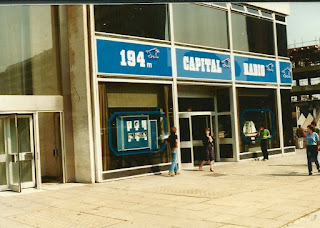
Despite this frustration, the job turned out to be one of the most enjoyable and rewarding I have done. Knowing that the radio station was making a practical difference to Londoners’ lives was incredibly heart-warming. The foyer – our ‘office’ – was enormous, more than 1000 square meters, with a ridiculously high ceiling and permanent home to three freestanding stalls: the ‘Capital Radio Shop’ sold station merchandise, ‘Capital Radio Jobspot’ offered job vacancy details and ‘Capital Radio Flatshare’ produced a printed sheet every Thursday afternoon listing rental accommodation available. The building’s ground floor full-length windows on a corner site enabled traffic passing on busy Euston Road and Hampstead Road to view the impressive Christmas decorations within, including a massive, illuminated pine tree. Pedestrians would stop and peer through the glass at us working inside.

Capital Radio’s decision prior to the station’s launch to rent the foyer and first floor was a brilliant marketing strategy, as its logo and name were emblazoned across the building at ground level around one of London’s busiest road junctions. To passers-by, it appeared that the station occupied the entire 36-storey tower, the capital’s tallest office block when completed in 1970. In reality, its upper floors were filled with unconnected businesses including the UK government’s military intelligence department intercepting mail. Capital Radio’s high-profile visibility was in stark contrast to its competitor ‘Radio One’ which had operated from an anonymous outbuilding (Egton House) since launch in 1967. BBC bigwigs had feared its youthful staff (including former pirate radio ship presenters) might scare the ‘serious’ broadcasters in Broadcasting House employed on its existing talk and classical music networks.

Another significant difference with its competitor was Capital’s open-door policy, permitting anyone to enter its impressive foyer through the revolving doors without a security check. Music fans would stand around hoping to get a glimpse of pop stars visiting for interviews. Radio presenters walked in and out and up the grand curved staircase to the first-floor studios. During the charity appeal, many generous listeners ventured in clutching their donations of toys which we added to the piles of presents. For amusement, we unboxed and put batteries in one state-of-the-art toy mouse that ran around on wheels with a movement sensor, enabling it to independently charge at speed across the polished floor towards anyone who entered through the revolving door and then chase them wherever they walked. Only on one occasion did we have to close and evacuate the foyer for several hours due to a bomb scare.

Christmas Eve was a sad day when the team had completed the charity appeal and parted ways for the final time. Following my mysterious attempted mugging, I reached home and found I was lucky to have escaped with mild bruising on my forearms. I packed a bag and headed to Deptford railway station, only to discover that the last train had already left. I had to return to my rented room, phone my mother and ask if she would come and collect me as there was no public transport during the next two days. Though she hated driving through London, she kindly drove fifty miles from Camberley to pick me up on Christmas morning so that I could spend the holidays with her and my sister.

In the New Year, I returned to the Capital Radio office to type up a report that catalogued, with Millie’s help, the volume of goods we had distributed during the Christmas appeal and the number of charities and families we had helped. Though no such post mortem had been requested, I considered it ‘good practice’ and I hoped to impress my boss with my thoroughness as a manager.

Much later that year, Steve Billington requested a further meeting in his office. Perhaps a full-time vacancy at the station had arisen? Sadly, it had not. I was asked if I would work on the next Christmas charity appeal. I was grateful for the opportunity. However, I was flummoxed to be told that I was to be demoted to the role of ‘deputy co-ordinator’ despite me having believed I had achieved a satisfactory job the previous year. Then I was gobsmacked to be told that the co-ordinator that year was to be … Pol. It seemed like some kind of voodoo that the person within our team who had demonstrated the least commitment last year should now be appointed to manage the rest of us.

Once activity started in December 1987, did Pol step up to his promotion and manage everything smoothly? No change of spots was evident. The only thing he seemed interested in managing was his own social calendar. It was Hobson’s choice: either the charity appeal would rapidly descend into chaos or I would have to manage it, just as I had the previous year. I took the reins informally, even though it proved frustrating when the most regularly spoken phrase by everyone involved was “Where’s Pol?” The charity appeal proved as successful as the previous year, though on this occasion Pol would take the credit. Did he write a report afterwards, as I had done? Er …

With the exception of the baffling change of co-ordinator, Steve Billington had been a fantastic boss and, in the New Year, he invited our whole team to reunite for a lunchtime meal at a restaurant in Tottenham Court Road to express his gratitude. I was appreciative of the start he had offered me at Capital Radio and the opportunity it presented to further develop my management experience. I had thoroughly enjoyed my time working there and, like my earlier job at ‘Metro Radio’, it taught me a lot about the problems that can befall a commercial radio station.

And so to ‘The Epilogue’:

In 1988, Camilla ‘Millie’ Dunne (daughter of Sir Thomas Dunne) married The Honourable Rupert Soames (grandson of Sir Winston Churchill) at a society wedding attended by her friend Lady Diana, Princess of Wales.

In 1989, I co-ordinated and wrote former pirate station ‘KISS FM’s successful second application for a London commercial radio FM licence, beating 39 competing bids.

In 1990, Capital Radio closed its community department as a result of the new commercial radio regulator ‘The Radio Authority’s ‘light touch’ strategy no longer requiring commitments from licensees to community activities. Steve Billington left Capital Radio.

In 1991, I attracted a weekly audience of more than one million listeners a week to black music station ‘KISS FM’ within six months of its successful launch, as its Programme Director, exceeding the Year One target.

As for Pol …

[Originally published at https://peoplelikeyoudontworkinradio.blogspot.com/2023/10/knock-me-down-with-stalker-1986-share.html]

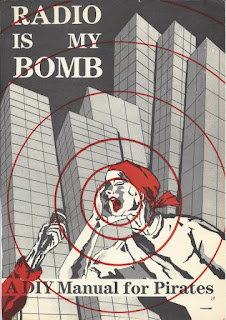
Radio is my bomb? : 2003 : the DAB digital radio customer complaint hotline, The Radio Authority

 The Bomb Squad arrived in vans, ran into the Holborn office block and up its staircase to the eighth floor. We watched events unfold from the car park below, the assembly point to which our organisation of forty-odd people had been evacuated an hour earlier.

That humdrum morning had been interrupted by a large cardboard box delivered by Royal Mail to our office. It was not particularly heavy but had lots of stamps on the outside with a ‘Belfast’ postmark. If you were a celebrity or public figure whose opinions were widely distributed, you might anticipate threats would occasionally be made against your life. If you had a desk job in a little-known British government quango, your greatest work challenge might normally be choosing where to lunch. However, that morning, the box’s addressee Soo Williams was taking no chances. The emergency services were called.

Eventually, the ‘suspicious package’ was removed by ordnance experts and exploded elsewhere. It was found to contain nothing but paper. Printed petitions signed by hundreds of Belfast citizens demanding that religious community radio stations be licensed locally. Williams’ name had been written on the box due to her recent promotion by The Radio Authority to manage the launch of ‘community radio’. Returning to our desks after the false alarm, I ruminated what those god-fearing citizens who had toiled to gather so many signatures might have thought of having been suspected by the recipient of being terrorists.

That morning’s event exemplified the disconnect between the regulator of the radio industry and the public it was supposed to serve. Someone with an interest in the UK community radio movement would have known that tiny unlicensed radio stations had existed for years on both sides of the Irish border, broadcasting church services and information to their communities. Indeed, one history argues that the Catholic Church in Ireland was “the world’s largest pirate radio operator”. However, few of The Radio Authority’s desk-bound administrators demonstrated interest in the medium they were employed to regulate. I was the only employee to have worked in a community radio station (licensed in a 1970’s experiment), having been a founder member of the Community Radio Association two decades previously. But now, within this dysfunctional workplace, I was regarded as the office junior … at the age of forty-four.

Back at my desk, I returned to taking regular phone calls from members of the public dissatisfied with the new-fangled DAB ‘digital radio’ receiver they had just purchased. I never quite understood why the switchboard regularly passed such calls to me, as I bore no responsibility for DAB radio, and my colleagues in the Development office suffered no such impositions. It was already self-evident to me that the rollout of this new radio technology had been disastrous for listeners, though I was expected to defend the system, and worse … to blame the listener for its inadequacies.

Staff were issued with a ‘helpful’ sheet of topics to raise with complainants about DAB. Suggestions to be made to members of the public experiencing difficulties tuning into stations on their new receiver included:

  • move your radio nearer a window
  • listen to the radio in an upstairs room
  • your residence might be constructed of the wrong materials
  • your residence might be located in a valley
  • your residence might be located in a dense urban area
  • your residence might be in an apartment block or a basement
  • you may need to install a rooftop antenna.

Many callers were understandably baffled and annoyed by these ‘answers’ to their problems, proffering a torrent of abuse or hanging up. Many had spent around £90 on a portable DAB receiver and expected it to deliver what the industry’s marketing had promised – ‘crystal clear’ reception of a wide choice of radio stations. The most popular receiver, the ‘Pure Evoke-1’, had been designed to be portable and had no socket to even attach the suggested external antenna, let alone the connectivity to update and improve its software. And why did it resemble a wooden post-war radio in an era when connected mobile phones were looking increasingly futuristic?

One of my callers’ commonest gripes was the result of DAB radios having been marketed and sold nationwide, even though many parts of Britain had yet to be connected to the DAB transmission system. In this instance, all I could suggest was that the consumer return their receiver to the shop and demand a refund because no digital stations were yet audible locally. I too shared this problem because, although The Radio Authority had denied me its Christmas cash bonus in 2002, I had received the DAB radio gifted to all staff. It remained in its box as I was living in Brighton, where DAB transmissions had yet to arrive.

The root of the dissatisfaction with DAB radio was not the technology itself, which had been a smart European innovation, but the way it had been implemented by Britain. Those critical roll-out decisions had been made by people like the ones in my workplace: administrators who had no experience working within the radio industry, encouraged by technologists keen to promote anything ‘digital’ with an evangelical fervour, oblivious as to whether consumer demand was evident. At the top of this unholy group of conspirators were government civil servants who mistakenly believed that Britain and British industry could dominate global markets by adopting a technological standard in which the rest of the world had shown scant interest. Meetings of this cabal seem to have merely intensified their cult-like determination.

The stumbling block their paper plan faced was the disinterest of the commercial radio industry itself which, at that time, was profitable and had expressed no dissatisfaction with its existing, robust FM radio transmission system. When The Radio Authority advertised the first national DAB multiplex licence in 1988, it faced the very real possibility that no radio companies would submit bids. To avoid this embarrassment, the regulator had to ‘strongarm’ Britain’s largest radio group into making the only application. GWR Group plc’s then chief executive Ralph Bernard later admitted:

“GWR was encouraged to apply for the national [digital] licence, and was under some pressure to invest in the opportunities for a national licence from the then regulator [The Radio Authority]. Had we not done it, there would be no national DAB platform now. Not only that, [the regulator] did not know what they would have done on the question of national radio stations with regard to the opportunities given by the then government to renew their national licences for a further period of time if they were to commit to going digital. But how can you [do that] if there are no opportunities to go digital because there is no national multiplex? When I put that question to The Radio Authority, I was told that the answer was: ‘We don’t know what would happen – there is no Plan B’. It was just an assumption that someone would go for [the national DAB multiplex].”

“When we were seduced into believing that this was going to be the only [national digital] licence, we realised that there would be substantial losses, but the payback would be when you have the opportunity to be the only player in the national market for DAB. When it’s The Radio Authority, an agency of government, you tend to believe what you are told. On that basis, the investment was justified and, at the time, getting it through my Board was not easy.”

Having rescued the regulator from potential embarrassment in its ill-judged pursuit of the DAB dream, Bernard naturally now held some sway over The Radio Authority and its decisions. There evidently did exist such a thing as a free lunch for its senior managers when Bernard would invite them to The Ivy restaurant in anticipation of outcomes coincidentally beneficial to his business. On two occasions at the regulator, my actions threw a spanner into this cosy relationship and I suffered consequences (see blogs here and here) from my bosses, despite me having acted in what I believed was the public’s interest. I learnt to my professional cost that I was supposed to be a ‘civil servant’ to commercial interests, not to our citizens.

How did the story end for commercial radio? Badly. GWR Group plc’s subsequent merger with Capital Radio Group plc, both profitable public companies prior to their investment in DAB, proved a financial disaster, their DAB assets were divested for a song, an offshore investor acquired the merged business and Bernard exited the industry. This tragedy was repeated in the lower echelons of the radio business when the entire UK commercial radio industry had to be rescued by private investors. Most local radio stations that had existed since the 1970’s were replaced by national ‘brands’. Local content all but disappeared. Thousands of radio professionals lost their jobs.

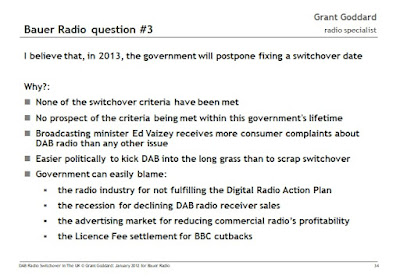
How did the story end for DAB radio? Even worse. In a presentation I was commissioned to make to the board of the second largest radio group in 2012, I predicted that the government would kick the much heralded ‘digital radio switchover’ date into the long grass. I was pooh-poohed by the company’s technologists at the meeting, but my predictions came to pass … while theirs turned to dust. Naturally, I was never invited back. British commercial radio’s enormous investment in the disastrous DAB platform impoverished the entire sector, reducing it to little more than a jukebox music service for listeners who lacked Spotify accounts.

The deluded dream finally died in 2016 when ‘Pure Digital’, the ‘great white hope’ of British designed DAB radio receivers (though manufactured in China), was sold to Austrian company ‘Aventure AB’ for £2.6m, following its £7.9m loss during 2015/6 as a result of declining sales and its “significant stock” of unsold radio inventory so old that it “needs to be assessed for risk of obsolescence.”

With the advantage of hindsight, the entire DAB debacle now seemed like a rehearsal for the similar self-harm caused by Brexit a decade later. Men in suits with little or no experience of working in the real world of commerce pursued a fever dream regardless of its practicality, oblivious to its outcomes but buoyed by their mistaken sense of superiority. Their project was to foist a uniquely ‘British’ solution on the population that would purposefully diverge the UK from the rest of the world (British DAB radios would not even function in France). Their words and documents were stuffed with misinformation and downright lies that supposedly supported their theories. Without their posh accents, they could have been mistaken for used car dealers.

Despite the wilful destruction of the commercial radio sector’s economic value, talent, creativity and public service that they had fomented, many of Britain’s DAB ‘protagonists’ went on to be lauded with industry awards, honours and lucrative jobs. For anyone who followed the Brexit disaster, it will sound like all too familiar a story.

[Originally published at https://peoplelikeyoudontworkinradio.blogspot.com/2023/10/radio-is-my-bomb-2003-dab-digital-radio.html]

The spy who disliked me : 2003 : Eva Koekelbergh, The Radio Authority

 “Do you know who I am?” my workplace colleague shouted down the phone. “Do you know who I work for?”

I suspect customer service personnel at Fortnum & Mason (which promises “everyone remembers their first encounter with us”) endure similarly haughty conversations with their upper crust clientele day in day out and follow a scrupulously polite script such as:

“Yes, madam, I can read your name on the order for wedding guest name cards and I can tell from your posh accent that you are a member of the British elite who since 1707 have purchased ordinary things from our Piccadilly shop at extraordinary prices, BUT …”

Perhaps private school timetables schedule one period per week of ‘Privilege Studies’ during which pampered Torquil’s and Persephone’s confidently acquire the skill of always getting their own way in life by addressing the 95% of Brits who they consider not ‘one of us’ as inferior beings … though I fail to recall my state school reciprocally teaching ‘deference’. Whether the harangued employee at Fortnum & Mason (“committed to delivering a sense of pleasure”) on the other end of the call had heard of The Radio Authority I doubt. Our government quango was so marginal that there were probably people toiling in radio stations who had never heard of it.

My colleague was usually more softly spoken until an issue arose with ‘service’, at which point the inherited gene that had probably balled out ‘the help’ in centuries past suddenly emerged on the radar screen like the tip of an upper-class iceberg. On a previous occasion, a phone charger left permanently plugged in under the same colleague’s desk had burnt out with a bang while she was sat in our crowded, unventilated office, but without injury. No eavesdropping was necessary to overhear how forcibly the manufacturer would be complained to, sued and adequate compensation secured for her having suffered this apparent near-death experience.

Our office proved the ideal place for my colleague to spend most of the year meticulously planning her spectacular wedding in the grounds of a hired West Country mansion. Months could pass without management delegating any work to us ‘development officers’ to do. The pay and conditions in this public sector agency were undeniably rubbish, but never have I been required to do so little work for a salary. If I exited the office even ten minutes after five o’clock, it would be my duty to switch off all the lights and lock the Radio Authority front door. So much time, so little work!

Evidently, no run-of-the-mill wedding was being planned from the desk next to mine. Its scale and lavishness would easily have triumphed in a ‘Radio Industry Wedding of the Year’ awards ceremony. Like all historic royal weddings, this was not a purely personal affair. It celebrated the alliance of two established ‘houses’ that since 1973 had been at war with each other, fighting innumerable battles over every issue known to the broadcast industry’s opposing armies. The bridegroom was a board member and director of a significant British commercial radio group. The bride worked for the government regulator of the very same commercial radio industry. It was a match made in conflict-of-interest heaven.

I had already observed that, as soon as something of even minor significance occurred at The Radio Authority, the bride-to-be would unhook her mobile phone from its charger and march to the ladies’ loo where she might remain a good while. Maybe she just suffered a weak bladder exacerbated by radio industry events. Whatever, by dint of a mysteriously indirect route, such news would magically appear within the pages of the next ‘Radio Magazine’, a weekly publication brimming with insider gossip that naturally was rabidly consumed by The Radio Authority’s staff.

Normally I would have remained coldly detached from such workplace intrigue but, this time, my life was impacted by the whiff of in-house espionage. Bob Tyler, a good friend for as many decades as I have attended radio conferences, was then news editor of the Radio Magazine and had a habit of phoning The Radio Authority switchboard and asking to be put through to me for an innocent chat. Having signed some kind of Official Secrets Act on my first day of work, I told him absolutely nothing confidential. However, his calls may have sowed seeds of doubt with my boss, David Vick, who one day discovered me alone in his office after I had entered to retrieve a document I had mistakenly left on his desk minutes beforehand. As the only employee with hundreds of published articles about the radio industry to my name, the fickle finger of fate appeared to point directly at me and, without explanation, Vick started to lock his office door when he was absent. Subsequently, I was the sole employee not to be awarded a Christmas bonus and my annual review was unremittingly negative.

“My father worked as a spy for the Dutch government,” the bride-to-be would tell the rest of us in the office, as if addressing an interviewer for a place at Oxbridge. I wondered to myself whether such an occupation passed as a ‘family business’ amongst her peers. Could her employment with The Radio Authority be merely an undercover mission in a quiet backwater for an MI5 agent? Suspicions were further aroused when our boss David Vick insisted he vet and approve each of her wedding guests, the list apparently resembling a who’s-who of everyone who presently worked in the British commercial radio industry. Not that I ever saw it. 

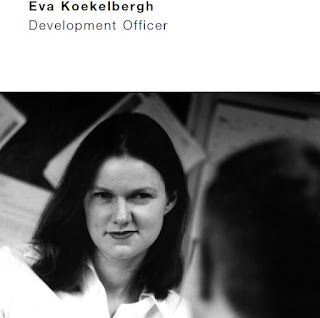
As the Big Day approached, it became apparent that all who worked in our office had received an invitation … except me. In fact, everybody in our department had been invited … except me. Indeed, I suspect that just about everyone employed by The Radio Authority had been invited … except me. Not that Eva Koekelbergh ever told me to my face that I would not receive an invitation to her big fat Wessex wedding. My desk was only six feet away from hers so the ‘oh dear, it must have been lost in the post’ excuse would have been wholly redundant. I had endured almost a year of aural torture, forced to listen to every minor detail concerning the biggest day of her life being phoned through to dozens of contractors and then chased up relentlessly from her desk, yet now I was being treated as if I might deliver a homemade bomb as my gift-wrapped present.

Though there may be eight million eligible bachelors in the naked city, the universe of Britain’s 5% appears more akin to the gene pool within a rural Mormon village. The bridegroom just happened to be the former Radio Authority line manager of the bride, and he also just happened to be best man at her present line manager’s wedding, and both men just happened to have attended the same university. For the cherry on top of this cake of coincidence, one of the six people working in our office was the daughter of one of the bride’s teachers at her former private school. When people casually comment ‘it’s a small world’, do they realise what a truism it is for a certain stratum of society?

One week before the Big Day that had necessitated a year of planning, including its own internet domain with gooey photos of the couple and a lengthy wedding gift list, the bride casually asked me if I wanted to attend her post-wedding evening soiree, but not the main event. I was tempted by an appropriately pithy two-word response but instead feebly explained that I was already busy that weekend. The few friendly staff I knew at The Radio Authority had already asked me privately why I had not been invited and all I could do was shrug. I had no idea. Anybody who was anybody in the British radio industry seemed to have been invited. I could only surmise that I must be ‘nobody’, despite having planned and executed London’s most successful large-scale commercial radio station launch during the previous decade.

Naturally, the wedding juggernaut did not come to rest abruptly at the end of the Big Day. Afterwards there were still the communal experiences and the photos to be ooh-ed and ah-ed over by colleagues in the office … and the gossip. Who did what, who saw what and who said what occupied many of the staff for several weeks afterwards. I just sat at my desk pretending to be deaf, dumb and blind. All I learned was that everybody seemed to have had a good time. The wedding had at least not cost me a penny. No present, no card, no car hire, no petrol, no hotel, no tuxedo hire. Even if I had received an invitation, I might have proffered a public explanation that I could not afford all these costs on my meagre salary (particularly as I was commuting to London by train from Brighton), even whilst harbouring the private reason that the wedding’s scale and ostentatiousness seemed to be drawn from the pages of ‘Emma’.

A few months later, The Radio Authority closed and the majority of its staff transferred to a new regulator named Ofcom where we worked in a huge, open plan office overlooking the River Thames. I was relieved that my newly appointed desk was no longer next to the post-honeymoon bride, not because I disliked her, but because during my eighteen months at The Radio Authority she had insisted on running a powerful electric fan on her desk, whatever the season. It might have had the effect of making her feel like Kate Winslet on the bow of ‘The Titanic’ but the airstream had simultaneously played havoc with my sinuses. I had asked her repeatedly to adjust the fan’s angle but somehow it had still subjected me to painful headaches.

I had only transferred to Ofcom in the desperate hope of being offered some proper work tasks to tackle after having been required to do so little at its predecessor. It was not to be. My new boss Neil Stock gave me nothing to do. When the BBC called unexpectedly to offer me contract work in Cambodia, I accepted the challenge. During my last afternoon at Ofcom, I bade a fond farewell to the few lovely colleagues who had been so good to me. On route towards the exit, I passed Eva’s desk. I considered stopping to say farewell but then reflected on my experiences and resolved to walk on by.

[Originally published at https://peoplelikeyoudontworkinradio.blogspot.com/2023/07/the-spy-who-disliked-me-2003-eva.html]

The man who mistook his wife for a hat : 2006-2009 : Enders Analysis

 1976. With trepidation, I knocked on the door of the Durham student newspaper to volunteer, opened it and encountered a cacophony of shrill, loud voices in an office no bigger than a two-up-two-down front room. A dozen people in close proximity were conversing at sufficient volume for their voices to project into a distant corner of a non-existent adjacent room. Never had I heard so few people generate so much noise. Not a chummy American loudness, but a commanding-the-troops ‘I’m in charge’ harshness. When one woman spoke, it sounded exactly how I imagined a horse might talk. I had stumbled into toff-land, the privileged world of the privately educated, a parallel universe of entitlement I had observed in television historical dramas but not realised still existed in the late twentieth century. Did I grow accustomed to their gratuitous noise pollution? No.

2006. With trepidation, I started my first day’s work at Enders Analysis. Its location in elite Mayfair, opposite the rear entrance of Park Lane’s Grosvenor Hotel, conveyed ‘class’. I was given a desk in a cramped room shared with colleagues who spoke loudly in plummy accents. The previous occasion I had endured transportation to toff-land, thirty years earlier, at least my commitment had been voluntary. Now I was indentured to spend forty hours a week in this socially hostile environment. Each occasion I opened my mouth seemed to confirm my appointment as the ‘accidental analyst’ to a job usually pre-ordained for yet another privately educated chap. Within days, the questions started.

“Why do you arrive at work so early every day?” asked Ian Watt one morning.

“My wife has to start work early, so I leave home with her,” I replied.

“Your wife is a banker?” my colleague suggested. I struggled to maintain a straight face at such a bizarre presumption.

“No,” I responded with hesitancy. “She works in an NHS hospital.”

There was a gap. I sensed a sharp intake of breath.

“Ooooohhhh,” said Watt with evident disappointment that betrayed a palpable disregard for public service, whether someone worked in a hospital kitchen or the deputy chief executive’s office.

If boisterous office chit-chat (“I’m off on holiday to Brazil next week”) proved insufficiently distracting, it was accompanied by personal phone calls made from colleagues’ desks, sometimes communicating disturbing content. Do I really need to hear you phoning a credit card company to increase the limit on a card in your father’s name for which you had applied and use? We all carried personal mobile phones and could go outside to make calls but, for these colleagues, there was evidently no shame or embarrassment in broadcasting their latest Famous Five-ish japes.

One regularly phoned his wife and, instead of a loving message, he would bark orders to her at the top of his voice as if she were a half-deaf scullery maid in his medieval castle. The tone of his phone calls disturbed me sufficiently to glance around our room to determine if the others had similarly felt they were being forced to eavesdrop on a suspected witch undergoing torture by the Inquisitor. None of them looked up or flinched during his tirades, as I did. I felt so alone in this workplace, observing that such humiliation of a fellow human appeared not only acceptable in toff-land but might be practised by my other colleagues.

“My wife is an opera singer,” he would turn around to tell us once his aggressive phone diatribes ended. I was uncertain whether this occupation was some kind of toff codeword for ‘slave’, or perhaps his entire household was staging a never-ending operetta in the ballroom where he had to phone in his part as the angry, posh analyst husband from Mayfair. His behaviour made me contemplate walking over and committing workplace violence but I was restrained by my poor chances in a pistol duel at dawn.

I soon discovered that ritual humiliation appeared to be my new workplace’s predominant management style. Within weeks of starting the job, I attended my first one-day radio conference at a Mayfair hotel a few hundred metres from the office. During the opening morning session, I received a text from a colleague telling me to return to the office because our boss needed me to do something unspecified urgently. Reluctantly leaving the conference, I returned to the office to be told that our boss was not there but would return soon. By the time the conference ended, I had wasted most of the day sat at my desk waiting for something, anything, to happen that required my presence.

If your private schooling imbued you with the notion that Miss Havisham was an ideal role model, such behaviour must simply propagate down your family money-tree. Many more humiliations followed, all of which I accepted with the uncomplaining resignation that a servant is forced to adopt to remain in the employ of an unhinged ‘big house’. The consequence is that the master progressively ups the ante in order to prompt a reaction, any kind of reaction, to their extensive repertoire of humiliations … and so it was.

2008. In front of my colleagues, boss Claire Enders told me she did not appreciate my work clothes. My suits were too baggy and my shirts were too patterned. I had not changed my dress style since starting work there, so I recognised this as her latest attrition. I wore a black or grey suit, a ‘designer’ work shirt, a subtly patterned tie and black shiny shoes. Once a month, my wife accompanied me on a Saturday hike around local men’s outfitters to peruse and purchase sale items. As a result of my daily cross-country run, my shoulders were broad but my waist was narrow, making any suit look ‘baggy’ on me. It was not my fault that many of my work colleagues were Billy Bunter-like!

In response, I resorted to wearing a plain white shirt and black tie every day under one of my existing suits. Then, in front of my colleagues, Enders complained I looked like an undertaker and ordered me to go to gentleman’s shops on Jermyn Street to buy new clothes. My patience with these workplace humiliations was wearing thin by my third year there. I neither agreed nor refused. As the only parent in the analyst team financially supporting their child’s university education, I could not suddenly throw my earnings at hideously expensive clothes. I had kept to my employer’s dress code at all times. I hoped that this latest humiliation might blow over … but I underestimated the persistence of my protagonist.

One week later, colleague Ian Watt told me he had been instructed to take me to Jermyn Street to buy new, more suitable clothes. We took a taxi, something I never afforded. During the one-kilometre journey, Watt wittered on about stuff while I shut my ears and stared vacantly out the window. I had decided to go along passively with his mission, as if he were demonstrating his superior breeding to a servant or slave … or wife. I did not lose my temper, argue or contradict him. I was merely a lowly bit player in his ‘Downton Abbey’ roadmap of British society. In my head, I was amused at the ridiculousness of this situation.

Inside the Dickensian shop (“Suits you, sir!”), Watt chose a new wardrobe for me. Bright pink shirts, elastic braces, ugly black shoes. I offered no opinion about his preferences. All I would have needed was a red nose to join a touring circus. He took my ‘outfit’ to the cash desk and unexpectedly asked me to pay. I refused. There was a standoff. Frustrated at not fulfilling the ultimate humiliation of making me fund my own unrequested makeover, he stormed off to replace most items on their shelves, before proffering his credit card to pay for the remaining two. During our taxi journey back to the office, I remained detached even when I heard him bellow at me:

“If you had attended a public school*, even a minor one, you would know how to dress!”

There, laid bare, was his contempt for me. It mattered not one iota that I had started working in radio more than three decades earlier and had successfully launched commercial stations attracting millions of listeners in the UK, Europe and Asia. It mattered not one iota that I had earned more mass media coverage for Enders Analysis with my published reports about the radio industry than all my analyst colleagues combined. All that mattered to him was the type of school I had attended many moons ago. The five-figure sum that his parents must have paid each term for his private school education seemed to entitle him to treat me like … you know what.

Unlike Pip, I harboured no desire to be accepted as a ‘gentleman’ by London society. You could stuff your flouncy shirts, your waistcoats, your pocket watch, your braces, your uncomfortable shoes, your sickening attitude to people like me. I knew who I was and was perfectly content in my own skin. Born in a council house, I attended school on a council estate and was obliged to become male head of my single-parent household at the age of fourteen. That is who I was. I refused to lick your … overprivileged ego.

Back at the office, the clothes bought in Jermyn Street sat in a bag beside my desk. I refused to even look at them. Naturally, further humiliations followed until, within months, I was forced out of my job. When I left for the final time, I placed the bag of new, unworn toff-wear on my empty office chair. There were no farewell drinks. There was no gratitude. There were no goodbyes. One day I was at work, then I had gone. Exiled from toff-land.

Several months later, I received an unexpected call on my mobile from Ian Watt. There was some work Enders Analysis wanted me to do. I knew from experience that Claire Enders could humiliate to the bitter end former employees who had been edged out of her workplace by asking a staff member to renew contact on her behalf. Watt droned on for a while and, though I was sorely tempted to shout an expletive at the same volume he reserved for humiliating people like me, I simply responded ‘no’ and put the phone down.

I don’t wanna go to Jermyn Street … ever again.

[* In British English, ‘public school’ confusingly means a private secondary school requiring fees.]

[Originally published at https://peoplelikeyoudontworkinradio.blogspot.com/2023/07/the-man-who-mistook-his-wife-for-hat.html]

It ain’t what you do, it’s the way that you hobnob : 1980 : Durham University Careers Advisory Service

“The Treasury,” said one.

“Banking,” responded another.

“The Civil Service,” replied another. It was my turn.

“Radio,” I said.

There was stunned silence. I felt all eyes turn toward me. Time seemed to pause while my colleagues processed their apparent incomprehension.

“What do you mean by ‘radio’?” eventually enquired the Economics professor in whose dark, dingy Old Elvet office our tutorial group was meeting.

I was somewhat taken aback. Who does not understand the word ‘radio’? Had he never read about Marconi? I grappled to maintain my decorum. I looked around at my fellow students dressed in three-piece suits or dress shirts or lavender cardigans with slacks over shiny black shoes. They appeared to have already been moulded into mini-me versions of their fathers (naturally there were no women). Their appearances were as dull and middle-aged as the careers they had said they desired. I was sporting my usual cheesecloth shirt, flared jeans and platform shoes, de rigueur 1970’s student-wear. Evidently, I inhabited a different dimension from my colleagues. Had Ann MacGregor twiddled the dials of her SAGE computer and sent me back a whole century to an era before radio had been invented? Where were Doug and Tony? I hoped they had not landed the other side of the street, inside Durham Prison.

“’Radio’ as in ‘broadcasting’,” I answered, struggling to control my patience, “where I want to produce programmes for a radio station.”

“Oh … kay,” said the tutor with the weariness of a grizzled academic attempting to explain monetarism to the village idiot. “So why are you here studying economics?”

“Because economics interests me,” I replied.

That was my second faux pas of the day. I looked around again and realised that my fellow students were not there primarily because of any enthusiasm for the subject. They were simply fulfilling their destiny, determined from the day they had been born into families who had then spent huge sums over two decades on their private education. For my colleagues, a job within the top echelons of government or commerce was not a career ambition. It was a birth right. It was simply the ‘payback’, the ‘return on investment’ expected as reward for the six-figure sum that Tarquin’s parents had spent to secure his social status. He and his former school chums felt entitled to their guaranteed shiny futures.

In the 1970’s there was no degree course in radio. No degree course in media. I was amongst Britain’s 94% of children who had attended state schools. Now I was amongst the 14% of the population to attend one of the country’s 45 universities. I had been forced to choose the academic subject in which I performed best at my school … and in which I was interested. With minimal career guidance, I had selected the university which I believed offered the best reputation. What nobody had advised me was that Durham was stuffed to the gills with toffs whose academic record at private schools had not proven exemplary enough to win them a place at Oxford or Cambridge. As someone who was certainly not ‘privileged’, had I wished to spend three years in a ‘Chariots of Fire’ theme park?

In my tutorial group, when one fellow student had spoken for the first time, I failed to understand a single word he had said. I assumed he must have been speaking some unidentifiable foreign language. Then I looked around and noticed my fellow students nodding in agreement as if they had understood him perfectly. I was confused. The next time he spoke, I struggled harder to comprehend his speech and managed to pick out the odd word in English. Only then did I realise that he habitually spoke in an upper-class accent so cut-glass as to prove almost incomprehensible to someone like me. Hand on heart, I am not exaggerating. I would have understood every word spoken by The Queen, but this young man’s speech was so stilted as to be easily mistaken for a parody of an upper-class twit.

I cannot recall a single conversation about economics with a fellow student on my course. Our academics never asked us to work in project groups. The toffs were being groomed to assume their rightful place as ‘captains’ of industry or government, for which there was no apparent necessity for them to converse with someone from the lower classes. It was evident to them from my accent, dress sense and demeanour that I resembled the servants or the ‘help’ their families employed at their mansions. I was similarly invisible to them, not having the ‘right stuff’ conferred by a private education, as had more than 90% of students at Durham. Worse, I betrayed no ambition to try and join their ‘club’. Unlike them, my parents had paid nothing toward my education, which made my chosen career very much my own affair.

I already subscribed to ‘Broadcast’ magazine and bought ‘The Guardian’ on Monday for its media job advertisements. Now it was time to visit the university’s Careers Advisory Service to locate suitable job vacancies. Its one-room office in a modern two-story building in Palmers Garth was filled with standalone shelf units of file holders, each collecting documents from one employer. I made an appointment to talk with an advisor but the earliest date was more than a month away. During the waiting period, I worked my way along every file on every shelf, searching for any employer within the media. What surprised me then was how few of the 4,000 Durham students seemed to require the facility. What I failed to understand was that most jobs for the upper classes were the outcome of who they knew or who their family socialised with, rather than requiring the bother of a formal application.

On the day of my appointment, I brought along my articles published in the student newspaper in a portfolio I had created from sheets of thick A3 black card stitched together. The advisor I met was an elderly woman with grey hair and John Lennon-style wire-frame glasses, like Granny from ‘The Beverly Hillbillies’. Asked about my career choice, I replied it was ‘radio’.

“We cannot offer you any help if you choose to pursue a career in the media,” she said sternly, staring at me over the top of her spectacle frames. What? I felt outrage that I had waited more than a month for her so-called ‘advice’.

“But I started producing radio programmes seven years ago in London and …” I told her.

“I’m sorry, but getting a job in the media is all about the people you know,” she interrupted and then stood up to go.

I was abruptly left alone, not even having been offered the opportunity to show her my portfolio. Or explain to her the details of my prior radio experience. Or my election as editor of the student newspaper. Or my election as editor of the annual student handbook. Or my election as deputy president of the students’ union. Or my success arguing with the University for an unprecedented increase in the student union’s subscription income. Or my success turning around the student food shop from loss to profit. None of that seemed to matter. I was appalled by the ‘careers advice’ I had just been given. My long awaited ‘interview’ had lasted less than a minute.

Eight months later, I received a letter from the Careers Advisory Service. I presumed it must be a circular sent to former students to update its records. But no! It was a personal letter requesting my help to advise an undergraduate who desired a career in radio and asking me to show him around my workplace. My initial thought was to tear this letter into little pieces and throw it on the living room fire. How very dare they! … However, a few days later, my benevolence got the better of me and I realised I should help a student who might be in a similar situation to mine not so long ago, regardless of how much contempt I felt for the letter’s sender.

I now had a full-time job at Metro Radio, the commercial music radio station in Newcastle, which I had achieved by responding to an on-air announcement I had heard asking for candidates. The vacancy had not been advertised in either ‘Broadcast’ magazine or ‘The Guardian’. I resolved to contact the student and arrange to chat and show him around the station’s premises. Whether he went on to pursue a career in radio I never discovered.

By then, I had learnt precisely how ‘selective’ the university was about recruiting students. In 1978/9, I had been the student representative attending Durham University’s ‘Admissions & Matriculation Committee’ where statistical reports showed that some years certain of its colleges had accepted not a single student educated in a state school. These data were never published.

Four decades later, surely things must have changed? Er, maybe not. A 2022 headline in the Durham student newspaper screamed ‘Durham has lowest state school intake of any UK university’ and quoted student Keely Brown:

“… many [Durham University students from state schools] have no prior knowledge of what awaits them at university, let alone experiences of classism or discrimination and, alongside feelings of imposter syndrome, it can feel like Durham isn’t the place for them.”

[Originally published at https://peoplelikeyoudontworkinradio.blogspot.com/2023/05/it-aint-what-you-do-its-way-that-you.html]

Born to be hired : 2006 : the new boy, Enders Analysis

 “How is it that jobs just seem to fall into the laps of posh people?” my daughter asked the other day.

A rhetorical question? A truism? Both? Those of us who work in industries populated largely by posh people whom we do not resemble may have observed two phenomena. Posh people are often appointed to posts for which they appear to have no relevant experience; and posh people are regularly promoted effortlessly without apparent need to demonstrate above-average talent or previous successes. Obviously not ALL posh people, but enough for such occurrences to be more than random chance.

Recently, I switched on BBC Radio Four mid-programme and heard a posh woman explaining her lengthy career. “I could have been anything,” she said confidently.

That single phrase encapsulates the social divisions so evident in Britain. If you are posh and your parents invest a small fortune in your private school education, it is drilled into you from an early age that you CAN and WILL do and be ‘anything’ in life. Meanwhile, the rest of us have to endure soul-destroying verdicts from state schools, careers services, Jobcentres and potential employers telling us of things we are not good enough to do and be in our apparently second-class lives. ‘Upstairs Downstairs’ proves not so entertaining a system when you have to make do in life with the scraps of opportunity that institutions occasionally chuck your way.

It used to be that posh offspring would join their families’ businesses or spontaneously be appointed ‘captains of industry’, as if managing a British industrial conglomerate was no different than taking daddy’s yacht out for a jaunt on a weekend. However, Britain’s post-war, post-colonial de-industrialisation (hastened during the Thatcher years) considerably narrowed such straight-ahead career opportunities. For a while, only politics, government, medicine, law and accountancy were considered suitable professions for posh people, whereas now those ambitions have had to be diversified into occupations such as … the media.

In 1973, Jenny Abramsky had joined the BBC as a lowly programme operations assistant, following an education at a London comprehensive (state) school and the University of East Anglia. After 26 years progressing through the ranks, she was finally appointed director of BBC radio. Following her retirement in 2008 from managing the largest radio operation in the world, it would be difficult to imagine a job description for her successor that would not have demanded similarly extensive experience in radio broadcasting. It is a sign of how times have changed that the BBC’s choice for the job was Tim Davie who had never worked in radio, but had attended private school, Cambridge University and was deputy chairman of Hammersmith & Fulham Conservative Association. It was transparent even then that the radio job was merely a stepping stone for Davie’s ambitions … and so it came to pass.

Occasionally a glitch in The Matrix does occur, maybe once in a lifetime, when mysterious forces within the universe collide to produce a job opportunity that would not normally appear on the precarious, non-linear career timelines endured by the non-posh. In 2006, I was unexpectedly offered an unadvertised post as a ‘media analyst’, a job title I had to search for on the internet to understand what it entailed. As the salary offered me was greater than any previously earned in Britain, it proved hard to resist.

On my first day of work at Enders Analysis, I was invited by my new colleagues to join them for lunch in a local ‘greasy spoon’. I had already spotted some clues: the office was located in Mayfair, a London district too expensive to even window shop; and the water cooler chatter was about made-to-measure suits by a tailor in Hong Kong.

“What school did you go to?” one of my new colleagues asked.

Decades had passed since I had last been asked about the school I had attended. I was now 48 years old, but I did not want to appear reticent to my peers on the first day.

“Strode’s College,” I replied.

My colleagues looked at each other as if I had mentioned a rarely-visited, faraway Pacific Island populated by savages.

“What sort of school is that?” one of them eventually followed up.

“It’s a sixth form college,” I replied.

This response evidently did not satisfy them. There was a more critical question they were burning to ask, a question that normally was not required of a new recruit. One of them dared to raise it with me.

“Is that a public school?”

In the 1984-ish world of British language, the phrase ‘public school’ means a private school where parents have to pay for their children’s education. What Americans call a ‘public school’ is known in Britain as a ‘state school’ because it is funded by the state. Although every child in Britain is entitled to a free education, a tiny proportion of parents choose a private schooling that they confidently expect will propel their offspring into an elitist trajectory.

It might have been my first day communing with my new ‘colleagues’, but my patience was already starting to be tested. I decided to respond obliquely.

“It used to be a grammar school,” I replied.

“So had it been a private school then?” one of them asked.

This question itself betrayed a flawed understanding of Britain’s school system viewed from the perspective of someone who graduated from private education. Grammar schools can only be state schools by definition. It was up to me to explain such fundamentals in the most black and white terms.

“No, it was a state school as a grammar school, and then it was a state school as a sixth form college,” I replied.

The fact that this humiliating Q&A was the first conversation with my new work colleagues turned out to be indicative of how my future in this job was going to proceed. I was not embarrassed about my education, a state-funded experience I shared with 94% of Brits. What I found difficult to process was my colleagues’ apparent belief that, thirty years after my departure, the status of my school continued to merit far more concern than anything I had done since.

Once the horrifying truth had been extracted from me that I was not ‘one of them’, their lunch chatter switched to other topics. Although I was employed as a media analyst, there were no follow-up questions about my relevant experience for the job, about employers I had worked for previously or about any successes I had achieved. It seemed as if my long career in radio counted for absolutely nothing with them. Of more importance was the type of school I had attended, a fact that certain colleagues were quick to remind me of later in this job.

Despite this rather rude introduction, I continued to join my colleagues for lunch in the same diner on following days in order not to appear unsociable. The cooked food was consistently terrible and caused me diarrhoea. Why did they go there? It soon became apparent from their chatter that one of them, my line manager, lusted after an East European waitress employed there who was probably a third of his age. Instead of castigating him as a ‘dirty old man’, his colleagues appeared to enjoy indulging his fantasies and encouraging his unwanted attentions by spending most lunchtimes being served food by this poor servant girl. I soon chose to duck out of their pantomime and went my own way to Eat or Pret A Manger for a cheaper, more wholesome takeaway sandwich.

During my first week, I had to ask my line manager’s advice about a paragraph I had written for a report. A quick visit to his adjacent private office should have lasted no more than a few minutes. Not so. I exited more than half-an-hour later, reeling from his account of sexual abuse suffered at private boarding school. One moment we had been talking about my punctuation, the next he had drifted into dark memories of bullying from many decades ago. I had not asked a question that might have prompted him to regale me with these horrific stories. Why had he considered it appropriate to burden the ‘new boy’ with such accounts?

Some months later, the whole team was required to attend a seasonal lunch at a basement restaurant in Mayfair. I hated these affairs as my colleagues would get drunk and talk even more loudly, but it was impossible to avoid such ‘team’ occasions. Sat facing each other along a long bench table adjacent to the kitchen, mid-meal I noticed under our table a liquid had started to flow around my shiny black shoes. In my lone sobriety, I raised the alarm with my colleagues, but was ignored until a chef appeared and shouted that a pipe containing used cooking oil had burst and was flooding the restaurant. Suddenly all us customers had to negotiate an extremely slippery floor, climb the stairs and exit onto the street.

On our way back to the office, I was walking alongside my line manager when he suddenly said: “Would you mind if I asked your advice about a personal matter?”

Considering some of our previous, scary conversations, I was half dreading what I might be about to hear. Why did he consider me to be someone suitable to share his private thoughts? His life experiences and his concerns seemed light years away from mine.

“The problem is my mother,” he explained. “She is spending money like water and nothing I say can seem to stop her. I am extremely worried that, when she dies, my inheritance will be insufficient for me to live on.”

“And how much do you think you will inherit when the time comes?” I asked with a great deal of trepidation.

“About one million pounds,” he replied without a hint of embarrassment.

[Originally published at https://peoplelikeyoudontworkinradio.blogspot.com/2023/03/born-to-be-hired-2006-new-boy-enders.html]