DAB in cars: the straw that will break digital radio switchover's back

Speaking today at the Intellect conference in London, broadcasting Minister Ed Vaizey tried to assure us that digital radio switchover was still “on course” to happen in the year twenty something or other:

“On cars, the move to include digital radio as standard in new vehicles has continued over the last year. Around 14% of new vehicles have DAB as standard, up from 4% a year ago.”

Within hours, this news was misinterpreted by one online news source as Vaizey having said:

Forty per cent of cars have DAB [Digital Audio Broadcasting] radios as standard now, up from just four per cent a year ago.”

From ‘14% of new cars’ to ‘40% of all cars’ in a stroke of a keyboard! No wonder the article went on to assert that “the key driver to the take-up of the [DAB] technology looks like it will come from the car industry as manufacturers start to fit digital radios as standard.”

How wrong can this statement be? Fewer than 1% of vehicles on the road currently have a DAB radio. That proportion is not going to increase quickly, even by 2013 or 2015, as the government wants it to. Rather than being “the key driver” for DAB radio take-up, cars will become THE major sticking point for digital radio switchover.

The UK car industry appears to be nearing the end of its tether over the confused information that has been fed to consumers in recent years about the so-called DAB ‘switchover’ and FM ‘switch-off’ date(s). This frustration boiled over at the last government Digital Radio Stakeholders Group meeting on 17 May 2011, when Bob Davis, who heads the Digital Radio Committee of the Society of Motor Manufacturers & Traders [SMMT], stood up to offer what he referred to as a “naughty” comment:

“Jane [Humphreys, Department for Culture, Media & Sport] said earlier ‘around 2015’ for a digital radio switchover. The automotive industry has made it very, very clear, since the process began, that it needs certainty. We’ve got 2013 [as the date for a government decision on switchover] and we think we’re working towards a 2015 switchover date. With respect, Jane, I can already see tomorrow’s headlines that DCMS says ‘digital switchover delayed from 2015’ because you used the phrase ‘around 2015’. That implies a delay. It may be what potentially happens in the market – it may be 2016, it might be a bit later than that – but, for the moment, from an automotive industry perspective, every time there’s a suggestion that 2015 has stopped being the aspirational date – or might stop being an aspirational date – all that happens is [that] the automotive industry, or parts of it, is given another opportunity to say ‘it ain’t going to happen, forget all about it’ and we will end up with the bigger problem of converting vehicles already in the parc to digital, because people will just say ‘if DCMS can’t give us certainty’ – and I accept that, at the moment, you can’t – but if DCMS are saying ‘around 2015’ instead of ‘in 2015’, it reduces the opportunity for SMMT to keep telling its members there’s a deadline, and it’s ‘this’. So please could we have a little bit of caution, from an automotive industry perspective, in (particularly) government references to switchover dates.”

Jane Humpreys: “Thank you, Bob, though I think I’m right in saying that the Minister has never said ‘it will be in 2015’. He too has said that it will be in terms of … that is the target to which we are working, but what is the principal objective is that we have to meet the criteria that have been set out and we have a piece of legislation – unless I’m much mistaken – that says there will be a minimum of two years’ notice. So….”

John Mottram, DCMS: “That’s right. I’m aware of three Daily Mail articles that suggest it’s seven years, two years, five years’ delay depending upon the date, so I think in terms of coverage and it being delayed, I think that delay is already out there. But to Jane’s point, I think the Action Plan and Ed [Vaizey]’s words make it clear that it’s a consumer-led approach. The industry target date is 2015 – we’ve never shifted from that – but that decision is based on the criteria….”

At that point, the meeting was abruptly closed. What had been scheduled to be merely another ‘tick the government box’ faux consultation meeting had suddenly started to spin out of control. The natives had started to get restless. It was time to turn them out onto the street again.

Which? says: DAB radio switchover must be "consumer led or not at all"

What would have to be done to make DAB radio successful?

“What there does need to be, as Freeview and digital satellite has shown in television, is simply a sufficient combination of services, technology, simplicity and price or discount to provide a value proposition for the consumer,” suggested Stephen Carter in 2004, when he was chief executive of Ofcom.

“….. for the consumer” were the key words. They were also the words that became forgotten. The consumer was ignored in the radio industry’s pursuit of the radio industry’s own agenda for DAB radio. As a consequence, DAB radio has still not succeeded … with consumers. The failings were acknowledged by Quentin Howard, one of the architects of DAB radio in the UK:

“The mistake by broadcasters was in not understanding that ‘build it and they will come’ is no longer practical in this integrated technological age.”

Which?, the UK consumer advocacy, noted the radio industry’s lack of attention to the consumer in a February 2011 briefing paper entitled ‘Digital Radio Switchover in 2015? Consumer Led Or Not At All’:

“The transition to digital radio is currently industry led. The benefits of a transition to digital radio over the current analogue service are not clear to consumers, and the uptake of the technology over the past 10 years reflects this.”

Which? suggested that, before the government can announce a date for digital radio switchover, the following criteria should be met:

• “Uptake should be a minimum of 70% of all FM radio listening transferred to digital, leaving 30% still listening on analogue (FM/LW/MW/SW) (the Government’s Digital Radio Action Plan suggests 50%)
• The transition to digital must not be announced until coverage, including a measure of signal quality, is better than that of FM radio
• DAB must have been fitted as standard in all new cars for at least two years and an effective and affordable solution to in-car conversion must be available prior to the announcement of a switchover (which costs no more than for in-home conversion)
• Government must conduct a full cost-benefit analysis from a consumer perspective as a priority because increasing consumer desire for DAB should not focus on cost alone
• Minimum standards associated with a kite mark must be ambitious and future-proofed and any incentive scheme to switch to DAB should offer only kite marked receivers
• Consumer group representatives must be involved in the development of an information campaign independent from industry to raise awareness of the digital switchover by consumers and ensure guidance and training tools are available to retailers. In this regard, any lessons from the Digital TV switchover should be acted upon
• In its assessment of the environmental impact of a switchover to digital radio, the Government must tackle the full range of issues around recycling of analogue sets and the energy impacts of DAB”

However, in some of these areas of concern, current policy on DAB radio appears to be moving in the opposite direction to that advocated by Which?:

• The 50% criterion (50% of radio listening via digital platforms before switchover can be announced) is not mandatory because it was never included in the Digital Economy Act [see Jan 2010 blog]
• The latest plan for DAB is not to deliver reception even as good as FM, but to make it worse than FM [see recent blog]
• Only 1% of cars have DAB radios fitted and future take-up will inevitably be slow [see recent blog]
• Roberts Radio reported a 35-40% customer return rate for its in-car DAB radio adaptors [see Nov 2010 blog]
• The cost benefit analysis of DAB radio to be considered by the government will also be authored by the government, rather than commissioned independently [see Jan 2011 blog]
• Roberts Radio admitted having had to pull the plug on several DAB receiver projects, including the industry’s promised ‘£25 DAB radio’, because they could not meet Roberts’ minimum quality standards

In July 2010, after the formation of the new coalition government, culture minister Ed Vaizey had said:

“If, and it is a big if, the consumer is ready, we will support a 2015 switchover date. But, as I have already said, it is the consumer, through their listening habits and purchasing decisions, who will ultimately determine the case for switchover.” [see Sep 2010 blog]

So, it might appear that the Minister and Which? are, in fact, both lined up in agreement that digital radio switchover can only happen if it is supported by consumers. So why has the government not yet recognised that consumers already seem to have given the thumbs down to DAB?

Because there are middle men (Ofcom, DCMS, Digital Radio UK, Arqiva, DAB multiplex licence owners) who persist in keeping the DAB dream alive in Whitehall. Yet again, consumers are being drowned out by the clamour of agencies eager to pursue their own narrow objectives. And the mantra of the middle men is: DAB crisis, what crisis?

David Blunkett's opinion of DAB radio: BBC is "defending the indefensible"

‘You & Yours’
BBC Radio 4
28 March 2011 @ 1200 [FM only]

Julian Worricker, presenter [JW]
Paul Everitt, chief executive, Society of Motoring Manufacturers & Traders [PE]
Laurence Harrison, technology & market director, Digital Radio UK [LH]

JW: Now, car manufacturers have long prided themselves on arming their vehicles with the latest groundbreaking technology, but there’s one in-car gadget which has remained stuck in the twentieth century. Radios in cars, generally speaking, are FM/AM analogue, and not digital. Around 20% of all radio listening takes place in the car, that’s according to RAJAR, the organisation which counts these things. So, if the UK is to go all-digital and the analogue signal switch is turned off – and that, of course, is the plan – cars need to be equipped with digital radios.

JW: Well, car manufacturers are planning that all new vehicles will have digital radios fitted from 2013. And, now, Ford says it will make digital radios available in its cars a year earlier than that. This will all help achieve the target that 50% of all radio listening should be digital, which is one of the pre-conditions for turning off the analogue signal. We can explore this with Paul Everitt, who is the chief executive of the Society of Motoring Manufacturers & Traders, and with Laurence Harrison, the technology & market director from Digital Radio UK, which is the company set up by broadcasters to help with the switchover. Gentlemen, good afternoon. Paul Everitt, why is the car industry pushing ahead with installing digital radios by 2013?

PE: Well, I think there are two key reasons. The first is because that’s the agreement we had with government as part of the Digital [Radio] Action Plan. They recognised that listening in-car was a key part of radio listenership and, therefore, early introduction of vehicles with digital radio was a key part of the package that needed to be achieved. But, I think, increasingly, what we are seeing, and certainly the announcement from Ford that you mentioned slightly earlier, is actually about the consumer saying that this is something that we want. The consumer now has an increasing opportunity to experience both the listening quality of digital in-car, but also the content, the increasing content, and desirability of the content on digital, as well as gradually and increasingly improving coverage. So, it’s a combination here of ….

JW: [interrupts]: Right, right, I just want to ….

PE: …. both something that we have to do, or we have agreed to do. But I think, increasingly, this is a push that is now coming from consumers.

JW: Okay, I just want to scrutinise that a little, because I don’t doubt that Laurence Harrison will say the same thing because we are told this is consumer led. But, surely, the truth of the matter is that the consumer has been led because of what the government requires you and others to do, so consumer choice only goes so far here.

PE: Well, I think we can argue the finer points of this, if you like. But, from an industry point of view, we began to be involved in this discussion during the course of 2008, obviously the conditions during 2009 with the development of the Digital Britain report brought that forward, or conclusions from that report have been built into vehicle manufacturers’ plans. But, as I say, what we are actually seeing today is, you know, increasing interest in digital from consumers.

JW: Okay. Let me bring Laurence Harrison in on coverage because, as I understand it, at least 90% [population] coverage is a target. That’s part of the targets that will only allow the switchover to take place. Now, 90% sounds positive until you then think about the 10% who can no longer hear what they are listening to now.

LH: Well, I think the key thing on coverage is to become the equivalent of FM coverage. So the 90% figure you refer to is around local coverage. Actually, on the coverage of national services, we are already at just over 90%, and the BBC has just recently committed to build that out to 93% by the end of this year. And the target thereafter is to get to FM equivalence as soon as we can, so that programme is well underway.

LH: And, if we are driving from A to B a significant distance, can we be sure that that coverage will remain consistent over that distance?

PE: So, you’re absolutely right. Of course, for the car market, geographical coverage is vitally important. What we do know now is that the vast majority of motorways and A roads have got good coverage, and significant coverage on B roads and smaller roads. But we are working with broadcasters to try and prioritise the road network going forward.

JW: Paul Everett, what about those who can’t afford to buy a new car after 2013 with a smart digital radio inside it? When that switchover eventually happens, what happens to them?

PE: Well, this has always been our biggest – or one of our biggest – concerns, which is that how do we retro-fit the entire vehicle parc? We are currently looking at something between 25 and 30 million vehicles all up, so it’s quite a challenge. What we have seen over the course of the last year – 18 months – is relatively low-cost adaptors. I think now … I mean the prices vary, but certainly less than £100 to adapt your vehicle, and these are sort of a relatively basic unit, so not desirable for everybody …

JW: What does ‘relatively basic’ mean in terms of what it will actually do?

PE: Well, it means you get a digital reception but you have to kind of plug it into the cigarette lighter and have a bit of an aerial up and …

JW: It’s a bit Heath Robinson, isn’t it?

PE: We would agree with that. From our perspective, we’ve been very much focusing on what we would see as an integrated unit. So, something that you can put into your car or have installed in your car which would effectively mean that you could just use your standard radio to receive digital broadcasts. Now, we’ve seen … I’ve seen first kind of trials of that technology. We hope that that’s going to be available from sort of around the end of this year – the beginning of next year – so we’re already seeing a market begin to develop and, as I say, I think we … well, there are two ways of looking at the problem. One is that we must all prepare because this switchover is going to happen. Or the one which we are focused on is: the more consumers have experience of digital, the more they like it and want it and therefore that’s a market driver, rather than sort of an administrative pull.

JW: No, and that’s a fair point because I read some surveys, Laurence Harrison, that I know you were quoted in in recent weeks. But the point that has just emerged from the last comment, surely, to put to you are that whatever we do here, it is going to cost us and we do not have any choice over that.

LH: Well, I think the stage we are at at the moment, as Paul said, is that we have not got a confirmed switchover date now, so what we are trying to do is build momentum.

JW: But it will happen one day.

LH: It will happen one day, but what’s going to drive people towards digital radio is the great content we’ve got. The same happened on TV. So if you look at the offering now on digital radio, you’ve got the soon to be launched BBC Radio 4 Extra on Saturday, 5 Live Sports Extra, 6 Music, Absolute 80s [and] 90s, Planet Rock, Jazz FM has just announced it is going onto the digital network, so the content offering has frankly never been better and what we do know about people that have digital radio is that once they’ve tried it, they love it.

[The programme was followed with a Yours & Yours blog which invited comments from listeners on their experiences with DAB radio in cars. David Blunkett MP submitted a comment to the programme about his experiences with DAB, upon which listeners made further comments.]

……………………………

‘You & Yours’
BBC Radio 4
1 April 2011 @ 1200 [FM only]

Peter White, presenter [PW]
David Blunkett MP [DB]
Lindsey Mack, senior project manager of digital radio, BBC [LM]

PW: Now, you’ve all been writing in, telling us about your frustrations with digital radios, after Monday’s report on how Ford is planning to install DAB radios as standard in some new cars from next year. Steve told us about his A370 journey between Cardiff and North Wales: perfect listening for 30 miles outside the Welsh capital, then nothing for 150 miles. By contrast, over on Anglesey, Steve tells us the only place that silences his DAB car radio is the Conwy Tunnel. Another correspondent was former Home Secretary, David Blunkett. He’s had trouble getting a DAB signal at his home in Derbyshire. So we brought him together with a senior digital manager for the BBC, Lindsey Mack, and David started by challenging the main claim of digital supporters that DAB achieves 90% coverage.

DB: My thrust was that there are not 90% of the population with access to digital [radio], and many of those who claim to have access have intermittent or interference with the access. And I’m a classic [case] because I can just about get digital radio in North Derbyshire, where I rent a cottage, if I hold the radio up to the roof, or I find one particular spot on the kitchen window sill. Get it out of kilter and either the signal goes or, as quite often I get, even in London, it breaks up.

PW: Right, let me at this point bring in Lindsey Mack. A lot of our e-mails mirrored what David had to say, and particularly this point: that the quality isn’t adequate for many people, even if they’re … it’s said they have reception, and in that so to talk of [FM radio] switch-off at this stage, you know, seems wrong.

LM: Over the last sort of two years, the BBC has been very committed to building out its DAB coverage. We actually are at 90% of the UK population, but that doesn’t mean that everyone’s going to always get a very good reception. A lot of it does depend on the device you have, as well. There are some receivers that are a little bit more sensitive than others. And, in fact, we’ve actually just been doing some tests on the last sort of bestselling sort of ten or dozen receivers in the market.

PW: But what a lot of people said to us, and I suspect David will reiterate this, is that FM, which digital is going to replace, that has a much more stable signal and that, even if you start to lose that signal, you don’t lose it altogether in the way you often lose the digital [signal] or it just goes into sort of burble.

LM: Yes, and with DAB, you usually either get it or you don’t. I mean, looking in Derbyshire, we’ve actually got very good coverage, especially North Derbyshire, so perhaps after this we could actually talk to David about the device he’s actually got, as well, just to see which one he’s actually using. Whilst the BBC has been very committed to DAB and extending the coverage, we are now actually having to make the existing coverage more robust, and that’s actually what we haven’t been doing as much before. What we’ve done before, we’ve concentrated on just rolling out DAB. Now we know we’ve got to really look at the whole way we’re measuring DAB. We’re looking at indoor coverage in particular. You know, originally, when we launched DAB, we actually based all our coverage on car listening and then, obviously, car listening didn’t take off the same way as people are actually listening indoors.

PW: Well, it couldn’t because there weren’t [DAB] radios in cars.

DB [laughs]: Absolutely.

LM [laughs]

DB: It is a problem, Peter, actually, that if you can’t get it and you can’t hear it, you can’t appreciate it. I’ve got no problem with the extra reach and the way in which [BBC] Radio 7 is now going to become Radio 4 Plus or, whatever, Extra. My problem is that there’s a big over-claim for this. Let’s take it steadily, let’s try and get it right, let’s not claim that people have got a service when they haven’t and, particularly, let’s not say – which was what the sell for DAB was – that this is going to be higher quality when, as you’ve just described, the burble, the break-up, the lack of a good sound… I have three DAB radios up north. I’ve tried them all in different places, so it’s: please don’t do to me and to the audience what always happens, which is: it is not the fault of the deliverer, it’s the piece of equipment you’ve got, and they’re pretty good pieces of equipment.

PW: But, David, it was your own government who published Digital Britain and it was your own government that set the 2015 date.

DB: Yeah, and I criticised them at the time. Everybody wants everything now. They want it faster, they want to claim it as the greatest quality. I mean, everything is always ‘the best ever.’ And, frankly, it isn’t and if we just accept that and say ‘lets take it steady and lets try and get it right,’ we’ll all be on the same page.

PW: So it isn’t the principle that you’re against. It’s the practice, really.

DB: Yes, it is. I mean, if FM is better than DAB, let us continue for the time being with FM and, in many parts of this country, it is.

PW: Lindsey Mack, 2015 is supposed to be dependent on, you know, the state of digital [radio listening] and the public’s attitude to it. There’s a report in the papers this week that, in fact, digital sales of digital radio have actually fallen, and fallen for the second year running.

LM: They did fall slightly down last year, compared to the year before but, to be very honest, over the last sort of quarter, the consumer electronic market has been hit very badly. Not just in terms of radio sales, but other consumer electronics as well. You know, the BBC is working very closely with commercial radio and doing a lot of sort of joint promotions. We have to get our messaging right on this.

PW: A lot of our listeners said ‘if it ain’t broke,’ you know, ‘don’t fix it.’ In other words, okay, people quite accept that you’ve got, that you should move on, and that digital probably is the next thing, but why get rid of FM before … in some ways, some people said ‘why get rid of it at all’? Why can’t they exist side by side?

LM: But we’re not getting rid of FM totally. What we’re saying is that the BBC services – the national services – are on FM and DAB, and also we have our digital-only stations on DAB. By 2015, we have to … hopefully, we will have reached 50% digital listening. That’s not [just] DAB. It’s digital listening across all platforms. But there’s a lot that has to be done by, you know, at 2015, and beyond that.

PW: Are you happy about that 2015 date?

LM: 2015 is just … is a date that the industry can focus on. It is not a switchover date. What we have to achieve by then, though, if we can, is obviously digital listening up, we have to have good coverage rollout which has to be robust. People have to be able to turn on their radio and it has to work.

DB: Well, just one final message, Peter, which is that Lindsey’s done a pretty good job at defending the indefensible …

LM: [scoffs]

DB: … and I commend her on it, but don’t get carried away by the anoraks. They’ll tell you anything is working, even if it isn’t.

PW: So what would be your … what’s your solution? What would you want the BBC to do, David?

DB: I’d want them to be absolutely clear and honest and to say: there are problems with this, we’re resolving them, we want people to buy the [DAB] radios because they’ll get the extra coverage of different channels, and we want to keep FM as long as it’s necessary for people to be able to listen to Radio 4 properly.

[thanks to Darryl Pomicter & Luke Shasha]

DAB radio lies: lobbyist claims 40% of listening to Radio 4's 'Today' show is via DAB

The Today Programme, BBC Radio 4, 22 November 2010 @ 0735
Ford Ennals, chief executive, Digital Radio UK [FE]

Q: Doubts persist over this particular digital standard [DAB], don’t they? Let’s just go through some. First of all: that it’s a stop-gap and that we’d all be better off with internet radio, which will become possible in cars and all over the place, and that there will really be no need for DAB at all.

FE: Well, look, what is certain is that the future of radio in the UK, and right across Europe, is digital. And what that’s going to bring is more choice, more competition, and more innovation …

Q: [interrupts] But your particular ‘digital’ is DAB digital, isn’t it …

FE: [interrupts] Well, no. It’s …

Q: … and there are other technologies available?

FE: No, not at all. We’re here to support and promote the transition to digital radio in all its forms, whether it be online, whether it be on TV, or whether it be DAB. DAB is one of those platforms. But, what we do see is great certainty that DAB is, if you like, the broadcast transmission backbone of radio, not just in the UK, but in Europe. There are 40% of all your listeners this morning listen to this programme, are listening on a DAB radio. And, I think, the simple fact is that, if they were all listening online, it couldn’t be supported and the internet would crash. So, right now, IP, as you call it, or online, just isn’t the right technology. It can’t sustain broadcast transmission of radio, and it’s not cost-effective, and it isn’t an option in the short or medium term.

Q: [incredulous] 40% of our listeners are listening on digital? Does that include listeners in cars, because I don’t know a single person who has got a digital radio in their car, I don’t think?

FE: Well, I think you have highlighted the real opportunity here. Car manufacturers have been slow to put digital radios in cars but, since the passage of the Digital Economy Act and the launch of the Digital Radio Action Programme [sic], they’ve now committed to having all new cars with digital radios in by 2013, and we’ve started to see Ford and Vauxhall and Mini putting them in. And I think that’s very important because …

Q: [interrupts] The ‘40%.’ Sorry, though. The ‘40%’ figure – did that include people in cars?

FE: Yes, urm. The 40% does include people in cars …

Q: Really?

FE: … and the targets that government have set also includes people in cars. So, what government is saying is, and I think supported by industry, is that we want to see 50% of listening to a digital platform, including DAB, before we take a firm decision about a switchover date.

Q: Mmm. Last quarter, digital listening was actually down, wasn’t it? It sort of implies that the message isn’t getting through.

FE: Well, actually, as I said, 40% of listeners are listening on digital. That’s over 20 million people every week listening to digital. This year, we’ve seen it grow by 20%. So, typically, what we see is growth in the first half-year, it slows down in the second half, and then steps up again in the second half [sic]. So, actually, quarter-on-quarter, we’ve seen moderate growth, but 20% growth year-on-year, and we’re looking for a major step at the beginning of next year. And, what I would say to people, if you’re buying a radio for a present this Christmas, make sure it’s a digital radio.


…………………………………………………..

Dear ‘Today’

I was shocked to hear Ford Ennals, chief executive of lobby group Digital Radio UK, proclaim on your programme that:

“there are 40% of all your listeners this morning listen to this programme, are listening on a DAB radio.”

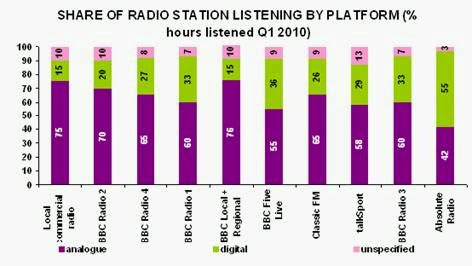
This statement is not merely an exaggeration, it is wholly untrue. The radio industry’s audience data (produced by RAJAR, published by Ofcom for Q1 2010) show that 27% of listening to Radio 4 is via all digital platforms, which include digital television, the internet … and DAB. See graph below.


In-car listening accounts for 19% of total radio usage, but this proportion is likely to be considerably higher during the morning commute period. Because DAB radios are installed in less than 1% of cars, it is probable that much, much less than 27% of listening to the ‘Today’ programme is via DAB.

Ford Ennals’ untruthful statement is only the latest in a long line of disinformation perpetuated by commercial forces that will gain financially from DAB take-up, and which are designed to mislead the public into buying DAB radios.

Yours

Grant Goddard

The Digital Economy Bill: let the horse-trading begin, says Shadow Minister

Ed Vaizey MP for Wantage & Didcot
Conservative Party Shadow Minister for Culture
23 March 2010 @ Imperial War Museum North

In today’s radio industry, brands have been shaped more by scarcity of analogue spectrum than necessarily by the market. Brands have been built as much on the frequencies they occupy as much as the characteristics of their content, and commercial revenues have tended to stay limited to local markets.

We very much support the move to digital switchover, both because we believe it is important obviously to upgrade the technology, but because we also think that it will encourage plurality and expand listener choice. We have got to be concerned that people will be ready before any switchover takes place and that there won’t be literally millions of analogue radios which suddenly become redundant. As you know, the government has set a provisional target date of 2015 and we are sceptical about whether that target can actually be met. That is not to say that we are sceptical about digital switchover. We simply think that 2015 might be too ambitious. But we are delighted to see that Ford Ennals is now chief executive of Digital Radio UK, after having steered digital television switchover so successfully, and we hope that all hurdles can be overcome.

We hope that the advent of new digital stations will bring significant new opportunities for independent radio production and it will also free up commercial radio spend. At the moment, as I understand it, the commercial sector spends nearly 10% of its annual revenue on analogue transmission. In the battle for ratings in the new digital world, we would hope that great programming would be at the forefront and that therefore a good proportion of the £40m annual cost of analogue broadcasting will go to independent radio production.

At the moment, the BBC holds four out of the five available national FM licences, and it has the only national digital multiplex. So the aspiration as we move over to digital is as much about making more space for plurality in radio broadcasting as it is about new technology. And if new stations are broadcast, we hope there is plenty of scope for new exciting radio production.

We are also keen obviously not to switch off FM, but to maintain FM as a spectrum particularly for local radio. As you are probably aware, there has been a lot of lobbying during the passage of the Digital Economy Bill about that. I’m pleased to say, as well, that some of the new technology that seems to be coming on-stream, with radios that can switch seamlessly between digital and FM broadcasts, will ensure that there will still be a place for ultra-local FM broadcast stations.

Obviously, many of you will also be interested in what will happen with the Digital Economy Bill as we approach the dissolution of Parliament. My understanding is that the Second Reading will happen on the 6th of April, which I think is also the date that Gordon Brown drives up the Mall to see the Queen to call for the dissolution of Parliament if he wants an election on the 6th of May […] We will have this rather surreal Second Debate in the House of Commons and then we will go straight into what is now called the ‘wash up’ where we horse-trade over the various clauses of the Digital Economy Bill to be passed by the 8th of April. But I can assure you that the deregulation of radio clauses in the Digital Economy Bill have strong cross-party support so, if anything is going to go through, it will be those clauses.

[…]

Q&A

Q: It’s interesting that you touch on digital radio as a platform going forward. Once we find the larger stations, commercial and the BBC, make the switch to digital, and they leave the FM spectrum, do you feel that the majority of listeners will move to digital radio when they vacate their homes, as most cars don’t come with a DAB receiver, so obviously the commercial sector and the BBC are going to be losing listeners because the majority of times listeners tune in to these station is in the car? Furthermore, with DAB, it’s reported and seen by some people in the media/press as being a failed format, competing with new technologies such as DRM. With these changes, do you think that, when people do make the migration to DAB, that smaller stations are going to lose out and that the money from the commercial side is going to be re-invested in programming and we’re not going to lose the quality of the content…

A: Well, I think the problem in the last few years has been a kind of half-way house, so people weren’t really sure what the future of digital radio was going to be, particularly with commercial radios stations that were having to make a double investment which was costing them a lot of money, so we supported the government in making a firm decision that we were going to move over to digital switchover. As I said in my remarks, I think that 2015 might be a bit ambitious.

Your particular point about converting cars to digital radio is, I think, the crucial point. We have got to get to a stage where new cars are fitted – as the French have now mandated, for example – with digital radios and that it gets easy to convert to digital in the car. I think that 2015 is going to be ambitious, but that does not mean that we are sceptical about switchover.

The other point about FM, as against DAB. I think that there will be… There are radios on sale now that switch seamlessly between FM and digital as if you were simply changing channels. I think that, particularly as FM will then be, broadly speaking, a spectrum used by the local radio stations, that won’t be such a problem if you’ve only got a digital radio in your car, as you tend to listen to a local radio station when you’re at home – or you can de-construct that remark. The point you make about whether DAB is the right technology or whether we should be using DAB+, to a certain extent I slightly take the view that we have gone down this road, so let’s leave it. I think the pain of trying to move to DAB+ or beyond will be too much, given how far we’ve come.

Q: I also found it quite interesting that you had the idea that there were going to be more digital-only services. In the past, we have seen digital services such as Capital Life and Core which have come and now gone again because they were not commercially profitable. Do you think that is not going to have an impact when most people make the migration to DAB? Do you think that the local full-scale FM operators are going to suffer?

A: Er, well, er, I hope that they won’t. There will be a distinction between national or big regional radio stations and local stations, and there is already a distinction between local and community which is ultra-local. As I say, we want to put in place a platform that will also enable cross-media ownership at a local level that will enable local media companies to create scale. So, what I hope is that, across the range of media. there will be opportunities for any good radio station that is likely to command a loyal audience – whether that be an ultra-local audience, a regional audience or a national audience – because, in terms of Capital Radio coming and going, I think that was frankly a symptom of that we were in a half-way house about digital. We need to drive digital, which I think is now underway.

[…]

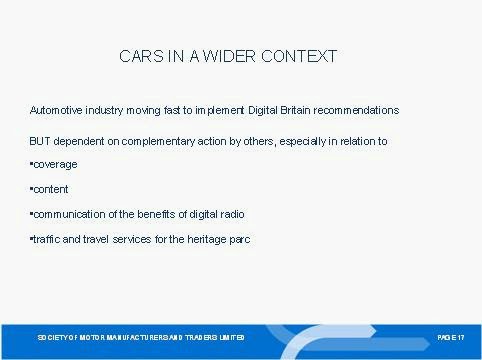
Car industry: “gaps in digital coverage are a major deterrent to [the] introduction of digital radios”

The Society of Motor Manufacturers and Traders [SMMT], representing 500+ companies in the UK car industry, has submitted written evidence to the House of Lords Communications Committee inquiry into digital radio switchover. Its members have itemised a number of concerns about the practicalities of the government proposal that all new cars be offered for sale with DAB radios by 2013:
• “the apparent perception that the markets for in-vehicle radios and domestic radios are similar, if not identical, and that any assumptions about the speed of take up can be applied to both markets
• the timeline for adapting the existing vehicle parc [cars already on the road]
• the continued availability of traffic information after 2015 to those driving vehicles which are not digitally-enabled
• the extent of radio transmitter coverage
• the need for broadcasters to promote the advantages of digital radio to consumers to create demand
• safety and security issues arising from the use of digital convertors
• the need for pan-European approaches to the introduction of digital radios in vehicles.”

The key issue raised by SMMT concerning the necessary robustness of DAB in-car reception across the whole of the UK would require a massive investment from the radio industry to rectify:

“SMMT members are clear that the gaps in digital coverage are a major deterrent to their introduction of digital radios as standard equipment. As outlined [below], any vehicle manufacturer bears the reputational risk if a radio in one of its products appears not to work properly. Drivers have become accustomed to the gradual deterioration in FM reception which occurs throughout parts of the UK and recognise this is not the fault of their radios. At the present stage of digital roll-out, shortcomings tend to be blamed on the vehicle manufacturer.

SMMT members therefore welcome the statements in the [Digital Britain] report that:
• one of the criteria for deciding the date of the Digital Radio Upgrade will be whether national DAB coverage is comparable to FM coverage and that local DAB radio reaches 90% of the population and all major roads
• the BBC should begin an aggressive roll-out of the national multiplex to ensure that its national digital radio services achieve coverage equivalent to FM by 2014.

However, there is also a need for a plan to enable reception on those stretches of road, primarily tunnels and long underpasses, where reception goes ‘dead’ for a short period. At present, for instance, FM coverage in the Dartford Tunnel is addressed by special measures. In shorter tunnels, the FM signal tends to deteriorate but not disappear, whereas the digital signal disappears entirely.

SMMT noted that:

“There appears to be an assumption that the market for in-vehicle radios and that for domestic radios have similar, if not identical, features. In fact, they differ in five main ways:
• in the automotive market, the vehicle itself, not the radio, is the reason for the purchase
• vehicles are required to undergo an approval process which is far lengthier than any applying to consumer goods
• the sizes of the two markets and their dynamics are vastly different, where customers purchase new radios more frequently than they do vehicles
• if a radio in a vehicle fails, or even only appears not to work properly, blame is attached to the vehicle manufacturer, whereas the reputational risk if a domestic radio fails is borne by the radio manufacturer
• in automotive applications, the radio is not static. It moves between transmitters and, therefore, complete and national coverage of the digital radio network will be required.”

SMMT’s concern for new cars is that:

“meeting a deadline of 2013 will be a challenge for vehicle manufacturers who began product development in 2009, but we expect it to be achievable. A bigger challenge is represented by those models already on the market or most of their way through the development cycle, where the manufacturers will have to decide whether to divert engineering resources to the task of digitally-enabling them or provide new vehicles with digital convertors.”

SMMT’s concerns for the cars already on UK roads are:

• “The [Digital Britain] report suggests that the majority of the vehicle parc should be converted to digital by 2015, with low-cost convertors for the remainder.
• Vehicle manufacturers are certain that retrofitting of digital radios on a large scale is impractical. Vehicles’ electronic systems have become increasingly integrated; often, the radio is part of this integration and cannot easily or economically be replaced. A radio has to operate in the vicinity of sensitive electronic components, and poor integration has a detrimental effect on other systems.
• Retrofit also affects the perceived quality of the vehicle:
          *  antennae have to be chosen very carefully – reception from an internal antenna may be poor if a vehicle is fitted with infra-red reflection glass, or if a magnetic antenna base is fitted to an aluminium body
          *  poor refitting of trim items removed to permit a retrofit will cause rattles.
• Drivers will, therefore, be reliant on the use of digital convertors to enable continued use of their analogue radios after 2015. As vehicles have very long lives, most of the vehicles first registered since 2006, if not earlier, will still be in use in 2015. It is likely that over 20 million vehicles will have to be so fitted, and very likely that most of the necessary sales will be made in the few months before the date for digital migration. The commitment for a cost:benefit study to be conducted before any digital migration date is announced is therefore welcomed by vehicle manufacturers because it should firmly identify the progress made towards digitally-enabling the car parc.”

The message from the car industry seems clear – why should they risk their reputations by installing DAB radios that will suffer poor reception due to lack of a robust DAB radio transmission system in the UK?

The bigger question is – why would consumers pay extra for a DAB car radio that offers increasingly little additional mainstream content over a standard FM radio?