Radio in the Digital Economy Bill: House of Lords Second Reading

Digital Economy Bill
2 Dec 2009 @ 1539
Second Reading, House of Lords [excerpts]

The First Secretary of State, Secretary of State for Business, Innovation and Skills and Lord President of the Council (Lord Mandelson):
We have also set out our vision for the future of digital radio, which will see the country shift to digital, when transmission coverage and audience numbers are wide enough, by the end of 2015.

The Lord Bishop of Manchester:
The switchover to digital radio may produce more problems than expected. Of course there is much to welcome in the creation of platforms for new content to meet the needs of specialist audiences. I think, for example, of Premier Christian Radio’s recent acquisition of a national DAB licence. However, there may be much to be concerned about over the plan to cut off national stations and many local services as early as 2015. While the Government have indicated that that will not be finalised until digital services account for 50 per cent of all radio listening and can reach 90 per cent of the population, it is also clear that without an early deadline, sufficient pressure may not build on radio manufacturers and retailers to shift to selling DAB sets only for cars as well as homes. The radio switchover again underlines the risk of creating another two-tier system where significant swathes of the country could lose their favourite national stations from the FM dial, including the BBC stations they pay for through the licence fee. Surely that cannot be right.
What government support will there be for the switchover to digital radio, which is likely to be not only more problematic but, generally, more expensive across the population than the TV switchover has been? Will the Minister accept that over-rushing towards analogue switch-off will not allow proper time for the Government, this House and the other place to think through the unintended consequences? Is there anything that the Government can learn from the German Government’s experience and their postponements of switchover plans?
….. On voluntary supported broadcasting, do the Government intend to keep some of the analogue spectrum going, for example, for hospital radio?
This country must, of course, embrace the opportunities offered by a digital economy, but the advantages must be shared by the widest possible number of citizens. Some, if not all, of the unintended consequences that could unfairly disadvantage people might be avoided by not being trapped in too rigid a timetable. If that happens, I fear that this country will not benefit from the best rewards that a digital economy offers.

Lord Carter of Barnes:
Secondly, in the critical areas of investment, infrastructure, spectrum liberalisation and the digitalisation and deregulation of sound radio, it provides a framework for innovation, development and investment.

Baroness Howe of Idlicote:
My Lords, when the noble Lord, Lord Carter of Barnes, introduced Digital Britain a little while ago we all recognised that things were beginning to happen and there were some very welcome realisations, for example, on the need to move forward with digital radio…….
I welcome those parts of the Bill which incorporate the Digital Britain promise to speed up delivery of a fully operational DAB digital radio platform. I spend a lot of time in cars and have had hearing difficulties since the arrival of my first child, so it is a real pleasure to enjoy the quality and clarity of digital sound, especially when listening to music-whether it is Radio 3 or Classic FM, both of which are excellent stations. The plank for Ofcom to be able either to terminate analogue licences without consent, subject to a minimum two years’ notice, or where appropriate to extend analogue licences up to and beyond switchover, on condition that digital services are also provided, will no doubt help to build in the much-needed flexibility to enable radio switchover. I very much hope and have confidence in the plans that have been outlined that it will happen by 2015. It is important that it does.

Lord Roberts of Llandudno
Today, I looked at the figures for radio listeners in Wales who have ever listened to digital audio broadcasting. I shall not go through the whole list, but in Cardiff, it was 27 per cent, while in the valleys, it was only 4 per cent. That is the difference. The most needy areas will not have the opportunity to benefit from these new high-tech developments. There is a pressing need for an extension of broadband, not least because of the commitment already made by the Government that fibre optic broadband should be prioritised in “notspots”, where other technologies have also failed.

Lord Clement-Jones:
I move on again, to independent radio services. We broadly welcome the provisions for digital switchover. Of course, full switchover will only happen on a specified date if certain criteria for uptake are met, and the only way that one will get further adoption is by setting a firm date. I hope that the Minister will confirm that we are currently working off a 2015 date, but there are concerns among smaller radio stations that the digital multiplex regions that have been defined are too large. Small, local stations will be broadcast across the whole of a large region covered by a multiplex, and may be expected to pay a rental reflecting that. That would be unfair on some of those small stations. Many of them are arguing for DAB Plus, a technology which would be, I believe, much more in tune with their requirements. I would be grateful to hear what the Minister says in that respect.

Lord Howard of Rising:
While we on these Benches support the switch from analogue to digital radio, it is a sensitive area. It would be good if the Government could give some assurances of what criteria will be used to decide when will be the appropriate time for the changeover. Will the Government be guided by the criteria set out in the Digital Britain White Paper, referred to by the right reverend Prelate the Bishop of Manchester? If so, we remain unconvinced that the 2015 target date is realistic and worry that millions of listeners and hundreds of local stations will be disadvantaged.
There are many for whom the digital switchover will cause problems: the elderly or the lonely, who may have had a wireless for many years which has become almost a companion; the blind person who will not be able to work the digital radio because the instructions are on a screen that they will not be able to see. I hope that the Secretary of State can reassure the House that proper care and attention will be paid to the needs of those who will encounter difficulties with the transition.

Lord Davies of Oldham:
The right reverend Prelate the Bishop of Manchester indicated the issues that arise with the digital switchover. I emphasise that we will not make the switchover for radio until there is already 90 per cent coverage in the United Kingdom and until 50 per cent of hours of radio are listened to via digital stations. We have criteria before we actually make the move. This follows on from points about the switch from analogue to digital television. I take on board his point that it is important that any changes that are made benefit people and do not shock them with a possible loss of services and extra cost. That point has to be addressed.

[next stage: House of Lords Committee, 6 January 2010]

Commercial radio and DAB: turkeys voting for Christmas

Significant players in the UK commercial radio industry, along with Digital Radio UK, the Digital Radio Development Bureau, DCMS and Ofcom are all lobbying for DAB receiver take-up to be accelerated and for consumers to migrate their radio listening to DAB as quickly as possible. However, the industry’s own data suggest that the pursuit of these strategies will simply reduce even further commercial radio’s already declining share of radio listening versus the BBC.

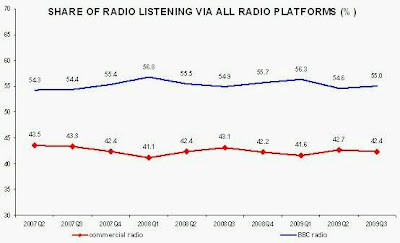
The commercial radio sector’s diminishing success in competing for listeners against the BBC remains one of its most pressing problems. In 1998, commercial radio’s share of listening was 51.1%, but that figure is now down to 42.4% [RAJAR Q2 1998 versus Q3 2009]. Conversely, the BBC’s share has increased from 46.8% to 55.0% over the same period. The long-term decline in commercial radio’s market power looks like this in recent quarters [see graph below]:

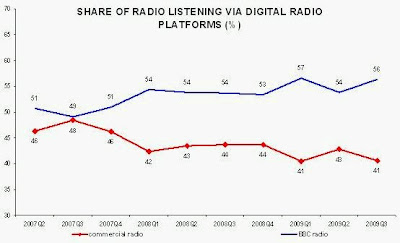
However, if we examine listening solely on digital radio platforms, we see that commercial radio is losing listening share much more sharply [see graph below]. In 2007, commercial radio’s share of listening via digital platforms had been above the average for all platforms and so was ‘helping’ the overall fight against the BBC for market share. However, in two of the last three quarters, commercial radio’s share via digital platforms has been lower than for all platforms, and so is now dragging down the sector’s overall market share.

Worse, with each new quarter, radio listening via digital platforms is growing as a proportion of total radio listening, so that the ‘contribution’ of digital platforms to the overall picture is becoming greater. In Q2 2007 (the earliest point on the timescale of these graphs), digital platforms accounted for only 12.9% of total listening. In the latest quarter, that proportion has increased to 21.1%.

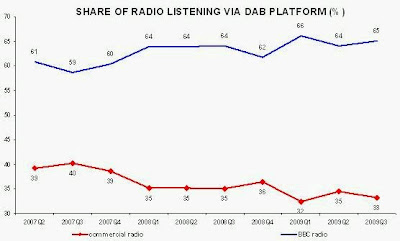
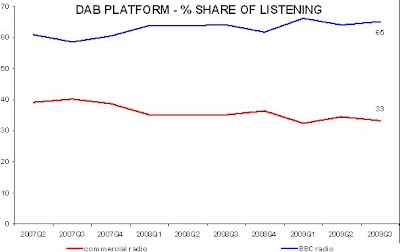
Now, if we extract listening via DAB from the total for all digital platforms, we observe two phenomena [see graph below]. Firstly, commercial radio is badly losing the battle for DAB platform usage to the BBC by a ratio of 1:2. Secondly, commercial radio’s performance on the DAB platform is worsening over time. It is the combination of these two trends which is dragging down not only the commercial sector’s share of digital platforms, but also its overall competitive performance against the BBC.

To make matters worse, DAB is the largest element of radio listening via digital platforms (up from 54.4% in Q2 2007 to 62.9% in Q3 2009 of listening via all digital platforms), and the DAB platform’s contribution to total radio listening is similarly growing (up from 7.0% in Q2 2007 to 13.3% in Q3 2009). DAB is the focus of the radio industry’s digital platform marketing campaigns, so the commercial sector’s current poor performance on this platform is disastrous.

The data suggests that, far from the DAB platform helping the commercial radio sector compete more effectively against the BBC, the absolute opposite holds true:
• The average adult with a newly acquired DAB radio uses it for listening in a way that effectively reduces the commercial radio sector’s overall share of listening versus the BBC
• Acceleration of DAB usage will only serve to accelerate the decline in commercial radio’s share of radio listening versus the BBC.

These outcomes are hardly surprising when one considers industry data which show that:
• DAB radios are purchased predominantly by older people (the average age of a DAB radio receiver owner is 46, according to RAJAR)
• Older people listen to BBC radio much more than to commercial radio (BBC radio accounts for 63% of radio listening amongst over-45s, according to RAJAR).

The paradox is that stakeholders in commercial radio continue to push for DAB to be adopted by consumers as quickly as possible, even though the inevitable outcome will be to reduce further the commercial sector’s listening share, handing the BBC even more of a competitive advantage.

So why exactly does the notion continue to be voiced by significant players in commercial radio that the DAB platform is itself the answer to the sector’s present lack of competitiveness with the BBC?

[Data source: RAJAR. Statistical note: The graphs above to do not sum to 100% because the minimal amount of platform data released by RAJAR is ‘rounded’ (hours listened to 1,000,000 per week; listening shares to 0.1%) and the listening apportioned to the BBC and commercial radio sometimes does not sum to the total for a platform. Part of this shortfall may be accounted for by ‘other’ listening (neither the BBC nor commercial radio) which is not itemised by platform. Data for individual quarters are therefore somewhat inconsistent, though the trend over several quarters is likely to be indicative.]

DAB radio: "let us get on this horse or get off it"

House of Commons Culture, Media & Sport Committee
“The future for local and regional media”
27 October 2009 in the Thatcher Room, Portcullis House

Andrew Harrison, chief executive, RadioCentre
Travis Baxter, managing director, Bauer Radio
Steve Fountain, head of radio, KM Group

[excerpts]

Mr Tom Watson: Can I ask you about Digital Britain and the Digital Britain Report? Do you think the report gave a good way forward for the commercial sector to journey out of its current troubles?

Mr Baxter: Perhaps I could ask Andrew to give an overview on that and then maybe we can give our respective views?

Mr Harrison: To give an overview, I think the short answer to that is “yes”. One of the fundamental issues the sector faces right now is the appalling cost of dual transmission. Ultimately, right now, this is a small sector and very many of our stations are simultaneously paying for the cost of analogue and digital transmission. That clearly does not make any financial sense. What we advocated for in Digital Britain was a pathway for all stations to end up with a very clear plan of what is the single transmission platform for them. That led, as I said in my opening remarks, to three very complementary tiers of the commercial radio offer. The first tier is a strong national offer on digital to compete with the BBC, and that is critical for the sector because the truth is that the FM spectrum is full. I am sure all of you will know from some of the other conversations we have had before that the BBC dominates the gift of analogue spectrum. It has four national FM stations; we only have one with Classic FM. For the sector to compete and capture its share of national advertising revenue, the ability to have a national digital platform I think is critical. As we then had the conversations with Digital Britain, I think it became very clear to all of us that you cannot just migrate national stations to digital and leave all of the large metropolitan local stations, like City in Liverpool for example or Metro in Newcastle, all the BBC’s local stations, as analogue only. The listeners to those stations will want the functionality, experience and benefits that come with digital. It is then very important that we have a second tier of the large local and regional stations which also migrate to digital. Critically, however, that nevertheless leaves an important third tier, which are the smaller or the rural stations for which either DAB coverage is currently not present – there is just not the transmitter build-out in some of the rural areas – or for which it is likely to be prohibitively expensive going forward. That sector equally needs clarity and that sector being able to stay on FM alongside community radio we feel gives a very balanced ecology where the sector has the most opportunity to compete and the lowest cost base because each station can ultimately choose whether it is on one transmission methodology, i.e. digital, or another, analogue. At the moment, we are in limbo where stations are paying for both but the profitability of the sector is fragile and there is not a plan. So we absolutely welcome the beginnings of that plan, which we recognise is the start of what is going to be a long and difficult journey as stations migrate and decide if their future is on digital only or their future is on analogue. The quicker we can move the industry there, clearly the better for the fragile economics of the sector.

Mr Baxter: Perhaps I can encapsulate some of the things we sent in to the Carter Review. Our business view generally is that the future is digital. There is hardly the need for me to make that clear to you. Our view has been for the last ten years that we will look at all platforms as we develop our business. We have successful radio stations, primarily operating for example off the audio channels on the Freeview digital television system. However, within that we think it is of real value for radio to have a bespoke platform and the one that is available to us that is a bespoke broadcast platform is DAB. It has, however, taken 12 to 13 years of very slow development for that platform to get to its current state. Therefore, our proposition to Carter’s Review was: let us get on this horse or get off it. We think we should get on it and put every possible energy we can over the next view years into getting consensus, direction and pace into the whole process of take-up, like there has not been during the last 12 years. If that can be achieved, it will produce a new resonance for commercial radio as a whole, indeed for the whole of radio. It will help position radio more effectively in the fragmenting media landscape we all have to deal with and give us an opportunity, as Andrew said, of clarifying our investment levels around platforms where currently we are having to pay for two when, in a future where either one is successful, we would only have to pay for one, thereby allowing resource to be put into developing content and other things around our business.

Mr Fountain: KM Group does have a digital platform. It is currently costing us over £100,000 a year and we get absolutely nothing back from it. I think the company at the time, six years ago, took the view that they wanted to be a part of the future. Circumstances since have not really helped them to be able to develop that particular medium. I think we too take the view that we would want to be part of a digital platform going forward, but there are a number of issues that would need to be overcome, not least of all the cost of entry and also in our particular case our DAB coverage and the coverage of our FM stations is not mirrored. We have better coverage right now on our FM platforms than we do on our one single DAB coverage. The problem around the coast, if you take that from Medway right the way round perhaps as far down as Rye, around the Kent coast and just touching into Sussex, is such that DAB does not actually reach into large parts of that coastal area.

Mr Watson: Would DAB+?

Mr Fountain: I could not answer that because I do not actually know.

Mr Harrison: No, there is no difference in terms of the coverage for DAB or DAB+. DAB+ is just a different method of compressing the signal so you can actually get more signal down the pipe, if you like; you tend to get more stations, but it does not actually affect the coverage.

Mr Fountain: You can see that in order for us to extend the coverage of DAB, there is clearly a cost involved, and there is also a conversation to be had between Ofcom and the French communication authorities as well.

Mr Watson: Presumably you are all relatively happy with what is quite a demanding timetable outlined in Digital Britain if your view is that we should just get on with it and do it?

Mr Harrison: I think you have expressed it exactly right. The timetable is demanding. I think it is set deliberately as being demanding. Digital Britain does not set a date for switchover. What it sets are two criteria that it says are axiomatic to be hit before switchover can be contemplated: one on listener levels and one on coverage, both of which we support. The aspiration in Digital Britain is to try and hit those two gates, if you like, by the end of 2013. On what Travis was saying earlier on, we think that is absolutely right, that the industry now works terrifically hard together, alongside the BBC and alongside the Government and the regulator to do our very best to hit those criteria. Once we then hit the criteria, the Digital Britain report identifies that it will probably take a couple of years from the criteria being hit before we could actually contemplate switchover. That is aggressive but we think it is appropriately aggressive against the context of an industry that is clearly struggling financially now, and the vast majority of my members are highlighting the cost of dual transmission as the single biggest cost issue that they face and self-evidently one that could be eliminated the quicker we can get to a decision one way or the other.

Mr Watson: May I ask you a bit of a left field question? You are quite confident that we should move to digital radio quite quickly. How confident are you that consumers will want to make that journey and that they will not migrate to internet, radio or choose to listen to live streaming sites like Spotify?

Mr Harrison: There are two different points there. We are quite confident, as you say, about the movement to digital, but purely because what the Digital Britain Report sets up are consumer-led criteria to drive that change. The criteria are absolutely that we will not move until coverage is built out to match FM. It would be absolutely suicidal for the industry to switch people off who currently listen and enjoy radio services, so it is axiomatic that we have to build coverage out. Secondly, the criterion is that listenership to digital has to be that the majority of all listening has to be to digital before you would contemplate switchover. We are not going to rush into this without being led by the consumer. What we are trying to do, as Travis said earlier, is inject some pace, momentum and energy into the process. If we wait for the natural replacement of sets and the natural progression of DAB – it has taken a long time to get to the listener levels we have right now, we still have all of the BBC’s services for example available on analogue – it is going to be very difficult to kick start the progression. We are very comfortable but we are comfortable because it is led by the consumer. The second part of your question is: are we worried about competing services? We are absolutely. I think there is a whole generation of new entrants into the market – Spotify, Last.fm, Pandora – available on-line, all of which are unregulated and against which we are competing for listeners and for advertising revenue. When you have a small, heavily regulated, constrained local radio sector competing with an unregulated world-wide series of music offerings, that is one of the challenges we have to face. We are, however, absolutely committed to the importance of a broadcast transmission methodology for digital. That is not to say that the internet will not be an important complement to that but our business model is based on a broadcast signal of one signal to a wider audience. There is very little evidence so far that on-line music offerings are in themselves profitable business models. For UK citizens and consumers, for our listeners, we think it is absolutely critical that radio remains free at the point of delivery. That has been one of its great strengths ever since the BBC was founded in the 1920s. Of course at the moment, although as I heard this morning the cost of broadband is potentially down to £6 a month, nevertheless, to access any internet-delivered service, you have to pay an ISP connection. That may change but I suspect we are a long way away from that.

[edit]

Mr Watson: Do you think the car industry is sufficiently prepared for the digital revolution?

Mr Baxter: I think we have had some very encouraging conversations with the motor industry over the last six months. The response to Carter’s work during the beginning of this year has helped galvanise interest in that area quite significantly, so I think there is a very different aura around those discussions than there was 12 months ago.

Mr John Whittingdale, Chairman: Just on the cost of the digital upgrade, what is your best estimate of how much it is going to cost?

Mr Harrison: I was on the working party, the Digital Radio Working Group, that was the forerunner for Digital Britain. That working group identified the cost of build-out, the one-off capital cost, as between £100 million and £150 million. That is quite a spread. The reason for the spread ultimately depends on what degree of coverage build-out you get to from equalling FM to universality and at what signal strength. Of course, you get real diminishing returns as you go to the very rural areas. That is the reason for the spread. There has been a lot of debate about that number. In reality, the way we have tended to look at it is that if you take that spread of £100-£150 million over the 12 year period of a licence, which is typically when a radio station is licensed or a multiplex is licensed, and if you said for round figures it is £120 million, that is £10 million a year for the licence period. I think it was £10 million a year that the Secretary of State quoted for example last week. Funding that we have always felt is actually absolutely critical to the build-out and conversation to Digital Britain. The commercial sector is absolutely happy to pay its way to the extent that the build-out is commercially viable but, after that, there is a clear public policy imperative. If the Government and Parliament decide that it is important to have a dedicated transmission structure for radio, that will be a public policy decision and it will need funding. That said, we believe that funding is very affordable. If you take that £100 million number, we believe that, for example, the BBC would save much more than that over the period of the 12-year licence just on what it will save on FM transmission alone, so there is a straightforward business proposition. Another way to think about the £100 million over a 12-year licence with the current Licence Fee settlement for the BBC at around about £3.5-£3.6 billion a year is that over 12 years that is £43 billion. The £100 million infrastructure cost for DAB radio is less than a quarter of one per cent of what the BBC’s income will likely be over the next 12 years. So it is eminently affordable if there is a public policy decision that it is important to do that build-out.

Chairman: Those two arguments suggest that you are looking for the BBC to pay for this.

Mr Harrison: We have said very clearly and very fairly that we are absolutely happy to pay our fair share in our way to what is commercially viable.

Chairman: What does that mean?

Mr Harrison: That means that we have already put our hands in our pockets substantially to build out coverage on a local and a national basis as far as we judge is affordable. I think realistically, given the state of the sector, the vast majority of the cost going forward, which is primarily designed to meet the BBC’s obligations of universality rather than the commercial sector’s obligations of viability, should rest with the BBC.

Chairman: So whilst RadioCentre is keen to move ahead with the digital upgrade, the economics of your sector at the moment means that you cannot really afford to put any more money into it?

Mr Harrison: We believe that transmission coverage build-out is axiomatic; it is one of the criteria to effect switchover. We cannot afford it but we absolutely believe the BBC can.

Philip Davies: Andrew, on this part can I ask you about how representative your view is of the industry as a whole? It was over this issue it seems more than any other that UTV Radio quit the RadioCentre and said that it felt that it was no longer representing the interests of the wider industry and gave too much power to its biggest member.

Mr Harrison: Yes, UTV did say that. Scott Taunton, the UTV Radio managing director, actually represented the commercial radio industry with me on the Digital Radio Working Group through all the per-work that was done for Digital Britain, and so they have been intimately involved. To be fair to UTV’s position, they have a particular reservation over the date and the timing for digital, but to be fair to the Digital Britain Report, and indeed we await the clauses of any potential Bill because it is not yet written, there has never been a formal switchover date actually agreed. Although, for example, I think Scott in his Guardian article yesterday talked about a 2015 date being farcical, that date has never been set. What have been set are two consumer-led criteria that have to be hit and then a transition period after that before we all migrate. As Travis said earlier, the majority of opinion across the sector, and certainly across my members and representing my board, is that we need now to put our foot on the gas and work hard to deliver the criteria. Inevitably, there is going to be a spectrum of views with different businesses in different places in terms of their own business models as to the urgency or not they see behind that. UTV are absolutely right to have their own position. They are more at the tail end of the timing.

Philip Davies: UTV did not just say that they had a different position to you. They said something a bit more fundamental than that that they felt that you were no longer representing the interests of the wider industry. It was not just as if they had a disagreement. They were indicating that there were others in the sector who shared their view. Do you accept that there are many others or some others in the sector that would share their view?

Mr Harrison: I would absolutely accept that we are a broad church and there is a breadth of opinion. I represent large and small stations, local and national, rural and metropolitan, so there is a breadth of opinion. To give you an example of that, our other major national station member that is on AM is Absolute Radio and they believe that the timing for digital should be sooner rather than later. They already have over 50% of their listening on digital platforms, one way or another, so they would move sooner. I have a number of digital-only stations in membership, stations like Jazz and Planet Rock, which clearly are already digital-only and would like to be in the vanguard. Inevitably, there is a spectrum of opinion and we try our best to reflect the overall views. The truth is that it is very unfortunate that UTV have left membership but we continue to represent the vast majority of the sector and its stations and will continue to try to steer a path, helping Government and helping the regulator through this tension.

Digital Radio Upgrade & the Digital Economy Bill

Westminster eForum Parliamentary Reception
Terrace Pavilion, House of Commons, London
28 October 2009 @ 1600

“The informal discussion that takes place can be expected to cross a range of current policy issues but the chosen theme is digital switchover and DAB.”

JOHN WHITTINGDALE MP, Chairman, House of Commons Culture, Media & Sport Select Committee:

The future of radio is very much a topic under debate. My Select Committee is currently conducting an inquiry into the future of local and regional media, of which radio is an absolutely critical part. So yesterday we were hearing evidence from Andrew Harrison of RadioCentre, Travis Baxter [of Bauer Media] who is here somewhere today, and Steve Fountain from KM Group. And we are very much aware of the pressures on commercial radio and the difficulties faced. But, at the same time, there are opportunities. And when Digital Britain came out, much of it had been trailed in advance, a lot of it quite controversial – things like top-slicing and file-sharing legislation – but the one bit which came as something of a surprise, I think, was the announcement of the date for Digital Radio Upgrade. Certainly, when I saw that in the Report, my immediate reaction was rather like the ‘Yes Minister’ Permanent Secretary who said: “That is a very brave decision, Minister”.

It is going to be challenging. It is slightly controversial. Not everybody in the industry is 100% yet signed up to it. Equally, there is a cost attached and we can have interesting debates about who is going to pick up the bill for it. And there will be quite a task to persuade people. In the same way that we had to work hard to persuade people that analogue switch-off of television was going to be beneficial, I think the task to persuade people in the case of radio is going to be even greater, particularly whilst we still have the overwhelming majority of cars with analogue radios in them. So there are challenges, but equally there are going to be benefits.

We heard yesterday about the costs to radio of having to transmit simultaneously in both analogue and digital and, clearly, that is something which would be reduced if we managed to get switchover. So this is a very important debate and I am keen that, when we come to debate the Digital Economy Bill when it is introduced, we should not overlook radio. There is always a danger that everybody focuses on television and there will be a huge argument about whether or not the BBC should be the exclusive recipient of the Licence Fee, and whether or not we should be trying to stop teenagers in bedrooms file-sharing, but it is important we should also debate radio and, certainly, that is something which I will try and do my best to ensure happens. But I think this afternoon is a good start to that and it is good to see so many people from the industry assembled in one room. So that’s enough from me, just to say welcome to the reception this afternoon …..

PAUL EATON, Head of Radio, Arqiva:

I would like to welcome you all as well on behalf of Arqiva and Digital Radio UK. Arqiva is part of Digital Radio UK, with the BBC and commercial radio, and I am very pleased to be joined today by Andrew Harrison, chief executive of RadioCentre, and Tim Davie, director of Audio & Music at the BBC.

Digital Radio UK has been formed by the radio industry to get the UK ready for the Digital Radio Upgrade. That upgrade is vital because radio faces a stark choice – we can either stay in the analogue world or we can move forward into the digital one. Both need considerable investment from all of the players but only one, digital, can give radio that exciting future that listeners deserve. Digital radio will mean more choice, a better quality listening experience and the kind of interactivity that we can only dream about today.

We all know that the road ahead is a difficult one. We know that the coverage is not good enough yet, we know that we haven’t got digital radio in enough cars, and we know that we need to get converters onto the market to turn analogue radios into digital ones – set-top boxes for radio, if you like. We know that there is new content and new services that need to go digital. So there’s a lot to do. But, in creating Digital Radio UK, the radio industry is demonstrating that it is serious about the digital future and is determined to address the issues and, in doing so, give the digital future that listeners deserve.….

SIMON MAYO, Presenter, BBC Five Live:

I had one of those “blimey, you’re old” moments this morning. I was talking about radio with my son – my eldest son is eighteen – and I asked him what he listened to and what his friends listen to. He thought for a moment and then he said “none of my friends have got a radio”. I thought that was quite an astonishing moment. Now, obviously, he is an unrepresentative sample of one, that is true. They kind of know about radio and they might listen online, and it’s on in the kitchen and they hear it in the car and they have an opinion of [BBC Radio One breakfast presenter] Chris Moyles, but that was it. It occurred to me that, really, radio has got a bit of a fight on its hands, which is where the kit here [points to display of DAB radio receivers] comes in, I think.

My parents’ generation didn’t need to be told that radio was fantastic. My father, if he was here, would talk about listening to Richard Dimbleby and Wynford Vaughan-Thomas and The Goons. The Goons generation didn’t need to be told that radio was great. The 60s generation didn’t need to be told that radio was great – they had the pirates, then they had Radio One. My generation fell asleep listening to the Radio Luxembourg Top 40 on a Tuesday night. It finished at 11 o’clock and that was quite daring – I see a few people nodding. That was quite daring staying up to 11 o’clock, and the fact that is was sponsored by Peter Stuyvesant cigarettes was even more dangerous. But we remembered it and we fell in love with radio, and I think there is a job to be done to make future generations fall in love with radio.

So enter digital. Partly that has to be done by the broadcasters in coming up with exciting new stations filling gaps that don’t exist. BBC7 is wonderful. Everybody will have their own particular favourites. Absolute Classic Rock is really rather good. If you want Supertramp and Led Zeppelin any time of the day, that’s the place to go. Really good stuff. There are some really big gaps that need to be filled, but that’s exciting. Analogue is full, so digital is the place to be.

But the kit is really exciting. If you have a radio when you are listening to a piece of music …. and you’re listening to the radio and an Angelic Upstarts track comes on, you press a button and it sends you an e-mail that tells you that they have reformed, you can buy their records and this is where they are playing. Or someone is listening to ‘Yesterday In Parliament’ and they hear a speech from a parliamentarian that they like, and they think “he’s interesting, she’s interesting”, press a button, you get sent an e-mail and it tells you who it is, how you can contact them – this sounds quite exciting. If you are listening to one of [presenter] Mark Kermode’s film reviews on Five Live, and you like the sound of the film, you press a button, and its sends you an e-mail, you go to your in-box and it’s got an e-mail telling you where that film is on, how you can go to see it, maybe a link to the trailer. All of that kind of information means that radio has got an exciting future, but it just means that we have to go out and explain it a bit more because people might not get it the way they used to.

Hopefully, there is still a role for the humble presenter. So you do a little bit as well. Thank you very much indeed for coming…..

[A Digital Radio UK factsheet entitled “A briefing on the digital radio upgrade” was distributed at the event. Click here to view.]

Digital platforms: commercial radio losing share to BBC

Today’s RAJAR data demonstrates that a gulf is opening up between BBC radio and commercial radio in their ability to attract listening to digital platforms. Over the last year, the BBC is accelerating away from commercial radio in its audience’s usage of DAB, digital television and the internet to listen to live radio programmes. The significance of this growing gulf is reinforced when one remembers that the main RAJAR survey, from which the data below is taken, only measures ‘live’ radio listening and does not incorporate listening to either time-shifted, on-demand radio (‘listen again’) or to downloaded podcasts, both forms in which the BBC offers a much greater volume of content than UK commercial radio.

The danger here is that the BBC is poised to dominate listening on digital radio platforms in the long term, exactly as it already dominates listening on analogue radio platforms. One of the main reasons that the commercial radio sector invested so heavily in digital platforms during the last decade was the opportunity it offered to compete more effectively with the BBC for audiences. In the analogue world, the commercial sector has always argued that the BBC (having been there first) was allocated more and better spectrum for its radio stations. ‘Digital’, particularly DAB, seemed to offer the commercial sector a chance to ‘even the score’ with the BBC. The RAJAR data show that this ambition is not succeeding.

Across all digital platforms aggregated, commercial radio is losing ground, with the latest quarter (Q3 2009) reducing its share of listening to 41%, versus the BBC’s 56% share.

Taking each digital platform in turn, commercial radio’s share of listening on the DAB platform fell to 33% in Q3 2009, compared to the BBC’s 65%. This is not surprising because the age profile of DAB purchasers tends to be older listeners who are statistically more likely to listen to BBC stations. However, it does pose a grave question as to the return that commercial radio can expect from its substantial investment to date in DAB infrastructure, if listening on that platform is dominated so much by the BBC.

The digital TV platform is one that commercial radio has long dominated because of the large amount of spectrum it leased in the early days of Freeview. However, the increasing popularity of digital terrestrial television has already substantially increased the cost of spectrum on Freeview for the radio industry when its contracts come up for renewal. Furthermore, the forthcoming re-ordering of the multiplexes to accommodate HD television and new compression codecs is likely to squeeze commercial radio’s access to Freeview spectrum even more so. Before long, it is likely that the BBC will dominate the digital TV platform, just as it already does on DAB. Presently, the BBC has a 45% share, compared to commercial radio’s 51%.

As might be expected, the BBC’s strong online presence has already put it in the commanding position in terms of its share of listening via the internet platform. The integration of BBC radio into the iPlayer has no doubt helped as well, whereas commercial radio’s offerings are relatively more fractured and less heavily marketed, despite the excellent innovation of the RadioCentre Player. The BBC has a 50% share of listening on the internet platform, compared to commercial radio’s 37%.

The significance of commercial radio’s diminishing share of these three digital platforms is demonstrated when we look at the two sectors’ listening shares achieved on the analogue platform alone. Once one removes the digital platforms from the picture, it is evident that the shares of both the BBC and commercial radio have remained relatively stable in recent years. In other words, it is commercial radio’s declining share of listening on digital platforms that is effectively pulling the sector’s total share of listening (analogue + digital) down, particularly as digital platforms are growing as a proportion of total radio listening (21.1% in Q3 2009).

There is a paradox here. The commercial sector invested heavily in the DAB platform, believing that the new technologies would help it INCREASE its overall share of radio listening versus the BBC. In fact, that investment has recently helped to DIMINISH commercial radio’s overall share of listening. Digital television remains the only platform in which commercial radio dominates, and yet this is the very platform where commercial radio will be forced to cede spectrum and face, once more, losing out to the BBC whose spectrum for radio is guaranteed.

It is important to emphasise that these graphs show only the SHARE of listening on these platforms. The volumes of listening on each of these platforms have demonstrated absolute growth for both commercial radio and for the BBC over the same time period. But, more than any other digital platform, it is significant that the DAB platform is dominated by the BBC which now accounts for almost two-thirds of its usage. Such data is important when making decisions about the potential returns on further investments in DAB infrastructure. Will further investment simply maintain the existing imbalance, or will it really improve commercial radio’s share? Does investment in infrastructure also require parallel investment in new content that will appeal directly to the older age groups who own DAB radios?

Some possible reasons for commercial radio’s diminishing share of listening on digital platforms include:

• Commercial radio’s tendency to invest in DAB infrastructure more significantly than in original digital-only content
• Recent closures of many digital-only radio stations in the commercial sector
• The BBC’s relatively stable resource base, at a time when commercial radio revenues are falling precipitously
• The BBC’s long-held policy to invest simultaneously in multiple platforms, whereas commercial radio has focused on DAB and, to a lesser extent, Freeview
• The BBC’s focus on creating exclusive digital-only content unavailable on the analogue platform
• The BBC’s 360-degree music royalty agreements which allow it to use diverse platforms, whereas commercial radio requires separate (and more restrictive) agreements for time-shifted content and podcasts
• The BBC’s long-term, consistent promotion of content and digital platforms across TV, radio and the internet whereas commercial radio is less willing to cross-promote content or digital platforms that migrate listeners away from its core analogue offerings
• Frequent management changes and ownership changes in some parts of commercial radio, where substantial consolidation has often translated into short-term ‘slash and burn’ rather than ‘invest and build’ policies.

Whatever the reasons, we are not where we were meant to be – that is, we are not where it had been anticipated more than a decade ago commercial radio would be when investment in digital platforms, notably DAB, was expected to produce a beneficial outcome for commercial radio audiences versus the BBC. To put it plainly, the strategy conceived in the 1990’s has not worked. Commercial radio offerings do not dominate digital platforms (yes, they are more numerous, but they do not attract more hours listened than the BBC). DAB has become a largely BBC platform.

So, what can be done? Some of the issues noted above require a more level playing field to be established between commercial radio and the BBC. One such example of a practical solution is the Radio Council plan for a new UK Radio Player that will offer BBC and commercial radio content from a single aggregated access point. Other issues remain mostly in the lap of the gods (revenues, for example). Some issues require the BBC to be less predatory (or more regulated) and for the commercial sector to be more focused on strategic, long-term objectives (such as an online strategy that is more than simulcasting).

There is no single answer to this complex problem, though the commercial radio sector is hobbled by both its present lack of profitability and the regulatory strings that are attached to the majority of its analogue radio licences. What is desperately needed in these difficult times is not minor regulatory tinkering (such as adjusting how many hours of local content a local station is required to broadcast) but a wholesale change in strategy to maintain a commercial radio sector that can thrive in the digital marketplace we now inhabit. Will the imminent Digital Economy Bill prove sufficiently forward-thinking in its radio policy proposals?

[Statistical note: The graphs above to do not sum to 100% because the minimal amount of platform data released by RAJAR is ‘rounded’ (hours listened to 1,000,000; listening shares to 0.1%) and the listening apportioned to the BBC and commercial radio sometimes does not add up to the total for a platform. Some of this shortfall may be accounted for by ‘other’ listening (neither the BBC nor commercial radio) which is not itemised by platform. Data for individual quarters are therefore somewhat inconsistent, though the trend over several quarters is likely to be indicative. Additionally, there is an element of radio listening unattributed to any platform, 12.8% of the total in Q3 2009, but which is roughly equally applicable to BBC radio and commercial radio.]

Funding DAB radio infrastructure upgrade: still 'no'

The Media Show, BBC Radio 4, 2 September 2009 @ 1330

Steve Hewlett interviewed Tim Davie, Director of BBC Audio & Music

We talked at the Radio Festival a few months ago and you talked a lot about DAB. The criteria have been stated now for moving forward to switchover, or before anyone contemplates switching off the analogue FM signal, of 50% of listening and 90%+ of coverage. Do you think that’s realistic by 2015?

I use the word ‘ambitious’ and I mean it. I think it’s tough. It is possible. I think the radio industry to date has shown an incremental path towards digital and, unless you get a big step change, you’ll never get there. And, to be fair, the BBC has driven this harder than anyone.

When we last spoke about it, there was a discussion of £100m or so being needed to pay for the rollout of not the BBC stuff but whatever is necessary for the commercial sector to go digital. At that time, I asked you specifically whether there was any money in your budget identified for that purpose and you said ‘no’. Has anything changed since we last spoke?

It’s another ‘no’. No, nothing has changed and until the plan ….

This is not going to happen, is it?

I think that radio will move to digital, and I think that ….

Will it be DAB?

I think at this point, it will be …. I believe in DAB. I say ‘at this point’ because I think we have hurdles to jump over.

Predicting the radio present, twenty years ago

Whilst looking for some information about the changes wrought by the Broadcasting Act 1990, I happened to find some old press cuttings from that time. What follows are some predictions for the 1990s UK radio industry that I had written in the February 1990 edition of “For The Record” magazine:

RADIO ONE continues to feel the winds of change instituted by the new Head of Music Roger Lewis and a team of younger presenters. It promotes and programmes itself more aggressively now and will continue to lead the way where commercial stations only follow. In the 1990s, it will sever entirely the relationship between its playlist and the current Top 75, thus sounding the death knell for the single as a commercial proposition.

NEEDLETIME RESTRICTIONS, which have held back developments in music radio for so long, will be legislated away, though not without a spirited fight by the record companies. As a result, all-music stations will become the norm in the commercial sector, leaving the BBC as the only producer of serious speech programmes.

MORE STATIONS will fracture the radio market into lots of small pieces, losing forever the kind of huge audiences attracted by the Sunday chart show or “Our Tune”. Record retailers will have to react by stocking a wider range of album releases and developing their specialist sections (a reversal of the 80s trend towards narrower stock). The album chart will increasingly reflect the sum of different sets of fans’ interests, rather than a common pop denominator.

OWNERSHIP of radio will narrow to a handful of large companies, despite the increased number of stations. The 80s saw radio shares treated as profitable propositions for the first time. The existing big boys (Capital Radio, Crown Communications, Trans World Communications) will continue to buy up anything and everything. Publishers (Associated Press, EMAP) will enter the fray, and TV companies will seek lateral integration with radio as a hedge against loss of their franchises. For the first time, radio shares will become an essential part of a media portfolio and change hands rapidly at inflated prices.

FM RADIO will reign supreme. Listeners will remember “medium wave” with the quaint fondness our grandparents reserve for “cats’ whiskers”. Push-button, auto-locate receivers become standard, timeshift recorders are introduced, knob-twiddling disappears, and listeners channel hop endlessly in search of the perfect beat.

SYNDICATED PROGRAMMES already enable David Hamilton to sound as if he works for your very own local station when he is really sat in a London studio. The development of whole syndicated networks in the 1990s means that your favourite rock station in Leeds is actually originated in New York and plays exactly the same records as WLUP Philadelphia.

DISC JOCKEYS will lose their aura as media stars and lose lucrative careers opening supermarkets, hosting TV shows or making their own hit records. Being a radio presenter will carry as much kudos as being a tax inspector.

SHOCK RADIO develops a huge cult following amongst young people, whilst deplored by their parents. The Radio Authority is belatedly forced to curb the phenomenon by introducing a largely ignored “Code of Presentation Conduct”. James Whale makes a film of his life story.

In the December 1989 edition of “For The Record”, I had written:

Asked whether the public service obligations in commercial radio would be abandoned completely, Lord Chalfont [newly appointed chairman of the newly created Radio Authority] has expressed hope that the Broadcasting Act would allow stations to continue with such commitments if they so wished. He added that, in his recent discussions with various MDs of local stations, they had expressed their avowed intent to maintain public service elements. This is a little like a headmaster hearing his class of fourth-formers promise never to drop litter, to always help old ladies across busy roads, and to keep their school uniforms on until they get home.

The issue of public service commitments in radio is important not just from a theoretical point of view, but because it directly affects the listener’s choice. We’re talking about the very things that should differentiate stations from each other.

At the bottom line, commercial radio does not exist to “satisfy” its listeners. It exists to deliver the largest targeted audience possible to the advertisers who pay money to do so. Listeners’ broadcasting needs are irrelevant to the stations’ profitability.

The cheapest form of radio programming is the continual play of well-known pop records linked by young local DJs who aspire to be Tony Blackburn – anything more fanciful than that costs more money and reduces the profit margin. So, in the brave new world where commercial radio is regulated by a “lighter touch”, the cheapest programming appealing to the lowest denominator audience wins hands down. Out go the rock shows, the folk shows, the local band slots and the ethnic language programmes that were necessary to comply with the IBA’s policy of serving all sections of the audience. Out goes anything but a token commitment to local news coverage, information services, off-air activities and social action broadcasting.

Independent Local Radio will increasingly have little that is either “independent” or “local” about it. If a bomb drops on your town at two in the morning, the one place you won’t hear about it is on your local station (unless the story makes the national news). They’ll simply carry on soothing you through the night – probably with a service beamed by satellite from London. ….

We’ll all get to hear more radio in the 1990s. But there are no guarantees to be seen so far that it will be any better for the consumer in its content.

Destroying BBC Radio One: it's the same old song

Interviewed for an article in The Sunday Times headlined ‘We’ll sell off Radio 1, say Tories’, Tory shadow broadcasting minister Ed Vaizey said: “Radio 1 is not fulfilling its obligation to its audience. Its median age is those in their thirties when it should aim much more at teenagers and [those in] their twenties. There is then a good argument for the BBC to be rid of Radio 1 and give the commercial sector a chance to use the frequency.”

After attending St Paul’s School and Merton College, Oxford, Vaizey (son of the late Lord Vaizey) worked for the Conservative Party’s Research Department for two years, before training and practising as a barrister. He writes a column for Tatler magazine.

——————–

Poor old Radio 1 is continually misunderstood by the big wigs who never listen to it, but who perpetually want to destroy the appeal of the UK’s only national pop channel. They fail to appreciate that the station is far more than ‘undistinguished Top 40’ radio, as The Sunday Times described it last week.

In its 1986 report on the future of the BBC, the Peacock Committee similarly felt that Radio 1 ‘did not provide a public service in the sense that Radios 3 and 4 very conspicuously do’. More cultural bigots talking rot.

Outside of London, commercial radio stations are as conservative in their choice of pop music as a local church disco. Radio 1 is the only medium to consistently expose new songs, new songwriters and new artists. Where it leads, commercial stations follow like sheep.

Despite no British artist or record company ever being awarded a Queen’s Award for Industry, pop music is undeniably one of this country’s most lucrative exports. Yet subsidies are unheard of for up-and-coming talent to write, record or perform.

Classical music, opera, dance, film, theatre and even jazz are handed untold state grants from so-called ‘arts’ bodies, yet pop music receives nothing. Radio 1 is the closest this country has to a public gallery for new musical talent that would otherwise remain completely unheard. And it manages to attract the biggest radio audience.

As Paul Gambaccini puts it, ‘Radio 1’s strongest claim to legitimacy is that it is the Radio 3 of popular music.’ Even ex-BBC boss Alisdair Milne understands that Radio 1 ‘does things the commercial sector would never do. It has a strong commitment to the creation of new pop music.’ ….. So why are the top cats so determined to destroy the BBC’s most valued asset?

Grant Goddard
City Limits magazine #571, London [excerpt]
17-24 September 1992

Digital radio switchover: 'you can't move faster than the British public want you to move'

Feedback, BBC Radio 4, 31 July 2009 @ 1330

Sir Michael Lyons, chairman of the BBC Trust, interviewed by Roger Bolton and listeners:

[Do you think the principle of moving across to DAB is a good one?]

The BBC has been a strong supporter of digital radio, believing that it will actually offer an improved service, and …

[Improved in what way? The quality of the existing services will be made better? Or it allows you to provide a range of other services as well?]

I think both. But, of course, you only satisfy the first of those two tests when you’ve actually got the same sort of coverage [on DAB] that you’ve got on FM. And indeed, it’s important to say that the BBC has already picked up what commercial radio was going to do in terms of more investment to get to 90% of the population, and that will be achieved by 2011. But I think we’re going to go on to the question of ‘[FM] switch-off’ because actually that’s a different issue altogether ….

[Well, one of the key things of public service is universal access and, clearly, a lot of people are saying [that] until 2015 there won’t be one because, unlike a television set, perhaps we’ve got five or six radios around the house and a different radio in the car. And are you telling us we are going to have to buy five or six new radios and a new radio for the car in order to listen to something we might not want in the first place? That’s the argument.]

Well, let me underline that I’m not saying that. That’s actually in the government’s Green Paper – they propose a date of 2015. The Trust is very clear actually. Who comes first in this? Audiences and the people you pay the Licence Fee. It is an extraordinarily ambitious suggestion, as colleagues have referred to, that by 2015 we will all be ready for this. So you can’t move faster than the British public want you to move on any issue. So there’s no doubt that 2015 looks challenging.

[Chairman, are you prepared to say, on behalf of the listeners, to the government, whichever government is in power, if they are insistent in pushing this through and you believe that listeners will be significantly disadvantaged, are you prepared to say ‘no, the BBC can’t go along with this’?]

Well, as things stand at the moment, [in] the Digital Britain report, it seems that the BBC will find the money for this final stage, so there are serious discussions to be had about how it’s going to be funded, as well as whether actually 2015 is in any way a realistic timescale. Now, what I can say now, is that those have already formed part of our discussion with Ministers and will continue to form part of our discussions with Ministers.

[But, to repeat my question, are you prepared to say at some point, or countenance saying, to a Minister ‘no, we can’t go along with this because, in doing so, we will provide a disservice to our listeners’?]

Well, I think I’ve said as much I need to say today …..

[…. as a diplomatic chairman …..]

…. and also, you know, it’s very important that I don’t try and conduct any discussion I’m having with Ministers over the air.

DAB radio in Germany: further public funding rejected

The organisation that funds public radio in Germany has rejected a request for €30m from state broadcasters to develop DAB broadcasting between 2009 and 2012, and has rejected an additional request for €12m to fund digital switchover. Following its meeting on 15 July, KEF announced that the funds for DAB development “will not be released because substantial elements of the criteria agreed previously with broadcasters had not been met and the viability of the projects could not be demonstrated.” According to Follow The Media, which broke the story online today, more than €200m of public money has already been spent developing DAB broadcasting in Germany.

In April 2008, twelve criteria had been agreed between KEF and the broadcasters that would need to be met for funds to be released for digital radio projects:
· Concrete agreements from public and private broadcasters to launch digital radio services, with a rollout plan
· Statements regarding the content of these digital radio services and their value to listeners as a nationwide offering, compared to existing FM stations
· Plans for added value services, such as Visual Radio, TPEG traffic data and podcasts
· Evidence of the extent of DAB usage, both in Germany and abroad
· Statements from manufacturers regarding their DAB radio receivers, delivery dates and retail prices
· Statements on the future of FM broadcasting
· Statements on the marketing strategy and necessary budgets for DAB
· Plans for the development of DAB broadcast infrastructure in metropolitan areas and their service quality
· Total costs of the proposed projects
· Implementation time of the proposed projects
· Milestones to be met in the implementation of the project, with KEF auditing their achievement
· Compliance with the KEF checklist and responses to additional KEF questions

At its meeting last week, KEF decided that “the criteria had still largely not been met”. A forecast of the total cost of implementing DAB in Germany was not offered to KEF, although transmission costs for the period 2009 to 2020 were estimated by state radio to be €163.6m. However, KEF was told that FM radio broadcasts could not be ended until digital platforms accounted for 90% of radio listening, which was anticipated by 2020. The public radio companies expected to make a further application to KEF for funds of approximately €300m to complete the switchover from FM to DAB beyond 2012.

The earlier decision by Germany’s private radio sector not to invest further funds in DAB development weighed heavily on the KEF decision, as it concluded that FM switch-off would be “unthinkable” without the participation of commercial radio in the DAB platform. KEF also made it clear that the financial savings anticipated from the ending of FM/DAB dual transmission were a pre-requisite for further investment in DAB, as was “a minimum diversity of programme offerings significantly above those currently offered on FM”.

Follow The Media reported: “There must be no more time wasted with this project now,” said media spokesperson Thomas Jarzombek of the CDU party in North Rhine-Westphalia to Wolbeck-Münster (July 17). “Instead, all the resources are now directed to the internet. …. After the exit of private radio stations and the rejection by the KEF, digital radio on DAB+ died.”