Digital radio station listening: a blip in time saves 6?

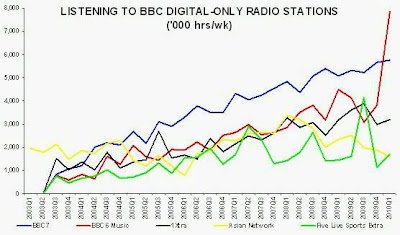
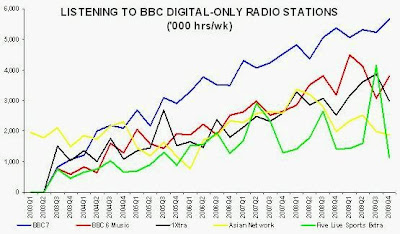
The dramatic upswing in BBC 6 Music’s listening during the first quarter of 2010 did not appear to have a knock-on effect on the BBC’s other digital stations [see graph]. 1Xtra was up slightly but still lower than it was in 2009. Asian Network dropped further and is now listened to less than part-time station Five Live Sports Extra.

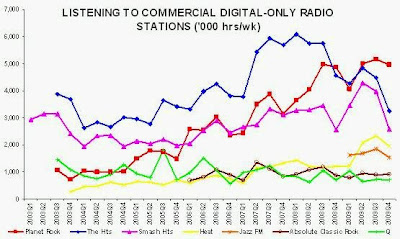
In the commercial radio sector, Planet Rock recorded its best quarter yet and cemented its lead over all its digital-only competitors (BBC 6 Music excepted) [see graph]. Its continuing success only confirms that consumers prefer real programme content to the digital music jukeboxes whose performances are little more than limping along.

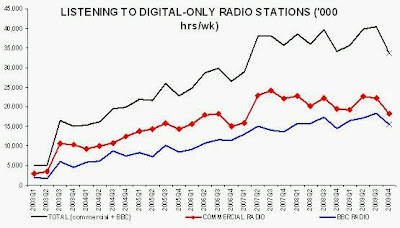
Even with this most recent quarter’s boost from BBC 6 Music and Planet Rock, total listening to digital-only stations has still shown almost no growth for three years [see graph]. Without the coincidence of those two successes, the latest quarter would have proven another disaster.

The question is what the next quarter will look like. We have seen listening to BBC 6 Music rise temporarily before at times when the channel has been in the press. Attracting listeners is only half the job. Keeping listeners is the much harder part.

Does the BBC 6 Music listening blip change the bleak outlook for digital radio stations? Not at all. Why? Because, even after this sudden upswing, 6 Music still attracts only two-thirds of the volume of listening to Radio 3, the BBC’s least listened to analogue national network. 207% of almost nothing still equals very little.

Car industry: “gaps in digital coverage are a major deterrent to [the] introduction of digital radios”

The Society of Motor Manufacturers and Traders [SMMT], representing 500+ companies in the UK car industry, has submitted written evidence to the House of Lords Communications Committee inquiry into digital radio switchover. Its members have itemised a number of concerns about the practicalities of the government proposal that all new cars be offered for sale with DAB radios by 2013:
• “the apparent perception that the markets for in-vehicle radios and domestic radios are similar, if not identical, and that any assumptions about the speed of take up can be applied to both markets
• the timeline for adapting the existing vehicle parc [cars already on the road]
• the continued availability of traffic information after 2015 to those driving vehicles which are not digitally-enabled
• the extent of radio transmitter coverage
• the need for broadcasters to promote the advantages of digital radio to consumers to create demand
• safety and security issues arising from the use of digital convertors
• the need for pan-European approaches to the introduction of digital radios in vehicles.”

The key issue raised by SMMT concerning the necessary robustness of DAB in-car reception across the whole of the UK would require a massive investment from the radio industry to rectify:

“SMMT members are clear that the gaps in digital coverage are a major deterrent to their introduction of digital radios as standard equipment. As outlined [below], any vehicle manufacturer bears the reputational risk if a radio in one of its products appears not to work properly. Drivers have become accustomed to the gradual deterioration in FM reception which occurs throughout parts of the UK and recognise this is not the fault of their radios. At the present stage of digital roll-out, shortcomings tend to be blamed on the vehicle manufacturer.

SMMT members therefore welcome the statements in the [Digital Britain] report that:
• one of the criteria for deciding the date of the Digital Radio Upgrade will be whether national DAB coverage is comparable to FM coverage and that local DAB radio reaches 90% of the population and all major roads
• the BBC should begin an aggressive roll-out of the national multiplex to ensure that its national digital radio services achieve coverage equivalent to FM by 2014.

However, there is also a need for a plan to enable reception on those stretches of road, primarily tunnels and long underpasses, where reception goes ‘dead’ for a short period. At present, for instance, FM coverage in the Dartford Tunnel is addressed by special measures. In shorter tunnels, the FM signal tends to deteriorate but not disappear, whereas the digital signal disappears entirely.

SMMT noted that:

“There appears to be an assumption that the market for in-vehicle radios and that for domestic radios have similar, if not identical, features. In fact, they differ in five main ways:
• in the automotive market, the vehicle itself, not the radio, is the reason for the purchase
• vehicles are required to undergo an approval process which is far lengthier than any applying to consumer goods
• the sizes of the two markets and their dynamics are vastly different, where customers purchase new radios more frequently than they do vehicles
• if a radio in a vehicle fails, or even only appears not to work properly, blame is attached to the vehicle manufacturer, whereas the reputational risk if a domestic radio fails is borne by the radio manufacturer
• in automotive applications, the radio is not static. It moves between transmitters and, therefore, complete and national coverage of the digital radio network will be required.”

SMMT’s concern for new cars is that:

“meeting a deadline of 2013 will be a challenge for vehicle manufacturers who began product development in 2009, but we expect it to be achievable. A bigger challenge is represented by those models already on the market or most of their way through the development cycle, where the manufacturers will have to decide whether to divert engineering resources to the task of digitally-enabling them or provide new vehicles with digital convertors.”

SMMT’s concerns for the cars already on UK roads are:

• “The [Digital Britain] report suggests that the majority of the vehicle parc should be converted to digital by 2015, with low-cost convertors for the remainder.
• Vehicle manufacturers are certain that retrofitting of digital radios on a large scale is impractical. Vehicles’ electronic systems have become increasingly integrated; often, the radio is part of this integration and cannot easily or economically be replaced. A radio has to operate in the vicinity of sensitive electronic components, and poor integration has a detrimental effect on other systems.
• Retrofit also affects the perceived quality of the vehicle:
          *  antennae have to be chosen very carefully – reception from an internal antenna may be poor if a vehicle is fitted with infra-red reflection glass, or if a magnetic antenna base is fitted to an aluminium body
          *  poor refitting of trim items removed to permit a retrofit will cause rattles.
• Drivers will, therefore, be reliant on the use of digital convertors to enable continued use of their analogue radios after 2015. As vehicles have very long lives, most of the vehicles first registered since 2006, if not earlier, will still be in use in 2015. It is likely that over 20 million vehicles will have to be so fitted, and very likely that most of the necessary sales will be made in the few months before the date for digital migration. The commitment for a cost:benefit study to be conducted before any digital migration date is announced is therefore welcomed by vehicle manufacturers because it should firmly identify the progress made towards digitally-enabling the car parc.”

The message from the car industry seems clear – why should they risk their reputations by installing DAB radios that will suffer poor reception due to lack of a robust DAB radio transmission system in the UK?

The bigger question is – why would consumers pay extra for a DAB car radio that offers increasingly little additional mainstream content over a standard FM radio?

Digital radio stations: listeners abandon ship

The latest RAJAR radio audience data demonstrated one thing clearly: the UK radio industry’s strategy for its digital stations is in tatters. Audiences for digital radio fell off a cliff during the last quarter of 2009. This did not appear to be the result of any specific strategy shift (no station closures, only one minor format change) but more the result of increasing public malaise about the whole DAB platform and the radio content that is presently being offered on it (plus a little Q4 seasonality) . The figures speak for themselves.

Total listening to digital radio stations is back down to the level it achieved in 2007, following a period of sustained growth between 2000 and 2007. Far from moving towards some kind of exponential growth spurt as the industry had expected, total listening now seems to have plateau-ed. It appears that market saturation has already been reached for much of the content presently available on digital radio platforms, considerably earlier than had been anticipated, and at a level of listening that cannot justify these stations’ existences for their commercial or BBC owners.

In the commercial sector, only Planet Rock has maintained its momentum, probably a reflection of its commitment to offering its listeners genuinely unique content. Elsewhere, the jukebox music stations have suffered massive falls in listening, possibly a result of their ease of substitution by online offerings such as Spotify and Last.fm, and of owner Bauer’s policy to curb investment in digital radio broadcast platforms and content.

Commercial radio has talked the digital talk for years about striving to make DAB a successful platform, vaguely promising new digital radio ‘content’ that it has still not delivered. Instead, it has spent the last few years cutting costs, consolidating, lobbying the government, complaining about the BBC, closing its digital stations and contracting out its DAB capacity to marginalised broadcasters (religious, ethnic, government-funded and listener-supported stations) that will never attract mainstream audiences to the platform (and whose listening is not even measured in the RAJAR audience survey).

From the listener’s perspective, the only thing that has happened to the DAB platform in recent years is the disappearance of commercial digital stations such as OneWord, TheJazz, Core, Capital Life and Virgin Radio Groove. For the average consumer, the arrival of Traffic Radio, Premier Christian Radio or British Forces Broadcasting Service are hardly replacements.

A report commissioned by RadioCentre from Ingenious Consulting in January 2009 concluded:

“Commercial radio is now at a crossroads with respect to DAB. It needs either to accept that the commercial challenges of DAB are insuperable and retreat from it – such a retreat, because of contractual and regulatory commitments, would be slow and painful; or strongly drive to digital.”

In the year since this report was prepared, commercial radio has done neither. Instead, it has spent a small fortune on parliamentary lobbying, not one iota of which has had a direct impact on 10 million increasingly baffled DAB radio receiver owners. These latest RAJAR data convey their clear message that content is their only concern.

For the BBC, the problem is somewhat similar. With the exception of Radio 7, listening to its digital radio stations remains unimpressive, despite them benefiting from massive BBC cross-promotion over many years. Some stations are outright disasters – Asian Network is listened to less now than it was almost seven years ago, when only 158,000 DAB radios had been sold. Some stations are simply not suited to the DAB platform – 1Xtra targets a youth audience who listen to a lot of radio online and via digital TV, but who have little interest in DAB (particularly as DAB is not available in mobile phones). Some stations will become redundant in an increasingly on-demand world – Radio 7 would eventually be little more than a shopfront for the huge pick’n’mix BBC radio archive to be made available to consumers online.

For the BBC, it is becoming increasingly hard to justify spending, for example, £12.1m per annum on the Asian Network when its peak audience nationally is only 31,000 adults. Broadcast platforms such as FM attract huge audiences for a fixed cost, making them the most efficient distribution system for mass market live content. As a result, Radio 1 costs us only 0.6p per listener hour. By comparison, the Asian Network is costing 6.9p per listener hour, probably making it more expensive to ‘broadcast’ than to send each listener a weekly e-mail attaching the five hours of Asian Network shows they enjoy.

The BBC should still be congratulated for creating new digital radio services in 2002 that attempted to fill very specific gaps in the market which commercial radio was unlikely to ever find commercially attractive. This is precisely why we value a public broadcaster in the UK. However, the BBC digital radio strategy over the last decade has suffered from:
•   The BBC’s evident inability to successfully execute the launch of genuinely creative, innovative radio channels that connect with listeners (GLR, the ‘new’ Radio 1, the original Radio 5)
•   The BBC pre-occupation with constantly creating new ‘broadcast channels’ when most niche content is more suited to narrowcasting and delivery to its audience via IP (live, on-demand or downloaded).

For the UK radio industry, its digital ‘moment of truth’ has belatedly arrived. A new strategy now has to be adopted which does not continue to raise the DAB platform to the level of a ‘god’ that has to be worshipped above all others. The future of radio is inevitably multiple-platform and the industry’s focus has to be returned to producing content, rather than trying to control the platforms on which that content is carried.

I suspect that Tim Davie, director of BBC Audio & Music, will eventually lead these winds of change, following in the wake of director general Mark Thompson’s pronouncements at the end of this month as to where the internal financial axe will fall. Where the BBC leads, commercial radio will inevitably (have to) follow.

The future digital radio strategy is likely to be ‘horses for courses’. Rather than all radio content being delivered via all available platforms, it will in future be delivered only where, how and when it is most demanded by listeners. Our economic times make this mandatory. The DAB platform’s mass market failure will make it necessary.

Costs/benefits of digital radio switchover: why the government buried the evidence

Digital radio switchover was first mooted in the 1980s and started to gather momentum following the first UK public demonstration of the DAB digital transmission system at the Radio Festival in Birmingham in 1991. New Scientist magazine reported then that DAB radio could be up and running in the UK “by the mid-1990s”. However, it was not until 1999 that DAB radio was launched publicly and DAB radio receivers were made available commercially.

Over this period of decades, it would have been sensible to commission some kind of cost-benefit analysis to assess if there were a potential net benefit to radio listeners, to the radio industry, and to the UK generally of embarking on a plan to convert the whole nation to digital terrestrial radio. If such an analysis was ever published, I must have missed it.

We are now in 2010, an incredible 29 years after research and development first started on DAB radio technology. The issue of digital radio switchover has been the subject of a succession of government initiatives since the end of 2007 (the Digital Radio Working Group, Digital Britain, the Digital Economy Bill). Has the government shared with the public a cost-benefit analysis which demonstrates that the public policy on digital radio pursued over the last 20+ years is somehow worthwhile? No. Does such a cost-benefit analysis exist? Yes. Can we see it? No. Where is it? Apparently, gathering dust on a government or Ofcom shelf.

How do we know this? A parliamentary committee recently delved into these facts during its current investigation into the issues surrounding digital switchover in the television and radio markets (see transcript below). Ofcom has remained remarkably silent on the issue of digital radio switchover in recent years. The regulator’s director of radio, Peter Davies, was last seen speaking publicly about DAB in November 2008 when he admitted that new legislation would be necessary to salvage the DAB platform. A little earlier, in April 2007, Davies had prematurely declared that “we are potentially at a Freeview moment with digital radio.” Three years later, radio’s ‘Freeview moment’ seems as far over the horizon as ever.

The first we knew that the government had commissioned some kind of cost/benefit analysis [CBA] for its proposed digital radio switchover was in November 2009 when the Digital Economy Bill was published. The government’s accompanying Impact Assessment document stated:

“The partial Cost Benefit Analysis conducted by Price Waterhouse Cooper (PWC) for the Digital Radio Working Group, which is available on the DCMS website, suggests the Digital Radio Upgrade could reduce the total transmission costs for the radio industry from £87.9 million to £64 million….”

“First, by supporting greater investment in DAB infrastructure a greater number of consumers will have access to DAB and the quality of reception will improve. Secondly, consumers will benefit from access to a wider range of services, specifically new national stations and functionality, such as pausing and rewinding live radio. Finally, the released analogue spectrum will allow for a greater range of community radio stations, as well as possible non-radio services. The PWC partial CBA for the Digital Radio Working Group suggests the value of these benefits could be in the region of £1.1 billion, over a period from 2009 to 2030…..”

“The significant consumer costs of the Digital Radio Upgrade in the non-voluntary conversion of analogue sets to digital, including the cost of in-car conversion. The PWC report suggested the cost of such conversion to be in the region of £800 million, again over the period from 2009 to 2003.” [typo – “2003” should be “2030”]

Although this document stated that the PWC report was available from the government’s web site, I have searched for three months and still never found it there. Nevertheless, the 91-page report entitled ‘Cost Benefit Analysis of Digital Radio Migration’, prepared for Ofcom by PWC on 6 February 2009, contains a number of very serious reservations that there will be ANY benefit from digital radio switchover, and it states:

“The results suggest that there are relatively few up-sides to the estimates, and several significant downside risks. … To a significant extent, the positive Net Present Value [NPV] of the Cost Benefit Analysis relies on two crucial parameters. The first is the Digital Radio Working Group [DRWG] recommendation that an enlarged regional [DAB] multiplex network should be implemented. Failure to implement would result in a substantial negative NPV. The second critical parameter is the time horizon. The results suggest that there is a very long pay-back from the DRWG policy ‘investment’ – the NPV turns positive after 2026. This result assumes that the existing multiplex licences are extended to 2030, as per the DRWG recommendations. Without the licence extension or any other policy instruments that provide clarity on the long term future of commercial radio, the industry and consumers may fail to see the benefits of digital radio over the longer term. Our analysis suggests that the NPV is negative should either of these two proposals not be implemented.” [emphasis added]

The PWC report explicitly noted for Ofcom the limitations of its analysis, as a result of the lack of consideration it had assigned to external factors. These paragraphs probably explain why the government has been so keen to keep the report away from public scrutiny:

“The scope of this study is limited to the assessment of the DRWG policy. The overall digital radio policy appraisal process would need to take into account other policy options and ‘states of the world’. With this in mind, we highlight three issues in particular:

1.    The impact of recession: We have assumed no change in commercial radio sector structure and health beyond a consensus view of advertising forecasts. As this CBA is conducted for the time period to 2030, short term recessionary impacts may have only a limited impact on the longer term outcome for the industry. On the other hand, the current economic downturn could still affect the short and medium term investments required for marketing or coverage extension, which in turn could delay the desired DRWG policy outcome.

2.    Other policy options: We recognise that to reach a view on this question of how to drive digital radio penetration and listening (which in turn delivers consumers’ and citizens’ objectives) requires a full assessment of the costs and benefits of a number of policy options; this study has examined one, the DRWG policy. This is the only policy assessed in this study and the policy is at an early stage of its development; Government and Ofcom could give consideration to other possible policy options. In addition, we recommend modelling a number of other ‘business-as-usual’ scenarios taking into account different assumptions, and assessing how they affect the CBA of the DRWG policy.

3.    Other digital platforms: This CBA assumes that DAB listening will continue to be the leading platform for digital radio listening. The DRWG has reinforced the view that ‘a radio-specific broadcast platform is an essential part of radio’s future’, and that DAB is the ‘most effective and financially viable way of delivering digital radio’ for the medium to long term. A long term view needs to account for the possibility of technology obsolescence or replacement. At present, there is no consensus view that suggests otherwise. However, there are signs that internet listening may begin to take off if internet radios are more actively promoted and technologies such as WiFi or mobile broadband mature and become universally available. A number of the cost and benefit categories assume an impact from increasing the coverage of DAB (for example, consumer benefits from increased coverage is assumed based upon the incremental benefits to consumers who could not receive digital radio stations). Should these trends continue, or a more structural shift to internet to occur, there would be a smaller benefit from increasing the coverage of DAB; consumers either have alternative access to digital radio even within out-of-coverage areas, or would prefer a non-DAB solution when they receive DAB coverage.” [emphasis added]

In the 12 months since the PWC report was prepared, all three of these assumptions have been undermined by subsequent events:

1.    The health and structure of the commercial radio industry have changed considerably during 2009:
•  Commercial radio’s financial health has been impacted severely by the recession. The sector’s revenues were down 19.5%, 10.8% and 12.5% year-on-year in the first three quarters of 2009. Revenues from national advertisers were down 28.8%, 16.1% and 16.5% respectively
•  In January 2009, an analysis commissioned by RadioCentre found that “the [commercial radio] industry as a whole is now loss making”. Hours listened, revenues and profitability have all fallen further since then
•  At the beginning of 2009, Global Radio was the biggest owner of DAB multiplex infrastructure. Since then, it has disposed of its entire stake in the national DAB multiplex and most of its stakes in local DAB multiplexes to transmission provider Arqiva, demonstrating the radio sector’s inability to generate profits from the DAB platform after 10 years

2.    The policy recommendations for digital radio switchover made by the Digital Radio Working Group have since been amended by the Digital Britain report and the Digital Economy Bill. The recommendations of the Working Group’s Final Report published in December 2008 had included:
•  “Government should agree a set of criteria and timetable for migration to digital”, whereas no criteria or timetable are specified in the Bill
•  “A long term plan should be developed to move all services to digital”, whereas the Bill acknowledges that some local radio stations will never have the opportunity to migrate to digital
•  “The BBC should build out its national [DAB] multiplex across the UK to reach FM comparable levels [of coverage]”, whereas the BBC has acknowledged that such expenditure is constrained by the Licence Fee settlement
•  “The government should consider funding options to enable this important investment [in DAB infrastructure]”, whereas the government has made no financial commitment to the build-out of DAB multiplexes
•  “The government must consider the case for a [import] duty exemption for digital radios”, a proposal that is not mentioned in the Bill
•  “Consumer groups believe that, once an announcement [of digital switchover] is made, no equipment should be sold that does not deliver both DAB and FM”, a proposal that has been dropped

3.    The DAB platform has failed to grow in 2009, as had been forecast by the government, Ofcom and the Digital Radio Development Bureau [DRDB]:
•  Volume sales of DAB radio receivers were down 10%, down 1% and down 6% year-on-year in the three most recent quarters for which data have been released by the DRDB
•  Listening to radio via digital platforms accounted for 20.9% of total radio listening at year-end 2009, compared to the 26% forecast by the government’s Digital Britain report in June 2009 (and compared to the 42% forecast by Ofcom in November 2006)
•  Listening to commercial radio via digital platforms accounted for 19.7% of commercial radio listening at year-end 2009, compared to the target 30% announced by RadioCentre in January 2007
•  Total hours listened to digital-only radio stations at year-end 2009 were at their lowest level since 2007, demonstrating that digital radio content is failing to drive consumer take-up of digital radio
•  Unused capacity on the DAB platform has increasingly been filled during 2009 by non-commercial, government-funded, listener-funded, religious or ethnic radio services, rather than by mainstream, mass appeal stations
•  The commercial radio sector launched no completely new broadcast digital radio stations in 2009 (Absolute Xtreme was replaced by Absolute 80s), and the BBC is expected to announce cuts to its digital radio stations at the end of this month

As a result of these developments during 2009, the minimal, long term benefits from digital radio switchover identified by the PWC report a year ago are likely to have been diminished to the point where there may no longer be any benefit evident at all, even as far into the future as 2030. So how can the government still justify pursuing its policy of digital radio migration? It cannot, which is why it remains so reluctant to engage in an analysis of the facts, the numbers, the data and the evidence, all of which clearly show that this misguided, poorly executed, top-down attempt to switch radio broadcasting in the UK to the DAB platform is likely to become a ‘white elephant’ that has already cost the radio industry getting on for £1 billion.

House of Lords
The Select Committee on Communications
“Digital Switchover Of Television And Radio In The UK”
27 January 2010 [excerpts]

Witnesses:
Mr Stewart Purvis, Partner for Content and Standards, Ofcom
Mr Peter Davies, Director of Radio Policy & Broadcast Licensing, Ofcom
Mr Greg Bensberg, Senior Adviser, Digital Switchover, Ofcom.

Baroness McIntosh of Hudnall: I feel we could get back on to slightly safer territory and the notion of cost and benefit. We understand that you commissioned a report from PWC last year into the costs and benefits of digital switchover in radio, but you didn’t publish it. We know, therefore, what we have learned from the DCMS about what it said. It appears that it found, for example, that the benefits could – and I emphasise the word “could” – outweigh the costs by £437 million after 2026, but that conclusion is hedged about with quite a lot of caveats to do with what would have to happen in order for that good outcome to eventuate, and that if those things didn’t happen, then quite quickly you would get into a position where the costs would outweigh the benefits. Can you tell us a bit about that report? In particular, can you tell us why you haven’t published it? Do you think that, given what it appears to say – I choose my words carefully – about the constraints on potential for benefit, that it should have been available to inform the Government’s digital policy? Can you also tell us about your own impact assessment on radio digital migration, which I believe you have been asked to undertake? Will this include a full cost-benefit analysis? When are you intending to publish it? ….. [edited]

Mr Purvis: There are a lot of questions there. Peter commissioned the piece, so I am going to ask him to talk to them, but let me say that you have talked about informing the Government’s decision and one of the main points of doing this was to help inform the Government’s decision. It was a government decision as to whether this information should be published or not. But, we felt, as part of the ….

Lord Gordon of Strathblane: Sorry, it was your document, though, wasn’t it?

Mr Purvis: No, it was actually a PWC document.

Lord Gordon of Strathblane: It was commissioned by you.

Mr Purvis: Commissioned by us, yes.

Lord Gordon of Strathblane: Surely, it would be your decision to publish.

Mr Davies: We were asked to commission it by the Government. We then commissioned it from PWC with a lot of input from various government departments and then submitted it to the Secretary of State.

Chairman: So you decided not to publish it.

Baroness McIntosh of Hudnall: Who owns it?

Mr Purvis: Whenever you commission a document from an outside source, in a sense the ownership of the detail must lie with the people who actually did the work, but, in a sense, when you commission it, obviously you commission it with a purpose and the purpose was to give it to the Government.

Baroness McIntosh of Hudnall: With respect, that is not necessarily true.

Mr Purvis: No, there are options.

Baroness McIntosh of Hudnall: I have work commissioned from me and it may be, and often is, on the understanding that the ownership of what I produce falls to the person who commissioned it from me.

Mr Purvis: Yes, that’s true, but in terms of the ownership. But in the sense of the responsibility for the detail of the commission, the source of the commission must inevitably take its full share of that. But there are a number of options which apply when these pieces of work are done. On this particular occasion, it was decided in conjunction with the Department that work would be sent to the Department. Perhaps the most important thing is for Peter to respond to your characterisation of the work, but, in a sense, we have not hidden the piece of work. Indeed, I think it is now available to you. Is that right?

Baroness McIntosh of Hudnall: In, as they say, a redacted form.

Chairman: Just to be absolutely clear, the Department asked you to commission the work from PWC. Is that what you are saying?

Mr Purvis: They asked us to commission the work. Did they ask us specifically from PWC?

Mr Davies: Not specifically from PWC.

Chairman: The Department said to Ofcom, “Ofcom, you go and commission this particular work.” Is that the position?

Mr Davies: Yes.

Chairman: You then got the work which then came back to you and then you sent it to the Government and the Government said, “We’re not going to publish this in full.”

Mr Davies: I think they have certainly made it available to various groups. I think consumer groups have had it for some time.

Chairman: Fine. There will be no problem, therefore, in this Committee having the full report.

Mr Davies: I think they have made available the redacted version rather than the full report. The reason for that is some of the numbers in there are commercially sensitive, but there is no reason why the Committee should not have the full report.

Mr Purvis: You certainly have seen the conclusions.

Baroness Howe of Idlicote: I just wonder who has paid for it. Has it come out of your budget?

Mr Davies: Yes.

Baroness Howe of Idlicote: Even more indication of ownership.

Baroness McIntosh of Hudnall: Shall we go back to the questions. We now know why you didn’t publish it. Am I right in thinking that, notwithstanding the fact that you did not publish it, it did influence the Government or is in the process of influencing the Government as far as their policy on digital migration goes?

Mr Davies: I think it is one of the inputs to government thinking, certainly. We were very careful when we sent it to the Secretary of State to make clear what all the caveats were. You are absolutely right, there are a lot of caveats around it. This is a piece of work which is at a very early stage of the process. We were very clear to government that they should not use this as the means of making a decision, but it might help to inform the decision.

Baroness McIntosh of Hudnall: The thing that is slightly troubling – perhaps only to me, but a bit – is that when you see what appears to be evidence that the costs and benefits are, let’s say, finely balanced, or could be, that the drive towards digital migration, one might think, was driven more by the technology than by the needs either of the broadcasters or the consumers. That’s the question that seems to me still to hang in the air. Is this technology-led or is it consumer-led, if we wrap into ‘consumers’ both the people who are the end-users and the people who are using the technology to deliver a service?

Mr Davies: I think that is why there are so many caveats around it, because it needs to be, as you say, consumer-led. So, some of the conditions that would need to be met for the figure to come out positive are that coverage needs to be built out, that the content proposition needs to be right, that a lot of the benefit in there is from additional choice for consumers. That is obviously down to industry to provide. That is not something that either government or Ofcom can do. One of the main caveats was the need to roll out the regional layer [of DAB multiplexes] that we were talking about earlier, to become a new national layer, so providing more choice of mass market stations, if you like. So it is absolutely consumer-driven, but where that leads you, I think it is probably too early to say, and, as you say, it is very finely balanced.

Baroness McIntosh of Hudnall: What about your own impact assessment?

Mr Davies: We haven’t done an impact assessment yet.

Baroness McIntosh of Hudnall: But you have been asked to – correct?

Mr Davies: At some point in the future. I think the Digital Britain report said that we would be asked to do one, but we haven’t been asked to do one yet. Obviously we would need to do that and we would need a much fuller cost-benefit analysis before any final decision was taken.

Baroness McIntosh of Hudnall: So that’s a future thing.

Government: agreement to finance DAB radio upgrade “not expected until late 2010”

Recent government correspondence (see below) has confirmed that:
• DAB upgrade is “unlikely to be an easy task”
• DAB upgrade is unlikely “to be resolved quickly”
• DAB upgrade requires agreement about the current levels of FM coverage
• DAB upgrade requires agreement of a plan for building out DAB
• DAB upgrade still requires agreement on the level of investment required
• the government “hopes to have a comprehensive plan by the end of 2010”
• the DAB upgrade funding issue still has to be agreed between the BBC and the commercial radio sector, which is not expected until late 2010.

House of Lords
Delegated Powers & Regulatory Reform Committee
Second Report of Session 2009-10 [excerpt]
re: Digital Economy Bill
17 December 2009

Clause 36
20. Section 58 of the Broadcasting Act 1996 makes provision for the duration and renewal of national and local radio multiplex licences, and in particular specifies the grounds on which an application may be refused. Section 58 is in Part 2 of the 1996 Act.
21. Clause 36 inserts a new section 58A into the 1996 Act enabling the Secretary of State by regulations subject to affirmative procedure to “amend section 58 and make further provision about the renewal of radio multiplex licences” and for that purpose to amend other provisions of Part 2 of the 1996 Act. There is a “sunset” provision preventing the power being exercised after 31 December 2015.
22. It is impossible to tell from the Bill whether the policy is that the licences should or should not be renewable at all, let alone for what period or on what grounds. Indeed, paragraph 56 of the memorandum candidly admits that the relevant policy decision has yet to be made. We draw attention to the skeletal nature of the power in clause 36, to enable the House to examine it further and determine whether it is justifiable in this context.

Attached is the Memorandum by the Department for Culture, Media and Sport and the Department for Business, Innovation and Skills which explained:

Clause 36: Renewal of radio multiplex licences: Amendment of Broadcasting Act 1996
Powers conferred on: Secretary of State
Power exercised by: Regulations
Parliamentary procedure: Affirmative resolution

Clause 36 adds a new section 58A into the Broadcasting Act 1996. That provision contains a power to amend Part 2 of the Broadcasting Act 1996 (and in particular section 58) by regulations for the purpose of making further provision about the renewal of radio multiplex licences. In particular, regulations made under this power may make provision about the circumstances in which OFCOM may renew a licence, the period of such renewal, the information that OFCOM may require from an applicant, the requirements that an applicant must meet, the grounds for refusal of an application, payments to be made and further conditions that may be included in a renewed licence.
The reason for providing for a power to amend Part 2 of the Broadcasting Act 1996 by order in this way, rather than making amendments in the Bill, is that the decisions about whether or not to extend radio multiplex licences are dependent on an agreed industry wide plan for rolling-out DAB to match FM coverage. This planning process can only begin when (a) OFCOM have the power to allow multiplexes to merge, which requires the new powers to change the frequencies allocated to multiplexes set out elsewhere in the Digital Economy Bill, and (b) when funding issues between the BBC and the commercial sector are agreed; which is not expected until late next year. The power conferred on the Secretary of State will be subject to a sunset provision, so that it cannot be exercised after 31 December 2015.
Given that the power provides for amendment of primary legislation relating to the regime for renewals of licences, we consider it appropriate that any order made under this power should be subject to the affirmative procedure.

Letter from the Rt Hon Lord Mandelson, Secretary of State, Department for Business, Innovation and Skills to the Chairman of the Delegated Powers & Regulatory Reform Committee [excerpts]
January 2010

1. I am writing in response to the Committee’s Second Report of Session 2009-10 published on 17 December which addresses the Digital Economy Bill…….

Independent radio services
Report paragraph 22: clause 36: Renewal of radio multiplex licences

22. The Committee considers that it is impossible from the Bill to determine whether the policy is for licences to be renewable and, if so, for what period and on what grounds. The Committee draws attention to the “skeletal nature of the power in clause 36, to enable the House to examine it further and determine whether it is justifiable in this context”.
23. The Department notes that the Committee does not recommend removal or amendment of this provision. The Government intends to further explain the rationale for the clause during the Committee stage of the Bill.
24. It is the Government’s aim to work with broadcasters and multiplex operators to agree how to build out the Digital Audio Broadcasting (DAB) infrastructure to meet FM coverage levels, one of the criterium that needs to be met in setting a date for digital switchover for radio. This is unlikely to be an easy task, or indeed to be resolved quickly. Among other things, it will require agreement about the current levels of FM coverage, the plan for building out DAB and the level of investment required. The Government hopes to have a comprehensive plan by the end of 2010.
25. The Government believes that a key component of this planning will be the ability to alter the terms of multiplex licence renewals. The existing section 58 of the Broadcasting Act 1996 allows OFCOM to renew radio multiplex licences granted prior to 30 September 2006 for periods of 12 or 8 years (depending on when the licence was granted). However, the Government recognises the need to reduce, as much as possible, the impact of infrastructure build-out on digital stations.
26. One way this can be achieved is to allow multiplex operators to spread the cost of any new investment over a longer licence period. This is why the Government has proposed new powers in section 58A to amend the provisions about the renewal of multiplex licences. The reason that the power is not more specific is because it will not be clear exactly how it will be most appropriately applied until the plan for the build-out of DAB is developed.
27. Exercise of the power will, in any event, be subject to parliamentary scrutiny due to the fact that any regulations will require resolutions of both Houses before being made.

Labour MP says government's analogue radio switch-off "is absolutely potty”

House of Commons
18 January 2010
Oral Answers to Questions

Rob Marris (Wolverhampton, South-West) (Labour): My understanding is that the Government currently propose that analogue radio be switched off in 2013. If that is the case, it is absolutely potty. Will the Government reconsider?

The Parliamentary Under-Secretary of State for Culture, Media and Sport (Mr. Siôn Simon): My hon. Friend is, for once, slightly wrong on the detail. The policy is that we move to digital in 2015, but not that analogue radio be switched off. Most big radio stations will move to digital, but smaller commercial and community radio stations will stay on FM and will be, as I have said, on the same dial as the big digital stations.

House of Commons
18 January 2010
Written Answers to Questions

Theresa Villiers (Chipping Barnet) (Conservative): To ask the Minister of State, Department for Transport with reference to the answer to the right hon. Member for East Yorkshire of 23 June 2009, Official Report, column 768W, on motorways, what assessment he has made of the effects on the level of motorway congestion of the DAB radio service Traffic Radio since its introduction.

The Parliamentary Under-Secretary, Department for Transport (Chris Mole, Ipswich) (Labour): Traffic Radio is one of a suite of Highways Agency information services designed to provide road users with access to the very latest traffic information.
Research has shown that awareness and usage of information services can influence levels of motorway congestion. It is not possible to directly correlate the impact of Traffic Radio to motorway congestion due to the complexity of assessing one information service in isolation from the others. In addition, information is only one of a series of measures that can contribute towards congestion reduction.
The Highways Agency is undertaking a piece of research to evaluate whether the anticipated benefits of Traffic Radio, as outlined in its original specification, have been realised. This work is due to be completed by April 2010 and will be supplemented by information from the agency’s annual Measuring Improvements in Network Information Services survey.

Parliamentary debate on local radio: Minister reads from the government DAB script

“The Future Of Local Radio” [excerpts]
Private Members’ Debate
Westminster Hall, House of Commons
12 January 2010 @ 1330

The Parliamentary Under-Secretary of State for Culture, Media and Sport (Mr. Siôn Simon): Local radio is, without question, important to the Government and to communities, playing an important role in binding together the social fabric. We take it very seriously.

Dan Rogerson (North Cornwall) (Liberal Democrat): On the point about the importance the Government place on local radio, it seems that local radio stations, and certainly those in my constituency, Pirate FM and Atlantic FM, do not necessarily feel that they have had the opportunity to get their points across at an early stage. That is why they are now contacting local Members to look at some of the issues when the Digital Economy Bill is debated on the Floor of the House. What sort of consultations are taking place with local radio stations?

Mr. Simon: The hon. Gentleman is quite right; there is undoubtedly some concern in the industry. There has been a bit of a campaign, led by UTV. I recently met, at RadioCentre, representatives of many local commercial local radio stations from across the country, and some of them will have been those he mentioned from his constituency. There was extensive consultation when the Bill was drafted, so we do take it seriously. During my remarks, I hope to allay some of the fears which may have emerged through misunderstanding.

Bob Spink (Castle Point) (Independent): There are genuine fears that the Bill will lead to a two-tier system, so would the Minister address a couple of those fears? Will Clause 34 genuinely lead to deregulation for smaller local radio? Will digital be affordable for smaller local radio, and how can we achieve that? Will smaller local radio get more access to higher-quality FM while it is still around?

Mr. Simon: I am pretty confident that I shall address all those points in my brief remarks. Let me make some progress before I take any more questions. Digital switchover provides new opportunities and increases functionality. It is an essential part of securing the long-term future. The total revenue of the commercial sector has fallen from £750 million in 2000 to £560 million now. At the same time, transmission costs have gone up, with stations now bearing the cost of carriage on FM, DAB, online and digital TV. A market facing such rising costs and falling revenue is unsustainable and puts the health of the entire sector under threat. Although the path to digital may not be easy, we are convinced that it is the only route for securing the long-term future of radio, and that is a view shared by the vast majority of the sector, notwithstanding some of the reservations raised by hon. Members. Therefore, rather than a catalyst for decline, the changes set out in the Digital Economy Bill are essential to secure the survival of local radio. For the first time, we will have three distinct tiers. First, there will be a tier of national services, both commercial and BBC, with a wide range of content. It will allow the commercial sector to compete more effectively with the BBC, employ high-profile presenters and attract high value national advertising and sponsorship. Secondly, a regional or large local tier, again comprising commercial and BBC services, will provide a wide range of programmes, including regional news, traffic and travel. The tier will increase the coverage size and potential revenue of many large local stations which, in turn, will increase the opportunity for linked advertising between regions so that regional commercial operators can benefit from quasi-national advertising. The hon. Member for Orkney and Shetland mentioned the issue of advertising being badly commissioned by the Scottish Government, which I understand. None the less, the benefits of linked advertising for regional radio can be very great if commissioned sensitively. Most important in the context of today’s debate, there will be a tier of local and community radio stations with the specific focus of informing and reflecting the communities they serve. They will be distinct from the national and regional tiers because of the very local nature of their content and they will benefit from less competition for local advertising funding.

Mr. Oliver Letwin (West Dorset) (Conservative): People in my constituency and elsewhere who depend on radios will not be able to get local radio if it is purely digitised.

Mr. Simon: Local radio will not be purely digitised. That tier will stay on FM for the foreseeable future, but it will not be an FM ghetto; it will be an accessible FM, as I shall explain.

Mr. Brian H. Donohoe (Central Ayrshire) (Labour): Given the time constraints, will the Minister agree to meet Members who are interested in the subject?

Mr. Simon: Yes, I am happy to meet Members who are interested. I have another meeting scheduled with local radio operators from all over the country, which will be under the same auspices as my recent meeting with them. (I am not sure whether I have enough time to continue. I do.) So, let me be clear: we see a digital future for all radio eventually. However, with more than 50 BBC services, nearly 350 commercial stations, 200 licensed community stations, the current infrastructure will not support a move to digital for everybody. For small commercial and community stations, the coverage area and the cost of carriage of a digital multiplex are too great. That is one reason why, for the time being, we believe that those stations are best served by continuing to broadcast on FM.

Malcolm Bruce (Gordon) (Liberal Democrat) rose —

Mr. Simon: I am nearly coming to my point, but I give way to the right hon. Gentleman.

Malcolm Bruce: Some of the small stations have already invested in being on digital. Are they not in danger of being kicked off to FM, having made that investment, and would that be a fair outcome?

Mr. Simon: No, small stations are not in such danger. Stations that are already on digital are not in danger of being kicked off digital, but they are suffering the extra cost of running on two platforms. That is one of the reasons why we need an orderly, managed and reasonably speedy transition to an affordable single platform for as many people as can afford to be on it. The idea of stations on more than one platform is not new, which moves us to a key point that has not been widely understood — it is really important. Listeners have for decades moved between FM and Medium Wave, and historically also to Long Wave. The current generation of DAB sets has tended to make that move a rather sharp distinction, which has led to the fear that FM will end up being a second-class ghetto tier. To avoid that, we are committed to ensuring the implementation of a combined station guide, which is similar to an electronic programme guide, that will allow listeners to access all sets will simply have a list of station names. The listener will not distinguish between FM and digital stations, but will simply select the station by name. We are already working with the industry on that system and encouraging its development and introduction as quickly as possible. That is a crucial difference that has not been widely promulgated or understood. It means that people can stay on FM and the new sets can service the same market. Only 5 per cent of the digital radio receivers currently on sale cannot receive FM. It is our intention that all digital receivers should be able to receive FM as well as complying with the World DMB profile, which will ensure that they can support other technologies to accommodate future changes. That crucial distinction has not been widely understood. When I explained it to people in the industry, it made a big difference. The hon. Member for Orkney and Shetland asked whether we could upgrade to DAB+ from the beginning. I understand why he says that, but we are not right at the beginning. There are 10 million DAB sets out there for which people have laid out large amounts of money. The BBC completed a study into the issue last year, and concluded that, on balance, it was not worth writing off that technology because of the impact on the 10 million people who had bought DAB sets. We have said that all new technology should be DAB+ and future compatible so that further change is future-proofed and DAB+ is not excluded. As for the switchover date of 2015, the hon. Gentleman asked whether it was the only way we would get things moving. The Government believe that 2015 is an achievable date. The actual date that switchover happens will depend on the criteria for listenership and coverage being satisfied. We think it can be done by 2015, and that it is important to set a challenging target. The issue of £20 sets was raised. There are already some £30 sets. We have five years to go until 2015, so we remain confident that we will have £20 sets by then.

Miss Anne Begg (Aberdeen, South) (Labour): I am interested to hear what my hon. Friend says about the 2015 date. Can I take it from what he said this morning that 2015 is an aspiration to encourage the industry to move towards digital — to put their house in order and get things ready? However, if the coverage is not there in places such as the constituencies of the hon. Member for Orkney and Shetland (Mr. Carmichael) and the right hon. Member for Gordon (Malcolm Bruce) where there are a lot of hills, will the Government look at the date again? That date is not already fixed.

Mr. Simon: As I said, we believe it is an achievable date. If more than 50 per cent of listeners are not on digital by then, and if coverage is not similar to FM — 98.5 per cent — it will not happen on that date. If for any other unforeseen reason, we are not, as a nation, in good shape to do it by then, we will not do it. We will not switch over at an inappropriate time, but we believe that it can and should be done in 2015. As time ticks on, let me say that a relatively small and cheap piece of hardware will be available to convert in-car sets to something that works in the future as well as the present.

[Sitting adjourned without Question put (Standing Order No. 10(11)).]

Internet radio: denigrate it, ignore it, marginalise it … consumers will still listen

It was a surprise to find that the entire front page of the most recent issue of the World DMB Forum’s global newsletter (‘Eureka!’) was filled with an article that did not extol the virtues of the DAB/DMB platform, but instead tackled the online radio platform and drew the conclusion that the internet “will NOT replace traditional broadcasting”. The article, entitled “The Future Of Radio”, sought to debunk the assertion that “the internet is the future of radio”.

It stated that the BBC iPlayer “allows the UK public to access almost all of its radio and TV programmes broadcast during the previous seven days”. This is inaccurate. The iPlayer offers nothing like “almost all” the BBC’s radio and TV output. Indeed, for some of the BBC’s radio and TV networks, the selection of content remains remarkably thin (mostly due to rights issues).

The article continued: “Given the outstanding success of the BBC’s iPlayer, it is surprising to learn from RAJAR’s latest audience figures that ‘radio via the Internet’ (in all its forms: live streaming; on-demand services and podcasting) accounts for only 2.2% of radio listening in the UK.

This is untrue. The RAJAR 2.2% share figure ONLY includes simulcast live streams of the BBC and UK commercial broadcasters. It does not include on-demand services; it does not include podcasts; it does not include listening to online radio services such as Last.fm, Spotify and Rhapsody; and it does not include listening to audio from overseas broadcasters. There is a detailed section on the RAJAR web site that explains these facts. RAJAR has never claimed that its data for ‘internet’ listening includes anything other than simulcast live streams of BBC and UK commercial radio stations.

The article then drew the conclusion: “Taking these differences in penetration into account shows that DAB listening in the UK is 10 times more popular than listening via digital TV or via the internet.” However, it is unclear what the phrase “10 times more popular” is trying to imply. Is that ‘10 times more listening’? Or maybe ‘10 times more reach’?

Interestingly, exploring the latter metric, RAJAR’s own research (as part of its MIDAS survey, rather than the main diary survey) found in December 2008 that the weekly reach of all internet-delivered radio content in the UK was 14%, compared to the DAB platform’s weekly reach of 17.8% during the same quarter (see graph below). Ten times more popular? The platforms were almost neck-and-neck in the ‘reach’ metric. I wrote about this research a year ago. It is the closest we have for now to a like-for-like comparison that includes all forms of audio delivered by the internet.


The most recent reach data for the internet platform in the above graph derives from Q3 2008 because RAJAR has not publicly released comparative data derived from its two subsequent MIDAS surveys (which are now only available on subscription).

RAJAR was keen to stress in its press release accompanying this week’s latest MIDAS 5 survey that:

74% of those Listen Again http://on-demand listeners said the service has no impact on the amount of live radio to which they listen, while half said they are now listening to radio programmes to which they did not listen previously”.

Somehow, the Daily Mail managed to mangle this factual statement into something that, yet again, portrayed the internet platform as an aggressor against DAB:

Rajar says the figures do not mean people are abandoning traditional or DAB radio sets but that more Britons are trying and using online stations as well.”


The problem the radio industry faces with the RAJAR audience metric is that it cannot have its cake and eat it. Either it chooses:

• to restrict RAJAR to measuring ‘traditional’, live radio and accepts that, as a result, the data will inevitably show that listening to ‘traditional’ radio is in continuing decline (which is RAJAR today, see graph above); or

• to expand the RAJAR metric to measure ‘audio’ consumption that includes on-demand and podcast content, as well as non-traditional radio such as Spotify and Last.fm, thus demonstrating that total listening is not at all in decline but, on the contrary, has been enhanced by audio content increasingly consumed via non-broadcast platforms and ‘on the go’.

For the BBC, Director of Audio & Music Tim Davie hinted at the last RadioCentre conference that he would be interested to see RAJAR extended to encompass time-shifted and downloaded audio, both of which account for an increasing proportion of BBC radio listening.

For its part, commercial radio has shown no interest in advocating such a re-definition of the RAJAR metric. Not only do its offerings of time-shifted and downloadable audio remain miniscule compared to the BBC, but it is locked into a strategy to maintain its ‘walled garden’. Understandably, it has no desire to demonstrate to the world that it is losing listening to competitors’ time-shifted audio and online ‘radio’. UK commercial radio has enjoyed a nice little over-the-air duopoly from 1973 until recently – best just to pretend that it remains one of only two games in town.

The paradox here is that commercial radio is busy presenting advertising agencies and potential advertisers with RAJAR data that only tell part of the story of how and what audio people are listening to in 2009. However, once their meetings with commercial radio people are over, those same advertisers and agencies will inevitably be busy booking advertising with all sorts of online media, including Last.fm and Spotify. They know precisely what opportunities are out there in the wide world beyond traditional broadcasting.

Simply ignoring new businesses that are competing for your listeners’ attentions is not going to make them go away. Sticking your head in the sand can only have the effect of devaluing RAJAR as a useful and accurate metric in the long term.

Remember King Canute.

Digital radio switchover: amendment to ‘consider the needs’ of listeners and small stations

Clause 30 of the government’s Digital Economy Bill sets out the process for determining the date for radio ‘digital switchover’:

97A: Date for digital switchover
(1) The Secretary of State may give notice to OFCOM nominating a date for
digital switchover for the post-commencement services specified or
described in the notice.
(2) When nominating a date, or considering whether to nominate a date,
the Secretary of State must have regard to any report submitted by
OFCOM or the BBC under section 67(1)(b) of the Broadcasting Act 1996
(review of digital radio broadcasting).

An amendment has been tabled by Lord Howard of Rising and Lord de Mauley which would require the government additionally to consider:

• the needs of local and community radio stations
• the needs of analogue listeners

as well as any reports submitted by Ofcom and the BBC. This amendment will be considered, along with many others not concerned with radio, when the Bill is debated by a House of Lords committee on 6 January 2010.

Although this amendment does not suggest a specific mechanism for canvassing the opinions of listeners or local radio stations, it nevertheless acknowledges implicitly that the consumer and small commercial/community radio stations need to have a voice in the process. It is about time.

From its earliest formulation, the proposal for radio broadcasting to be switched from FM/AM to DAB seemed to have been intended to create:
• a ‘walled garden’ under the control of the UK’s largest commercial radio owners and the BBC who, between them and transmission provider Arqiva, not only own the entire DAB infrastructure but also act as ‘gatekeeper’, deciding which station has access to the platform.
• a ‘walled garden’ on DAB that would hopefully stop consumers listening to content not produced or approved by the BBC or the largest commercial radio companies, such as online radio (most of which originates or is owned overseas), pirate radio, community radio and small independent stations.

Massive consolidation in commercial radio since then has resulted in a more divided industry than ever, in which the biggest commercial players are eager to ‘nationalise’ or ‘regionalise’ what had been licensed as local radio stations, whereas most of the smaller commercial and community owners want to keep local radio as local as they can.

There is no longer likely to be a single organisation that can embrace the full range of stakeholders in the radio sector. Even government agencies such as Ofcom and DCMS seem wilfully to be ignoring the wider picture, as if seduced by notions that ‘DAB must happen’, ‘bigger must be better’, ‘Britain must lead the way’ and ‘consumers don’t know what’s good for them’.

Inevitably, it will end in tears. You can pass all the laws you want but, if you cannot get the consumer interested in DAB, it will fail. And, to date, the consumer seems largely disinterested and could not care less that manufacturers of DAB radios are mostly British (though they manufacture outside the UK) or whether they listen to British radio content.

Ofcom’s most recent market research shows the stark reality: 64% of households say they are unlikely to buy a DAB radio in the next 12 months, and a further 20% say they don’t know.

You ignore consumer opinion at your peril.

BBC radio: endangering commercial radio's 'heartland audience'

Dear David Liddiment

I was interested to see your article in The Guardian, on behalf of the BBC Trust, defending Radio Two from accusations made by the commercial radio sector that the station has deliberately sought a younger audience. You say:

“What about the challenge that Radio 2 is getting younger? We found that Radio 2’s under-35 audience did grow significantly between 1999/00 and 2004/5 (albeit from a low base). However, over the past five years, the age profile of the station has remained stable and there’s been no increase in reach to under-35s.”

Your analysis here focuses on two specific metrics – under 35’s and Radio 2’s ‘reach’ – whereas the important issues raised by commercial radio rightly concentrate on:
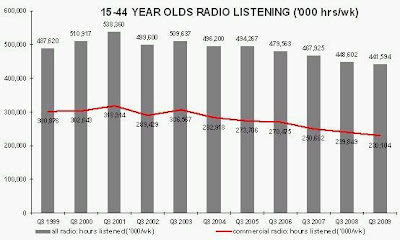
• Commercial radio’s ‘heartland audience’ of 15 to 44 year olds, which it has pursued for many years as a result of advertiser demand to reach this segment of the population;
• ‘Share of listening’ as the appropriate metric because there is a direct correlation between this figure (how many hours are listened to commercial radio) and how much revenue the sector generates.

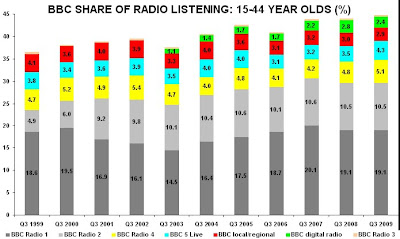
The graph below, taken from RAJAR data, shows the ‘share of listening’ attracted by BBC radio stations amongst 15-44 year olds since 1999.

It is evident that the listening share of most BBC stations has remained relatively static over this period. The exception is Radio Two, whose share of listening amongst 15-44 year olds has more than doubled from 4.9% to 10.5% over the last decade. It is true that this growth has started to level out in recent years, as your article asserts, but there is no denying that the damage has already been done.

The graph shows clearly that this significant increase in listening has not been achieved by migration from competing BBC radio services to Radio 2. On the contrary, the BBC’s overall share of listening amongst 15-44 year olds has increased from 36.5% to 44.7% during the last decade and, most importantly for commercial radio, is continuing to grow year-on-year.

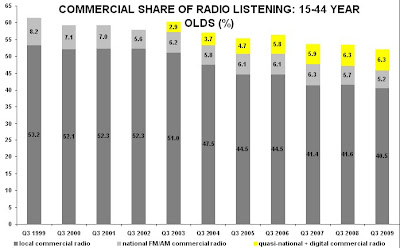
The graph below demonstrates clearly that it is commercial radio which has lost listening share, from both its local and national stations, that has migrated to the BBC. As a result, commercial radio’s listening share amongst 15-44 year olds has fallen from 61.7% to 52.1% over the last decade.

 
The danger for the commercial radio sector is that, if its market share falls below 50%, potential advertisers might no longer consider radio to be the ‘powerhouse’ delivery platform amongst 15-44 year olds that it used to be. The impact will not simply be a proportional loss in advertising revenues, but a significant loss of confidence in radio as an advertising medium to reach 15-44 year olds.

This is why, inside the BBC and Radio Two, a change in strategic policy might look as if it only results in an increase in BBC market share of a percentage point or two. For the commercial sector, not only does that single percentage point lead directly to a proportional loss of revenue but, sustained in the longer term, it can potentially undermine the medium’s ability to convince advertisers to use radio rather than, say, digital TV or the internet.

This is why the promise you make that “Radio 2 listeners won’t get any younger” is little comfort to a sector that has already been damaged by BBC strategic policies and which is continuing to lose market share year-on-year amongst its ‘heartland audience’ to BBC radio as a whole.

Of course, some of this listening loss can be attributed to commercial radio’s own competitive (in)ability to compete with the BBC – I would be first in line to argue that case – but unless its downward spiral of diminishing listening and diminishing revenues can be reversed, commercial radio could be decimated to the point where it can no longer be a financially viable business.

I write to you not to criticise Radio Two, which is a remarkable station, nor to apologise for the commercial radio sector, which has to shoulder considerable blame for losing touch with its audience. I write to illustrate that the industry’s own data clearly shows the BBC continuing to eat away at commercial radio’s ‘heartland audience’, and I write so that the BBC Trust might understand the consequences if the migration of radio listening to the BBC continues at its current rate.

Yours,
Grant Goddard

30 November 2009