BBC Licence Fee settlement: for radio, where will the axe fall?

Jeremy Hunt, Secretary of State for Culture, Olympics, Media & Sport
20 October 2010

“In the end the deal we got [for the BBC Licence Fee settlement] was tough but fair. Tough because the BBC, like everyone, is going to have to make demanding efficiency savings. But fair because it allows them to continue to make the great programmes that we all love and licence fee payers won’t have to pay any extra for the privilege. The assurances I have secured on magazines, local and online activities will also give some comfort to the BBC’s commercial rivals that the licence fee will not be used to blast them out of the water.”

——————–

Feedback, BBC Radio 4, 21 October 2010 [excerpt]
Roger Bolton, interviewer [RB]
Sir Michael Lyons, chair, BBC Trust [ML]

RB: Does that mean that you would regard any significant cuts in the domestic radio services as something you could not go along with?

ML: I think … that’s rather a sweeping assurance that you’re asking me to give …

RB: Well, it’s people who listen to Radio 4 and to Radio 3 and who value that greatly, and Radios 1 and 2, want to know, as a result of this settlement, will they see major economies made in their networks?

ML: Well, let me be very clear, as I said before. The Trust is clear on the importance to Licence Fee payers of the family of BBC services. The care that we take in reflecting on those radio services is, I think, reflected in the decision that we took on 6 Music – a very careful balancing of the public value that that service provides against its cost. What I can give you assurance on is that the Trust will continue to demonstrate that care across the range of BBC services.

——————–

Tim Davie, Director, BBC Audio & Music
Interviewed by Beehive City, 20 October 2010

“I don’t think anyone is proposing taking £300 million [for the BBC World Service] out of the Audio & Music budget. There wouldn’t be a lot left.”
“Obviously this is a decision taking place at a pan-BBC level rather than just looking at radio services. As the guy in charge of Radio I would say that our portfolio delivers value for money for the licence fee. I think Radio stacks up very well.”
“I don’t want to go into detail about discussions at this point in time. It remains speculation until we see what comes out in the Comprehensive Spending Review.”

——————–

The Tony Livesey show, BBC Radio 5 Live, 28 October 2010 [excerpt]
Stephen Nolan, interviewer (presenter, BBC Radio Ulster) [SN]
Tim Davie, Director, BBC Audio & Music [TD]

SN: Interesting times for the BBC, Tim, aren’t they, because, with the Licence Fee freeze over the next six years, how’s that going to be felt by radio listeners? What are they going to miss, what are they going to lose?

TD: Well, I think it’s too early for me to say ‘oh, we’ve just had a settlement, this is what it affects’. I would say, as an overall principle, the last thing that people want – me or others want to do – is do things that affect the quality of listening. I think that one of the things the BBC has done pretty well over the last few years is: we have taken out quite a lot of costs. But the truth is our radio services, I think, are in fine shape. That’s for the listeners to decide but, actually, the numbers are good, I think the quality of programming is – frankly, it is quite easy to do cheap radio. The issue is that we also want to do the investigative journalism, we want to do the big stuff, and I think listeners care about that stuff. I would say that, of the Licence Fee, radio is only, at most, 20%. So, in terms of good value for money, as the head of radio, I would be arguing our case pretty hard.


SN: You say it’s quite easy to do cheap radio. Do we do cheap radio?

TD: I think, you know, overall, we do good value radio which is – I’m choosing my words carefully there – because, I think, cheap radio, what I meant by that was that it’s quite easy to have one person playing records. We don’t do that. You know. We get people like yourself, who have a point of view….

SN: [interrupts] Yes, we do! We don’t have one person playing records? Chris Moyles plays records. Radio 1 plays records and the commercial sector could do that any day of the week, couldn’t they?

TD: Well, I think Radio 1 is … that’s a big debate. I’m very clear that Radio 1 does something very different to commercial radio. An average commercial radio station would play probably about 200 records a week and Radio 1 … our records … we may get up to 900. We’ll be playing a lot more new music and, actually, we do a lot more speech. Nine million people are listening to news on Radio 1, with something like Newsbeat, and that’s important.

SN: BBC Radio 2 and the commercial sector will argue until the day they die –and I spent ten years working in the commercial sector – that Radio 2 should be given to the commercial sector. Give them a chance because that’s [no more than] very good presenters playing music.

TD: Well, I don’t think they would do what we do. Radio 2 is currently just about 50% speech so, if you listen … on a day in Radio 2, about half of it is speech.

SN: And define ‘speech.’ Are you including presenter links in that? Including monologues and all?

TD: I’m including everything in that. I’m also including Jeremy Vine doing Poetry Week last week. I’m in ….

SN: [interrupts] But it is a bit of a con to suggest that 50% is speech when that includes a presenter saying ‘good morning, it’s ten past ten’, because the commercial sector can do that.

TD: Well, of that, there’s a bit of speech which is those pure links. Point taken. But I think, if you listen to, as I say, Jeremy Vine, you also … It’s not just about music versus speech. You take the Folk Awards, you take Jamie Cullum doing jazz, I think Radio 2 can be pretty proud of what it does, and its playlist versus a commercial station… All I would say – and this is a very simple request, and a strange one by the head of BBC radio – but have a listen to commercial radio for a while and have a listen to us. I think that listeners know the difference.

SN: What is the difference? If someone was listening to commercial radio?

TD: I think we’re a lot less dictated to by a fixed playlist. We do have a playlist but it makes [up] a lot less of our output. I think we give our presenters, as you know, quite free reign and we allow them to do their stuff. And I think … there’s great commercial radio, by the way, and it would be remiss of me to say anything otherwise. But I would say the BBC – the great thing about having fixed income – is that we can do stuff. We can say go and do your stuff and, sometimes, as you know, that can get lively. But, overall, I believe in trusting presenters. The interesting thing as well, by the way, is [that] music services now on the web – you get all these automated recommendations – the one thing I think radio is doing well on is that we don’t kind of do that. We give a presenter the chance to do their stuff.

——————–

House of Lords

debate on media ownership, 4 November 2010 [excerpt]

Lord Myners: I hope that when the BBC licence is next reviewed we start from a presumption that the BBC should not be doing certain things. The BBC should have to prove why it should continue to operate Radio 1 or Radio 2, for instance. It is extraordinarily difficult to explain to a foreign visitor why Radio 1, a popular music station, is a nationalised industry, and why it is necessary for it to be provided by a public service as opposed to a competitive one.

BBC head of radio: DAB not "a clear enough offer to listeners"

The Tony Livesey Show, BBC Radio 5 Live, 28 October 2010 [excerpt]
Stephen Nolan, interviewer (presenter, BBC Radio Ulster) [SN]
Tim Davie, Director, BBC Audio & Music [TD]


SN: There are big problems with the digital spectrum, aren’t there, because we cannot seem to hit any target that we are given for people switching to digital?

TD: I don’t think we’ve had many targets … Let’s be honest, I don’t think we’ve had many targets in the past. Digital stations are doing well. Digital listening – we’ve got to be careful – includes online, which is doing pretty well, there’s more we can do. Then also you’ve got DAB. Now DAB, you’re right, it’s been marginally growing for a while …

SN: Why?

TD: I just don’t think it’s been a clear enough offer, in my language, to listeners. I mean, people love radio. They are very happy with their FM radio. Why on earth would you change? And I think the radio industry has to say: ‘the reason you will change is – here’s a load of content’. And there’s clues like 6 Music, or other …. you know, that people love. And here’s a load of stuff that people love, and here’s a better … this device does something better than the other one.

SN: Or, Tim, it’s for the BBC to take a huge risk, and a controversial risk at that, and to withdraw mainstream programming from the FM spectrum and put it onto DAB. Imagine how the numbers would soar if it had [BBC Radio 1 breakfast DJ Chris] Moyles or …

TD: [interrupts] Imagine my inbox!

SN: Exactly, exactly. It’s a serious point.

TD: Sure.

SN: Imagine if you had Moyles or [BBC Radio 2 breakfast DJ Chris] Evans exclusively on DAB, or a massive programme.

TD: Right! And … we could do that. The issue would be that, with current coverage levels and with the amount of devices – particularly in Northern Ireland – I would basically be saying that you can’t listen to it in your kitchen, and everyone pays the Licence Fee. So I think the strategy for digital, where we are taking things away, is not going to work. My approach would very much be that I do want you to feel a bit of pain for not having a digital radio, but that pain is not about not getting The Archers, or not getting Chris Moyles. It’s about: ‘you could get a bit more over here’, or ‘there’s a bit of [Radio] 4 Extra over here that you could really do with’, and that’s what television did with some of those channels.

SN: Do you think, in terms of the internet, that radio is going to fundamentally change?

TD: I think there will be a lot more on-demand, obviously, so people will expect to be able to call up a programme and …

SN: I’m talking about the [UK] Radioplayer, obviously, which people are describing as the new YouView for radio.

TD: Well, er, yeah. Basically, the Radioplayer is … we’ve got the whole industry together. Only about 3% of listening is online and I can’t understand that, as head of radio. I know I’m biased but, at the end of the day, when I’m shopping and doing my Tesco shop or wherever online, why aren’t I listening to the radio? [to SN] Well, you would relate to this because it means more listeners. I think that one of the things is that I think it’s a bit confusing. You’ve got the BBC on the iPlayer, which is pretty good, and we’ve got other bits and … So we’ve put it all together and there will be a thing called the Radioplayer. Now, it gets a bit complex, but I think the YouView thing that you refer to is when you’ve got an internet connection to your television. Now, when you click your television on, I want one Radioplayer icon where you can go in and listen to all the radio. Now, the …

SN: On the TV?

TD: Yeah. On any screen – sorry to sound ‘new age’ – any screen anywhere, whether it’s a … whatever the size of it, you can go and get all your radio services. We don’t currently have that.

Digital Radio Upgrade? More like Digital Radio Groundhog Day.

It was the Radio Festival, the industry’s annual get together. Everyone wanted to talk about how wonderful the DAB future of radio would be. But nobody wanted to explain how ‘Digital Radio Upgrade’, the government policy to make the UK’s DAB transmission system fit for purpose, will be paid for. It is the radio sector’s favourite parlour game: pass the DAB Upgrade parcel.

The first player is the BBC:

Q: “Very briefly, a one-word answer. Do you have any money set aside now to spend on [Digital Radio Upgrade]?”

Tim Davie, director of BBC Audio & Music: “No.”

Second is commercial radio:

Q: “Does commercial radio have any money to spend on [Digital Radio Upgrade]? […] What’s your guess?”

Phil Riley, chief executive of Orion Media: “‘No’ is the answer at the moment.”

Third are the politicians:

Jeremy Hunt MP: “I think the most important thing is not something the government can do, but something the industry can do …”

But hold on. This dialogue came from the Radio Festival in 2009…. We need to fast forward one year.

It was the Radio Festival, the industry’s annual get together. Everyone wanted to talk about how wonderful the DAB future of radio would be. But nobody wanted to explain how ‘Digital Radio Upgrade’, the government policy to make the UK’s DAB transmission system fit for purpose, will be paid for. It is still the radio sector’s favourite parlour game: pass the DAB Upgrade parcel.

The first player is the BBC:

“It remains to be seen who will pick up the £100m tab [for Digital Radio Upgrade], with [Tim] Davie saying he did not have the necessary funds.” [from The Guardian]

Second is commercial radio:

“[Global Group chief executive Ashley] Tabor said the commercial [radio] sector will only pay for the rollout of those local DAB multiplexes that are commercially viable.” [from The Guardian]

Third are the politicians:

Ed Vaizey, Minister for culture, communications & creative industries: “The BBC has to work with me on coverage. I am talking to the BBC and I hope to accelerate the pace of digital radio coverage.”

Déjà vu, anyone? Delegates paid £899 to witness this repeat performance. I have already placed my bet on precisely the same sentiments being made at the Radio Festival in 2011, though the odds offered by the bookie were not at all good. On the coach home from the Festival, everyone must have joined in the usual radio industry singsong:

“When do we want digital radio switchover? Now!
Who do we want to pay for DAB Upgrade?
Somebody else!”

And while we are on the topic of déjà vu, I am reminded of an analyst report about DAB from June 2008, in which I had written:

“The digital switchover of radio is so far into the future as to be intangible.”

I was swiftly rebuked for this viewpoint in an e-mail from a radio sector CEO.

Now fast forward to the 2010 Radio Festival. Andrew Harrison, chief executive of commercial radio trade body Radio Centre, said:

“There is no doubt if [digital take-up] carries on at its current projectory we will never get there.” [sic]

The current RadioCentre strategy remains inexplicably that the BBC should pay not only for improvements to the BBC’s DAB radio transmitters, but also for the commercial radio sector’s (see earlier blogs here and here). The nails seem to have been hammered firmly into that coffin by this week’s speed-axing session between the government and the BBC.

Although subsequent press reports have implied that the cost of the (previous) government’s Digital Radio Upgrade policy will now be underwritten wholly by the BBC, the available evidence says otherwise. The resulting four-page letter from the government to the BBC Trust set out in detail all the new items to which the BBC’s funds will have to be applied in future. The World Service? Yes. BBC Monitoring? Yes. S4C TV? Yes. Local television? Yes. DAB radio? No….

Oh, hold on. In the penultimate paragraph on the final page there is a single sentence about DAB penned by Secretary of State Jeremy Hunt:

“I also welcome the BBC’s plans to enhance its national DAB coverage in the period of this agreement, and to match its national FM coverage as a switchover date draws near.”

But while the rest of the letter is littered with the oft repeated phrase “The BBC will …”, this solitary mention of DAB radio is couched only in terms of “BBC plans” without a hint of compulsion. DAB is an obvious afterthought here and, much to RadioCentre’s chagrin, it refers only to the BBC improving its own DAB transmitter coverage and not to improving commercial radio’s.

In the coming months, when the inevitable axe falls sharply across BBC budgets as a result of this week’s gobsmacking (© Ray Snoddy) agreement between the BBC and the government, DAB radio must be an obvious short straw. Lose BBC local radio, or lose DAB? BBC local/regional radio accounts for 15% of BBC radio listening. BBC digital radio stations account for 4%. Here comes the chopper ….

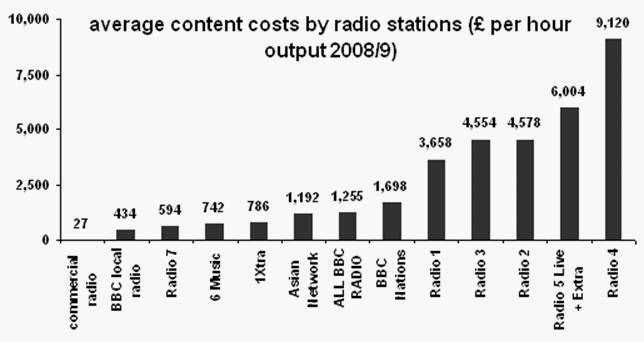
David vs Goliath: commercial radio spends £27 per hour on programmes, BBC Radio 2 spends £4,578

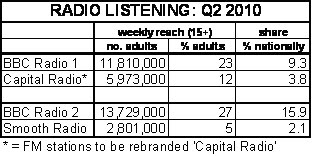
There has been an abundance of fighting talk from the commercial radio sector in the press in recent weeks. Commercial radio seems determined to pick another fight with BBC Radios 1 and 2, two of the three most listened to radio stations in the UK.

Guardian Media Group Radio announced that “by broadcasting on National DAB, Sky, Freeview and Freesat, Smooth Radio will provide a strong commercial alternative to BBC Radio 2.” Chief executive Stuart Taylor said:

“We are still at war with the BBC and we still compete for listeners tooth and nail, as we always will.”

The press headlines affirmed:
· “New national network makes a Smooth attack on Radio 2” (Telegraph)
· “Forget Radio 2: in five years’ time, we’ll all be going Smooth” (
Independent)
· “Smooth Radio takes on Radio 2 in national rollout” (
Marketing Week)
· “Radio Two faces fight, warns new Smooth news chief” (
Press Gazette)

Then, Global Radio announced that its local FM stations will be re-branded ‘Capital Radio’ in 2011. Chief executive Ashley Tabor said:

“With the launch of the Capital network, there will now be a big national commercial brand seriously competing with Radio 1.”

The press headlines responded:
· “Capital Radio will go national in bid to challenge Radio 1” (Evening Standard)
· “Capital Radio set to rival BBC Radio 1 in move to broadcast nationally” (
Daily Mail)
· “Global to take on Radio 1 with Capital Network” (
Marketing Week)
· “Capital Radio to form first national commercial radio station” (
ITN)

Both the GMG and Global Radio statements achieved the intended sabre-rattling headlines in the press though, for me, these sentiments are remarkably hollow. This ongoing phoney war between the BBC and commercial radio is like a war between a one-eyed giant and an over-exuberant mobile phone salesman. The giant will win every time. Commercial radio can huff and puff all it wants, but the BBC knows it is perfectly safe in its house built from Licence Fees. It can afford to chuckle loudly at every challenge like this lobbed at it by commercial radio. Why?

Firstly, you could only ever hope to seriously compete with the existing formats of BBC Network radio stations if you had access to their same abundance of resources. This is something that Channel 4 belatedly realised after having promised for two years that it would invent a new commercial radio station to compete with BBC Radio 4. Then it scrapped its radio plans altogether.


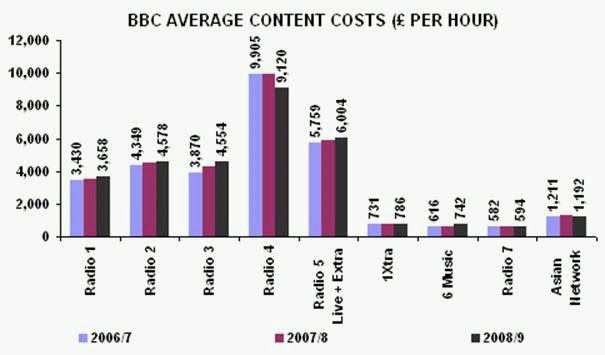
The huge gulf between the funding of commercial radio content and BBC Network Radio content makes direct competition simply pointless. In a recent report for the BBC Trust, I noted that commercial radio spends an average £27 per hour on its content, while BBC Radio spends an average £1,255 per hour. There is no way that commercial radio can make programmes that will sound like Radio 2 on a budget that is 170th of the latter’s £4,578 per hour.

Secondly, what sort of message do these press headlines send to consumers? To me, they say ‘we realise that Radios 1 and 2 are fantastically successful, so we want a slice of their action’. Or maybe even ‘you really like Radios 1 and 2, don’t you? Try us, because we want to be just like them.’ So where is the Unique Selling Point [USP] for your own product? Don’t you have enough faith in it to tell us why it is so good, rather than comparing it to your much bigger, much more successful rival? Or is this the Dannii Minogue method of marketing?

I had always been taught that the cardinal sin of radio was to mention your competitors to your audience. Every reference to your competitor tells the audience how much you respect them and their success. Ignore them! Pretend your competitor does not even exist! Plough your own furrow and concentrate on making a radio station that is genuinely unique. Then you will create a brand that has a genuine USP, rather than being merely a pale imitation of Radio 1 or 2 without their big budgets. ‘I can’t believe it’s not Radio 2’ is not a tagline to which to aspire.

Thirdly, neither Capital Radio nor Smooth will be genuinely ‘national’ stations, as in capable of being received on an analogue FM/AM radio from one end of the country to the other. So why pretend to consumers and advertisers that they are ‘national’? In the case of Capital, its proposed FM network presently covers 57% of the UK adult population. In the case of Smooth, RAJAR tells us that DAB receiver penetration is presently 35%. Just how little of the UK population can you cover and yet still describe yourself as ‘national’?


Fourthly, don’t keep looking at Radio 1 and 2’s huge audience figures and dreaming of how much money you could make if only you could monetise their listenership. Part of the reason older listeners probably like Radio 2 is because there are no advertisements. Accept the fact that Radios 1 and 2 together account for a quarter of all radio listening in the UK. Compared to those mammoths of radio, both Capital and Smooth are mere termites. Live with that fact and, instead, seek out commercial clients who are not merely frustrated because they cannot advertise on BBC Radio, but who actively want to use your radio station because your audience is intrinsically valuable to them.

Finally, invest the time and money to develop your own on-air talent rather than simply hanging on the coattails of others’ successes. Whatever his next gig might be, Chris Moyles will forever be remembered as ‘the saviour of Radio 1’, just as Chris Evans will always be remembered for his Radio 1 breakfast show, not for his subsequent time at Virgin Radio. Find new people who are good at radio and put your faith in them. Why does Smooth’s schedule have to resemble Frankenstein’s monster, stitched together with a bit here from Radio 1 in the 80s, and a bit there from Radio 2 last month?

What your radio station should be doing is not competing with Radio This or Radio That for listeners, but competing directly for consumers to spend time with you because you are ‘you’. Radio is not like selling soap powder or yoghurt pots, where your business model can be built upon undercutting the price of a competitor’s product, however low-quality your own cheapo version might be. There is no price of admission in radio. Your content needs to be ‘different’ rather than ‘the same’ and it needs to create its own unique place in the market.

You should not think of your market competitors as radio stations, but as each and every opportunity a consumer is presented with to pass their leisure time. A winning station must be able to convince a consumer to listen to it, rather than watch television, read a book or simply sit in silence. Because radio is ‘free’, the competition for radio is everything else that is also free to consumers at the point-of-use.

To offer a practical example, when I worked on the launch of India’s first commercial radio network, Radio City, the advertising agency produced an excellent marketing campaign that extolled the virtues of the station over other radio stations. But the campaign had to be rejected and the agency briefed in more detail. Why? Because we were launching the very first radio station on the FM dial in a city such as Bangalore, so the overriding challenge was to persuade people to use ‘radio’ at all, or to persuade people to buy an FM radio for the first time, or to persuade people to switch off their television and turn to radio instead.

This philosophy seems to be a million miles away from the current UK commercial radio strategy which seems to focus on berating BBC radio for being too successful, whilst wanting to somehow achieve part of that success through osmosis. If only half this war effort was put into developing policies to make the commercial sector’s stations successful on their own account, the BBC would soon cease to matter.

Instead, RadioCentre is now demanding that commercial radio be allowed to re-broadcast old Proms concerts recorded by BBC Radio 3. But how many of our 300 commercial radio stations play classical music? One. And which Proms concert do you recall that would fit into Classic FM’s playlist of short musical extracts? What next? Will Capital FM be asking the BBC for the rights to re-broadcast some old Zoe Ball Radio 1 breakfast shows?

In September 2010, the government’s Consumer Expert Group criticised RadioCentre for having proposed a policy for the BBC’s Strategy Review that, it felt, would have “bullied” listeners.

Trying to bully listeners? Trying to bully the BBC? This is the war of the playground, not of a mature media industry that has a strategy of its own making, a plan, a roadmap for its future success. “It’s not fair. Your willy is bigger than mine.” No, it probably isn’t fair, but life deals you a hand, you have to stop whining, get on with it and make the best of what you’ve got.

Just accept this reality: commercial radio’s willy is never going to be as big as the BBC’s. So competing directly on size alone is a complete waste of time when, instead, you should be developing your own individual ‘technique’.

BBC Trust chair notes "the absence of a coherent digital [radio] strategy"

On 8 September 2010, Sir Michael Lyons, chair of the BBC Trust, and Mark Thompson, director general of the BBC, appeared before the government’s Culture, Media & Sport Committee. They were asked about BBC radio policy by a committee member:

David Cairns: It will be brief because it is about radio. Clearly the [BBC Radio] 6 decision has come and gone. Where does this leave you? There seems to be a slight divergence between the Trust and the executive on the vibrancy and distinctiveness of the offer. You wanted to close Radio 6 to make [Radios] 1 and 2 more distinctive. Now 6 is staying open, so a couple of headlines on where we are in terms of the strategy in radio, with particular reference to 1 and 2?

Sir Michael Lyons: It isn’t part of the Government’s structure that the Trust and the Director General have to agree on everything and indeed we’ve had some criticism for not more frequently exposing to public scrutiny the debates which do take place, which are often challenging. I think getting the balance of that right between how much of that discussion is open is I think a matter for reflection.

Now let’s turn to the strategic review: the Trust rejected the proposal to close BBC 6 in its current form believing that the arguments didn’t stand up as a result of the consultation analysis we’ve done. But what that proposal did do was to bring into really quite sharp relief the two big strategic issues sitting behind it. The first of those – the greater distinctiveness of Radio 1 and Radio 2 – very much the subject of the service reviews that the Trust had undertaken earlier in the year, requiring both stations to work more energetically to distinguish themselves from each other and to serve a rather different audience demographic.

The second issue, of course, is the absence of a coherent digital strategy – not an issue for the BBC alone because it immediately brings in the issue of where the Government stands on DAB radio for the future. So where we are at the moment is the Director General is now working on both of those issues, recognising those are the big issues, the big strategic issues, and 6 continues perhaps for ever but certainly until both of those big issues are clear to us.

Mark Thompson: I think Michael answered that very clearly. We have had, I believe, a real success with our television portfolio, including our digital channels, in helping encourage the public to move from analogue to digital television. We are not alone in that, Sky has done a great deal to help with that and so have others. But we know that our digital television channels have made a significant difference in people wanting to take digital television up. We have yet to see the same level of success with digital radio. We are very committed to digital radio. We support the Government’s and indeed the previous Government’s ambitions around moving towards analogue-to-digital switchover in radio as well. The challenge for the BBC is coming up with a portfolio of services which firstly encourages people to sign up on digital radio, but in ways which support the rest of the radio market rather than producing adverse competition.

We need to make sure that the core mainstream channels, like Radio 1 and Radio 2, are sufficiently distinctive, are really doing something different from their commercial counterparts, but also that we have a range of attractive but also distinctive new digital services.

So I think this is a hard Sudoku. It’s not absolutely straightforward because there are a number of different things going on, and I take the BBC Trust’s response on 6 Music I think in the way it is intended which is there are bigger things at stake here. Go back and look at the broad radio strategy and that’s what we’re doing at the moment.

——-

On 14 September 2010, Jeremy Hunt, Secretary of State for Culture, Media & Sport, appeared before the government’s Culture, Media & Sport Committee. He was asked by a committee member about progress with digital radio switchover:

Damian Collins: There was a report in the press this morning claiming that a report to your Department has been published today by the Consumer Expert Group, saying that 2015 is too early as a target date for digital radio switchover, and even questioning the consumer demand for it. I wonder what your views are on that?

Mr Hunt: On 8 July Ed Vaizey published a digital radio action plan. We made it very clear that we think when it comes to radio, the future is digital. We aspire to the 2015 date but there need to be some changes in consumer patterns of radio consumption before we would agree to a switch-off of the analogue spectrum. Those include a greater-than-50% market share for digital radio listening. At the moment it is about 25% and DAB is only 16%. It includes, for national radio stations, coverage that is as good as FM and, for local stations, 90% coverage and coverage on all major roads. So until we are confident that those conditions are met, we won’t be signing the bit of paper that says there will be switchover in 2015.

Damian Collins: But do you still see 2015 as a date the industry should be aiming for?

Mr Hunt: I hope that we can deliver it by then but they need to work much harder to persuade consumers of the benefits of digital radio. I would much rather this was a process similar to the transition from records to CDs and from CDs to iPods, which was driven by changes in consumer behaviour, rather than something that we change as a sort top-down mechanism.


[these transcripts are uncorrected and are not yet an approved formal record of proceedings]

UK commercial radio: Q2 2010 national revenues down 40% since 2003

It seems like only yesterday that the Radio Advertising Bureau [RAB] was telling us that:

“The [commercial radio] sector has turned a corner and not only halted [revenue] decline, but moved into renewed growth …”

In fact, it was 20 May 2010 and the reason for the RAB’s optimism was the sector’s 2009 revenue performance. Yes, revenues in 2009 were down 10% year-on-year and yes, back in 2008, they had already been down 6% year-on-year. But, as I noted at the time, mere numbers never seem to get in the way of the trumpeting of a “terrific achievement.”

Fourteen days prior to the RAB pronouncement, a general election had ousted the Labour government and introduced a new Conservative/Liberal coalition. The writing was clearly on the wall that tougher times were ahead for the commercial radio sector. At the beginning of May 2010, I had
spelled out emphatically the dire implication for commercial radio revenues of an incoming Conservative government:

“The Conservative Party pledged in its manifesto to reduce advertising expenditure by government departments, if elected. The planned cuts would be significant, 40% of the COI 2008/9 budget of £540m, according to one press report. … A 50% budget cut to COI expenditure on radio would lose commercial radio £26m to £29m per annum, 6% of total sector revenues.”

And so it came to pass, even though the Radio Advertising Bureau was still insisting in June 2010:

“We are optimistic that radio’s strengths will be recognised as COI budgets come under ever greater scrutiny.”

But budget cuts of 50% cannot be executed that recognise the radio medium’s strengths. Since May 2010, public funding of commercial radio has fallen sharply from 18% of sector revenues and will not be bouncing back anytime, at least not while the Conservative Party holds the public purse strings. The largest commercial radio owners have been hit the hardest, whilst the smaller local stations (that rely much more on local advertisers) have been little impacted.

As a result, it was no surprise that commercial radio revenue data for Q2 2010 were released quietly without fanfare or further pronouncements about “renewed growth.” The notion that commercial radio revenues had “turned a corner” looks even more hollow now, a mere four months after the Radio Advertising Bureau had uttered those words.


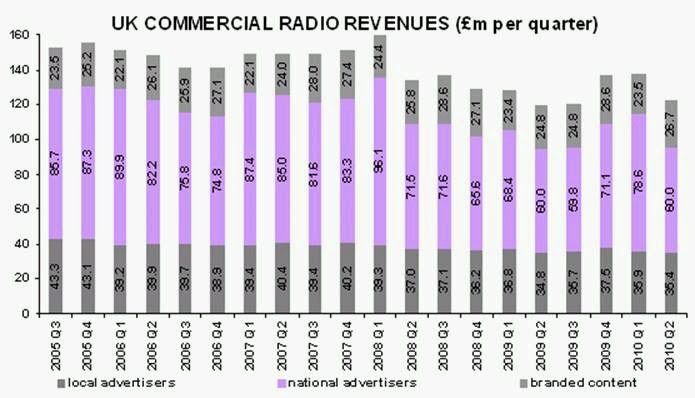
Q2 2010 TOTAL REVENUES
· Up 1.9% year-on-year, but remember that Q2 2009 had been the sector’s most disastrous
· Q2 2010 total revenues are the third lowest this millennium (after Q2 and Q3 in 2009)


Q2 2010 NATIONAL REVENUES
· No change year-on-year, but remember that Q2 2009 revenues were already down 16.1% year-on-year and, before that, Q2 2008 had been down 15.9% year-on-year
· Q2 2010 national revenues are the second lowest this millennium (after Q3 2009)

Q2 2010 LOCAL REVENUES
· Up 1.7% year-on-year, but remember that Q2 2009 was already down 6.0% year-on-year and, before that, Q2 2008 had been down 8.4% year-on-year
· Q2 2010 local revenues are the lowest since Q2 2009 and, before that, Q1 2002

The most frightening facts about the Q2 2010 data are:
· National revenues have fallen 40% since Q4 2003
· National revenues have fallen to a level the sector had attained in 1998 (earlier, if inflation is considered) when there were about eighty fewer commercial radio stations

If Q2 2010 was bad for commercial radio, then the following quarters are likely to be worse, as the impact of government expenditure cuts will have wreaked havoc across complete quarters of commercial radio’s national revenues. The outlook for the commercial radio sector looks anything but “terrific”, though trade body RadioCentre was still peddling eternal optimism in its September 2010 newsletter:

“Whilst revenue for Q1 2010 was up 7.3% year on year, the best performance and highest growth for 2 years, Q2 proved more of a challenge with the election and subsequent cuts in government expenditure. However, the RAB is working with a wide range of advertisers to bridge the gap, and the current outlook for quarter three is that we’ll see a modest growth, even despite COI cutbacks.”

And, after this week’s Radio Advertising Awards (where, ironically, “government departments and campaigns scooped the most awards,” wrote Marketing Week), the RAB was still proclaiming “… the outstanding work which has seen our [commercial radio] sector return to growth …”

Suffice to remind you that Q2 and Q3 in 2009 witnessed the commercial radio sector’s lowest recorded revenues this millennium, so that any year-on-year increase will have been achieved from a base of absolute ‘rock bottom’. To add to the gloom, Minister for the Cabinet (and the government’s Paymaster General) Francis Maude
told The Times last week:

“We are looking at whether we should be expecting the BBC — when people are paying their Licence Fee — to carry some public information advertisements. It wouldn’t be a propaganda operation but this is public service broadcasting. The taxpayer might say, ‘Should I be paying out my taxpayer’s money for the Government to pay ITV to carry public information advertisements?’”

So the worse news for commercial radio is that it could be about to lose whatever remaining government advertising has survived, if pubic service announcements are to be switched to BBC Radio. After all, not only would such a policy save the government a further £30m per annum, but BBC Radio reaches 67% of the UK adult population per week, greater than commercial radio’s 64%.

In May 2010, I had predicted that the government could adopt just such a policy:

“If a government were to return to the post-War COI policy of using public broadcasters to air its Public Service Announcements, rather than paying commercial rates for airtime, up to 18% of commercial radio revenues would disappear at a stroke.”

I am sufficiently ancient to remember the intriguing, but rather bizarre, Public Information Films that used to grace BBC television. I also remember the Public Service Announcements that local commercial radio stations were required to broadcast for free when the Independent Broadcasting Authority was the sector regulator. So such a policy would be nothing new and should have been anticipated by the sector.

But what can commercial radio do? The key is the word ‘commercial’. The industry was foolish to have ever considered public expenditure on radio advertisements anything more than an ‘extra’ that was bound to disappear some time at the whim of politicians. That time is now. The same way that the government is mounting a war on ‘benefit scroungers’ who are said to have become too reliant on public handouts, the Conservatives are effectively waging a war against ‘COI scroungers’ – commercial broadcasters whose sales teams knew they could rely on government advertising handouts to meet their revenue targets and earn their bonuses.

How did the industry let itself get into this state? ‘Commercial radio’ was always meant to be ‘commercial’, not publicly funded. In exactly the same way, ‘local commercial radio’ was always meant to be ‘local’. It is the very point at which you begin to lose sight of who you really are that you set off down a rocky road that leads to inevitable oblivion.

Local Commercial Radio, know thyself.

The exit strategy for DAB radio switchover: the Consumer Expert Group addresses Vaizey’s “big if”

When you are looking for an exit route from a product you have been developing for nearly two decades, and which has consumed hundreds of millions of pounds, you need to find a damn good reason that will deflect the blame elsewhere. You need a report, an organisation or some bona fide research that screams out ‘no’ at the highest volume. Then your response can be: “I would be a fool to ignore the warning signs voiced by X” when what you are really saying is: “Blame them, not me! It’s them that made me do it.”

DAB radio and digital radio switchover presently seem to be at this point. But there is a big problem for a radio industry that is belatedly trying to find a way ‘out’. Almost all previous reports produced by the government, the regulator, the radio industry, the electronics industry, the working groups, Digital Britain and the car manufacturers have been overwhelmingly positive about DAB and have painted an amazingly rosy future. There has been almost nothing published about DAB by agencies of the state that has said plainly: “Stop this crazy plan.”

So whose fault can it be that DAB radio and digital switchover has not worked? Given the sheer number of agencies that have been so gung-ho for so long about DAB, the fickle finger of fate naturally had to point elsewhere and so it landed upon ‘the consumer’. It becomes much easier to decide that the general public is the reason for a masterplan’s lack of success when everybody sat around the government’s conference table is feeling a little guilty about their shared role in a wasted £1bn investment.

A change of regime is always a useful point at which to invoke such a change. In July 2009, less than a year into his first radio job, the BBC’s top radio manager Tim Davie explained that digital radio switchover would be determined by listeners, not by the BBC:

“From a BBC perspective, whether it be ‘Feedback’ or our constant audience research, the idea that we would move to formally engaging switchover without talking to listeners, getting listener satisfaction numbers, all the various things we do, would be not our plan in any way. We would be – we are – in dialogue now for the next six years. … I think we are pretty committed to digital. Having said that, since I have arrived at the BBC, I certainly haven’t seen it as inevitable that we move to DAB.”

The following month, BBC Trust chairman Sir Michael Lyons reinforced this notion:

“Who comes first in this? Audiences and the people who pay the Licence Fee. It is an extraordinarily ambitious suggestion, as colleagues have referred to, that by 2015 we will all be ready for this. So you can’t move faster than the British public want you to move on any issue.”

The change of government then provided an opportunity for the Department for Culture, Media & Sport [DCMS] to similarly invoke the will of the people in determining digital radio switchover. In July 2010, culture minister Ed Vaizey said:

“If, and it is a big if, the consumer is ready, we will support a 2015 switchover date. But, as I have already said, it is the consumer, through their listening habits and purchasing decisions, who will ultimately determine the case for switchover.” [emphasis added]

For both the BBC and the government, the problem with belatedly putting the consumer at the centre of digital radio switchover is that almost no organisation, over the course of a decade of DAB, has done any significant consumer research about DAB. Why? Because the implementation of DAB radio in the UK had always been a top-down policy initiative by civil servants, regulators, trade organisations and commercial opportunists, without ‘the man on the Clapham omnibus’ having ever been consulted.

There was one notable exception. When the government’s Digital Radio Working Group considered the issue of DAB radio switchover during 2007/8, a sub-committee named the Consumer Impact Group had prepared a report. However, this report was not made public until almost a year after the Working Group had been wound up. The report had been highly critical that consumers’ viewpoints were not being considered:

“The group is concerned that the case for digital [radio] migration has not been made clearly enough from the point of view of the consumer. While it is clear what the rationale is for the radio industry, the group would like to see a compelling argument as to why digital migration is desirable for consumers and what its benefits would be for consumers.”

But that was then, this is now. Then, digital radio was considered by the previous government to be a real possibility, and that is why dissent from consumer groups was buried. Now, that same consumer dissent could provide the perfect nail on which to hang any number of DAB exit strategies. A new report outlining the massive consumer challenge of digital radio switchover would be a perfect ‘get out of jail free’ card for many long-term DAB stakeholders.

So today, a new report has been published by the government’s Consumer Expert Group [CEG] which asks the pertinent question ‘Digital radio switchover: what is in it for consumers?’ Moreover, rather than it being embarrassedly added to the depths of the DCMS web site a year later, today’s report was circulated to the press and stakeholders in advance of publication. Its introduction states:

“This report was not requested by Government but the CEG have taken the initiative to attain a thorough understanding of the consumer issues surrounding digital radio and bring them to the Government’s attention as preliminary policy decisions are made.”

In other words, this new report just happens to directly address the “big if” cited in the culture minister’s speech about digital radio switchover nine weeks earlier. If its publication were not startling enough, its conclusions are damning in almost every respect about the lack of progress made to date with digital radio switchover. But, before that, the report is quick to invoke the role of consumers in what it admits is “new” government policy:

“Setting a date, or a firm commitment to a date, would have had the effect of scaring consumers to switch. Clearly this would not be compatible with Government policy to support a switchover when enough listeners voluntarily adopt digital radio. Government’s new emphasis on consumers should provide the focus to ensure consumer concerns and needs regarding digital radio are addressed, thereby reducing the barriers to voluntary take-up.”

However, if these “consumer concerns and needs” were to prove simply too onerous and costly for the government to address in the current economic climate, the choice is now there to opt out of pursuing the DAB switchover policy altogether. The Film Council … the Audit Commission … DAB radio switchover. Chop chop chop. The first two might have seemed a bit arbitrary to voters. Now, at least this one has a consumer report to back it up.

So this new report reiterates and elaborates the same arguments made in the previous consumer report to the Digital Radio Working Group two years earlier, and adds some more. Its recommendations are worth quoting in full:

“The consumer costs and consumer benefits of digital radio
• A full cost benefit analysis from a user perspective must be carried out as a matter of urgency;
• Consumer benefits need to be clear and demonstrable before an announcement for a digital switchover is made;
• A workable system for the disposing and recycling analogue radios, which consumers are likely to implement must be introduced;
• Emphasis should not be placed on driving down costs unless the sound quality and functionality of cheaper DAB sets are at least equal to analogue;
• There must be more emphasis on improving the basic usability, rather than the advanced functionality, of digital radio to encourage take-up;
• Both the BBC and the commercial sector need to offer new and compelling digital content to convince consumers to adopt digital radio;
• Research into consumers’ willingness to pay and into their concerns and needs relating to digital radio needs to be carried out as a matter of urgency.

Take-up
• The take-up criterion should compare like-for-like listening platforms and measure DAB listening only;
• A digital switchover date should only be announced when no more than 30 per cent of listening remains on analogue;
• The target date for a digital switchover should be revised upwards as 2015 is realistically far too early for the necessary preparations to be put in place for consumers. Any target date set should be looked upon as secondary to consumer issues such as willingness to adopt the technology, voluntary take-up and digital radio reception as an instigator for switchover;
• Measures need to be taken to introduce a more inclusive methodology for measuring take-up.

Coverage
• The fair allocation of coverage build-out costs between the BBC and the commercial sector must be made once build-out plans are agreed;
• The coverage criterion should be measured by signal strength, not just population, so that indoor and mobile reception are considered;
• The coverage criterion must be geographically weighted to ensure rural communities are not left behind;
• The switchover roadmap must include plans for DAB+;
• DAB+ compatible chips must be installed as standard to “future-proof” receivers as a matter of urgency;
• The reception time delay between receivers should be standardised.

Vehicles
• A Digital Radio Switchover date cannot be announced until DAB radios have been standard in vehicles for a minimum of 2 years, in other words by 2015 at the earliest;
• An affordable in-vehicle converter needs to be developed urgently which works with a vehicle’s external aerial, is safe, easy to fit and aesthetically pleasing;
• A switchover date cannot be announced until there is a solution to in-vehicle conversions, providing the majority of motorists with the opportunity to have a digital radio in their vehicle;
• A solution for the continuation of traffic and travel services on FM for a transitional period following digital switchover needs to be agreed;
• An accreditation scheme for dealers and other installers of retrofit digital devices must be developed.

Accessibility
• Digital switchover should not go ahead without suitable equipment being available for all listeners including older and disabled people;
• Digital radios which incorporate voice output technology must be available for blind and partially-sighted people preferably via the mainstream market or, if that is not feasible, through a channel made affordable by Government intervention, such as a help scheme;
• Appropriate information and support on the enhanced features of accessible digital radios should be available from retailers;
• Appropriate usability requirements should be included in minimum receiver specifications and a kitemarking scheme;
• The proposed integrated station guide must be consumer tested before any decision on its inclusion in devices is made.

Consumer information
• A clear and balanced public information campaign needs to be implemented through a trusted body, independent of the industry;
• Once a switchover date is announced, sales of analogue-only radio must stop;
• A post-announcement information campaign to target vulnerable groups should be developed;
• The digital tick should be adopted for digital radio and adapted as necessary;
• A ‘scorecard’ should be displayed on all products to convey more information about the available features at the point of sale;
• A digital radio pre-purchase checklist should be widely available and at point of sale;
• An effective training and “accredited adviser” scheme needs to be developed for retailers;
• The CEG must be involved in the minimum specification for digital radio;
• The CEG must be involved in the design and development of any public information campaigns.

Consumer support and a help scheme
• Any Digital Radio Switchover must be accompanied by a help scheme to assist those who would find it disproportionately difficult to switch;
• The eligibility criteria of a help scheme should include people registered blind or partially sighted, those on low incomes, the over 65s and those with learning disabilities and other cognitive difficulties such as Alzheimer patients;
• A help scheme for digital radio should provide appropriate accessible equipment and include as many instructional home visits as necessary;
• A help scheme should be publicised early on in the information process on a national level and the publicity should coincide with the start of the national information campaign for a switchover;
• The CEG must be consulted in the preparation of printed material and publicity on the help and support available;
• The engagement of the voluntary sector in providing assistance with a digital radio switchover should be properly supported and funded;
• Government should ensure that charities, such as Wireless for the Blind Fund and W4B, are not undermined financially or strategically by a help scheme or any of its components, as these charities will be left with providing the ongoing of support, assistance and help people need once a help scheme has finished.”

These recommendations seem to divide into: those that would require considerable time to implement, those that would require considerable money to implement, those that would require both time and money, and those that would be almost impossible to implement. Such recommendations should have been considered and acted upon before DAB transmitters even started to be built-out in the 1990s. Their presence in 2010 only serves to highlight the ineptitude of the 1990s ‘plan’.

No organisation escapes unscathed from the critique of the Consumer Expert Group (some are not named): BBC radio, commercial radio, Ofcom, RadioCentre, receiver manufacturers, the Digital Radio Development Bureau, Digital Radio UK, etc. By spreading the criticism so widely, no single stakeholder gets to feel singled out or isolated for DAB’s failure.

Now it is left to the government to decide to pull down the shutters on DAB radio switchover. That will not require the immediate death of DAB. But it will provide the BBC with something that it can sacrifice down the line to budget cuts in the assault on its Licence Fee. For commercial radio, it will provide relief from expensive dual transmission costs, once a settlement has allowed it to keep its coveted licence renewals invoked by this year’s Digital Economy Act. For consumers, it will offer certainty that FM radios will continue to work. There will be sighs of relief all around.

I started writing about DAB radio as a news editor in 1992 and today’s report is the first government distributed document I have seen that sensibly articulates the multitude of barriers and obstacles to digital radio switchover happening in the UK. The very first words of the report summarise the current situation perfectly:

“Despite the introduction of digital radio in the UK in 1998, analogue radio is still a key feature in many households.”

Now we await the fat lady.

DAB radio's slow consumer take-up: lessons not learnt from FM radio 50 years earlier

“Without a knowledge of your history, you cannot determine your destiny”

Misty In Roots, ‘Live At The Counter-Eurovision 1979’
Recent history can teach us important lessons. Efforts to turn dreams into reality come a lot easier if we learn from what has gone before us, what has gone right, and what has gone wrong. This is as true in radio as it is in any human endeavour.
Dr. Stephen Lax, Senior Lecturer in Communications Technology at the University of Leeds’ Institute of Communications Studies, has written an excellent paper entitled ‘A Vision For Radio: Engineering Solutions For Changing Audiences – From FM to DAB’. It was published in a recent anthology ‘Digital Radio In Europe’. The following are excerpts taken directly from Dr. Lax’s work and document what the radio industry should have learnt from the slow consumer take-up of FM radio half a century ago before it embarked upon DAB radio.
“The introduction of FM was itself no straightforward matter of replacing its AM forebear, and neither have innovations in radio technology in the half century that followed been unproblematic. It is in the context of this history that the emergence of DAB should be studied.
Like DAB, FM was widely claimed to offer a significant improvement in sound quality in comparison with the then universal AM modulation system. By the early 1940s, its technical superiority was established. One leading figure amongst US radio engineers, W.R.G. Baker, suggested in 1943 that FM was ‘so much better technically than the present regular broadcast system that it can’t fail of acceptance.’ Yet, despite such advantages, for several decades it did indeed fail to be accepted as a replacement for AM.

[…]
Following a UK launch in 1955, the BBC rolled out the FM service relatively quickly: by the end of 1959, most transmitters had been upgraded and 96.4% of the population was within range of the signals; but, even ten years later, when coverage was over 99%, the corporation noted that only one third of households had any form of FM receiver. A similarly slow rise in the popularity of FM continued in the US: although FM services had begun there on the VHF band some ten years earlier than in the UK, it was not until after 1979 that FM finally achieved a higher share of listening than AM.
[…]
[In 1974], [BBC director of engineering James] Redmond expressed puzzlement at the slow adoption of FM, even for fixed reception in the home. Despite its superior sound quality, he noted that ‘changeover has been slower than anticipated.’ …. [One] reason was the simulcasting of radio programmes on FM and on AM, rather than offering new programmes on the new service: listeners would only be able to hear on FM what their AM receivers already gave them.
[…]
This history serves as an illustration of how an apparently self-evidently superior technology pursued as a solution to a problem of audio quality did not automatically find favour with listeners, who […] were apparently prepared to put up with inferior sound and were less inclined to adopt FM while it offered little new programming or competition with television in the evening.
[…]
A mismatch is revealed between the broadcasters’ and engineers’ beliefs as to what was important to listeners, and the preferences and priorities of the vast majority of those listeners themselves.
[…]
[A group of audio enthusiasts] was contrasted [by Wireless World magazine in 1961] with ‘the most important group of all, the reasonable layman’ who simply wants decent reproduction at a reasonable cost, and it is this far larger group that no doubt hesitated to replace perfectly adequate AM receivers with the more expensive FM variety.
[…]
…. early promotion of DAB by the industry certainly used the phrase ‘CD-quality sound’, and placed this and related phrases at the top of the list of DAB’s advantages.
[…]
However, just as the slow pace of adoption of FM confounded broadcasters, for whom its advantages were self-evident, DAB too has failed to gain an enthusiastic embrace from the audience.
[…]
The exhortation ‘radio must go digital’ has been expressed repeatedly over the years: for example, by the Director General of Audio Visual Policy at the European Union’s Media programme, Spyros Papas, in 1998; by BBC Director of Radio, Jenny Abramsky, in 2003; and, more recently, in 2009 by French National Assembly member Patrice Martin-Lalande and, less surprisingly, by Quentin Howard of World DMB. For these commentators, the logic of this transition is self-evident and so needs little explanation, technical or otherwise, and none is offered – put simply, radio cannot remain an analogue technology when all other consumer technologies are digital. Yet, however compelling the logic might be from a technical point of view, the development of both FM and of DAB have failed to follow it: both have emerged only slowly and, in the case of DAB, its future remains uncertain.
[…]
A further difficulty for DAB was the changing landscape of radio in many countries during the period of its development such that, by the time of its public launch in 1995, it was seen by some as reflecting a view of the radio industry that was out of date.
[…]
Just as, by the time FM was launched, other changes in radio had made its introduction more complex, so too we can observe similar, non-technological reasons for the problems in introducing DAB.
[…]
In the case of digital radio, it is possible to identify a number of intentions behind its development, from an imagined need to compete with other emerging technologies to a macro-economic need to aid a key industry. In contrast to the history of radio technology frequently presented as a straightforward series of technical challenges faced and solutions proffered, we find instead that apparently compelling innovations follow a complex path in which cultural practices and economic interests must be taken into account.”

[reprinted with permission of the author]

Digital radio switchover: talk is cheap, action will never happen

Politics is the art of flip-flop policymaking (and justifying it convincingly). This is evident in the new UK government’s first statement about DAB radio and digital radio switchover, published this week. What is its new policy? Well, there is no new policy. The Conservatives are simply continuing the previous Labour government’s ill-advised determination to foist digital radio switchover on an increasingly resistant public. A critic might even be so bold as to say of new Secretary of State for Culture, Media & Sport, Jeremy Hunt:

“The Government have ducked sorting out digital radio switchover…. They are giving Ministers the power to switch over in 2015, yes, but without taking any of the difficult measures necessary to make it practical or possible.”

But wait! In fact, these were the words of Jeremy Hunt himself, in April 2010, criticising his predecessor, Ben Bradshaw, during the previous Labour government. Now that the boot is on the Right foot, Hunt seems to have simply dusted off the Labour policy he had previously lambasted, crossed out Bradshaw’s name and written in his own instead.

In his same speech to the House of Commons, Hunt had been scathing about the digital radio switchover clause in the Digital Economy Bill:

“I think that clause is so weak that it is virtually meaningless, as it gives the Secretary of State the power to mandate switchover in 2015 but the Government have not taken the difficult steps that would have made that possible, such as ensuring that the car industry installs digital radios as standard [….] and that there is proper reception on all roads and highways. As a result, a lot of people are very concerned that 110 million analogue radios will have to be junked in 2015.”

That was ‘opposition’ Hunt then. Three months later, ‘government’ Hunt appears to see nothing problematic with the digital radio switchover clause. Indeed, the new government has committed itself to exactly the same fantastical strategy for DAB radio as the old government:

• digital radio listening will somehow reach 50% of the total by 2012
• someone somewhere will pay to upgrade the DAB transmission system to render it as robust as FM
• someone somewhere will launch lots of fab new digital radio stations
• consumers will somehow be persuaded to replace all six or more of their household’s radios with new DAB ones
• analogue radio transmitters will somehow be switched off in 2015
• all cars will somehow be fitted with DAB radios by 2015
• mobile phones and portable devices will somehow all suddenly include DAB, rather than FM, radio receivers.

All these objectives always had been, and still are, pure fantasy. None, and I literally mean ‘none’, of the available evidence and data demonstrate that these things will happen. Definitely not by 2012, certainly not by 2015, and probably never.

A year ago, Hunt was very clear in marking out his party’s strategy for digital radio as more realistic than the ruling Labour government’s:

“I think the most important thing is not something the government can do, but something the industry can do is, which is to develop new services on digital platforms that actually mean there is a real consumer benefit to DAB. At the moment, the benefits are marginal. I mean, there are some benefits in terms of quality, but your batteries get used up a lot more quickly, the reception is a lot more flaky, and a lot of the things that make digital switchover attractive on TV don’t apply to radio in the same way. So I think the industry needs to do a lot more to make it in consumers’ interests to have that switchover…..

We have also got to think about consumer anger. Consumers are people that the radio sector needs. It’s going through a very tough patch. We don’t want to switch off listeners by suddenly saying that we are not going to – that we are going to force you to have a new radio, and there’s a real danger, if we do that, that they might start listening to their iPods and their CD players instead. … At the moment, we seem to be getting into this mindset where we want to force it on the public, even though the public can’t really see what the benefits are.”

So, between then and now, who is it that has convinced Hunt to backtrack and instead to endorse the status quo? The civil servants in his Department who hitched their wagon to the ‘DAB is the future’ train too long ago to let go now? The Ofcom radio staff who were appointed years ago on the strength of their promise to deliver digital radio switchover? The commercial lobbyists who still fantasise about the huge profits to be made (for Britain!) from global exports of their European DAB technology? All of them are nothing more than dreamers.

At the same time, many of these same parties are already distancing themselves from responsibility for DAB so as to save their own skins once DAB’s ‘fall from grace’ inevitably arrives:

• the government is saying that digital radio switchover depends upon the public’s take-up
• the regulator is saying that digital radio switchover depends upon the radio industry’s commitment
• the commercial radio industry is saying that digital radio switchover depends upon the BBC paying
• the BBC is saying that digital radio switchover depends upon its audiences
• the BBC Trust is saying that digital radio switchover depends upon the commercial radio sector’s commitment.

For years now, the stakeholders assembled around the table in those endless DAB committee meetings have been occupied identifying DAB’s problems yet, at the same time, every one of them has expected somebody somewhere else to fix them. But there is no sugar daddy out there. There is no cavalry about to ride over the horizon. It is you stakeholders who created such a mess of DAB and either you must fix it….. or throw in the towel.

This week’s announcement about digital radio switchover demonstrated that the new government does not have the guts to do what many, including the House of Lords Communications Committee chaired by Lord Fowler, had asked of them. To commission an objective analysis of why DAB was introduced in the first place, how close we really are to digital switchover, whether we will ever get there, what the costs have been to the radio sector to date, and to evaluate whether it is still worth pursuing these objectives thirty years after the DAB technology was invented.

Instead, the government has decreed that the present DAB unreality will continue … probably until one of these stakeholders eventually is forced by circumstance to kick the entire digital radio switchover issue into the long grass. In the meantime, the poor consumer is still on the end of misleading campaigns to persuade them that they will need to buy new DAB radios (which are mostly British), throw out their old radios (which are mostly foreign) and somehow get used to the sub-standard quality of DAB radio reception that most of us experience. No wonder they are asking in increasing numbers: ‘What was wrong with FM?’ And the correct answer is: ‘Nothing at all’.

This week’s government statement by Ed Vaizey, the new Culture Minister, was so woolly and vague that the media were able to write it up from wholly contradictory viewpoints.

“Government abandons 2015 target date for switching radio to digital signal,” said the Bloomberg News headline.

“Radio industry welcomes Tory backing for digital switchover in 2015”, said The Guardian headline.

Those two headlines cannot both be true. All the government has done this week is leave everyone more confused than ever. So why did it bother saying anything at all? A critic of Ed Vaizey’s announcement might be moved to say:

“We have got to be concerned that people will be ready before any switchover takes place and that there won’t be literally millions of analogue radios which suddenly become redundant. As you know, the government has set a provisional target date of 2015 and we are sceptical about whether that target can actually be met.”

But wait! In fact, those were the words of Ed Vaizey himself, in March 2010, criticising the then Labour government’s digital switchover plans.

Meet the new boss, same as the old boss.

What is RAJAR’s function? Cheerleader or research bureau?

This week’s publication of the latest UK radio listening figures begs the question as to what RAJAR’s function is:

• Is RAJAR a cheerleader for radio, to convince Licence Fee payers and advertisers how successful radio is? Or,
• Is RAJAR a serious research agency providing objective data to advertisers and advertising agencies about radio audiences?

I ask because this week’s media coverage of the latest RAJAR results seemed to result entirely from the cheerleader role, while the objective data role was nowhere to be seen.

The Guardian headline said: “Radio’s booming”. The BBC News headline said: “Radio listening soars”. The Media Week headline said: “Radio industry buoyed by strong Q1”. The Drum headline said: “All time radio high”.

So the radio sector is apparently performing better than ever? Well, if you believe the opening statements of the RAJAR press release:
• “Radio listening reaches an all time high as 46.5 million adults tune in to radio”
• “Radio listening in the UK has reached an all time high as 46.5 million adults, or 90.6% of the UK population (15+), tuned in to their favourite radio station each week”

The question is: who is this press release for? Certainly, it is not for the people who use RAJAR data for their work – buyers in advertising agencies and advertisers – who know from their daily examination of the detailed numbers that “radio listening” is certainly not at all at an all-time high. Rather, the volume of radio listening has been in decline since 2003, a long-term trend that shows no sign of abating.

The RAJAR press release is deliberately misleading in its use of wording. This is by no means the first time. Previous RAJAR press releases have claimed that radio listening has hit some kind of high. In RAJAR-land, every day seems to be a sunny day. This is the kind of PR puff we come to expect from commercial companies. But RAJAR is not selling anything. It is meant to be providing objective radio listening data to the media sector. It is funded jointly by the BBC Licence Fee and commercial radio.

In fact, the “all time high” assertion in the RAJAR press release derives solely from the fact that more people are listening to radio than ever before. This is good news, but the number of people listening to radio is at an “all time high” for the same reason that hospitals have more patients than ever, schools have more children than ever, and public transport has more users than ever. The adult population of the UK is increasing by around 1% per annum. More people = more people using things.

So from where does the RAJAR assertion “radio listening reaches an all time high” derive? It is nothing more than hot air. If, in using the phrase “radio listening”, RAJAR had meant to imply “the volume of radio listening”, then it is a plain lie.

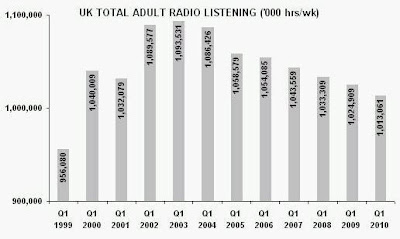
More people are listening to the radio, but they are listening for less and less time. The volume of radio listening, the total number of hours that all UK adults spend listening to the radio, has been declining since 2003. Here is a graph of RAJAR’s own data that shows it:

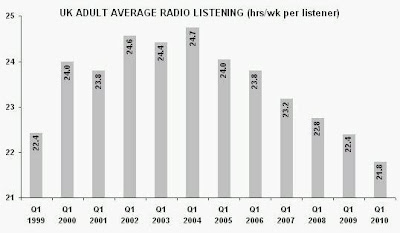
The average amount of time adult radio listeners spend listening to the radio has been declining dramatically over the same period. Here is a graph of RAJAR’s own data that shows it:

Are either of these facts, from the same research, mentioned in the latest RAJAR press release? Of course not. Why? Because RAJAR’s cheerleader role seems to require it to publicise a metric for radio listening that shows an increase: the absolute number of people listening, in this press release.

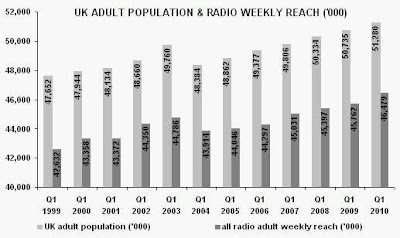
Here is a graph that shows the increase in the UK adult population and the number of people listening to radio. When the estimated population goes up, the estimated number of radio listeners goes up!

The airtime buyers in advertising agencies who have to use RAJAR data on a day-to-day basis probably chuckle at the preposterousness of the RAJAR press releases, laugh at how gullible the media are to simply reprint their headlines, and then go back to their work.

For some people (like me, having analysed radio audience data for 30 years), it creates market confusion. Clients are understandably puzzled and baffled when they see a presentation that clearly shows radio listening is in decline in the UK. They inevitably ask with suspicion: “But didn’t RAJAR just say that radio listening is at an all-time high?”

So why is RAJAR hell bent on this policy of trying to pull the wool over people’s eyes? Why does it need to be a public cheerleader for radio when we already have RadioCentre, the Radio Advertising Bureau and the BBC Press Office, each issuing their own PR puff on the RAJAR results? The RAJAR press releases might convince journalists, but they certainly don’t fool the media industry players. Instead, the opposite effect is probably the case.

How can the radio industry expect to be treated seriously within the wider media sector when its industry ratings body, charged with publishing objective listening data, insists upon grabbing headlines with misleading facts about radio audiences?