An elite academy for aspiring rent-a-gob politicians : 1976 : Durham Union Society

“I’m sorry but you must wear appropriate attire to attend,” the usher told me sternly.

I thought I had been dressed normally enough, but apparently not. I was waving my club membership card, having paid the annual subscription during Freshers’ Week. Only then did I learn that it was insufficient merely to be a paid-up member. Nobody had told me I needed additionally to wear an academic gown to be admitted, one of those flimsy black material things belonging to previous centuries or ghost movies. Since my arrival at university, I had spotted a few students wafting around the streets wearing such gowns and I had considered their fashion sense preposterous, particularly in the ‘Year of Punk’. Why would I waste £37 of my Surrey County Council student full grant on such an anachronistic garment? Now, to my frustration, I was being refused entry to the society’s first debate of the academic year and had to walk the mile back to my college in autumnal darkness.

I was unaware then that Durham University was so normalised to its elite status that it even labelled its relationship with the local population ‘town and gown’. Evidently it never had considered itself an integral part of Durham, one of Britain’s poorest working-class regions, because its students were not drawn from the locality but from some of Britain’s poshest families whose offspring had proven insufficiently academic to gain admission to Oxbridge. I recall my shock during a party at fellow student John Cummins’ town centre flat when I learnt that his parents had purchased that property for the duration of his studies. Whilst processing my astonishment, I rudely fell asleep on his sofa in the midst of the revelling. Only later did I discover that such investments by rich parents were commonplace. (Despite showing little interest in the pop music with which I was obsessed, later John landed a job at ‘The Tube’ music TV show and was then appointed Channel 4’s launch head of youth television.)

Clubs had never been for me. At school, the only one I had joined was ‘Strode’s Film Club’, a sixth-form wheeze by classmate and film buff Martin Nichols to legally screen in the main hall X-rated movies such as ‘Straw Dogs’, ‘Lord of The Flies’, ‘Canterbury Tales’, ‘North by Northwest’, ‘Celine and Julie Go Boating’ and ‘Closely Observed Trains’. Now, as a naïve fresher at university, I had been told it was essential to join numerous clubs, particularly the debating society, so I had paid my money, only to be turned away from its first event. A historian had written in 1952:

“When a young man comes into residence in Durham, in seven cases out of ten he decides to become a member of the Union Society. […] And he is then in the succession of many whose first experience in oratory and official administration, gained in the Union Debating Hall and clubrooms, has stood them in good stead for the rest of their lives.”

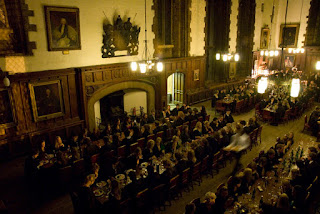
I was unable to benefit from this ‘experience in oratory’ until later in the year when I discovered the club held one annual debate where neither membership nor a gown were necessary to attend in the Great Hall of Durham Castle. It seemed bizarre that the town’s castle operated as neither a tourist attraction nor the home of some wealthy bigwig, but as a college of the university in which 150 students had lived and studied from 1837. Apparently, between the thirteenth and fifteenth centuries, its oversized dining room had been renowned as Britain’s largest ‘Great Hall’. I sat at the back in my usual student-wear to quietly observe a debate dominated by white males wearing gowns.

What I witnessed stunned me. It was difficult to decide what impacted me the most. Adolescents of my age acting as if they were already middle-aged men, seemingly in imitation of their family’s upper-class characteristics. Boys confident enough to stand up and talk loudly and at length on global issues about which they displayed only the most basic understanding. Conversely, their peers not replying with factual corrections because they too were eagerly awaiting a chance to stand up and mouth their own ignorance. Overloud voices and theatrical flourishes as if the debater were the lead actor in a school play. Mob-like cheering and jeering at speakers as if it were some medieval tournament. Rude audience comments shouted out during speeches, eliciting rumbustious laughter. Loud banging of fists on tables and foot stomping like a mob of noisy yobo’s.

What proved most baffling were the moments when a participant whom I vaguely knew would stand up to argue a point of view that I had thought was the opposite of their personal beliefs. It appeared that, in this playground, moral certitude had to be sacrificed to the altar of argument purely for argument’s sake. It was an intellectual game whose purpose was to impress one’s peers with wit and verbosity rather than facts or evidence. The medium WAS the message, not the content that was being spoken … or more often bellowed. During an evening of insufferably posh accents, visions of fencing, guns at dawn and gloves smacked across opponents’ cheeks crossed my mind. It was evident that many of my fellow students must have already practised this parlour game for years in ‘debating societies’ at their private schools … while, in my parallel state school universe, I had been occupied presenting pop music programmes on London pirate radio stations.

At the event’s conclusion, I stumbled outside into the night air, reeling as if I had been returned to Earth after abduction by an alien civilisation. Perhaps you required blue blood to feel at home in there. I resolved not to renew my club membership nor to attend further debates. The academic Sir Walter Moberly had commented in 1950: “Undergraduate debates are not conducted at the deep level at which convictions are really formed.” This notion that an individual can lack personal conviction to debate or argue a point forcefully was a foreign land to me. I could frame an argument for my principles, but why would one propose a point of view that is not one’s own? Unless you never bother with ‘convictions’ and follow a path of merely blowing with the prevailing wind.

It was not until 1990 that Britain’s primary legislature, the House of Commons, allowed its proceedings to be permanently televised, following its eleventh vote on the issue during the preceding twenty-two years. The motion was opposed by then prime minister Margaret Thatcher because “my concern is for the good reputation of this House.” Initially, only close-up shots of the politician holding the floor were permitted because a wider view would have shown the public the faces of their elected representatives jeering, hectoring, desk banging and rabble-rousing during many speeches. This restriction was later relaxed, allowing the rest of the world to witness for the first time the childish habits of grown men who had never moved on from ‘bunfights’ in oak-panelled dining rooms during ‘High Tea’.

Watching those early televised broadcasts vividly recalled the one debate I had attended more than a decade earlier. I suddenly understood that Durham Union Society had been established in 1842 as ‘A Nursery of the [House of] Commons’, as noted a headline in ‘The Guardian’ newspaper. My privileged contemporaries had been in training to become politicians since an early age. Durham had merely been the latest stop on their route to the elevated roles to which they had forever been told they were entitled. Articulating this notion of ‘power’, Sir Winston Churchill had once observed at the Oxford Union: “If you can speak in this country, you can do anything.”

House of Commons rules strictly forbid members to call each other ‘a liar’ or to make an accusation of ‘lying’. As a result, just as I had witnessed in Durham, speakers are permitted to spout any old tosh that comes into their heads and get away with it. How can a critic ‘speak truth to power’ in a forum where the currency of ‘truth’ is not merely devalued but prohibited? Politicians know they can say whatever is expedient in the moment without any recourse, while the rest of us would be sacked from our jobs for what our world considers to be lying.

In my own field, the lack of, ahem, ‘conviction’ of politicians responsible for the British government’s media policy has been evident often. In March 2010 whilst in opposition, Ed Vaizey MP said “the government has set a provisional target date of 2015 [for digital radio switchover] and we are sceptical about whether that target can actually be met.” However, by July that same year and after an election had appointed him the new government’s culture minister, Vaizey conversely said that “2015 is an achievable target date and we will work to support that ambition.” Ho hum.

During the period when I seemed to be the only City analyst covering the radio broadcast industry, I would occasionally be contacted by the BBC to be interviewed for a programme. Before sunrise one day, a BBC car collected me from home to take me to the studios of the ‘Today’ programme on ‘Radio 4’ for a live item about digital radio switchover. On arrival, I was told that I would be answering the presenter’s questions and then the government minister would be introduced and quizzed. However, the minister had insisted that I not be permitted to follow up or respond to what he would be saying. It was obvious that my presence in the studio would suggest a semblance of ‘balance’ whilst not actually allowing genuine debate or argument.

I had arrived at the BBC early and spent an age waiting in the show’s ‘green room’. The minister arrived late, accompanied by a flunky, entered the room and said to me: “So you are the person they have brought here to tell me that everything I am about to say is wrong.”

Just as I had witnessed in Durham, patronising privileged toffs like him function in a world where they insist upon immunity from contradiction or correction to the drivel they shout. Despite my anger at his comment, I followed the instructions for that morning’s appearance, but have refused every BBC invitation since. Where there is purposefully no genuine debate, what would be the point?

Is this the “honourable tradition” maintained by graduates of debating societies like Durham Union Society, the phrase attributed to the club in 1952 by its historian who suggested it:

“… should always retain at least some its present rooms as a gentlemen’s club. There may it long offer to future generations those opportunities for the making of friendships, for argument, and for training in life and thinking …”?

‘Training’ for a ‘life’ as a conviction-free politician?

[Originally published at https://peoplelikeyoudontworkinradio.blogspot.com/2023/11/an-elite-academy-for-aspiring-rent-gob.html]

One good turn deserves a cold shoulder? : 2004 : BBC World Service Trust, Phnom Penh

“I understand you’re an expert in messaging,” said the woman sat behind the desk.

I looked blank. I had absolutely no idea what she was talking about. If she meant SMS text messaging, I did not even own a mobile phone!

“I was told you are experienced in capacity building,” continued the woman, undeterred.

I looked even more blank. What on earth was she talking about? I had just flown half way around the world. This was my first meeting with the boss of the project where I was to work. Yet I had zero understanding of what she had just said. I began to wonder if the office back in London had mistakenly sent the wrong person (me) to the wrong location (Phnom Penh, Cambodia). Did she think I was someone else? I had been sent here to do radio training. Had the international wires become crossed somewhere?

It took me several weeks to understand that Giselle Portenier, manager of Cambodia’s BBC World Service Trust project, had been addressing me in ‘NGO-speak’, an esoteric language I had never before encountered. People working in such ‘Non-Governmental Organisations’ (er, international charities) apparently use terminology that substitutes long words for concepts which the rest of the world refer to with short words. Some might call this professional obscurantism.

During my first week, Portenier insisted I attend a two-day workshop organised by the Centre for Disease Control concerning drama programmes created to communicate health issues to the population. My takeaways were that NGO staff love the sound of their own voices and try their utmost to turn simple tasks into overcomplicated diagrams and flow charts. I strained to stay awake in Cambodia’s oppressive daytime heat and quickly tired of hearing NGO people talk to each other in a language that was apparently English, but might as well have been Mongolian for all I could understand. Luckily, I managed to excuse myself from a similar two-day workshop about ‘messaging’ the following week.

Why was I in Cambodia? In July 2002, I had been unemployed and applied in desperation for an advertised role with the BBC World Service Trust in Ethiopia. The only thing I recall about that interview was sitting alongside dub poet Benjamin Zephaniah (born two days before me!) in the lobby of Bush House. Having neither attended Oxbridge nor benefited from a family member or acquaintance employed in the Corporation, I was hardly surprised to receive my thirty-seventh consecutive BBC rejection letter. The Holy Grail I had coveted since childhood was receding further over my horizon with every CV submitted.

Fast forward to December 2003. I was in a dead-end job at Ofcom where my line manager Neil Stock had met me on Christmas Eve to say “there is nothing for you to contribute to” the media regulator’s work schedule during the first quarter of the next year. I had just discovered a voicemail message on my work phone from the BBC, asking if I was the ‘Grant Goddard’ who had applied for a job the previous year. My contact details had proven a dead-end and it had resorted to contacting a referee in the United States I had listed who advised that I now worked for ‘The Radio Authority’ … which was found to have closed. I phoned back, confirmed it was me and explained that I had since changed address. Would I be interested in a consultancy role lasting two to three months? Though I had accrued eight weeks’ unused holiday at Ofcom, it refused me paid or unpaid leave to pursue this opportunity … so I resigned.

Roy Head, director of the BBC World Service Trust’s health division, explained by phone that a contract had recently been signed between the Cambodia government and the Corporation to train local staff at two radio stations to produce phone-in shows around health issues. A decade earlier, he had managed the United Nations’ radio station ‘UNTAC’ in Cambodia. Head confided that, only after signing this contract had he discovered that the BBC’s ‘executive producer, radio’ in Cambodia, despite having held numerous posts within the Corporation since 1987, apparently had no experience producing a live radio programme. Neither had the Cambodia project manager who had produced television documentaries for the BBC since 1986. I respected Head’s honesty when he admitted my involvement would help him out of a very large hole. The Cambodia government was becoming increasingly impatient for the training to start, necessitating my arrival as quickly as possible. Yes, the pay (£750 plus US$100 pocket money per week) was not great because it had had to be unexpectedly eked out of an existing budget, but Head promised me better paid similar BBC work afterwards if I would solve his pressing problem.

I nearly never made it to Cambodia. The nurse I was mandated to visit at BBC White City could not locate the required ‘BCG’ vaccination on my left arm and threatened to block my departure for several weeks to redo it. Was I born in Britain? Yes. Did I have paperwork proving I had received the vaccine? Er, I was a child. Where did I receive it? In a health clinic, long gone, at the corner of Upper College Ride and Saddleback Road on the Old Dean Estate in Camberley, 200 metres from the house in which I had been born. After an extended interrogation, as a last resort she inspected my right arm and found a faint tell-tale circular mark there, and expressed astonishment that I was the first person she had encountered with it on the ‘wrong’ arm. All I could presume was that some nurse in the 1960’s had decided it would never matter as council estate children were destined to go nowhere anyway.

On arrival in Phnom Penh, my line manager Chas Hamilton invited me to homemade dinner in his flat and filled my head with gossip about his BBC colleagues. He was particularly incensed that his boss Portenier, before her recent arrival, had allegedly demanded her flat be remodelled at considerable public expense to include, shock horror, a sunken bathtub. As a short-term consultant (given BBC contract number WST001), I preferred to avoid such office politicking. I chose to keep my burning question – how is a BBC employee promoted to a radio management role without having produced a live radio programme? – to myself. The Corporation evidently worked in mysterious ways.

After a morning visit to one of the radio stations in Phnom Penh at which I would be working, the Cambodian BBC driver was en route to the office when I requested he stop for me to buy a takeaway lunch.

“I will take you to a hotel for lunch, sir,” he kindly offered.

“No, thank you,” I said. “I can buy something at one of these roadside shacks and eat it at the office.”

“But they only serve noodles, sir,” he explained patiently.

“Yes, and that is what I want for lunch,” I insisted.

Despite his complete puzzlement, he parked the BBC four-wheel-drive alongside a random food stall, translated my order into Khmer and, minutes later, I left clutching a knotted transparent plastic bag containing my freshly stir-fried order for less than a dollar. At the BBC office, I went to the kitchen, requested a plate, emptied out my food and sat at the dining table to eat it, much to the amazement of the Cambodian staff. My new colleagues found it hard to believe that I ate noodles at home all the time.

From that day forward, I joined the local staff for lunch daily in the BBC kitchen, with between five and fifteen of us gathered around the large dining table for the mandatory two-hour break inherited from French colonialists. Each of us paid the BBC kitchen manager a dollar a day to take our preferences and venture out to numerous street stalls to fulfil our orders. The food was always fantastic and the company was excellent, though I could not understand the Khmer chatter. The project’s Cambodian receptionist sidled up to me and explained with awe:

“In all the time we have been here, not one of the foreigners working here has sat down and ate our food with us, except on special occasions such as Chinese New Year.”

So where did all the ‘foreigners’ go every day? On one occasion, sat at the kitchen table ready to eat lunch, Portenier approached me and insisted I accompany her and the other ex-pats ‘out’. We were driven in several cars to an international hotel that appeared completely devoid of guests, where we were offered menus and then waited over an hour in the lobby for our dishes to arrive. The food, the surroundings and the conversation were all mediocre, though I presume that the BBC was picking up the tab for its employees’ daily lunchtime jollies to various Phnom Penh hotels. Thankfully, I was never invited again.

The BBC had initially ordered my air ticket to return to London three months later. As my work was still far from complete, I had to spend three hours sat uncomfortably on a long wooden bench in a tiny Phnom Penh travel agency that attempted to change the date … unsuccessfully. I decided unilaterally to use the ticket (rather than waste it) to fly home for a quick visit, only to discover that Roy Head, having sent me to Cambodia, was no longer with the BBC, reportedly having become ill after a work trip to Brazil. Back in London, I was called to a meeting with his successor at Bush House, a brusque woman who demonstrated little interest in my work but asked me to spy on my line manager Chas Hamilton and report what he was or was not doing. I refused. I had been hired as a consultant solely to train people in radio, not indulge in espionage. The BBC booked my new ticket to return to Cambodia a week later and gave me boxes of radio equipment to transport in my heavily surcharged, overweight suitcases.

Returned to Phnom Penh, when one of my station projects was about to launch its new weekly live youth phone-in show, I drafted a press release and asked Portenier to approve it, transpose it onto BBC notepaper and circulate it through established PR channels. She refused. I was perplexed. Surely it was positive news to herald the successful completion of part of the BBC’s contract with the Cambodia government. Apparently not. In order not to disappoint the radio station’s production team with whom I had worked so closely for months, I was reduced to secretly commandeering a BBC car and driver when Portenier was absent from the office in order to hand deliver to each of Phnom Penh’s newspapers my press releases in Khmer and English that omitted mention of the BBC’s involvement.

This negative response was very dispiriting as it appeared that neither my local project manager, nor my local line manager, nor the replacement BBC manager in London seemed even vaguely appreciative of my success saving their bacon. My second radio station project was almost ready to launch too but I considered now was a good time to return home, having already spent twice as long in Cambodia as my contract had required. The local BBC staff organised a fantastic farewell party for me in the office and gave me presents. Neither Portenier nor Hamilton attended. To be accurate, Hamilton arrived at work after it had finished. At the airport, several of the wonderful Cambodian radio station staff I had trained arrived unexpectedly to see me off. They cried. I cried. They and the lovely local office staff had made my work worthwhile.

By the time I landed in London, my BBC e-mail account had already been cancelled, preventing continuing contact with my colleagues in Cambodia. I sent Portenier an email apologising (ahem!) for not having seen her before I left and thanking her for “all her help”. Her reply lacked a shred of gratitude:

“I know you were planning to do a handover report for David. Did that happen? I know he tried to get in touch in England, but failed.”

My BBC contract had not required me to write a report. Besides, in Cambodia I had been fully occupied each week spending four days from 8am to 5pm training two teams, one day in the radio studio and two days preparing materials for my next sessions, without any BBC input. Meanwhile, the project’s head of radio seemed to have spent most of his time sat in his cosy BBC office. Neither did I know who ‘David’ was. Nevertheless, I offered my services to help out for free in the BBC’s Bush House office, hoping to avail myself of future opportunities. I submitted six applications for advertised vacancies in the BBC World Service Trust during 2004 and 2005, for one of which I was interviewed, but without success. Nobody in the BBC thanked me for my work bailing it out in Cambodia or offered me the better paid, follow-on opportunities I had been promised. I had no idea how to contact Roy Head once he had left the BBC.

When I signed on for Unemployment Benefit, my most recent work in Phnom Penh was viewed suspiciously because, whilst I had been away, British tabloid newspaper front pages had splashed stories about 1970’s pop star ‘Gary Glitter’s exploits with underage boys in Cambodia. The young ‘JobCentre’ officer instructed me to apply for a radiology vacancy in a local hospital, not comprehending it was totally unrelated to radio production.

Giselle Portenier completed one year in charge of the Cambodia project before leaving the BBC and returning to Canada.

In 2006, Chas Hamilton lauded the youth phone-in radio show I and my trainees had created as the project’s “most popular”, noting that “all members of the production team … had no previous media experience before we plucked them from university and trained them.” His invisible ‘executive production’ role while I was there had apparently proven so successful that the BBC promoted him to manage their entire Cambodia project. I hope he enjoyed the accompanying apartment’s sunken bathtub he had seemed to envy so much.

[Originally published at https://peoplelikeyoudontworkinradio.blogspot.com/2023/11/things-you-say-you-love-youre-gonna.html]

I can't dance to that music you're playin' : 1970 : Emperor Rosko, The Paris Theatre, London

 “Would you like to dance?” the girl asked.

I was dumbfounded. Nobody had ever asked me to dance. Particularly a girl!

“Er, no thanks,” I mumbled pathetically.

“Oh, go on, please,” she chivvied. Anyone else would have been flattered. But me? I was terrified. 

“Sorry, but I can’t dance,” I tried to explain. The girl looked disappointed but gave up and walked back to the stage. It might have been the beginning of a beautiful friendship. But I blew it.

It was true. I have never been able to dance. Too self-conscious. Too buttoned-up in that English way. The last occasion I recall dancing wildly was the 1977 Trevelyan College Summer Ball to which fellow student Zena Carter had generously invited me and whom I must have embarrassed immensely with my feeble attempt at ‘Saturday Night Fever’ moves I had just seen at Durham’s cinema. All the posh male students in attendance wore black tuxedos, while I looked completely out-of-place in a borrowed white suit, jigging around to the local live band ‘No Exit’ featuring a certain ‘Sting’. I still cringe. Three years later, my job would be adding hit songs by his next band ‘The Police’ to local station ‘Metro Radio’s playlist.

But that was in the future. Back in 1970, another reason I turned down the girl’s invitation to dance was that I had become terribly shy. At primary school I had considered myself no different from my classmates. Then, after moving to grammar school in 1969, I was developing a creeping sense of inferiority, not comprehending why my termly school reports criticised me for not being sufficiently vocal in class. Achieving classwork and exam results near the top of my year of sixty students was seemingly judged insufficient unless you flaunted your cleverness by regularly sticking up your hand in class and pushing yourself in front of teachers. In my new ‘streamed’ school, populated by many privately educated ‘prep school’ protegees, it appeared a boy might inexplicably be considered deficient for simply being ‘quiet’ and demonstrating no interest in blowing his own trumpet. I responded to my school’s reproaches by retreating into shyness in company … which dogged me for decades to come.

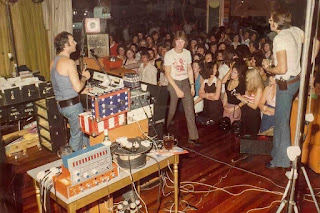
I might have felt less self-conscious about the girl walking up to me in the end seat of the fourth row on the left side of the centre aisle, had my mother not been sat right next to me. I was embarrassed. I was twelve years old, though I appeared older because of my height. I had written to the BBC Ticket Unit to request a pair of tickets to attend the live broadcast of Emperor Rosko’s Saturday lunchtime ‘BBC Radio One’ show at London’s Paris Theatre. None of my new schoolfriends appeared to be interested in the music I followed, so my mother had accompanied me on the train from Camberley.

The Paris Theatre had been an art-house cinema showing French films in Lower Regent Street until the BBC acquired it in 1946 and equipped it with a radio studio to record concerts and live comedy shows before a seated audience of around 400. From 1968, the weekday lunchtime ‘Radio One Club’ show had been broadcast live from the venue, hosted by a station DJ and showcasing a live band in front of an audience who had all sent to the BBC for their ‘Club’ membership cards. It was the station’s earliest attempt at outreach to its listeners and, by the 1970’s, was extended from London to cities around the country. In 1974, it was replaced by the touring ‘Radio One Roadshow’ whose format was similar to the large summer outdoor events Rosko had been organising independently since the 1960’s.

I was a huge fan of Rosko’s weekly radio show because he played reggae and new American soul records as yet unreleased in Britain. At that time, when around 100 new singles were released a week in the UK, record companies would wait to see which American singles proved successful in North American charts before committing to a British release date. This delay could be months, often allowing British pop artists to ‘cover’ American soul hits before the original was available in shops. My parents owned Julie Grant’s single of ‘Up On The Roof’ which had reached number 33 in 1962, but they had never heard the original by The Drifters which failed to chart in Britain. Grant successfully parlayed her chart success into several television appearances and a concert tour with The Rolling Stones, another British act recycling American black music at the time.

Each week I would record Rosko’s 90-minute Saturday show onto an audiocassette and listen to it repeatedly on headphones while I did my homework, before recording the next show over it the following weekend. This was the first occasion I heard James Brown’s ‘Sex Machine’ single, Rosko playing the A-side one week and its B-side the next. It changed my life! Many outstanding tracks like this recorded onto my cassette I went on to buy as imported American singles from ‘Contempo’ at 42 Hanway Street or ‘Record Corner’ in Balham, the main retailers for new American black music as yet unreleased in the UK. Many of those songs first heard on Rosko’s show I still know by heart and treasure to this day. Without the benefit of a black music radio station in Britain (London soul pirate ‘Radio Invicta’ did not launch until December 1970), Rosko was the nearest experience available, even though he mixed reggae and soul with some pop and rock tracks.

What marked Rosko’s shows out from the rest of ‘Radio One’s output was that he simultaneously operated a mobile discotheque (the ‘Rosko International Roadshow’) and compered concerts by American soul artists touring the UK. That gave him a unique insight into the specific music British audiences wanted to hear, something that many of his studio-bound radio colleagues did not understand. The other factor was that Rosko was allowed to choose his own records to play on the radio, whereas the music in most shows was selected by ‘Radio One’ producers, the majority of whom preferred twee British novelty acts to ‘foreign’ reggae and soul. These ‘gatekeepers’ could determine through national airplay whether a record was to become a hit or not in Britain, so the charts inevitably reflected their value judgements.

I was fascinated when analysing the British singles charts from this period to discover the volume of chart-topping pop songs that are never played as ‘oldies’ nowadays because they sound embarrassingly quaint or sentimental. Compare that to the significantly lower chart positions achieved by many black music recordings considered now to be ‘classic’ or ‘standards’ [documented in my book ‘KISS FM’]. It is forgotten just how ‘white’ the BBC’s popular music station sounded overall, despite valiant attempts to play more soul by daytime DJ’s Tony Blackburn and Dave Lee Travis. My appreciation of reggae was sparked by Rosko but had to be developed by evenings tuned to ‘Radio Luxembourg’ which Trojan Records paid to play their latest reggae releases. In 1971, singer Nicky Thomas even recorded the song ‘BBC’ to chastise ‘Radio One’ for not playing enough reggae, its release accompanied by a protest march to Broadcasting House. This had no evident impact on the station’s producers who were almost exclusively recruited from the white middle-classes and who moulded ‘Radio One’ in their own image.

This was why my visit (without dancing) to the Paris Theatre that Saturday was to become such a memorable experience, having enjoyed some of my favourite soul and reggae tunes played loudly through Rosko’s enormous sound system loudspeakers. When the girl asked me to dance, Rosko had been playing Edwin Starr’s ‘War’, a remarkably innovative Motown production by Norman Whitfield recorded to protest the Vietnam War with its chorus: “war … what is it good for? … absolutely nothing!”

A few years ago, I created a Spotify playlist of several hundred Whitfield productions, such remains my unbridled enthusiasm for his work (often with songwriting partner Barrett Strong). At the beginning of October this year, something prompted me to return to this playlist and update it with songs Whitfield subsequently recorded for his own label, notably by Rose Royce. I spent the following days listening non-stop to songs from my enlarged playlist such as ‘War’, ‘Stop The War Now’, ‘Friendship Train’, ‘Unite The World’ and ‘You Make Your Own Heaven And Hell Right Here On Earth’ all recorded half a century ago, all explicitly criticising violence and promoting peace. This was the music I was listening to only days later when news broke of atrocities committed in Israel. The music was appropriate … but the timing was inexplicably spooky.

[Originally published at https://peoplelikeyoudontworkinradio.blogspot.com/2023/10/i-cant-dance-to-that-music-youre-playin.html]

The unmagical mystery tour : 1973 : Piggott’s Manor, Letchmore Heath

 There was a loud knock on the front door. Who could be visiting unannounced after dark? Certainly not Mr Dickinson from ‘The Pru’ who always called during daylight hours to collect monthly premiums in cash for our insurance policy. The opened door revealed two men in uniform whose van parked outside had a strange aerial on its roof. What had my father done? Was he about to be forcibly dragged away from our suburban Orgonon? No. The men said they were from the Post Office’s Radio Interference Service and were investigating a recent spate of complaints from residents in surrounding streets of strange patterns interrupting their television viewing. Could they come in and inspect our equipment?

My parents’ enthusiasm for modern gadgets had equipped our living room with one of Camberley’s first state-of-the-art Bush colour televisions to receive the ‘BBC2’ service launched earlier in 1964. It had required the installation of a different aerial on the roof and an amplifier to successfully receive the UHF signal from a far transmitter. Although our own television reception had been fine, the men from the ministry believed that the amplifier must be faulty, transmitting interference instead of receiving signals, a problem they had sleuthed to our house. We were required to switch off the amplifier and temporarily refrain from watching BBC2. Hullabaloo and Custard had sold us a technicolour dream though I was now to be deprived of my daily look through the square or round window with Big Ted and Jemima.

The technical problem was eventually fixed and our BBC2 viewing resumed, even after the annual Licence Fee was doubled to £10 in 1968 for the 20,428 UK households that owned a colour TV, a dismal figure that betrayed the initial failure of the technology’s launch. We missed the first black-and-white BBC1 transmission of ‘Magical Mystery Tour’ on Boxing Day 1967 because we always spent the holiday at my grandparents’ house next door, stoically without a television. Instead, we gathered in our living room expectantly on 5 January to watch BBC2 repeat the programme in colour. This film premiere had been trailed as an artistic triumph for the world’s biggest pop group.

My parents owned all The Beatles’ albums to date and had watched their films at the Camberley Odeon. Earlier that decade, my father had bought a second-hand Uher reel-to-reel tape machine and had recorded the group’s performances broadcast live on the BBC Light Programme with a microphone held to the speaker, while his family was ordered to remain silent. The resultant tapes were played repeatedly in our house at high volume, years before homemade audiocassette compilations became possible and decades before Spotify would offer the same outcome at the press of a mouse button.

Once the 52-minute film of embarrassingly indulgent pop icons acting sillily in and around a bizarre coach trip had ended, we looked around to gauge each other’s reactions. It had been an incomprehensible and barely entertaining viewing experience, we agreed. The next day at school I wrote a short account of our evening in my ‘day book’ and drew an accompanying colour picture. No classmates had watched the film. My female teacher likely presumed my parents to be hippies. Our home’s complete collection of Beatles albums came to an abrupt halt. My mother transferred her musical affections to non-stop Herb Alpert.

After this artistic disappointment, The Beatles faded from my childhood. I learned that John Lennon had moved into a mansion (‘Tittenhurst Park’) in nearby Ascot when one of my father’s clients was appalled to discover the identity of his new neighbour. I recall our family being dragged along by my father to walk around Bruce Forsyth’s house on Wentworth Drive as a possible home, the estate agent spouting that a Beatle lived nearby (Tittenhurst Park is 1.6 miles away). I was excited by our potential neighbour but appalled to contemplate a home adjacent to a golf course in the middle of nowhere. Luckily it never happened.

Years passed during which our family circumstances changed irreversibly. One morning in 1973, my father turned up unexpectedly at our home and insisted I accompany him on a trip. I adamantly refused but my mother insisted I go, hoping I might learn something about my father’s current ‘circumstances’. Only months earlier, he had quit our home for good and since had done his best to humiliate and impoverish his former family. He had even gone to court to demand regular access to his two-year-old daughter whom he had never wanted in the first place. One Friday a month, he would turn up and drive off with my baby sister, leaving my mother fretting inconsolably the whole weekend as to whether we might ever see her again. What ‘childcare’ my father provided at weekends we never learned, as he had been notably absent in his other children’s upbringing and his new lover was a mere teenager.

There was no conversation during our car journey. Not LITTLE conversation, NO conversation. My father talked though I said absolutely nothing. He still drove his left-hand-drive American Motors Javelin AMX sports car as fast and recklessly as he ever had, breaking speed limits, overtaking on blind corners and generally terrifying me. Only the air conditioning kept me cool. I hated being there. Since leaving our home, my father had ignored me, ignored my birthday, ignored Christmas and sustained his total disinterest in my life. I had no respect for him because he had never done anything to earn respect from me. He seemed not to have the faintest idea of what a father should say or do for his children. Tellingly, after he had left, I never missed my father at all. Rather than tears, I felt relief. Why would I miss someone who had only ever used my talents to further his own greedy ambitions?

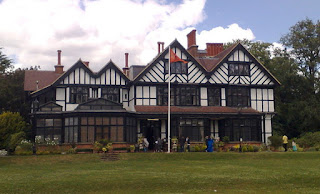
After an hour and a half of stoney silence, we had travelled past Elstree and arrived before a huge mock-Tudor mansion in extensive grounds. He parked facing the front of the house and its luxurious lawns, telling me he had to go inside for a meeting and would leave me in the car for a while. I was just pleased not to have to suffer any more of my father’s dangerous driving and not to have to be in the company of someone who had always felt like a stranger to me. I switched on the car radio and listened to music.

I saw lots of people all dressed in similar orange medieval-style robes coming and going from the mansion and walking along its driveway in singles and in groups. I had never seen anything like it. Not in Britain anyway. I had seen photos of Buddhist monks in picture albums of faraway lands. But it felt eerie to be seated in a car in deepest rural Hertfordshire, surrounded on its driveway by people who looked as if they had materialised en masse from another dimension and a different time. What was I doing here and, more to the point, what was my father doing here?

Only later did I learn that Beatles member George Harrison had recently purchased this property with its seventeen acres of land, then known as Piggott’s Manor, and donated it to the Hare Krishna religious movement that had outgrown its Hindu temple in central London. The property was renamed Bhaktivedanta Manor and immediately attracted a huge volume of visiting devotees, the religion’s membership having been boosted by Harrison’s very public advocacy since The Beatles years. In the present day, 60,000 visitors annually are reported to attend its religious festivals.

For me, the irony of our visit that day was that my father’s life could not have been further from the altruistic philosophies of the Hare Krishna movement. I knew he had no interest in religion and had probably never even visited a church. If he was here, it must have been for his professional advice as a quantity surveyor. Perhaps modifications were necessary to this mansion as it had functioned as a nurses’ training college since 1957, owned by St Bartholomew’s Hospital in London. How could he have hustled this appointment? We knew from my father’s court papers that he claimed now to be living in the gated, 420-property St George’s Hill estate in Weybridge, home to many pop and entertainment celebrities, including John Lennon (before his move to Ascot) and Ringo Starr.

Did I meet George Harrison? No. Was I invited inside the mansion to hold the end of my father’s tape measure, a task required of me since I could walk? I honestly cannot remember. What happened next? I know he drove me home … again in silence. I was so consumed by the pointlessness of our father/son ‘road trip’ that almost everything else that had occurred was immediately eclipsed in my mind. Why had he insisted I accompany him? Was he trying to impress me? Was he trying belatedly to demonstrate his credential as a father? Or had he imagined I could help him secure a new client? I have no answers. It became our final day spent (un)together.

Half a century later, I was watching the 1969 Beatles footage in the fascinating 2021 ‘Get Back’ documentary when I noticed a Hare Krishna member who had accompanied George Harrison sat cross-legged on the floor of the group’s recording session. Memories of one of the strangest and most unrewarding days spent with my father came flooding back.

[Originally published at https://peoplelikeyoudontworkinradio.blogspot.com/2023/07/the-unmagical-mystery-tour-1973.html]

This is your early morning trunk call : 2004 : BBC World Service Trust, Cambodia

[Malene, BBC World Service Trust, Phnom Penh, 2004]

 I pull back the bedroom curtains and, from my window, see a huge elephant ambling along the promenade above the Mekong River. I know it must be 6:30 a.m. Every day at this time Sam Bo, the only elephant in Phnom Penh, walks to his day-job giving rides to children around the base of the city’s only hill. The street beside him is already filled with rush-hour traffic, since most shops and offices open daily at seven. Weaving in and out between huge chrome-clad and tinted windscreen four-by-fours driven by NGO staff and government officials are hundreds of motorbikes, which have totally replaced the humble bicycle as Cambodians’ preferred mode of transport. If there is a Highway Code, nobody seems to have read it. Confusingly, traffic travels in both directions on both sides of the road and often on the pavement too.

You see young schoolchildren riding motorbikes to school, and parents carrying three or four children precariously on a single bike. I have seen a motorbike carrying a full-size palm tree, another loaded with an iron girder which could easily have decapitated someone, and a bike carrying three dogs, one of which had its paws on the handlebars. Few people wear crash helmets, but most wear surgical masks (available in various colours from market stalls) to keep the dust, pollution and bugs out of their mouth and nose. Phnom Penh is the L.A. of Asia – nobody walks. What were once pavements are now clogged with parked cars, row upon row of parked bikes, impromptu shops, and families sat on plastic patio chairs selling petrol in old soft drink bottles from the kerb. The few people who walk around this city – the very poor and foreigners – are forced to negotiate the gutter, where we risk being hit by bikes coming at us from all directions.

In the morning, I work at the Women’s Media Centre of Cambodia where I am training four enthusiastic staff to produce a youth phone-in show that launches in May. They are very excited that the Centre has just been nominated for this year’s One World Broadcasting Trust Special Award for Development Media. The team share an office in the Centre which they have proudly designated the ‘BBC Office’, even though they are not BBC staff. The only drawback to working in this beautifully airy, purpose-built broadcast centre is that we are shadowed by a massive transmitter mast in the car park that broadcasts the Centre’s radio station ‘FM 102’ to 60% of Cambodia’s population. Although the custom is to remove one’s shoes before entering the building, staff have to don flip-flops to use electrical equipment such as the photocopier, or risk electrocution from the mast’s 10kW electrical field (as I found out to my peril).

At lunchtime, almost everyone goes home for a two-hour siesta that offers slight relief from the constant 35-degree daytime heat. I take lunch at the real BBC office – a villa whose walled garden includes luscious banana and mango trees – with the handful of the thirty local staff who live too far away to return home. Malene, one of two BBC housekeepers, purchases our food from the plethora of nearby pavement snack stalls, according to our culinary preferences, at a cost of less than a dollar each. Dishes are always accompanied by boiled rice or noodles, though Malene once glowed with pride when she presented me with a plate of chips procured from who knows where.

After a productive afternoon working at the Women’s Media Centre, I walk home past a school when a girl, aged about eleven and dressed in regulation white blouse and navy skirt, rushes out of the school gates, runs across the road and, without a hint of self-consciousness, starts a conversation with me in perfect English. After a minute, she sees a motorbike taxi stop outside her school gates, bids me farewell, jumps on the back (side-saddle, as is customary for girls) and waves goodbye as she disappears down the street. She inspires confidence that the future of this country will be bright in her generation’s hands.

[First published in ‘Ariel’, 11 May 2004, p.3]

[Originally published at https://peoplelikeyoudontworkinradio.blogspot.com/2023/04/this-is-your-early-morning-trunk-call.html]

Growing DAB radio usage in the UK. Confused? You should be!

“Digital listening at an all-time high,” shouted the headline of one online news story. Yes, it was the quarterly RAJAR radio ratings, offering opportunities for some journalists to pitch their stories just about any which way they wanted. The opening sentence of this particular report said:

“The digital revolution shows no signs of slowing down, and not even the radio airwaves are set to maintain their analogue tradition, as a new [RAJAR] study suggests.”

Hardly. This news story was interesting because it achieved two simultaneous feats of confusion:
• ‘DAB radio’ and ‘digital radio’ are two different things. ‘DAB’ is the platform on which the UK radio industry bet the farm in the 1990s. ‘Digital radio’ is radio received on any platform that is not analogue (AM/FM) and includes the internet, smartphones, digital TV … and DAB
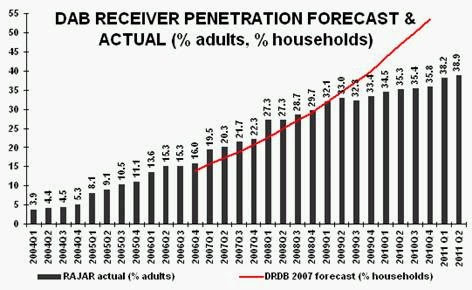
• The fact that DAB listening is growing does not necessarily mean that it is replacing analogue listening at a rapid rate of attrition. Why? Because DAB listening, even after 12 years, is still at a remarkably low level.

These confusions are not accidental. At every opportunity, statements made by Digital Radio UK have sought to confuse the public by referring to ‘digital radio’ as if it means precisely the same as ‘DAB radio.’

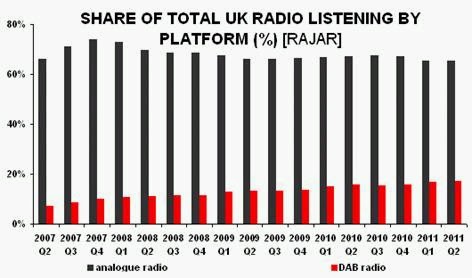
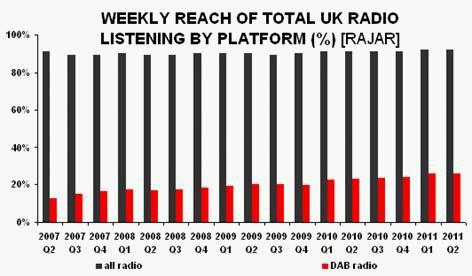
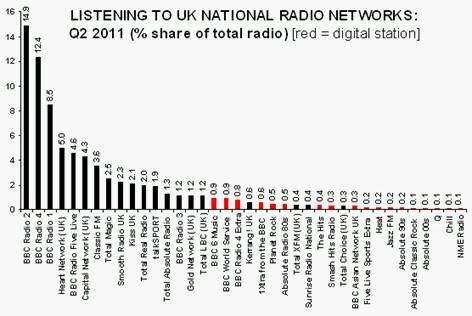
A look at the graphs below of the latest RAJAR data illustrate clearly that the “analogue tradition” in radio remains so dominant that the real question to be asked is: how come DAB usage is still so low after so many years and after so much money has been invested in content, transmission systems and marketing?

The adage ‘a picture speaks a thousand words’ has never been more true than with DAB/digital radio usage. The four graphs above – all taken from the industry’s latest RAJAR data – say it all by showing:
• how little impact DAB radio has had on analogue radio usage in the UK
• how slow the rate of growth is of DAB receiver take-up and of digital radio station listening.

Far from radio losing its “analogue tradition,” as the news article asserted, the old FM/AM platforms look, from these data, to be as strong as ever in the market.

One hint that some digital radio stations on the DAB platform could be on their way out is the BBC’s latest decision to aggregate listening for Radio 4 and Radio 4 Extra in RAJAR. It had been doing this from the outset for Five Live and Five Live Sports Extra, on the premise that ‘Sports Extra’ was only a part-time broadcast station.

I would not be at all surprised to see the BBC:
• similarly aggregate Radio 2 listening with 6 Music
• similarly aggregate Radio 1 listening with 1Xtra
• downgrade its digital radio stations from full-time DAB broadcast stations to online, on-demand ‘extra content’ available via RadioPlayer, iPlayer and applications.

The problem with national broadcast BBC radio stations, whether analogue or DAB, is that the BBC Charter insists they must be made available universally to all Licence Fee payers. Given the huge cost of extending the BBC’s national DAB transmission multiplex to near-universal coverage equivalent to FM radio, particularly at a time when the BBC is having to cut budgets massively, it would be more sensible to downgrade ‘1Xtra’, ‘2Xtra’ and ‘4Xtra’ to ‘red button’ status whereby they offer additional content on a part-time basis. The consumer would access these Extra ‘stations’ via a complementary platform (IP) rather than the BBC having to shoulder the financial burden of programming them as 24-hour broadcast entities.

It would prove a convenient solution for the BBC. As it found with 6 Music last year, public controversy surrounds any decision to close a radio station, however small its audience in absolute terms. Alternatively, by pursuing the ‘Extra’ route, the digital stations can be re-branded, re-purposed and re-platformed away from expensive, fixed-cost DAB and towards IP, where the cost of delivery varies proportionately with the number of people using it. What better way to deliver value for money to Licence Fee payers? And what better way not to face public wrath for ‘closing’ a digital radio station.

As BBC Radio 2 DJ Steve Wright said on today’s Broadcasting House show:
“Maybe full digitisation [of radio from FM/AM to DAB] may well take thirty years …”

As the graphs above demonstrate, there IS slow growth in DAB usage, but the rate is insufficient to replace analogue radio as the dominant consumer platform any time soon. It’s time for BBC strategy to catch up with that reality.

UK listening growth demonstrates radio's strengths in a multi-tasking world

The latest RAJAR ratings data for Q2 2011 demonstrate the continuing strength of the radio medium in recession Britain. Maybe if your TV or mobile subscriptions are having to be pruned, you turn to radio instead. In times of austerity, one of radio’s greatest attributes is that it appears to consumers to be available ‘free’ at the point-of-use.

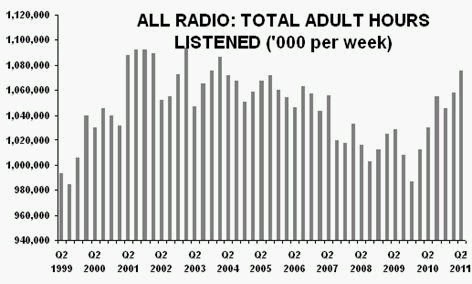
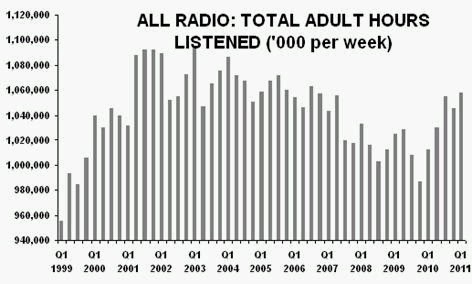
‘All radio’ listening (1,076m hours per week) is at its highest since 2003. Adult weekly reach is 91.7%. Each listener spends an average 22.6 hours per week with ‘radio.’ These are impressive numbers. In this respect, it is important to remind ourselves that the RAJAR definition of ‘radio’ excludes:
• ‘listen again’ consumption of broadcast radio (online catch-ups of ‘The Archers’, for example)
• all podcasts
• listening to pure online radio stations
• listening to online music streaming services or personalised online radio (Last.fm, Spotify, etc).

If these additional ‘radio’ consumption sources could somehow be added to the RAJAR data, it looks likely that, using a wider definition, ‘radio’ would be performing at an all-time high. This is not at all surprising in our time-precious, multi-tasking world. Radio proves the perfect aural accompaniment to online social activities, whereas it is nigh impossible to watch television or read a newspaper at the same time as you browse the internet. Radio is a secondary medium – it never monopolises your time.

Commercial radio has benefited from this uplift in total radio listening. Total hours listened to commercial radio (470m per week) have risen from what is beginning to look like a nadir in early 2010.

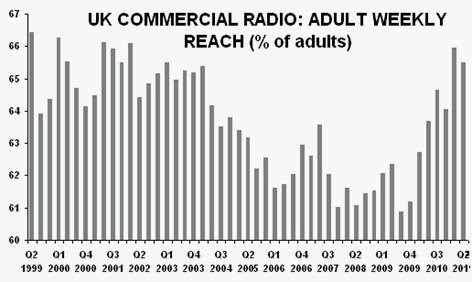
During the last two quarters, commercial radio’s adult weekly reach has jumped above the 65% threshold (65.5% in Q2 2011) that had not been breached since 2003.

In absolute terms, commercial radio’s adult weekly reach has almost caught up with the UK population growth experienced since 1999, rising to 34m in Q2 2011, marginally below its all-time high the previous quarter.

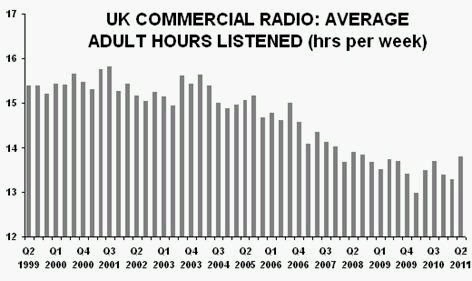
The remaining stumbling block for commercial radio is that its average hours consumed per listener remain stubbornly low (13.8 in Q2 2011). As noted previously, young people are spending less time with radio [see blog]. Commercial radio’s audence is considerably more youth-orientated than BBC radio, which is why the average length of time for all adults listening to commercial radio remains in the doldrums.

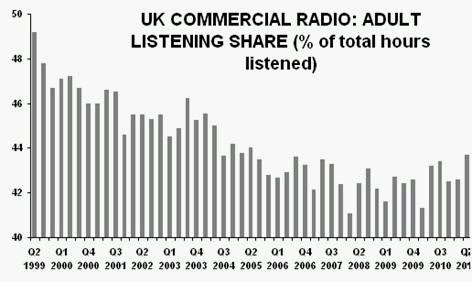
With all this good news for the commercial radio sector, you might imagine that its share of total radio listening had started gaining in leaps and bounds at the expense of the BBC. Unfortunately, this is not the case. The BBC has benefited just as much as commercial radio has from the overall increases in radio listening. As a result, everyone’s volumes are ‘up’ and the share of commercial radio versus BBC radio has remained relatively constant. In Q2 2011, commercial radio’s 43.7% share was certainly an improvement on the situation in 2008, when it had looked as if the 40% barrier might be plumbed for the first time.

In fact, the BBC’s sustained strength in radio is becoming increasingly understated as more and more ‘radio’ listening is attributable to ‘listen again’ on-demand usage and podcasts. The BBC dominates the content available on both these platforms, whilst commercial radio’s offerings remain relatively sparse. At present, neither platform is measured within RAJAR. If they were, commercial radio’s share would undoubtedly be diminished further.

At present, this status quo (using RAJAR’s anachronistic definition of ‘radio’ as purely live and broadcast) suits both parties. The BBC does not wish to be seen to be even more dominant than it already is (54.0% of radio listening in Q2 2011). Commercial radio does not wish to be seen to be weaker than it already is (43.7%) in comparison to the BBC.

And who pays for RAJAR? The BBC and commercial radio. So we are stuck with an old fashioned metric that does not measure radio consumption in the 21st century sense of what we now call ‘radio,’ but which keeps both its paymasters happy … particularly as neither the BBC nor commercial radio would currently wish to demonstrate publicly the increasing popularity of online ‘radio’ consumption – which remains the biggest long-term external threat to them both.

Andy Parfitt leaves BBC Radio 1 on a high: separating the man from the myth

Andy Parfitt’s departure from the station controller job at BBC Radio 1 after thirteen years marks a significant event for the UK radio sector. Parfitt’s accomplishments during his tenure were many, but did not extend to significantly turning around the station’s audience ratings.

At the time Parfitt took on the controller job in March 1998 at Radio 1:
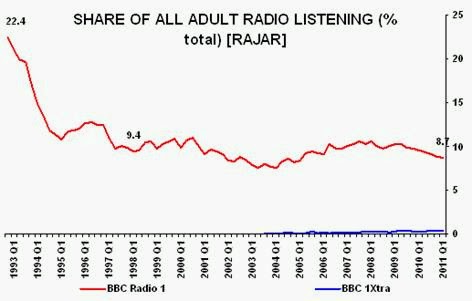
• its share of listening was 9.4%, compared to 8.7% in Q1 2011
• its adult weekly reach was 20%, compared to 23% in Q1 2011
• its average hours per listener per week were 8.1, compared to 7.8 in Q1 2011.

One metric did demonstrate a healthy increase – Radio 1’s absolute weekly reach was up from 9.7m adults in Q1 1998 to 11.8m in Q1 2011. However, part of that increase is attributable to the UK adult population having grown by 9% in the interim. Certainly, more adults listen to Radio 1 now than in 1998, but for shorter periods of time, and so the station’s share of total radio listening has declined.

Given this impasse to the improvement of Radio 1’s ratings, I was surprised to read in the BBC press release announcing Parfitt’s departure that:
“Appointed Controller, BBC Radio 1, in March 1998, Andy has led Radio 1 and 1Xtra to record audience figures …”

… and surprised to read Parfitt’s boss, Tim Davie, declaring that:
“Andy has been a fantastic Controller and leaves Radio 1 in rude health – with distinctive, high quality programmes and record listening figures …”

The one person still working at Radio 1 who should know for sure that “record audience figures” had not been achieved during the last quarter, last year, the last decade or during Parfitt’s entire tenure is Andy Parfitt. Why? Because, between 1993 and 1998, Parfitt had been chief assistant to then Radio 1 controller Matthew Bannister, a turbulent period during which the station’s audience was decimated by a misguided set of programme policies that failed miserably to connect with listeners.

Between the end of 1992 and March 1998, when Parfitt took over from Bannister (whom the BBC had promoted to director of radio), Radio 1’s:
• share of listening fell from 22.4% to 9.4%
• adult weekly reach fell from 36% to 20%
• average hours listened per week fell from 11.8 to 8.1
• absolute adult reach fell from 16.6m to 9.7m.

Radio 1 lost an incredible 58% of its listening, and 7m listeners, within that five-year period, a calamitous disaster from which the station has never recovered [see graph above]. Since then, Parfitt has kept the ship relatively steady, having been appointed in 1998 as a safe pair of BBC hands for Radio 1 after the tragedy of Bannister (who had come from Capital Radio via BBC GLR and had a fantastic track record in news radio, but not in music radio).

Never again will Radio 1 achieve a weekly audience of 17 million adults, as it had done in 1992. Those days are long gone. In recent years, fewer young people are listening to broadcast radio, and they are listening for shorter periods of time. Sadly, radio does not prove as exciting for them as the internet, games or social networking.

Of course, it would have been nice for any incumbent to leave the Radio 1 job on a ‘high.’ But, unfortunately, it was never going to happen with Parfitt, or probably with any successor. Radio 1’s ‘golden age’ was wilfully destroyed twenty years ago. Nevertheless, somewhere, somebody in the BBC must have decided to invoke the notion of Parfitt’s “record audience figures,” regardless or not of whether they were a fact.

What surprises me is that every BBC press release must have to pass through endless approvals – within the originating department, in the press office and in the lawyers’ office – before it reaches the public. Did nobody out of the dozens of people that must have checked this particular press release ask the simple question: can you substantiate this “record audience figures” claim?

RAJAR radio audience data are publicly available for all to see. Anyone from the BBC could have checked and found that, using every radio listening metric known to man, Radio 1’s “record audience figures” were all achieved two decades ago, rather than at any time during Parfitt’s tenure. Maybe they didn’t check. Or maybe they did, but pressed ahead anyway.

The ability to play fast and loose with numbers and statistics, particularly those that can be said to be at an ‘all time high,’ might appear to be endemic within the UK radio industry. I have highlighted similar instances of the industry’s abuse of statistics in other claims. Now that the consumer press only seems interested in ‘radio’ stories involving celebrities, and now that the media trade press has been reduced to recycling radio press releases, ‘myth’ can quite easily be propagated as ‘fact.’

I am reminded of a passage in my new book about KISS FM when, two decades ago, I had asked my station boss why an Evening Standard profile of him and his car had featured a vehicle that was not the one he owned or drove.

“It seemed to make a better story,” he told me.

When UK radio listening figures are this good, why does RAJAR need to fib?

It is good to know that radio is still an extremely popular medium in the UK, something borne out by the latest radio audience metrics published by industry body RAJAR for Q1 2011. However, in its determination to make every quarter’s results newsworthy, RAJAR has a track record of bending the truth to achieve press headlines [see blog May 2010]. This latest quarter was no exception.

According to the RAJAR headline:
• “Total radio listening hours reach 1,058 million per week – new record.”^

RAJAR explained:
• “The total number of radio listening hours broke all previous records to reach 1,058 hours per week …”^

Fantastic news! Except that this is not at all true. RAJAR’s own historical data tell a different story:
• 1,088 million hours per week in Q2 2001
• 1,092 million hours per week in Q3 2001
• 1,092 million hours per week in Q4 2001
• 1,090 million hours per week in Q1 2002
• 1,072 million hours per week in Q4 2002
• 1,094 million hours per week in Q1 2003
• 1,066 million hours per week in Q3 2003
• 1,076 million hours per week in Q4 2003
• 1,086 million hours per week in Q1 2004
• 1,072 million hours per week in Q2 2004
• 1,068 million hours per week in Q3 2004
• 1,059 million hours per week in Q1 2005
• 1,068 million hours per week in Q2 2005
• 1,072 million hours per week in Q3 2005
• 1,060 million hours per week in Q4 2005
• 1,063 million hours per week in Q3 2006

During sixteen quarters between 2001 and 2006, total hours listened to radio were greater than they were last quarter. “New record?” No. “Broke all records”? Er, no.

The reality is that total radio listening has not yet returned to the level it had achieved in 2001. Except that, ten years ago, the UK adult population was 48.1 million, whereas now it is 51.6 million. So the population has increased by 7% over the last decade. Yet total UK radio listening is still less than it was then.

Most statisticians I know would refer to that as a like-for-like 7%+ decline in total hours listened to radio. However, to RAJAR, it is evidently a “new record” that “broke all previous records.”

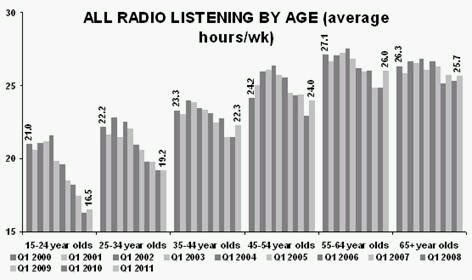
Why does any of this matter? Because radio broadcasters have been progressively losing usage over most of the last decade. Initially, it was 15-24 year olds that were spending less time with radio. Increasingly, it is also 25-34 year olds. For a decade, the UK radio industry has desperately needed a coherent strategy to reverse this loss of listening. The decline in young adult listening to broadcast radio does not merely impact the NOW. If these consumers do not find anything in their youth worth listening to on the radio, they will grow old without the radio habit. Their radio listening patterns NOW are likely to influence radio listening for the next half-century.

This is why RAJAR’s continuing efforts to achieve yet another headline in the Daily Mail proclaiming “Radio listening at an all time high” are ultimately redundant. Those headlines do not impact the reality of the data collected from tens of thousands of radio listeners every month. Those data show incontrovertibly that listening is in significant long-term decline amongst younger demographics. And radio will be in mortal danger if it does not re-invent itself for the next generation.

You only have to listen to any pirate radio station in London to understand that the gulf between what young people are actually listening to and what the old fogies who run UK radio are giving them has never been wider. Chris Moyles is as passé as Dave Lee Travis was twenty years ago.

So, yes, RAJAR’s fibs and the resulting Daily Mail headline will be another opportunity for champagne corks to pop in radio boardrooms across the land. But if radio doesn’t start making itself exciting and relevant to young people, broadcast radio’s future role will be relegated to a soundtrack in old people’s homes. Complacency such as that propagated by RAJAR will only make many radio businesses redundant in the long run.

^ in a footnote this small, the RAJAR press release admits the caveat “since new methodology was introduced in Q2, 2007.”

Commercial radio: "so keen to hold back the BBC?"

House of Lords Select Committee on Communications
Inquiry on Governance & Regulation Of The BBC [excerpt]
22 March 2011 @ 1515

Baroness Deech: Listening to you, I am a bit puzzled about why you are so keen to hold back the BBC. Can’t Virgin Media and the local commercial radio stations stand on their own two feet? Why have they got to hold back the BBC?

Mr Andrew Harrison [chief executive officer, RadioCentre]: I would not characterise it at all as wanting to hold back the BBC; I would characterise it as wanting a level playing field for the commercial sector to compete. The truth is that, in radio, the BBC is hardly held back. It has 55% national market share, it has the vast majority of national FM spectrum and it has a huge raft of local radio stations, so it is hardly held back. We seek the opportunity to build our own commercial businesses, entrepreneurially and innovatively, without facing the elephant in the room that, every time we try to do something new, there is a BBC service that pops up to squash it before it has time to be established.

Mr Andrew Barron [chief operating officer, Virgin Media]: With great respect, I think we are in slightly different places. I would argue that Virgin Media is one of the companies pushing the BBC forward in many instances.

[This is an uncorrected transcript of evidence taken in public and webcast on http://www.parliamentlive.tv. Any public use of, or reference to, the contents should make clear that neither Members nor witnesses have had the opportunity to correct the record.]