DAB radio receiver sales in 2010: what was the actual number?

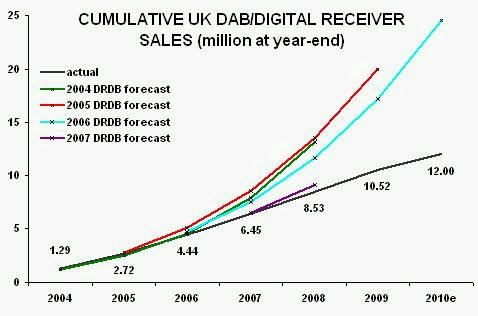
On 21 December 2010, a press release from Digital Radio UK announced that “12 million digital radios have been sold in total in the UK” and estimated that:
· “due to strong Christmas sales, over 2m digital radios will be sold during 2010
· A cumulative total of 20 million digital radios will be sold by the end of 2013.”

It takes a brave person to predict in mid-December what a year-end sales figure will be. More so with DAB radio receivers because, in previous years, the month of December alone has accounted for more than a quarter of annual sales.

It takes an even braver person to predict that, by year-end 2013, an additional 8m digital radios will have been sold. Whether or not 2m units were actually sold in 2010, we do know that just under 2m units had been sold in 2009, and just over 2m units in 2008 and in 2007. So please can Digital Radio UK explain what revolutionary change will ensure that sales suddenly spurt during 2011, 2012 and 2013? Buy one, get one free?


Perhaps this new ‘20m by 2013’ figure was forecast by the same party that produced earlier forecasts for the Digital Radio Development Bureau, the forerunner to Digital Radio UK. As the graph above demonstrates, none of those forecasts made in 2004, 2005, 2006 and 2007 were rooted in an analysis of reality. If they were, then 24.5m digital radios would have been sold by now. Whereas, the actual figure is 12m, less than half the forecast for 2010 the industry had made four years ago.

It is interesting to note that all the recent sales figures offered by DAB lobbyists refer to ‘digital radios’ rather than ‘DAB radios.’ One wonders exactly how many internet radio receivers have been sold in the UK and are being used to prop up the illusion that DAB radio is some kind of success story with consumers. When I have asked for a breakout of internet radio sales, data were not supplied.

If, as the Digital Radio UK press release shouts, a “digital radio landmark” was really achieved in December 2010, then why are the recorded UK monthly and quarterly sales figures for DAB radios not available from the Digital Radio UK web site for the public to admire? (Maybe because the Digital Radio UK web site is completely empty.)

The chief executive of Digital Radio UK was quoted last week saying: “There is now real momentum in the transition to digital radio.”

“Real momentum” is not what the sales data for DAB receivers, even those few estimated figures released by Digital Radio UK, demonstrate to be the reality.

UK commercial radio revenues Q3 2010: still no sign of "renewed growth"

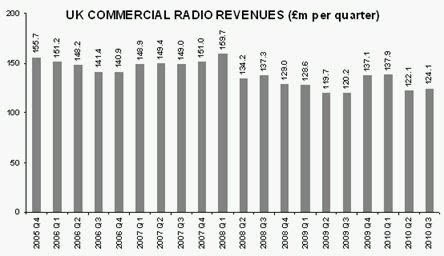
2008 had been a bad year for commercial radio revenues, down 6% year-on-year. 2009 was a worse year, when revenues fell a further 10% year-on-year. So how is 2010 shaping up? Radio Advertising Bureau data for Q3 2010 demonstrate that, although revenues are likely to be up marginally for the calendar year, they have yet to regain the substantial losses suffered during those previous two years.

Why? Because commercial radio’s falling revenues are largely the result of structural decline, something that the ‘credit crunch’ of 2008/9 merely exacerbated. Adjusted for the impact of inflation, commercial radio revenues peaked in 2000 and, by 2009, were down 32% in real terms. The single-digit improvements we might see in 2010 will claw back only a tiny part of these enormous losses.


Q3 2010 TOTAL REVENUES
· Up 3.2% year-on-year to £124.1m, but remember that Q3 2009 had been the sector’s second lowest this millennium

In May 2010, the Radio Advertising Bureau had told us that “the [commercial radio] sector has turned a corner and not only halted [revenue] decline, but moved into renewed growth …”

Industry data has yet to validate this assertion. The last two quarters produced the third and fourth lowest revenue totals of the decade, showing that the radio sector is certainly not out of the woods yet. More than anything, the industry’s revenues still seem to be bumping along the bottom. “Renewed growth” is not on the horizon yet.


Q3 2010 NATIONAL REVENUES
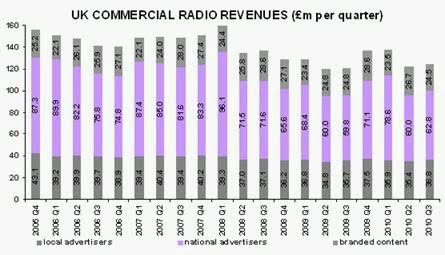
· Up 5.0% year-on-year to £62.8m

Q3 2010 LOCAL REVENUES
· Up 3.1% year-on-year to £36.8m

Q3 2010 BRANDED CONTENT REVENUES
· Down 1.2% year-on-year to £24.5m


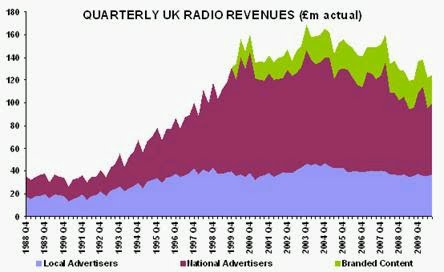
The revenue data for the long term [see graph above] illustrate clearly the transformation of the commercial radio sector from a healthy growth industry in the 1990s to one that stagnated after 2000, and which has subsequently moved into decline. Whilst revenues from local advertisers have simply stalled in recent years, revenues from national advertisers seem unlikely to ever recover from substantial declines suffered since their peak in 2000. This has necessitated significant restructuring of the commercial radio sector in recent years.

For those larger commercial radio stations that depend upon national advertisers the most, the outlook continues to look bleak. Data from Nielsen estimated that advertising spend by the government’s Central Office of Information [COI] fell by 47% in 2010 year-on-year. COI expenditure has been a greater proportion of commercial radio revenues than of any other medium, making radio particularly vulnerable. In May 2010, I had predicted:

“A 50% budget cut to COI expenditure on radio would lose commercial radio £26m to £29m per annum, 6% of total sector revenues. A 50% budget cut to all public sector expenditure on radio would lose commercial radio £44m to £48m per annum, 9% of total sector revenues.”

Not only have these cuts been realised, but the Cabinet Office is continuing to pursue a plan for the BBC to carry public service messages for free, rather than pay commercial broadcasters for airtime [also predicted here in May 2010]. This could lose commercial radio a further 6% to 9% of revenues.

In 2009, even before these drastic cuts to government expenditure on advertising, commercial radio was attracting only 4% of total display advertising expenditure in the UK, one of the lowest proportions globally [see Ofcom report]. What is UK radio doing so wrong that Ireland, Spain and Australia achieve more than double that amount? And why was that percentage already falling before the COI cuts, demonstrating the radio medium’s comparative lack of appeal to potential advertisers?

There could not be a worse time to be a commercial radio station dependent upon national advertising. Yet now is the precise time when several large commercial radio owners are busy transforming their local and regional stations into national ‘brands.’ As a response to the sector’s structural challenges, this is tantamount to cutting off your nose to spite your face. ‘Localness’ has consistently been shown to be the most important Unique Selling Point of local commercial radio, according to Ofcom research. Throw that localness out the window and all that remains is a music playlist which can be generated by any computer application.

UK commercial radio has always been good at making ‘cheap and cheerful’ local radio, but has been rubbish at making national radio that could compete with the BBC’s incredibly well resourced national networks. The recent decisions of commercial radio owners to switch from production of local radio services with a track record of success to production of ‘national’ ones that have a history of relative failure create massive risks for an industry already in decline.


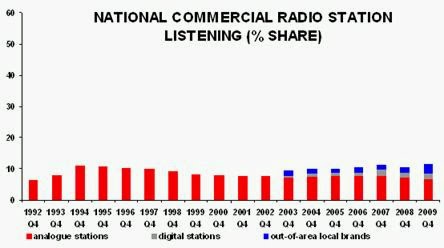
History tells its own story. The launch of the UK’s first three national commercial radio stations between 1992 and 1995 had much less of an impact on radio listening than had been anticipated. By 1997, Richard Branson had decided to sell Virgin Radio (for £115m) – it was obvious that national commercial radio was not going to be a massive moneyspinner. In 1997, Virgin Radio’s listening share had been 2.6%. Last quarter (Q3 2010), it had fallen to 1.2% (renamed Absolute Radio after another sale in 2008 for £53m), while the combined share of the three national stations was 6.8%. [source: RAJAR]


BBC national networks account for almost half of all radio listening. The only time that their share has not exhibited long-term growth was during the early 1990s, when Radio 1 self-destructed under the management of Matthew Bannister. Since that disaster, the BBC’s national networks have been successfully clawing back listening year-on-year.

The current scenario in which the owners of commercial stations that were licensed to serve local audiences have decided to subvert that purpose to take on the might of the BBC national networks is either brave, or madness, depending upon your viewpoint. What I see is a monolithic BBC that has existed continuously for nearly a century, and then I see three national commercial radio stations that have had a succession of at least three owners each during their almost twenty-year struggle to attract listeners.

National commercial radio. Just why are parts of the commercial radio industry so eager to emulate an idea that has only led to well documented failure?

Commercial radio local DAB build-out "not the BBC's responsibility" says BBC Trust chairman

Culture Media & Sport Select Committee, House of Commons
15 December 2010
BBC Annual Report & Accounts 2009-10 [excerpt]

Sir Michael Lyons, Chairman, BBC Trust
Mark Thompson, Director General, BBC

Damian Collins, MP Folkestone & Hythe (Con): Has the [Licence Fee] settlement affected the amount of support you can give to digital radio switchover and the build-out of digital radio in local services within the regions?

Sir Michael Lyons: What you see in yesterday’s announcement is a clear message that the BBC remains committed to DAB and will continue to build out up to FM equivalents. That is clear. It is involved in discussions with the commercial radio industry and Government about local build-out, for which it is not responsible and for which there are not funds currently identified. They were expected to be undertaken by the commercial operators of those Mux [DAB multiplex] licences.

I don’t think I should add very much to that, other than that, clearly, the Government has determined on a switchover date. Whether that can be achieved is, in our view, whether the audience is ready for it to be.

Damian Collins: I suppose whether it can be achieved ought to be linked to the level of coverage as well. The Government has been clear about that, too. In those negotiations you are having with Government and the commercial stations, is the amount of money you have on the table a smaller amount, as a result of the settlement, than it was before?

Mark Thompson: No.

Sir Michael Lyons: It is clearly another one of the pressures that we have to balance in a tighter envelope; that is the important thing.

Mark Thompson: I think it is fair to say that the underlying commitment that we have made and the focus we have on the building out of our own national multiplex, is unchanged by the settlement.

Sir Michael Lyons: Absolutely. It is a reference to local, I think, that I was …

Mark Thompson: Quite. But the BBC’s focus has always been … the issue about local is that we only have in England, and only intend to have, a single BBC local radio station per region. With each local multiplex that has been opened so far, we have taken a place on that multiplex; we decided that we should do that.

I have no reason to believe we would not continue to do that as they are built out. But whereas the national multiplex, obviously, is a way of getting additional BBC services to the public – the digital services – there is no such increase in BBC services that we can offer if you are taking a single station which is analogue and putting it on digital as well. So our focus is on national build-out, and the broad policy and the commitment over time to absolutely keeping pace with the audience, building out nationally, is unchanged by the settlement.

Damian Collins: Your commitment is clear, and you made that again today, but is it going to take longer to get there now, as a consequence of finding some other issues you have to deal with?

Mark Thompson: I don’t think so. If you say something slightly different, which is, “Would some people have liked some level of additional commitment in the settlement?”, perhaps they would, but it is not there.

Damian Collins: But as far as you are concerned, your commitment is the same?

Mark Thompson: It is exactly the same.

Damian Collins: In the document put to us yesterday, you talk about preparing for any potential radio switchover. That does not sound like it is going to happen within the next five years.

Sir Michael Lyons: That is not a judgment for the BBC; that is a judgment for Government. The BBC is very clear that it is doing its bit in these national investments. There remain unresolved issues about where the investment comes from at a local level. That is not the BBC’s responsibility, but we are part of those discussions. And then, very critically, as the Government has conceded, switchover can only take place … I do take your point that audience preparedness will to some extent depend on coverage, but it also depends on choices made about replacement television sets, investment in cars and a whole series of other things, which are not in our gift.

[This is an uncorrected transcript of evidence taken in public and reported to the House. The transcript has been placed on the internet on the authority of the Committee, and copies have been made available by the Vote Office for the use of Members and others. Any public use of, or reference to, the contents should make clear that neither witnesses nor Members have had the opportunity to correct the record. The transcript is not yet an approved formal record of these proceedings.]

NORWAY: digital radio switchover "postponed indefinitely"

In November 2010, a daily newspaper in Denmark reported that the government’s plan for digital radio switchover had been postponed indefinitely [see earlier blog]. Now, the same is reported to have happened in Norway.

“The transition from analogue to digital radio began more than ten years ago. At the end of 2010, we still have no idea what is going on,” said the headline in Norwegian daily newspaper Aftenposten.

In 2009, then culture minister Trond Giske had promised that the Norwegian government would publish a white paper in 2010 on digital radio switchover [see earlier blog]. It has failed to appear. “Recently, it has become clear that the strategy had to be postponed indefinitely,” said Aftenposten.

Ib Thomsen, cultural affairs spokesman for the Progress party, said: “This is undoubtedly a hot political potato and DAB is, in many ways, a risky sport.” He believes that it is wrong to compare the migration of digital radio with digital television switchover, as many do, because the number of radios in use is much greater. “Nevertheless, we should not set a [switchover] date in order to go out and force people to buy new radios,” Thomsen said.

Olemic Thommsessen, cultural policy spokesman for the Conservative party, said: “I am more concerned with getting the policy on the table so that we can advance work on planning a digital radio future.” He noted that it had been a long time since the government’s last review of digital radio strategy, and that subsequent development of DAB and DAB receiver sales had not lived up to expectations.

Trine Schei Grande, leader of the Liberal party, said: “The time is over when politicians can decide how people will listen to the radio.” She believes that the only way to get listeners to invest in digital radio is to make digital content and stations sufficiently attractive. Until then, she said, FM transmissions must be continued.

Øyvind Vasaasen, distribution manager of state broadcaster NRK, said it would not be a very costly issue for NRK to broadcast DAB+ transmissions, should it be required by the government. He emphasised that NRK had a continuing obligation to serve those who had already bought DAB radios that do not support the newer DAB+ standard. “These can be addressed by broadcasting in both DAB and DAB+ for a period,” he said.

The possibility of the government switching from the DAB to the DAB+ standard was taken up by a commentary in Aftenposten, whose headline asked: “Your new, expensive DAB radio may be useless in a few years. What is really happening?” It explained:

“The problem is that there are already more than 300,000 DAB radios in the country. NRK distribution manager Øyvind Vasaasen had said that NRK has a contract with listeners who have already bought a DAB radio, and which makes it difficult to switch [to DAB+]. What about all those who listen on one of the country’s 15+ million FM radios? Does NRK not have a contract with them? And what of DAB users who feel they had signed the contract without full disclosure?”

The commentary continued: ”When [state broadcaster] NRK had argued for a transition from FM to DAB, it had said that the DAB system would give us CD-quality audio from the radio. It has not. DAB technology does allow very high sound quality, but most stations use lower sound quality than FM, according to University of Oslo professor Sverre Holm. Many people find the [DAB] sound clearer and less harsh, but many also complain of less detail and poorer stereo image. Moreover, no local radio station can afford the investment of over half a million kroner to broadcast on DAB, so that the diversity we were promised has not become a reality.”

Even DAB lobbyists are acknowledging the slow take-up achieved to date. Jørn Jensen, president of World DMB, the international marketing organisation for DAB, told Germany’s Digitalmagazin recently:

“Digital radio is still in its infancy. If we compare the situation to the computer market, we are still in the time of MS-DOS!”

Ofra Haza: the making of world music's first international star

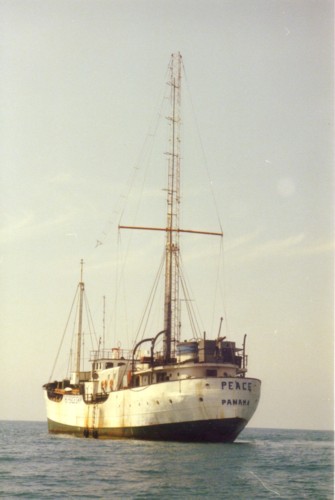
In January 1985, I had arrived in Israel to work as a DJ on a radio station, but this was no ordinary radio. The studios of ‘The Voice of Peace’ were on a ship anchored permanently in the Mediterranean Sea. Aware of my interest in cutting edge music, the station’s popular breakfast DJ Dave Asher (who had been living in Israel for some time) played me a recent 12-inch single by a young Israeli singer of Yemeni origin named Ofra Haza. It was a traditional Yemeni song, re-mixed and cut up into a state-of-the-art club tune that sounded to me like a new, exciting ‘Middle East meets West’ genre. I wanted to find out more, but the terrible winter storms and shortage of staff meant that I was stuck working on the ship for the next three months.

Eventually, during my first shore leave, I visited the Tel Aviv office of the small independent record company, Hed Arzi, that had produced the Ofra Haza single. They were baffled that a British DJ would be so interested in one of their worst selling record releases, and particularly one that seemed to have such minimal mainstream potential. They humoured me and let me sit at a desk in their office, penning handwritten letters to radio DJs and record labels that I knew back in the UK, sent by airmail along with the single and related album ‘Yemenite Songs’.

Within a month, I had received replies from John Peel at Radio One and Charlie Gillett at Capital Radio, both saying that they had played Ofra’s record on their shows and had received enquiries asking where the record could be purchased. During my next shore leave, I returned to Hed Arzi, whose staff were amazed that their song had been played on national radio in the UK. They introduced me to Ofra and her manager for the first time. I wrote again to several UK record companies and one of them, Globestyle, was convinced sufficiently by the airplay to release both the single and the album.

I returned to the UK at the end of 1985 and spent the next two years trying to convince everyone I knew of Ofra’s talent. By 1987, I had given away so many copies of her records to music industry people that the UK record company said I would be given one last free box. By chance, I had recently been invited to attend a monthly staff meeting of London pirate station Kiss FM (at the London School of Economics) and, as a last resort, I distributed copies of Ofra’s records from this last box to some of the station’s DJs.

Kiss FM DJs Jonathan More and Matt Black, recording together as ‘Coldcut’, had already enjoyed underground success with some highly original cut-up singles on their Ahead Of Our Time label. They liked the Ofra Haza songs so much that they cut up one of them into their homemade remix of US rappers Eric B & Rakim’s latest single ‘Paid In Full’. Island Records in the UK released this remix without seeking Eric B’s prior approval, and without clearing the Ofra Haza sample. By the end of 1987, the single had reached number 15 in the chart, giving Eric B his first British hit and earning significant royalties for the Israeli record company because a third of the track featured Ofra’s voice.

More than anything, the chart success of that Eric B remix stimulated huge public interest in Ofra Haza’s voice beyond the narrow market for ‘world music’ (which had just been marketed as a new genre). In early 1988, I organised interviews for a promotional visit to the UK, shepherding Ofra Haza and her manager to Radio 1, the World Service and commercial radio stations. The UK record company re-issued Ofra’s ‘Im Nin Alu’ single, which quickly garnered radio airplay this time, despite it being sung in a strange, foreign language. However, the public demand for the single was so great that the independent label had difficulty fulfilling orders, so it licensed the track to Warner Brothers. After an initial meeting with the major label, my direct involvement with Ofra Haza ended abruptly, just as she was invited back to the UK to perform on ‘Top Of The Pops.’

After the success of this single internationally, the Israeli record label invited me to London’s Sarm Studios, where the follow-up single was being mixed. It was evident that none of the Warner Brothers personnel involved had any understanding of the unique charm of Ofra’s Yemeni music in the international marketplace. Ofra’s manager was far too keen to turn her into a mainstream pop singer, which is exactly how the public perceived her in Israel. As a result, the follow-up single bombed and, sadly, it seemed as if Ofra was consigned to be a one-hit wonder as a result of poor career guidance.

In 2000, I was shocked to learn of Ofra’s death at the age of 42 from AIDS-related organ failure. Two years later, an Israeli television film crew came to London and filmed an interview about my role in creating their country’s most successful international pop star. They had just filmed a similar interview with John Peel at his home, during which he impressed them by producing the handwritten letter that had accompanied the Ofra records I had initially sent him from Israel seventeen years earlier. The interviewer asked me if I had made a fortune from ‘discovering’ Ofra Haza for the international market. All I had received was one cheque for £200 from the UK record company in 1988 to reimburse my expenses for Ofra’s first London promotional visit.

Ofra’s incredible voice lives on through the music she recorded, although I am always reminded of the parts of her life that had been unbelievably tragic. The crucial roles of the late John Peel and Charlie Gillett in her international success should not be forgotten. Ofra Haza’s music arrived in the Western world at a time when the public welcomed sounds that challenged their expectations. We are musically much the poorer for the loss of Ofra, and of John and Charlie, from our world.

‘The Israeli Madonna’
Thursday 30 December 2010
11.30am-12.00noon
BBC Radio 4


[photo: Grant Goddard]

Digital Radio UK meets BBC Radio Northampton listeners in a DAB black hole

In October 2007, Ofcom had awarded the DAB local multiplex licence for Northamptonshire to NOWdigital Ltd. and had required “implementation by September 2008” to put it on-air. The multiplex was to carry BBC Radio Northampton along with commercial stations. More than three years after this licence award, the DAB service has still not launched. As a result, BBC Radio Northampton is not yet available on DAB.

NOWdigital Ltd. had been owned by GCap Media, the UK’s largest commercial radio group, which was acquired by Global Radio in 2008. In 2009, NOWdigital Ltd. was sold to Arqiva, the transmission specialist which owns the lion’s share of DAB commercial infrastructure in the UK. In its application for the Northamptonshire licence in 2007, NOWdigital had boasted:

“GCap … has invested more into digital radio than any other UK operator. This investment has driven the industry forward and is helping build radio’s digital future … Having launched and operated multiplexes since 2001, NOWdigital is in an excellent position to successfully launch and operate the Northamptonshire multiplex.”

So what has Ofcom done to make this licensee comply with the stipulation that the Northampton DAB multiplex had to be launched by September 2008? Nothing. Does the commercial radio industry have a masterplan that includes a specific date for the launch of the Northamptonshire DAB multiplex? No. NOWdigital states disingenuously that its on-air date for Northamptonshire is “awaiting launch”.

Northamptonshire is one of 13 local DAB multiplex licences that Ofcom
awarded in 2007 and 2008 that have failed to materialise by their required launch dates. In 2007, Ofcom also awarded a national DAB multiplex licence to a consortium, led by Channel 4 television, that similarly failed to launch (all trace of which has been erased from the Ofcom web site).

Despite three years of broken promises to the people of Northamptonshire by Ofcom, NOWdigital, GCap Media, Global Radio and Arqiva that a local DAB radio multiplex will be launched for their area, they were not excused from this year’s Christmas radio industry campaign to sell more DAB receivers. DAB marketing organisation Digital Radio UK was interviewed by BBC Radio Northampton last week, though it was unable to offer even a vague date when either the local DAB multiplex for Northamptonshire will be launched, or when the signal of the existing DAB national multiplexes will be improved.

Although Digital Radio UK is funded jointly by the BBC, commercial radio and Arqiva, these heavyweight stakeholders could offer nothing more concrete to the people of Northamptonshire than platitudes and more promises about DAB … always in the future tense.


BBC Radio Northampton,
lunchtime show
15 December 2010 @ 1223 [excerpts]

Stuart Linnell, presenter [SL]
Jane Ostler, director of communications, Digital Radio UK [JO]

SL: You said, Jane, that the coverage and the reception is pretty good in most parts of the country. From my experience, and from what I hear people saying, where it’s good, it’s great. Where it’s not so good, it’s blooming awful.

JO: Yes. That is absolutely right, and we know that organisations like the BBC actually have a plan in place to make sure that coverage improves. And that’s not only building more transmitters, but it’s also increasing the power on transmitters, so that you don’t get the drop-out of signal that you will get in some areas. However, we know that when people do have a good signal, they absolutely love digital radio and everything that it brings …

[…]

SL: Rod in Daventry has got a question about the DAB signal in Northampton. It’s not specific to any one radio station, this question, I don’t think. It’s come in on a text. He just says: why is the DAB signal in Northampton so weak?

JO: Yeah, there are variances around the country in the signal. And, as I say, you know, there are plans in place, over the course of the next few years, to improve coverage for national radio stations and local radio stations as well. It’s one of these things that we are used to with other electronic devices like mobile phones and even Freeview signals. You know, there’s a course – an engineering programme – that’s taking place over time that will allow the signal to improve. So, if it is weak at the moment, it will get better.

[…]

JO: We believe that DAB will … is the broadcast backbone for the country. It’s free to air, it’s becoming increasingly available, and the signal is getting better all the time…

[…]

John in Corby [caller]: My question is that I watch this, I’ve been doing radio for sixty years, I’ve watched this very, very carefully, and the thing is that there are some very attractive radios which carry DAB which are available now. I take all the magazines, every magazine that’s related to radio and high fidelity in this country. And the point is this. What the $64,000 question is, dear Stuart, is: when shall DAB radio be available on Radio Northampton? Can the lady guesstimate that? That’s what’s important – all the things that have been broadcast about it – I won’t buy a DAB radio until I can get it in my locality, my local station, which makes commonsense to me.

SL: Okay. We get the point. Jane, do you know the answer to that?

JO: That is a very good question from John because I know that BBC Radio Northampton is not available on a local digital multiplex. Obviously, around the Northampton area, you can get – and Corby, you can get – the national stations but not the local ones. There are plans in place to build local coverage, and that includes BBC services by the time …

John [interrupts]: This is what will be needed and this is what will sell the radio … this is what will sell the radios, in my view. [When] this fine station in this fine county has its own DAB service.

JO: Yeah, we completely support that and we understand that. What’s happening is: there is a plan in place to develop local coverage in time for the digital radio switchover, and these plans are being worked on right now. So I can’t give you an exact date, but it will be over the next few years that local radio will be more available on digital.

SL: Because we must make it clear that John’s question is a valid one, but it’s not just BBC Radio Northampton that’s not on DAB. There are other stations as well who have not yet migrated to that platform.

JO: That’s right. The local stations in your area aren’t available. They are in some, but not in your particular area. But you can, subject to doing a postcode check, you can still get all the national services that are available …

[…]

Peter [caller]: What exactly is going to happen to existing car radios and also hi-fi stereos at home and also alarm clock radios? Is there going to be an adapter?

JO: If I deal with the car question first. That is also a very good question. There are lots of cars, there are lots of lorries and vehicles on the road, and only a small percentage of them today can actually receive digital radio. But you will start to see – and it’s starting already, and over the next few years – an increasing number of adapters coming onto the market, which you can either fit yourself or which you can get fitted by stores such as Halfords, for example. And then that’s with existing vehicles. With new cars, the motor manufacturers who import and make vehicles in the UK have committed that all new cars will have digital radio as standard by the end of the year 2013. So more and more adapters will come onto the market that are available …

SL [interrupts]: Can I just push you on that a little bit, Jane, because I heard – this is going back probably about 18 months now – that one of the largest motor manufacturers in the world, manufacturing two major brands – luxury brands – in this country, had actually withdrawn their DAB digital radios from their cars, as an optional extra even, because they said it just wasn’t working – the technology wasn’t good enough. Have all the manufacturers now signed up?

JO: They have, into the UK, of getting DAB as standard in cars – in new cars – by the end of 2013. And part of this target date that we talked about earlier on has got the motor manufacturers moving, and it’s also got other manufacturers coming up with new devices which you can fit into your existing car alongside your FM radio.

SL: And that really answers Peter’s point that, whether he has got his clock radio, his hi-fi in his lounge or the car radio, there are going to be adapters that will covert them to take DAB as well.

JO: Not, not the alarm clock. No, the alarm clock example is one where … I think, if you did want an alarm clock that had DAB radio built in, you’d have to get a new alarm clock.

SL: Buy a specific one, okay?

JO: Exactly, exactly. They are increasingly available in stores and they are becoming more affordable all the time.

SL: But for the hi-fi and for the car radio, there should be an adaptor at some stage.

JO: The hi-fi is an interesting question actually because obviously you can get digital radio tuners for hi-fi’s now which can plug in as a separate device. Quite often, a radio might be built into something like a large amplifier where the primary use is actually the amplifier rather than the radio. Ultimately, it would be down to the listener. But these devices are becoming available all the time and, if you go into any electrical store, you’ll start to see more digital radio devices.

SL: Okay, does that answer your question, Peter?

Peter: Yes, it does. I just hope that … I think it’s going to be a big sledgehammer to get a DAB adapter to fit in an existing car. There’s not a lot of room underneath dashboards.

JO: That’s absolutely fair. You can get some now which actually fit onto your windscreen and plug in around the dashboard. But soon, towards the end pf next year, when we anticipate that digital radios in cars will double during the course of next year, you will start to see these devices more hidden away in the glove compartment and that sort of thing.

[…]

SL: It’s Mike in Northants who says: digital reception on Radio Five Live for me, he says, was dreadful, so I just switched back to AM and FM and rejected DAB. No more problems.

JO: Right, well that’s … I don’t know precisely where he lives but, obviously, doing a postcode check would tell him whether he should be able to receive a good signal or not. And there are currently … until the transmitter improvements happen, there are other ways of listening to Radio Five Live, for example on the internet, and on digital television platforms as well, in fact. But, as I say, these coverage improvements are happening all the time. He should check his postcode at our web site.

[…]

Graham from Whitehills [caller]: I’m a communications buff so, as soon as DAB came out, I went and bought myself a mains portable one before I found out I couldn’t get Radio Northampton on it. The big, big problem is that it roars through batteries. It uses batteries at twice the rate of anything else I’ve ever owned.

SL: And I had a letter about this from somebody a while ago, Jane, asking why … is digital radio really environmentally friendly, because it uses up so much power?

JO: Yeah, you will find this is absolutely true for older radio sets that, you know, have been bought a few years ago, that they were quite power hungry and used a lot of batteries all the time and many people chose to operate them from the mains. But there’s been a report out in the last few months that government’s done about the battery consumption and the energy consumption of digital radios. And you’ll find that all the main manufacturers now are making really amazing claims about the battery life of the radios, that they will last for, you know, in some cases, hundreds of hours and use less power than an energy efficient lightbulb and that sort of thing. So, as technology progresses, the energy consumption gets better as well. So I’m afraid that some of those older radios do use quite a lot of energy and the new ones don’t.

SL: You need a new one for Christmas, Graham.

Graham: Yeah, eighty quid down the drain, that was. Thank you.

JO [laughs]: You can get them … you can get them from around £25 now, so you needn’t spend that much.

Graham: Yeah, but I paid eighty. Bye.

[…]

SL: Somebody’s asking: why is it that, when you’re listening to DAB, sometimes it can suddenly cut out altogether or just go to an absolutely garbled signal that sounds like it is underwater?

JO: Yeah, that’s … that’s something that happens when you’re on the edges – or on the fringes – of a reception area and, like other digital media, it can also happen during periods of high weather pressure. So you will find that, if you’re on the edges of a reception area, the signal does cut out rather than degrade gently, which is what it does with FM. So, again, as the coverage improves and the signal strength improves, that should stop happening.

GERMANY: planned 2011 re-launch of national DAB "solved a problem that did not exist"

On 15 December 2010, five commercial radio stations in Germany – New Wave Radio, Lounge.fm, ERF Medien, Radio Energy in Hamburg and Regiocast Digital – signed contracts with transmission provider Media Broadcast to broadcast on the new national DAB+ platform, scheduled for launch in 2011.

One week earlier, British company Frontier Silicon, “market leading supplier of digital radio technology worldwide”, had announced that, in order to persuade four commercial radio broadcasters in Germany to persevere with DAB, it had promised them it would purchase an unspecified amount of their advertising airtime for the next four years.

Anthony Sethill, Frontier Silicon CEO, put a positive spin on an act that some might perceive as little more than legalised bribery in the face of desperation to sell DAB hardware in Germany: “We are delighted that our innovative approach to supporting the roll out will help everyone working on this new radio service to bring their efforts to fruition.”


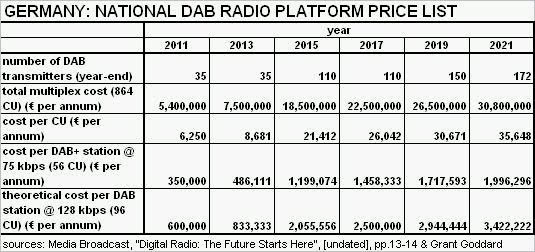
For years, German transmission provider Media Broadcast has been eager to put into action its masterplan to lock new DAB+ broadcasters into minimum 10-year contracts, for which it will be charging €2m per annum per station by 2021. The combination of Media Broadcast’s enthusiasm for the financial returns from DAB transmission contracts, and Frontier Silicon’s enthusiasm for the potential sales in Germany of DAB receivers that incorporate its technology, plus the offer of an amount of cash, persuaded a few commercial broadcasters to take on the risk of using the DAB+ platform.

Helmut Egenbauer, CEO of Media Broadcast, said: “Having introduced Frontier Silicon to the commercial broadcasters, we are delighted to see that their discussions have led to this important commitment to DAB+ radio services.”

Those five German commercial broadcasters should understand that even Frontier Silcon’s subsidy might not prevent them losing money hand over fist for the entire ten years of their transmission contract with Media Broadcast. The evidence is already there from the UK market. Not one commercial digital-only radio station has yet made an annual operating profit from the DAB platform in the UK, even after eleven years, let alone come close to recouping its investment.

Research commissioned by RadioCentre in 2009 found that the average annual revenues of a digital radio station were around £130,000 per annum. By then, 10m DAB receivers had been sold in the UK. Yet Germany is still at Year Zero with DAB+ radio penetration. The same report for RadioCentre had noted that the “annual negative cash flow impact of DAB” on the UK commercial radio industry was around £27m per annum, or 5% of sector revenues. Can German commercial radio afford to deplete its profitability by that sort of amount, year-on-year, for the next decade?

Frontier Silicon’s press release quoted Helmut G. Bauer as a “representative of the commercial broadcasters,” saying what a fantastic deal it was and promising that “2011 will be year that DAB+ is successfully launched in Germany.” However, Bauer is not associated with the German commercial broadcasting trade body, VPRT, which has been outspoken in its condemnation of plans for digital radio switchover in Germany. Bauer is a Cologne-based lawyer who has long made pro-DAB presentations at media conferences, and pro-DAB statements to the press, as a ”consultant.”

In fact, VPRT had
commented: “As we know, DAB failed in the market. Against this background, plans for the closure of FM – originally scheduled for as early as 2015, but now postponed – are absurd from an economic and social perspective and are therefore unacceptable.”

Noting the developments in Germany this week, Berlin-based Christoph Lemmer wrote in Radioszene magazine:

“With this decision, DAB will now actually be introduced by those who have succeeded, smelling a quick buck, in selling Germans a new sort of equipment, with millions to be sunk into to a new transmission network. Our old radios will be useless for DAB. Those who want to continue listening to the radio will need a new receiver.“

“It does not take a prophet to suspect that the private radio industry has shot itself in the foot by agreeing to sign the DAB contracts. A few shekels subsidy from a chip manufacturer who wants to install as many of its chips in DAB receivers – that is what has led to this. You, dear people, were not considered in the end. Do you really believe that devices with DAB will ever be as numerous as FM radios are today?”

“No one will understand what [DAB] is and why it is good. Because, with DAB, you have solved a problem that did not exist. The existing technological distribution of radio programmes is excellent and widely used. You did not have to change anything. The argument that DAB will create new radio channels with lower entry barriers is specious, as long as media regulators continue not to award licences for technically available [analogue] frequencies because they do not want additional competition in the market.”

This week, World DMB, the body marketing DAB radio globally, was so excited by developments in Germany that its web site posted seven news stories about it on 15th, nine on 16th and a further four on 17th. The overkill speaks volumes. Lacking any upturn in DAB receiver sales, the only positive news that DAB lobbyists can muster is this second attempt in Germany to launch a DAB technology that was first developed in 1981.

It is hard to recall a comparable technology whose proponents were still pushing for its launch three decades after its invention. DAB proponents argue that, simply because DAB is ‘digital’, it is inevitable that it will replace analogue radio. History indicates otherwise.

Digital Audio Tape. Introduced 1987. Abandoned 2005.
Digital Compact Cassettes. Introduced 1992. Abandoned 1996.

DAB radio & switchover: the British public speaks its mind

Q. Who will decide if/when digital radio switchover ever happens? The public. Who says so?

In July 2009, BBC ‘head of radio’ Tim Davie had
said:
“… the idea that we would move to formally engaging [digital radio] switchover without talking to listeners, getting listener satisfaction numbers, all the various things we do, would be not our plan in any way.”

In August 2009, BBC Trust chairman Sir Michael Lyons had
said:
“It is an extraordinarily ambitious suggestion, as colleagues have referred to, that by 2015 we will all be ready for [digital radio switchover]. So you can’t move faster than the British public want you to move on any issue.”

In July 2010, Culture Minister Ed Vaizey had
said:
“If, and it is a big if, the consumer is ready, we will support a 2015 switchover date. But, as I have already said, it is the consumer, through their listening habits and purchasing decisions, who will ultimately determine the case for switchover.”

Q. What is the BBC’s strategy for digital radio switchover?

In July 2010, the BBC Trust
told the BBC Executive that it:
“should draw up an overarching strategy for digital radio.”

Q. What is the public’s opinion of DAB radio?

Research published this week by the BBC Trust for the Strategy Review collated opinions voiced in 20 focus groups held in September 2010 in ten locations. Below are excerpts that relate consumers’ experiences with DAB radio and the BBC’s digital radio stations. They make sobering reading ….
Key Findings

The availability of radio services on the move (especially in-car and for those working outdoors) was felt to be of continued high importance. People expect radio to stay portable – at least the range of stations they currently have available on analogue, including local stations which are critically important in-car for their local travel information. In this context especially there was strong resistance to the idea of analogue radio switch-off, and considerable scepticism as to whether or not this will actually happen.

4.2 The range of services provided by the BBC

“Rather than spending money on Radio 57 or whatever, invest more money on the core main programmes.”
35-44, Male, C2DE, Crowthorne

4.3 Attitudes to DAB radio

Many of the distribution issues we set out to discuss in the groups related to the availability of DAB (or of certain stations on DAB). However, what became clear in the groups was that, although we did speak to some real fans of DAB, most licence fee payers we spoke to do not yet view DAB as an essential service in the way they do Freeview, for example. This certainly coloured their reaction to some of the trade-offs they encountered between funding distribution and content.

“I think they should improve the Freeview signal before they start worrying about the radio. Radio is fine.”
18-24, Female, ABC1, Inverness

These attitudes were coloured by a number of factors:
· Limited awareness of what DAB is and what it offers
· Limited awareness and uptake of the BBC’s digital-only radio stations (most digital radio listeners within the groups were using digital radio as a means of listening to stations they would otherwise be able to receive via analogue)
· Most DAB set owners we spoke to had received them as presents – they hadn’t necessarily had a compelling reason to buy one
· Many trialists of DAB in the groups had been frustrated with their experiences – e.g. intermittent/non-existent signals, limited range of their favourite stations available
· Some doubts as to whether DAB technology will be around in the long term

“I did have a DAB radio but I didn’t notice it being any better”
18-24, Female, C2DE, Cheddar

“I find DAB radio can be quite troublesome although that’s not BBC specific. The signal seems to interrupt quite regularly”
45-59, Female, ABC1, Crowthorne

“I don’t find that DAB radio is achieving a lot for me. It’s supposed to be better quality, but because of the size of the set I’ve got, it doesn’t really make any difference.”
55+, C2DE, Derby

“Aren’t we the only ones to use DAB? Europe uses a different system and America too – I don’t see the point of it now so many people have the internet as it’s as cheap to get an internet radio as it is a DAB radio and you can listen to far more stations on it”
25-44, ABC1, Fort William

“You can’t get much [on DAB in the car] – no Radio 1, no Radio 2, no Radio 5 live, no Radio 4, you just get a message saying ‘no reception’. You need to be on top of a mountain to receive it. It’s a complete waste of time.”
55+, C2DE, Derby

There was real confusion and in some cases concern about the idea of a digital switchover for radio, and some debate as to whether the mooted date of 2015 was realistic or not. Certainly in the current circumstances there would be much resistance among participants in these groups to the idea of switching off analogue radio, especially those for whom in-car listening was an important (or the dominant) part of their radio listening.

“They can’t switch off analogue radio – people are really not going to be happy with that”
18-24, Male, C2DE, Belfast

“The idea of making all radios into digital is just ridiculous… It’s not persuading you – it’s just pushing you”
18-24, Female, C2DE, Cheddar

“What about all the car radios – surely we’re not going to replace all those?”
25-34, Female, ABC1, Caernarfon

“Are you telling me my radios will be totally obsolete if they do this? That’s outrageous”
60+, Female, ABC1, Newry

5.1 Availability of services

“I’m going to sound old fashioned but the core product is BBC One, BBC Two and Radios 1 to 5”
35-44, Male, C2DE, Crowthorne

The digital-only radio stations were considered of significantly lesser importance (awareness of these was limited, and listening to them was quite sporadic through the sample). In fact in several groups it was suggested that one solution to the complex problems of making access to digital radio more easily available to people would be to get rid of the stations altogether!

“I don’t think anyone really cares about the digital channels and they won’t until all the non-digital signals have been turned off”
25-34, Male, C2DE, Newry

“It’s limited because digital radio hasn’t really taken off.. they’re talking about changing over in 2015… if it’s half the hassle of the digital [TV] switchover, it will be a dead loss”
45-64, ABC1, Merthyr Tydfil

6.1 Availability of platform choice

There was also a general consensus across the groups that, although the convergence of platforms has started to offer useful additional means of consuming ‘broadcast’ services, as a minimum the BBC’s television services should be available via a television set, and the main radio services via a radio set.

“It’s good enough to be able to get main stations on analogue radio and the others through the TV – I don’t think they need to be able to get all these radio stations on radio only.”
25-34, Female, ABC1, Caernarfon

Lack of availability of BBC Radio Derby on DAB

Local radio was considered to fulfil an important community service, particularly by those in the older group, who remarked that there had been a decline in the range of local media available (local newspapers closing, and the ITV regional television coverage now being focused on Birmingham).

As such, BBC Radio Derby was felt to be important to giving the city a sense of identity. Sports coverage was an integral part of this (for the men especially), and Derby-specific coverage was felt to help ensure that they don’t live in the shadow of nearby Nottingham. Frequently, they felt, Derby is treated like a poor relation next to Nottingham; the availability of BBC Radio Nottingham (but not BBC Radio Derby) on DAB was yet another manifestation of this, they believed.

A number of them had bought DAB radio specifically with the intention of listening to BBC Radio Derby and had thus been extremely disappointed not to be able to find it.

“I asked for a DAB set for Christmas, specifically so I would be able to listen to Radio Derby, nice and clear, around the house – not realising that you can’t get Radio Derby on DAB at all… I only found out when I pressed the ‘auto-scan’ button… Leicester, Nottingham, loud and clear, but no Derby… I felt really let down.”
55+, C2DE, Derby

“My wife bought me one for Christmas. It wouldn’t work next to the bed – we thought it was broken. We ended up just using it as an alarm clock. It never occurred to me that it might not work depending on where you live.”
40-54, ABC1, Derby

There was little awareness or understanding of the reasons why this is the case (the lack of a local commercial multiplex operator), so some participants were upset that the BBC appeared to be viewing Derby as a lower priority than neighbouring areas. Others had assumed that this was a technical issue (reception problems), rather than the station not being broadcast on DAB. (There was some awareness of a promised launch date of July 2010, but they claimed that this date had been and gone with no further update on what was happening.)

“What makes me angry is that Radio Derby comes out as one of the best local news stations in the country, but it’s not available on the latest technology.”
55+, C2DE, Derby

“If you can get the others, you’d just assume that you can get Radio Derby as well. Whose decision is it not to have it?”
40-54, ABC1, Derby

Some of the participants had experimented with some of the BBC’s digital-only stations on DAB. Radio 7 in particular was well-liked by some of the participants in the older group, and some of the younger men had used 5 live Sports Extra, but their overall impression with DAB was one of disappointment. The absence of BBC Radio Derby was a significant contributor to this, along with poor reception quality.

“The way they sell DAB it was going to be the be-all-and-end-all of radio listening, but it’s just been a great disappointment.”
55+, C2DE, Derby

Although many were disappointed with DAB in general, the absence of BBC Radio Derby from DAB was not felt to be a major problem for them as long as the station remains available on analogue (many were listening out of home in any case – traffic reports in the car, or match commentary when out and about at the weekend).

However, in line with most other groups, these participants would be extremely upset if the analogue signal were switched off and BBC Derby only then available online.

Radio Foyle on DAB

Many participants felt that they get a better reception with DAB than on analogue (in the home). Many of the older group in particular claimed to have experienced reception problems with Radio Foyle in particular on analogue, especially in bad weather. However it was not a case of a having had a desperate need to get a digital radio because they got no analogue signal previously, more that the sound was not always great and they sometimes experienced reception problems.

“DAB radio… I got it out of curiosity… everybody said it was better than analogue… the analogue sometimes you can’t tune in because you have got high pressure or rain or wind. The DAB you can pick it up.”
50+, ABC1, Londonderry

Most assumed that Radio Foyle was already on DAB, as they insisted they were listening to it on their DAB radios – it is not entirely clear whether this is confusion between DAB and analogue signals on the same set, or they have been experiencing the ‘dynamuxing’ test.

“No I didn’t know that because when I press it comes up on my DAB radio so I thought it was. I just took it that all the stations I can pick up on my DAB are digital.”
50+, ABC1, Londonderry

“Foyle on an ordinary radio is still poor I think. I am right in Derry. On the digital they do both seem clear to me.”
30-49, C2DE, Londonderry

When it was explained to them that ‘dynamuxing’ the two stations would result in two mono (as opposed to one stereo) stations, reactions were somewhat mixed. Although some participants were adamant that going from stereo to mono would compromise their listening experience, particularly when listening to music, others admitted that they were not sure what mono sound is, and probably wouldn’t be able to tell the difference! It is also worth noting that, from the description they gave of their DAB sets, the majority of participants in the groups were listening to DAB on mono-only sets anyway.

On balance, all participants would prefer both stations to be available, even if this meant mono-only broadcasting. The younger group, who were more loyal Foyle listeners, were happy enough with the availability of Foyle on analogue only, but would be concerned by the prospect of an analogue radio switch-off, in which case continued availability of Foyle would be vital.

Poor DAB coverage (in Fort William)

Most of the participants in the groups are used to struggling with coverage issues. Lack of DAB coverage is just the latest manifestation of issues they have experienced historically with analogue television and radio signals.

“I live over in a rural area completely surrounded by hills so there is no radio reception at all so all our radio listening is done through the TV box or the internet”
25-44, ABC1, Fort William

“I tried a DAB radio but it wasn’t very good – it would go for a bit then completely cut out and we have no FM signal at all out in the glens where I am”
45-64, C2DE, Fort William

As a result, satellite (by which most really meant Sky, as awareness of Freesat was very low) had become the default standard for most to receive television, especially for those outside the main town of Fort William itself, and many were increasingly using the good broadband services that are now available to them as a more reliable means of accessing media content.

“We’ve been up there seven years now and when we first moved we had a reasonable medium wave signal for Radio Scotland but then that tailed off but we get no FM and there was no TV until satellite came on stream… We had very young children at the time and they were happy just watching DVDs… There are about 250 people in our village and many of the surrounding communities have the same issues… There used to be a mast for the TV but that was turned off and now everyone has a satellite dish… satellite has been a godsend for us – especially for the radio – but we are now even more likely to be listening online. Our broadband is excellent – 8Meg – and now we even have wi-fi radios in the house.”
25-44, ABC1, Fort William

Some participants in the groups had been drawn to DAB, but left frustrated by the experience.

“I won a DAB in a Radio Scotland competition and I was really excited about being able to listen to 6 Music but there was absolutely no signal so I gave it to my dad down in Glasgow and he’s really happy with it”
25-44, ABC1, Fort William

Limited availability of Radio Wales and Radio Cymru on DAB

In common with many of the research locations across the country, issues surrounding the lack of availability of Radio Wales and Radio Cymru were caught up in other issues around the quality of DAB signal in general.

While some participants (for example, one lived near a mast) were experiencing extremely good reception via digital, others were having problems based on their location and even the prevailing weather conditions.

“If you get a rain cloud overhead, or worse than that the snow, you might as well chuck it in the bin.”
45-64, ABC1, Merthyr Tydfil

“People who live in the dips – they can’t get any kind of digital radio reception at all… they’ve got to do something to help them.”
25-44, C2DE, Merthyr Tydfil

This frustration was a manifestation of a broader dissatisfaction with digital reception in general. Many were experiencing problems with their television reception (especially, but not exclusively through Freeview). Lack of a reliable television signal was seen by most as a more significant problem than lack of a reliable radio signal.

“They said the digital signal was going to be better – that you’d be able to get S4C and Channel 4 – but it’s actually worse.”
25-44, C2DE, Merthyr Tydfil

“Wales has always got problems, we get worse service with the digital, the broadband, the post… We pay the same, we have a right to the same service.”
25-44, C2DE, Merthyr Tydfil

As a result many in the groups considered themselves to be disgruntled licence fee payers.

Most could understand that there are diminishing returns in terms of building out the transmitter network, and that those in the more mountainous parts of central Wales (for example) might not be able to have access to the same choices as people in more densely populated areas. However, in these groups the argument was most strongly made that people in these areas should have some kind of discount from their licence fee in recognition of the reduced service they receive.

“They [the BBC] can’t please everyone, they’re doing the best they can, but If people can’t get the service, why should they pay the full money.”
45-64, ABC1, Merthyr Tydfil

“You shouldn’t be penalised for living in an area where they can’t provide these services, because we have to pay extra to get Sky, for example, to be able to receive it.”
45-64, ABC1, Merthyr Tydfil

DENMARK: "DAB radio: we do not use it here!"


‘DAB radio: we do not use it here!’ said the headline in daily newspaper Ekstra Bladet last month, noting that the proposed digital radio switchover in Denmark has been postponed indefinitely.

Danish state radio, Danmarks Radio [DR], confirmed that it will half its number of DAB radio channels, reducing its total radio services from 23 to between 10 and 12 by next year. In April 2010, the government had insisted that state radio should, in future, focus on quality rather than quantity [see earlier blog]. Despite having launched its DAB channels in 2002, in aggregate they achieve less than a 10% share of radio listening in Denmark.

Mikael Kamber, media director of Danmarks Radio, commented: “It was a great idea when we introduced so many DAB stations at that time. Then, they were a public service channel assignment. DR helped launch digital listening. But I will say that, today, we can state: mission completed.”

Kamber suggested that, with the growth of online music players such as Spotify and TDC Play, consumers now had lots of other options to find exactly the music that suits their tastes. He explained: “Anyone listening can go online and find exactly what interests him. If you want to hear saxophone music, then there are plenty of opportunities to find it. You can even find saxophone music from the New York school on the web “.

One of the factors limiting DAB usage has been listener inertia. In 2009, nine out of ten Danes listened to only one or two radio stations each week. “New figures show that only 6% of listeners to [youth station] P3 change channel,”
said Danmarks Radio media researcher Dennis Christensen. “The remainder listen to P3 whenever they turn on their radios.”

GERMANY: DAB "is not financially viable", internet radio on the rise

“DAB or DAB+, in its current form, is not financially viable for commercial radio stations,” said Stefan Schmitt, managing director of RTL’s Berlin radio stations, in Promedia magazine. He pointed out that user numbers were increasing steadily for the internet, wireless via PC, laptops and smartphones. “Under these circumstances, I do not know where exactly the added value is for DAB,” he said.

Schmitt argued that the whole radio business model is still based on FM broadcasting and will remain so “for the foreseeable future.” He believes that the best alternative to broadcasting is currently ‘online radio’: “We are achieving market penetration [with online] much more rapidly than with DAB, which is not market driven.”

In Germany, a dispute continues to rage over the funding of DAB radio. The CDU party’s media expert Thomas Jarzombek has argued that “more than €200m of public funds were wasted on DAB” and that “these resources should be used for technologies that are well received by the public.”

Negotiations have been proceeding for months over a further €42m of public funds earmarked to be released to re-launch DAB radio nationally using the DAB+ codec, following the failure of the earlier launch using the older DAB codec. Initially, the contracts between transmission provider Media Broadcast and the station owners were meant to have been signed on 22 July 2010. Then, the subsequent 22 September 2010 deadline for negotiations passed without agreement, as a result of commercial radio’s unwillingness to commit financially to broadcasting on DAB+. This deadline has been extended again to 15 December, which experts in Germany
now suspect is “the last chance for DAB+.”

At its annual conference on 12 November 2010, the German association of commercial broadcasters, VPRT, reiterated its opposition to the government forcing the introduction of DAB+ radio upon the German market. Outgoing VPRT vice president Hans-Dieter Hillmoth
said: “The current draft of the new Federal Telecommunications Act ignores the existing interests of commercial radio in the functioning infrastructure, whose core business is FM radio.”

New
research in Germany by the Frankfurt Link Market & Social Research Institute has demonstrated the increasing popularity of listening to radio via the internet platform. Consumers’ preference for radio delivered to a PC or laptop increased 84% year-on-year, and is now exceeded only by traditional radio hardware – car radios, kitchen radios and stereo systems. Amongst 14-29 year olds, radio via a PC/laptop scored second only to the car radio.

The question put to respondents was: “Radio can now be received on many different types of appliances. Please indicate which appliances you particularly appreciate, regardless of duration of usage.”