UK commercial radio revenues underperform the 2010 media market

Marketing magazine’s annual survey of the top 100 advertisers announced some good news:

“More than three-quarters of the UK’s top 100 advertisers increased their adspend in 2010, defying predictions that the year would mark a steep decline in marketing budgets. By channel, the biggest year-on-year increase was in TV advertising, with a 17% rise, according to Nielsen; print, outdoor and cinema spend also rose.”

So, good news for radio too? Marketing continued: “The only medium in which spending fell was radio, falling 6% on 2009 levels.” Oh dear.

Why was radio so badly hit in 2010? Partly because of commercial radio’s greater dependency than other media on public expenditure which, as Marketing explained, was cut drastically in 2010:

“The government’s commitment to slashing public-sector spending was reflected in the 50% year-on-year decline in the COI’s [Central Office of Information] adspend to £105.4m.”

And partly because the volume of commercial radio listening has been in decline for the last decade, and sector revenues are a product of listening:
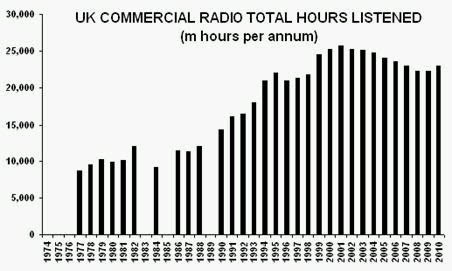

Encouragingly, 2010 witnessed a 3% year-on-year increase in the total volume of commercial radio listening, the first increase since 2001. However, total radio listening (commercial + BBC) had increased in 2010 by 2%, making commercial radio’s gain only marginally greater than the total market.

As for the other issue of slashed public expenditure on commercial radio, although 2010’s loss of £24m seemed bad [see blog], 2011 could prove to be worse. On Friday, the Cabinet Office recommended the scrapping of the 60-year old Central Office of Information:

“As part of the changes, the COI will be replaced with a new body, the Government Communications Centre, with a wider remit and responsibility for keeping a tight reign on advertising and marketing spend. … The report does not say how much the government might cut from its £1bn annual communications bill, or how much of the £540m spent on everything from TV, radio and posters to sponsorship might be reduced.”

This would prove a further financial blow for commercial radio, since COI expenditure on radio of £30m in 2010 still contributed as much as 11% to the sector’s national advertising revenues, even after having been slashed by the coalition government.

Although Marketing’s (Nielsen) data reported that radio’s national revenues fell by 6% in 2010, the commercial radio sector’s own numbers showed a 6% increase. This discrepancy is puzzling. Nevertheless, analysis of the industry’s dataset tells us:


TOTAL UK COMMERCIAL RADIO REVENUES:
· 2010: £522.6m (£505.5m in 2009)
· Up 3% in absolute terms
· First year-on-year increase since 2007
· Down 1% at constant prices [RPI]

UK COMMERCIAL RADIO NATIONAL REVENUES:
· 2010: £276.2m (£259.4m in 2009)
· Up 6% in absolute terms
· First year-on-year increase since 2007
· Up 2% at constant prices [RPI]

UK COMMERCIAL RADIO LOCAL REVENUES:
· 2010: £144.3m (£144.7m in 2009)
· Down less than 1% in absolute terms
· Lowest value in absolute terms since 2001
· Down 5% at constant prices [RPI]
· Lowest value at constant prices since 1992

This apparent collapse in local advertising revenues would appear to mask a dichotomy that is taking place in the radio sales market. For those stations in small groups or independently owned that rely almost entirely on local revenues, the market for local advertising has already rebounded from the recession. The closure of many local newspapers, the cuts to local council freesheets and the closure of many local radio station offices owned by large radio groups have left these genuinely local stations in an opportune position to hoover up more local advertisers.

On the other hand, local radio stations that have been transformed recently by Global Radio into ‘national brands’ (Heart, Capital) seem to be abandoning their interest in local advertising markets. If I owned a local business in Eastbourne, I would like to know how effective an advertisement would be on the local Heart FM station in my immediate area of Eastbourne & Hastings. This is no longer possible because Global Radio has done away with RAJAR audience data for many local markets. The smallest market that RAJAR can tell me about now is “Sussex,” comprising 1.3m adults – much too big a coverage area for an advert for my one local shop in Eastbourne.

This new strategy seems inconsistent with the Heart FM licence for Eastbourne & Hastings which Ofcom insists is “A LOCALLY ORIENTED CONTEMPORARY AND CHART MUSIC AND INFORMATION STATION…” So, please will Ofcom explain how Heart FM can be a “locally orientated” station if, as a potential advertiser in Eastbourne, I can no longer determine how many people would hear an advertisement broadcast on the station?

RAJAR explained the changes to its data: “Campaigns transferred from Q3 2010 to Q4 2010 will contain the old station definitions and they will be visible Q4, however the data will not be accurate. Please re-plan the campaign using the new regional definitions available in Q4.” In plain English – audience data for local stations have been removed and merged into regional groupings from last quarter.

So, it would seem that the ‘nationalisation’ of the content on Global Radio’s Heart and Capital brands has been accompanied by ‘nationalisation’ of advertising sales. If ever there seemed like a wrong time to be pursuing national advertisers for commercial radio, surely it must be now [see blog]. In real terms, national advertisers spent no more on commercial radio in 2010 than they had in 1997. However, in 1997, there were only 200 commercial radio stations, whereas now there are 300.

I am reminded of a meeting in 2007, just weeks before EMAP was sold, with its chief executive when I asked him if he felt there was anything that the group’s radio division should have done differently. Local advertisers, he told me. We neglected local advertisers in pursuit of the larger amounts we could earn from potential national advertisers. But we turned our backs on previously loyal local advertisers who quickly lost interest in our stations without regular contact from our salespersons.

Here is a lesson to be learnt from the UK’s second largest commercial radio group. Don’t look your local cash cow in the mouth.

GERMANY: government drops FM radio switch-off 2015 date from new legislation

VPRT, the German trade association for commercial media, has welcomed the government’s decision not to include clauses in its new Telecommunications Bill that would have switched off FM radio broadcasts in 2015. In its 9 March 2011 press release, VPRT stated: “FM is and remains the basis for the development of new radio services.”

VPRT described the earlier federal plan to switch off FM radio on 31 December 2015 as a “completely unrealistic statutory requirement” which would have made redundant 300 million FM radio receivers.

Germany is making a second attempt to launch DAB radio with ten national services scheduled to start in August 2011. US broadcaster Radio Disney had been an initial applicant for one of the national commercial DAB radio channels, but subsequently withdrew its proposal in January 2011. Some of the other commercial stations had been offered a financial subsidy by DAB chip manufacturer Frontier Silicon in December 2010 [see blog].

However, as one German publication commented: “So far, consumer interest in digital radio has been extremely low.” Pit Klein from the magazine ‘Sat+Kabel’ explained: “We have estimated from the regional media authorities that only about 500,000 DAB radio devices are in circulation.” Christoph de Leuw from the magazine ‘Audio Video Foto Bild’ said: “In some areas, [DAB radio] receives only two or three stations. No one buys a new radio receiver for €100 to receive two stations … People are satisfied with FM quality. The real, practical benefits to consumers [of DAB] are yet to be determined.”

Experts in Germany agree that the future of radio is digital. “Whether the digitalisation of radio will take place on DAB is questionable,”
said Sven Hansen, editor of the computer magazine ‘c’t’.

[with thanks to Follow The Media]

DAB radio take-up in the UK: the 2010 year-end scorecard

“I think that there is great potential for digital radio, as the UK and Danish experiences demonstrate.”
Neelie Kroes, vice president for the digital agenda, European Commission, 3 March 2011

“This milestone is part of building momentum for the transition to digital radio in the UK …”
Digital Radio UK, December 2010

“I think that there has been a transformation in the last twelve months.”
Ford Ennals, chief executive, Digital Radio UK, February 2011

“2010 was a fantastic year for the DAB family, with much encouraging news and positive activity from individual markets …”
Jørn Jensen, president, World DMB, March 2011

“We are seeing increased momentum and activity as digital radio switchover moves from debate to reality …”
Bernie O’Neil, project director, World DMB, March 2011

“2010 had a real sense of forward momentum and activity …”
Caroline Brindle, project office manager, World DMB, March 2011

“Building momentum”? “Transformation”? “Fantastic year”? “Increased momentum”? “Forward momentum”?

Is this DAB radio that we are talking about? In the UK, at year-end 2010, the picture looked like this:

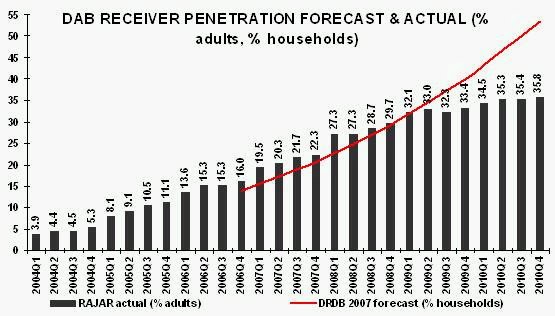
DAB radio receiver penetration:
· 2010 year-end forecast: 53.4% (Digital Radio Development Bureau, 2007)
· 2010 year-end actual: 35.8%

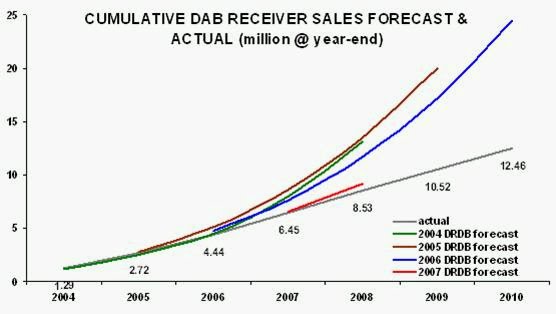
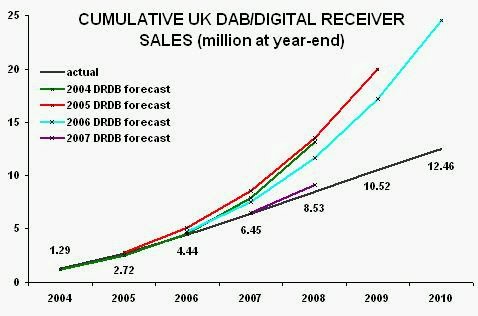
Cumulative DAB radio receiver sales:
· 2010 year-end forecast: 24.5 million (Digital Radio Development Bureau, 2006)
· 2010 year-end actual: 12.5 million

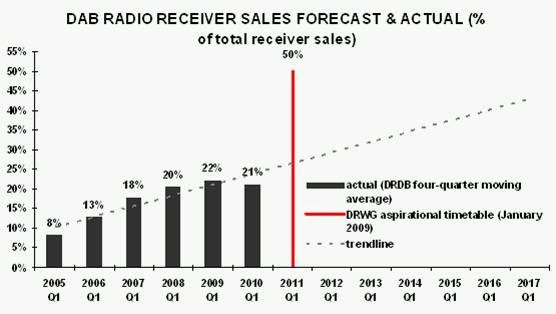
DAB radio receiver sales as % total receiver sales:
· Q1 2011 forecast: 50% (Digital Radio Working Group, 2009)
· Q1 2010 actual: 21%

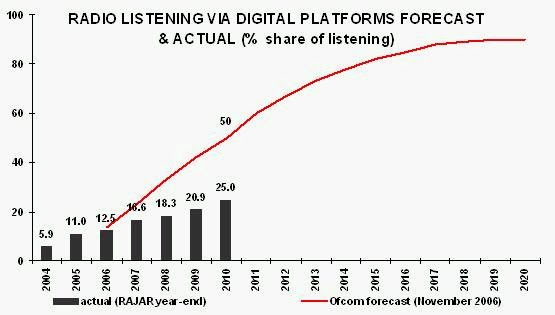
Radio listening via digital platforms:
2010 year-end forecast: 50% (Ofcom, 2006)
2010 year-end actual: 25%

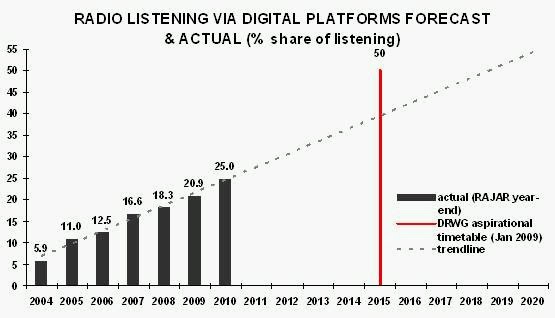
Radio listening via digital platforms:
2015 year-end forecast: 50% (Digital Radio Working Group, 2009)
2010 year-end actual: 25%

Radio listening via digital platforms:
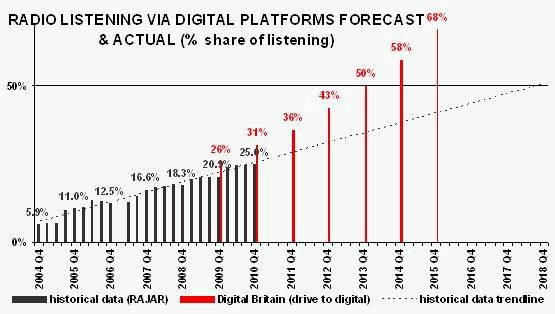
2010 year-end forecast: 31% (Digital Britain: drive to digital, 2009)
2010 year-end actual: 25%

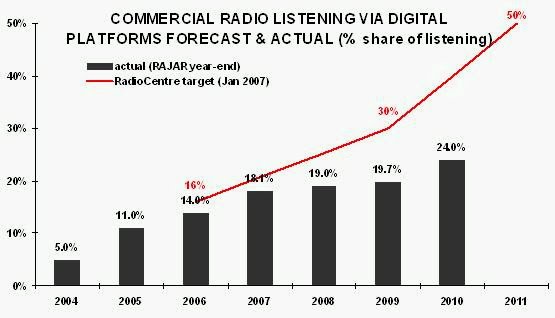
Commercial radio listening via digital platforms:
2010 year-end forecast: 40% (RadioCentre, 2007)
2010 year-end actual: 24%

None of the stakeholder forecasts of DAB take-up in the UK have come to pass. In this respect, 2010 was no better a year than any other.

Neelie Kroes is mistaken. Evidence from the UK experience certainly does not demonstrate the “great potential” for DAB radio.

Public spending cuts impacted commercial radio 2010 revenues by £24m

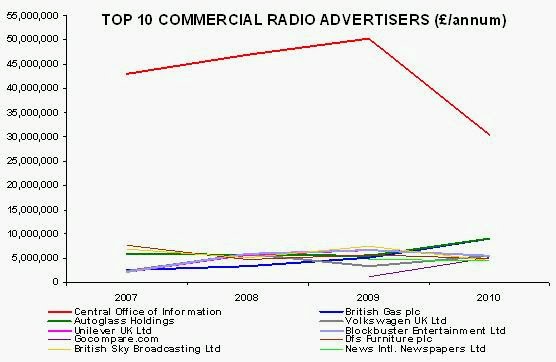
Who was UK commercial radio’s biggest advertiser in 2010? British Gas? No, it was second. Autoglass? No, it came third. Volkswagen? No, it was fourth. Unilever? No, it came fifth.

Radio’s biggest advertiser in 2010 was the government (in the guise of the Orwellian-sounding Central Office of Information [COI]). Not only was the government the biggest advertiser on radio, but it was far and away the biggest advertiser by miles. The government’s £30m expenditure on radio in 2010 exceeded the sum total of British Gas, Autoglass, Volkswagen and Unilever.

After the coalition government was formed in May 2010, it immediately executed Conservative Party strategy to cut public expenditure on commercial advertising by 50%. Before the election, I had predicted that this Conservative policy would have a disastrous impact on commercial radio revenues [see May 2010 blog]. It did.

Although the coalition had been in power for little more than seven months by year-end, COI expenditure on radio was quickly slashed from £50m in 2009 to £30m in 2010. Additional (non-COI) public expenditure cuts reduced radio’s revenues by a further £4m in 2010. This £24m total was a significant loss to commercial radio, and represented 9% of national revenues, or 5% of total revenues.

Did radio suffer greater cuts from the COI than other media? Seemingly not. Radio’s share of COI ad spend was 27% in 2010, slightly higher than the previous year. The reason the impact was so great for radio was the sector’s much greater dependency upon public money than competing media (television, the press, billboards).

In June 2010, the Radio Advertising Bureau had said bravely: “We are optimistic that radio’s strengths will be recognised as COI budgets come under ever greater scrutiny.” Evidently, radio strength’s were not.

By September 2010, the Radio Advertising Bureau said that it was “working with a wide range of advertisers to bridge the gap” left by public expenditure cuts. What was the outcome?

There were some impressive gains for radio from other clients in 2010:
· British Gas increased its expenditure on radio from £5m to £9m year-on-year (particularly impressive since it had only spent £2m on radio in 2007)
· Autoglass increased its expenditure on radio from £5m to £9m year-on-year (50% of its ad budget)
· Gocompare.com increased its expenditure on radio from £1m to £5m year-on-year
· More Than increased its expenditure on radio from £2m to £4m year-on-year
· Mars increased its expenditure on radio from £1m to £4m year-on-year
· Asda multiplied its expenditure on radio eight-fold to £3m year-on-year

The problem was that even these gains combined did not match the loss from government spending cuts. The huge challenge the commercial radio industry still faces is its history of increasing dependency upon one very large advertiser.

Additionally, there were other clients that either spent less in 2010, or might in 2011:
· Blockbuster Entertainment was radio’s sixth biggest advertiser in 2010 (spending 50% of its ad budget on radio), but filed for bankruptcy in the US in September 2010
· Sky TV reduced its expenditure on radio to £4m in 2010 from £7m the previous year
· BT reduced its expenditure on radio to £4m in 2010 from £7m the previous year
· Proctor & Gamble reduced its expenditure on radio to £4m in 2010 from £6m the previous year
· Specsavers had been the second biggest spender on radio in 2009, spending £8m, but dropped out of the top 20 in 2010

However, these single-digit losses were dwarfed by the £24m reduction in public expenditure on radio advertising in 2010.

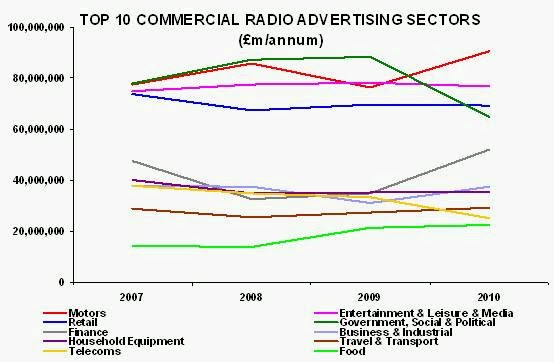
In terms of product sectors, motor vehicles rebounded from the recession and led the field in 2010 with £90m expenditure on radio. The finance sector similarly rebounded to £52m in 2010. On the other hand, the property sector did not rebound and its spending on radio of £8m in 2010 was down 42% compared to two years earlier. Likewise, online retailers spent only £2m on radio in 2010, down 55% from two years earlier.

Public expenditure on radio fell from the number one product sector in 2007, 2008 and 2009 to fourth place in 2010. Inevitably, given that the coalition was only elected mid-2010, the cuts to public expenditure are likely to have as much impact on radio in 2011 as they had in 2010. Neither is there any prospect of these cuts being restored under the present government.

Total radio sector revenues for 2010 are likely to be up slightly year-on-year [see Oct 2010 blog]. This is not something to shout about, given that Q2 and Q3 in 2009 had produced commercial radio’s lowest recorded revenues this millennium. However, it is an achievement in an environment where expenditure by commercial radio’s biggest advertising client fell off a cliff (as the graphs above demonstrate visually).

Unfortunately, in the longer term, unless commercial radio succeeds in improving its performance with listeners, both in absolute terms and in comparison with BBC radio, it cannot expect its revenues to return to levels recorded a decade ago. By 2009, UK commercial radio revenues had fallen by 32% since 2000 in real terms. Radio’s revenues from national advertisers had fallen by 47% during that period. That will be an almost impossible expanse of ground to regain.

[data source: Nielsen Media Research]

Does the nation love its digital radio stations? 86% of UK adults say 'no'

In his perceptive commentary on last quarter’s RAJAR radio audience figures, IPSOS’ research manager Andy Haylett noted:

“18.5 million adults are DAB owners, yet only an estimated 12.6 million are confirmed listeners. What are the other 6 million doing with their DAB sets? Further investigation shows that there are only 7.4 million listeners to digital-only stations, of which under half (3.3m) comes from DAB listening. This suggests that around three quarters of all DAB listeners are tuning to stations readily available on a traditional analogue transistor.”

This reiterates a point I have made previously in this blog [Feb 2009, Aug 2009, Feb 2010]. After more than a decade, it is a sad fact of life that digital radio stations on broadcast platforms have not succeeded in setting listeners’ hearts on fire:
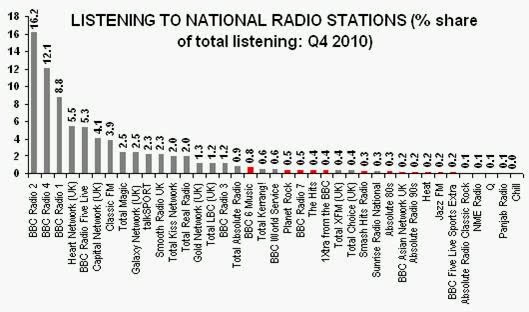
· Only 4.6% of all radio listening is to digital radio stations
· 18.2% of all radio listening via digital platforms is to digital radio stations
· 7.4m adults per week listen to digital radio stations (14.3% of adults)
· 3.3m adults per week listen to digital radio stations via DAB (6.4% of adults)

Of course, the corollary is that digital platforms are being used predominantly for listening to radio stations that are already available to consumers on the analogue platform:
· 95.4% of all radio listening is to analogue radio stations
· 81.8% of all radio listening via digital platforms is to analogue radio stations
· 44.2m adults per week do NOT listen to digital radio stations (85.7% of adults)

These figures might have been understandable during the early years of DAB radio. But now? After more than a decade? Planet Rock launched in 1999; the BBC digital stations in 2002. Compared to the influence that digital terrestrial television stations have had in the UK over a shorter period, digital radio stations have had very little impact on radio listening patterns to date.

The overwhelming use of digital platforms to listen to analogue radio stations begs the question: so what is the point of DAB? There was never anything wrong with FM radio anyway, and there is no proposed alternate use for FM spectrum, so why is the government insisting that consumers and the radio industry both spend huge sums of money to enable the public to listen (on DAB) to exactly what is available already (on FM/AM)?


In the graph above, the listening to digital radio stations is shown in red (analogue stations in grey). It remains tiny. Despite BBC Radio 6 Music’s uplift after last year’s consumer campaign, it still languishes as the UK’s 18th most listened to national radio station. Fortunately for the BBC, the funding for its digital radio stations continues to come (for now) from the public purse.

For commercial radio, the funding for digital radio stations has to come from deep pockets. Not one digital radio station has yet made an operating profit. History is littered with commercial digital radio stations that used to be on the national DAB platform: ITN News, Talkmoney, The Storm, PrimeTime Radio, 3C, Capital Disney, Core, Virgin Radio Groove, Oneword, Capital Life, TheJazz, Fun Radio, Virgin Radio Xtreme and Panjab Radio.

Some of these digital radio stations had offered fantastic content unavailable elsewhere (PrimeTime, OneWord). Other digital stations had had very little thought put into their creation. Former GWR staffer Steve Orchard boasted that his company’s strategy for Planet Rock had been conceived in The Lamb Inn, Marlborough: “Going into a pub with Ralph Bernard, my boss, listening to the classic rock jukebox and coming out, several pints later, with Planet Rock sketched out on the back of an envelope.”

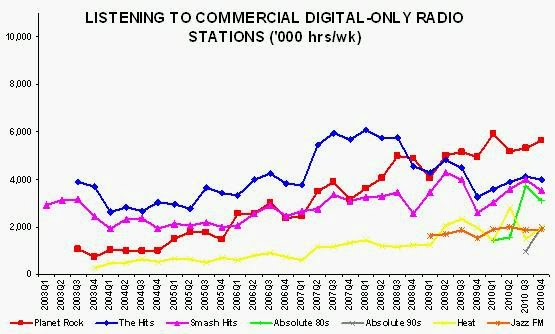
GCap Media sold Planet Rock in 2008 to an ‘outsider’ and it has been the commercial radio industry’s most listened to digital radio station since 2009. It speaks volumes that the entire UK commercial radio sector’s efforts at digital radio stations over more than a decade have been trumped by a music enthusiast with no previous radio sector experience.

However excellent it is, Planet Rock alone cannot save the DAB platform from continuing consumer disinterest. It would require a dozen stations of this calibre to create a portfolio of sufficient interest to stir consumers. Worse, for those consumers who have tried DAB and given up due to the platform’s other issues (poor reception, lack of mobility, lo-fi audio, expensive hardware), even a dozen stations might not tempt them back.

It is understandable, therefore, that Planet Rock’s owner, Malcolm Bluemel, should be frustrated with the rest of the radio industry for not following in his wake. This month, he said:

“I’ve only been in the radio industry about two and a half years now and I’ve never actually come across an industry that has such a collection of self-interest in discussing this matter [digital switchover]. I’m quite amazed at this need for certainty around the future of business. I came from an era where, to get a decent radio [station], I had to stick my AM transistor under the bedclothes and listen to Kid Jensen from Luxembourg at night. Well, now we’ve got people saying ‘Well, I want to know this, I want to know that, I want to know that my radio stations will be this, and I can have that, and I want it all, and I want it all now.’

It’s fairly obvious to me that, as an industry, we should be all sticking together. Digital is here. It’s not a question of a switchover date. Digital is out there. It’s being listened to. There’s 1.1 million people listening to 6 Music, there’s 827,000 people listening to Planet Rock on digital radio NOW. So why don’t we just accept the fact that digital is here and all get together and say ‘Right, how are we going to make this work for the industry?’ For all those people with their self-interest and their stupid press statements over ‘20 years [until digital switchover]’ or whatever it is (how ridiculous is that?), and just get together and have a consensus of opinion about how we are best going to do this, but collectively for the radio industry, and stop fighting amongst ourselves because of our own petty little grievances.”


Planet Rock’s 827,000 weekly reach last quarter is a remarkable achievement. Compare this to the dismal performances of some analogue commercial radio stations. Absolute Radio, with the benefit of a national AM licence and a London FM licence, reached only 1,375,000 adults per week. Xfm reached 938,000 adults nationally with the benefit of a London FM licence. Choice FM reached 734,000 adults nationally with the benefit of a London FM licence.

By comparison, Planet Rock has performed miracles, given that the only broadcast platform it has access to is DAB. As Bluemel identified, paradoxically, the thing that is stopping him from turning Planet Rock into the profitable radio station that it should be is the very industry in which he is working. Whilst (post-GCap Media) Planet Rock is doing all the right things for all the right reasons, the rest of the industry, where DAB is concerned, continues to do all the wrong things for all the wrong reasons.

Unfortunately, the barriers to Planet Rock’s commercial success are the outcomes of the sad history of the DAB platform:
· The commercial radio sector initially invested in DAB to control the platform, not to create successful digital radio stations
· The BBC decided to launch minority interest digital radio stations that would not cannibalise its existing national analogue networks
· The commercial DAB multiplex owners (aka the largest commercial radio groups) did not want upstart independents creating successful digital radio stations on their DAB platform
· The industry’s ‘build it and they will come’ strategy for DAB failed because consumers are driven by content, not by platforms
· If you wanted to persuade consumers to buy relatively expensive DAB radios, you should have inspired them with new content rather than have threatened them with FM switch-off
· Radio listeners are loyal and do not like losing access to content they once enjoyed (the closure of digital radio stations)
· DAB radio reception, for many, is still not as robust as FM or AM

The best solution for Planet Rock would be a national analogue licence. Or, at least, a London FM licence. However, the radio regulatory system we have in the UK militates against that possibility. Why? Because politicians, civil servants and regulators have ensured that those who already own (what were once) commercial radio ‘licences to print money’ get to keep them, seemingly in perpetuity.

It is the existing radio industry itself which is limiting Planet Rock’s opportunities for greater success. We do not enjoy an openly competitive radio market that allows new entrants such as Bluemel to shake up our stagnant radio industry with new, exciting ideas. Instead, ‘outsiders’ have to stand around on the sidelines while the owners of stations such as Absolute Radio, Xfm and Choice FM continue to run them into the ground. So why don’t they just sell them?

Sell their stations? Of course not! When you are part of a commercial radio oligopoly, why would you want to encourage an insurgent, who might actually understand how to create a successful radio station, to camp right on your analogue doorstep? Not only might he show you up, but he might even steal listeners from your other stations. Instead, the current philosophy is to let ‘outsiders’ bleed to death financially on the DAB platform, while the incumbents continue to divide up (what is left of) the spoils of FM/AM radio between them.

So we listeners get the (analogue) mediocrity they think we deserve.

[blog headline adapted from Andy Haylett’s of IPSOS]

Rubbish DAB radio reception: why is Ofcom working hard NOT to fix the problem?

“Ofcom’s primary concern in radio is to look after the interests of the listeners.”
Peter Davies, Ofcom, January 2007.

When something is broken, you have to fix it. Thinking about fixing it, planning to fix it, talking about fixing it, convening meetings about fixing it – none of these will actually fix it. You just have to fix it.

DAB radio reception has been broken since the broadcast platform was introduced in the 1990s. Transmitter powers are inadequate and there are insufficient transmitters, particularly in urban areas. These issues have still not been fixed.

For most of the last decade, the radio industry and the regulator were in denial that DAB reception was rubbish. Initially, it proved easy to blame the consumer. The advice to early DAB adopters was that they should install a DAB aerial on their roof and attach it to their new DAB radio because their home might be constructed of the wrong type of materials (bricks?). What? All this just to listen to Radio 7 in the bath?

Eventually, sufficient people had bought DAB radios that they started to compare experiences. People in the same street, the same family, the same house all found that they had similar problems with DAB reception.

In 2004, a technical paper entitled ‘Indoor Reception Of DAB’ by Simon Mason of NTL concluded that “a field strength of 71 dbμV/m is required in order to provide good indoor DAB reception to handheld devices.” Mason found that, in London, “the worse [sic] reception areas were, in every case, on the ground and first floors” of large buildings.

In 2006, at the TechCon conference, Ofcom’s Mark Thomas explained: “The Radio Authority had no data of how [DAB] receivers performed, so it had to make some very broad-brush assumptions. More recently, now that we have a lot of receivers in the market and we can see how they behave, an industry group has been working under Ofcom’s chairmanship for the last two years to look into the issue in more detail and come up with some modus operandi for new transmitter sites.”

At the same conference, EMAP’s Grae Allen
advocated: “In the future, as I envisage it, we will see a need to put more and more [DAB transmitter] sites inside the cities in areas where we actually need significant power where people are living and working.”

Did any of these ‘fixes’ happen? Only in London, and only for one of the four DAB multiplexes that serve the capital. Did Ofcom fix this? No. Did the radio industry pay for it? No. It was BT that paid for new DAB transmitters in London to improve the reception of its new mobile television service, Movio, which soon failed commercially. The DAB improvements were left in place.

As Mark Thomas had explained, it was the regulator (the Radio Authority, now Ofcom) that had set the technical criteria for DAB transmitters in the UK. So you might imagine that it would naturally be the regulator that would take responsibility to fix inadequate DAB reception. You would be wrong.

In 2010, Ofcom launched a consultation about the terms of its contract renewals for DAB multiplex licences. You might think that this would be the ideal opportunity for Ofcom to insist that licensees must improve the coverage of DAB transmitters so that consumers would receive satisfactory reception. You would be wrong.

Ofcom indirectly acknowledged that the current quality of DAB reception was the result of inadequate criteria having been implemented. It stated:

“Digital One’s [national DAB] network and all other existing DAB networks have been planned to a signal strength of 58 dBμV/m. This is what we currently call ‘outdoor’, or mobile, coverage.”

“A signal strength of 65 dBμV/m is what we currently call ‘indoor’, or portable, coverage. The network of 30 additional transmitters that Digital One implemented in order to facilitate the now-defunct BT Movio mobile television service were planned in order to deliver coverage in certain areas at a much higher signal strength of 82 dBμV/m.”

Evidently, BT had understood that you cannot hope to persuade consumers to spend their money on new equipment if they find that reception is not good enough to use it. Unfortunately, nobody in the radio sector took the hint. So what did Ofcom decide to do about this sorry state of affairs that has ruined so many listeners’ usage of DAB since 1999? Nothing at all. It said:

“In general, the coverage which applicants for radio multiplex licences propose to deliver has been seen as a commercial decision for the licensees, with neither Ofcom nor its predecessor regulator the Radio Authority seeking to impose a minimum coverage obligation that an applicant’s proposals must meet …” [emphasis added]

This decision was made, despite Ofcom having already convened meetings of an “ad-hoc working group” that had included the BBC, the government and the DAB multiplex licensees. The outcome was:

“This group came to a provisional agreement that the field strengths currently used for determining coverage are no longer appropriate given operators’ experience after several years of operation. The group provisionally agreed that a revised set of appropriate field strengths should be used from now on …”

This group’s new recommended signal strengths for adequate DAB reception were:
· 58 dBμV/m for outdoor reception
· 69 dBμV/m for indoor reception
· 77 dBμV/m for indoor reception in dense urban areas.

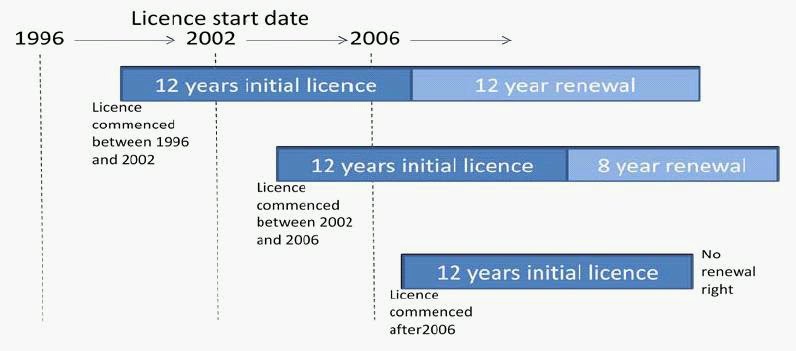
So it would make perfect sense for Ofcom to insist upon these agreed new field strengths in the new contracts for DAB multiplexes that will run for a further 12 years. But to Ofcom, it did not. Ofcom simply said to multiplex owners: just carry on as if nothing is at all wrong with DAB reception. In Ofcom’s words:

“We are not proposing to set any additional coverage obligations that Digital One must meet as part of the [national DAB multiplex] licence renewal process” and “we will not set any additional coverage obligations for local [DAB] radio multiplex licensees as part of the process of licence renewal …”

Perhaps Ofcom should explain precisely how its policy on DAB reception quality is working “to look after the interests of listeners.” The story to date seems to look like this:
· When DAB was introduced, the regulator got its technical sums wrong
· Poor quality reception dogged DAB from the beginning
· The regulator ignored the problem
· The radio industry knew this was a problem
· The regulator still ignored the problem
· Belatedly, the industry came up with better DAB technical parameters
· Implementing those new parameters would cost it lots of money
· Belatedly, the regulator acknowledged the problem
· The regulator refused to accept responsibility for having created the problem
· The regulator refused to take responsibility for fixing the problem
· The regulator said it was a “commercial decision for the licensees” to fix the problem
· The regulator renewed existing DAB multiplex licences to prolong the problem for a further 12 years.

Maybe Peter Davies’ earlier quote should be amended to:

“Ofcom’s primary concern in DAB radio is to stick two fingers up to all those radio listeners who, since 1999, have spent money buying a DAB radio, taken it home, and found that reception is too poor to use it.”

DAB radio numbers: why do they keep making them up?

I’m a numbers man. I can tolerate a little numerical exaggeration, a few rounding ups, or even the odd ‘nearly x million’. But when people invent numbers and stick them in their press releases, I reach for my calculator. Not for the first time, today Digital Radio UK advanced the concept of ‘mind over mathematics’ to a new level.

In its press release of 21 December 2010, Digital Radio UK estimated “that due to strong Christmas sales, over two million digital radios will be sold in 2010.” I questioned how this could be true in my blog. Turns out that it wasn’t.

In today’s update, Digital Radio UK admitted that the “increase in digital radio sales” it had heralded in December was, in fact, a decrease because “2010 was slightly down in digital radio sales volumes (-2.3%) compared to 2009.”

In plain English, 1.94m digital radios were sold in 2010, compared to 1.99m in 2009 and 2.08m in 2008. Increase? No. Growth? No. Over 2m in 2010? No. Were these sales figures in the Digital Radio UK update? No.

In another numerical nonsense, today’s Digital Radio UK update said:

“If this annual growth rate [in digital radio listening] is sustained, then the Government criterion of 50% of digital listening will be achieved in 2014.”

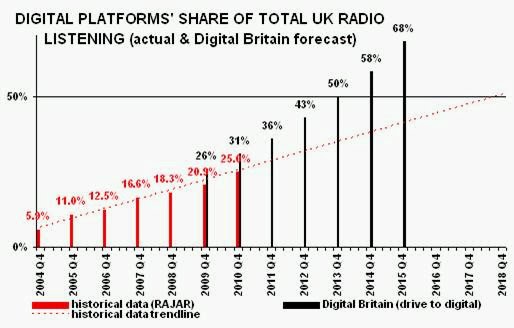
This is mumbo jumbo rubbish from people who like to use numbers to baffle the public and to obscure the truth. The 50% threshold is no more likely to be reached in 2014 than it is in 2013, which had been the original government target. A trendline* through six years of quarterly data (see graph above) shows that the 50% criterion will not be reached until year-end 2018.

So what happened to the original 2013 target for 50% that had been set by the government’s 2009 Digital Britain report? It now seems to have been completely forgotten. No explanation, no apology – just ignored (in June 2009, I had predicted that the 2013 target would prove “impossible”).

So how confident is Digital Radio UK that its new 2014 target is attainable? Enter stage left its CEO, standing next to a PowerPoint chart last week:

“This next chart is the most risky one I have in the pack. I hesitate showing you, particularly given the most recent conversations. But, I think, rather than just looking at a moment in time, there is a value in extrapolating. And all sorts of health warnings around this, you know, you’ve got government economists, you’ve got analysts in the stock market, you know, you can’t ever predict these things correctly. But, just taking the trends of the last three years and of the last year and running them forward – and life won’t be that simple but – just to understand from a mathematical calculation, where would that take you? Well, if we took the three-year compound growth rate, of the last three years, it would run us through to achieving 50% by the end of 2015, if we take the three-year curve. If we took the one-year curve that we’ve seen in 2010, it would take us to the end of 2014. To get to the end of 2013, which was an aspiration of Digital Britain, would require the compound growth rate to rise to 26%. So it needs to take a step change. You could put an argument forward that there are step changes coming, in content, in coverage, in cars, in communications and in consumer electronics. But I think it would be a brave man, or a brave woman, to say that, you know, you are definitely going to hit that grey line, and I wouldn’t say that. What I would say is that, on current trends over the last three or four years, we are likely to hit 50%, you know, in the next five years, I would say.”

So, February 2011 plus five years equals 2016. Well, this does not match the forecast in the ‘real world’ graph above of 50% being attained by year-end 2018. But neither does it match the 2014 date in today’s Digital Radio UK update.

Exactly where that leaves us is unclear. Is it 2014? 2016? Another year? Any old year?

DAB and realism and numbers seem to mix as well as oil and water and … er, more oil.

“Quite where the maths comes from to deliver 2014 is beyond me!” one senior radio executive said to me today. “Why do they put this out when it will surely mean another stick to beat them when it doesn’t happen?”

[* = there is no statistical evidence from historical data to demonstrate that the automated Microsoft Excel trendline is anything other than straight line.]

DAB radio switchover: the view from the government bunker

The government’s second stakeholder consultation on DAB radio switchover happened this afternoon. It was held in what felt like an underground government bunker in Victoria. No windows, long corridors, and lots of seemingly identical numbered rooms hidden by massive doors that had no viewing windows. When I tried to go up a staircase to ground level, a man appeared from nowhere and told me not to.

Even if the bomb had dropped, down there, you might not have known it. The cityscape outside could have transformed into a wasteland but, down there, you can be certain that our civil servants would continue planning digital radio switchover regardless, even if the precise date had to be postponed until the contamination had receded. I imagine that the government staff working there hardly need to go out, even at lunchtime, because a little lady with a trolley probably comes around with salmon sandwiches.

In this cosseted environment, it is easier to understand how you might spend your days (or months or years) of servitude, devising schemes that have so little relevance to the real world above your bunker office. Perhaps this is why the afternoon was filled with PowerPoint presentations that all looked great, slides that had lots of action words, and monologues from grey men that were filled with the current jargon. It was a perfectly unreal world.

What the afternoon lacked was realism. Occasionally I had to pinch myself to make sure that this was not a Lemsip-induced slumber. It wasn’t. However, I did witness the Civil Service suggest that asking consumers their opinion about DAB radio switchover would be a good idea, as if it was a novel thought that had just come to them. Not withstanding that the government has been pursuing the notion of the DAB platform since the 1980s but, in all those decades, somehow omitted the ‘consumer’ (or ‘listener’) from its plans.

The following quotes came from our civil servants this very afternoon. I wrote them down. Reading them now, these lines could have been extracted from the script of a lost episode of ‘Yes Minister’ in which the cast cleverly parody government plans for digital radio switchover. Sadly, they did not. This is what stakeholders were told today (amongst many other things):

“We genuinely have seen more progress [on digital radio switchover] in the last eighteen months than we have in the last six or seven years I’ve worked on this issue. But, as far as the consumer is concerned, we’ve never certainly in any way advocated or used 2015 [switchover date] as a ‘stick.’ It’s always been the industry target. And, certainly, when this government came in, it was adamant and clear that the consumer would make the case for switchover by purchasing habits, by the percentage of listening [on digital platforms], the way it absorbs and consumes radio. Now, will I, at this point, say that there has been a cross-pollination of those two things? Has the 2015 [date], which was an industry date, started to creep into the public consensus and been used by the media as a scare tactic? Yes, of course it has. And do we, as an industry, need to look at that? Yes, I think we do. I would say that I don’t think anyone – I think very few people – in this room would welcome the government standing up tomorrow and saying that the [switchover] date is the 31st December 2015. And I don’t think we have any answers to the questions that we need to have the answers to before any such decision can be made, and whether the consumer genuinely believes that this is something they want to do.”

“I don’t think we know what listeners want. I think part of this [Digital Radio] Action Plan process is absolutely understanding the value people put on various parameters of radio – what they want, how they want to consume it. I think that part of understanding this decision is understanding the listener better. And I think, whilst we all have our own views on that, I don’t think there’s enough evidence based [data] for us to make those assumptions about what listeners want.”

“I don’t think the government has never ever said ‘digital radio switchover will happen in 2015’ but we think we need to go away and look at the messaging around the cross-pollination. The one thing I would say is: 2013 and 2015 is used by both sides of people in the debate, those who like to frighten people into the fear of losing their analogue services, and those who like to sell digital radios. For all of us who believe that certainty and clarity and the consumer is important, I think we all need to look at how we use the threat of 2013 and 2015 and have some consistency ourselves about how we talk to the consumer about it.”

Threat? Are radio listeners so malleable that they must be viewed by government like cattle to be herded to slaughter? Maybe I imagined mistakenly that government was FOR the people. Anyway, I suppose we should be grateful at all that the ‘consumer’ has suddenly been pushed centre stage in the long running DAB drama, even it is so late in the show [see 2009 blog and 2010 blog where I predict it would be ideal for bureaucrats to eventually blame DAB’s failure on the consumer rather than themselves].

Is there any difference between the government forcing the population to buy a DAB radio to listen to The Archers, and Sky persuading them to buy Sky Atlantic to watch their favourite HBO shows that used to be free? Is the government’s DAB switchover drive really a policy for public regulation, or simply capitalist radio (© LBC poster campaign 1989)?

This afternoon, while DAB was being discussed in the government bunker, could anyone have actually achieved satisfactory DAB radio reception down there? I think not. Are those government people listening to DAB in their cubicles? They can design as many PowerPoint presentations as they want but, at the end of the day, if DAB radio don’t work properly now, then it don’t work for the consumer.

Bauer Radio talks the DAB talk, but walks its Magic brand off DAB

Bauer Radio is the second largest commercial radio group in the UK. It publicly supports the government’s plans for DAB radio switchover. Only this month, Paul Keenan, chief executive of Bauer Media, told The Guardian: “What part if any is the BBC going to play on the local DAB level?” He went on to ask:

“Will there be some form of seismic content innovation or intervention that really pulls listeners across [to DAB]?”

Keenan need have looked no further than his own company’s DAB radio strategy to discover a form of “seismic content intervention” that might well result in pushing existing listeners away from DAB, rather than pulling them in. While Keenan was talking to The Guardian, Bauer was busy pulling the plugs on its ‘Magic’ brand from the DAB platform in the following areas:
· Aberdeen
· Ayr
· Birmingham
· Bradford & Huddersfield
· Cambridge
· Dundee & Perth
· Edinburgh
· Glasgow
· Kent
· Northern Ireland
· Norwich
· Peterborough
· Stoke
· Sussex Coast
· Swansea

If you were a loyal listener to Magic in one of these areas, your favourite station simply disappeared from the DAB menu in January 2011 (Magic had 1m out-of-analogue-area listeners per week, contributing 24% of the brand’s total hours listened, according to RAJAR). This change is surprising given that, as recently as May 2008, Bauer Radio decided to add its Magic brand to the DAB platform in the following areas:
· Aberdeen
· Ayr
· Birmingham
· Bradford & Huddersfield
· Cambridge
· Dundee & Perth
· Edinburgh
· Glasgow
· Kent
· Northern Ireland
· Norwich
· Peterborough
· Stoke
· Sussex Coast
· Swansea

In 2008, in most of these areas, Magic had replaced another Bauer brand, ‘Kiss’, which could not have pleased existing Kiss listeners. Now, in 2011, it is the Kiss brand that is replacing the Magic brand in all but three of these areas. Musical chairs, anyone?

In 2009, Bauer had said that it was investing in the “right long-term platforms for the right stations at the right time.” So, in 2008, Kiss was right for DAB whereas, in 2011, now Magic is right?

It is hard to believe that such precipitous content changes inspire consumer confidence in the DAB platform. But, sadly, the DAB platform has never really been about ‘radio’ and ‘listeners’. Loyalty to DAB radio? What’s that? For commercial radio, its pursuit of the DAB platform had been about the exercise of power, the expectation of profit and the promise of automatic renewals for the industry’s most valuable analogue radio licences.

It was also about a much coveted transfer of the power to determine which stations are broadcast to a cartel of commercial DAB multiplex owners, and away from the regulator. This is why station changes on DAB, such as Bauer’s (Kiss to Magic to Kiss) can be executed without a public consultation or impact assessment.* The regulator merely nods its head and makes a quick note in a file. So what role does Ofcom play in ensuring that the DAB radio platform “furthers the interests of citizens and of consumers” as mandated by law? The answer is: absolutely none. We might as well have a scarecrow in charge of digital radio at Ofcom.

The reason that Bauer Radio (with a 25% listening share of commercial radio) made these latest changes to DAB is that it is locked in a war with archrival Global Radio (38%). Neither company has a track record of developing its own successful radio stations from the ground up. Both companies are piled high with acquisitions and mergers of other radio businesses. As a result, the two compete with each other by moving their radio pieces around the chess board, rather than by innovation.

In January 2011, Global Radio extended its ‘Capital’ brand outside London, replacing the former ‘Galaxy’ brand and some local FM stations. Global describes the brand:

“Capital’s target audience of 15-34 year olds are big fans of popular music, they are media savvy and are on trend.”

To compete, Bauer Radio extended its Kiss brand to every available local DAB multiplex (replacing Magic). Bauer describes the brand:

“Kiss evolves around ever changing lifestyles and trends of the UK’s young 15-34 market … Every part of their day revolves around music.”

If, like me, you think that these two brands sound almost identical, understand that this phenomenon is the outcome of long understood business practice in the radio sector. In 1951, American economist Peter Steiner wrote:

“If, as is often suspected, [radio] broadcasters exaggerate the homogeneity of audiences and their preferences for certain program stereotypes, the tendencies towards [programme] duplication will be increased. … The problem, of course, is that a series of competing firms, each striving to maximize its number of listeners, will fail to achieve either the industry or the social good. Here, then, competition is providing a less than desirable result.”

In the UK, this is precisely why we have a regulator for radio broadcasting – to ensure that consumers benefit from a wider choice of content than a free market would provide. However, with its hands tied in DAB policy by the Broadcasting Act 1996, and its laissez-faire ‘do nothing until someone complains about it’ strategy, Ofcom has had no more impact on the DAB station menu than having no regulator at all.

DAB is the Wild West of radio where anything can, and often does, happen. Seemingly, it often happens with little concern for listeners or for those who paid good money for a DAB receiver. Without a sheriff in sight, or a cavalry about to ride over the horizon, the danger is that the public might come to view DAB radio as nothing more than a bunch of cowboys locked in a private war of one-upmanship.

Yet the radio industry wonders why the DAB platform is not stimulating more listening or more receiver sales.

[*NB: There was an Ofcom consultation in November 2010 about a change of format for the Kiss brand, but this did not touch upon Magic being dropped from DAB. Magic continues to be simulcast on DAB in nine areas where it is already available on FM or AM, as a contractual condition of its automatic analogue licence renewals.]

Q: Who is the government commissioning to produce an objective report on the costs & benefits of DAB radio switchover? A: The government

For two decades, the British government has pursued a policy to replace analogue radio broadcasting with DAB digital radio broadcasting. Why? The real reasons might as well be lost in the mists of time (or maybe were never made public). However, this has not stopped the government and its civil servants continuing to pursue the same digital radio switchover policy since the 1980s, despite overwhelming evidence that the surrounding media landscape has changed beyond recognition in the interim.

Because the government policy to replace AM and FM radio with DAB radio had never been decided on the basis of consumer demand, commercial necessity or global standards, it was unnecessary for officials to produce a document that justified it logically. When a government decides that a particular policy is necessary, it can make legislative change happen without recourse to the consumer market outside of Parliament or the Ministries. Politics and the real world do not inhabit the same space.

In the case of DAB radio switchover, the government made no effort to produce a cost/benefit analysis until 2008, when PricewaterhouseCoopers [PWC] was commissioned by Ofcom. However, the resulting 91-page report did not provide the solid, positive argument for DAB radio switchover that the government had desired. So the PWC report was hidden from the public for a year, eventually to be released and trivialised by civil servants [see blog entry Feb 2010].


In contrast to the government’s unbridled enthusiasm for DAB, the PWC report felt that “the [radio] industry and consumers may fail to see the benefits of digital radio over the longer term.” It concluded that “there are relatively few up-sides to the estimates and several significant downside risks” from its cost/benefit analysis of DAB radio switchover [see
blog entry Jul 2010].

The House of Lords Select Committee on Communications, in a report on digital radio switchover in March 2010, expressed its dissatisfaction with the government’s attempt to bury the evidence from this PWC report:

“We strongly regret that the cost benefit analysis carried out by PricewaterhouseCoopers was not published at the time it was delivered to Ofcom and the Department for Culture, Media & Sport in February 2009.”

The government responded that “technical difficulties” had prevented the report’s publication for nearly a year. As excuses go, it would probably have been better for the government not to have responded at all.

After this embarrassing debacle over the PWC report, the government must have wanted to commission a further report that would conclude what PWC had not: that DAB radio switchover is a wonderful thing and that there are sensible economic arguments to justify forcing it upon the British public.

In June 2009, the government’s Digital Britain report promised: “We will conduct a full Impact Assessment, including a Cost/Benefit Analysis of Digital Radio Upgrade.”

In January 2010, Ofcom’s Peter Davies offered
evidence to the House of Lords Communications Committee that another report would be done:

Baroness McIntosh of Hudnall: “What about your own impact assessment?”

Mr Davies: “We haven’t done an impact assessment yet.”

Baroness McIntosh of Hudnall: “But you have been asked to – correct?”

Mr Davies: “At some point in the future. I think the Digital Britain report said that we would be asked to do one, but we haven’t been asked to do one yet. Obviously we would need to do that and we would need a much fuller cost-benefit analysis before any final decision was taken.”

In June 2010, the government stated:

“We agree that a full impact assessment is an essential part of informing the Government’s decision on whether and when to move from a primarily analogue to a digital radio landscape. Work has already begun to collect the evidence needed to support an impact assessment and analysis should begin shortly.” [emphasis added]

Here we are now, in January 2011, and there remains no sign of the long promised cost/benefit analysis of DAB radio switchover, despite the new government continuing to pursue the digital radio switchover policy of the previous government. However, in December 2010, a document from the Department for Culture Media & Sport [DCMS] (marked “UNCLASSIFIED”) disclosed:

“The Government launched a joint Government and industry Digital Radio Action Plan on 8 July 2010. This Action Plan sets out the process for providing ministers with the information and assurances necessary to make a decision on whether and how to proceed with a Digital Radio Switchover. … Fundamental to the information provided to Government as part of the Action Plan will be a comprehensive Cost Benefit Analysis on the proposals for a digital switchover. … Government is conducting the modelling of the costs and benefits in-house. This research will provide robust evidence of potential costs and benefits to consumers of digital switchover to be incorporated into the Government’s Cost Benefit Analysis.”

So the government has confirmed that the government decision on digital radio switchover will be informed by a government cost/benefit analysis of digital radio switchover that utilises government modelling of the costs and benefits. It appears that, in the case of DAB radio switchover, the government has decided to be judge, jury and executioner too. This smacks more of ‘big brother’ than of the Conservatives’ much touted ‘big society.’

The unclassified DCMS document hinted that the earlier PWC report had not produced the desired results:

“A similar piece of work was carried out by PricewaterhouseCoopers in 2008 to inform the work of the Digital Radio Working Group into the future of digital radio and the potential for switchover. That Cost Benefit Analysis raised a number of caveats, chief among which were the gaps in research into consumer behaviour and willingness to pay. Although the radio ecology has changed since that Cost Benefit Analysis was produced, the document provides useful insights and the recommendations made by PricewaterhouseCoopers on further research remain valid.”

So what will be in the government’s new cost/benefit analysis report? The latest version of the government’s Digital Radio Action Plan explained:

1.4 IMPACT ASSESSMENT
Carry-out an impact assessment of the options and timings of the Radio Switchover. This will include, but not limited to, the following:
· the costs and benefits of any interventions to enable the switching the migration of all national and large local radio stations to DAB and alternative uses for the analogue spectrum vacated after the Radio Switchover;
· the rural impact of implementing the Digital Radio Switchover;
· Impact on energy consumption of a Switchover; and
· Environmental impact of analogue receiver disposal following Switchover.”

Interesting to see that neither the ‘consumer’ nor the ‘listener’ are mentioned here. For this workstream, the “first report to Ministers” is not scheduled until Q4 2011. It is evident that there is little urgency to execute this new cost/benefit analysis or for it to make a significant contribution at this juncture to any government re-evaluation as to whether to proceed with DAB radio switchover. If a cost/benefit analysis were a genuine priority, why was:
· the PWC report buried in February 2009 for a year
· a new cost/benefit analysis promised by Digital Britain in June 2009 but not prioritised subsequently
· the government saying in June 2010 that “work should begin shortly” on the analysis
· a “first report” of this work now not scheduled to be presented until Q4 2011?

If the government’s DAB radio switchover policy were but a minor issue within the DCMS Ministry, all this deceit, delay and manipulation might be considered trivial. It is not. In December 2010, Minister Ed Vaizey admitted that he receives more correspondence from angry consumers about DAB radio than about any other issue within his portfolio.

So why are we witnessing such a continued lack of government transparency on the DAB radio switchover issue, despite prime minister David Cameron’s commitment in November 2010 to make the UK “the most open and transparent government in the world”?