The 'Fahrenheit 451' of commercial radio history : 2003 : The Radio Authority

“Without a knowledge of your history, you cannot determine your destiny” Misty In Roots, ‘Live At The Counter-Eurovision 1979’

 I love history. I hated History. My Empire-made History GCE text book chronicled world history from the era Neanderthal Man emerged from Milton Keynes up to Britain’s singlehanded success winning the Second World War. Neither the book nor my teacher brought history to life, debated the outcomes or analysed lessons learned. Weekly homework was an essay merely paraphrasing one chapter of the book. Termly tests required regurgitation of these essays, a task I failed as I could not memorise names, dates and events by rote. After two tortuous years, we had just learned of Hannibal opening an elephant sanctuary and Britain’s offer to the Romans of work visas to build its roads and public baths … when I was finally allowed to drop History.

Before grammar school beat History out of me, I had developed my own random interest in the subject. We had few books in our home and my parents had a remarkably hands-off attitude to childrearing, so the local library substituted as my mentor as soon as I could walk. I would stagger along the 500-metre route home weighed down with dozens of fiction and non-fiction books, my borrowing limit enhanced hugely by additional tickets I had registered in the names of my younger brother, parents and grandparents. Junior school set no homework, my schoolfriends all lived a mile away and my parents left me home alone most weekends to build their dream house, so I read voraciously. Combining the librarians’ helpful suggestions with my own casual curiosity, I devoured The Narnia Chronicles by age eight, lost interest in finishing ‘The Lord of The Rings’ at age nine and was given nightmares by John Fowles’ novels at age ten.

Radio broadcasting had emerged as an early interest, stimulated by my parents’ love of ‘Big L’ on their car radio, so I collected any information I found about the industry, clipping news stories from newspapers and Pritt sticking them into scrapbooks. Much later, I combed second-hand book sellers and charity shops for books to add to my growing personal collection. As one of Amazon’s earliest international customers, I had to fax a scan of my credit card to order arcane radio books unseen in Britain. I kept two lists, one of radio books I owned and the other of book titles I wanted, updated by scanning British Books in Print catalogues in libraries. I felt there was much I could learn about radio from its history.

It was not until the 1980’s that I discovered the library of the Independent Broadcasting Authority (IBA) government quango, a little-known haven in its Brompton Road office. Its diligent librarian clipped every story about broadcasting from national and local newspapers and filed them by topic in folders. I spent weeks there, probably months in total, reading commercial radio licence applications and researching the history of commercial radio from its launch in 1973. Cuttings in the library’s ‘pirate radio’ folders proved an essential source for my narrative about the two-decade struggle by London pirate stations for legal status published later in my KISS FM book. Then, in 1991, the government split the IBA into separate regulators for television and radio. The library that had proven so invaluable suddenly vanished.

Years passed until I was reminded of the usefulness of this library when I was researching a report for the BBC Trust. Where was it now? I learnt that it had been stuffed into 1,100 boxes containing a million documents and been donated to Bournemouth University. However, 800 of those boxes remained archived in an off-site storage facility that could not be visited. The University sent me a 10MB file of its ‘IBA Archive’ that detailed its contents, but it had been compiled in Microsoft Access, not a software within reach of a cheapskate non-academic. Dead end. My cherished memories of reading thousands of documents in the air-conditioned comfort of the peaceful IBA library would never be repeated.

The government replaced the IBA with The Radio Authority for the regulation of commercial radio. In 2002, on my first day of employment there in a junior role, I was shown around all the offices of its floor within a Holborn tower block. At the end of the tour, I asked: “Where is the library?”

“Library?”, my guide laughed. “We don’t have a library.” I was nonplussed.

“But you receive hundreds of applications for radio licences,” I replied. “What happens to them?” A decade earlier, I had sat in the IBA library for days reading dozens of radio licence applications. Then I had written the application for London pirate station KISS FM that had won its licence. I knew from experience that applications could be as thick as phone directories and included detailed tables, spreadsheets, budgets, programme plans and market research. They were significant historical documents.

“Once we have read the applications and awarded a particular licence, we send them to an archive somewhere,” replied my guide. “If you want a particular document, you CAN request it. But it can take weeks or months to be delivered from the archive.” I was still reeling. I was thinking to myself: surely the basic day-to-day task of a media regulator is to ensure that a radio station acts upon the promises that it has made in its licence application. But if that document is not at hand, apparently not.

By the end of my first day of work, this conversation was just the first indication of baffling work practises I encountered at The Radio Authority. One year later, the organisation was preparing to be closed and merged into a new regulator named Ofcom. Each of the forty-odd staff was required to join an assigned group that was preparing the merger. I was told to attend meetings of an Ofcom sub-sub-subcommittee that I found had no responsibility for radio. My contribution was nil.

Then, unexpectedly, one of the managers approached me and assigned me a second task. The entire correspondence between commercial radio stations and the IBA, plus its successor The Radio Authority, was kept in a series of packed filing cabinets in the finance office, ordered by sequential chronological licence number. These were effectively the regulator’s master files. Nothing at the organisation was stored digitally. Everything was still on paper. 

What was my new task? I was ordered to look at the paperwork of every licenced radio station and destroy all documents that were not a legal or contractual requirement. Day-to-day correspondence in both directions would be discarded. I was told that Ofcom had requested the records of commercial radio licences be reduced from several overflowing filing cabinets to a single drawer. Everything not legally required had to be destroyed. (Afterwards I was uncertain if this had been a genuine Ofcom order or just a useful excuse to destroy evidence.)

I was conflicted. To this day, I fail to comprehend whether I was given this task because I had a better knowledge of radio history than my colleagues (only one other of whom had worked in a commercial radio station). Or was it an act of deliberate cruelty by a manager who had already screamed at me for having had the temerity to write and circulate documents that analysed the radio industry WITHOUT HAVING BEEN ORDERED TO? Was I being valued … or bullied?

I set to work over the following weeks, glancing at each report and item of correspondence filed during the thirty-year history of Britain’s 267 commercial radio stations. The only exception was KISS FM’s folder which I had been forbidden to handle. I had to discard more than ninety percent of this fascinating history. Other staff were similarly throwing out their own paper records, filling huge fabric sacks that lined both sides of the main corridor. At times the volume of rubbish was so great that it became difficult to navigate until the weekly pick-up. The scene resembled a movie thriller when the bad guys have been tipped about an imminent police raid and then rush hell for leather to destroy all their incriminating evidence. During those few months, we produced dozens of rubbish bags that were to be shredded and burnt.

I was sorely tempted to try and save some of these historical documents but, having signed some kind of Official Secrets Act on my first day of work, I realised I could be prosecuted if any of these discarded documents ever appeared in public. For consolation, I salvaged the contents of the stationery room which bizarrely had also been binned, hid it all under my desk and took home night-by-night sufficient paper, pens, notepads and folders to supply my household for the next decade. Many of The Radio Authority’s senior staff had chosen to retire rather than transfer to the new regulator, so we can only guess how many skeletons in their office closets were burned in the organisation’s bonfire of the vanities.

After decades having researched, read and created a personal library focused on the history of radio broadcasting, it remains difficult to reconcile this crazed episode in my career when I had to incinerate a significant part of that history. I love history. I hated being ordered to destroy so much irreplaceable history at The Radio Authority. Having worked in Germany and Cambodia, I know what horrors sometimes follow such book burnings. 

[Originally published at https://peoplelikeyoudontworkinradio.blogspot.com/2023/02/the-fahrenheit-451-of-commercial-radio.html]

Whoah, I'm going to Guyana : 1986 : Mary Strong, Radio Thamesmead


People don’t just disappear, do they? I don’t mean a clothes-on-beach John Stonehouse sort of disappearance. Nor a dead-nanny-on-floor Lord Lucan type of crime. Those were elaborate, doing-a-runner schemes. As was my father disappearing for good with the teenage bride of a neighbour. That had simply been middle-aged madness, but I digress. No, I mean a person who achieves a vanish-into-thin-air disappearance, leaves no trace whatsoever and is never heard from again. Sometimes it does happen.

There were only a few of us who lived as far away from our school as a thirty-minute train journey. We would gather on the train platform in our bottle-green blazers, kids surrounded by bowler-hatted grey men with briefcases who had been passing their entire grey lives riding the 8:10 train to grey jobs in The City. Being children, we always boarded the eighth carriage, the last that fitted onto our station’s platform, and walked through the long connecting corridor to the empty twelfth carriage which served as our pre-school playground. Spending an hour each day travelling back and forwards on trains meant we got to know each other well.

Then, one day, one of us was not on the platform. Maybe a doctor’s appointment? But the next day it was the same. If a family holiday had been imminent, surely he would have told us? A week passed. No sign of our friend. Another in our group phoned his home and learned that he had been killed in a car accident. It was a huge shock. Aged twelve, we always imagined we would live forever. Until then, the most tragic incident witnessed at school had been Marina Hirons’ screams on breaking her arm in a playground fall during netball. The school failed to acknowledge our friend’s death. His name was hurriedly deleted from the morning class register. No announcement was made at morning assembly. Counselling? What was that? We were expected to demonstrate stiff upper lips. But I never forget our young schoolfriend and the way he suddenly disappeared from our lives.

After that loss, I witnessed further disappearances. Did I mention my father walking out the following year, taking with him everything he had ever bought for his family? Or my girlfriend fifteen years later who, after admitting to sex with a teenage work colleague, then disappeared while I was away with half the contents of the flat we had jointly furnished. (Maybe a pattern here?) Or the female tenant who disappeared in 1986 from my ten-person Deptford Housing Co-operative house. After several months’ absence, I requested the key to her top-floor bedroom which I coveted as less noisy than mine on the first floor. I opened her door with trepidation and the scene uncannily resembled a TV detective entering the bedroom of a missing person. All her possessions had been left in situ, except that she had gone. It took me a week to clear it all out in black bin bags before I could move in. Sorting through her personal stuff, I began to feel I knew her life, even though she might possibly be dead.

The most memorable disappearance happened that same year in my workplace. Mary Strong was an affable middle-aged woman employed as full-time secretary at Radio Thamesmead community station. She lived locally, was very outgoing and chatty with everyone who worked in or visited our office. It seemed as if she had worked at the station forever because she knew everyone who had passed through its doors. We saw her as a reliable, responsible fixture in the building, someone who was adept at solving problems and making things happen. Then, one day, she did not come to work. She would always phone if there was a problem. Now her home phone remained unanswered. Nothing was heard from her. A week passed. Someone at the station visited her Thamesmead flat. There was no answer and no sign of her.

Mary’s boss at Radio Thamesmead was the station’s formidable volunteer chairwoman, Lesley Pullar, whom I respected immensely. She took me aside at work and confided how extremely worried she had become about the sudden disappearance of her previously reliable, right-hand woman. She explained that Mary had long been entrusted with administration of the station’s finances and had held the organisation’s cheque book to pay its bills. Then Lesley suddenly and uncharacteristically became sombre and tears started to well up in her eyes.

“Last week,” she admitted, “Mary asked me unusually to sign a blank cheque to pay a bill because she knew I was going to be away … and I have to admit that I did what she asked.”

The gravity of her words hung in the air. I looked at her in shock. Surely the disappearance of such a reliable mainstay of our tiny radio station could not be connected to this blank cheque. We had to consider all possibilities. Lesley regularly came to the radio station but, as I worked there full-time, she requested my input to understand what might have happened. We attempted to figure out what events might have led up to the day of Mary’s disappearance. I consulted my diary and subtly asked my team if they had observed anything untoward in recent weeks.

At that time, only four local radio stations had been licensed in London, of which Radio Thamesmead was the smallest and the only one to broadcast solely on a local cable system, rather than on the FM or AM wavebands. Despite the station’s audience probably never having exceeded a hundred listeners, in the minds of people seeking publicity we were worth a visit. It was a relatively simple task for Mary Strong to arrange their on-air interview. As a result, whilst I was there, politicians such as former British prime minister Edward Heath were happy to visit Radio Thamesmead for an interview, as were musicians such as legendary reggae singer Alton Ellis who lived locally.

One such visitor was musician Rudolph Grant, younger brother of superstar Eddy Grant who was probably the most successful black singer/songwriter/producer in Britain during that time. Rudolph had recorded a popular reggae song ‘Move Up Starsky’ in 1977 under the name The Mexicano (which I had bought as a single), despite him having been born in Guyana and having no apparent connection with Mexico. By the early 1980’s, he was recording under the name Rudy Grant, had secured a contract with renowned producer Mickie Most’s RAK Records but, having failed to find commercial success, was no longer with the label. Rudy had visited Radio Thamesmead recently to promote his music and had been a big hit with Mary Strong, who then talked about him regularly to station staff. It was apparent to those of us working in the office that the two had struck up a friendship that had extended beyond his promotional visit.

Mary had a desk in the Radio Thamesmead office, where Lesley told me the station’s cheque book was kept locked in its top drawer. Problem was that only Mary had the key. We searched for a duplicate in the office but found none. I asked Lesley if I should break open the desk. She reluctantly agreed. I took a letter opener to the top drawer and broke the lock. Inside we found the station’s cheque book. Lesley was too terrified to open it. I picked it up. Inside there was no blank cheque. It had been torn out. With Mary’s usual efficiency, every cheque stub had been inscribed with the date, the payee and its amount … except for the final cheque stub which had been left blank. Our worst suspicions had now been confirmed.

Lesley contacted the bank and was told that the entire balance of the account had been withdrawn with that one cheque she had signed. This would be as much a disaster for Lesley as for the radio station. She contacted the police. They explained that there was little they could do because Lesley had signed the blank cheque and given it to Mary, but they would investigate. I felt immense sympathy for Lesley. She had trusted a long-time salaried employee and this is how her confidence had been repaid. Now she had the difficult task of explaining to the station’s management committee that its funds had suddenly disappeared, along with its most trusted member of staff.

Eventually Lesley heard back from the police that it was believed Mary Strong had taken a flight to the Caribbean immediately after her disappearance from Radio Thamesmead. There was nothing we could do. I do not recall reading anything about Mary’s disappearance in the press. Understandably, the incident was too embarrassing for the radio station, and for Lesley Pullar, to court public attention. By the end of 1986, when I moved on from working at Radio Thamesmead, Mary had not reappeared.

Now, whenever I recall colleagues I knew at Radio Thamesmead, I imagine Mary Strong could have been lounging on a deserted sandy beach drinking iced cocktails in the shade of palm trees by the sunny Caribbean Sea … leaving the rest of the station’s team volunteering for free or working for peanuts in two cramped, terraced houses on one of the most deprived council estates in London. As Hughie Green would say: Opportunity Knocks!

According to Wikipedia, Rudy Grant’s “single [record] ‘Mash in Guyana’ proved a major success in his country of birth” and “he wrote the song on a visit to Guyana in 1986,” only his second return trip since his family had emigrated to Britain in 1960.

[Originally published at https://peoplelikeyoudontworkinradio.blogspot.com/2023/02/whoah-im-going-to-guyana-1986-mary.html]

One door opens, another is closed by someone posh : 2009 : John Myers, Digital Britain

 A posh voice opens doors. Not literally, unless you are royalty, but figuratively. Opportunities seem to fall out of the sky for those who speak in a recognised way that conveys their breeding and their assumed elevated status in British society. I have observed this as someone who has never considered myself posh, as someone who has never been perceived as posh, but as someone who was thrust unprepared into a world of posh people from the age of eleven. Until my first day at grammar school, I had mistakenly believed that ‘people were people’ (to quote Lou Rawls) and that ‘meritocracy’ was a fact rather than a fancy theory. My mum had believed it too, having just bought me a red ‘Harvard’ sweatshirt from Farnborough outdoor market for having passed the eleven-plus exam. I wore it to bed (in the style of Susan Saint James) for the next thirty years until it literally wore out .. but Harvard remained a fantasy.

My claim to have never had a posh, or posh-ish, voice could be challenged by someone who knew me at age four. I was shocked when I revisited a recording of my recital by heart at that age of ‘Winnie The Pooh’, made on a Uher reel-to-reel tape recorder my father had bought second-hand from the pages of ‘Exchange & Mart’ magazine which he would pore over every week. I sounded frighteningly like a distant relative of the Queen and nothing at all like my parents. Maybe I was trying to emulate fellow toddlers at Gay Trees nursery school on Grand Avenue where owner Mrs Potten had insisted I play a reluctant shepherd in the annual Nativity play. In summer, she would lead us all onto the adjacent Recreation Ground to sit on the grass and watch the uncensored violence of her one-woman Punch & Judy show.

During the following seven years, I attended a state school on a council estate where my posh-ish voice must have been modified by a desire to integrate with my new set of peers whose ‘overspill’ families had been relocated there from South London suburbs bombed during the War. From then onwards, the only posh voice evident in our household was my mother habitually answering our phone with “Camberley double one three one”, inexplicably speaking as if she were Mrs Bouquet. Aside from this mannerism, I cannot remember meeting anyone who had a posh voice. It was not until I was aged seventeen that I visited the Ascot home of posh schoolfriend Kate Graves and asked why there was a bell button in every room, only to be told that it was used to call a servant from the scullery. Okay, I thought to myself, I must have passed into a parallel universe.

My first indication that posh people and radio were a match made in heaven arrived when I was sharing a landing with a Durham University final year music student who had heard me regularly rabbit away about my passion for radio. One day he startled me with the news that he had accepted his first job as a producer on BBC radio. I was gobsmacked. Why? Because he had never once shown an interest in radio or demonstrated any understanding of how radio programmes are produced. I was pleased for him … but I was baffled. He had not been hired as a trainee. He had been hired to produce radio programmes without apparently having what might be considered the relevant skills to do the job. Months later, I looked in ‘Radio Times’ and, sure enough, his name was listed as producer of major daytime programmes on BBC Radio Three.

Perhaps this event, which seemed insignificant at the time, had been sent to me as a sign. Perhaps the gods were telling me that I should heed their advice, that I must stop believing in ‘meritocracy’ and that I should find myself a career ambition other than radio. If that was the case, I stupidly ignored their heavenly intervention. As a result, I expended a huge amount of effort during the next three decades, making dozens of applications for BBC radio job vacancies, being interviewed for many of them, but always being rejected. On occasion, I knew the person whom the BBC appointed and I knew the brevity of their CV … but they did possess a posh voice.

Fast forward to 2009. I was crossing London’s Shaftesbury Avenue in the company of John Myers, for whom I was writing a report for the British government’s Digital Britain initiative. Having finished a work meeting together in a nearby café, I was about to catch an Underground train home, whilst John was heading to his chauffeur-driven car. As we stood on the kerb, waiting for the traffic lights to change, John said something casually to me that started with the words: “Posh boys like you …”.

I immediately laughed out loud. Without thinking, my reflex action was to declare to John: “I’m not posh”. The words fell out of my mouth immediately without considering any potential consequences.

“Really?” said John.

“Yes,” I said. “I was born in a council house and went to school on a council estate. I am definitely not posh.”

“Oh,” responded John … and then we moved on to discussing other topics.

On my way home, I reflected on why John might have thought I was posh. He had a broad Lancashire accent and could never himself have been described as posh. He had worked his way up the radio industry from a start as programme assistant in BBC local radio in 1980, ending as chief executive of Guardian Media Group Radio in 2008. I could only guess that most of the people John was meeting at his present level of work were undeniably posh. He had been commissioned by the government, its ministers and its civil servants to produce a significant report on the regulation of the commercial radio industry in the digital age. Almost every one of his contacts for this work must have been posh. Perhaps, to him, I appeared to be just another of these posh ‘boys’.

Whatever the reason for his off-the-cuff comment, I sensed during the weeks and months that followed, that John’s attitude to me altered perceptibly. He continued to hold daily conversations with me by phone, email or in-person, as was necessary for me to ghost-write his report. In parallel, he had regular conversations and meetings with senior people in the radio industry, government and the Civil Service. But I was never invited to meet any of these people, even though it would have proven a lot more productive for me to have taken notes at these meetings rather than having to wait for John to relay me their content and outcomes. John convened and met regularly with a ‘committee’ of seven senior people and with a separate ‘consultation group’, both of which are listed at the end of the written report. I was credited merely with ‘research and support’, despite having transformed John’s handful of pages into a coherent 104-page document.

As a result of the report, John was invited by the radio industry to give the keynote speech at the 2009 Radio Festival event. As with the report, John sent me his drafted notes in advance, which I converted into a speech and an accompanying presentation. He did not invite me to attend the event. One morning, I woke to hear the bedside radio on BBC Radio Four broadcasting a live interview with John concerning the report. Once the written work had been completed, John did not keep me informed of the publicity it was receiving or its impact on government policy.

I was disappointed. John had needed my skills to research and write what came to be known as ‘The Myers Report’. However, after our ‘posh’ conversation, he had been careful to keep me away from the radio industry people who might prove useful contacts for me to find a job in radio, but who might see that it was really me writing the report rather than John himself. I understood how difficult it must be for a significant document bearing your name to be ghosted by someone else who had never been chief executive of a radio business, as he had, and by someone who was not even posh like his peers. 

I consider John an example of how ‘posh’ not only commands respect amongst similarly posh people, but equally from people who are not at all posh. Posh equals clever. Posh equals superior. Posh equals special. Posh equals the ability to make people of every class believe you deserve to be treated as someone who can rule, can manage, can order, can tell the rest of us what we do. Whatever comes out of a posh person’s mouth is believed and, even if evidently untruthful, is retained as ‘gospel’. Posh people maintain their superiority only because the rest of us let them, encourage them and look up to them in the master/servant, upstairs/downstairs deference we have implicitly imbibed since childhood. Posh is superpower.

I had worked with John only as a result of sending him an e-mail attached to an analysis paper for MA studies that I had written earlier about the same regulatory aspect of radio for which his report had been commissioned. He had offered me a £10,000 fee to provide research support. Very quickly, my responsibilities went much further and led to five months full-time work on this report, during which time I had to reject offers of other freelance work. I shared my concerns with John that my work with him had deprived me of income and he promised that, although I was underpaid for this commission, he believed it would lead to further reports on which the two of us could continue to work together. He recognised that we had complementary skills and we worked well together.

The first negative signal arrived when I invoiced John for my fee once the report had been published by the government. I was registered with HMRC for VAT (sales tax) and was legally required to add an additional 17.5% to my invoice. John responded that he was not registered for VAT and therefore could not reclaim any VAT he might pay to me. As a result, he did not want to pay the VAT on my invoice. This response confused me. I had no knowledge of the amount he had been paid by the government to write the report that I had just ghosted for him. I was certain it must be at least ten times the fee he was paying me. He was disputing a payment of £1,750 that was required by tax law, when he had probably earnt one hundred times that sum for the same work. I persisted but he refused steadfastly to pay the VAT of my invoice. I was not at all happy.

In 2010, I read in the news that John had been commissioned by the BBC to write a report about its radio services. This was exactly the kind of further work that John had promised me and which I was hoping to be considerably more lucrative for my contributions. I met him at a café near Broadcasting House to discuss this next project. Initially, he wanted to know about the online blog I had been publishing since 2008.

“How much are you paid for your blog?” John asked me, betraying his lack of understanding of online social media platforms.

I had to explain that a blog pays nothing but its author hopes that their online presence would lead to connections, work and income in the long run. It was a marketing exercise, but intrinsically unprofitable. He still seemed enthusiastic.

“How did you get your book published about DAB?” John asked.

My anthology of blog pieces about DAB radio had just been self-published as a book, so I offered him a free copy and explained the basics of creating a book for sale online and in bookshops. He seemed intrigued by the potential. Finally, our discussion moved on to the BBC report which John had been commissioned to write. My expectations were high. I was excited by the prospect of much needed work.

“You will not be involved in this report,” John said suddenly. “But I hope there will be something we can work on together in future.”

I was in shock. So much shock that I cannot recall the remainder of the meeting. I left feeling disappointed, deflated but mostly … betrayed. I had had to reject work the previous year because of the intensity of work on our last report. I had been paid a pittance. I had been promised work that now had not materialised. Because of the minor contribution with which I had been credited in the last report, I had received no unsolicited approaches to write similar reports. My work had been unacknowledged, unrewarded and now I felt I had been side-lined altogether.

I never received further offers of work from John Myers. But he started publishing his own blog about radio, much like mine. Imitation may be the sincerest form of flattery … but it does not pay the bills. Eventually I noticed that, in his blog, John was citing analyses of radio data that I had done and published in my blog, but he was neither crediting me nor linking to the source. As a result, I stopped publishing further blog entries after August 2011. It seemed pointless offering John further examples of my skills in analysis for him to claim the credit and make money.

In 2011, John Myers was appointed chief executive of The Radio Academy. In 2012 he was appointed visiting professor at the University of Cumbria. He published his own book about radio the same year but did not send me a copy.

At a Tribunal in 2015, John Myers was found guilty of tax evasion on earnings of £6.3m in 2005/6, for which he had paid only £130,000 in tax.

[Originally published at https://peoplelikeyoudontworkinradio.blogspot.com/2023/02/one-door-opens-another-is-closed-by.html]

The year of living namelessly : 1986 : Grant Pearson, Radio Thamesmead

[pic: Lorraine Holloway, The Radio Thamesmead Survivors’ Forum]

 What’s in a name? Well, first impressions are lasting impressions (as The Impressions’ song goes). When our names are usually the first thing that strangers know about us, we are judged solely on the basis of two words. So many people have met me and said “I thought you were American”, a belief based on nothing other than my name. I recall a colleague at The Radio Authority, Janet Lee, confiding that when some people met her for the first time, they would admit “I thought you would be Asian”. All our prejudices and preconceptions are poured into imagining who someone is, even before we know anything about them beyond their name. If you have an unusual or foreign-sounding name, in Britain you are much less likely to be selected for a job interview and your career will be considerably more difficult to pursue in many professions.

In radio broadcasting, your name takes on even more importance. Most radio presenters do not use their real name on-air because it is either too boring, too common or, conversely, too difficult to enunciate easily. Sometimes, like former Metro Radio colleague ‘Giles Squire’, they might choose their on-air name to match a voice that is supposed to convey authority and superiority. So many radio presenters I have worked with have asked me “What is your real name?”, anticipating that I must really be called something quite plain. They are surprised when I respond that ‘Grant Goddard’ is my real name and always has been. The only exception was, as a fourteen-year-old, I had used the name ‘Kid Grant’ when presenting shows on London pirate radio stations, mainly because I thought it would avoid the Post Office tracking me down and prosecuting me. It was also a childish homage to Kid Jensen on Radio Luxembourg, one of my favourite presenters on one of my favourite radio stations of the time.

I have always had difficulty making people understand my name. Grant was an unknown first name in the 1960’s and 1970’s. I never discovered anyone who shared my name until I was amazed to meet another Grant in Durham in 1977, a fellow student with whom I instantly shared a bond of name difficulty. Names I have mistakenly been called include Graham, Grunt, Gram, Gran, Great, Green and Greet. As an adult, I have given up correcting people who call me ‘Mister Grant’ in their belief that it must be my surname. I thought that this identity problem was going to be my life forever. Then, unexpectedly, the landscape changed after February 1990 when Grant Mitchell was introduced as a character on popular British TV soap ‘Eastenders’. The power of television suddenly created an avalanche of people named Grant. I have always wondered why the show’s writers chose this particular name. Was it connected to me having just appeared as the subject of the lead story on the front page of Broadcast magazine, the weekly trade paper for the TV and radio industries?

So why was I named Grant? Once my father had returned from National Service in the Suez, my parents decided they would emigrate to Canada. Had they visited Canada? No. Did they know anyone who had emigrated or visited Canada? No. But, in the 1960’s, no paperwork was required by Canadian authorities. You just booked a flight to Canada and there you were, ready to start a ‘new life’. In preparation for this family adventure, my younger brother and I were both given what my parents believed to be common North American names, thinking it would help their children integrate. However, by 1966, my parents had changed their minds and, instead of emigrating, they decided to buy a plot of land in Britain and build their own Frank Lloyd Wright-style house. Do I mean they contracted builders to construct their house? No. They built their house literally with their own hands. It took years … but that is a story for another day. Anyway, the outcome was that my brother and I were saddled with ‘foreign’ names that would forever elicit “Can you spell that?” in phone calls to customer service staff.

After a lifetime of name difficulties, I was totally resigned to owning a name which had been designed for an existence elsewhere that my parents believed would somehow resemble lifestyles seen in ‘Bewitched’ (our dog had been named Samantha), ‘I Dream of Jeannie’ and ‘The Dick Van Dyke Show’. It was now January 1986. I desperately wanted a job working in radio. My applications to the BBC and commercial radio stations had all been rejected. I took a job as programme manager at a tiny community station called Radio Thamesmead. The pay was so low that I barely broke even. I was living at my mother’s house 30 miles west of London and spent four hours per day commuting to and from its location 10 miles east of London. It was crazy … but it was work.

I arrived for the first day in my new job and was greeted by Radio Thamesmead’s station manager, Grant Pearson. He was only the second person I had ever met with my name. Quite a coincidence, I had thought. Sat behind his desk, this older man explained the basics of my work and then suddenly said something that I could never have anticipated in a million years.

“It would be too confusing to have two Grant’s working here. You will have to choose a different name,” he said. There was a gap of silence. I thought I must have misheard him.

“Sorry?”, I said eventually.

“Your name,” he repeated. “We cannot have two people working here with the same name. Do you have a middle name you can use instead?”

“I have no middle name,” I replied truthfully. I was still baffled. Never in all my years had anyone told me I could not be called by my real name. I stared at him, sitting behind his desk in the former living room of a converted flat on a council estate in one of the most deprived areas of London, managing one of Britain’s smallest radio stations. He was strangely wearing a suit in a community project where everyone else I had seen (including myself) was dressed casually. He resembled a salesman in a Bexley hi-fi shop. I later learnt that this had in fact been his previous job. He apparently had no prior experience in radio. Whereas my resume had shown that my career in radio had started more than a decade earlier, during which time I had worked at stations with audiences measured in millions.

“Do you have a nickname that you can use instead of Grant?” he asked, continuing to press his point.

“No, I have never had a nickname,” I replied. “Everyone has always called me Grant.” In the bafflement of the moment, I believed this to be completely true. I was momentarily too floored to delve so far back as to recall that Mrs Keep, the very elderly lady who lived next door when I was a toddler, insisted on calling me Little Jo. She had heard my father calling “Jo” in our garden and had assumed it must be the baby’s name, whereas it was my mother’s pet name (but not her given name). To this one neighbour, I remained Little Jo until we moved house when I was aged ten. But, now sat opposite this seemingly bizarre man in his smart suit, I was too preoccupied with the here and now to access memories from almost thirty years earlier.

“You will have to choose a name you want to be called,” said the man who evidently enjoyed flexing his powers in this miniscule community project. My new role did not even report to him. My salary was to be paid from a job creation scheme funded by a national charity commissioned by the government, not from the project’s own resources. My line manager, who I had never met, apparently worked in an office located miles away in central London. I reflected that it would not be a good start to this new job to argue with someone in my workplace with whom I would have to work so closely. I could judge in my mind that this was not the day to start a name war.

“I have always been called Grant. How can I choose another name?” I asked him, sounding somewhat desperate but accepting of my fate. I was wondering what other craziness I would have to endure in this job, beyond this jumped-up man in a suit. Should I leave now? No. I knew I needed a job, any job right now, and I would have to suffer the humiliation that he seemed eager to direct my way.

“You need to choose a name right away,” he insisted. “I am about to write a press release to post on our noticeboards. In a few minutes, I will introduce you to each of the team working here and I need to know how I should introduce you.” I considered what name to choose. It was a task I had never imagined I would be required to do in the first hour of my first day. His insistence was so illogical that I decided I would substitute one of the most uncommon first names with the one that was the most common in Britain.

“If I have to change my name,” I replied, “then I will be called John.” My logic was that there must be someone else in this workplace who was named John. Would that prove to be an equally problematic choice in the mind of this evidently crazed man? Would he reject John too? Or was this just a case of him flaunting his egoistic power over his own name?

“Okay,” he said. “Here you will be called John Goddard.” Question answered. It was apparently all about his inflated ego. That day, he went on to introduce me as John to everyone at the radio station. He put my new name on the noticeboard. For that entire year of 1986, I was known at Radio Thamesmead as John Goddard. Nobody else and nowhere else knew me by that name. It was confusing for me. At first, when one of the staff I was managing called “John”, I thought they were addressing someone else. The madness continued until, by December, my one-year contract ended and I left to join what I thought might be a less bizarre employer, London’s Capital Radio. Grant Pearson was still working at Radio Thamesmead when I left. I had moved on, he had not. Did I ever run in to him again in subsequent decades? No, I did not.

During the following three years, I never gave another thought to this strange episode in my career. By 1989, I was involved in London black music pirate radio station KISS FM with whom I was preparing a licence application. I was attending a radio industry conference in Birmingham with some of my new colleagues. After one seminar in a lecture theatre had ended, our group got up and joined the crowd in the aisle headed towards the exit. I noticed that someone who looked familiar was rushing up to us.

“John, it’s good to see you again,” said this person. Close up I recognised him as Cemal Hussein, the chief engineer (and much more) of Radio Thamesmead. He was one of the cleverest people and also one of the friendliest of the wonderful team I had worked with there. We hugged and chatted a little. It was great to see him again. After he left, my colleagues from KISS FM looked at me quizzically.

“John?” one of them asked.

“It’s a long story,” I responded.

This is that story.

[Originally published at https://peoplelikeyoudontworkinradio.blogspot.com/2023/01/the-year-of-living-namelessly-1986.html]

What are words worth? : 2003 : Professor Anthony Everitt’s community radio report, The Radio Authority

 I like to be helpful. If I have a skill, I will offer it to help solve a problem at work. I thought that was what working for an organisation was all about. The bringing together of people with different skills to work together to move things forward. But, in reality, I have often found that demonstrating a skill you have at work can get you noticed, but not necessarily in a positive way. Bizarrely, someone in a workplace who can demonstrate proven skills can be seen as the enemy. Why? Because, in the British media industry, most people are appointed not on the basis of the skills they bring to the job, but on the basis of who they are. Are they ‘one of us’? Did they go to the right school, usually a private school? Do they speak with a posh accent? Do they know the ‘right people’? Once given the job, these incumbents do not take kindly to some upstart colleague or underling who demonstrates in the workplace that they have proven skills which their posh colleague or manager have never had … and have never had to have. They have been granted their role because they are simply ‘the right stuff’.

The Radio Authority had commissioned a report about the potential for a new community radio sector in the United Kingdom. The Authority had no real interest in launching community radio, but it had suddenly become convenient. The British commercial radio industry had lobbied to be relieved of its responsibility to provide local news bulletins on its radio stations. News was expensive, compared to DJ’s playing records. News was unionised and journalists were relatively well paid compared to non-unionised local presenters. After 30-odd years of having had to provide local news bulletins, commercial radio owners demanded to their regulator, The Radio Authority, that this requirement be stopped. But how to succeed in proving that doing less, cutting its services, making journalists redundant, could be argued as good for commercial radio’s listeners? It needed a good wheeze that was believable.

Although there had been demands for a community radio sector in Britain since the 1970’s that had consistently been rebuffed by the regulator and government, thirty years later it was suddenly the perfect time to accept and promote the idea. The plot went like this: new community radio stations would broadcast local news to their listeners, so what was the point of local commercial radio stations also providing a similar local news service? The commercial radio industry cooked up a scheme with the regulator under which community radio stations would be licensed nationwide for the first time. However, those stations would be shackled to a licence regime that denied them the technical resources to reach many people, the financial resources to be sustainable or the ability to generate revenues by selling on-air advertising. As a result, these stations would prove no threat to existing commercial radio owners, either by stealing their listeners or their revenues. Starved of sustainability, community radio stations would likely go bust very quickly. The stations themselves could be blamed for their failures, not The Radio Authority and certainly not commercial radio.

For the commercial radio industry, this was a win-win proposal. This new tier of community radio stations was to be licensed to fail but could relieve them of having to continue the expensive job of providing local news. Their stations could later lobby that they no longer needed to be local at all because they no longer broadcast local news. Their stations could be regional, or even national, cutting their operators’ expenses even further. The British government went along with this bizarre scam. I sat in the front row of a conference and witnessed a government minister argue from the podium that, by licensing a new tier of community radio stations to broadcast local news, commercial radio owners could no longer be required to provide regular local news bulletins. I wanted to jump up and shout “bullshit” but everyone in the audience nodded their heads sagely as if it all made perfect logical sense. Not for the first time, I felt like the upstart in a room of worthies who could not see the reality unfolding in front of them because their only evident skill was having ‘the right stuff’.

It was 2003. I desperately wanted a job working in radio but all my applications for vacancies had been rejected. So here I was unexpectedly working for The Radio Authority. By now, I had sat at my desk for several months without doing any work. That sentence is not an exaggeration. My managers had not given me a single task to do, so I had been able to sit there, getting on with my own projects on my desktop computer, but looking busy. I had no idea why I had been recruited for a job that seemed to involve doing nothing. Now they had commissioned a report on the potential for community radio from an academic. I had had no involvement in the commissioning. Nobody at The Radio Authority had ever asked me anything about community radio, despite the fact that I was the sole employee to have worked in a British community radio station. In 1983 I had been a founder member of the Community Radio Association. I was the only person at The Radio Authority who had attended the Association’s last annual conference. I had circulated to colleagues a short note on what had happened at the conference. Nobody responded.

Somebody in the office shared with me a Word copy of the professor’s completed report to read and told me it was about to be sent to the designers commissioned to put fancy graphics and a cover around it. I read it and realised immediately that the document was not ready to print. Nobody at The Radio Authority had even thought about editing the report, correcting the layout, correcting typos or doing all the little stuff that a sub-editor has to do prior to publication. I had not been given this Word document because it was my responsibility at work or because of my experience as a writer and editor since the 1970’s. A conversation ensued that seemed rather baffling to my colleague. I suggested the document could not be published as it was because it had not been ‘subbed’. Bafflement. I tried a different approach. If the document was published as is, it would prove an ‘embarrassment’ to The Radio Authority. I had already learnt that my workplace only acted decisively when it needed to avoid ‘embarrassment’. It worked. I offered to sub-edit the document prior to publication because I had the skills that apparently nobody else in my office possessed.

During the next few weeks, I communicated regularly with the report’s author whilst editing his document. I was pleased to have something to do that could use my skills and was connected with radio. I knew about community radio, I knew about editing. I had honed these skills over several decades. In the back of my mind, I must also have been thinking that I might be given some actual work to do by my managers at The Radio Authority in editing and/or community radio if I demonstrated my skills with this document. I wanted to be able to use my skills in my job. Until now, I had had no opportunity to show what I could do. After completing the editing of the document, I shared it with the author who was fulsome in his praise for my contribution and commented that I had been the best editor he had ever worked with. I handed back the edited version to my colleague. It was passed to the designers and printed.

I was not even sure that my line mangers knew or cared that I had edited this report. Internally I did not receive any credit or thanks for my work. On the contrary, I was the only employee denied an end-of-year bonus that year. My hope that it might lead to my involvement in the licensing of new community radio stations was quashed when it was announced that the person responsible would be Soo Williams who worked in the same office as me. I had never heard her express any interest in community radio. She was initially charged with organising a large meeting with community groups interested in applying for licences. She seemed fearful and asked me how to organise such a meeting and to suggest a suitable venue. I helped selflessly, once again with the hope it would lead to involvement. She accepted my suggestion of hiring a room at the London School of Economics. The meeting went ahead. I was not invited. I had no further involvement in The Radio Authority’s work on community radio.

In 2019, Soo Williams was awarded an MBE for her services to community radio.

[Originally published at https://peoplelikeyoudontworkinradio.blogspot.com/2023/01/what-are-words-worth-2003-professor.html]

DAB Radio Switchover: Dead As The Dodo

In 2004, I wrote my
first article predicting that the UK’s implementation of DAB digital
radio was headed for failure. It was not guesswork. I had analysed radio
industry data since 1980. I had worked
at The Radio Authority when it implemented DAB. I had worked
in Ofcom’s radio division. I had seen DAB from inside and outside the regulator
and the commercial radio industry. Only five years after its launch, the available
evidence demonstrated that DAB was headed for disaster in the UK.
I continued to write about
DAB – in press articles, in analyst reports, in my blog, in
my book ‘DAB Digital Radio: Licensed To Fail’ – and to talk
about DAB in radio and TV interviews. I did this not because I was ‘anti-DAB’
or a ‘campaigner’ (as some described me), but because my work as a media analyst
requires me to carefully examine the facts and figures and to document their consequences.
I had nothing to gain personally from stating evident truths.
Between 2004 and
today, the UK
radio industry could have scrutinised the growing collection of analyses that
demonstrated DAB consumer take-up was failing. It could have taken firm,
decisive action to transform DAB radio from failure to success. It chose not
to. Instead, I found myself on the receiving end of abuse, slander and libel.
Two years ago, I
stopped writing about UK
radio in this blog because ‘Jimmy’s and ‘John’s were pasting my analyses
into their press articles, blogs and corporate statements, uncredited and without
permission. Those same people then e-mailed me to ask why I was no longer
updating my blog!
I write today
only to bookend this blog. In recent months, it has been interesting to witness some
of my ‘critics’ make a 180-degree turn and suddenly herald the imminent non-event
of DAB radio switchover, whilst citing my analyses (uncredited) in support of
their newly adopted viewpoint.
I wrote about DAB
because I consider that this single issue has contributed more to the decline
of the UK
radio industry than all other sector issues combined. Thousands of experienced radio
professionals have lost their jobs. Hundreds of genuinely local radio stations
have disappeared. Much radio in the UK has become a shadow of its
former self. The medium is suffering rapidly declining appeal to those aged under
30. The industry that I have worked in since 1972 is on the rocks. Most of the
blame for this sorry state of affairs can be laid directly at the UK radio industry’s
single-minded pursuit of DAB since the 1990s, at the expense of all other
objectives and at a cost of more than £1bn.

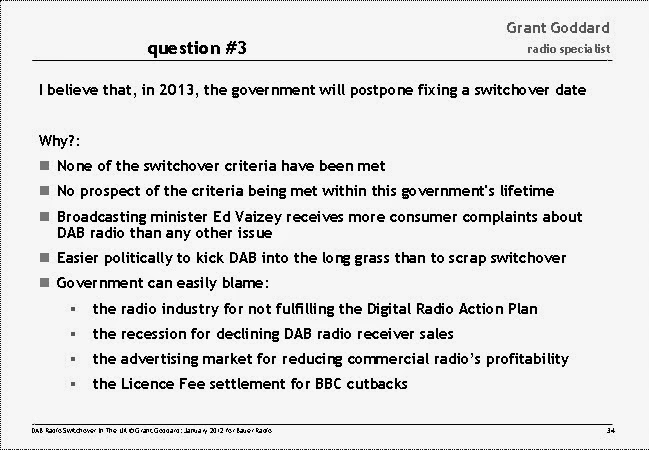
Excerpt from client presentation by Grant Goddard in January 2012

In 2011, I had
been invited by the government’s Department of Culture, Media & Sport [DCMS]
to participate in a consumer panel as part of its consultations about DAB
switchover. Addressing an audience of industry stakeholders, I predicted that
the government would kick the DAB radio switchover decision into the long grass
in 2013. I made the same prediction in my presentation to the board of one of
the UK’s
largest commercial radio companies [see above].
After the close
of the DCMS stakeholder session, its chairperson, a civil servant in the DAB
radio switchover section, leaned over to me and said something along the lines
of: “You really shouldn’t be writing
the things you do. People don’t like it, you know, and it is making them
angry.”
She is one of a select
group of people in DCMS, Ofcom, Digital Radio UK,
the BBC and RadioCentre who have earned their livings by pumping out factually
incorrect reports supporting their fiction that DAB radio is a massive UK success
story and that DAB switchover is inevitable. Public money and BBC Licence Fees
have paid many of these people for years to mislead the public and the media about
DAB radio.
Anyone with
knowledge of the UK radio
industry and training in statistics could have concluded from available data
during the last decade that the implementation of DAB radio in the UK was headed
for disaster. My analyses were not ‘rocket science’. What riled the army of DAB
propagandists was that my published analyses directly contradicted their bullshit.
The final e-mail sent to me by the chief executive of the Digital Radio
Development Bureau (forerunner of Digital Radio UK) said:
“If you are going to deliberately mis-use the
information we provide to you to construct as negative a view as possible with
cheap shots like those below then we just won’t co-operate with you in the
future.”
He saw only “cheap shots”, rather than
evidential analysis, in my 2008 Q2 commercial radio sector report published by
Enders Analysis, which had said:
“Although it remains the most popular platform for
digital radio, ‘DAB’ usage seems to be steadfastly stuck at 9.0% of total
commercial radio listening, dwarfed by the continued dominance of analogue
radio (69.2%). Whilst 87% of households now have access to digital TV, and 67%
have access to the internet, DAB penetration remained static at 27.3% in Q2
2008. Sales of DAB receivers have failed to continue the momentum demonstrated
in Q1 2008, unit sales having slowed to 108,000 in June 2008, their lowest
monthly level since June 2007. With sales of DAB receivers still concentrated
mainly in the Christmas period, the imminent danger is that the hardware’s
relatively high average ticket price, combined with the effects of the consumer
‘squeeze’, could impact the much needed winter 2008 sales peak (552,000 units
sold in December 2007).
Despite the sterling efforts of the Digital Radio
Working Group (convened by the Department for Culture, Media & Sport) over
the past eight months, the radio industry, as yet, seems no closer to finding
an immediate solution to the problem of slow DAB take-up than it was a year
ago. Although all parties agree that it is ’content’ that will drive consumers
to purchase DAB radios, the major radio groups have still not unveiled any
plans to stimulate the consumer market with new digital radio brands.”
Five years on,
the numbers may have changed but the unresolved problems with DAB radio remain
exactly the same. My analyses and predictions during the last decade have
proven correct … while a small army of DAB propagandists have been paid
handsomely during that time to produce a massive volume of ‘South Sea
bubble’ hot air about DAB radio, partly paid for from public funds. Doubtless
they will be rewarded for their failure.
Selected writings on DAB radio:
·        
Channel 4: Radio Ambitions Aim Too High, Enders Analysis, July 2007
·        
Digital Radio Switchover: Somewhere Over The Rainbow?, Enders Analysis, October 2007
·        
The Future Of Digital Radio: Is It DAB?, Enders Analysis, January 2008 
·        
Tuned Into The Future Of Radio, Broadcast,
June 2008
·        
DAB Radio: Nice Platform, Shame About The Take-Up, Enders Analysis, June 2008 
·        
The Second National Digital Radio Multiplex: Waiting For Godot?, Enders Analysis, October 2008
·        
Channel 4 Radio: Six Feet Under, Enders Analysis, October 2008 
·        
The Digital One Radio Multiplex: Desperately Seeking Subsidy, Enders Analysis, October 2008 
·        
Talking Radio: Grant Goddard [Channel 4 Radio], Broadcast,
October 2008
·        
In The Ditch With DAB Radio, The Register, December 2008
·        
Digital Radio In The UK: Progress And Challenges, EBU 3rd Digital Radio
Conference, June 2009
·        
Germans
And Swiss Snub DAB
, The
Register, London,
July 2009
·        
‘Digital Britain’ And The Radio Sector, egta Radio Newsletter
no.16, November 2009
·        
DAB Radio In The UK: It Ain’t What You Do, It’s The Way
That You Do It
, 
Radio Today
‘e-Radio’, April 2010
·        
DAB Is Dead, Index On Censorship,
June 2010
·        
DAB Digital Radio:
Licensed To Fail
, Radio Books,
October 2010
·        
Response to Ofcom consultation: ‘An Approach To DAB Coverage
Planning’
, UKRD Group Ltd. et al, September 2011

Growing DAB radio usage in the UK. Confused? You should be!

“Digital listening at an all-time high,” shouted the headline of one online news story. Yes, it was the quarterly RAJAR radio ratings, offering opportunities for some journalists to pitch their stories just about any which way they wanted. The opening sentence of this particular report said:

“The digital revolution shows no signs of slowing down, and not even the radio airwaves are set to maintain their analogue tradition, as a new [RAJAR] study suggests.”

Hardly. This news story was interesting because it achieved two simultaneous feats of confusion:
• ‘DAB radio’ and ‘digital radio’ are two different things. ‘DAB’ is the platform on which the UK radio industry bet the farm in the 1990s. ‘Digital radio’ is radio received on any platform that is not analogue (AM/FM) and includes the internet, smartphones, digital TV … and DAB
• The fact that DAB listening is growing does not necessarily mean that it is replacing analogue listening at a rapid rate of attrition. Why? Because DAB listening, even after 12 years, is still at a remarkably low level.

These confusions are not accidental. At every opportunity, statements made by Digital Radio UK have sought to confuse the public by referring to ‘digital radio’ as if it means precisely the same as ‘DAB radio.’

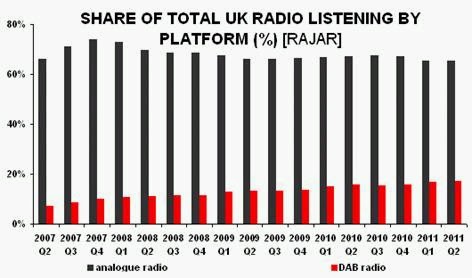
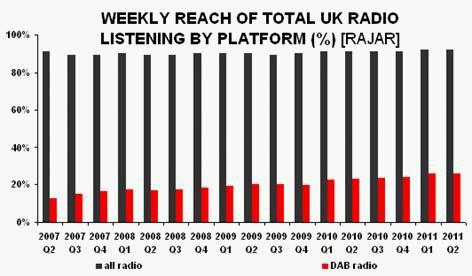
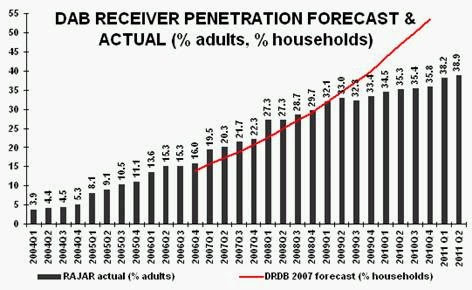
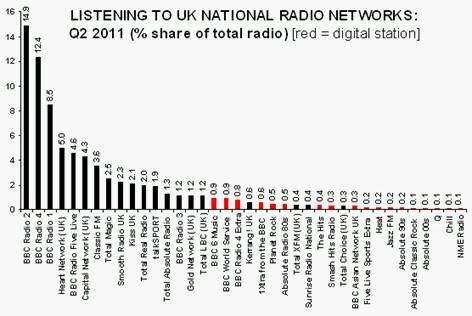
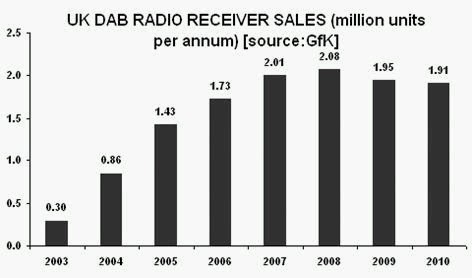
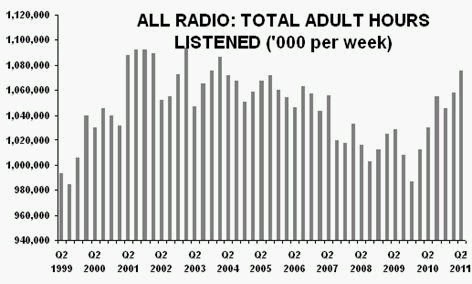
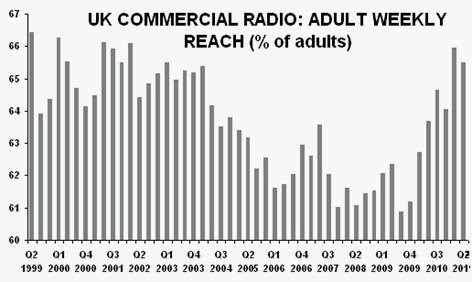
A look at the graphs below of the latest RAJAR data illustrate clearly that the “analogue tradition” in radio remains so dominant that the real question to be asked is: how come DAB usage is still so low after so many years and after so much money has been invested in content, transmission systems and marketing?

The adage ‘a picture speaks a thousand words’ has never been more true than with DAB/digital radio usage. The four graphs above – all taken from the industry’s latest RAJAR data – say it all by showing:
• how little impact DAB radio has had on analogue radio usage in the UK
• how slow the rate of growth is of DAB receiver take-up and of digital radio station listening.

Far from radio losing its “analogue tradition,” as the news article asserted, the old FM/AM platforms look, from these data, to be as strong as ever in the market.

One hint that some digital radio stations on the DAB platform could be on their way out is the BBC’s latest decision to aggregate listening for Radio 4 and Radio 4 Extra in RAJAR. It had been doing this from the outset for Five Live and Five Live Sports Extra, on the premise that ‘Sports Extra’ was only a part-time broadcast station.

I would not be at all surprised to see the BBC:
• similarly aggregate Radio 2 listening with 6 Music
• similarly aggregate Radio 1 listening with 1Xtra
• downgrade its digital radio stations from full-time DAB broadcast stations to online, on-demand ‘extra content’ available via RadioPlayer, iPlayer and applications.

The problem with national broadcast BBC radio stations, whether analogue or DAB, is that the BBC Charter insists they must be made available universally to all Licence Fee payers. Given the huge cost of extending the BBC’s national DAB transmission multiplex to near-universal coverage equivalent to FM radio, particularly at a time when the BBC is having to cut budgets massively, it would be more sensible to downgrade ‘1Xtra’, ‘2Xtra’ and ‘4Xtra’ to ‘red button’ status whereby they offer additional content on a part-time basis. The consumer would access these Extra ‘stations’ via a complementary platform (IP) rather than the BBC having to shoulder the financial burden of programming them as 24-hour broadcast entities.

It would prove a convenient solution for the BBC. As it found with 6 Music last year, public controversy surrounds any decision to close a radio station, however small its audience in absolute terms. Alternatively, by pursuing the ‘Extra’ route, the digital stations can be re-branded, re-purposed and re-platformed away from expensive, fixed-cost DAB and towards IP, where the cost of delivery varies proportionately with the number of people using it. What better way to deliver value for money to Licence Fee payers? And what better way not to face public wrath for ‘closing’ a digital radio station.

As BBC Radio 2 DJ Steve Wright said on today’s Broadcasting House show:
“Maybe full digitisation [of radio from FM/AM to DAB] may well take thirty years …”

As the graphs above demonstrate, there IS slow growth in DAB usage, but the rate is insufficient to replace analogue radio as the dominant consumer platform any time soon. It’s time for BBC strategy to catch up with that reality.

UK DAB radio receiver sales fell in 2009 and 2010, but "digital radio sales have held up – they are flat" insists Mr Switchover

For an organisation that has been charged with marketing DAB radio to the British public, Digital Radio UK has managed to remain remarkably invisible during 2011. This alone made the appearance of Digital Radio UK’s chief executive on BBC Radio 4’s ‘You & Yours’ show notable. The fact that nothing new was said was hardly surprising – there is nothing new to say about DAB.

Out in the real world, as opposed to the imaginary world inhabited by Digital Radio UK, the notion that ‘DAB radio’ will replace AM/FM radio is already a dead duck. The only believers still worshipping ‘DAB’ seem to be Digital Radio UK, RadioCentre, Ofcom and government civil servants.

The evidence is transparent. The number of DAB radio receivers sold in the UK fell year-on-year in both 2009 and 2010 (by 6% and 2% respectively). These data are collected by GfK and supplied to Digital Radio UK. These numbers, together with a nice colour graph, were distributed at last month’s RadioCentre members’ get-together. These are industry data of which Digital Radio UK is perfectly aware.

Yet, Digital Radio UK’s chief executive insisted in this interview on national radio that “digital radio sales have actually held up – they are flat year-on-year.” This is untrue. ‘Down’ is not ‘flat.’ ‘Down’ is ‘down.’ DAB radio receiver sales peaked in 2008 and have been falling since. DAB receiver sales in 2010 were 8% below that 2008 peak. That is clearly not ‘flat.’

I wonder how it is that:
• The chief executive of a high-profile marketing organisation can appear on Radio 4 (audience: 11m adults per week) and flatly state something that he must know not to be true?
• The board of Digital Radio UK does not haul him in and remind him that his job description is to ‘persuade’ consumers of the value of DAB, not deceive them?
• A substantial proportion of this organisation’s funding is derived from the BBC Licence Fee, so the public is effectively paying for an executive to tell them untruths about consumer take-up of DAB radio?

You & Yours
BBC Radio 4
29 July 2011 @ 1200

Ford Ennals, chief executive, Digital Radio UK [FE]
Wiiliam Rogers, chief executive, UKRD [WR]

Q: Are you not disappointed with the lack of a rise in [DAB] radio sales?

FE: No, I think what the Ofcom report confirms is the solid progress that is being made. We see growth in overall digital listening, we see growth in terms of the number of homes that have a digital radio receiver in there. So, 40% of all homes now have a DAB receiver in them, we know that 47% of all listeners are listening to digital radio every week, and we have seen growth in digital listening. So I think progress is being made. I think we are in a difficult sales period for overall retailers and we have seen a decline in overall consumer electronics sales. Digital radio sales have actually held up – they are flat year-on-year. We have now sold 13 million DAB digital radios, but the key thing, just lastly, to remember is that you can receive digital radio via digital television, via a computer or, indeed, via a smartphone and many, many households and consumers have those.

Q: William Rogers, are you surprised by the lack of increase in interest in digital radio?

WR: No, not in the least. And I think we have to remember that Ford, with respect to him, is being a little disingenuous because, of course, the switchover is about people being forced to move way from analogue and onto DAB. So that’s the issue we need to focus on. And what this report highlights, and I’m personally delighted to see it, is it really does shine a light on the shambles that is this proposed DAB migration.

Q: But things aren’t that bad. There are increases in radio usage, as Ford has just indicated.

WR: Well, hang on a minute. The whole premise behind the switchover is that it will be, quote, consumer led. And the one thing we know from these statistics is that, whatever else it is, it’s not being consumer led. As your reporter quite rightly said earlier, of the eight-and-half million radio devices sold in the twelve-month period we are talking about, four out of five of them did not have a DAB receiver capacity. And, more interestingly, of those people who were asked whether they were likely to buy a DAB set at any time in the next twelve months, four out of five of them said they were not likely to. So the consumer is making it very clear what they want and, after eleven years, it’s time this thing was put to bed.

Q: Ford Ennals, one of the things that we constantly hear from listeners is the whole issue of reception. That’s really what, I think, the message is that we get from people. That is what they are worried about. Whether they approve or not [of DAB], what they say is an awful lot of people can’t get them [DAB radio signals] and, if they can get them, they can’t get them consistently.

FE: Well, I think, where the industry and the broadcasters are absolutely unified and agreed is that digital is the future of radio in the UK. And I think it’s just a matter of the timetable and the transition path for that. One of the big issues is, as you have said, is about coverage and about the ability of everyone to get a strong [DAB] signal. Now, what Ofcom have done is developed a plan to extend coverage, both of the local services and the national services, so that people can receive those services and get more confidence. But there is a direct parallel here with TV and digital television – I ran the TV switchover programme – and, back in 2006, the majority of TV sales were analogue and only 75% of the population could get digital television. Now, what happened over the next few years is we saw a very swift transition and we saw transmitters built out that so everyone could get digital TV. We’ll see the same on radio.

Q: What about that, William? We don’t jump ‘til we have to. We don’t buy ‘til we have to.

WR: Look, look. Let’s be clear about this. Ford Ennals is paid to market the DAB switchover, so I understand why he has to say what he has to say, because the message from this report is clearly embarrassing for him to make a case which clearly doesn’t exist. There are a number of points we have to remember. First of all, the comparison with TV switchover is plainly an absurd point to make. They are not remotely, in any way shape or form, similar. And people are choosing not to endorse DAB as an alternative [to FM/AM]. The critical thing we have to understand here is three elements. First of all, ….

Q: You’ll have to confine yourself to one because we are really tight for time.

WR: Okay, the fundamental problem with this whole process is that you cannot migrate an entire sector if the [DAB] platform you have chosen does not have the capacity to allow you to do so. And there are scores of radio stations in this country who will be denied the opportunity to move to a DAB platform, because the choice was wrong in the first place.

Q: A ten-second response.

FE: Just finally. People love digital radio. We’ve seen it with [BBC] 6 Music and we saw the campaign to save 6 Music. We’ve seen it with the response to Radio 4 Extra. And they’ll continue to enjoy it in the future.

Q: I’m sure our postbag and our e-mails will be as big as usual. William Rogers and Ford Ennals, thank you both very much indeed.

……………………………..
Point of information:
Ford Ennals was chief executive of Digital UK, the TV switchover marketing organisation, from April 2005. He announced his departure in November 2007, the same month that the first UK region entirely switched off analogue television broadcasts.

UK listening growth demonstrates radio's strengths in a multi-tasking world

The latest RAJAR ratings data for Q2 2011 demonstrate the continuing strength of the radio medium in recession Britain. Maybe if your TV or mobile subscriptions are having to be pruned, you turn to radio instead. In times of austerity, one of radio’s greatest attributes is that it appears to consumers to be available ‘free’ at the point-of-use.

‘All radio’ listening (1,076m hours per week) is at its highest since 2003. Adult weekly reach is 91.7%. Each listener spends an average 22.6 hours per week with ‘radio.’ These are impressive numbers. In this respect, it is important to remind ourselves that the RAJAR definition of ‘radio’ excludes:
• ‘listen again’ consumption of broadcast radio (online catch-ups of ‘The Archers’, for example)
• all podcasts
• listening to pure online radio stations
• listening to online music streaming services or personalised online radio (Last.fm, Spotify, etc).

If these additional ‘radio’ consumption sources could somehow be added to the RAJAR data, it looks likely that, using a wider definition, ‘radio’ would be performing at an all-time high. This is not at all surprising in our time-precious, multi-tasking world. Radio proves the perfect aural accompaniment to online social activities, whereas it is nigh impossible to watch television or read a newspaper at the same time as you browse the internet. Radio is a secondary medium – it never monopolises your time.

Commercial radio has benefited from this uplift in total radio listening. Total hours listened to commercial radio (470m per week) have risen from what is beginning to look like a nadir in early 2010.

During the last two quarters, commercial radio’s adult weekly reach has jumped above the 65% threshold (65.5% in Q2 2011) that had not been breached since 2003.

In absolute terms, commercial radio’s adult weekly reach has almost caught up with the UK population growth experienced since 1999, rising to 34m in Q2 2011, marginally below its all-time high the previous quarter.

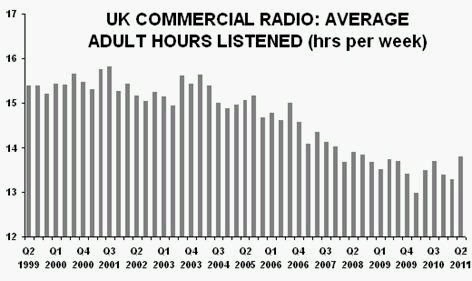
The remaining stumbling block for commercial radio is that its average hours consumed per listener remain stubbornly low (13.8 in Q2 2011). As noted previously, young people are spending less time with radio [see blog]. Commercial radio’s audence is considerably more youth-orientated than BBC radio, which is why the average length of time for all adults listening to commercial radio remains in the doldrums.

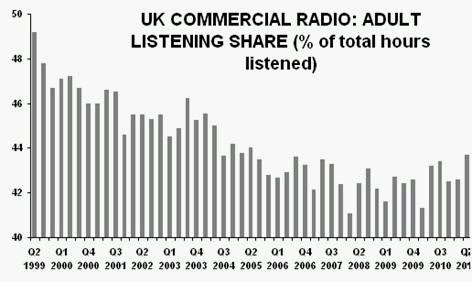
With all this good news for the commercial radio sector, you might imagine that its share of total radio listening had started gaining in leaps and bounds at the expense of the BBC. Unfortunately, this is not the case. The BBC has benefited just as much as commercial radio has from the overall increases in radio listening. As a result, everyone’s volumes are ‘up’ and the share of commercial radio versus BBC radio has remained relatively constant. In Q2 2011, commercial radio’s 43.7% share was certainly an improvement on the situation in 2008, when it had looked as if the 40% barrier might be plumbed for the first time.

In fact, the BBC’s sustained strength in radio is becoming increasingly understated as more and more ‘radio’ listening is attributable to ‘listen again’ on-demand usage and podcasts. The BBC dominates the content available on both these platforms, whilst commercial radio’s offerings remain relatively sparse. At present, neither platform is measured within RAJAR. If they were, commercial radio’s share would undoubtedly be diminished further.

At present, this status quo (using RAJAR’s anachronistic definition of ‘radio’ as purely live and broadcast) suits both parties. The BBC does not wish to be seen to be even more dominant than it already is (54.0% of radio listening in Q2 2011). Commercial radio does not wish to be seen to be weaker than it already is (43.7%) in comparison to the BBC.

And who pays for RAJAR? The BBC and commercial radio. So we are stuck with an old fashioned metric that does not measure radio consumption in the 21st century sense of what we now call ‘radio,’ but which keeps both its paymasters happy … particularly as neither the BBC nor commercial radio would currently wish to demonstrate publicly the increasing popularity of online ‘radio’ consumption – which remains the biggest long-term external threat to them both.

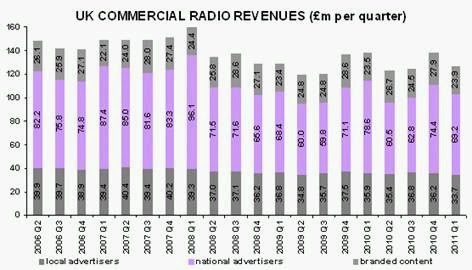
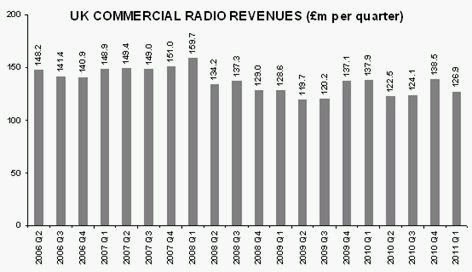
UK commercial radio sector revenues Q1 2011: local advertising hits 10-year low

Data published last week for 2011’s first quarter demonstrate that revenues of the UK commercial radio sector are still struggling to rebound from the previous two years’ ‘credit crunch.’

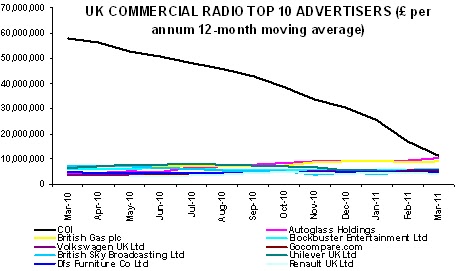
A large part of the problem is the coalition government’s swingeing cuts to its marketing budget since May 2010, which have afflicted commercial radio advertising much more significantly than other media [see blog]. Additionally, and very worryingly, in Q1 2011, revenues from local advertisers fell to their lowest level for a decade, even at a time when local radio might be thought to be making client gains from the decimation of the local newspaper industry.

As has been suggested here previously [see blog], the strategy of the largest commercial radio owner, Global Radio, to transform its local stations into ‘national’ brands would seem to be a recipe for disaster at a time when:
• the national advertising market for radio is shrinking so rapidly (down 34% in real terms between 2004 and 2010)
• the BBC continues to dominate the national radio marketplace with exceptionally well-funded, ubiquitous brands [see blog]
• Ofcom’s market research points to overwhelming demand from consumers for more local radio rather than more national radio [see chapter 4(d)]
• many local commercial radio offices have been closed just as local newspapers have closed in many local markets.

TOTAL UK COMMERCIAL RADIO REVENUES:
• Q1 2011: £126.9m (£137.9m in Q1 2010)
• Down 8.0% year-on-year
• First year-on-year decrease since Q3 2009

UK COMMERCIAL RADIO NATIONAL REVENUES:
• Q1 2011: £69.2m (£78.6m in Q1 2010)
• Down 12.0% year-on-year
• First year-on-year decrease since Q3 2009

UK COMMERCIAL RADIO LOCAL REVENUES:
• Q1 2011: £33.7m (£35.9m in Q1 2010)
• Down 6.1% year-on-year
• Lowest quarter since Q1 2001

Although the quarter-on-quarter trend during the last three years appears to be relatively flat, once the data is viewed in the longer term, it is apparent that the commercial radio sector has been unable to grow its revenues back to the peak achieved in 2004. Adjusted for inflation, the ‘real’ peak occurred in 2000 and, by 2010, commercial radio total revenues had fallen by 33%.

Following the impact of the ‘credit crunch,’ the subsequent blow to the sector caused by the government’s slashed expenditure on commercial radio advertising from its Central Office of Information [COI] has been catastrophic. COI spend on radio in the twelve months to March 2011 was down 80% year-on-year. In the year to March 2010, the COI had been the radio sector’s biggest advertiser by a factor of eight but, only one year later, it had been diminished to almost par with the second biggest radio spender, Autoglass.

In June 2011, the government confirmed that the COI will be axed altogether, offering no respite to the commercial radio sector. According to The Guardian:
“Instead the government intends to run advertising and marketing activity out of the Cabinet Office, hiring about 20 extra staff to complement existing communications teams.”

With local advertising revenues having hit a decade-low in Q1 2011, and national revenues having fallen 34% in real terms between 2004 and 2010, surely it should be time for commercial radio to ask itself:
• is the current local-station-turned-national-network policy the appropriate strategy for the current advertising market?
• is the current local-station-turned-national-network policy the appropriate strategy to satisfy radio listeners?
• how much longer can the ‘slash and burn’ strategy (as pursued by GWR, then by GCap, now by Global Radio) be applied to the commercial local radio industry before there is simply nothing left to cut?
• how much more shareholder value can be destroyed in commercial radio before revenues fall faster than costs can be cut?

A question I was asked by one senior radio executive last week was: how will all this commercial radio ‘slash and burn’ end? I wish I knew. Of one thing I am certain: it must eventually end in tears once the net book values of dozens of commercial radio licences have to be written down by millions of pounds in the accounts of their owners.

This process has already started tentatively:
• Global Radio valued its licences at £333m on 31 March 2010, after having swallowed a £54m ‘impairment’ write-down in 2008/9
• in 2009/10, the Guardian Media Group suffered an ‘impairment’ of its radio licences by £64m and now values them at £68m
• Times of India looks likely to have to take as little as £20m for Absolute Radio, a national station it had acquired for £53m only three years ago.
We have to anticipate more write-downs like these.

At some point, even millionaires must not enjoy watching as their radio assets are reduced to dust by shrinking audiences/revenues. But what can be done when those same owners have already starved the goose that had once laid the golden local commercial radio egg?

[Historical data from some previous quarters have been revised marginally at source]