DAB radio receiver sales suffer negative growth

DAB radio receiver unit sales fell by 10% year-on-year in the final quarter of 2008 in the UK, jeopardising the digital platform’s future as a mass market replacement for analogue radio. This is the first quarter to have recorded negative year-on-year growth since DAB sales records began six years ago. It marks a significant setback for DAB stakeholders who had invested in a six-week marketing campaign during the run-up to Christmas which promoted the DAB platform heavily on BBC and commercial radio.

The Digital Radio Development Bureau, the trade body charged with promoting the DAB platform, issued a press release today stating that the “one ray of sunshine in a gloomy Christmas season for retailers was DAB digital radio”. Its statement failed to mention the negative growth experienced in what is traditionally the most critical quarter of the year for DAB radio sales. Retail data collected by GfK for the DRDB clearly show the declining growth rate of DAB radio sales having started in the second quarter of 2008, a trend that is likely to have been further exacerbated by the ‘credit crunch’.

However, this disastrous sales performance has not prevented those UK companies who are pushing the DAB platform from continuing to talk up the success of their technology. Imagination Technologies, the parent company of the Pure Digital brand of DAB radio receivers, today announcedrecord export growth for 2008” and that it “had more than tripled overseas sales in the year ending 31 December 2008”. Hossein Yassaie, Chief Executive of Imagination Technologies, said: “Our strong overseas growth is further evidence that DAB digital radio is gaining traction worldwide, and that the transition to digital radio is inevitable.”

However, overseas markets account for only 15% of Pure Digital sales (half-year to end October 2008), so why did Imagination Technologies feel it worthwhile to issue a press release for a relatively insignificant revenue stream? It is probably because Imagination has to convince Lord Carter that the government should back DAB radio technology as part of his recommendations within the forthcoming Digital Britain report. Imagination Technologies has bet the farm on DAB becoming a successful, global technology. If the UK government does not decide to force radio listeners to migrate to DAB technology, Imagination could lose its shirt.

Imagination Technology’s interim results, published six weeks ago, admitted that revenues from its Pure Digital DAB radio receivers were up only 2% year-on-year, a result it attributed to “the downturn” in the UK market, which still accounts for 85% of its global sales. Chief Executive Hossein Yassaie said there had been a “UK slow-down” of DAB radio receiver sales and noted that “the introduction of lower price radios and the onset of the recession meant that the increase of the UK DAB market was less than 5%”. Pure Digital Marketing Director Colin Crawford said this week: “Our [DAB] sales at Christmas were good, though a little bit down on last year.”

Disappointing sales figures seem only to have encouraged the DAB protagonists to push the boundaries of their government lobbying beyond the limits of truthfulness. In its latest annual report, Imagination Technologies claimed that “DAB has reinvigorated the now rapidly growing UK radio market and effectively replaced analogue radio”. The latter statement is untrue. According to industry data, only 21% of radio receivers sold in the UK during the last twelve months were DAB, the remaining 79% being old fashioned analogue. The overwhelming majority of radios in use in the UK remain analogue, and DAB is nowhere near having “effectively replaced” them.Another corporate victim of over-enthusiastic government lobbying for DAB is Frontier Silicon, whose Chief Executive Anthony Sethill was quoted in a company press release issued in December 2008 as saying: “Digital radio is here to stay, with DAB sets outselling analogue models by six to one”. Once again, the industry data demonstrates this statement to be a blatant untruth, and simply part of a desperate campaign by a clutch of inter-connected companies to convince the government that DAB technology is already a ‘success’ in the UK.

Frontier Silicon is a privately owned UK company which describes itself as “the world’s leading supplier of innovative semiconductor, module and software solutions for digital radio and connected audio systems”. Its electronic modules are in 80% of all DAB radios, making it “the number one supplier to the DAB/DAB+ market”. In 2003, Imagination Technologies took a 17% equity stake and £1.25m of loan stock in Frontier Silicon. Imagination has an 80% share of the worldwide market for the intellectual property on DAB chips, which are then incorporated into Frontier Silicon’s modules. However, in 2008, Imagination’s stake in Frontier Silicon had to be written down from £7 million to £3.6 million, likely a result of slowing DAB take-up.

Another of Frontier Silicon’s ten investors is Digital One, the owner of the UK’s only national commercial radio DAB multiplex. Digital One is controlled by Global Radio, the UK’s largest commercial radio group, owner of one national station, dozens of local stations and with stakes in the majority of local DAB multiplexes. For Imagination Technologies, Frontier Silicon, Digital One and Global Radio, a decision by the UK government to implement a forced consumer migration to DAB radio would have a hugely beneficial impact on their financial performances. For Imagination, which reported its first profitable year in 2007/8 (£1.88 million pre-tax profits), it might even turn the company’s forecast 2010/11 pre-tax profit of £11.84 million into a reality.

More than a decade ago, the idea of a few bright sparks in the government’s Department of Trade & Industry was that DAB radio technology could be quickly made a hit in the home market, take-up would then spread globally, and DAB would become a hugely profitable technological export for the UK. This dream continues to be espoused by Intellect, the trade association of the UK technology industry, which told Lord Carter in December 2008:
The UK is the home of the major chip manufacturer of DAB silicon, as well as two leading receiver manufacturers and, as such, is uniquely positioned to benefit from the potential expansion of DAB not just in the UK, but globally. We believe that this example of high value manufacturing could make a substantial contribution to the UK’s future prosperity………….”

Unfortunately, the dream is not working out as planned. DAB take-up in the UK market has proven laboriously slow and is in danger of being superseded by newer technologies. Worse, overseas markets have shown little interest in DAB. In Europe, only Denmark has a DAB market as developed as the UK’s. Globally, Australia is about to launch DAB but the largest market, the US, has chosen a different digital radio standard. Several countries have experimented with DAB and since abandoned the technology.

With overseas markets looking less likely to prove a source of significant export revenues, the UK technology companies pushing DAB have become increasingly desperate to ensure that their products at least succeed in their home market. Hence, their desperation to persuade the government to force a consumer switchover from FM to DAB. The average household owns six radios, and a government-backed FM switch-off will force all six to be replaced with shiny, new DAB radios. That’s a lot of potential revenue for a select number of UK technology companies.

DAB radio: now you hear it (in-store), now you don't (in-home)

The Digital Radio Development Bureau [DRDB] announced yesterday that, after a one-year trial, Ofcom “has agreed to put in place a permanent licensing regime for all retailers across the country” to install DAB repeaters that will boost the signal in-store. According to DRDB:
“Many electrical retailers suffer from poor analogue and DAB signal strength due to the steel framed infrastructure of the building or their basement location. Installing a DAB repeater on the roof of the store means a signal can be boosted in-store and DAB radios can more easily be demonstrated, thus increasing sales potential.”

Currys owner DSGi’s Trading Manager Amanda Cottrell said:

We know from experience that demonstrating DAB radio in-store is the best way to show consumers the benefits of more station choice, ease of tuning and clean, digital quality sound. Consumers like to get hands-on with new technology and these DAB repeaters will help us to maximise sales in areas where demonstration was a problem.”

I understand the retail sales floor problem, but am I the only one worried that the solution implemented here might not be quite appropriate? I admit it is a very long time since I studied consumer law (1981, Durham Technical College), but my thinking is that these actions could potentially lead to consumer redress under UK legislation. Have the legal eagles at Ofcom considered this fully?

Under Section 15 of the Sale Of Goods Act 1979, when goods are sold by ‘sample’ (ie: consumer sees in-store demonstration sample of DAB radio receiver, but store supplies consumer with sealed, boxed good), “the goods must correspond to the sample in quality”. The law requires “that the goods will be free from any defect, making their quality unsatisfactory, which would not be apparent on reasonable examination of the sample” [my emphasis].

Under the new ‘repeater’ system, when the consumer examines the in-store sample of the DAB receiver, the receiver will be capable of offering ‘perfect’ reception of DAB radio stations. This is due to the installation of special in-store equipment. A fixed antenna has been installed on the roof of the building, pointed directly to the nearest DAB transmitter mast, and its received signal supplies a relay transmitter (transmitting the same stations) placed on the shop floor adjacent to the DAB radio receiver demonstration area.

When the consumer takes the sealed, boxed DAB radio home, they may open it and find that reception of radio stations on their hardware is not as good as it was in-store. This is because their radio is not receiving the DAB signal from a relay transmitter only metres away from the receiver, as it was in-store. Instead, it is receiving signals from the nearest DAB transmitter, probably miles away, and that signal may or may not penetrate the building in which they are using the radio.

The consumer could theoretically apply to Ofcom to install a relay transmitter in their home, in order to replicate the precise conditions in which the sample DAB receiver was demonstrated in-store. Ofcom’s response to the consumer’s application would certainly be ‘no’. Thus, the in-store ‘sample’ DAB receiver was purposefully demonstrated to the consumer under an artificially created environment that cannot ever be reproduced within the consumer’s home.

This would not be the first time that the marketing of DAB radio in the UK has come under legal scrutiny for potentially misleading consumers. In 2004, Ofcom banned an advertisement broadcast on London station Jazz FM which had claimed falsely that DAB radio offers consumers “CD-quality sound”. In 2005, the Advertising Standards Authority upheld a complaint against DAB multiplex owner Switchdigital for a misleading radio advert which had claimed that DAB radio was “distortion free” and “crystal clear”. In its verdict, the ASA said it had “received no evidence to show that DAB digital radio was superior to analogue radio in terms of audio quality”.

The problems concerning the paucity of DAB reception in some circumstances (basements, steel buildings, built-up areas) have been known to the broadcast industry for a long time. At the 2006 TechCon event, Grae Allen, then manager of digital distribution at EMAP Radio, had explained that “[the] Wiesbaden 1995 [radio conference] and all the other DAB planning dealt with mobile reception – in-car and portable outdoors. It made assumptions about aerial heights being just above ground level and, to provide good service to 99% of locations, the conclusion was that it required 58dbųV per metre to maintain that quality of service, and it made some assumptions about the performance of receivers and aerials.” In practice, he said, “some receivers do not quite live up to expectations – some have lossy aerial systems and suffer from self-noise.” Grae said that 2006’s European Regional Radio Conference “[was] moving DAB to become a truly indoor medium. The new planning model has around 10dbųV higher field strength than was envisaged in the original plan.”

In 2006, BT Movio had been about to launch a mobile TV service using DAB spectrum, and Grae said: “That raises a question. We are seeing increasing numbers of hand-held receivers, such as the BT Movio receiver, that do not have an aerial of any significant size. So, in some areas, we may have to go to higher field strengths to deliver to handhelds indoors. So how are we going to improve the coverage? Unfortunately, the people who fill in RAJAR diaries don’t tend to live in large numbers alongside the sheep in the fields [where DAB transmitters are mostly located]. They live in the cities and the urban sprawl, and that’s where we need to deliver the high field strengths that are required for the types of receivers that are becoming popular, and the level of service that is expected. In the future, as I envisage it, we will see a need to put more and more [transmitter] sites inside the cities in areas where we actually need significant power where people are living and working.”

Mark Thomas, then head of broadcast technical policy at Ofcom, admitted at the 2006 TechCon event that the original DAB power allocations had proven too low: “The Radio Authority had no data of how [DAB] receivers performed, so it had to make some very broad-brush assumptions. More recently, now that we have a lot of receivers in the market and we can see how they behave, an industry group has been working under Ofcom’s chairmanship for the last two years to look into the issue in more detail and come up with some modus operandi for new transmitter sites”. Mark concluded: “The Ofcom approach is that the industry co-operates between commercial operators with each other, and with the BBC, in identifying the sites that will improve field strength of DAB services to consumers and will also avoid the issues surrounding Adjacent Channel Interference. ACI also adds to the investment challenge that all of this spectrum development is building.”

Now zoom forward from 2006 to December 2008 and read the Final Report of the Digital Radio Working Group, which said:
“We believe that action is needed to improve the quality and robustness of the existing [DAB] multiplexes’ coverage. We recognise that such a request has significant financial implications for multiplex operators…”

So, it would appear that, from 2004 onwards (when Mark acknowledges Ofcom was aware of the problem), the UK radio industry has continued to market and sell millions of DAB radios to UK consumers, in the full knowledge that its DAB transmission infrastructure requires a significant upgrade to provide consumers with sufficiently robust DAB radio reception in built-up areas and in homes.

The latest DRDB ‘repeater’ sales initiative merely tackles the symptom of poor DAB reception which has existed for years, and the solution is limited entirely to electronics retailers. What is still missing is a solution to the core problem of the “quality and robustness” of DAB radio reception….. for consumers.

The Digital One DAB radio multiplex – fixing 'market failure'… ten years too late

Digital One is the owner of the UK’s first and only national commercial radio DAB multiplex. If you produce commercial radio content that you wish to make available nationally on the DAB platform, you have to go to Digital One and agree a price and a contract. That price is set by Digital One, not by Ofcom or any other regulatory body. Digital One is the national DAB ‘gatekeeper’ and it decides what commercial radio brands we hear and what we don’t hear on DAB. It would be hard not to consider Digital One’s operation monopolistic.

Furthermore, Digital One is part of a vertically integrated business. Its controlling shareholder is Global Radio (formerly GCap Media, formerly GWR Group), the UK’s largest commercial radio group. In this way, Digital One/Global Radio’s business is an end-to-end operation that includes: generating radio content (‘stations’), some of which are carried on the DAB platform; selling advertising space around that content, some of which is carried on the DAB platform; owning the national DAB platform in the UK; and owning the ‘gatekeeper’ role for other radio content providers wanting access to that national DAB platform. (This ‘gatekeeper’ role was bestowed upon the DAB multiplex owner, rather than Ofcom, by the 1996 Broadcasting Act.)

Does Digital One’s business work in the interests of a competitive broadcasting sector or the listening public? Is this not a case where some kind of intervention by the regulator is appropriate? Within Ofcom’s own definition of ‘market failure in traditional broadcasting’, one of the main six reasons it uses to justify regulatory intervention is where:
“Restricted access to spectrum makes entry impossible on market grounds and, without competition, the ability of the market to deliver the most efficient solution is impaired”.

Ofcom then explains this issue in more detail:
“A tendency towards monopoly/oligopoly. Economies of scope and scale are inherent in broadcasting and will tend to encourage the concentration of ownership in large, often vertically-integrated companies. The result of an unregulated market might therefore be reduced competition, less choice for viewers and either higher prices or lower quality than would be available in a competitive market”.

Is this not exactly what has happened with the national commercial radio DAB platform? Digital One seems to have operated its ‘gatekeeper’ monopoly over the platform in a way that that has reduced competition, offered less choice to listeners, and maintained high carriage prices. The end result? After a decade of operation, there is only one radio station that has elected to contract with Digital One to be carried on its DAB platform of its own volition. There is enough bandwidth on the multiplex for a clutch more national stations, but that capacity remains unused.

Digital One was awarded a 12-year DAB licence in June 1998 to operate the “first and only national commercial digital multiplex licence”. It promised to pay the regulator a licence fee of £10,000 per annum. However, until very recently, if you had approached Digital One and asked the cost of putting a radio station on its multiplex, you would have been expected to pay more than £1 million per annum. Furthermore, if your proposed content competed directly with that of Digital One/Global Radio’s own digital radio stations, carriage might not have been offered, even at that price.

Therefore, it proves somewhat surprising to see today that Digital One issued a press release and published an advertisement inviting “expressions of interest from companies ready to contract and launch digital radio stations in 2009” on its DAB multiplex. It is even more surprising to learn that “capacity is available for mainstream stations, as well as more specialist channels appealing to a diversity of tastes and interests”. And it is shocking to read that “Digital One is reviewing its charges for capacity” and that “it is anticipated that prices will initially be set below Digital One’s 2008 rate card, in order to provide an incentive for approved applicants to invest in high quality services….”

The appropriate time to have published such a ‘call for content’ was June 1998, immediately after Digital One was awarded the DAB multiplex licence by the regulator. Perhaps then the sad story of the DAB platform’s slow development in the UK would have turned out differently. By now, Digital One might have fostered a broad range of audio content on the national DAB platform provided by a variety of producers, creating a ‘compelling consumer proposition’ that could have motivated the public to purchase DAB radios in significant numbers. But, unfortunately, it did not turn out that way and now, after a decade, DAB remains barely off the starting blocks.

Instead, for a decade, Digital One has clung on to the notions that:

  • its monopoly over the DAB infrastructure is valuable in itself, even if the capacity is mostly unused (is a rail network valuable without trains?)
  • its ‘gatekeeper’ role enables it to push its own digital services to listeners, at the expense of competitors and potential competitors
  • high carriage fees for external users will quickly put them out of business
  • listeners will lap up its own controlling shareholder’s content on the DAB platform, however little is invested in its production (one computer + 100 CDs = digital radio station)
  • ‘control’ of a broadcast platform is alone sufficient to create a profitable monopolistic business

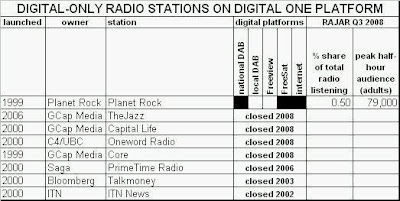
It hardly inspires confidence in the Digital One DAB platform that Global Radio’s predecessor, GCap Media, closed three of its own digital-only stations carried on its platform last year, and sold Planet Rock to an entrepreneur with no other radio interests. Neither is it a good advertisement for Digital One that its platformproviding coverage to 90% of the population of Great Britain” only succeeds in securing a peak half-hour audience of 79,000 adults for its last remaining digital-only audio contractor, Planet Rock.

Digital One’s licence for the “first and only national commercial digital multiplex licence” will expire on 14 November 2011. Would I sign a contract with a company that has unashamedly hogged the UK DAB national multiplex for its own selfish ambitions since 1998, but now suddenly wants to offer me capacity on its multiplex, just as its own life is expiring? My attitude would be: so you’ve screwed up almost a decade of your 12-year monopoly and lost everything but your shirt in the process, but now, on your deathbed, you want me to pay you good money for carriage on a platform that you yourself have helped ruin?

Digital One’s announcement today reminds me of those grocery stores that put cans of food in a 10p bargain bin that are not only damaged, but are also only a few days away from their expiry date. You expect me to buy these? I guess we will see if there is somebody out there desperate enough to take the bait. I can think of many radio formats unavailable on AM/FM that should have a national platform in the UK. Would any of them work on DAB? Ten years ago, yes, they might have done. Now, no. The DAB platform has proven to be a failure with consumers, and Digital One has played a very large part in making it so. And yet, Digital One has decided now to advertise its newfound enthusiasm for “enhanced choice, variety and innovation” on its DAB platform.

A case of: too much, too little, too late…….

Classic FM – always check the expiry date before purchase

When Global Radio paid £375 million for GCap Radio in 2008, the portfolio of stations it acquired included Classic FM, the most listened to and most profitable of the UK’s three national commercial radio stations, and the only one of the three on FM. Classic FM was almost the only jewel remaining in GCap’s tarnished crown, after its management had destroyed the audiences/revenues of Capital FM and its other city FM stations by implementing disastrous content and commercial strategies. Classic FM presently has an 11% reach, a 3.8% share, 66% of its adult hours listened derive from the desirable ABC1 demographic, whilst 85% derive from ‘housewives’. Its only competitor in the classical music format is national BBC Radio Three, which has only a 4% reach and a 1.2% share but, of course, carries no commercials. Classic FM is a cash cow. [ratings: RAJAR]

There is only one problem for Global Radio. Classic FM’s licence expires on 30 September 2011 and it cannot be automatically renewed. This is a big problem. Whereas local commercial radio licences are still awarded (and re-awarded) by Ofcom under a ‘beauty contest’ system, national commercial radio licences are not. The system for national commercial radio licences is simple. Sealed bids are placed in envelopes. Ofcom opens the envelopes. The bidder willing to pay the highest price wins the licence. That’s it. This system is enshrined in legislation. Even if Ofcom wants a different system, it cannot change it without legislation.

As Classic FM’s new owner, Global Radio definitely wants a different system that will enable it to hang on to this most valuable asset. Global has been busy bending the ears of anybody and everybody who it might be able to persuade to interpret the broadcasting rules in a way that lets it keep Classic FM after 2011. Even Ofcom has had its lawyers busy examining the legislation to see what flexibility it has to interpret the rules in a way that might maintain the status quo.

Unfortunately, the legislation in the Broadcasting Act 1990 is quite specific:
“[Ofcom] shall, after considering all the cash bids submitted by the applicants for a national licence, award the licence to the applicant who submitted the highest bid.”

There is one, and only one, caveat in the legislation:
“[Ofcom] may disregard the requirement imposed by subsection (1) [above] and award the licence to an applicant who has not submitted the highest bid if it appears to them that there are exceptional circumstances which make it appropriate for them to award the licence to that applicant; and where it appears to [Ofcom], in the context of the licence, that any circumstances are to be regarded as exceptional circumstances for the purposes of this subsection, those circumstances may be so regarded by them despite the fact that similar circumstances have been so regarded by them in the context of any other licence or licences” [emphasis added].

Nothing more explicit is mentioned in the legislation about these possibly “exceptional circumstances”. The problem facing Ofcom is that, if it were to award the licence to Global Radio in a hypothetical situation where it had not been the highest bidder, whoever was the highest bidder would be likely to seek a judicial review, forcing Ofcom to explain in front of a set of judges the precise nature of the “exceptional circumstances” it had invoked. This would not be a pretty sight. There are no precedents because this part of the legislation has never been used before.

So what is the precise meaning of the ‘cash bid’ that has to be submitted to Ofcom in a sealed envelope? It is an amount to be paid annually by the winner throughout the licence period (increased annually by the rate of inflation). When Classic FM won the licence in 1991, it agreed to pay £670,000 per annum, plus 4% of its revenues as demanded by the regulator.

Later on, the Broadcasting Act 1996 allowed the regulator to extend Classic FM’s licence once, but on new terms, if the station agreed to simulcast its output on DAB. The regulator set Classic FM’s new licence payment as £1 million per annum plus 14% of its revenues from 1999. This new licence would have expired in 2007.

Then, the Communications Act 2003 allowed Ofcom to extend Classic FM’s licence again for a further four years but, once again, it could re-set the terms. Ofcom reduced Classic FM’s licence payment to £50,000 plus 6% of its revenues from 2007. This is the licence that expires in 2011.


Why did Ofcom decide to reduce the payments so substantially in its 2006 decision? It argued that the growth of listening via digital platforms was “leading to a decline in the scarcity value of the analogue spectrum”. Additionally, it argued that the licensee’s “share of advertising, derived as a result of access to the analogue spectrum, is likely to fall.”


Ofcom had forecast in November 2006 that digital platforms would account for 33% of radio listening by 2008, and 50% by 2010. By the time the Classic FM licence was due to expire in 2011, Ofcom anticipated that digital platforms would be responsible for 60% of radio listening overall. In other words, the FM licence would, by 2011, be accountable for only the minority of listening to Classic FM.

Ofcom’s forecast proved to be extremely wide of the mark. By Q3 2008, only 18.7% of radio listening accrued from digital platforms, little more than half of what Ofcom antcipated. The 50% threshold is unlikely to be reached even by 2015, and certainly not by Ofcom’s target of 2010. As a result of these forecasting failures, Classic FM (along with the other two national commercial stations) is now paying Ofcom an amazingly discounted rate for the licence fee to use analogue spectrum. The combined licence fees of the three national licensees would have been £7 million per annum under the previous regime, whereas these were reduced by Ofcom to less than £1.5 million (by Ofcom’s own estimate).

The net result of these changes is that Global Radio has a bargain licence on its books. Classic FM probably generates more than £20 million revenues per annum, but Global now pays only £1.3 million for its licence. The bad news is that Global Radio’s cash cow will end in September 2011. If Global does not win the re-advertised national FM licence, the value of its balance sheet could be up to halved. On the other hand, to keep this prize asset it will have to bid significantly more than the £50,000 annual licence fee it is paying now, so that Classic FM’s future profitability would be impacted anyway, even if Global managed to keep the licence.

However, there are plenty of other media owners out there who would like to have the UK’s only national commercial radio FM licence in their portfolio. The fact that the DAB platform has not grown anywhere near as quickly as anticipated in the UK simply makes this FM licence more valuable. The last time the licence was advertised in 1991, bids were only open to European Union applicants. Since then, legislation has opened up the bidding process worldwide. The licence format does not have to be classical music – the licensee can operate any format of its choice, apart from pop music (this caveat is in the legislation).

The fly in the ointment is that Ofcom adopted a new policy in 2007 that all its analogue local and national radio licences would be scheduled to expire on 31 December 2015, or five years from their commencement, whichever is longer. For Classic FM, this means that its next licence period would theoretically run only from 1 October 2011 to 1 October 2016. If a new bidder won the licence by offering the highest cash bid, five years is hardly enough time for a nascent business to establish itself and become profitable, particularly if it were to adopt a format other than classical music. The Ofcom policy seems unworkable in practice, and also seems biased in the incumbent’s favour.

Now, with an understanding of Global Radio’s desperation to hang on to its Classic FM licence almost at any cost, it is useful to re-read Paragraph 2.3 of the Final Report of the Digital Radio Working Group. Remember that Global Radio owns about 50% capacity of the UK’s commercial radio DAB transmission capacity and Global Radio accounts for 39% of commercial radio listening. The Report said:

“In exchange for its ongoing and future commitment to DAB, we believe the radio industry must have greater certainty and control of its future. Therefore, we propose that the government must relax some of the existing legislative and regulatory burdens placed on the radio industry, which will require parliamentary time, as outlined below and Ofcom should consider how to reduce some of the existing regulatory burdens.

First, the commercial radio industry must be granted a further renewal of its analogue services which are carried on DAB, and of DAB multiplex licences. [emphasis added]”

Now read this quote once more but replace the phrase ‘the radio industry’ or ‘the commercial radio industry’ with ‘Global Radio’. Aha! Wouldn’t it be great for Global Radio if the government could be persuaded to step in and somehow automatically renew its “analogue service” Classic FM licence, thus avoiding a licence auction in 2010? Even moreso if Global could be allowed to continue paying only £50,000 per annum (plus 6% of revenues) for the FM spectrum it uses? If you were Global, would you not be eager to offer the government a deal whereby you maintain your costly DAB infrastructure (and maybe even extend it) as the price you have to pay for securing the future of your most significant balance sheet asset?

From reading its Final Report, it certainly looks as if the Digital Radio Working Group bought into this argument. The next hurdle for Global Radio is to persuade Lord Carter and his Digital Britain team to buy into the same deal, which is: we promise to keep the DAB platform alive, despite it losing us a small fortune, if you ‘arrange’ legislation that enables us to keep the Classic FM licence for another decade. Thus, the government avoids the embarrassment of the DAB platform failing in the UK, and Global Radio might stand a better chance of staying in business.

To date, the other commercial radio owners have seemed happy to go along with this plan. They, like Global, would get to renew their radio licences automatically too (although none of their licences are as individually valuable as Classic FM’s). On the other hand, they too will be burdened with the continued costs of simulcasting their services on the DAB platform, with almost no financial return. However, despite most radio owners’ private dislike of the whole DAB ‘fiasco’, publicly they continue to stress their continuing support. Nobody turns down a ‘free lunch’, and a free licence renewal is an enticing offer for a radio industry still built upon oligopoly power rather than open competition.

The only question now is whether the government considers it politically worthwhile to ‘help’ the commercial radio sector with new legislation that would extend the licence status quo, in return for forcing onto consumers a ‘new’ DAB radio technology that is more than a decade old and has long been superseded by innovation.

Lord Carter’s pronouncements during the next fortnight might give us an idea of how important/unimportant it is to the government to: 1) bale out privately held Global Radio; 2) force further investment in improving/developing the DAB platform.

Shipwrecked on desert island DAB

One important question was sidestepped by the Digital Radio Working Group in its enthusiasm for the DAB platform in the Final Report: if DAB only comes to be adopted in a handful of countries, what are the ‘opportunity costs’ for UK consumers? In other words, if UK consumers are forced by government policy to purchase DAB receivers to replace their analogue radios, what other consumer hardware will they not purchase, either because it does not incorporate DAB radio, or because they have already spent their allocated budget replacing all five or six analogue receivers in their household with DAB radios?

The answer might be provided by the annual International Consumer Electronics Show [CES] taking place this week in Las Vegas, which describes itself as “the world’s largest consumer technology tradeshow” with 2,700 exhibiting companies, 500 expert speakers and 200 conference sessions.

The Digital Radio Working Group had written in its Final Report that:
“…. the DAB standard used in the UK and all three variants will be receivable on [radio] sets which manufacturers will be producing from [2009], so creating a European-wide market for digital radio.”

You might imagine that such innovations in DAB radio hardware would be reflected at this week’s CES event? Apparently not. Only 6 out of the 2,700 exhibiting companies list ‘DAB’ in their descriptions – the UK’s Frontier Silicon (“the leading supplier of audio processors for digital radios powering over 70% of all DAB radio products”); Germany’s Fraunhofer Institute (“audio/video compression technologies”); Taiwan’s Joycell (broadcast antenna manufacturers); China’s Blue Tinum and Shenzhen Baoan Fenda which manufacture DAB/FM/internet radios; and Hong Kong’s Kenwin Industrial which makes plastic injection moulds for electronics products. Additionally, not one of the 200 conference sessions at CES is about DAB. The reality is that, for most of the 130,000 people attending the event, DAB will simply not exist.

But, if you do a search for ‘internet radio’ at CES, you find a list of 393 exhibitors, 320 products and 32 conference sessions. Now compare that with ‘DAB’: 6 exhibitors, 8 products, 0 sessions. Furthermore, the newly formed Internet Media Device Alliance, a group of companies significantly involved in internet radio, will be launching at CES. One of its steering committee members is Anthony Sethill, CEO of Frontier Silicon, who said: “Frontier’s role in the formation of the IMDA affirms our position as the leading supplier of Internet radio connected audio products to the global consumer electronics market.” The significant word there is ‘global’. Despite its current dominance of the largely UK market for DAB, Frontier needs a global market for its product lines…. something that DAB’s limited take-up will never offer it.

So why does the Digital Radio Working Group want to shipwreck UK radio listeners on a desert island of DAB (for accuracy, I should add that you can take your DAB radio to Denmark or Norway and it will work there too)? The answer might be in paragraph 3.10 of its Report, which states:
“We strongly believe that in order for radio to preserve the qualities which make it such a valued part of our everyday lives, and to allow it to build a strong future, it must have a space where it can be the master of its own destiny and have the freedom to take risks” [emphasis added].

If you replace the word ‘radio’ with ‘the BBC and UK commercial radio companies’ and then read this sentence again, it becomes perfectly clear that what the Working Group is advocating is protectionism of the British radio broadcasting industry – protectionism from unregulated radio content delivered from non-UK sources via internet radio. Heaven forbid that we UK residents might prefer listening to Ryan Seacrest over Johnny Vaughan, because the government will seemingly do as much as possible to stop such an outrage happening.

If you think this is a fantastical notion, I suggest you read paragraph 3.9 of the same Report, which is unapologetically ‘patriotic’:
Radio is an important part of the national discourse and perhaps an even more important voice in local democracy. These principles are the bedrock of radio in the UK and we believe they are something which citizens not only value, but expect”.

The fact is that UK radio, much more than television, offers an easy platform for politicians and their policies to be propagated to mass audiences of voters (viz Radio 4’s Today programme). Incredibly, the Central Office of Information has long been commercial radio’s biggest advertiser! The best way to preserve this cosy relationship is to build a wall around it.

For the mandarins, it might look like a nice walled garden to play in. For us consumers, it has all the hallmarks of a content prison.

Heart disease – turning 'big fish/small pond' into 'big pond/small fish'?

Today has seen Global Radio extend its Heart FM brand to more local markets in England, replacing heritage names such as Chiltern, Hereward and Broadland that seem to have existed for decades. There seem to be at least three different issues involved in these changes:

1. The loss of ‘heritage’ station names. One of radio’s biggest long-term challenges has always been the difficulty users have had finding stations on their analogue radio and identifying them properly. The more crowded the AM/FM wavebands become, the more imperative this ‘finding’ and ‘identifying’ becomes. In the early days of UK commercial radio, most station names did not include their frequencies simply because there was so little choice on the dial. Although the switch to Heart FM does not involve frequency changes, it is bound to cause confusion amongst some listeners that their radio might have tuned to something other than their favourite station. If they then switch the dial, there is the potential to lose their listening to a competitor. Anything that encourages dial twiddling can only be a bad thing.

2. Brand duplication. In markets such as Bedfordshire, Heart FM was already heard across parts of the area from the Londonwide station of the same name. In Dunstable/Luton, Heart FM London attracted a 3.1% share, compared to local station Chiltern FM’s 8.6%. From now on, two Heart FM’s can be heard on different frequencies. How exactly will RAJAR determine if a respondent in Bedfordshire was listening to Heart FM Dunstable or to Heart FM London, particularly at times when they carry the same programmes? For the consumer, is this not reducing the content choice in the market? For Ofcom, is this not wasteful duplication of frequencies, something for which the commercial sector has always been quick to point an accusing finger at the BBC?

3. Networked programming. Heart FM stations will retain local programming on weekdays 0600 to 1000 and 1300 to 1900. The PR script from Global HQ to be used as quotes in the local press runs:
“We have increasingly found our listeners have more than just a local outlook. They read national magazines like Hello and Heat, they watch national TV shows and they surf the net, too. As well as local news and information, listeners are telling us they want more showbiz gossip, more celebrity interviews and a bigger professional sound from their local station. Currently, they have to switch to national stations like Radio 1 and 2 to get this.”
The networked shows on Heart FM are presented by Toby Anstis (1000 to 1300), Matt Wilkinson (1900 to 2200), Simon Beale (2200 to 0100) and Gareth John (0100 to 0600). I am sorry but, when you compare this talent to the name presenters and significant editorial content on Radios One and Two, it pales by comparison.

The problem? Global Radio, just like GCap Media before it, and GWR Group before that, bought a bunch of local commercial radio stations and wanted to turn them into something they are patently not – an almost, kind of, quasi-national station. In the UK, we have local commercial radio stations licensed to serve local populations, and separately we have national commercial radio stations licensed to serve national audiences. They are different. If I were to buy a grocery store in Dunstable, and then I buy a similar store in Luton, and suddenly hang an identical sign on the front of both of them that says “Global Supermarket”, it does not automatically put me in the same league as Tesco, Asda or Sainsbury. Surely, the way a local shop can thrive commercially is by striving to perfectly complement the offerings of the big supermarkets, not by trying to emulate them. As a consumer, if I want Asda, I will go to Asda. If I want Radio Two, I will go to Radio Two, not jumped-up, local-ish, quasi-national Heart FM.

Global Radio’s aspirations ‘to make a station what it is not’ are no different than many previous radio station owners. When Jazz FM won the first specialist music licence in London, its owners tried their hardest to make it anything other than a jazz music station. When EMAP bought KISS FM in London, it wanted it to compete head-on as a pop music station with Capital FM. When EMAP bought Melody Radio in London, it wanted it to be anything other than an easy listening station. A succession of owners of Virgin Radio tried to make it anything other than a straight ahead rock music station. Now that Global Radio has bought Choice FM, it seems to want it to be another KISS FM, rather than a station for black Londoners. I could go on and on…. The wheel is being constantly reinvented day in, day out. Many times, in radio, it turns out square.

Forgive me a short anecdote. Soon after it had opened, I visited the new local commercial radio station for Reading called Radio 210 for a guided tour. I lived only 14 miles away, but I could not pick up the station’s signal because its transmitter covered only the city of Reading. In 1979, the station had a weekly reach of 41% adults and cumed 2.4m hours/week [JICRAR]. Between then and now, the station’s owners lobbied the regulator successively (and successfully) to allow them to extend the station’s area by adding relay transmitters and increasing power outputs. Today, that same station covers most of Berkshire, North Hampshire and as far west as Andover, which is almost 50 miles from Reading (does anyone in Andover feel a connection to faraway Reading?). Today, Radio 210’s weekly reach is 28% and it cumes 1.3m hours/week, even in its much expanded coverage area [RAJAR].

The conclusion. You can become a big fish in a small pond, with a lot of hard work and effort. You can deliberately move to a bigger pond. But you must accept that you will now be a smaller fish….. and the massive risk is that you might never be a big fish ever again….. anywhere, any when.

For the US experience, “Why Local Radio Is No Longer Local” is a very worthwhile (lengthy) read [thanks to Mark Ramsey for the tip].

Ofcom's radio licensing strategy – adding fuel to the unprofitable fire

The closure of Edinburgh station Talk 107 on 23 December almost coincided with the fifth birthday of Ofcom (on 29 December). Talk 107 was the first commercial radio station to be licensed by Ofcom, so its failure and subsequent closure could seem symptomatic of Ofcom’s radio licensing strategy. Over five years, instead of Ofcom playing a significant role in creating a vibrant, profitable and creative UK commercial radio industry, its licensing decisions have often exacerbated the problems of a sector already beset with massive structural and financial challenges.

Ofcom has licensed 39 new commercial radio stations to date, taking the total number of UK licensed commercial radio stations past the 300 mark. This number, in itself, is a large part of the problem. These newly licensed stations each add a whole new set of largely fixed costs to the sector. Even if the average cost of each of these new stations is only £250,000 per annum, Ofcom’s licensing has increased sector costs by almost £10m per annum (in 2007, Ofcom estimated the sector’s aggregate costs as £400m).

At the same time, most newly launched commercial radio stations have failed to attract significant new listening or new revenues to the sector. New stations seem to simply cannibalise the audiences of existing commercial radio stations (I researched the impact of introducing the tier of regional commercial stations and found only one station had not cannibalised commercial radio audiences). As a result, the sector’s aggregate costs have increased whilst its aggregate revenues have not been expanded, and so profit margins are being squeezed further.

Additionally, the formats of many of the winners in Ofcom’s licensing ‘beauty parade’ were inevitably destined for commercial failure, with Ofcom seeming to ignore the empirical evidence. In a market the size of Edinburgh, Talk 107’s talk format could never succeed, given that the same format has been unable to make an operating profit in the UK’s largest local market, London, since the end of the 1980s. Similarly, Ofcom’s idea of introducing a local rock music station in Plymouth would have been a disaster (the station never even launched) given the miserable audiences for Xfm and Virgin Radio. And the three Original stations licensed by Ofcom launched with such esoteric music formats that their failure quickly prompted owner CanWest Global to sell up and quit the UK radio business altogether.

The size of most of the newly licensed stations was insufficient to ever make them profitable. Ofcom’s own research found that the majority of small stations fail to generate an operating profit – stations serving under 50,000 adults make an average annual loss of £3,000; stations serving between 50,000 and 150,000 adults make an average annual loss of £20,000; and stations serving between 150,000 and 250,000 adults make an average annual profit of £65,000. Although 63% of commercial radio stations serve areas of less than 250,000 adults, they collectively generate only 11% of sector revenues.

Knowing the unprofitable economic performance of most small commercial radio stations, it made no commercial sense for Ofcom to choose to licence 21 of its 39 new stations to populations of 250,000 or less. All this has done is increased the number of loss-making commercial radio stations and dragged down the profitability of the entire sector. The roll-call of stations licensed by Ofcom in its first five years includes:

  • Talk 107 Edinburgh, closed by UTV after 15 months on-air
  • Touch FM Banbury, up for sale or closure by CN Group after two years on-air
  • Brunel FM Swindon, sold by The Local Radio Company after 21 months on-air to Laser Broadcasting, forced into administration four months later, acquired by Southwest Radio
  • Original Solent, Original Bristol and Original Aberdeen, sold by Canwest Global which exited its UK radio venture two years after Solent had launched
  • Diamond FM Plymouth, never launched by Macquarie Bank
  • Southend Radio Southend, sold by Tindle Radio to Adventure Radio before it launched
  • Sunshine FM Monmouth, acquired by Murfin Music when Laser Broadcasting forced into administration after 10 months on-air
  • Xfm South Wales sold by GCap Media to Town & Country after six months on-air
  • Minster FM Northallerton, licensed to serve 39,000 adults, annexed to Darlington after eight months on-air
  • Perth FM Perth, eventually launched last month, two years after winning its licence from Ofcom, and ten weeks after owner Mark Page closed L107 Lanarkshire
  • The Severn Shrewsbury and The Wyre Kidderminster, now sharing programmes under co-owner Midland News Association
  • kmfm Ashford, now sharing programmes with co-owned KM Radio stations
  • [a question remains over the control of Andover Sound Andover and whether licence winner Tindle Radio has sold or reduced its 100% stake between the licence award in July 2006 and the station’s launch in May 2008]

Some of the 39 new local stations licensed by Ofcom are only required to broadcast locally-produced content for four hours per day on weekdays (the breakfast show), while the majority are required to broadcast no more than four hours per day of locally-produced content on weekends.

The question has to be asked…. Are the financial losses incurred by these stations worth the marginal amounts of local content offered to the populations in the markets they serve, and the resultant low ratings achieved by most of them?

So what is the point of licensing small local radio stations that barely broadcast local content and are unlikely to break even?

UK commercial radio revenues – a shrinking 'pint pot'

The Q3 2008 UK commercial radio revenue data slipped out in mid-December without even a press release and seem to have been largely ignored, so it seems worth a quick note…..

The good news? Q3 2008 revenues of £137.3m were up 2.3% quarter-on-quarter, and both local and national revenues showed increases.

The bad news? This quarter-on-quarter improvement is little comfort, because Q2 2008 had been the worst performing quarter since 2000. Now, Q3 2008 is the worst performing quarter since 2002. Year-on-year, Q3 2008 is down 7.8%. The four-quarter moving average to Q3 2008 is down as little as 1.0% because the first quarter of 2008 and the last quarter of 2007 had shown healthy increases.

The prognosis? The party is well and truly over. The UK commercial radio sector needs to face the fact that its revenues are in long-term decline. As recently as September 2008, RadioCentre chief executive Andrew Harrison said he was “confident that [Q2 2008 revenue] is only a temporary blip following our previous four successive quarters of growth” and that “the signs are that Q3 2008 is already starting to look brighter”. However, the data demonstrate clearly that neither Q2 nor Q3 are a “temporary blip” or statistical error. Once you adjust the revenue figures for inflation, commercial radio revenues peaked in 2000.

The symptom? Listening to commercial radio is in decline. Aggregate adult hours listened to commercial radio are down more than 4% year-on-year (RAJAR, four-quarter moving average Q3 2008). Unless the radio industry can increase its unit price (no – check Capital FM’s disaster), there is no way to squeeze increased revenues from decreased hours listened. These are the basic rules of business. The fact is that hours listened to commercial radio in 2001 exceeded 507m per week, whereas they were 432m in Q3 2008.

The solution? The issue is not so much commercial radio’s reach (which is relatively steady), as it is commercial radio’s average hours listened. Stations must persuade their listeners to stay tuned for longer. Adult female average hours for commercial radio are falling by 3.7% per annum (RAJAR, four-quarter moving average Q3 2008). The average adult female commercial radio listener consumed 13.2 hours per week in Q3 2008, compared to 15.5 hours per week in 2000.

To increase its aggregate hours listened, commercial radio should benefit from the rising UK population and from the fact that it is offering a ‘free good’ in this Credit Crunch time. Stations are lucky they do not have to persuade listeners to part with increasingly scarce cash, but simply their time. The UK commercial radio sector needs to rise to this challenge, and not be content to excuse itself with further talk of ‘blips’.

Digital Radio Working Group – it must be 'Numberwang'!

The Final Report of the Digital Working Group published today includes an “Aspirational Timetable” which, it says, will “act as a useful guide for those working towards digital migration in the coming months and years”. The projected dates in the timetable include:

  • End 2010 – “DAB sales to exceed sales of analogue radios”
  • 2014 – “All new cars to be fitted with digital radios”
  • 2015 (approx) – “Migration criteria met”

One of three specified “migration criteria” is:

  • “that at least 50% of total radio listening is to digital platforms”

which would look like this by (year-end) 2015:

How likely is this outcome???

It might prove instructive to re-examine earlier forecasts for digital radio take-up published by three leading stakeholders – Ofcom, RadioCentre and the Digital Radio Development Bureau:


This last graph is interesting because the Digital Radio Development Bureau published progressively less optimistic annual forecasts for DAB set sales in 2004, 2005, 2006 and 2007. Its 2007 forecast only projected figures to 2008. When I enquired in September 2007 why the forecast horizon had been reduced by three years, the DRDB told me:

The problem with forecasting a cumulative to 2011 is that there are too many variables. If we based it on what there is available now in the traditional radio market, we could certainly come up with a figure. But if, as suggested in the forecast, DAB moves into other form factors, such as mobile phones, docking stations, MP3, MP4 etc, then that ‘traditional’ figure would be selling the market short and would not be indicative of the potential cumulative market for DAB.”

Fifteen months on, DAB has made slow progress moving into these other ‘form factors’, with mobile phones and cars still on the starting blocks.
Notably, DRDB has yet to publish a 2008 forecast.

None of this statistical evidence offers confidence that the Digital Radio Working Group’s “Aspirational Timetable” is anything more than ‘pie in the sky’.

Nokia – a 'Man Friday' for radio?

Radio has a problem. Young people are listening less to radio in aggregate. This is the result of two main factors: their declining numbers within the population (there will be fewer than 8m 15-24 year olds in the UK by 2014, compared to 8.2m in 2008); and the increasing competition for young people’s leisure time. Radio as a whole is losing listening amongst 15-44 year olds, but commercial radio is losing proportionately more than the BBC. This is disastrous for the commercial sector, which defines 15-44 year olds as its ‘heartland audience’ for advertisers.

[source: RAJAR]

So who is working the hardest to enable and promote the notion of radio listening amongst young people? Could it be Nokia?

Nokia had a 38% market share last quarter of mobile devices globally. In Q3 2008, Nokia sold a staggering 118m mobile devices worldwide, 27.4m of which were in Europe. In the UK, of the 94 Nokia models available, 70 include FM radios and 24 include Wi-Fi capability (19 have both FM radio and Wi-Fi). As a result, the overwhelming majority of new Nokia devices sold in the UK offer consumers listening to either FM broadcast radio and/or IP-delivered radio connected via Wi-Fi. Does this make Nokia the biggest selling brand of radio receivers in the world?

Would not a generic campaign to promote radio listening on mobile phones prove a worthwhile marketing project to be funded jointly by commercial radio and the BBC? The mobile phone hardware is (literally) already sitting in millions of people’s pockets, offering them the capability to listen to radio. Of course, mobile phone operators are never going to promote the radio listening function on the handsets they sell, for the simple reason that it earns them no revenues, and every quarter-hour spent listening to the radio is a quarter-hour lost of phone usage.

Is the UK radio industry capitalising on this huge volume of FM receivers incorporated into phones with which Nokia and its competitors are flooding the market, but whose radio function seems to sit mostly unused in people’s pockets and handbags? Seemingly, no. Instead, the industry is wedded to the notion of spending millions of marketing pounds trying to convince consumers to purchase yet another piece of hardware that enables them to receive the ‘DAB’ digital radio platform. The hurdle is that the average retail price of a DAB radio receiver is still £90+.

In this converged world, is there a mobile phone available in the UK that incorporates the DAB platform? No. Why not? Because ‘FM radio’ is a long established, global broadcast platform used in almost every country, whereas the ‘DAB radio’ system is only commercially underway in the UK, Denmark, Norway and, imminently, Australia and China. Will ‘DAB radio’ ever become a global system that replaces ‘FM radio’? No, because the US (the biggest consumer electronics market in the world) has already adopted a completely different digital radio standard. Would Nokia make a phone that includes DAB? Despite a recent report, it would seem highly unlikely. The consumer market for DAB simply isn’t big enough for a global player like Nokia.

Which is precisely why UK receiver manufacturers, such as Pure and Roberts, continue to dominate our domestic market for DAB radio hardware – the addressable market is simply not big enough for most global brands to be interested in ‘DAB radio’. But neither Pure nor Roberts will ever make mobile phones or cool-design i-Pods that include DAB radio and which might appeal to fashion-conscious, brand-obsessed, young people. As a result, the DAB platform is condemned to be largely the province of older demographics who listen at home on DAB ‘kitchen radios’. And, importantly, they are mostly listening to their same, favourite analogue stations via DAB platform simulcasts that they used to listen to on FM/AM. New, digital-only radio stations barely get a look-in in the radio ratings.

Neither do the UK sales figures of DAB hardware look particularly impressive, compared to Nokia’s success in pumping FM radios into the market. In the decade since DAB was introduced, more than 7m DAB receivers have been sold. But, during the last year alone, more than 8m analogue radios were sold in the UK. Amazingly, 79% of new radios sold in the UK during the last year were analogue, rather than DAB. Despite a landmark pronouncement in 2006 by online electronics retailer Dixons that it would no longer sell analogue radios, consumers have continued to demonstrate their interest in purchasing inexpensive AM/FM radios. Dixons has been forced to eat humble pie and now stocks four models of analogue portable radio, the cheapest of which is £8.79, alongside 38 models of DAB radio, the cheapest of which is three times that price.

In the face of consumer reticence, the UK commercial radio industry, supported by Ofcom and the government, has been busy the last decade desperately trying to persuade the public to migrate its radio listening to the DAB platform. The sticking point here is the pre-requisite for consumers to spend considerable sums replacing all the analogue radios they own with more expensive, new digital ones. Meanwhile, global heavyweights like Nokia, pursuing their own strategy to satisfy consumer needs, continue to supply the market with millions of analogue FM radios incorporated into a myriad of converged, portable devices. Could the UK government ‘persuade’ Nokia not to push its FM radios in the UK market? Er, probably not. In which case, its proposed analogue radio ‘switch-off’ remains a completely lost cause.

Perhaps instead of viewing Nokia and its ilk as an irrelevancy to its long-held digital migration plans, the UK radio industry needs to simply capitalise on the massive penetration of FM-enabled (and now IP-enabled) phones already within the consumer electronics market. These phones are the ‘sleeping giant’ that could potentially reinvigorate radio listening, particularly amongst the young demographics. All their owners need is a ‘call to action’ – a marketing campaign to make them realise that they already have the world’s most immediate, live, portable broadcast medium in their pocket.

[many thanks to Daniel for the idea for this post]